Latest News and Comment from Education

Tuesday, June 27, 2017

Symposium: The crumbling wall separating church and state - SCOTUSblog

Symposium: The crumbling wall separating church and state - SCOTUSblog:

Symposium: The crumbling wall separating church and state


Symposium: The justices reach broad agreement, but on a narrow question
Fred Yarger is the solicitor general of Colorado. He filed an amicus brief for the state in support of the church in Trinity Lutheran v. Comer. Although it represents a significant victory for religious liberty, Trinity Lutheran Church of Columbia, Inc. v. Comer does not appear to alter fundamentally how the First Amendment will be understood and applied in cases involving claims of religious fre
Symposium: The Constitution provides a level playing field for people of faith
Hillary Byrnes is Assistant General Counsel for the United States Conference of Catholic Bishops. She filed an amicus brief for the conference and other organizations in support of the church in Trinity Lutheran v. Comer. Five years ago, Trinity Lutheran Church applied for a grant from Missouri’s Scrap Tire Grant Program so that it could resurface the church’s preschool playground with rubber mat
Symposium: The crumbling wall separating church and state
Erwin Chemerinsky is Dean and Raymond Pryke Professor of First Amendment Law at University of California, Irvine School of Law. As Justice Sonia Sotomayor powerfully observed in her dissent, the Supreme Court’s decision in Trinity Lutheran Church of Columbia, Inc. v. Pauley is unprecedented in American history: Never before had the Supreme Court held that the government is required to provide ass
Live blog of orders (Update: Completed)
We live-blogged this morning as the court released orders. The transcript is available at this link . The post Live blog of orders (Update: Completed) appeared first on SCOTUSblog .
Tuesday round-up
Yesterday, on their last day on the bench for October Term 2016, the justices agreed to review two challenges to the Trump administration’s entry ban in October and partially lifted the injunctions against enforcement of the ban. Coverage comes from Matt Ford in The Atlantic , Nina Totenberg at NPR (audio), David Savage in the Los Angeles Times , Jordan Fabian at The Hill , Politico , Gary Gately

YESTERDAY


Symposium: Trinity Lutheran and Zelman – Saved by footnote 3 or a dream come true for voucher advocates?
Frank S. Ravitch is Professor of Law and Walter H. Stowers Chair in Law & Religion at Michigan State University College of Law. On its face, Trinity Lutheran Church v. Comer does not appear to have anything to do with school vouchers. After all, the primary issue in the case is whether a state can deny, pursuant to its state constitution, a grant to a church school under a program that awards fun
 Symposium: The crumbling wall separating church and state - SCOTUSblog:

State auditor orders ECOT to stop spending tax dollars on attack ads

State auditor orders ECOT to stop spending tax dollars on attack ads:

State auditor orders ECOT to stop spending tax dollars on attack ads


Ohio Auditor Dave Yost has ordered ECOT to stop using taxpayers dollars on television ads attacking the state Department of Education’s decision to seek repayment of $60.4 million, saying the commercials are not proper expenditures “and are impermissible.”
In a letter to the giant online charter dated Friday, Yost said he was writing ECOT “to demand that you act without delay to cease and desist the expenditure of public funds” being used for ads.
Join the conversation at Facebook.com/columbusdispatch and connect with us on Twitter @DispatchAlerts
ECOT spokesman Neil Clark could not be reached for comment Monday afternoon. He has not returned phone calls or emails since Thursday, when he confirmed that state tax dollars meant to educate ECOT students were being diverted for the public-opinion fight with the department over funding. ECOT has launched a barrage of television ads attacking the department as being against school choice and against ECOT students.
“It is my understanding that the costs of the preparation and dissemination of the broadcasts are being defrayed by ECOT out of funds received by it from the state of Ohio and allocated to and intended for the education of students enrolled in your institution,” Yost says in the letter, which he provided in response to a Public Records Act request.
If so, that spending is “in support of your dispute with ODE, the administrative agency charged with the responsibility of enforcing the full compliance of Ohio schools with applicable law. As such, if these facts are correct, the expenditures cannot be justified as advancing a proper public purpose and are impermissible.”
The Dispatch reported on Saturday that Clark confirmed last week that ECOT was paying for the ads from its state tax receipts. He defended the practice.
“ECOT has a right, and a fiduciary responsibility, to employ, fund and use resources for any activity that they believe can lead to making ODE change its current position or affect the General Assembly to try to change ODE,” Clark said State auditor orders ECOT to stop spending tax dollars on attack ads:

Virtual Schools in the U.S. 2017 | National Education Policy Center

Virtual Schools in the U.S. 2017 | National Education Policy Center:

Virtual Schools in the U.S. 2017

Image result for Virtual Schools
In the five years since the first NEPC Annual Report on Virtual Education was released in 2013, virtual education continues to be a focal point for policymakers. Proponents argue that virtual education can expand student choices and improve the efficiency of public education. In particular, full-time virtual schools (also sometimes referred to as virtual charter schools, virtual academies, online schools or cyber schools) have attracted a great deal of attention. Many believe that online curriculum can be tailored to individual students more effectively than curriculum in traditional classrooms, giving it the potential to promote greater student achievement than can be realized in traditional brick-and-mortar schools. Further, the promise of lower costs—primarily for instructional personnel and facilities—makes virtual schools financially appealing to both policymakers and for-profit providers. The 2017 NEPC Annual Report contributes to the existing evidence related to virtual education, and so to debates surrounding it. It provides objective analysis of the characteristics and performance of full-time, publicly funded K-12 virtual schools; available research on virtual school practices and policy; and an overview of recent state efforts to craft new policy. 
Share
Share
Share
Share
Share
Share
Share
Share
Image result for National Education Policy Center

Ed Notes Online: Did Charters Blink When Faced with Demise of Mayoral Control?

Ed Notes Online: Did Charters Blink When Faced with Demise of Mayoral Control?:

Did Charters Blink When Faced with Demise of Mayoral Control?


Acting to avert a leadership crisis in New York City’s schools amid a legislative stall in the Capitol, Gov. Andrew M. Cuomo intends to call a special session of the State Legislature as early as Wednesday and introduce a bill that would extend mayoral control of the city’s educational system for one year.The session would be focused on granting Mayor Bill de Blasio another year of control over the city’s schools and their 1.1 million students, according to an administration official.

Andrew Cuomo to Call Special Session to Extend Mayoral Control of Schools - The New York Times

Mr. Flanagan and his Republican colleagues did pass several bills this month to extend mayoral control, but each bill included an increase in charter schools around the state, something that doomed them in the Democrat-dominated Assembly. Charter schools would not be addressed in the bill sent by the governor, according to the administration official.
Cuomo will introduce one year extension with No charter strings attached. And we know the hold charters have over Cuomo --- that he is brokering this to avoid an end to mayoral control which is a key to ed deformers, means the charters have blinked -- which by the way I predicted when I called in to the Brian Lehrer show and he asked me about the impact on charters if mayoral Ed Notes Online: Did Charters Blink When Faced with Demise of Mayoral Control?:


Supreme Court rules on church playgrounds; are vouchers for religious schools next? | EdSource

Supreme Court rules on church playgrounds; are vouchers for religious schools next? | EdSource:

Supreme Court rules on church playgrounds; are vouchers for religious schools next?


Read the Opinion: Trinity Lutheran Church of Columbia, Inc. v. Comer


U.S. Secretary of Education Betsy DeVos and other supporters of school choice are hailing a U.S. Supreme Court decision Monday as one more step toward tearing down states’ opposition to tuition vouchers for private and religious schools.
Opponents in California and in other states whose constitutions ban using taxpayer money for religious schools, while disappointed with the ruling, are warning not to read too much into it.
In Trinity Lutheran Church of Columbia, MO. v. Comer, the court ruled 7-2 that the state of Missouri violated a church’s right to freely exercise religion by denying it a state-funded grant to improve the church’s preschool playground. Speaking for the majority, Chief Justice John Roberts wrote that Missouri’s policy excluding churches from participating in the playground retrofit program “expressly discriminates against otherwise eligible recipients by disqualifying them from a public benefit solely because of their religious character.” This, Roberts wrote, “is odious to our Constitution all the same, and cannot stand.”
The state funded 14 of 44 schools that had sought money to fix their playgrounds. Trinity Lutheran’s application had been rated 5th-most eligible before state officials ruled that the Missouri Constitution prohibited using public money to support religious schools.
California, like Missouri, is one of three dozen states that in the late 19th century passed the “Blaine Amendment,” named for a prominent politican from Maine, prohibiting the use of public money for religious schools. California’s version also bans teaching “any sectarian or denominational doctrine … directly or indirectly,” in any public school.
In a footnote to the decision, Roberts implied that the decision applied only to Supreme Court rules on church playgrounds; are vouchers for religious schools next? | EdSource:
 

When the firing of a principal raises bigger questions than one person’s bigotry - The Hechinger Report

When the firing of a principal raises bigger questions than one person’s bigotry - The Hechinger Report:

When the firing of a principal raises bigger questions than one person’s bigotry
Dismantling racist policies is harder than destroying tangible symbols of racism


n New Orleans, we took four Confederate monuments downlast month. But living tributes to white supremacy are still among us: racist teachers and schools with discriminatory policies are hurting black children every day. Statues can be taken down; but we must topple the structures that create unconscious and conscious biases against black students.
On May 25, the Nevada-based management group of the New Orleans charter school, Crescent Leadership Academy, announced the firing of its principal, Nicholas Dean. He had been spotted in a photograph standing next to a man holding a Confederate flag in Lee Circle, where the statue of Gen. Robert E. Lee was scheduled to be taken down later that day.
Dean originally claimed he was just there to witness a historical event. But it didn’t take long for his leanings to become apparent. Three days later, a video surfaced of him being interviewed on an alt-right podcast. Dean, who is white, wore two rings associated with Nazism and white nationalism; one was emblazoned with what experts described as the Nazi SS Skull and the other with the German Iron Cross. Rite of Passage, the chain that manages Crescent Leadership Academy, then determined he wasn’t a good fit for the job.
Dean led Crescent Leadership Academy, a last-chance school for students who have been expelled, for three years. Eighty-four percent of its population is black. The termination of someone who, ridiculously, describes himself as a “might supremacist” (as opposed to a white one) shouldn’t distract us from bigger questions. We should demand to know how Dean was hired in the first place, and, moreover, why he lasted so long in the position. But there are bigger issues at hand: namely, the dubious merits of second-chance schools.
Join the conversation later on Andre Perry’s radio show, “Free College,” hosted Tuesdays on WBOK1230 in New Orleans at 3pm Central/4pm Eastern 504.260.9265.
Since his firing, Dean has offered multiple arguments via social media on the so-called hypocrisy of race and liberalism that burdens When the firing of a principal raises bigger questions than one person’s bigotry - The Hechinger Report:


Cartoons on Teaching English | Larry Cuban on School Reform and Classroom Practice

Cartoons on Teaching English | Larry Cuban on School Reform and Classroom Practice:

Cartoons on Teaching English


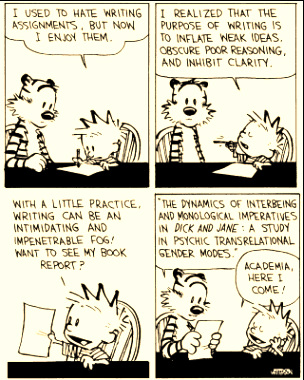
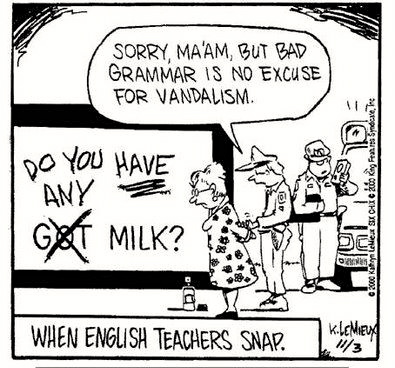
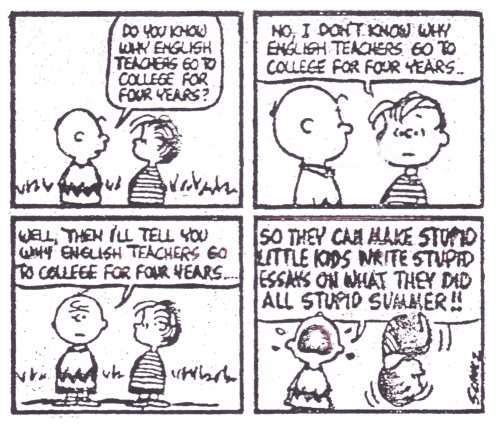
Over the years, I have run cartoons on teaching different subjects from math, science to social studies. This collection of cartoons looks at the teaching  of English in K-12 schools (and teaching in general) and its effects on students, pupils, or whatever word you want to describe the young who must attend school. Enjoy!


1365381187.jpg
EnglishTeachersSnap.jpg
395072c43c45c11e80030fa4d91935f9.jpg
VentrescaEnglish.jpg


See more cartoons: Cartoons on Teaching English | Larry Cuban on School Reform and Classroom Practice:

Some Fed Ed Regulations Under the Microscope | Truth in American Education

Some Fed Ed Regulations Under the Microscope | Truth in American Education:

Some Fed Ed Regulations Under the Microscope


Last week, I highlighted the news that the U.S. Department of Education is looking for public feedback on different federal education regulations.
Several people asked me what regulations they could comment on since the website for that wasn’t exactly straightforward. Here are a few regulations, identified by the taskforce, that are related to K-12 education.
This list is NOT exhaustive (click links to read the regulations):
These regulations are not new so they are not open for comment at Regulations.gov so what I would do is leave a comment on the notice the U.S. Department of Education released last week.
If I learn of additional regulations to add or additional information I’ll post again. Just remember comments are due by August 21, 2017.
 Some Fed Ed Regulations Under the Microscope | Truth in American Education: