Latest News and Comment from Education

Saturday, June 17, 2017

Ms. Katie's Ramblings: Support Room 134!

Ms. Katie's Ramblings: Support Room 134!:

Friends, family, even public education supporters I don't know on social media are always asking about how they can help given the constant madness of the Chicago Public Schools. Well here's a way!


The Chicago Public Schools has been in a devastating manufactured budget crisis for many years now, with no end in sight. We need structural change. But in the meantime, those of us in the schools try to shelter our kids as much as possible, and this is where you come in.


Students in Room 134 working on a project
I teach special education in a severely underfunded school on Chicago's Far Southside neighborhood of Roseland. My school is a high-poverty school serving primarily African-American students. Help me provide a high-quality educational experience despite the chaos of CPS, the callousness of our Mayor, and the cruelty of our broken state politics.

Please donate to my classroom!! I need help replenishing basic supplies including pencils, gluesticks, markers, folders, prizes for our prize box, items from Teachers Pay Teachers, and other classroom basics.


You can donate via Paypal (all donations will be strictly for classroom needs, going directly to students): paypal.me/KatieOsgood417


OR

Buy directly from my Amazon Wishlist which will be updated throughout the summer: http://a.co/c3N5yX0 


I chose to not go through Donors Choose this year as they take a huge chunk of the proceeds for themselves and place silly restrictions on asking for the basic supplies most teachers today need. Other fundraising sites also charge, so I thought it best to stick with free sites.

Thank you for your support!


 Ms. Katie's Ramblings: Support Room 134!:

Education Dept. closes transgender student cases as it pushes to scale back civil rights investigations - The Washington Post

Education Dept. closes transgender student cases as it pushes to scale back civil rights investigations - The Washington Post:

Education Dept. closes transgender student cases as it pushes to scale back civil rights investigations


Image result for big education ape devos civil rights

The Education Department’s Office for Civil Rights this week closed a long-running discrimination case involving a transgender student and withdrew its earlier findings that the girl had suffered discrimination at school, a move that comes amid the Trump administration’s push to scale back civil rights investigations in public schools.
The agency communicated its decision in a letter this week to lawyers representing the girl, an elementary school student in Highland, Ohio. The letter provided no reason or legal justification for withdrawing its 2016 conclusion that the girl’s school wrongly barred her from the girls’ bathroom and failed to address the harassment she endured from classmates and teachers, who repeatedly addressed her with male pronouns and the male name she was given at birth.
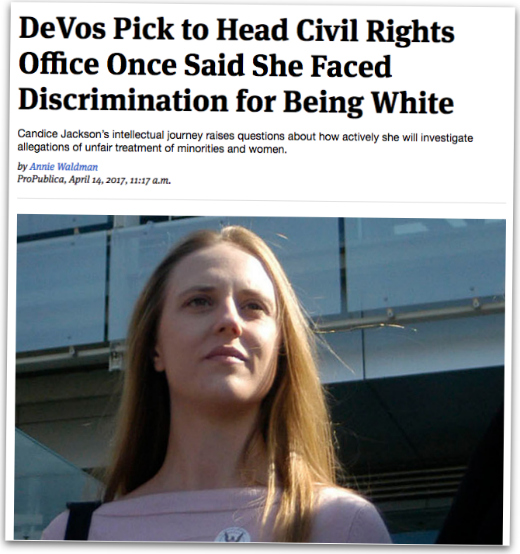
Candice Jackson, acting head of the civil rights office, said the department closed the case because the student has filed a legal challenge against the school district, and the matter will be settled in court.
Officials withdrew the findings of discrimination, Jackson said, because those findings were based on guidance that directed schools to allow transgender students access to bathrooms matching their gender identity. The Trump administration rescinded that guidance in February.
Civil rights advocates see the closure of the Ohio case — and especially the unusual withdrawal Education Dept. closes transgender student cases as it pushes to scale back civil rights investigations - The Washington Post:


A teacher’s decision to be ‘visibly queer’ in his photo with President Trump - The Washington Post

A teacher’s decision to be ‘visibly queer’ in his photo with President Trump - The Washington Post:

A teacher’s decision to be ‘visibly queer’ in his photo with President Trump


When Rhode Island’s teacher of the year took his turn in front of the camera with President Trump, he struck a pose some took as an act of defiance:
Nikos Giannopoulos cocked his head ever so slightly away from the president, toward a black lace fan he’d brought with him. He wore a rainbow pin on his lapel, a ring through his nose and a gold anchor around his neck.
“Bold, Gay Teacher Of The Year Photo Bombs Donald Trump With Fan,” was HuffPost’s first headline (later toned down) after Giannopoulos posted the photo on Facebook on Thursday and quickly amassed thousands of shares.
“A fierce pose,” wrote the Daily Mail.
Giannopoulos, who only received the photo recently, did not sound fierce on the phone with The Washington Post. His attire in the Oval Office, he explained, was more or less the same style he wore in the classroom at Beacon Charter High School for the Arts, where his work as a special-education teacher won him Rhode Island’s teacher of the year award and a trip to the A teacher’s decision to be ‘visibly queer’ in his photo with President Trump - The Washington Post:

NYC Public School Parents: Mayoral Control Expiration -- What it Really Means

NYC Public School Parents: Mayoral Control Expiration -- What it Really Means:

Mayoral Control Expiration -- What it Really Means


The state law dictating the governance of NYC schools expires on June 30th.  In the State Senate, Republicans and a rogue gang of Democrats calling themselves the Independent Democratic Conference (IDC) are refusing to consider renewal until the Assembly agrees to create more charter schools in NYC.  In the political battle over privatization of our public schools, some have claimed the expiration of mayoral control will be catastrophic and put our kids at risk.

Ignore the fear mongering coming from many quarters, especially the mayor, on what the expiration of mayoral control means.

Here's what it really means:

Fewer mayoral appointees on central board

The central school board will go from thirteen members to seven.  This board was labeled "The Panel for Educational Policy" by Mike Bloomberg instead of "the Board of Education" but it's the same entity in the law, "the city board".  Each borough president will continue to appoint one member.  What changes is the mayor now gets only two appointees instead of eight.

In the current system the mayor selects the chancellor.  When the law reverts, the board has this power.  We already have a chancellor so the new board will likely just reaffirm her position.  There are few decisions made in the summer.  The big stuff happen later -- budgets are considered in the spring. The board will have to meet to approve contracts.

True, the new board composition allows less influence for the mayor and more for the borough presidents but keep in mind our current borough presidents -- Gale Brewer, Ruben Diaz Jr, James Oddo, Eric Adams and Melinda Katz -- are probably the most serious and level-headed set the city has ever seen.   In other words, there 
NYC Public School Parents: Mayoral Control Expiration -- What it Really Means:

WILL's Faulty School Voucher Study Cheered by Other Bradley Funded Groups | PR Watch

WILL's Faulty School Voucher Study Cheered by Other Bradley Funded Groups | PR Watch:

WILL's Faulty School Voucher Study Cheered by Other Bradley Funded Groups


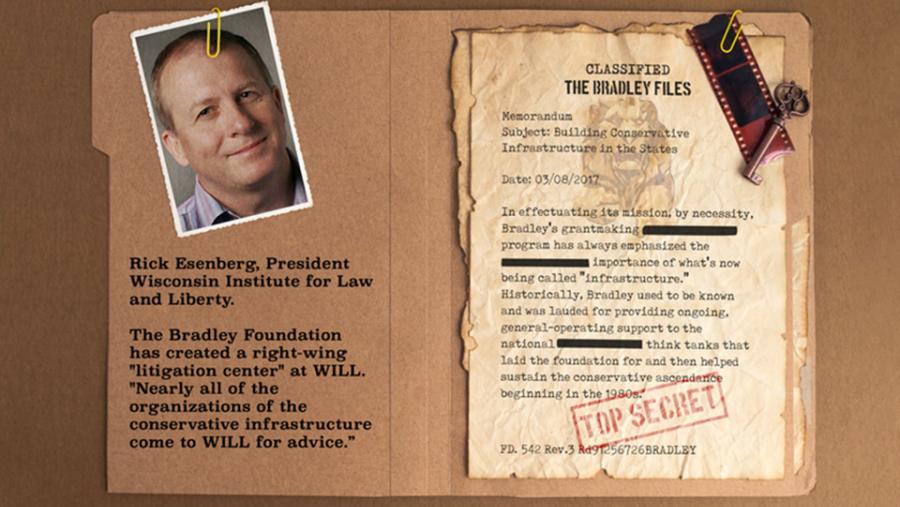
 A recent foray into education "research" by the Bradley Foundation's Wisconsin Institute for Law and Liberty (WILL) is a case study not only in politically motivated research, but also in how the Bradley-funded echo chamber operates to inflate questionable claims and stave off critics.

The Milwaukee-based Lynde and Harry Bradley Foundation is perhaps best known for its advocacy of private and religious school vouchers. Bradley was instrumental in creating the nation's first voucher "experiment" in Milwaukee in 1990. A new cache of internal Bradley documents has come to light, which pull back the curtain on the $835 million organization and its efforts to advance school privatization, attack teachers unions and construct right-wing "infrastructure" nationwide.
The study in question is one that WILL released on March 1, 2017, purporting to show students in Milwaukee's private and religious voucher school program outperforming students in Milwaukee's public schools. Had WILL's conclusions been accurate, they would have contradicted consistent research findings from the last two decades showing Milwaukee voucher students fared worse or no better than their public school counterparts and several very recent studies showing voucher students throughout the nation faring extremely poorly.
Instead, the release of WILL's study showed that when one Bradley-backed organization speaks, numerous others rise up to echo it, and some mainstream news outlets are snookered by the noise.
The Center for Media and Democracy documented recently that the Bradley Foundation has poured at least $3.65 million into WILL since 2011. It has also received support from the Walton Family Foundation in 2014-2015, $585,000 according to IRS filings. Bradley funded WILL primarily to be a "litigation center" to aid the fight over school vouchers, to attack public sector unions and to backstop Wisconsin's right-wing infrastructure. For instance, Bradley notes, "WILL has represented School Choice Wisconsin in various actions against the Department of Public Instruction," (WILL, GPR, 11/10/15). And WILL filed an amicus brief in Duncan v. Nevada supporting the universal voucher program providing taxpayer money for private and religious schools, struck down by that state's highest court.
But Bradley's favorite litigation team is "morphing" into a think tank, say the Bradley documents, and producing studies on education. The stakes are high. The Bradley Foundation has spent untold millions supplementing Milwaukee voucher schools and advancing school vouchers in cities and states in partnership with the Walton's and Betsy DeVos' American Federation for Children. With DeVos now the head of the U.S. Department of Education, any study touting purported benefits of vouchers will be seized upon as Gospel by DeVos and Trump in their effort to expand vouchers nationwide.

Not "Apples to Apples"

WILL's March 1 report, Apples to Apples: The definitive look at school test scores in Milwaukee and Wisconsin, authored by WILL research director Will Flanders who has a PhD in political science, compared, for a single school WILL's Faulty School Voucher Study Cheered by Other Bradley Funded Groups | PR Watch:

South Carolina's online charter schools: A $350 million investment with disappointing returns | News | postandcourier.com

South Carolina's online charter schools: A $350 million investment with disappointing returns | News | postandcourier.com:

South Carolina's online charter schools: A $350 million investment with disappointing returns

Image result for big education ape cyber charter


Online charter schools have grown exponentially across South Carolina and the nation — and questions about their effectiveness are growing, too.
Today, the state has five virtual charter schools that together enroll roughly 10,000 students, up dramatically from about 2,100 students nine years ago when the state's first cyber schools opened. A 2007 bipartisan bill fueled their growth by authorizing the state's virtual schools program, and since then, taxpayers have footed the bill to the tune of more than $350 million.
Despite this hefty investment, online charter schools have produced dismal results on almost all academic metrics, according to state and district data. On average, less than half of their students graduate on time. At one cyber school, nearly a third of students dropped out last school year. Data from the S.C Public Charter School District, which oversees these schools, shows just one in two virtual students enroll for a full year.
Supporters of online education, including U.S. Department of Education Secretary Betsy DeVos, praise virtual schools for their flexibility, innovation and reach. For struggling, home-bound or bullied students, advocates argue, these schools are lifelines.
But critics contend state taxpayers have spent tens of millions of dollars lining the pockets of the for-profit companies that manage these schools at the expense of their flailing students. 
"It concerns me," said Don McLaurin, chairman of the S.C. Public Charter School District Board of Trustees. "Right now, for a variety of reasons, the virtuals are having performance problems, at least some of them. ... We may have more than we need." 

Lagging behind

On almost every measure of student achievement, virtual schools lag behind their brick-and-mortar counterparts:
 Image result for big education ape cyber charter

Notes for Final Class Size Amendment | AMPS

Notes for Final Class Size Amendment | AMPS:

Notes for Final Class Size Amendment

Class-Size-Matters-1-zk3e4e


On Monday June 12, the Operations Work Group of the Madison Metropolitan School District received an update on the 2017-18 budget, and discussed amendments submitted by Board Members (video here, meeting materials may be found at BoardDocs, here; it appears a second cost analysis on class size prepared by the district has not been posted on BoardDocs, it may be found here, a cost analysis prepared by community members is somewhat lower).
An amendment I submitted establishing “hard caps” on class sizes, and differentiating among classes and schools by grade span and a different poverty calculation than participation in the state Achievement Gap Reduction program (AGR, formally SAGE) has garnered much attention and more than a little support.  My amendment, with an explanation of poverty measure may be found here (a little more below).  The next step is preparing a “final” amendment for submission and vote (with the understanding that the amendment may be amended at the June 26, 2017 meeting, prior to a vote).  That process is the topic of this post.
The intent of my initial amendment was three-fold.  First, I wanted to get some sense of the costs involved.  Second, I wanted to shift thinking away from average class size to maximums, and away from AGR as the only means to differentiate between high and low poverty schools in this context.  Last, I wanted to give people opportunities to think, and talk, and write about class size in our district.  The numbers I used were not my ideal class sizes, and not intended to be final.
I have learned a little more about costs; made some impacts in how class size is being considered; and learned much about all aspects of class size impacts from the many staff, parents, and teachers who have opined in public and private.  Thank you all.
I want this discussion to continue, but soon the focus must shift to making concrete progress in addressing the most important class size issues in our district.  To do this I have to draft a budget amendment, and try to get it passed.
This involves prioritizing among the many issues and actions that have been discussed, and finding mechanisms to budget according to those priorities.  In an effort to be transparent, and as a plea for one more round of feedback and ideas Notes for Final Class Size Amendment | AMPS:

Pearson Botches Mississippi Testing [Again]; Mississippi Immediately Severs Contract | deutsch29

Pearson Botches Mississippi Testing [Again]; Mississippi Immediately Severs Contract | deutsch29:

Pearson Botches Mississippi Testing [Again]; Mississippi Immediately Severs Contract


Education and testing mammoth Pearson has an established history in botchinghigh-stakes testing.
Pearson did it again, in Mississippi.
According to the Associated Press (AP), Mississippi canceled its contract with the testing giant after Pearson fessed up to mixing up scoring tables for an exam that now has approximately 1,000 Mississippi students either graduating when exit scores were not actually high enough or not graduating because of test scores that were not too low after all.
From AP on Friday, June 16, 2017:
The Mississippi Department of Education is firing a testing company, saying scoring errors raise questions about the graduation status of nearly 1,000 students statewide.
The state Board of Education revoked a contract with NCS Pearson in closed session Friday, after the Pearson PLC unit told officials it used the wrong table to score U.S. history exams for students on track to graduate this spring. Students who did poorly got overly high scores, while those who did better didn’t get enough credit.
Associate Superintendent Paula Vanderford says it’s too soon to know how many students may have graduated or been denied diplomas in error, or what the state will do about either circumstance.
The AP release continues with an inept-yet-contrite Pearson will “assist the state in Pearson Botches Mississippi Testing [Again]; Mississippi Immediately Severs Contract | deutsch29:


thoughts on what we should teach our children

thoughts on what we should teach our children:

thoughts on what we should teach our children

socrates-quotes-elearning.jpg


I am a professional teacher, and with a school having decided they want me for the forthcoming year, I will be continuing in that capacity for at least another year, despite now being 71 years old.  In fact, it is my hope to continue in that capacity for as long as I am able to make a positive difference in the lives of adolescents. 
Officially I teach social studies, and over the years have taught American History, World History, Comparative Religion, Economics (Macro and Micro), US Government, Comparative Government, and Social Issues.  I have also taught English and Study Skills.  Outside of school I have taught SAT Prep (verbal and Math) and writing. And for what it is worth my undergraduate degree was music and my first graduate degree was religion.
Beyond that, before becoming a teacher I spent 20 years in data processing / computers, was a Certified Systems Analyst and am still a Certified Data Processor.
This is preface.
I read often about how we need to teach students to code, about how important it is to teach STEM (Science, Technology,Engineering, Math) subjects (sometimes modified to STEAM with the inclusion of Arts).  I think we are missing some important things in thinking about education, about what we want our children to learn.  I am going to offer some thoughts, developed over all of my life, not just my 2 decades as a classroom teacher. 
I do not assert that my ideas represent a complete approach to education.  But I do offer this:  I have not only been a professional educator for some two decades, I have been a life-long student.  I took ten years to get my undergraduate degree.  I continue thoughts on what we should teach our children:


Image result for big education ape teacher ken Image result for big education ape teacher ken

Catch up with CURMUDGUCATION

CURMUDGUCATION:

Catch up with CURMUDGUCATION


FL: Death To Public Education

Florida has long struggled to take the lead in the State Most Hostile To Public Education contest, with North Carolina, Wisconsin and Nevada giving some real competition. But this week, Florida's legislature and governor took a decisive leap forward. Let there be no doubt-- no state is more hostile to the very idea of public education than Florida. Just a quick search through this blog will remind

JUN 14

5 Causes of Ed Reform Fails

Robyn Schulman is a Forbes contributor covering "the intersection of education and entrepreneurship." She the senior editor of thought-leadership for 51talk, "a leading education startup in China." So she's not necessarily the kind of person I'd be inclined to pay attention to. But her new Forbes piece is a worthwhile read. The Top 5 Reasons EdTech Startups Fail And How To Avoid Them lists five pr

JUN 13

DeVos Doctrine Reaches Out To Charter Fans

The rise of Betsy DeVos opened up some schisms in the education reformster world, including, notably, voucher fans versus charter fans. Charter fans have been distrustful, even openly resistant to DeVos and whatever agenda she is drifting toward. Charter schools and voucher schools are natural competitors, with vouchers having a distinct edge with the private religious school market. But I think i

JUN 12

NEA Whiffs Again

Back in the day, NEA leadership should have picked up a clue that they'd backed the wrong horse when they published this article in 2013 . " 10 Things You Should Know About the Common Core " included such notable observations as "Most NEA Members Support the Common Core," and while you might get a chuckle out of the rest of the list, the real harbinger is in the long, blistering comments section.

JUN 11

ICYMI: Baby baby edition

I'm a little behind on reading and writing this week, but on the plus side, I'm way ahead on babies. Here's some reading from the week behind us. Read and pass it on. Some Unpopular Thoughts on Teacher Evaluation Mitchell Robinson with some interesting thoughts about how teacher evaluation ought to work. Linking Graduation to High Stakes Testing Was a Mistake An op-ed in the Seattle Times makes a

JUN 10


You'll Never Be a Writer

This is a line often included in one of those self-reported stories that people feel compelled to share when they discover they are talking to an English teacher. It's not quite as popular as those standards "I Always Hated English Class in High School" or "I Hate To Read" or the super-popular "I Guess I'll Have To Watch My 
CURMUDGUCATION:


Education Dept. Says It Will Scale Back Civil Rights Investigations - The New York Times

Education Dept. Says It Will Scale Back Civil Rights Investigations - The New York Times:

Education Dept. Says It Will Scale Back Civil Rights Investigations


WASHINGTON — The Department of Education is scaling back investigations into civil rights violations at the nation’s public schools and universities, easing off mandates imposed by the Obama administration that the new leadership says have bogged down the agency.
According to an internal memo issued by Candice E. Jackson, the acting head of the department’s office for civil rights, requirements that investigators broaden their inquiries to identify systemic issues and whole classes of victims will be scaled back. Also, regional offices will no longer be required to alert department officials in Washington of all highly sensitive complaints on issues such as the disproportionate disciplining of minority students and the mishandling of sexual assaults on college campuses.
The new directives are the first steps taken under Education Secretary Betsy DeVos to reshape her agency’s approach to civil rights enforcement, which was bolstered while President Barack Obama was in office. The efforts during Mr. Obama’s administration resulted in far-reaching investigations and resolutions that required schools and colleges to overhaul policies addressing a number of civil rights concerns.
That approach sent complaints soaring, and the civil rights office found itself understaffed and struggling to meet the department’s stated goal of closing cases within 180 days.The office’s processing times have “skyrocketed,” the Education Department spokeswoman, Liz Hill, said, adding that its backlog of cases has “exploded.” The new guidelines were to ensure that “every individual complainant gets the care and attention they deserve,” she said.
In the memo, which was first published by ProPublica, Ms. Jackson emphasized that the new protocols were aimed at resolving cases quickly.
“Justice delayed is justice denied, and justice for many complainants has Education Dept. Says It Will Scale Back Civil Rights Investigations - The New York Times:
Image result for big education ape devos civil rights
 Image result for big education ape devos civil rights