Latest News and Comment from Education

Saturday, June 10, 2017

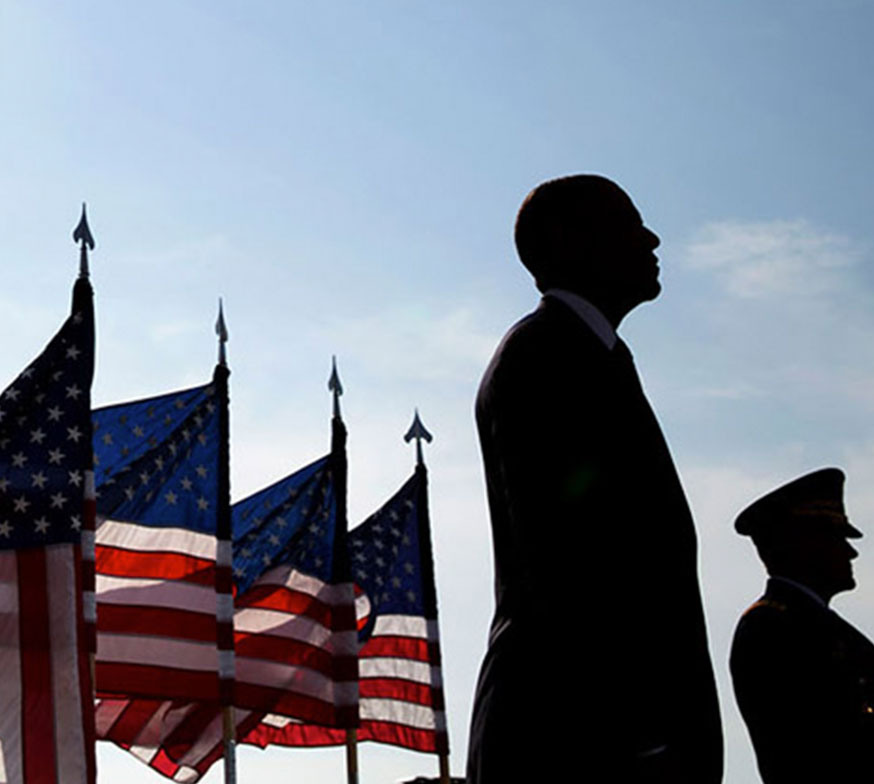
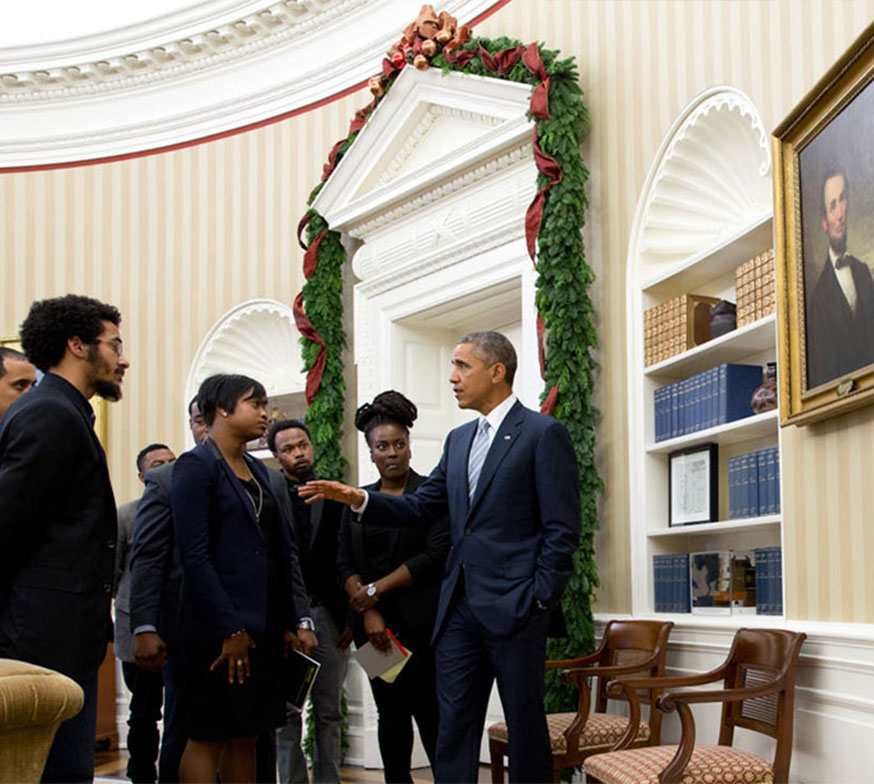
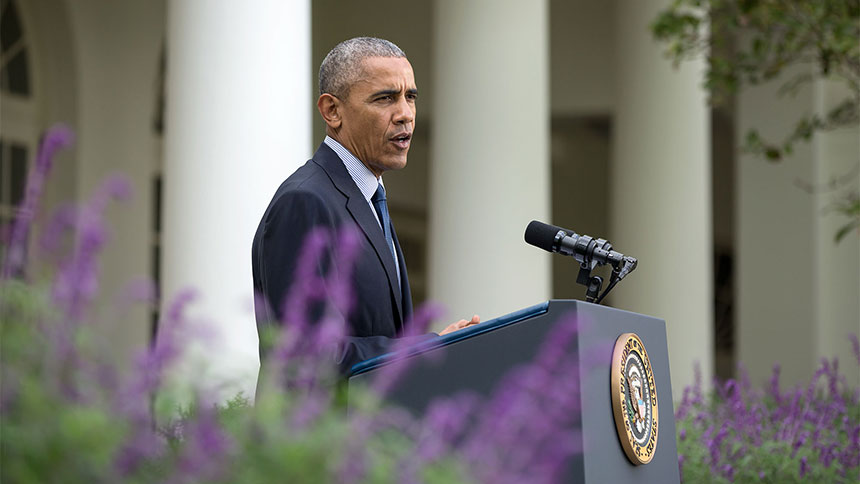
AN IN-DEPTH LOOK AT PRESIDENT OBAMA’S RECORD IN FIVE AREAS| whitehouse.gov

The White House | whitehouse.gov:

AN IN-DEPTH LOOK AT PRESIDENT OBAMA’S RECORD IN FIVE AREAS


Yes, we did. Yes, we can.

“You were the change. You answered people's hopes, and because of you, by almost every measure, America is a better, stronger place than it was when we started.”
- President Barack Obama


When Philanthropists Rule: Part Two of a Review of "The Givers" - Living in Dialogue

When Philanthropists Rule: Part Two of a Review of "The Givers" - Living in Dialogue:

When Philanthropists Rule: Part Two of a Review of "The Givers"

Image result for David Callahan The Givers


By John Thompson.
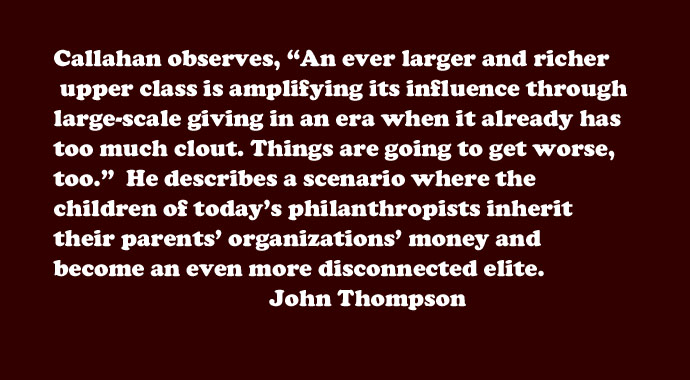
As explained in this previous post, I began David Callahan’s The Givers with a commitment to avoid confirmation biases. As he notes, plenty of teachers (like me) detest corporate school reform. But, even if Callahan had concluded that education philanthropists produced significant gains in student performance, his narrative would have raised alarms about the longterm growth of the new donor class.
Second, despite the damage done by the new edu-philanthropy, I remain an incorrigible optimist. I wasn’t prepared for such a persuasive case that a new type of donors was leading to a “benign plutocracy.” But, Callahan shows how they’ve created “a clash of philanthropic titans, with ordinary Americans on the sidelines.”
The Givers begins with the first politicized think tanks of the 1960s and 1970s, such as the American Enterprise Institute. The AEI may have been one of the more intellectually honest of the conservative alternatives to academic research, but it is still a shame that it didn’t abide by the rules of evidence that apply in universities.  These first generation think tanks were designed to “excel at framing the terms of public debates” and “wage big-picture ideological warfare.”
The success of right wing advocacy organizations contributed to the “income chasm” and the inequality of our “Second Gilded Age.” Federal domestic discretionary spending is the lowest in five decades, meaning that there is more need for private donations. The conservative movement won tax breaks, as well as the US Supreme Court’s Citizens United ruling. This has enabled elites to “buy megaphones that often drown out the voices of ordinary people.”
The rise of Silicon Valley prompted the growth of what ProPublica’s Jesse Eisenberg called “a society of When Philanthropists Rule: Part Two of a Review of "The Givers" - Living in Dialogue:
 Image result for big education ape free lunch

Standing Up For Our Public Schools

Standing Up For Our Public Schools:

Standing Up For Our Public Schools

Image result for Standing Up For Our Public Schools
– Bobbi Murray / Capital and Main
In the past five years, the LAUSD Board had denied nine charter renewals while renewing at least 162. The charter industry, therefore, considered the Board to be hostile towards charters and spent $9,695,351.00 on the last School Board election, purchasing seats for Board Members who will do their bidding. Now, with a majority secured, charters like Celerity (whose offices have been raided by the FBI) and Magnolia (which according to the California Charter School Association, operates academically inferior schools) can be assured that the  pro-charter majority on the Board will see that these privately run schools are not held accountable at all for the public funds that they receive.
The outsized influence of the charter industry goes beyond the election cycle. Despite the fact that the majority of students enrolled within the LAUSD attend public schools, it is the charters that receive preferential treatment at Board meetings. Parents, teachers, and students are regularly bussed in (during school hours) in an attempt to sway the Board to ignore the various allegations against them. Unfortunately, no such organization exists to represent LAUSD public school students and so their voices Standing Up For Our Public Schools:


Keeping retirement weird. June Gloom in L.A. and the Blues in Chicago. | Fred Klonsky

Keeping retirement weird. June Gloom in L.A. and the Blues in Chicago. | Fred Klonsky:

Keeping retirement weird. June Gloom in L.A. and the Blues in Chicago.

18954823_10156217744892067_2644279590255591424_nIt was a beautiful summer night at Millennium Park for the opening of Chicago’s Blues Fest.We arrived in time for a set by the Chicago hip hop star, Rhymefest.
Funny thing about Rhymefest. A couple of years ago he ran for alderman of the 20th Ward and came in second to the incumbent Willie Cochran. Rhymefest got 45.4% of the vote to Cochran’s 54.6%.
About half way through the final set led by the great Chicago bluesman, Billy Branch, a few drops of rain began to fall, chasing away those less experienced with this annual event. It always rains at Blues Fest. The drops lasted just long enough to open a few spots on the lawn for late comers.
The group of young folks nearby would not be moved by rain or threat of rain. They were having too much fun drinking red wine from a plastic bag and passing a joint around, unfased by the private park security that made regular passes checking for who-knows-what.
We, on the other hand, kept our bottle of cheap Bordeaux hidden in a plastic Mexican bag, wrapped in a green kitchen towel, exposing it only long enough to pour some liquid into a red Solo cup.
What a difference 24 hours can make.
Just the day before my brother and I flew out of LAX after spending a few daysKeeping retirement weird. June Gloom in L.A. and the Blues in Chicago. | Fred Klonsky: 


Betsy DeVos' Testimony And New York's Integration Plan : NPR Ed : NPR

Betsy DeVos' Testimony And New York's Integration Plan : NPR Ed : NPR:

This Week In Education: DeVos, Discrimination, Desegregation

Image result for big education ape DeVos, Discrimination, Segregation

Hello, and welcome to another excitement-filled edition of our weekly news roundup!
Questions about federal law and discrimination for DeVos
On Tuesday, Education Secretary Betsy DeVos appeared before a Senate Appropriations subcommittee, and Democrats pounded her with questions about civil rights protections, particularly for LGBTQ students and those with disabilities. After facing similar questions in a House subcommittee appearance last month, DeVos this time took a new tack, repeating the same answer at least 14 times:
"Schools that receive federal funds must follow federal law."
At one point, Sen. Jack Reed, a Rhode Island Democrat, demanded, "But what does that mean?"
The question went unanswered, and it's an important one, especially if the Education Department is suggesting, as it seems to be, that federal laws would offer vulnerable students meaningful protections from discrimination if they attend private schools, which are mostly religious, using vouchers.
Attempting to answer Reed's question, NPR Ed unpacked the relevant federal laws — Title IX, IDEA, ADA, etc. — and found an important trend: When it comes to regulating private schools, especially private religious schools, federal law provides relatively weak civil rights guardrails.


More on that here.
The hearing was also marked for its pushback on President Trump's proposed 13 percent cut to education, coming from both sides of the aisle.
"It's likely that the kinds of cuts proposed in this budget will not occur," summed up Sen. Roy Blunt, a Missouri Republican and chair of the subcommittee. History suggests he may be right.
New York City announces school integration goals
The nation's largest public school system released a plan this week to increase integration by race, income and English language learner and disability status. But advocates called it less than ambitious, and it didn't use the word "segregation."
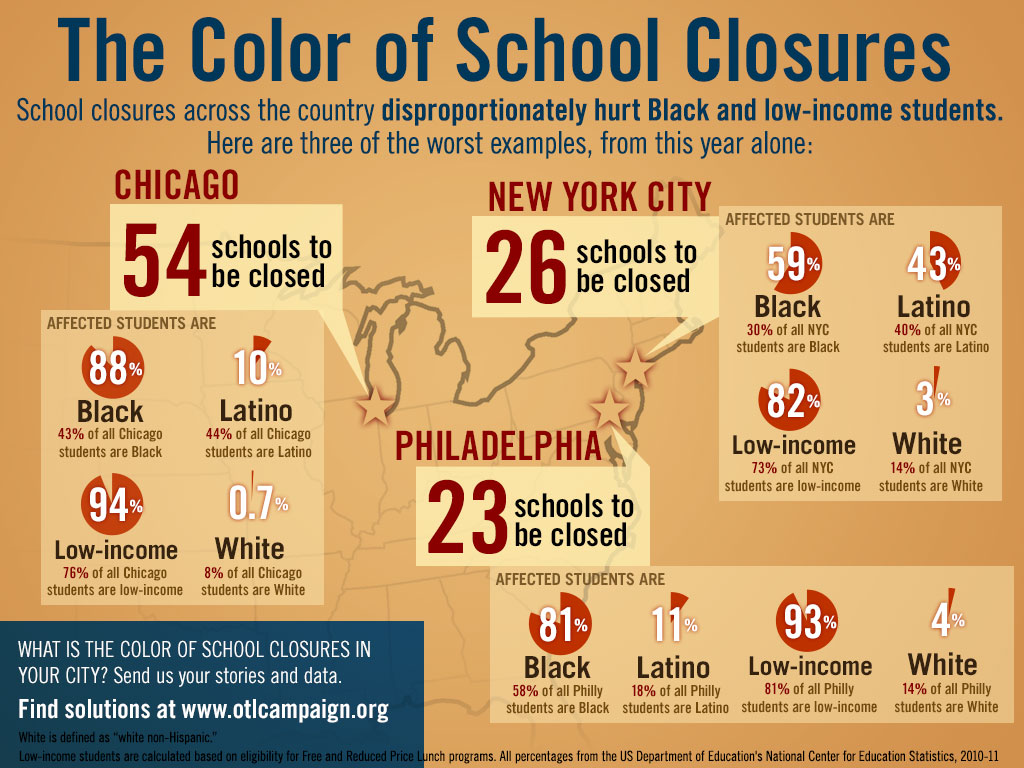
Seventy percent of New York City school children are black and Latino. But more than two-thirds attend schools that don't look like the city, with African-Americans and Latinos clustered in some schools and whites and Asians overrepresented in others. The same clustering is seen with regards to income.
The city plans, within five years, to increase by 50,000 the number of students attending schools that reflect the city's racial demographics and to decrease by 10 percent the number of schools that are concentrated in terms of both poverty and wealth. The city will also simplify the all-choice admissions processes for middle and high school in an attempt to make it easier for families with fewer resources to access better opportunities.
WNYC interviewed Ritchie Torres, a city councilman from the Bronx, who called it "an incremental approach" but one that "legitimizes diversity as a public policy objective."
Chicago is an example of a large urban school system with an ambitious integration plan, which we covered here.
Harvard students' admission rescinded over obscene Facebook memes
At least 10 would-be members of Harvard's Class of 2021 had their admissions offers rescinded after a group exchange of racist and sexually offensive Facebook messages, The Harvard Crimson student newspaper reported this week.
The Crimson reported that within a group of about 100, the students exchanged images with captions that made light of pedophilia and the Holocaust and had other offensive themes.
Nationally, 43 percent of young people report they have personally been called offensive names on the Internet, according to a study released earlier this year by the nonpartisan think tank Data & Society.
Billionaires disrupt education
The New York Times took a look this week at the attempts by tech titans to transform public schools with what one scholar called "a monopolistic approach to education reform."
In a wave of philanthropy on a scale not seen since the Rockefeller and Carnegie era, leaders like Mark Zuckerberg of Facebook, Marc Benioff of Salesforce and Reed Hastings of Netflix, and nonprofits like Code.org, have each invested tens of millions of dollars in technology and direct grants to schools.
Some of these investments serve companies' direct business interests, such as preparing more students for computer science jobs or selling software and hardware to what is projected to soon be a $21 billion ed-tech market. In all cases, concluded The Times, there is little independent oversight of these efforts and little independent proof of benefits to learning.
Betsy DeVos' Testimony And New York's Integration Plan : NPR Ed : NPR:

Success Academy Wins Round in Fight Over Preschool Oversight - The New York Times

Success Academy Wins Round in Fight Over Preschool Oversight - The New York Times:

Success Academy Wins Round in Fight Over Preschool Oversight


Success Academy and other charter schools won a victory in a long-running dispute with New York City when a state appeals court ruled on Thursday that the city cannot regulate a charter school’s prekindergarten programs.
It was the charters’ first win in the dispute, which began in the fall of 2015 when Success Academy, which had just begun offering prekindergarten in three of its schools through the city’s universal prekindergarten program, refused to sign a contract required by the city. The city said that the contract was necessary to ensure consistent quality across prekindergarten programs, while Success said that the contract violated state law, which it argued gave a charter school’s authorizer the sole right to oversee the school’s operations. Success’s authorizer is the State University of New York.
When the city withheld payments for Success’ prekindergarten program, Success sought help from the State Education Department. But the state education commissioner, MaryEllen Elia, ruled in early 2016 that it was legal for the city to require charter schools to sign its contract in order to be paid. The State Supreme Court in Albany rejected a request by Success and a group of parents to overturn the commissioner’s decision. The parents and Success then appealed to the State Supreme Court’s Appellate Division. In the meantime, Success canceled its prekindergarten classes for the 2016-17 school year.
In a ruling issued on Thursday, a panel of judges unanimously rejected Ms. Elia’s decision, saying that she had misinterpreted state law. The ruling, written by Justice William E. McCarthy, said that “the Legislature did not intend for a school district’s right of inspection to empower a school district to regulate a charter school’s prekindergarten programming and operations.”
The ruling sent the case back to the commissioner, directing her to Success Academy Wins Round in Fight Over Preschool Oversight - The New York Times:
Big Education Ape: Success Academy’s First State Audit: Let the Pouting Begin | deutsch29 - http://bigeducationape.blogspot.com/2016/12/success-academys-first-state-audit-let.html

Why schools still can't put segregation behind them

Why schools still can't put segregation behind them:

Why schools still can’t put segregation behind them

Image result for big education ape charter school segregation
A federal district court judge has decided that Gardendale – a predominantly white city in the suburbs of Birmingham, Alabama – can move forward in its effort to secede from the school district that serves the larger county. The district Gardendale is leaving is 48 percent black and 44 percent white. The new district would be almost all white.
The idea that a judge could allow this is unfathomable to most, but the case demonstrates in the most stark terms that school segregation is still with us. While racial segregation in U.S. schools plummeted between the late 1960s and 1980, it has steadily increased ever since – to the the point that schools are about as segregated today as they were 50 years ago.
As a former school desegregation lawyer and now a scholar of educational inequality and law, I have both witnessed and researched an odd shift to a new kind of segregation that somehow seems socially acceptable. So long as it operates with some semblance of furthering educational quality or school choice, even a federal district court is willing to sanction it.
While proponents of the secession claim they just want the best education for their children and opponents decry the secession as old-school racism, the truth is more complex: Race, education and school quality are inextricably intertwined.

Rationalizing Gardendale’s segregation

In some respects, Gardendale is no different from many other communities.
Thirty-seven percent of our public schools are basically one-race schools – nearly all white or all minority. In New York, two out of three black students attend a school that is 90 to 100 percent minority.Why schools still can't put segregation behind them:
 Image result for big education ape charter school segregation


Stability and Change in a Four-Decade Career in Teaching (Part 3) | Larry Cuban on School Reform and Classroom Practice

Stability and Change in a Four-Decade Career in Teaching (Part 3) | Larry Cuban on School Reform and Classroom Practice:

Stability and Change in a Four-Decade Career in Teaching (Part 3)

Image result for Stability and Change in a Four Decade Career in Teaching
After leaving the superintendency, I spent the next twenty years as  a professor at Stanford University. I taught four courses during the academic year and did research. Most of the courses I taught were about the history of school reform, leadership in schools, instruction and curriculum (for those preparing to teach history in public schools), and organizational theory. I team-taught “The History of School Reform” with historian of education David Tyack for a decade. I also team-taught with high school history teacher Lee Swenson a course on Social Studies Curriculum and Instruction for ten years. The seminar I taught annually was “Good Schools: Research, Policy, and Practice.” After I retired in 2001, I continued to teach the “Good Schools” course every other year until 2013. So for over a quarter-century, I have taught courses at the graduate level. I noted often to myself that what I had learned in teaching 16 year-olds, especially the need for a broad-ranging repertoire of teaching methods applied in many ways to 26 year-olds.
A specific example of how I taught courses might help readers get a clearer sense of my teaching graduate students in their 20s and 30s. Here is an actual lesson plan I prepared for the “Good Schools” seminar I taught in February 2006. The seminar met for an hour and fifty minutes twice a week.
The planning for the lesson generally went like this: the night before I taught, I would re-read the selections I had assigned to students from a reader that I had compiled and they bought. I would type out the lesson plan on my laptop. Next Stability and Change in a Four-Decade Career in Teaching (Part 3) | Larry Cuban on School Reform and Classroom Practice:

School Vouchers: Transubstantiate Your Cash For Fun and Profit | gadflyonthewallblog

School Vouchers: Transubstantiate Your Cash For Fun and Profit | gadflyonthewallblog:

School Vouchers: Transubstantiate Your Cash For Fun and Profit

Image result for big education ape devos alec
When is a tax dollar not a tax dollar?
Screen Shot 2017-06-09 at 2.36.42 PM
When it’s used to pay for a school voucher.
That’s the slight of hand behind much of our education policy today.
Lawmakers want to give away a huge bundle of your cash to religious schools, but they can’t because of that pesky old First Amendment.
The establishment clause sets up a distinct separation between church and state. It explicitly forbids public money being spent on any specific religion.
So these lawmakers do a bit of magic. They take that money, wave their hands over it, mumble a few secret words and VoilĆ ! It’s no longer public; it’s private. And private money can be spent any way you want – even on religion.
Here’s how they do it.
You simply take public tax dollars and turn them into credits that can be used to pay for alternatives to public schools. Call it a “school voucher.”
But wait a minute. Isn’t that like a check? If Peter writes Paul a check, that money is no longer Peter’s. Now it’s Paul’s. Right?
Yes. But that’s not what’s happening here.
A school voucher isn’t a check. A check is an order to your bank to transfer funds to another account or to be exchanged for cash or goods or services. School vouchers do not come from your account. And they cannot be transferred into just any account or spent in any way.
They’re more like food stamps. It’s not money that can be used in any way you see fit. It’s money that can only be used to pay for a child’s education. And you can only use School Vouchers: Transubstantiate Your Cash For Fun and Profit | gadflyonthewallblog: 

Rockland County New York Democrats: "No Independent Democratic Conference" Badass Teachers Association:

Badass Teachers Association: Rockland County New York Democrats: "No IDC" by Jake Jacobs:

Rockland County New York Democrats: "No IDC" 

by Jake Jacobs

ROCKLAND-DEMS-VOTEIDC.jpg

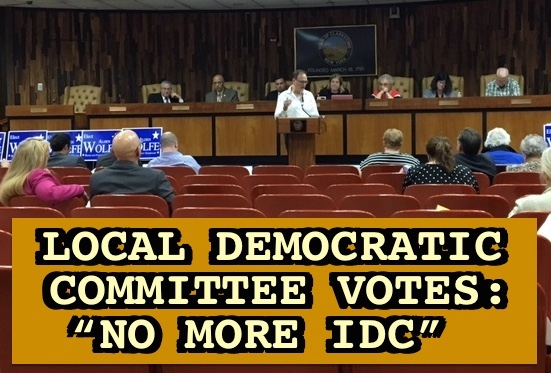
An anti-IDC resolution was overwhelmingly approved Thursday evening at the annual convention of the Rockland County Democratic Committee of New York. Following candidate nominations and typical convention business, a motion was circulated calling for all Democrats to unify to end Republican control of the New York State Senate.

It was overwhelmingly approved.

Since 2011, the Independent Democratic Conference, a breakaway group of Democratic NYS Senators has prevented mainline Democrats from controlling the chamber, choosing instead power-sharing agreements and back room negotiations with Republicans, an arrangement the IDC claims is the best way to “get things done”. In recent months, an IDC protest movement has been growing in size and intensity, insisting that all Democrats come together to show firmer opposition to the Trump agenda by taking the gavel away from the GOP.

Rockland County Democratic chairwoman Kristen Stavisky acknowledged the presence of local grassroots organizations Rockland Citizens Action Network and Rockland United who introduced the resolution as a response to Trump's “onslaught” against democracy. Mentioning recent comments made by NY Senator Kirsten Gillibrand and DNC chair Keith Ellison who echoed the call for Democrats to act swiftly to take back control of the NYS Senate, the resolution found strong support in the room from Rockland County committee members.

Though not named, the measure was aimed at Rockland County’s State Badass Teachers Association: Rockland County New York Democrats: "No IDC" by Jake Jacobs


 Image result for big education ape real democrat
Image result for big education ape real democrat

Preschool Social Emotional Learning (SEL): Discipline in Disguise?

Preschool Social Emotional Learning (SEL): Discipline in Disguise?:

Preschool Social Emotional Learning (SEL): Discipline in Disguise?

Image result for in Disguise


Social Emotional Learning is popular! But why do school reformers discuss SEL like it has been hiding under a rock someone just kicked over? Haven’t preschool teachers always worked with children on how to get along? While reading and thinking about preschool, I thought it would be interesting to explore SEL as it relates to this age group. I’ve written about SEL before. Here. Is it preschool discipline in disguise?
For example, a recent report by Penn State and the Robert Wood Johnson Foundation, Promoting Social Emotional Learning in Preschool: Programs and Practices that Work, says SEL in preschool means children should be able to get along and cooperate with others, manage strong feelings, focus attention, and persist at challenging tasks.