Latest News and Comment from Education

Thursday, May 25, 2017

5/25/2017 – Jeff Bryant Welcome to the Opportunity Network Update!

5/25/2017 – What Betsy DeVos Calls Education Transformation Is Actually Public Theft:

Education Opportunity Network -
Jeff Bryant Welcome to the Opportunity Network Update!
Image result for Jeff Bryant


 What Betsy DeVos Calls Education Transformation Is Actually Public Theft

THIS WEEK: DeVos Upholds Discrimination … Democrats Delivered DeVos … Voucher Evils … School Choice Scam … Taking To The Streets

TOP STORY

What Betsy DeVos Calls Education Transformation Is Actually Public Theft

By Jeff Bryant

“Betsy DeVos wants to give your tax dollars to private schools and businesses and tell you it’s an education ‘transformation.’ That’s the main theme of an address she gave this week to a conference held by the organization she helped found and lead, the American Federation for Children. Declaring ‘the time has expired for reform,’ she called instead for a ‘transformation … that will open up America’s closed and antiquated education system.’ Her plan also opens your wallet to new moochers of taxpayer dollars.”
Read more …

NEWS AND VIEWS

DeVos Won’t Say Whether She’d Withhold Federal Funds From Private Schools That Discriminate

The Washington Post

“Education Secretary Betsy DeVos refused to say Wednesday whether she would block private schools that discriminate against LGBT students from receiving federal dollars … Asked by Rep. Katherine M. Clark (D-Mass.) whether she could think of any circumstance in which the federal government should step in to stop federal dollars from going to private schools that discriminate against certain groups of students, DeVos did not directly answer. ‘We have to do something different than continuing a top-down, one-size-fits all approach,’ DeVos said.”
Read more …

Don’t Like Betsy DeVos? Blame The Democrats.

New Republic

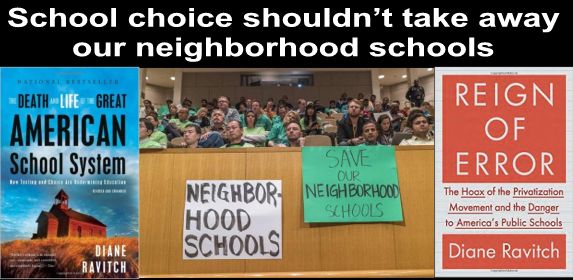
Education historian Diane Ravitch writes, “Thirty years ago, there was a sharp difference between Republicans and Democrats on education. Republicans wanted choice, testing, and accountability. Democrats wanted equitable funding for needy districts and highly trained teachers. But in 1989, with Democrats reeling from three straight presidential losses, the lines began to blur … After George W. Bush made the ‘Texas miracle’ of improved schools a launching pad for the presidency, many Democrats swallowed his bogus claim that testing students every year had produced amazing results … Obama and Education Secretary Arne Duncan doubled down on testing, accountability, and choice … Trump and DeVos rely on the same language to tout their vision of reform. They’re essentially taking Obama’s formula one step further: expanding ‘choice’ to include vouchers.”
Read more …

Opening Pandora’s Box

Political Research Associates
“Polly Williams, the Wisconsin African American lawmaker behind the nation’s first school voucher program, believed vouchers could help students of color in urban Milwaukee. Conservative donors and right-wing think tanks saw her program as opening the door to the privatization of public education … But by the late 1990s, Williams had been pushed aside, just as she feared that students of color from low-income families would be pushed aside by the diverging agenda of her White conservative partners.”
Read more …
School Choice Is A Scam In Segregated Neighborhoods

The Chicago Reporter

Chicago community organizer Jitu Brown writes, “What [Betsy] DeVos fails to understand is the intentional structural racism that has been accepted by Democrats and Republicans, where children from black and brown communities are intentionally underserved by the system all citizens pay taxes into … DeVos has not yet learned that we, meaning black and brown families, don’t have the choice of great neighborhood schools within safe walking distance of our homes … The solution implemented by the same system that produces this inequity is to further diminish democracy and accountability to the public by privatizing what is a public good.”
Read more …

Fed Up With A Budget Crisis, Illinois Citizens Take To The Streets

The Progressive

Jeff Bryant writes, “A small group marching 200 miles from Chicago to the Illinois State Legislature in Springfield demand the passage of a new Illinois state budget … The marchers are demanding a People and Planet First Budget for Illinois that proposes $23.5 billion in new state spending … To pay for their demands, the marchers want corporate tax loopholes closed, taxes on higher income earners raised, and a LaSalle Tax that taxes financial transactions … State funding for education is a major sticking point in the legislative stalemate … The marchers’ call for increased financial support for public education in their state is relevant to the rest of the nation. State after state continues to withhold funding for public education to keep taxation on wealthy people and corporations at historic lows.”
Read more …

National teachers union president blasts Martinez during state Capitol visit - The Santa Fe New Mexican Education

National teachers union president blasts Martinez during state Capitol visit - The Santa Fe New Mexican: Northern New Mexico Education:

National teachers union president blasts Martinez during state Capitol visit

Image result for National teachers union president blasts Martinez during state Capitol visit

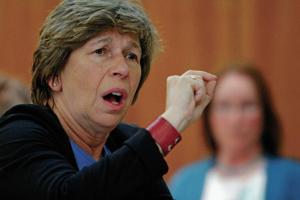
The head of one of the country’s most powerful teachers unions came to Santa Fe on Wednesday and criticized Gov. Susana Martinez’s education policies as a “blame and shame” approach that demoralizes teachers and hurts efforts to improve public schools.
During a news conference at the Capitol less than an hour before the start of a special legislative session to balance the state budget, Randi Weingarten, president of the American Federation of Teachers, likened Martinez and New Mexico Public Education Secretary Hanna Skandera to President Donald Trump. She said Martinez and Skandera, like Trump and U.S. Education Secretary Betsy DeVos, want to destabilize and privatize public education.
She also blasted Trump’s proposal, announced earlier this week, to cut $11 billion from federal public education funding. That move “is cruel and callous and catastrophic,” Weingarten said.
Democratic lawmakers from both the Senate and House of Representatives surrounded her and pledged to hold firm against any additional cuts to public education.
Martinez vetoed all funding for the state’s higher education system earlier this year, partly in protest of the state Senate’s failure to hold confirmation hearings for two of her appointees to The University of New Mexico Board of Regents. But Martinez and Republican lawmakers have told The New Mexican they also intend to protect public school funding levels for the coming year.


Representatives for the governor and Skandera said Weingarten’s appearance at the Capitol, which came as the state Democratic Party held a march in support of National teachers union president blasts Martinez during state Capitol visit - The Santa Fe New Mexican: Northern New Mexico Education:

Jitu Brown: School Choice Is A Scam In Segregated Neighborhoods | PopularResistance.Org

School Choice Is A Scam In Segregated Neighborhoods | PopularResistance.Org:

School Choice Is A Scam In Segregated Neighborhoods

Photo by Marc Monaghan
Wendell Phillips Academy High School is a public school located in the Bronzeville neighborhood on the South Side of Chicago.

Above Photo: Photo by Marc Monaghan. Wendell Phillips Academy High School is a public school located in the Bronzeville neighborhood on the South Side of Chicago.
Secretary of Education Betsy DeVos seems not to hear the fierce protests of parents, teachers and school officials over school closings and charter expansion in New York, Chicago, Oakland, Detroit and other American cities. How else to explain her continuing tone-deaf comments praising the glories of school choice?  In truth, school choice does not exist in most black and brown communities in the United States. That is why her words ring false and her promises sound empty to the people living in those communities.
Whatever hope existed that DeVos would learn on the job and inform her boss, President Donald Trump, of the need to respect that history and build on the effectiveness of American public schools while improving them, has been dashed. During her confirmation hearings, DeVos was criticized for her lack of experience with and knowledge of the public education system.
Her later words at the Brookings Institution exemplified someone in a position of great power, who just does not get it: “How many of you got here today in an Uber, or Lyft, or another ridesharing service? Did you choose that because it was more convenient than hoping a taxi would drive by? Even if you didn’t use a ridesharing service, I’m sure most of you at least have the app on your phone. Just as the traditional taxi system revolted against ridesharing, so too does the education establishment feel threatened by the rise of school choice. In both cases, the entrenched status quo has resisted models that empower individuals.”
What DeVos fails to understand is the intentional structural racism that has been accepted by Democrats and Republicans, where children from black and brown communities are intentionally underserved by the system all citizens pay taxes into.
In Chicago, a child who goes to a neighborhood school near DePaul University enjoys a teacher’s aide in every class, robotics, debate teams, fully stocked libraries and after-school programs; while on the south side of the same city, in some schools there is one teacher’s aide in the building, with no library, no world language and 42 kindergarten students in one class.
In the historic Bronzeville community on the South Side of Chicago, simply to save Walter H. Dyett High School, our community’s last open enrollment neighborhood high school, I joined 11 other parents on a hunger strike for 34 days, from Aug. 17 through Sept. 24, 2015.
On the 25th day, Mayor Rahm Emanuel held a ribbon-cutting ceremony for a $21 million annex at Lincoln Elementary, a school with an upper-middle-class, white constituency in the upscale Lincoln Park community.  Today, Walter H. Dyett is open, serving School Choice Is A Scam In Segregated Neighborhoods | PopularResistance.Org:
Image result for henry ford you can have any color

Who Is Behind the Assault on Public Schools? | Howard Ryan | Monthly Review

Who Is Behind the Assault on Public Schools? | Howard Ryan | Monthly Review:

Who Is Behind the Assault on Public Schools?

Image result for big education ape billionaires

Over the past three decades, public schools have been the target of a systematic assault and takeover by corporations and private foundations. The endeavor is called “school reform” by its advocates, while critics call it corporate school reform. Finnish educator Pasi Sahlberg has given it the vivid acronym GERM—the global education reform movement. Its basic features are familiar: high-stakes testing; standardized curricula; privatization; and deskilled, high-turnover faculty. In the United States, public schools have become increasingly segregated, destabilized, and defunded, with the hardest hit in low-income communities of color.
Nevertheless, while the political conflicts and social ramifications of the school reform phenomenon are well known, basic questions about the movement remain underexamined. Who really leads it? What are their aims and motives? After briefly taking up the statements of the reformers themselves, I will turn to the views of their progressive opponents, and offer a critique of three influential interpretations of the school reform movement. Finally, I will present my own theory about this movement, its drivers, and its underlying aims.

What the Corporate Reformers Say

The school reform movement presents itself as a collaboration among grassroots groups, business leaders, and private donors, united in an effort to improve education, foster a better economy, and help poor children escape poverty. Their goal is to “prepare America’s children for success in college and careers” (Barack Obama), “give low-income and minority students a world-class education” (Bill Gates), and help Americans “maintain our standard of living” (Eli Broad).1
For these reformers, high-stakes testing and teacher “accountability” are the defining metrics of success. George Shultz and Eric Hanushek of the conservative Hoover Institution at Stanford claim that if U.S. students raised their scores on the major international mathematics test by forty points over the next twenty years, the country could expect $70 trillion rise in GDP over the next eighty years. “That’s equivalent to an average 20% boost in income for every U.S. worker each year over his or her entire career.”2
A large body of research, however, challenges the merits of high-stakes testing and other elements of the corporate school reform package.3 It is also at least questionable whether the reformers really believe their own statements.
The reformers’ interest in school improvement appears, in a number of ways, to be less than genuine, to mask a different agenda. They prescribe models for mass education that they do not consider suitable for their own children.4 They sponsor think tanks to produce “junk research” praising their models, while ignoring studies that contradict their models.5 They insist that full resourcing of schools is unimportant or unrealistic, and that “great teachers” will succeed regardless of school conditions, class size, or professional training.

Progressive Interpretations

Critics on the left have done much to expose the hoax character of the school reform movement: documenting the destructive impact of school closures and privatization; showing how publishers, testing and technology companies, and real estate investors use the reforms Who Is Behind the Assault on Public Schools? | Howard Ryan | Monthly Review:
Image result for big education ape billionaires

The End of the Neighborhood School - CityLab

The Problem of Geography in School Choice - CityLab:

The End of the Neighborhood School

Trump’s education budget aims to deliver a big boost to “school choice”—and siphon resources from urban schools in low-income areas.


Donald Trump’s proposed education budget aims to cut spending by 13.5 percent, or $9.2 billion, from the current $68.2 billion budget. It’s the biggest single-year cut a president has tried to make since Reagan attempted to gut the department in 1983. Targeted for the biggest hit: public schools. Specifically, after-school programs, teacher training, foreign languages, and the like would be slashed or eliminated.
Yet the budget gives public schools a way to make some cash: If local districts agree to allow open enrollment, in which parents, regardless of where they live, can send their children to any area public school, the districts will be awarded grants from a $1 billion initiative clunkily dubbed Furthering Options for Children to Unlock Success (FOCUS). When a child moves from one school to another, the local, state, and federal funds attached to them would follow.  
FOCUS reflects Education Secretary Betsy DeVos and her signature fixation on “school choice,” whereby students have the option to attend schools different than the one they are zoned for geographically. These schools may be public, including charter schools (as in the case of FOCUS), or they maybe be private schools, including religious schools. Trump and DeVos support supplying parents with vouchers to offset the costs of private schools; the White House budget ups the funding for charter schools and private school choice to the tune of $417 million.
While it’s almost guaranteed Congress won’t pass the budget, the big boost to school choice is a sign of how far the issue has come in the past 15 years, among both Republicans and Democrats. The Obama administration didn’t support private school vouchers, but it did promote charter schools. For instance, Obama’s 2009 Race to the Top program, a $4.35 billion grant that aims to spur and reward innovation in K-12 education, rewards states for allowing the growth of charter schools.

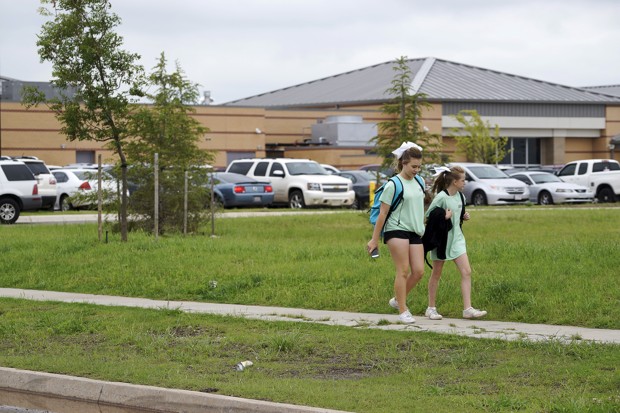
Students walk home from Briarwood Elementary, a traditional public school in Oklahoma City. (Rick Wilking/Reuters)

School-choice supporters tout it as a way for parents living in neighborhoods with low-performing schools to send their kids to better schools in low-poverty areas. It’s a strategy generally applied to urban contexts, as rural areas are more likely to have a single school that the community rallies around. And it’s on the rise across the country. “We still have neighborhood attendance zones, and most children in the U.S. attend traditional public schools,” says Matthew Chingos of the Urban Institute. “But 42 The Problem of Geography in School Choice - CityLab:

The Betsy DeVos School Choice Lie | deutsch29

The Betsy DeVos School Choice Lie | deutsch29:

The Betsy DeVos School Choice Lie


If you think that US ed sec Betsy DeVos wants anything other than to end American public education and replace it with an a-la-carte, private-school-favoring menu of largely underregulated school-like options, think again.
This, readers, is her single goal. And if you don’t agree with her, you are of limited intellect and capability.
Consider these excerpts, which she gave on May 22, 2017, as part of a speech to a pro-voucher group that she founded, the American Federation for Children (AFC):
We’ve had 30 years of “reform.”
And while we celebrate the progress that has been made, each year there are still far too many kids falling through the cracks.
The time has expired for “reform”. We need a transformation – a transformation that will open up America’s closed and antiquated education system.
If we really want to help students, then we need to focus everything about education on individual students – funding, supporting and investing in them. Not in buildings; not in systems.
It shouldn’t matter where a student learns so long as they are actually learning.
It shouldn’t matter if learning takes place in a traditional public school, a Catholic school, a charter school, a non-sectarian private school, a Jewish school, a home school, a magnet school, an online school, any customized combination of those schools – or in an educational setting yet to be developed. …
We must offer the widest number of quality options to every family and every child. Empowering parents with choices is how to give students second, third or fourth chances before it’s too late.
Even the most expensive, state-of-the-art, high-performing school will not be the perfect fit for every single child. Parents know – or can figure out – what learning environment is best for their child, and we must give them the right to choose where that may be.
But it’s not enough to promote choice simply for the sake of choice. That doesn’t serve kids. If a menu is full of bad options, then do you really have a choice at all?
The point is to provide quality options that serve students so each of them can grow. Every option should be held accountable, but they should be directly accountable to parents and communities, not to Washington, DC bureaucrats.
In order to succeed, education must commit to excellence and innovation to better meet the needs of individual students. Defenders of our current system have regularly been resistant to any meaningful change. In resisting, these “flat-earthers” have chilled creativity and stopped American kids from competing at the highest levels. Our current framework is a closed system that relies on one-size-fits-all solutions. We need an open system that envelopes choices and embraces the future.
DeVos tosses in words like “quality” and “accountable”; however, she also states time and again that regulation of her quality word salad “should be left up to the states”– which means that states can do whatever they wish because they get the ultimate choice in her school choice utopia.
And if you don’t agree, it isn’t because you could see some legitimate problem with The Betsy DeVos School Choice Lie | deutsch29:
Image result for big education ape alternative facts devos

Chicago is a union town, charter schools are no exception. | Fred Klonsky

Chicago is a union town, charter schools are no exception. | Fred Klonsky:

Chicago is a union town, charter schools are no exception.

ct-passages-charter-school-strike20170524.jpg

I heard this morning that the teachers at Passages charter in Chicago won a late night agreement on a union contract. If they hadn’t, Passages would have been the first charter school strike in the United States.
“Chicago has become the epicenter of charter union organizing in the country,” complained Andrew Broy, president of the Illinois Network of Charter Schools.
We’re number one!
Andrew should have known. Chicago is a union town.
WBEZ reports that the Passages contract gives their teachers a 21% pay increase. More details will be released later.

The Condition of Education

The Condition of Education:

The Condition of Education

Image result for reign of error life and death of


This website contains key indicators on the condition of education in the United States at all levels, from prekindergarten through postsecondary, as well as labor force outcomes and international comparisons. The indicators summarize important developments and trends using the latest statistics, which are updated throughout the year as new data become available. In addition, this website has Spotlight indicators that provide more in-depth analyses on selected topics.
The Condition of Education is a congressionally mandated report that is provided to Congress each year.

No Choice But to Unionize: Loss of Health Benefits Spurs ESPs to Organize

No Choice But to Unionize: Loss of Health Benefits Spurs ESPs to Organize:

No Choice But to Unionize: Loss of Health Benefits Spurs ESPs to Organize

Image result for big education ape union

It was two days before Thanksgiving Day in 2015. Without warning or provocation, 27 education support professionals (ESPs) in the affluent Solana Beach School District in California were blindsided by an email from the district’s director of human resources.
The surprise blast stated in stark terms that their health benefits under the Affordable Care Act (ACA) were being cancelled in a month.
“It was a sad day in our district,” says Robin Park, an instructional aide for special education at Solana Vista School and one of the email recipients. “It showed there was nothing we could do when something like this happens to us (ESPs).”
Surprisingly, the email sparked a heated conversation among ESPs in the district that wound up inspiring an activist movement in this upscale community popularly known as the “Beverly Hills of San Diego.”
After returning from the holiday break and contacting the California Teachers Association (CTA), Park, CTA staff, and other educators organized a community petition drive and public rally at the next school board meeting December 14. Park says it was the first time that board members learned about the classified workers losing health benefits.
“They were shocked, just stunned,” he says. “Administrators apparently had not felt like they needed to tell the board about cancelling our health coverage.”
Since the medical coverage issue was not on the board’s agenda, they decided to call an emergency meeting to address the matter on December 18. Workers at nine job sites were affected, including those in almost every classified job category, from custodians and paraeducators to technical, maintenance and food service employees. A significant number of clerical service employees at schools and the district’s Child Development Center were particularly affected.
“We knew it was time that classified and certificated employees be treated equally and fairly,” says Park, who graduated from Northern Arizona University with a degree in elementary and special education. “We’re on the same team.”
At the emergency meeting, board members voted unanimously to offer benefits to the affected workers through the district’s plan, which would no longer depend on ACA-dictated policies.

Looking Forward

With support from CTA and members of the Solana Beach Teachers Association (SBTA), classified workers continued their fight for workers’ rights by establishing the Solana Beach Association of Support Professionals (SBASP) in March 2016.
“We hadn’t realized that we could overwhelmingly unionize across the district,” says No Choice But to Unionize: Loss of Health Benefits Spurs ESPs to Organize:

Common Core Bombing in Brazil, World Wide Curriculum Base Faces Obstacles

Folha de S.Paulo - Internacional - En - Culture - Under Discussion in Brazil, Curriculum Base Faces Obstacles in the USA - 22/05/2017:

Under Discussion in Brazil, Curriculum Base Faces Obstacles in the USA

Image result for big education ape gates master of the world
The current scenario in Brazilian education is very similar to what the situation was like in the United States back in 2010. That year, then-President Barack Obama, billionaire Bill Gates, and teaching associations and unions bet on an unprecedented and rigorous national curriculum standard aimed at placing the country's students among the best in the world in international learning assessments.
Obama invested about US $1 billion in the idea. The founder of Microsoft contributed US $200 million. States governed by Democrats and Republicans voluntarily incorporated the policy.
Seven years following the launch, the success envisioned has not yet become reality-and they are doubts if this will ever be the case. The situation serves as a warning for Brazil, which is prepared to adopt the National Common Curriculum Base (BNCC).
In nations with smaller populations, such as Australia, Singapore, and Portugal, curriculum standards have been successful. For many researchers, however, it is more appropriate to compare Brazil with the United States. Both are continental and federative (meaning states have autonomy) countries that also have regional educational inequalities.
The American document, known as the Common Core, establishes a set of skills that students should have at each grade level, from pre-school to high school. At least in theory, standardizing education allows for greater collaboration among states and facilitates comparisons among them.
These objectives are similar to those in Brazil. Last past month, the government of Brazilian President Michel Temer (PMDB) launched its curriculum standards, with full support of the states, municipalities, and private foundations. At the ceremony, managers from the administration of former President Dilma Rousseff (PT) were present, in a display of non-partisan support.
Discussed since 2014 during the PT (Workers Party) government, the Brazilian proposal encompasses pre-school through high school. It will include both public and private schools, and a population of 40 million students (The US has 55 million students).
In determining what each student must know for each grade level, the document will be required to reference new teaching materials and teaching training. States and municipalities will develop their own plans (the curriculum itself) to teach what is determined by the National Base.
Such a re- organization was what the US also hoped for with the Common Core, starting in 2010. Today, however, optimism has been transformed into skepticism. Of the 45 states that adopted the Common Core, 9 have ceased using it. Popular approval of the measure, which was 90% in 2012, is now at 50%, according with a national poll from Education Next magazine. Among teachers, the support has fallen from 80% to 40% during that same time period.
OBSTACLES
What happened between 2010 and 2017?
Errors in implementation and political disputes were the answers most frequently heard during the last seven months of reporting, which included school visits and consulting of academic studies, researchers, authorities, directors and teachers in different American states such as New York, Kentucky, Washington, California and New Jersey.
"The Common Core was well designed. It is compatible with the best curriculum standards in the world, but this is not enough. This should be seen by the Brazilians as a strong warning sign," said the German Andreas Schleicher in an interview with Folha. He is director of PISA, the main international student assessment body.
Overseeing this test since its start 20 years ago, Schleicher is one of the best- known experts in educational systems in the world. "Without good implementation, a good curricular base can just become words on paper." Implementation is the step that Brazil is about to take.
The USA did not improve its performance on the most recent PISA test, which was done in 2015. Some states have used the Common Core for two or three years, but American students continued to score below average among developed countries in mathematics.
A resident of Long Island, a middle-class region of New York, Jeanette Deutermann,43, recalls the initial phases of the Common Core. In 2012, her son started to have stomachaches. He cried when going to school, a public one. A doctor said that it might be stress. "But how? Stress in an eight-year-old boy?" recalls the mother.
Still without a clue about what was happening, the housewife talked with his teachers. She discovered that the curriculum had changed due to the Common Core. The means of teaching was different. The boy did not understand the classes and the mother could not help him, as she did not know the new method.
Additionally students were submitted to a new test, the results of which played a role in teacher evaluations. "The school became focused on what would take place in these tests,"said Jeanette. There were even special classes just for preparation.
Evaluating teachers and schools had a proposition: to try to guarantee that the new curriculum was in fact adopted in the classrooms.
This concern made sense. In 1979, Larry Cuban, today a professor emeritus of the School of Education at Stanford University, compared curricular reforms to a hurricane at sea: there is an enormous churn on the surface, but the deep waters remain nearly unaltered.
According to Cuban, politicians, specialist and authorities are on the surface while the classrooms are submerged. And implementing the Common Core in a hurried way, taking advantage of the initial excitement, could create a shakeup in deep waters.
John King, Commissioner of Education in New York during the implementation of the Common Core, says that the tests were also important to reveal advances and difficulties in the school systems.
Image result for big education ape gates personalized learning

Betsy DeVos Refuses to Rule Out Giving Funds to Schools That Discriminate - The New York Times

Betsy DeVos Refuses to Rule Out Giving Funds to Schools That Discriminate - The New York Times:

Betsy DeVos Refuses to Rule Out Giving Funds to Schools That Discriminate

Image result for big education ape devos discrimination

WASHINGTON — Betsy DeVos, the education secretary, on Wednesday fiercely defended budget plans to spend $1.4 billion on the Trump administration’s expanded school choice agenda, but refused to say whether her office would withhold funds from private schools that discriminate against students.
In her first testimony to Congress since a bruising confirmation hearing in January, Ms. DeVos appeared unflappable as she told members of a House Appropriations subcommittee that the budget sought to empower states and parents to make decisions about students’ educations.
“We cannot allow any parent to feel their child is trapped in a school that isn’t meeting his or her unique needs,” Ms. DeVos told lawmakers.
But Democrats derided the education spending blueprint for the 2018 fiscal year as tone deaf to low-income and working-class Americans. Representative Rosa DeLauro of Connecticut, the top Democrat on the panel, called it “cruel” and “inhumane.”
The budget plan would eliminate more than 20 education programs and redirect funding to expanding school choice initiatives. Those include a $250 million program to give students publicly funded scholarships to attend private schools.
But Ms. DeVos said states, not the Education Department, would decide whether to withhold federal money from private schools that are neither required to serve a diverse pool of students nor held publicly accountable for doing so.
Earlier this week, in a speech to school choice advocates, Ms. DeVos said that state participation in the voucher program and other federally funded school choice initiatives would be optional. But, she said, states that chose not to participate would be making a “terrible mistake.”
Representative Katherine M. Clark, Democrat of Massachusetts, asked how Ms. DeVos would respond to a state that gave federal funding to a school that denied admission to students from lesbian, gay, bisexual or transgender families.
“For states that have programs that allow for parents to make choices, they set up the rules around that,” Ms. DeVos replied.
Though she said the Education Department’s Office for Civil Rights would vigorously investigate any discrimination claims, Ms. DeVos declined to say how, specifically, she might protect students’ rights by intervening in state funding decisions.
“I’m shocked that you were unable to find one example of discrimination against students that you would be willing to stand up to,” Ms. Clark said.
Ms. DeVos maintained that parents should have the final say in what kind of schools their children attend. “Too many children today are trapped in schools that don’t work for them,” she said. “We have to do something Betsy DeVos Refuses to Rule Out Giving Funds to Schools That Discriminate - The New York Times:
Image result for big education ape devos trump civil rights

STRIKE AVERTED: Passages Charter School (IL) Reaches Tentative Agreement | deutsch29

STRIKE AVERTED: Passages Charter School (IL) Reaches Tentative Agreement | deutsch29:

STRIKE AVERTED: Passages Charter School (IL) Reaches Tentative Agreement

Image result for big education ape union

Chicago-based Passages Charter School was set to strike on 7 a.m., Thursday, May 25, 2017, if it could not reach an acceptable agreement with its management organization. Asian Human Services, Inc. (AHS).
Had Passages followed through with its plans to strike, it would have been the first charter school to do so. Charter schools rarely unionize; however, it seems they are doing so more and more as charter school teachers and staff tire of living the unsustainable life of the at-will employee.
One of the Passages teacher complaints was that salaries were low, between $30K and $40K, even as CEO salaries were notably larger.
According to the Passages web site, tentative deal was reached at 11 p.m., Wednesday, May 24, 2017. The web site includes two statements: One from the union representing the Passages teachers, teaching assistant, and staff, and another from the AHS management, apparently posted prior to reaching the agreement.
Below are both statements. First, a brief word from the union, ChiACTS:
Press Release
May 25, 2017
12:15 a.m.
At approximately 11:00 p.m. May 24, 2017, bargaining teams for Asian Human Services, Inc. and ChiACTS, Local 4343, reached tentative agreement on an initial collective bargaining agreement.
Local 4343 represents the teachers, paraprofessionals, teacher assistants, administrative assistants, school counselors, case managers and office clerks employed by AHS at Passages Charter School.
In light of the tentative agreement, Local 4343 has canceled its scheduled strike planned to begin at 7:00 a.m., Thursday, May 25, 2017.
The parties are currently scheduling ratification votes among their respective groups.
And now, from AHS (Passages management), apparently prior to reaching the agreement:
AHS/LOCAL 4343 NEGOTIATIONS UPDATE
  • AHS has been bargaining in good faith with Local 4343, the union that represents the teachers and paraprofessionals at Passages Charter School, for more than a year.
  • Negotiations began in May 2016, shortly after the Union was certified by the National Labor Relations Board.
  • The parties have met on more than 30 separate occasions for negotiations over an initial collective bargaining agreement to govern the 
  • STRIKE AVERTED: Passages Charter School (IL) Reaches Tentative Agreement | deutsch29:
Image result for big education ape charter school union

Mike Klonsky's SmallTalk Blog: If Chicago could vote, Claypool wouldn't have been CEO in first place.

Mike Klonsky's SmallTalk Blog: If Chicago could vote, Claypool wouldn't have been CEO in first place.:

If Chicago could vote, Claypool wouldn't have been CEO in first place.

Marching through the rain yesterday through Chicago Loop. 
Visitors in town yesterday from the west coast were awed by this city's political life. First by the march for immigrant rights and Fight For15 march they encountered on their drive in and second, by the vote of "no confidence" in schools CEO Forrest Claypool, they read about this morning.

The conversation made me recall the reasons I left the warmth, smog, the earthquakes and my beloved Dodgers in L.A. for the frozen winter tundra and steamy summers of the Windy City back in 1968 and then again in 1975.

Yes, I explained, if you miss the protest today, stick around. There will be another tomorrow. This is a vibrant political and cultural community, a union town and a sanctuary city. It was here that candidate Trump met his first major sign of mass resistance, turned a fled the city.

I've grown to love Chicago.


If Chicago could vote, Claypool would not be here. 

THE 99% VOTE OF CTU MEMBERS sent another powerful message both to the mayor and city and state officials, that Chicago teachers are a force to be reckoned with and that his hand-picked CEO has no juice as far as they are concerned.

The vote may give the mayor the excuse he's been looking for to get rid of this, his 3rd CEO and the 7th so far under mayor control began under Daley. We recall how Rahm Emanuel's second CEO, J.C. Brizard was hired after suffering his own vote of no-confidence back in his previous district of Rochester. Rahm and the Civic Committee must have taken that vote as a feather in Brizard's cap and a sign that Mike Klonsky's SmallTalk Blog: If Chicago could vote, Claypool wouldn't have been CEO in first place.:

Image result for big education ape Claypool
 Image result for big education ape  chicago byrd

Mother Crusader: Don't Like Chris Christie? Blame the Democrats.

Mother Crusader: Don't Like Chris Christie? Blame the Democrats.:

Don't Like Chris Christie? Blame the Democrats.

Image result for Senate President Sweeney is paving the way for Governor Christie

Yesterday Diane Ravitch published a piece in The New Republic, titled Don't Like Betsy DeVos? Blame the Democrats.

If you care about public education at all, it's a must read. 

When I heard today that Senate President Sweeney is paving the way for Governor Christie, the least popular governor in the country, to replace three of the State Board of Education members who aren't 100% blind Christie loyalists, a mere six months before a gubernatorial election, I instantly thought of Diane's piece.

It's critical to remember that every awful thing Chris Christie has done to public education during his tenure has been done either with the direct assistance of the Democratic majority, or with their complicit silence. 

And the State Board of Education hasn't stood in Christie's way, either - until February


In a rare rejection of a Gov. Chris Christie proposal, the state Board of Education on Wednesday shot down his controversial plan to experiment with lower certification standards for charter school teachers and principals. 
The board voted 5-2 with one abstention to remove Christie's proposed five-year pilot program from his promised charter school deregulation package.
Three of the board members that cast no votes, including the president and vice-president of the board, are on the brink of being removed from their seats, likely because of this vote.

This narrative from Save Our Schools New Jersey's Facebook page explains what's about to 

Mother Crusader: Don't Like Chris Christie? Blame the Democrats.:


Image result for big education ape christie booker

Image result for big education ape christie obama