Latest News and Comment from Education

Thursday, May 18, 2017

SCHOOL IS IN BEYOND THE FEMINIST CLASSROOM | Bitch Media

School Is In | Bitch Media:

SCHOOL IS IN

BEYOND THE FEMINIST CLASSROOM

Student with vines creeping near.
Illustration by Chris Kindred

This article appears in our 2016 Winter issue, Nerds. Subscribe today!
One of my most striking lessons in gendered classroom dynamics came in a history seminar during my final year at a women’s college. The college allowed men into its graduate program in teacher education, and one of those men sat across from me in this seminar, dominating discussions even when he clearly hadn’t done the reading. Still, the nine women, including myself, who filled out the rest of the class found ourselves deferring to him: We gestured that, yes, he could speak before us; we quietly pursed our lips when he talked over us without realizing it, and we shifted uncomfortably rather than challenge him on questionable interpretations of history.
Finally, the professor, a man and an avowed feminist, intervened. “Hey, let me stop you there,” he said to the student. “You’ve spoken a lot this class. You need to make space for the women in the class to speak.” The professor enforced the policy for the rest of the class, and for the remainder of the semester actively intervened to prevent the male student from monopolizing the conversation. If he hadn’t intervened, the semester could have been unproductive, demoralizing, and incessantly frustrating.
And it wasn’t just that one man in that one seminar. Since beginning my graduate studies in history at a major (coed) research institution, the same dynamic emerges, ever more fierce in an environment where grad students battle for professorial favor, and women, while increasingly present, still make up less than half of my department. From the time we were children, we have navigated classrooms that—from test questions that favor wealthy, white, male students to unconscious bias on the part of educators—too often reinforce society’s broader, structural inequalities.
Feminist classroom practices, when implemented, can play an important role in creating a learning atmosphere where students from all backgrounds can engage in critical analysis of course materials and in challenging prevailing modes of thought and discourse.
Yet despite the importance of feminist pedagogy in combating structural oppression, we should also be clear: Feminist pedagogy alone is inadequate to the barriers facing women, people of color, and queer people in institutions of higher education.
Instead, we should look toward changing the institutions that structure our teaching. Just as we teach students to contextualize the texts and people we study, we must understand our classrooms as products of the broader university environment.
Today’s universities are hardly the wood-paneled rooms filled with old men smoking pipes. Higher education has changed, but not in a singular direction. The legacies of the Black freedom struggle and the women’s liberation School Is In | Bitch Media:

Jeff Bryant – Trump’s Education Budget Feeds School Privatization At The Expense of Students

5/18/2017 – Trump’s Education Budget Feeds School Privatization At The Expense of Students:

Trump’s Education Budget Feeds School Privatization At The Expense of Students

Image result for Trump’s Education Budget

THIS WEEK: Truth About Vouchers … Segregation Worsens … School Choice Poll … Vouchers Fail Special Ed … Bad News From LA

TOP STORY

Trump’s Education Budget Feeds School Privatization At The Expense of Students

By Jeff Bryant

“The vision of ‘education reform’ coming from the Trump administration and Secretary of Education Betsy DeVos entails cutting direct aid to students, especially those from low-income families, in order to expand the private sector’s financial footprint in education. That at least is what’s reflected by a leaked budget document obtained by the Washington Post … Deep spending cuts … sever funding to … federal government supports that largely serve children and youth from low-income households … More money would go to incentivize ‘alternatives to traditional public schools’ at the K-12 level and increase the costs of college loans, a federal program with significant ties to the financial services industry.”
Read more …

NEWS AND VIEWS

The Promise And Peril Of School Vouchers

NPR

“‘Social justice has come to Indiana education,’ Gov. Mitch Daniels said in 2011 after the state made several big changes to its education system. Among those changes was the new voucher program … In 2013, Mike Pence … oversaw a dramatic expansion of the program. Lawmakers added new pathways for students to qualify, making the voucher more accessible to children who had never attended a public school. They also expanded the program’s reach to include some middle-class families. Voucher enrollment doubled … Today, more than half of all voucher students in the state have no record of attending a public school.”
Read more …

GAO Study: Segregation Worsening In U.S. Schools

USA Today

“America’s public schools – 62 years after the Supreme Court’s historic Brown v. Board of Education decision – are increasingly segregated by race and class … Both the percentage of K-12 public schools in high-poverty and the percentage comprised of mostly African-American or Hispanic students grew significantly, more than doubling, from 7,009 schools to 15,089 schools. The percentage of all schools with so-called racial or socio-economic isolation grew from 9% to 16%. Researchers define ‘isolated schools’ as those in which 75% or more of students are of the same race or class … Charter schools … may take minority and poor students from larger more diverse public schools and enroll them into less diverse schools.”
Read more …

AP-NORC Poll: Most Know Little About Charter Schools

ABC News

“Americans know little about charter schools or private school voucher programs. Still, more Americans feel positively than negatively about expanding those programs … 55% of respondents say parents in their communities had enough options with regard to schools, about 4 in 10 feel that the country in general would benefit from more choice … About 7 in 10 respondents feel that both charter schools and private schools funded with taxpayer money should meet the same education standards as public schools.”
Read more …

For Families With Special Needs, Vouchers Bring Choices, Not Guarantees

NPR

“When it comes to vouchers for special ed, the problem, say legal experts, is twofold: not enough rights and not enough money … The federal Individuals with Disabilities Education Act, or IDEA, guarantees children with disabilities a ‘Free Appropriate Public Education,’ known as FAPE … Religiously based schools, which make up a majority of private schools … don’t even have to follow the Americans with Disabilities Act, the federal law that guarantees basic accommodations like wheelchair access.”
Read more …

Charter Supporters Win Control Of Los Angeles School Board

Diane Ravitch’s Blog

Education historian Diane Ravitch writes, “Two pro-charter candidates swept to victory … in Los Angeles … It was the most expensive school board race in U.S. history. At least $14 million was spent, most of it by the charter forces … Only 75,000 people voted. This marks the first time that the board of LAUSD has a pro-charter majority. It was an exceptionally dirty campaign … Charter operators want a larger share of LAUSD construction funds and more of its buildings. They will now encounter no opposition from the board … LAUSD will now become a dual school system, with no constraints on charter growth.”
Read more …
5/18/2017 – Trump’s Education Budget Feeds School Privatization At The Expense of Students:


Image result for Trump’s Education Budget

The Canary in the Mine | The Merrow Report

The Canary in the Mine | The Merrow Report:

The Canary in the Mine

Image result for big education ape Broad Prize
If you are looking for convincing evidence that “test-based accountability” and test-score obsessions are counter-productive, the ‘Canary in the Mine’ is the Broad Prize for Excellence in Urban Education.  Without much publicity, the Broad Foundation did not award the $1,000,000 Broad Prize for Excellence in Urban Education in 2015 or 2016 and has no plans to begin awarding it in the future.
Here’s why: It turns out that the NAEP scores of most of the Broad Prize winners (public school districts) have been flat for years. These districts have been living and dying by test scores, and it’s not working well enough to impress the Foundation’s judges.
Ben Weider of the blog 538 deconstructed the issue in a well-reasoned piece, “The Most Important Award in Public Education Struggles to Find Winners.”  Not long after, the Foundation decided to ‘pause’ the $1 million award, citing ‘sluggish’ changes in urban schools.   As Howard Blume of the Los Angeles Times hasThe Canary in the Mine | The Merrow Report:

School Closure as a Strategy to Remedy Low Performance | National Education Policy Center

School Closure as a Strategy to Remedy Low Performance | National Education Policy Center:

School Closure as a Strategy to Remedy Low Performance

Image result for big education ape School Closure

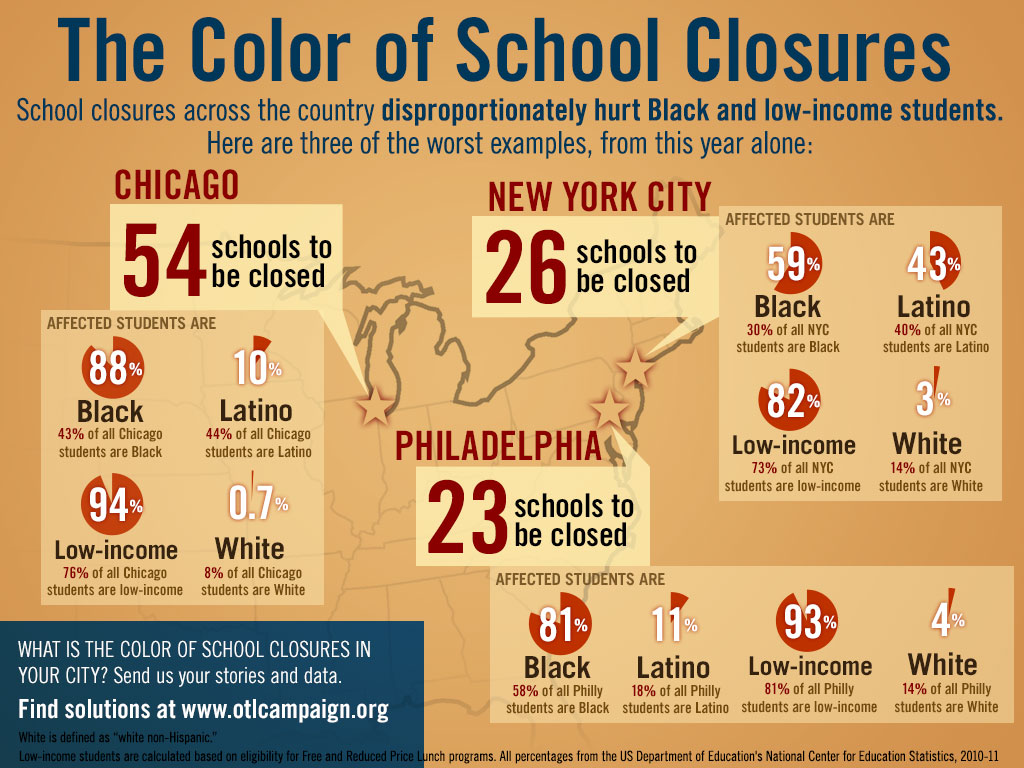
This brief investigates whether closing schools and transferring students for the purpose of remedying low performance is an option educational decision makers should pursue. The authors draw on a relatively limited evidence base that consists of peer-reviewed research studies and well-researched policy reports.
The authors conclude that school closures as a strategy for remedying student achievement in low-performing schools is a high-risk/low-gain strategy that fails to hold promise with respect to either student achievement or non-cognitive well-being. It causes political conflict and incurs hidden costs for both districts and local communities, especially low-income communities of color that are differentially affected by school closings. It stands to reason that in many instances, students, parents, local communities, district and state policymakers may be better off investing in persistently low-performing schools rather than closing them.
Share


 School Closure as a Strategy to Remedy Low Performance | National Education Policy Center:

Image result for big education ape School Closure


Here are K-12 education programs Trump wants to eliminate in 2018 budget - The Washington Post

Here are K-12 education programs Trump wants to eliminate in 2018 budget - The Washington Post:

Here are K-12 education programs Trump wants to eliminate in 2018 budget


Mental health services. Civics and arts programs. International education and language studies. Anti-bullying activities. Gifted and talented initiatives. Full-service community schools.
These are some of the K-12 education programs that President Trump is proposing be eliminated in his first full budget, as explained in a story published on The Washington Post’s website, here.
The story, based on documents obtained by The Post, details the $10.6 billion in cuts the administration wants to make in federal education initiatives, and how it wants to reinvest part of the savings into efforts to promote school choice.
Here are some details that aren’t in the story. First is a list in the budget documents of proposed discretionary programs targeted for elimination, which the documents say will save $5.9 billion, and following that are the given justifications for each. They were targeted, the documents say, because they “achieved their original purpose, duplicate other programs, are narrowly focused, or are unable to demonstrate effectiveness.”
The president’s budget also eliminates funding for a program in the ESSA known as Title IV, meant for academic enrichment and student support. Details are at the bottom of this post.
Why are these being cut? Here is the rationale for each, from the budget documents.

Broken Record Betsy | janresseger

Broken Record Betsy | janresseger:
Broken Record Betsy


I don’t usually agree with Andrew Rotherham, a former domestic policy advisor to Bill Clinton, the founder of and a partner at Bellweather Education Partners, and now a commentator for Campbell Brown’s project, The 74, an online news service with a pro-“reform” edge.  Rotherham is a committed education “reformer,” a pro-innovation, pro-charter-school technocrat. But this week I laughed in agreement when, commenting on Education Secretary Betsy DeVos, Rotherham surmised that maybe “even asking her about the weather gets you an answer about school vouchers.”
DeVos and her husband and both of their parents control a network of family foundations that have made major contributions to pro-privatization lobbies and think tanks: the Council for National Policy, the American Federation for Children, the Alliance for School Choice, the Foundation for Excellence in Education, the Institute for Justice, the Mackinac Center, and the Great Lakes Education Project.  For decades Betsy DeVos has been a proponent of school vouchers to support religious education and homeschooling. When a hapless DeVos faced the U.S. Senate’s Health, Education, Labor and Pensions Committee for her confirmation hearing last January, she didn’t do much to hide her disdain for public education.
But I imagined that just perhaps, after DeVos took over the U.S. Department of Education, she would come to appreciate its primary programs—funding Title I to support schools serving concentrations of very poor children—providing resources to pay at least part of the expense of federally mandated programs for disabled children through the Individuals with Disabilities Education Act (IDEA).  And I imagined that just maybe, after she learned more about the essential role of the Office for Civil Rights to protect children experiencing discrimination and bullying, she might come to appreciate the role of the Department of Education that she is charged with overseeing.  Naively, I dreamed that after DeVos made some visits to public schools, she might come to appreciate the dedicated work of the professionals serving children. For example, she visited a public school in Van Wert, Ohio, my state. When I read about the robotics program she saw in this small town’s high school, I was impressed. But I guess none of this has cracked the armor of Betsy’s preconceived beliefs.
On Tuesday in the Washington Post, Valerie Strauss called her column, This Is the New Betsy DeVos Speech Everyone Should Read. You may remember that DeVos went to an ed tech Broken Record Betsy | janresseger:

Russ on Reading: Invented Spelling: Discovering How Words Work

Russ on Reading: Invented Spelling: Discovering How Words Work:

Invented Spelling: Discovering How Words Work


I was excited when my niece Jennifer shared this wonderful piece of writing by her daughter, Callie. It reminded me of the joy I would take in my young students' developing understanding of how words work when I was in the classroom. Invented spelling is truly joyous because of the great value it brings to the learning/teaching interaction. I have long considered it unfortunate that the discoverer of invented spelling, Charles Read, named it that. When we use the word spelling in any context, many teachers, students, and especially parents go directly to a binary paradigm - spelling is either right or it is wrong. Invented spelling, however, is not really about spelling, and it is certainly not about right or wrong, it is about discovery and problem solving and creating communication. It is about figuring out how words work. All of us want children to discover how words work, so if we called invented spelling "word discovery" it would likely be an easier sell for everyone.

The advantages of invented spelling are clear.


  1. Invented spelling encourages children to match the sounds they hear in words to letters (phoneme-grapheme correspondence). This ability is strongly correlated to learning to read.
  2. Invented spelling allows students the independence to get their ideas down on paper without having to be concerned (for the moment) with correct spelling. So, a young writer can create an exciting story about The E Noormus Teradaktl, instead of being limited to words he can spell and writing a boring story about The Big Duck.
  3. Invented spelling provides the teacher with a clear window into what a child knows and does not know about how words are constructed, and provides data for making further instructional decisions.
Let's take a look at Callie's writing above and see what "windows" into her Russ on Reading: Invented Spelling: Discovering How Words Work:

The Fundamental Dilemma Within Any Instructional Reform | Larry Cuban on School Reform and Classroom Practice

The Fundamental Dilemma Within Any Instructional Reform | Larry Cuban on School Reform and Classroom Practice:

The Fundamental Dilemma Within Any Instructional Reform

Image result for Instructional Reform

Over five years ago I wrote a post on a new teacher’s dilemma. In that post I defined what a dilemma was and distinguished it from a problem. Then I presented an instance of a dilemma in a novice’s classroom and asked readers what they thought. I have written about dilemmas often in this blog (see here and here).
Because “dilemma” is so  often used as a synonym for “problem” and because these tensions over choices are constant in our personal and professional lives, I want to dig deeper into one facing all policymakers, past and present, intent upon altering how teachers teach from kindergartens to Advanced Placement courses. Whether teachers are new or experienced, whether they are white, African American, Latino, or a first generation college graduate in their family the tension between policymakers seeking to change traditional classroom practices and classroom teachers who are expected to put new instructional policies into practice–has been a constant.
In concrete terms, the dilemma is basically that those who adopt instructional policies aimed at changing how teachers teach (e.g., turn-of-the-century Progressives advocating student-centered learning, the highly touted Reading First program that the federal government mandated and monitored a decade ago; current deploying of tablets and software to every teacher and child in district schools asking that teachers drop old ways of teaching and embrace new ones such as “personalized learning.”
In short, new instructional policies a  century ago and now assume that teachers are part of the problem–why else adopt a policy seeking improvements in The Fundamental Dilemma Within Any Instructional Reform | Larry Cuban on School Reform and Classroom Practice:

Why Delinking Graduation from the Smarter Balanced Assessment & Other Tests is the Right Thing to Do. | Seattle Education

Why Delinking Graduation from the Smarter Balanced Assessment & Other Tests is the Right Thing to Do. | Seattle Education:

Why Delinking Graduation from the Smarter Balanced Assessment & Other Tests is the Right Thing to Do.

Screen Shot 2017-05-16 at 3.01.44 PM
I am writing to encourage everyone who values the 13 years of hard work completed by students as they reach their senior year to call their state legislators. My request is simple: ask your legislator to pass HB 1046. This bill will serve to delink all high stakes testing requirements in all subjects from high school graduation.
While this bill does not eliminate the state tests, it DOES eliminate the high stakes attached to these tests, which is a big step forward in supporting students whose futures have been severely damaged by high stakes testing.
In 2013, Seattle Times writer Donna Blankenship notified her readers about some stark facts tied to the state’s End of Course Math tests:
“But that doesn’t make life any easier for the nearly 7,000 students in the Class of 2013 who have yet to pass the newly required math test and didn’t get their diplomas last month.”
2013 was the first year the state required students to pass an end of course math test in order to graduate and earn their diploma.
This got me thinking. Since 2013, how many students in Washington State have been denied a diploma for failing a high stakes tests required for graduation? I don’t see the numbers posted clearly anywhere, despite the state’s creation of these high stakes.
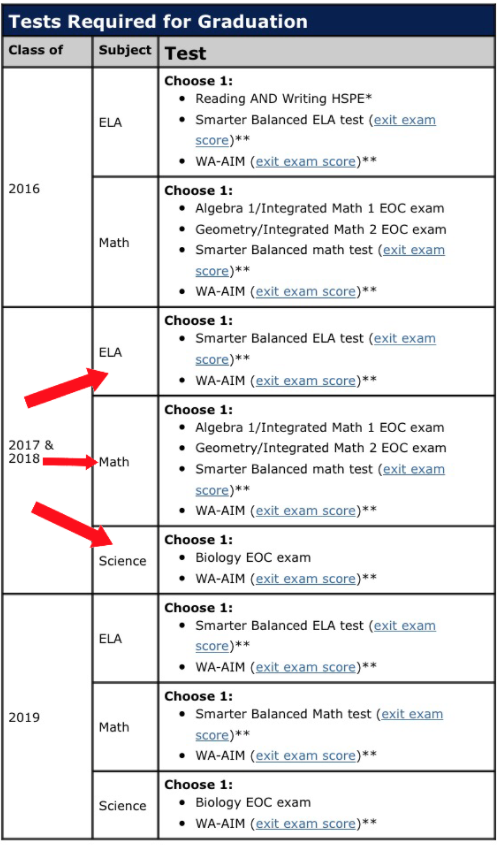
It gets worst. In 2017-18, students will  be required to pass three high stakes tests in order to receive their diplomas, per OSPI:
Screen Shot 2017-05-16 at 3.03.39 PM
I wrote OSPI and asked them about the number of students who will be denied a diploma because of end of course tests required by the state. After all, we know Why Delinking Graduation from the Smarter Balanced Assessment & Other Tests is the Right Thing to Do. | Seattle Education:

What If We Held An Election And Nobody Came? – redqueeninla

What If We Held An Election And Nobody Came? – redqueeninla:

What If We Held An Election And Nobody Came?

Image result for What If We Held An Election And Nobody Came?
Shame on you Los Angeles
The international movement admiring “strongmen” leaders which sanctions rhetorical, and sometimes even physical violence, has seen its latest expression in Los Angeles’ battle for public schools.
There are a lot of angry white women out there, and they vote.
Despite a series of rallies in Los Angeles which brought out 750,000 women(+others) to Resist Trumpism, demagoguery and racism, subsequent expressions of outrage have been attenuating at 50,000 for the Science March, 30,000 for the May Day Immigrants’ March, 5,000 for the Tax March and a couple thousand for Earth Day.
And here, now, all this sound and fury seems to have signified nothing. Tuesday was Los Angeles’ chance to actually enact all that resisting so many have been agitating about and what happened? No one turned out to vote.
Yet again, and in even fewer numbers than last time, when push came to shove and despite all that protesting and whinging and keening, Angelenos didn’t belly up to the voting kiosk and ink-a-vote:
Tuesday’s municipal election where actual real-life Resistance was on the line culminated in the devastating, and impactful triumph of appearance over What If We Held An Election And Nobody Came? – redqueeninla:

Billionaires with Agenda to Privatize Public Schools Buy LAUSD School Board Election for $10 Million - California Teachers Association

Billionaires with Agenda to Privatize Public Schools Buy LAUSD School Board Election for $10 Million - California Teachers Association:

Billionaires with Agenda to Privatize Public Schools Buy LAUSD School Board Election for $10 Million
Public Education Should Be About Kids, Not Profits


BURLINGAME – California Teachers Association President Eric Heins released the following statement today about the disappointing outcome of the Los Angeles Unified School District School Board election Tuesday:
“Showing that money clearly can impact local elections, a group of billionaires with an agenda to privatize our public schools spent more than $10 million to buy two seats on the Los Angeles Unified School District Board. Last night’s election is certainly disappointing for educators and parents fighting to keep the right of a free public education available to all students. The record-breaking amount of money spent in these two school board races is sadly not surprising, as the same group of corporate charter school donors spent more than $27 million to buy state legislative seats last year. Public education should be about kids, not profits.
“Educators will never have the bank accounts of these billionaires, but what we have is the deep commitment and will to speak out for our students and to fight for the quality public education they deserve. Joining with parents and our community supporters, who spent countless hours working so hard on these campaigns and who did not allow the misinformation and exorbitant spending to slow them down, we will not stop now.


“We will continue to work with coalition partners to ensure passage of three key bills – AB 1360, AB 1478 and SB 808 – to ensure accountability, transparency and equity to unregulated charter schools. Together, we will fight to invest in our neighborhood public schools. Together, we will fight for all students and against President Trump’s and Secretary DeVos’ plans to privatize our schools and divide our communities.”Billionaires with Agenda to Privatize Public Schools Buy LAUSD School Board Election for $10 Million - California Teachers Association:


Ed Reformers Are Going to Discuss Their Failures | deutsch29

Ed Reformers Are Going to Discuss Their Failures | deutsch29:
Ed Reformers Are Going to Discuss Their Failures


It seems that the ed reform message is once again shifting.
Years ago, around 2013, I first heard the ed reform message shift in regard to the state-run Recovery School District (RSD) in New Orleans. RSD was supposed to be revolutionary. In 2013, I first heard RSD “mother,” former La. state ed board member Leslie Jacobs, defend RSD as “improving.”
Improvement in and of itself is good. However, this ed reform “improvement” message followed years of damning locally-run New Orleans schools and boasting about amazing changes to come.
In short, the “improvement” narrative was face-saving, post-boast backpedaling.
The next major ed reform backpedal I heard came in 2014, and it concerned what was supposed to be the (again) revolution that was the Common Core State Standards (CCSS).
The backpedal narrative in this case was one of “faulty implementation.”
Now, via the American Enterprise Institute (AEI), the latest ed reform shift is for ed reformers to “fail better.” From the AEI article, written by Michael McShane:
Policy ideas like charter schools, teacher evaluation and high standards first exist in the abstract. When they are actually implemented, they look quite different from state to state or district to district. What one state calls “charter schooling” might look different from charter schooling in another state. So if charter schools struggle in one state, it isn’t necessarily an indictment on the idea as a whole….
Opponents (who were against the policy before any data were available) come out and tut-tut at advocates, telling them to “follow the data” or not to “cling to ideology.” Advocates circle the wagons. They spin the findings or pettifog the implications. They counter with personal stories or impugn the motives of critics. Rinse and repeat. (By the way, much of this is covered much more in depth than I can manage here in Rick Hess’s great new volume “Letters to a Young Education Reformer.”) …
For our part, Jay Greene, chair of the Department of Education Reform at the University of Arkansas, and I are co-hosting a conference in Kansas City on May 22 where top education researchers are going to talk about failure. Authors will tackle many of the major topics of education policy of the last quarter century: Test-based teacher evaluation, technology in classrooms, teacher preparation, No Child Left Behind and more. But rather than trying to make some kind of global statement about whether or not something like evaluating teachers based on performance or having the federal government intervene in low-performing schools is a “success” or “failure,” authors will dig into specific examples, what went wrong and most importantly, what we can learn from it.
Like so much about ed reform slogans upon first mention, the phrase “fail better” is Ed Reformers Are Going to Discuss Their Failures | deutsch29:

Charter Schools and Voucher Schools are Virtually Identical | gadflyonthewallblog

Charter Schools and Voucher Schools are Virtually Identical | gadflyonthewallblog:

Charter Schools and Voucher Schools are Virtually Identical


Screen shot 2017-05-17 at 8.30.20 PM


The stark orange monolith that was Donald Trump is starting to crumble.
And with it so are the dreams of corporate education reformers everywhere.
Where in previous administrations they could pass off their policies as Democratic or Republican depending on whichever way the wind blows, today their brand has been so damaged by Trump’s advocacy, they fear it may never recover.
Under Presidents George W. Bush and Barack Obama, they could champion both charter schools and school vouchers with impunity. But now the privatizers and profiteers hiding in progressive clothing are trying desperately to rebrand.
Not only is Trump’s voucher plan deeply unpopular, but the public has already begun to associate any kind of school privatization with a doomed President.
So like cockroaches, neoliberals have begun to skitter to one type of privatization over another. Fake Democrats hide beneath unfettered charter school expansion. Bought-and-sold Republicans cling to the idea that we should spend taxpayer dollars on private and parochial schools.
But is there a real substantial difference between each of these so-called “choice” schemes? Or are they both just scams when compared with traditional public schools?
THE DIFFERENCES
Charter Schools and Private Schools are basically the same thing.
Charter schools are completely funded by tax dollars. Private schools – even when school vouchers are used – often need to be subsidized by parents. For instance, many private schools charge tuition of $30,000 – $40,000 a year. Vouchers rarely provide more than $6,000. So at best they bring the cost down but still make it Charter Schools and Voucher Schools are Virtually Identical | gadflyonthewallblog:

CURMUDGUCATION: The Geography of Reform

CURMUDGUCATION: The Geography of Reform:

The Geography of Reform

It's an oft-repeated reformster refrain.


Students trapped by zip code in failed schools. Paul Ryan offering a lifeline for trapped students.  And here's Betsy DeVos at a recent speech, explaining some of the fundamental flaws of our terrible awful no good very bad public education system:

The system assigns your child to a school based solely upon the street on which you live.

We get these repeated versions of the same question-- why can't students leave their zip code to attend a quality school?

I believe that's the wrong question. Here's the one we should be asking--

Why can't every single student attend a great school without leaving their own community?

Really. Why should a student have to leave her friends, neighbors, the familiar sights and sounds of her neighborhood? Why should she have to travel far from home to get a good education? Why shouldn't every community get the chance to create and support a great school that reflects the community and serves every child in it?

That's the promise of public education-- that every community will get to create its own school to serve all of its students, even as it strengthens the ties that bind that community together.

But why not give non-wealthy students the choice that wealthier families get? Sure-- but when those 
CURMUDGUCATION: The Geography of Reform: