Latest News and Comment from Education

Saturday, May 6, 2017

Sen. Bernie Sanders Endorses Steve Zimmer and Imelda Padilla for LAUSD School Board | UTLA

Sen. Bernie Sanders Endorses Steve Zimmer and Imelda Padilla for LAUSD School Board | UTLA:

Sen. Bernie Sanders Endorses Steve Zimmer and Imelda Padilla for LAUSD School Board


LOS ANGELES — Sen. Bernie Sanders endorsed UTLA-backed candidates Steve Zimmer and Imelda Padilla.
It is unprecedented for a front-running presidential candidate to support a school board candidate, but shows the high stakes nature of the Los Angeles Unified School Board election.
“Billionaires should not make a profit off of public school children. That's why I'm supporting Steve Zimmer and Imelda Padilla for the Los Angeles School Board. They will fight against the Trump/DeVos agenda to destabilize and undermine public schools," said Sen. Bernie Sanders in a statement.
On Friday, UTLA President Alex Caputo-Pearl was canvassing in support of Steve when he heard the news.
“Bernie’s support underscores the consequences of this election,” Caputo-Pearl said. “Voters have a choice to make: Will our students have two pro-public education advocates in Steve and Imelda or two adversaries, bought and paid for by outside billionaires?”
Some of the key billionaire donors to Nick Melvoin and Kelly Fitzpatrick-Gonez include the usual suspects in the pro-privatizing world: Real estate mogul Eli Broad, Republican Richard Riordan, Gap founder Doris Fisher and the Waltons of WalMart. According to a new report, titled Out of Town Billionaires and Trump Backers Attempt to Hijack School Board Elections” in addition to donations to elect Nick and Kelly, the Walton family has donated to conservatives such as Ted Cruz, Mike Pence and Jeff Sessions.
“Our elections should be determined by our communities, not outside money from billionaires with a sordid history of failed privatization schemes like Betsy DeVos, the Walton family and Eli Broad,” Caputo-Pearl said. “This election is about our students, parents and communities and deciding the best direction forward. That’s by voting for Imelda and Steve.”Sen. Bernie Sanders Endorses Steve Zimmer and Imelda Padilla for LAUSD School Board | UTLA:
Image result for big education ape zimmer

NPE Action endorses Steve Zimmer for LAUSD
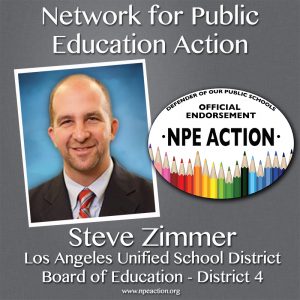
 The Network for Public Education Action is endorsing Steve Zimmer for The Los Angeles School District’s District 4 School Board seat. Voting will take place on May 16.

Even though Mr. Zimmer has served on the Board since 2009, he is facing tough opposition from a candidate backed by the California Charter School Association and by the billionaires who have tried for over a decade to take control of the Los Angeles School system, with the goal of school privatization and charter expansion.
Zimmer told NPE Action that “I’m running for re-election to keep working together with our LAUSD family to improve our schools. We’ve made real and substantial change since I was elected, raising graduation rates from 56% to 75%, increasing arts programs, science education, expanding magnet and language programs. But we are far from done. We must redouble our efforts and focus our energy. We need to invest in expanding early childhood education so all students are ready for school. We need to make sure all students are reading by 9. And we cannot rest until all our programs are rich in the social emotional learning that every student needs to excel. “
Steve has the strong support of the teachers of the LAUSD.
Steve  also has the support of Network for Public Education Action President, Diane Ravitch who had the following to say about Steve. “Steve Zimmer has worked hard as a teacher and a board member for the children and families of Los Angeles. Now the billionaires have targeted him. Stop the billionaires. Stop those who are pushing the Trump-DeVos agenda. Re-elect Zimmer!”
The stakes are high for students and public education in Los Angeles. Please spread the word and vote for Steve Zimmer on May 16th! NPE Action endorses Steve Zimmer for LAUSD
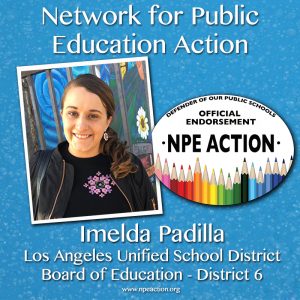
The Network for Public Education Action is endorsing Imelda Padilla for The Los Angeles School District’s District 6 School Board seat. Voting will take place on May 16.
Imelda describes herself as “the proud daughter of a landscape-gardener and a warehouse worker who was born and raised in Sun Valley.” She is a graduate of the local public schools and she wants to work to preserve them and make them better.
Imelda told us, “Today, too many outside interests burden our neighborhood schools with bureaucratic red tape making it challenging for quality teaching to reach the desks of students. Rather than encouraging kids to pursue post-secondary opportunities, the Los Angeles Unified School District has put forward an adult agenda disconnected from classrooms. I intend to focus on the needs of all students and educators by being solutions oriented to ensure every child reaches their fullest potential.”
Imelda is strongly opposed to vouchers and believes that it is important to keep class size small. Although she is not an educator, she believes she has the skill set needed for success.
“ As a youth and labor organizer, I have a winning record in fighting for the needs of all students; demanding resources be redirected to our students and parents. I’ve devoted my life to advocating for our most vulnerable and will not stop until we reach 100% graduation. “
The stakes are high for students and public education in Los Angeles. Please spread the word and vote for Imelda Padilla on May 16th! You can share a link to this email here.NPE Action endorses Imelda Padilla for LAUSD District 6 Board seat




Thursday, May 4, 2017

Jeff Bryant: The Democrats’ Dilemma On Charter Schools

The Democrats’ Dilemma On Charter Schools:

The Democrats’ Dilemma On Charter Schools


President Donald Trump’s adamant promotion of “school choice” and his selection of Betsy DeVos for education secretary have put advocates for charter schools in the Democratic party in a bind, and now they’re scrambling to keep the luster of the well-polished charter school brand unblemished.
Their latest tactic is to carefully distinguish charters from the system of school vouchers Trump and DeVos favor, but they serve this cause poorly by making erroneous claims about how the charter industry works in most communities and what these schools do to harm public education.
The latest misfire comes from David Leonhardt’s op-ed in Monday’s New York Times in which he takes on DeVos and her preference for vouchers while denigrating charter skeptics as people who need to get “an open mind.”
It’s a precarious tightrope Leonahrdt attempts to walk, and he stumbles quite badly.
First, A Little Background
First, it’s important to understand the source of the school choice schism in the Democratic party goes back 25 years, Jeffrey Henig explains in Education Week, when proponents of school choice came up with two different ways to achieve their goals: school vouchers and charter schools.
While conservatives favored vouchers, which were a creation of free-market economist Milton Friedman, political centrists and some left-leaning people became infatuated with charters because they were birthed by “business-oriented moderates and technocrats” who became the predominant force in the Democratic party during Bill Clinton’s presidential administration.
Around the turn of the century, these two strains of school choice advocacy united after pro-voucher forces, largely funded by the Walton Family Foundation (of Walmart fame), encountered a series of stinging defeats at the ballot box and a rising tide of anti-voucher sentiment among the general public.
Voucher advocates welcomed their union with charter school fans because it gave their cause a bipartisan aura and some support from the civil rights community. “Charter proponents … welcomed the political and philanthropic support of the pro-voucher forces,” Henig writes, because they needed rightwing leverage and money to undermine opposition coming from teachers’ unions and public school advocates.
For conservatives, the bipartisan unification for school choice established the slippery slope to potentially privatize public education. Moderate and lefty supporters of charter schools, on the other hand, got a Faustian bargain that gave them “education reformer” cred and the favor of Wall Street investors in exchange for colluding with the right wing.
With Trump and DeVos, the bargain Democrats made on charter schools has come due.
What Leonhardt Gets Wrong
So what’s a charter-loving Democrat to do? Based on what Leonhardt writes for the Times, many are choosing to re-up their support with false claims and deceptive rhetoric.
Leonhardt begins his column by calling attention to a new study showing the voucher program in the District of Columbia has had a negative impact on student achievement – a worthwhile news item to note for sure. But it becomes quickly apparent Leonhardt brings the subject up not to lambast DeVos but to miscast charter school skeptics as actors in a “caricature” debate over the fate of public education.
That’s a convenient strawman that leads him to state there are those who “conflate vouchers … with charter schools,” but he cites no credible sources to substantiate his belief that critics of DeVos and school choice are incapable of distinguishing between charters and vouchers.
Most concerning about Leonhardt’s column, though, is the many misleading statements he makes about how charter schools operate and what their impact is.
He cites a few credible studies showing positive impacts of charter schools on student achievement, but he doesn’t appear to have read credible reports that have found otherwise.
For instance, the most rigorous and most expensive study of charter school performance commissioned by the US Department of Education found no overall positive effect for charter schools.
A recent study of charter schools in Texas found charters overall have no positive impact on test scores and have a negative impact on earnings later in life.
So it’s totally misleading for Leonhardt to argue charters have “flourished” (whatever that means) when their track record is decidedlymixed at best.
Leohardt then piles on one misleading statement after another.
His assertion that “charter-school systems are subject to rigorous evaluation and oversight” is counter factual to reports from the charter industry itself that show only about 3 percent of charter schools are closed for under-performing, and even those that are closed have operated an average of 6.2 years.
In Ohio, only one of 10 charter school students attend a school rated high performing.
In Michigan, charter schools score worse on national assessments, known as “The Nation’s Report Card,” than their traditional public-school The Democrats’ Dilemma On Charter Schools:
Image result for big education ape democrats

AFT President: Betsy DeVos and Donald Trump Are Dismantling Public Education | Time.com

Donald Trump and Betsy DeVos Undermine Public Education | Time.com:

AFT President: Betsy DeVos and Donald Trump Are Dismantling Public Education

Image result for big education ape trump devos
Donald Trump may say teachers are important, but he spent his first 100 days undermining the schools most educators work in —America’s public schools.

One of President Trump’s first acts was to appoint the most anti-public education person ever to lead the Department of Education. Betsy DeVos has called public schools a “dead end” and bankrolled a private school voucher measure in Michigan that the public defeated by a two-to-one ratio. When that failed, she spent millions electing legislators who then did her bidding slashing public school budgets and spreading unaccountable for-profit charters across the state. The result? Nearly half of Michigan’s charter schools rank in the bottom of U.S. schools, and Michigan dropped from 28th to 41st in reading and from 27th to 42nd in math compared with other states.
Now DeVos is spreading this agenda across the country with Trump and Vice President Mike Pence’s blessing. They’ve proposed a budget that takes a meat cleaver to public education and programs that work for kids and families. After-school and summer programs — gone. Funding for community schools that provide social, emotional, health and academic programs to kids — gone. Investments to keep class sizes low and provide teachers with the training and support they need to improve their craft — gone. Their budget cuts financial aid for low-income college students grappling with student debt at the same time the Trump administration is making it easier for private loan servicers to prey on students and families.
The Trump/DeVos budget funnels more than $1 billion to new voucher and market strategies even though study after study concludes those strategies have hurt kids. Recent studies of voucher programs in Ohio and Washington, D.C., show students in these programs did worse than those in traditional public schools. Further, private voucher schools take money away from neighborhood public schools, lack the same accountability that public schools have, fail to protect kids from discrimination, and increase segregation.
It’s dangerous in education when the facts don’t matter to people. But it doesn’t stop there. Schools must be safe and welcoming places for all children, and that’s a belief shared both by parents who send their kids to voucher schools and those who send their kids to public schools. But Trump and DeVos have acted to undermine the rights of kids who look or feel different, and to cut funding for school health and safety programs.
What Trump and DeVos are doing stands in stark contrast to the bipartisan consensus we reached in 2015 when Congress passed a new education law that shifted the focus from testing back to teaching, pushed decision-making back to states and communities, and continued to invest funds in the schools that need it the most. It offered an opportunity to focus on what we know works best for kids and schools—promoting children’s well-being, engaging in powerful learning, building teacher capacity, and fostering cultures of collaboration.
The Trump/DeVos agenda not only jeopardizes that work, their view that education is a commodity as opposed to a public good threatens the foundation of our democracy and our responsibility to provide opportunity to all of America’s young people.
Americans have a deep connection to and belief in public education. I see it every day as I crisscross the nation talking to parents, teachers, students and community members about what they want for their public schools. And it transcends politics. It’s one of the reasons we saw such a massive grass-roots response to the DeVos nomination from every part of the country.
A recent poll by Harvard and Politico showed that while parents want good public school choices to meet the individual needs of their kids, they do not want those choices pit against one another or used to drain money from other public schools. In other words, the DeVos/Trump agenda is wildly out of step with what Americans want for their kids.
It’s what I saw when I took DeVos to visit public schools in Van Wert, Ohio, last month. This is an area that voted more than 70 percent for Trump, but people Donald Trump and Betsy DeVos Undermine Public Education | Time.com:
Image result for big education ape trump devos

St. Hope schools founded by former Sacramento Mayor Kevin Johnson will unionize, labor group says | The Sacramento Bee

St. Hope schools founded by former Sacramento Mayor Kevin Johnson will unionize, labor group says | The Sacramento Bee:

Kevin Johnson’s charter schools have long angered unions. Now teachers there may join one.

Image result for big education ape kj

A majority of teachers at the St. Hope Public Schools charter system have signed a petition to become members of the Sacramento City Teachers Association, the labor union announced Wednesday.
If completed in the coming months, as SCTA officials expect, the marriage of the activist-style teachers union and the charter school system founded by former Mayor Kevin Johnson would be an odd pairing within the Sacramento City Unified School District.
No other independent charter schools in the district have unionized, and education labor leaders have long been critical of Johnson and his wife, Michelle Rhee. The Sacramento teachers union has remained an ardent opponent of St. Hope since it won school board approval to convert Sacramento High School to a charter campus in 2003.
Rhee is a prominent advocate for charter schools, chairs the board for St. Hope and is the former chancellor for Washington, D.C., public schools, where she drew controversy for bucking the teachers union.
“It used to be insurance companies and the trial lawyers doing the big fight,” said Sacramento political consultant Andrew Acosta. “Now you have this becoming much more of teachers unions vs. charter school playing itself out.”
The Sacramento teachers union has eyed St. Hope schools for years. John Borsos, executive director for the labor group, said there have been periods since the school system was created more than a decade ago that educators expressed an interest in trying to organize.
“From the moment St. Hope was created, there was always a belief that if educators decided it was right for them, then being unionized made sense,” Borsos said.
St. Hope has more than 1,600 students and 100 teachers in four schools: Sacramento Charter High, P.S. 7 Middle School, P.S. 7 Elementary and Oak Park Prep. Its largest school – the high school – has more than 900 students and occupies the former campus of Sacramento High School. The city’s oldest high school, Sacramento High faced possible state takeover in 2003. It closed in June and reopened the next fall as a charter. Within a few years, its graduation rates improved and academic performance improved and its dropout rates fell. By 2009, more than 70 percent of its graduating class was accepted to a four-year college.
Stephanie Farland, a consultant on charter school oversight in California, said she sees the benefits that students can receive when there is no labor agreement. But she also sees the price that young or new teachers pay because of high involvement, home visits and long hours.
“Charter schools often are successful because they have highly engaged and involved staff,” said Farland, executive director of Sacramento-based Collaborative Solutions for Charter Authorizers, which works with school districts and county education offices in California.
One of the reasons, she said, is that “most charters don’t have union rules they have to follow. They really work the teachers pretty hard.”
That translates into historically high turnover rates and burnout, she said. “While they are there, they are doing a great job,” Farland said. “But once they burn out, there are really no protections for them.”
She said she understands the need for teachers to be paid well and fairly. “But for the charters that are successful and have high expectations for teacher involvement, I think unionization is going to hurt that.”
Statewide, about 30 percent of charter schools had some form of collective bargaining agreement or representation in 2015, according to the California Charter Schools Association.
“I think it has a lot to do with the national political context,” Borsos said. “I think there’s a lot of uncertainty and concern. And I think that one thing the labor movement has represented is stability, job security and professional advocacy. And the national turmoil has percolated down into the communities. I think people are feeling the turbulence.”

RELATED STORIES FROM THE SACRAMENTO BEE

Borsos said the labor group expects that “when people see the success that St. Hope educators have,” teachers at other charters will want to join in.
The SCTA cited a lack of transparency and high turnover as key issues with the St. Hope system.
Kingsley Melton, a law and public service teacher at Sacramento High, was among those who talked to co-workers about signing the SCTA petition.
“It was not easy,” Melton said of those conversations. “But it was easy to talk about theSt. Hope schools founded by former Sacramento Mayor Kevin Johnson will unionize, labor group says | The Sacramento Bee: 
Image result for big education ape kj

Wednesday, May 3, 2017

CURMUDGUCATION: LAUSD: More Cyber-shenanigans

CURMUDGUCATION: LAUSD: More Cyber-shenanigans:

LAUSD: More Cyber-shenanigans

Karen Wolfe has continued to pay attention to what Los Angeles schools are up to, a necessary activity as LAUSD is under constant siege by folks who would like to see it dismantled and the parts used to feed the LA charter industry. The extra challenge is that many of those folks are working form inside the district itself.


Another batch of consultants heading for an LAUSD board meeting.


Witness the latest growing mess that Wolfe and others have brought into the light with a series of posts. I'm going to give you the bold strokes, but I strongly recommend that you read about this issue herehere, and here.

LAUSD has some previous experience with tech-driven fiascos. There was the ipad disaster, in which a reality-impaired faith in tech power was yoked to some insider dealing ending up in the waste of huge mounds of taxpayer money. And its district-wide student information system (MiSiS) which turned out to have no actual capabilities other than making vendors rich. People love to sell big expensive computer-driven tech systems to LAUSD because-- well, that's a customer with a lot of money.

So here's LAUSD's latest tech initiative:


Some of these seem innocuous enough. Money for phone and connectedness upgrade? Sure.Enterprise reporting-- wait? LAUSD needs to spend $8 million on a system to get reports out of data systems they already have? What the hell kind of data systems do they use that don't actually generate reports?

Learning management system? Okay, all the kids are getting these nowadays, and none of them are great, but they are largely a fact of life. Except that this one (Schoology) is touted as being a huge success in Uruguay. Fun fact: Fred Baxter was once the ambassador to Uruguay, but he was also an international investment banker before ending up on the board of Alliance, a charter chain in LA (the one fighting against unionization by teachers with the help of millions in dark moneydonations). Baxter also has had a Family Foundation that is right in there with the Broad Foundation, helping seed the ground for charters in LA through moves like paying for education coverage in the LA Times.Okay, we may be playing a little too much connect-the-dots, but in LA, as with many other hotbeds of charter-choice promotion, it's hard not to feel that there are well-moneyed wheels within other well-connected wheels. And we should note, not for the 
CURMUDGUCATION: LAUSD: More Cyber-shenanigans:

Teachers seek to form union at California charter school chaired by Michelle Rhee - The Washington Post

Teachers seek to form union at California charter school chaired by Michelle Rhee - The Washington Post:

Teachers seek to form union at California charter school chaired by Michelle Rhee

Image result for big education ape rhee

Michelle Rhee, the former chancellor of D.C. public schools, made a name for herself as one of the nation’s chief critics of teachers unions and a prominent evangelist for charter schools, which are for the most part union-free. Now, Rhee leads a small network of California charter schools — and its teachers are seeking to form a union.
A majority of teachers at Sacramento’s St. Hope Public Schools — founded nearly 15 years ago by Rhee’s husband, former NBA star and Sacramento mayor Kevin Johnson — have signed a petition asking to join the Sacramento City Teachers Association, according to the association’s John Borsos. The Sacramento local is affiliated with the powerful California Teachers Association (CTA) and the National Education Association, the nation’s largest labor union.
Kingsley Melton, a government teacher at St. Hope’s Sacramento Charter High School, said that he and his colleagues are concerned about what he described as unsustainably high teacher turnover. As much as 40 percent of teachers leave and must be replaced each year, according to Melton, who partly blamed the uncertainty of year-to-year contracts and compensation that can fluctuate unpredictably from one year to the next. The Washington Post could not independently confirm the turnover rate.
“We’re all at-will employees, we have no rights, and our payment swings by $10,000 based on the observations of one often overworked and inconsistent principal,” Melton said. “If you’re young and planning a family, it’s very difficult to gain stability.”
Melton also said he and other teachers have not been able to get clear information about school budgets, and he hopes a contract will improve financial transparency.
In response to a request for comment on the teachers’ complaints and their petition to organize, St. Hope Public Schools released a statement: “The fact the CTA has brought outside media attention to this shows that their priority is on creating national political theatrics. While that’s unfortunate, the focus of St. HOPE Public Schools will remain on students and ensuring they get the education they deserve.”
Rhee, who has served as chair of the St. Hope board since 2014, did not respond to a separate request for comment. She previously founded and led StudentsFirst, an organization that gave her a national platform to advocate for the kinds of policies she pushed for in D.C. and that drew ire from unions, such as evaluating teachers in part based on test scores, firing teachers who perform poorly and giving financial bonuses to those who exceed expectations.
St. Hope is composed of several campuses that together employ roughly 100 teachers, according to the Sacramento union, and that serve more than 1,600 children in kindergarten through 12th grade. St. Hope focuses on preparing low-income and minority children for college.


Charter schools are publicly funded but privately run, and most employ non-unionized teachers. In 2012, 7 percent of charter schoolteachers nationwide Teachers seek to form union at California charter school chaired by Michelle Rhee - The Washington Post:
Big Education Ape: Let's Hear it for Michelle Rhee one more time: Ex-California Sen. Ron Calderon to be sentenced in corruption case | The Sacramento Bee - http://bigeducationape.blogspot.com/2016/10/lets-hear-it-for-michelle-rhee-one-more.html
Big Education Ape: Make America dumb again: What Michelle Rhee’s meeting with Donald Trump says about the president-elect’s education priorities - Sacramento News & Review - - http://bigeducationape.blogspot.com/2016/11/make-america-dumb-again-what-michelle.html
Image result for big education ape rhee union


Teachers union opens a front on former Sacramento mayor's charter schools - LA Times

Teachers union opens a front on former Sacramento mayor's charter schools - LA Times:

Teachers union opens a front on former Sacramento mayor's charter schools
Image result for big education ape kj
eachers at a network of Sacramento charter schools founded by former Mayor Kevin Johnson are trying to unionize, citing growing discontent over the schools’ management and high staff turnover.
The four schools, which are operated by St. Hope Public Schools, are a desirable target for a union for political and strategic reasons. Although Johnson no longer oversees them, his wife, Michelle Rhee, is the chairwoman of the organization’s governing board. As the former schools chancellor in Washington, D.C., Rhee was one of the most public faces of a campaign to change how public schools are run and a favorite target of teachers unions.
On Tuesday, the Sacramento City Teachers Assn. announced that more than half of the teachers, psychologists and school counselors at St. Hope Public Schools had signed a petition asking to be represented by the union, an arm of the California Teachers Assn.
If their effort is successful, it could pose a challenge to the charter organization’s leadership. Charter schools, which are publicly funded but operate without many of the restrictions placed on traditional public schools, typically are nonunion.


It would also mean that a majority of the 15 charter schools operating within the Sacramento City Unified School District would be unionized, said John Borsos, executive director of the Sacramento City Teachers Assn.
Borsos said St. Hope teachers had periodically expressed interested in unionizing over the years, but a majority tilted in favor only in the last several months. He declined to say how many signatures the union had gathered.
“We expect we’ll inspire others to follow their lead,” he said, suggesting that staff at other charter schools might make similar attempts. “The more success we’ve had in being able to make improvements in other schools, the more likely educators who are similarly situated are going to see the benefits.”
Kingsley Melton, a teacher at Sacramento High School, which is part of the St. Hope network, said some teachers had decided to unionize after attempts to resolve disputes with the organization’s leadership failed. He said frequent turnover of teachers and administrators and a general “lack of transparency” had fueled the push.


“Our desks are old, we have to fight for resources for kids — and when we asked where the money’s going, we never get a full answer,” he said.
St. Hope officials did not respond to requests for comment. Chief of Schools Shannon Wheatley emailed staff this week to express his disappointment in what he called a “small group of employees who want to form a union.”
Wheatley told them he had worked for a traditional public school “that prioritized the needs of adults before those of children.”
“I came to St. Hope so that I didn’t have to deal with union politics and adult issues dominating the day,” he wrote.Teachers union opens a front on former Sacramento mayor's charter schools - LA Times:
Image result for big education ape kj
 Image result for big education ape kj rhee

WAIT FOR IT
Image result for big education ape kj rhee

Big Education Ape: KJ and The Art of Deal Making in Sacramento - http://bigeducationape.blogspot.com/2015/07/kj-and-art-of-deal-making-in-sacramento.html

Tuesday, May 2, 2017

Monday, May 1, 2017

How Many Public School Students Are Taught by Certified and Experienced Teachers?

How Many Public School Students Are Taught by Certified and Experienced Teachers?:

How Many Public School Students Are Taught by Certified and Experienced Teachers?

teaching experience and certification

The vast majority of U.S. students in public schools are taught by certified and experienced teachers, according to data compiled by the National Center for Education Statistics (NCES). Roughly 94%  of students were taught by a state-certified teacher in the 2011–12 school year – the most recent figures available from the Schools and Staffing Survey (SASS), which includes questions about the sampled teacher’s state teaching certification.
When it comes to actual years of experience, the same survey revealed that 80% of students had a teacher with more than 5 years of experience. Specifically, 23% were taught by teachers with 6–10 years of experience, 20% by teachers with 11–15 years, 23% by teachers with 16–25 years, and 14% by teachers with 26 or more years.
NCES also looked for trends in the 2013 and 2015 National Assessment of Educational Progress (NAEP) annual report cards, which look specifically at grades 4 and 8 in math and reading. Based on that data,  92% of 4th-graders and 90 percent of 8th-graders in 2015 were taught by a state-certified math teacher – a slight dip from 2013. And about 76% of 4th-graders and about 75% of 8th-graders in 2015 had a math teacher with more than five years of experience.
Both sets of data, however, reveal that percentages differed by various school and student characteristics. For example, some students groups – in particular, Black students, Hispanic students, students in high-minority schools, and students eligible for free-or reduced lunch – were somewhat less likely to have a state-certified teacher. In general, they were also less likely to be taught by teachers having more than 5 years of teaching experience and with a postsecondary degree in the subject area in which they teach.
Source: Certification Status and
Experience of U.S. Public
School Teachers, National Center for Education Statistics
There were also apparent gaps in city schools compared to those in rural and suburban areas. In 2015, approximately 91% of 8th-graders had a reading teacher who had state certification. But the percentage was lower for students in urban schools (89%) than in suburbs (93%). In addition, in schools with high-minority enrollment (75% or more), the percentage was 4 points lower than in schools with lower minority enrollment.
The percentages for both certified and experienced teachers in both groups of data, however, did not appear to vary by student disability status, English language learner status, or grade level.
What Happens as the Teacher Shortage Deepens?
The teacher shortage that is being felt in many parts of the country has triggered concerns that states are being forced to skirt certification requirements and lower the bar on qualifications in order to fill empty slots. There is a “coming crisis in the How Many Public School Students Are Taught by Certified and Experienced Teachers?:

NYC Public School Parents: Urgent! Please contact Congress today -- urge them NOT to cut funds for class size reduction!

NYC Public School Parents: Urgent! Please contact Congress today -- urge them NOT to cut funds for class size reduction!:

Urgent! Please contact Congress today -- urge them NOT to cut funds for class size reduction!


It was just reported that Congress will vote early this week on an education budget that would cut Title IIA funds by $300 million — which are used by districts across the country to keep teachers on 
staff and prevent class size increases.


In NYC, 100% of these funds or $101 million are spent to fund approximately 1000 teaching positions. President Trump’s budget would eliminate these funds altogether for the following year.


Please write Congress today: Urge them NOT to cut Title IIA funds. Already more than 300,000 NYC students are sitting in classes of 30 or more.


As I explained in a recent piece in Alternet, districts throughout the country have already lost thousands of teaching positions since the Great Recession which were never replaced — increasing class sizes to sky-high levels.


For more on the myriad, proven benefits of smaller classes, check out our research summary hereBut please write to Congress today by clicking here.


 NYC Public School Parents: Urgent! Please contact Congress today -- urge them NOT to cut funds for class size reduction!: