Latest News and Comment from Education

Friday, April 14, 2017

Missouri reverses course on aid to religious organizations - SCOTUSblog

Missouri reverses course on aid to religious organizations - SCOTUSblog:

Missouri reverses course on aid to religious organizations 


Next week the justices are scheduled to hear oral argument in Trinity Lutheran Church of Columbia v. Comer, in which a Missouri church is challenging the state’s denial of its application for a grant to resurface the playground used by its daycare center. In rejecting the church’s application, the state relied on a provision in its constitution that bars state funds from going to churches. Trinity Lutheran argues that its exclusion from the playground program violates the Constitution. (A more extensive preview of the case can be found here.)
The lower courts ruled for the state, and in January 2016 the Supreme Court agreed to review the dispute. However, the justices put off scheduling the case for oral argument for over a year – perhaps (although there is no way to know) to allow a nine-justice court to hear the case. Justice Neil Gorsuch will be on the bench when the justices return from their recess next week, but a recent announcement by the state casts some doubt on whether the justices will actually decide the case on the merits. Yesterday Missouri Governor Eric Greitens – who took office earlier this year – announced that the state had changed the policy at issue in this case to allow the state’s Department of Natural Resources to give grants to religious groups to fund not only recycled playground surfaces but also school field trips to state parks and programs to promote recycling and erosion control.
A press release issued by the governor’s office suggested that the decision would not affect Trinity Lutheran’s case, because the state had already made the decision to deny the church funding. However, interest groups opposing the church have countered that the governor’s decision has rendered the church’s case moot, because Trinity Lutheran can now apply for and receive funding for the playground program. The justices, of course, will ultimately decide whether the case can go on, and they are likely to spend at least part of next week’s oral argument exploring that question.
Recommended Citation: Amy Howe, Missouri reverses course on aid to religious organizations,SCOTUSblog (Apr. 14, 2017, 10:54 AM), http://www.scotusblog.com/2017/04/missouri-reverses-course-aid-religious-organizations/

DeVos Pick to Head Civil Rights Office Once Said She Faced Discrimination for Being White - ProPublica

DeVos Pick to Head Civil Rights Office Once Said She Faced Discrimination for Being White - ProPublica:

DeVos Pick to Head Civil Rights Office Once Said She Faced Discrimination for Being White
Candice Jackson’s intellectual journey raises questions about how actively she will investigate allegations of unfair treatment of minorities and women.

The new acting head of the U.S. Department of Education’s Office for Civil Rights once complained that she experienced discrimination because she is white.
As an undergraduate studying calculus at Stanford University in the mid-1990s, Candice Jackson “gravitated” toward a section of the class that provided students with extra help on challenging problems, she wrote in a student publication. Then she learned that the section was reserved for minority students.
“I am especially disappointed that the University encourages these and other discriminatory programs,” she wrote in the Stanford Review. “We need to allow each person to define his or her own achievements instead of assuming competence or incompetence based on race.”
Although her limited background in civil rights law makes it difficult to infer her positions on specific issues, Jackson’s writings during and after college suggest she’s likely to steer one of the Education Department’s most important — and controversial — branches in a different direction than her predecessors. A longtime anti-Clinton activistand an outspoken conservative-turned-libertarian, she has denounced feminism and race-based preferences. She’s also written favorably about, and helped edit a book by, an economist who decried both compulsory education and the landmark Civil Rights Act of 1964.
Jackson’s inexperience, along with speculation that Secretary of Education Betsy DeVos will roll back civil rights enforcement, lead some observers to wonder whether Jackson, like several other Trump administration appointees, lacks sympathy for the traditional mission of the office she’s been chosen to lead.
Her appointment “doesn’t leave me with a feeling of confidence with where the administration might be going,” said Theodore Shaw, director of the Center for Civil Rights at the University of North Carolina School of Law, who led Barack Obama’s transition team for civil rights at the Department of Justice.
“I hope that she’s not going to be an adversary to the civil rights community and I hope that the administration is going to enforce civil rights laws and represent the best interests of those who are affected by civil rights issues.”
On Wednesday, DeVos formally announced Jackson’s position as deputy assistant secretary in the Office for Civil Rights, a role that does not require Senate confirmation. The 39-year-old attorney will act as assistant secretary in charge of the office until that position is filled. DeVos has not yet selected a nominee, who would have to receive Senate confirmation. As acting head, Jackson is in charge of about 550 full-time department staffers, who are responsible for investigating thousands of civil rights complaints each year.
Jackson referred ProPublica’s interview request to the U.S. Department of Education, DeVos Pick to Head Civil Rights Office Once Said She Faced Discrimination for Being White - ProPublica:


Rep. Dingell, AFT President Weingarten to join AROS for National ‘Build Schools, Not Walls’ launch | The Michigan Chronicle

Rep. Dingell, AFT President Weingarten to join AROS for National ‘Build Schools, Not Walls’ launch | The Michigan Chronicle:

Rep. Dingell, AFT President Weingarten to join AROS for National ‘Build Schools, Not Walls’ launch


On Tuesday, U.S. Rep. Debbie Dingell (D-Mich.) and American Federation of Teachers President Randi Weingarten will join the Alliance to Reclaim Our Schools and dozens of public school advocates in launching a national “Build Schools, Not Walls” campaign.
The event at Dearborn’s Edsel Ford High School will bring together educators, parents, students and advocates to urge President Donald Trump, Secretary of Education Betsy DeVos and the American public to focus on what unites us instead of what divides us. In kicking off the “Build Schools, Not Walls” campaign, organizers will insist that instead of banning Muslims at airports and building a wall that will cost taxpayers countless millions, our elected leaders should invest that money in high-quality neighborhood public schools where all children—no matter their race, ethnicity, religion or citizenship status—feel safe, loved and respected and get the education they deserve.
The multifaceted campaign, which is being coordinated by AROS, the AFT and the National Education Association, will include a variety of digital, in-person and community actions. A main component of the campaign will be a nationwide day of action to take place on May 1; organizers are estimating that more than 100,000 people at more than 2,000 schools in 200 cities will take part in the day of action.
      WHAT:               
“Build Schools, Not Walls” National Campaign Launch
WHO:                
  •  Rep. Debbie Dingell
  •  Randi Weingarten, AFT president
  • Keron Blair, AROS executive director
  • Hassan Jaber, ACCESS CEO and executive director
  • David Hecker, AFT Michigan president
  • Terrence Martin, Detroit Federation of Teachers executive vice president
  • Edgar Gomez, 482Forward leader
  • Christine Sipperley, Dearborn Federation of Teachers president
  • Michigan parents, students and community members


WHERE:           
Edsel Ford High School, 20601 Rotunda Drive, Dearborn, MI 48124
WHEN:              
Tuesday, April 18, 9:30 a.m
 Rep. Dingell, AFT President Weingarten to join AROS for National ‘Build Schools, Not Walls’ launch | The Michigan Chronicle:

Democrats ask GAO to examine tax-credit programs as Trump pushes public dollars for private schools - The Washington Post

Democrats ask GAO to examine tax-credit programs as Trump pushes public dollars for private schools - The Washington Post:

Democrats ask GAO to examine tax-credit programs as Trump pushes public dollars for private schools

Senate Democrats are asking the Government Accountability Office to examine state programs that offer tax credits in exchange for donations for private-school scholarships, arguing that it’s important to identify potential risks of financial misconduct at a time when the Trump administration might push for a new tax credit at the federal level.
“With the strong possibility of federal legislative activity on tax-credit vouchers at the federal level in the near future, we are interested in how states have designed these programs, whether they have strong internal controls, and whether they pose a risk of waste, fraud, abuse, misconduct, or mismanagement,” three senators wrote in a letter to Gene L. Dodaro, head of the GAO.
“A multi-state analysis of this issue by GAO would help inform the advisability of any future federal programs and help ensure proper fiscal accountability and transparency for federal funds,” they wrote. The letter, dated April 13, was signed by the ranking Democrats on the Senate education and finance committees, Sens. Patty Murray (Wash.) and Ron Wyden (Ore.), and by Sen. Sheldon Whitehouse (D-R.I.).
Tax-credit scholarship programs function much like traditional private-school vouchers, but they were designed to work differently to get around state bans on using public funds to benefit religious institutions. Companies can receive a full or partial state tax credit if they donate funds to help children pay for private school, which means instead of sending tax dollars to the state treasury, they send the money to a scholarship-granting organization. That organization is then responsible for giving out the money to families.
Seventeen states now offer such tax credits, and they each have different rules regarding which students are eligible for the money, how much money each student gets, and whether and how much information private schools must publicly report about how they use the dollars and how their students perform academically. Rules also differ regarding which organizations qualify to receive and then dole out tax-credit donations, and how much of that money they can use for overhead expenses.
“These inconsistencies make it challenging for policymakers to assess the consequences of Democrats ask GAO to examine tax-credit programs as Trump pushes public dollars for private schools - The Washington Post:


Ed Notes Online: on CPE1: Norm in The Wave - Legendary Progressive School Under Assault

Ed Notes Online: on CPE1: Norm in The Wave - Legendary Progressive School Under Assault:

on CPE1: Norm in The Wave - Legendary Progressive School Under Assault

CPE1 Update: 


Image result for deb meier


Parent and teacher reps met for hours yesterday with the Chancellor's "team" which included 
Phil Weinberg, Laura Feijoo, Louis Herrera, Yolanda Torres. A group of supporters sat on the steps of Tweed as a show of support. A 120 page binder listing Garg transgressions, including violating numerous chancellor regs, was handed over.

Below is my column this week, a brief attempt to explain the CPE1 situation to the Rockaway community in a nutshell.

Published in The Wave, April 14, 2017
http://www.rockawave.com/node/243225?pk_campaign=Newsletter


Parents support UFT Chapter leader Marilyn Martinez at her hearing.  

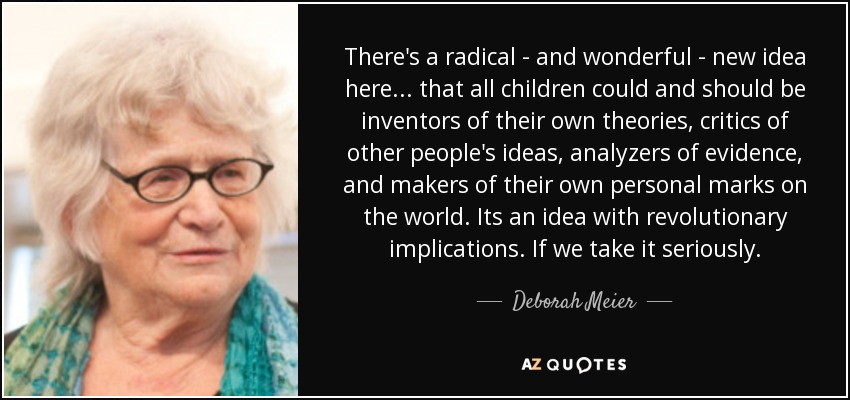
Parents support UFT Chapter leader Marilyn Martinez at her hearing. When I was a young teacher dreaming about teaching in a child-centered progressive school (which I never got to do), the model school set up in East Harlem (District 4) in the mid-1970s by Debbie Meier, one of the gods of teaching in this country for 50 years, was a magnet for teachers and parents looking for alternative ways of working with kids that were far from the mainstream. Central Park East (CPE) became a nationwide model, offering elementary school children a private school model of education and making it available to parents who did not have the means to send their kids to elite schools. A major component of such education in Debbie’s vision was a non-segregated and diverse population that would be roughly one third black, Latino and white in a neighborhood where such an option was not available. Call it the one of the early concepts of choice within a public school system which is so pushed by the charter school lobby. Debbie won a McArthur Genius Award for her ground breaking work in New York and in Boston.

The CPE model was the furthest thing from today’s no excuses, test-driven, anti-union, rigid, corporate as opposed to student-driven charter factory floor concepts.

People from all over the nation came to study the practices in the school, which involved student choices in what they would learn, in addition to a wide degree of latitude for teachers; a democratically run school where major decisions on hiring and practices were decided jointly by teachers and administrators with a lot of parent input. Principals sometimes referred to 
Ed Notes Online: on CPE1: Norm in The Wave - Legendary Progressive School Under Assault:

Image result for deb meier

Bible classes in schools can lead to strife among neighbors

Bible classes in schools can lead to strife among neighbors:

Bible classes in schools can lead to strife among neighbors


federal lawsuit was filed recently against the Mercer County, West Virginia Board of Education, challenging a Bible program in the elementary schools. The plaintiffs are the Freedom From Religion Foundation and two parents and their children. One parent and both children have kept their names anonymous due to fear of reprisal.
The Bible class was listed as an elective, but almost all students enrolled. The complaint alleges that the few who opted out were harassed and discriminated against. One of the plaintiffs in the case had already suffered harassment.
In my research for the book I wrote in 1999, “School Prayer and Discrimination,” I explored what happens to religious minorities and dissenters when public schools engage in sectarian prayer and Bible reading.
There is a long history of discrimination and even violence linked to Bible reading and school prayer.

What the law says

Students have always been free to pray or read the Bible on their own or with friends during free time at school. In public schools these days, student religious groups have access to school facilities before and after school to the same extent as any other noncurriculum-related student group. Any school that violates these principles would also violate the Constitution.

The Bible. feryswheelCC BY-ND

In contrast, school-endorsed Bible courses that promote a religious perspective have been unconstitutional since a 1963 U.S. Supreme Court ruling prohibited school-sponsored prayer and Bible reading.
Over the years, there have been a number of attempts – often supported by state legislatures – to get around the prohibition on Bible reading by offering Bible courses. If offered as electives and taught “objectively,” such classes could be considered constitutional.
What this means is if a public school offers a class that focuses on religion or the Bible, the material would have to be taught without promoting any particular religious position. Those of us in the law and religion field sum it up as, “Teach it, don’t preach it.”
These classes cross the line if they endorse or favor a particular religious view. The Mercer County case will thus examine if the class, as alleged, is overtly sectarian and promoted by the school, and hence unconstitutional.
Significantly, in many such cases where students opt out or dissent, parents have evidence of discrimination and harassment aimed at their children.
In fact, the United States Supreme Court acknowledged the concern about community members and school officials engaging in harassment of dissenters in an important footnote in a recent school prayer decision, Santa Fe Independent School District v. Doe. The case challenged the practice of having a student deliver a prayer over the public address system before each home varsity football game.
The United States Supreme Court quoted a lower court order prohibiting any attempt “to ferret out the identities of the plaintiffs in this cause, by means of bogus petitions, questionnaires, individual interrogation, or downright ‘snooping.’” The lower court had said it wanted the “proceedings addressed on their merits, and not on the basis of intimidation or harassment…”
As is evident from the above example, there are good reasons why families are often afraid Bible classes in schools can lead to strife among neighbors:


New Report Paints California's Charter Schools As Economic Boondoggle That Has Little to Do with Student Need, Cost Efficiency, or Quality - Education Law Prof Blog

Education Law Prof Blog:

New Report Paints California's Charter Schools As Economic Boondoggle That Has Little to Do with Student Need, Cost Efficiency, or Quality


A new report on California's charter schools may be one of the most scathing to date--in part because it does more than examine student achievement.  Achievement studies inevitably raise methodological and interpretation debates.  More simply, it is often unclear whether the studies are comparing apples to apples.  This new study, however, filters charter schools through other more straightforward data and factors: locality need, cost efficiency, and legal compliance.  On these measures, the report suggests that California's charter school expansion is a financial boondoggle.  To use a baseball analogy, the disappointing quality of many of these schools is really just the fourth strike against a policy that should have already been called out. The report's introduction states:
From less than 200 schools in 1998, the California charter school industry has grown by more than 600%, to over 1,200 schools serving nearly 600,000 children, or nearly 10% of the state’s students. One of the sources fueling this growth is an extensive network of government programs that provide public funding or tax subsidies for charter school buildings. Over the past 15 years, California charter schools have received over $2.5 billion in tax dollars or taxpayer subsidized funds to lease, build, or buy school buildings. This report finds that this funding is almost completely disconnected from educational policy objectives, and the results are, in turn, scattershot and haphazard. Hundreds of millions of dollars are being spent each year without any meaningful strategy. Far too much of this public funding is spent on schools built in neighborhoods that have no need for additional classroom space, and which offer no improvement over the quality of education already available in nearby public schools. In the worst cases, public facilities funding has gone to schools that were found to have discriminatory enrollment policies and others that have engaged in unethical or corrupt practices.  
The reports key findings include:
  • Over the past 15 years, California charter schools have received over $2.5 billion in tax dollars or taxpayer subsidized funds to lease, build, or buy school buildings.
  • Nearly 450 charter schools have opened in places that already had enough classroom space for all students—and this overproduction of schools was made possible by generous public support, including $111 million in Education Law Prof Blog:
 

Jeff Bryant: Erie Pennsylvania’s Schools Are a Canary in the Coal Mine of Education

Erie Pennsylvania’s Schools Are a Canary in the Coal Mine of Education:

Erie Pennsylvania’s Schools Are a Canary in the Coal Mine of Education


Jay Badams has reached the limits of his patience.
As superintendent of Erie, Pennsylvania schools since 2009, he’s dealt with the chronic underfunding of his schools for years. Every year, he and his staff grapple with ever more painful budget cuts. He and his staff are sick and tired of meetings on what to cut next. Should it be libraries? Athletics? Art and music programs? His repeated appeals to state lawmakers to come to Erie’s rescue have had little effect.
When Badams and his colleagues calculated the district’s budget this past spring, they found that closing four of the district’s high schools could save two to three million dollars.
But the decision to consider closing Erie public high schools is more of an “ethical decision” rather than just about the dollars and cents, Badams tells me in a phone conversation.
Because many of the school districts that surround Erie are so much better funded, students from the closed Erie high schools could transfer to schools offering a far better educational experience. The neighboring Harbor Creek district, for instance, spends $1,360 more on each student than Erie can.
“We have only one competitive high school offering a single track in science, technology, engineering and math,” Badams told me. “Competitive programs at high schools in some of the surrounding districts have multiple tracks, extensive foreign language instruction and other electives—it’s like comparing a goat track to a state-of-the-art indoor-outdoor stadium.”
But is closing the high schools the right thing to do?
This is the ethical question many more communities are likely to face.
chools in low-income communities in many states don’t have the resources to give students access to opportunities that are available in wealthier areas. This well known fact is most Erie Pennsylvania’s Schools Are a Canary in the Coal Mine of Education:

High School Graduation—Rahm’s Plan Worse than Ohio’s Terrible Plan, But Arne Loves It | janresseger

High School Graduation—Rahm’s Plan Worse than Ohio’s Terrible Plan, But Arne Loves It | janresseger:

High School Graduation—Rahm’s Plan Worse than Ohio’s Terrible Plan, But Arne Loves It

I had imagined it would be pretty hard to come up with worse high school graduation requirements than the new Ohio plan endorsed by Governor John Kasich. Watching the state move toward the implementation of our new graduation requirements a year from now is like watching a train speeding down the wrong track. It is expected that nearly a third of the students in Ohio’s Class of 2018 won’t be able to accrue the required 18 points—based on their cumulative scores on end-of-course exams—to graduate from high school next June. Remember that the cut scores on high stakes exams are not in some way scientific, but can be raised or lowered depending on how many students politicians want to pass or fail.
School superintendents from across Ohio have been holding protest rallies at the statehouse, and this week even the Ohio State Board of Education proposed a one-year emergency exemption to allow students to graduate from high school in June of 2018, as long as they have passed all their classes even though they may not have scored high enough on the tests. The State Board suggests that students could make up for low test scores with, “some career training goals or by doing things like having strong attendance or classroom grades their senior year.” For the members of the State Board to oppose Governor Kasich on this matter is pretty amazing. After all, eight of the 19 members of the Ohio State Board of Education are appointed by the governor and most of the rest of them are members of his party.
But Chicago’s mayor (who also runs the public schools) Rahm Emanuel just came up with a more punitive and less workable plan to toughen up. Here is the Chicago Tribune: “Emanuel’s proposal would add one more big item to the graduation checklist for high school seniors: proof they’ve been accepted into college or the military, or a trade or a ‘gap-year’ program. The requirement would also be satisfied if the student has a job or a job offer… Emanuel and High School Graduation—Rahm’s Plan Worse than Ohio’s Terrible Plan, But Arne Loves It | janresseger:


Mike Klonsky's SmallTalk Blog: On Hitting Left Today

Mike Klonsky's SmallTalk Blog: On Hitting Left Today:

On Hitting Left Today


Jose Rico joins us for conversation about Chicago schools and immigration tomorrow on Hitting Left with the Klonsky Brothers at 11AM 105.5 FM in Chicago, www.lumpenradio.com. live streamed around the galaxy. Jose was part of the board's Latino Advisory Committee that resigned in mass in February to protest inequitable cuts in the budget.


Larry Miller
I'll also be interviewing Larry Miller who, along with a slate of progressives, won his election to the Milwaukee school board last week. The slate, backed by the Working Families Party, defeated the well-financed campaigns of some of their opponents by relying on grass-roots organizing. They are committed to rolling back vouchers and other Betsy Devos privatization initiatives.

Another great show. You would be crazy to miss it.
Mike Klonsky's SmallTalk Blog: On Hitting Left Today:


Have Silicon Valley Teachers Using Technology Daily Altered Their Classroom Practice? (Part 3) | Larry Cuban on School Reform and Classroom Practice

Have Silicon Valley Teachers Using Technology Daily Altered Their Classroom Practice? (Part 3) | Larry Cuban on School Reform and Classroom Practice:

Have Silicon Valley Teachers Using Technology Daily Altered Their Classroom Practice? (Part 3)

Image result for technology in the classroom


Eleven percent (N=4) of the teachers answered both yes and no. These teachers made a distinction between how they taught lessons before they had new technologies and what they now do with devices and software. They referred to students having more information available than before and how essential aspects of their lessons could be done easier and faster than before were common themes. But they drew a distinction between the help that high-tech tools give them and the constancy of core practices that are part of their planning and interactions with students during a lesson. They saw both change and stability in their lessons as a result of integrating digital tools into their teaching.
Nicole Lenz-Martin teaches in the San Mateo Union High School District at Aragon High School. An 11-year veteran of teaching, she teaches Spanish level 3 through level 6 (including Advanced Placement). Elenz-Martin is also an instructional coach in the district and an instructor in the Stanford World Language Project. Here is her “yes” and “no” answer to my question.
My teaching — in terms of pedagogical strategy and philosophical beliefs about World Language instruction — has not changed because of my regular use of technology; however, the regular use of Chromebooks in my classroom has dramatically changed my access to student learning, monitoring of their proficiency development, and my ability to cover more material over the course of a school year. 
Why yes:
 My students are required to be much more engaged and participatory in their learning because of their interaction with my lessons through technology.  When covering material in class, every student can interact with the Have Silicon Valley Teachers Using Technology Daily Altered Their Classroom Practice? (Part 3) | Larry Cuban on School Reform and Classroom Practice:

Governor Carney Is NOT Letting The Sunshine In!!!! – Exceptional Delaware 2017

Governor Carney Is NOT Letting The Sunshine In!!!! – Exceptional Delaware 2017:

Governor Carney Is NOT Letting The Sunshine In!!!!


The Resolution That Is A Must-Read For All Teachers, Students, Parents, & Politicians – Exceptional Delaware 2017 - http://wp.me/p4JboV-4hi 

In February, Delaware Governor John Carney brought back the Family Services Cabinet Council through Executive Order #5.  Many in Delaware thought this was a good thing.  But apparently transparency took a backseat to this return.  The group met on Wednesday, April 5th, 2017 in a meeting that was closed to the public and press.  What is the point of this council if it is not able to be seen by the public?
I discovered this when I was looking at the Governor’s public schedule last week.  I also view the Delaware Public Meetings Calendar and did not see this on there.  I would have attended this meeting had it been made public but I never had the chance.
For a council that is responsible for recommendations for so many issues in Delaware, I am shocked they wouldn’t let the public in on it.  To that end, I emailed Governor Carney’s staff about this gross oversight on April 6th.  Over a week later and NO response.
This is the kind of crap I would expect from former Delaware Governor Jack Markell.  I truly hoped Governor Carney would be different.  But I am not seeing that marriage between the state and the public.  Especially with a council as important as this one.  So what are the areas this council covers that Carney doesn’t want the public to hear conversation about?
If this council isn’t open to the public will we ever see any minutes from their meetings?  Attendance?  Who else is invited?  What they are even doing?  I urge Governor Carney to answer these questions and make this council open to the public.  Delaware got an F for transparency and came in 49th out of 50 states in an evaluation of public transparency at the end of 2015.  That should have ended on January 17th, 2017, the day Governor Carney swore his oath of office and promisedGovernor Carney Is NOT Letting The Sunshine In!!!! – Exceptional Delaware 2017: