Latest News and Comment from Education

Friday, April 7, 2017

Arizona's New Voucher Program Set to Become Largest in the Nation, But It Is Also the Biggest Farce - Education Law Prof Blog

Education Law Prof Blog:

Arizona's New Voucher Program Set to Become Largest in the Nation, But It Is Also the Biggest Farce

Image result for Farce

According to the AP, Arizona just passed a bill that will make every student in the state eligible for voucher.  It may become the biggest voucher program in the nation.  The "program allows parents to take between 90 percent and 100 percent of the state money a local public school would receive to pay for private or religious education. The average student who isn't disabled will get about $4,400 a year, but some get much more."  The funding mechanism and its expected cost to the state is murky.  "The original Arizona plan was estimated to cost the state general fund at least $24 million."  Now, a revised plan and estimate are supposed to save the state $3.4 million by 2022.
What is clear, however, is that Arizona's per pupil funding for public schools currently ranks 47 out of 50 states.  To make matters worse, it distributes those meager funds unequally.  The Education Law Center's 2017 School Funding Fairness Report grades Arizona's funding distribution as an "F."  Schools with moderate levels of student poverty receive only 88 cents on the dollar in comparison to schools with no student poverty.  The comparison is even worse between high poverty school districts and low poverty school districts.  In other words, Arizona spends the least on students who need the most.  
That same report also shows that Arizona is doing almost nothing to fix its low funding levels or unequal distribution.  Arizona ranks 49th in the nation in terms of the level of fiscal effort it exerts to fund its schools.  
These background facts place Arizona's new voucher program in a troubling light.  These cold hard facts show that the state is not really interested in supporting adequate and equal education for its students.  Thus, it is no Education Law Prof Blog:

Today, on Hitting left with the Klonsky Brothers. | Fred Klonsky

Today, on Hitting left with the Klonsky Brothers. | Fred Klonsky:

Today, on Hitting left with the Klonsky Brothers.

HITTING LEFT #3

Tune in to the Klonsky Bros. Hitting Left show this morning 11-12 (CDT) on Lumpen Radio, streaming live across the globe.
Today’s guests include MoveOn.Org‘s Electoral Field Director Matt Blizek and Chicago Votes organizer Camille Williams.
Today, on Hitting left with the Klonsky Brothers. | Fred Klonsky:

Trump Administration—Supporting Oversight of For-Profit Colleges? | janresseger

Trump Administration—Supporting Oversight of For-Profit Colleges? | janresseger:

Trump Administration—Supporting Oversight of For-Profit Colleges?


It is too early in the four-year term of President Donald Trump to be sure of anything or to take a deep breath of relief.  But last month there was one encouraging sign from the Trump Justice Department.  Contrary to what can only be described as excited anticipation by the operators of for-profit colleges of the rollback by Trump’s people of Obama’s regulations, attorneys at the Department of Justice filed a legal brief supporting one of the Obama administration’s most effective rules to reign in the for-profits—a rule that is unpopular across the for-profit sector.
The Trump administration’s legal brief defends what’s known as the gainful employment rule, which has penalized some of the very worst for-profit colleges and trade schools that depend on federal Pell Grants and federally backed loans for the bulk of their revenue but that fail to provide adequate training to enable their graduates to land jobs or pay off their debts. The gainful employment rule is intended to protect student-borrowers from debts they will never be able to pay off and to to prevent a massive loss of tax dollars when borrowers with untenable debts eventually default.
Here is Suzanne Mettler in Degrees of Inequality, her book (published in 2014) on the problems of for-profit colleges.  Mettler describes the gainful employment rule as perhaps the most highly contested of the Obama administration’s efforts to crack down: “In what turned out to be their most controversial proposal, the so-called gainful employment rule, they set out to limit federal student aid to schools that failed to establish a record of positive outcomes for their students, as indicated by measures of their subsequent earnings relative to their student loan debt and by their loan repayment rates… Defenders of for-profit universities champion them as belonging to the private sector, but in recent years as in the past, they receive nearly all of their revenues from the U.S. federal government.”  Mettler documents the percentage of federal funding at fifteen of the largest for-profits: “Notably, these institutions, with only one exception earned between 60.8 and 85.9 percent of their total revenues in 2010 from Title IV of the Higher Education Act, meaning predominantly student loans and Pell grants… Most received an additional 2 to 5 percent from military educational programs, including the post-9/11 GI Bill.  The sum of these federal government funds added up, as a portion of all revenues collected, to a minimum of 65.8 percent for ITT and a maximum of 93.7 percent for Trump Administration—Supporting Oversight of For-Profit Colleges? | janresseger:

Johns Hopkins Researcher Celebrates the “Promise of Louisiana Curriculum” Associated with Common Core (?) | deutsch29

Johns Hopkins Researcher Celebrates the “Promise of Louisiana Curriculum” Associated with Common Core (?) | deutsch29:

Johns Hopkins Researcher Celebrates the “Promise of Louisiana Curriculum” Associated with Common Core (?)

Image result for Louisiana common core


In November 2016, Ashley Berner, Deputy Director of the Johns Hopkins Institute for Education Policy, published this review of her own book, which happens to feature Louisiana as an example of the success of closely aligning curriculum with the Common Core State Standards (CCSS) “or a version derived from them” (ahem).
Berner’s review includes some select tidbit examples of Louisiana’s academic success:
There was, however, a surprise finding in the national analysis: Louisiana’s teachers demonstrated a significantly stronger grasp and use of standards-aligned materials and practices than their peers elsewhere. The question was, why?
What makes the difference in teacher practices particularly interesting is the recent rise in Louisiana’s student achievement:
  • The state’s 4th-grade students had the country’s highest growth on the National Assessment of Educational Progress reading test and tied with Mississippi for the fastest state growth in math. Louisiana was among the top five states in narrowing several achievement gaps: the white-black gap in 4th-grade math, the white-Hispanic gap in 4th grade math and reading; the white-Hispanic gap in 8th grade math and reading (“NAEP 2015: Mathematics and Reading Assessments” 2015).
  • In 2013, Louisiana became one of 12 states to require all juniors to take the ACT test. In 2015, Louisiana’s students gained more points in their composite ACT scores than those in the other 11 states that required 100% participation (“Louisiana Is Number One State in ACT Gain” 2015).
  • The College Board announced in 2014 that Louisiana had made the country’s greatest gains in the number of students scoring a 3, 4, or 5 on AP exams, and the number of students taking AP courses more than doubled between 2012 and 2016 (“Louisiana Students Achieve Top Advanced Placement Gains in State History” 2014).
The combination of Louisiana teachers’ distinctive responses and the state’s rising student achievement prompted RAND’s research team to press further. Was there a connection between these two phenomena and how the Louisiana Department of Education had leveraged the standards?
Notice the focus here on “growth” and gains”– which deflects focus from achievement translating into any practical outcome. But we’ll return to these three bullet points of Louisiana student achievement score-upping.
As for quantitative support, Berner surveyed teachers, including Louisiana teachers.
For qualitative support, the researcher questioned the Louisiana Department of Johns Hopkins Researcher Celebrates the “Promise of Louisiana Curriculum” Associated with Common Core (?) | deutsch29:

TALKING LITERACY WITH HIGH SCHOOL TEACHER JARRED AMATO « Dad Gone Wild

TALKING LITERACY WITH HIGH SCHOOL TEACHER JARRED AMATO « Dad Gone Wild:

TALKING LITERACY WITH HIGH SCHOOL TEACHER JARRED AMATO


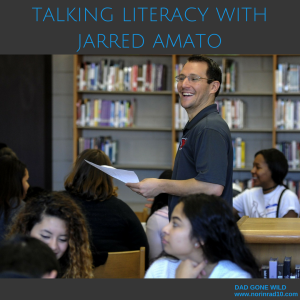
Anybody who is involved in education issues and is active on social media should be aware of Maplewood High School English teacher Jarred Amato. Amato has been teaching now for about 8 years, after entering the profession through the Nashville Teaching Fellows/TNTP. He’s proven to be a dedicated, innovative professional, and at a time when young males need more role models, he’s just what the doctor ordered. Last summer Jarred dedicated himself to learning more about “book deserts” and then paired with his students, many of whom reside in those deserts, to do something about them. The result was what he calls Project Lit. Something equally refreshing about him is his humility. He recognizes that he is benefiting from exposure to great educators and that he’s just one of a system full of great teachers. Jarred and I recently sat down for a coffee and a chat at Portland Brew on 12th Avenue South.
Dad Gone Wild: Afternoon Jarred. You doing all right
Jarred Amato: I’m good, TC. How are you?
DGW: I’m doing all right. I’m kind of laughing a little bit because when you and I first met, what, about four years ago?
JA: That sounds about right.
DGW: Yes, four years ago and that was under little different circumstances.  Where was it, a teacher cabinet or a teacher group? Teachers for reform? Do you remember it at all?
JA: (looking puzzled) I’m not sure.
DGW: It was a meeting held by a group of primarily parents and some teachers who were trying to form a group to promote education reform, and you and I were on different sides of the table. I think I kinda got kicked out of that meeting, or it was hinted at that I might not be a good fit. That’s back when battle lines were really being drawn.
JA: Oh, over at the community center, right?
DGW: That’s the one, and that time we were definitely in opposition. But I’ve kept track of your career over the last several years, and I have to say I’m impressed. It’s reinforced to me that in arguing policy, we have to really be careful that the end result is not running people out of the conversation. It would have been a big loss if you were no longer in the classroom because of some ideology battles.
JA: Thank you for that. It’s been a blast. This is my eighth year in the classroom, and it’s crazy to look back at how much I’ve grown from 2009, graduating college and stepping right into the classroom at Jere Baxter MS to now at Maplewood HS. I look at my transformation as a teacher, but also how I’ve broadened my perspective on education policy, not just here, but nationally and internationally. I have been fortunate to learn from and work alongside some great people during my TALKING LITERACY WITH HIGH SCHOOL TEACHER JARRED AMATO « Dad Gone Wild:

Compromise or Corporatize? educationalchemy

educationalchemy | Authored by Morna McDermott-A blog dedicated to democracy, public education, and the power of the imagination to fight corporate greed–if the truth sounds crazy it is because we have become too accustomed to falsehoods:

Compromise or Corporatize?


A passage from Tipu’s Tiger, a writing collective*:
“The concept of allyship has been instrumental in imposing more moderate power brokers and elite protest managers on decentralized movements in an attempt to rein in disruptive protest. Any social movement in recent memory that has attempted to break the mold of permitted rallies and marches, and raiie the economic cost of doing business as usual, has had to face a social justice industry deigned to channel social unrest into electoral politics, elite representation, and fantasies of political reform without mass popular resistance.”
This blog is about writing less, and listening more. I am seeking responses and reactions (post them in comments) to the quote above as it relates to possible questions to consider:

A Teachable Moment: Separating facts from Russian fiction in election rigging | Reclaim Reform

A Teachable Moment: Separating facts from Russian fiction in election rigging | Reclaim Reform:

A Teachable Moment: Separating facts from Russian fiction in election rigging


Russian rigging of our last presidential election is a fact.
Who was involved, and to what extent was there collaboration are the questions.
Below are facts as published and footnoted in Harper’s Magazine Weekly Review for April 6, 2017 available online and at newsstands. Here are extended excerpts.
The FBI, the Senate, and the House of Representatives continued their investigations into the Russian government’s possible collaboration with the campaign of Donald Trump…[1][2] White House press secretary Sean Spicer said that the investigations had uncovered “no connection” between Russia and the Trump campaign, and U.S. officials said that the FBI had obtained records of phone calls, business transactions, and meetings suggesting that Trump campaign members coordinated with Russia over the release of information damaging to Trump’s Democratic rival, Hillary Clinton.[3][4] It was reported that the Kremlin had paid at least 1,000 people to create false news stories in swing states to tilt the election in Trump’s favor, and Trump’s longtime friend and former adviser Roger Stone, who refers to himself as a “dirty trickster,” who admitted to corresponding with the hacker responsible for leaking emails from Clinton’s campaign staff, and who, like Trump, was mentored by Roy Cohn [who worked with Sen. McCarthy during the notorious McCarthy Communist Witch Hunts and blackballing scandals], a former counselor for the Gambino and Genovese crime families, announced that he would not tell Congress who informed him ahead of time that WikiLeaks was going to release information stolen from the Democratic National Committee.[5][6][7] U.S. officials confirmed that the Kremlin had recalled a diplomat from the United States out of concern that his attempts to affect the outcome of the election would be exposed, an allegation previously made by a former British intelligence officer in a largely unsubstantiated dossier… and which Spicer called “fake news.”[8][9][10] Trump’s former national-security adviser, Michael Flynn, who resigned in February after he was discovered to have discussed U.S. sanctions withA Teachable Moment: Separating facts from Russian fiction in election rigging | Reclaim Reform:


Seattle Schools Community Forum: Race, Education Reform and Public Schools

Seattle Schools Community Forum: Race, Education Reform and Public Schools:

Race, Education Reform and Public Schools

Image result for Race, Education Reform and Public Schools

A very fine article from NPR from last September about race and charter schools provided a wide variety of thoughtful opinions.  Much of the debate has been around the NAACP calling for a moratorium on the opening on new charter schools.  

Some education leaders are rushing to embrace the newly frank conversation about the racial impact of education reforms. Others are caught awkwardly in the middle. And some — especially conservative — reformers feel alienated.
 Jonathan Stith 

"A lot of charters are just shiny versions of the school-to-prison pipeline. There are reports of fraud.

"I have yet to see a black community that has voted directly for charter schools. They always are imposed. Districts are being taken over by governors or mayors and given very little voice. And so there's this false language around choice.

"At the same time, we're not with the status quo. We're clear that 50 years after Brown v. Board of Education, public schools have never served black children."
Jacqueline Cooper 

"The NAACP moratorium is inexplicable to me. Over 700,000 black students are enrolled in public charter schools.
"Who is anyone else to tell a parent where their child should be educated?"
I find that last statement puzzling when you are talking about public schools.  The government, funded by the citizens gets to choose the teachers, the principals, the curriculum, so why wouldn't they decided on where schools are and who goes to them?

The issue really is - and can be singly put - that every child deserves a quality neighborhood school.

Dr. Michael Lomax 


"I disagree with the moratorium on charters because I think charters are part of the solution.

"But many of these charter providers — social entrepreneurs with a new generation of philanthropists supporting them — know very little about their communities and are dismissive of legacy institutions that they see as dinosaurs. And as a new generation of African-American activists are coming to the fore, they're saying: Why are these organizations setting the agenda for educational change in our communities and not engaging us in the discussion?
Rick Hess

"Reform is increasingly a question of race-based grievance rather than helping all children."
Black Perspectives published a great provocative article last October called Seattle Schools Community Forum: Race, Education Reform and Public Schools:

Advisory Commission on Special Education Agenda April 19-20, 2017 - Administration & Support (CA Dept of Education)

ACSE Agenda April 19-20, 2017 - Administration & Support (CA Dept of Education):

ACSE Agenda April 19-20, 2017
Advisory Commission on Special Education (ACSE) meeting agenda.
Image result for Advisory Commission on Special Education


Advisory Commission on Special Education Members
  • Gina Plate, Chair
  • Barbara Schulman, Vice Chair
  • Michele Andrus
    Mildred Browne
    Somer Harding
  • Havaughnia Hayes-White
    Sara Jocham
    Betty Karnette
    Christina Mills
    Gloria Perez-Stewart
    Lester Pincu
    Keila Rodriguez
    Kimberly Salomonson
    Mariano Sanz
    Steven Winlock
Student Members
  • Leanne Libas
Legislative Members
  • Vacant, Senate
  • Tony Thurmond, Assembly
State Board of Education
  • Niki Sandoval, Liaison
State Special Schools
  • Scott Kerby, Director, State Special Schools and Services Division 
    California Department of Education
Executive Secretary
  • Kristin Wright, Director, Special Education Division
    California Department of Education
Agenda Times Are Approximate and Are Provided for Convenience Only
Items may be re-ordered to be heard on any day of the noticed meeting. The order of business may be changed without notice. Every effort will be made to Webcast this meeting in its entirety, but some portions may not be Webcast due to logistical constraints.
Advisory Commission on Special Education
Meeting ScheduleMeeting Location
Wednesday, April 19, 2017
10 a.m. - 5 p.m. Pacific Time ±
California Department of Education
1430 N Street, Room 1101
Sacramento, California
916-445-4602
Thursday, April 20, 2017
9 a.m. - 1 p.m. Pacific Time ±
California Department of Education
1430 N Street, Room 1101
Sacramento, California
916-445-4602
Advisory Commission on Special Education
Breaking Barriers Ad-Hoc Workgroup
(Due to logistical constraints, the Ad-Hoc Workgroup will not be Webcast)
Meeting ScheduleMeeting Location
Wednesday, April 19, 2017
8 - 9:45 a.m. Pacific Time ±
California Department of Education
1430 N Street, Room 1801
Sacramento, California
916-445-4602
Please see the detailed agenda for more information about the items to be considered and acted upon. The public is welcome.
Guidelines for Public Input Sessions
The Commission welcomes public involvement. Opportunities for public comment are provided at every Commission meeting.
Reasonable Accommodation for Any Individual With a Disability
Pursuant to the Rehabilitation Act of 1973 and the Americans with Disabilities Act of 1990, any individual with a disability who requires reasonable accommodation to attend or participate in a meeting or function of the Advisory Commission on Special Education (ACSE), may request assistance by contacting the Special Education Division, 1430 N Street, Suite 2401, Sacramento, CA, 95814; telephone, 916-445-4602; fax, 916-327-3706.

Advisory Commission on Special Education
Mental Health Subcommittee Ad-Hoc Workgroup
Wednesday, April 19, 2017, 8–9:45 a.m. Pacific Time
California Department of Education
1430 N Street, Room 1801
Sacramento, California

(Due to logistical constraints, the Ad-Hoc Workgroup will not be Webcast)
Members of the ACSE Mental Health Subcommittee Ad Hoc Workgroup will be meeting prior to the start of the ACSE meeting to discuss opportunities and challenges at the state level related to collaboration across systems to transform children's social, emotional, and behavioral health.
AGENDA
  1. Review of data provided by the CDE, if available
  2. Discussion of pending legislation
  3. Breaking Barriers discussion from Symposium

Advisory Commission on Special Education
Wednesday, April 19, 2017, 10 a.m. Pacific Time
California Department of Education
1430 N Street, Room 1101 
Sacramento, California 
NOTE: Items not heard or completed on April 19, 2017, may be carried over to April 20, 2017.
10–10:15 a.m.
  • Call to Order–Roll Call
  • Salute to the Flag
  • Communications and Announcements
  • Nomination and Election Committee Update–Submission of Self Nomination Forms
  • Review of Agenda
10:15–11 a.m.
Item 1–Assessment Update: Michelle Center, Director, Assessment Development and Administration Division, California Department of Education (CDE), will provide an update on the California Assessment of Student Performance and Progress Systems (CAASPP). (Item type: Information, discussion, action)
11–11:15 a.m.
Item 2–Annual State Application under Part B of the Individuals with Disabilities Education Act (IDEA): Nora Walker; Associate Governmental Program Analyst; Assessment, Evaluation, and Support Unit; Special Education Division (SED); CDE; will provide an update on the status of the preliminary application for federal fiscal year 2017 funding under the IDEA. (Item type: Information, discussion)
11:15–11:30 a.m.
Item 3–Mental Health Subcommittee Ad Hoc Workgroup Report: Members of the ACSE Mental Health Subcommittee Ad Hoc Workgroup will report on the activities of the workgroup, including potential outcomes or proposed action items from the meeting of April 19, 2017. (Item type: Information, discussion, action)
11:30–11:45 a.m.
Item 4–State Special Education Director’s Report: Kristin Wright, Director, SED, CDE. (Item type: Information, discussion)
11:45 a.m.–1 p.m. LUNCH
1–2 p.m.
Item 5–Update on the Development of California’s Accountability System: Director Cindy Kazanis of the California Department of Education (CDE) Analysis, Measurement, and Accountability Reporting Division (AMARD); and Jenny Singh, Administrator of the Academic Accountability Unit, CDE, AMARD, will discuss recent developments in creating an integrated local, state, and federal Accountability and Continuous Improvement System, including a review of the new California School Dashboard Report. (Item type: Information, discussion, action)
2–2:45 p.m.
Item 6–Legislative Update: Allison Smith, Education Programs Consultant, Policy and Program Services Unit, SED, CDE, will provide an update on current legislative items. (Item type: Information, discussion, action)
2:45–3 p.m. BREAK
3–3:45 p.m.
Item 7–Youth Organizing! Disabled and Proud Overview: Christina Mills, ACSE Commissioner and Deputy Director of the California Foundation for Independent Living Centers, and Yolanda Vargas, Youth Organizer at the California Foundation for Independent Living Centers, will provide an overview of the Youth Organizing (YO)! Disabled and Proud program, which connects, organizes, and educates youth with disabilities. (Item type: Information, discussion)
Background information:
Youth Organizing! Disabled and Proud External link opens in new window or tab.
3:45–4:15 p.m.
Item 8–Student Voice: Leanne Libas, ACSE student commissioner, will share her educational experience as a student with a disability and offer recommendations to the field based on those experiences. (Item type: Information, discussion)
4:15–4:45 p.m.
Item 9–Review of Advisory Commission on Special Education Priority Documents: In 2014–15, the ACSE engaged in a strategic planning process that resulted in guiding documents for prioritizing the work of the Commission, including Disability Equity considerations, ACSE Priority Areas, and the Legislative Platform. The ACSE will review these documents and determine if any changes are appropriate. (Item type: Information, discussion, action)
4:45–5 p.m.
Item 10–General Public Comment and Organizational Input: Public comment and organizational input is invited on any matter, including items not on the agenda. The ACSE is precluded from discussing matters not on the agenda; however, questions may be asked by Commissioners for clarification purposes. Issues raised by the public may be referred to a future meeting agenda. Depending on the number of individuals wishing to address the ACSE, the Chair may establish time limits on presentations. (Item type: Information)
5 p.m. ADJOURNMENT
Adjournment of day's session.

Advisory Commission on Special Education
Thursday, April 20, 2017, 9 a.m. Pacific Time
California Department of Education
1430 N Street, Room 1101 
Sacramento, California
9–9:15 a.m.
  • Call to Order–Roll Call
  • Salute to the Flag
  • Communications and Announcements
  • Review of Proposed Meeting Dates through February 2020
  • Review of Agenda
9:15–10 a.m.
Item 11– Magnolia School District: Dr. Frank Donavan, Superintendent of Magnolia School District, will provide information on the Magnolia School District’s approach to effectively serving students with disabilities. (Item type: Information, discussion)
Background information:
Magnolia School District External link opens in new window or tab.
10–10:15 a.m.
Item 12–Liaison Reports: Niki Sandoval, SBE; Assembly Member Tony Thurmond; and ACSE Commissioners. (Item type: Information, discussion, action)
10:15–10:30 a.m.
Item 13–Family Voice: Family Empowerment Centers (FECs) and Parent Training and Information Centers (PTIs) participants will present issues of importance to families. A listing of California’s federally funded FECs and PTIs can be found on the CDE, California Parent Organizations Web page or at the California Family Empowerment Centers on Disability External link opens in new window or tab. (PDF) (Item type: Information, discussion)
10:30–11 a.m.
Item 14–Fresno County Request for a Charter Schools Special Education Local Plan Area (SELPA): Trina Frazier, Administrator for the Fresno County SELPA, will provide an overview of Fresno County’s request to establish the Fresno County Charter Schools SELPA. It is the goal of the Fresno County Charter SELPA that all pupils with exceptional needs at the charter schools within the SELPA receive appropriate special education services. Fresno County’s request to establish a charter SELPA will be heard by the State Board of Education during its May 2017 meeting. (Item type: Information, Discussion, Action)
11–11:15 a.m. BREAK
11:15–11:45 a.m.
Item 15–California Commission on Teacher Credentialing’s Preliminary Education Specialist Workgroup Update: Sarah Solari Colombini, Consultant, Professional Services Division, Commission on Teacher Credentialing (CTC), will provide an update on the activities and recommendations of the Preliminary Education Specialist Workgroup, including a summary of outcomes from the April 2017 CTC meeting. (Information, discussion, action)
11:45 a.m.–12:30 p.m.
Item 16–Kern County Superintendent’s Request for a Non-Integrated Special Education Facility: Dr. Mary Barlow, Kern County Superintendent of Schools, will outline Kern County’s request for approval to build a non-integrated special education facility to house its Aurora Program for students with severe emotional challenges. Donna DeMartini, Administrator, Focused Monitoring and Technical Assistance Unit II, SED, CDE, will present the SED’s findings related to the request. Pursuant to Section 17070.80 (d)(3) of the California Education Code, the ACSE will prepare a recommendation to the State Superintendent of Public Instruction. (Item type: Information, discussion, action)
12:30–12:45 p.m.
Item 17–General Public Comment and Organizational Input: Public comment and organizational input is invited on any matter, including items not on the agenda. The ACSE is precluded from discussing matters not on the agenda; however, questions may be asked by Commissioners for clarification purposes. Issues raised by the public may be referred to a future meeting agenda. Depending on the number of individuals wishing to address the ACSE, the Chair may establish time limits on presentations. (Item type: Information)
12:451 p.m.
Item 18–Agenda Building for ACSE Meetings: Commissioners will discuss potential items to be included on future ACSE meeting agendas. (Item type: Information, discussion)
1 p.m. ADJOURNMENT
Adjournment of day's session.
Adjournment of meeting.
Questions: Venetia Davis | vdavis@cde.ca.gov | 916-323-9773 
Last Reviewed: Thursday, April 6, 2017
Image result for Advisory Commission on Special Education
Related Content
Recently Posted in Special Education