Latest News and Comment from Education

Tuesday, April 4, 2017

Betsy DeVos compares school choice to hailing Uber or Lyft. But both are privileged services used by only 15% of Americans — Quartz

Betsy DeVos compares school choice to hailing Uber or Lyft. But both are privileged services used by only 15% of Americans — Quartz:

Betsy DeVos thinks choosing schools should be like Uber or Lyft—but both are for the wealthy


School choice, the controversial idea of having government money follow students to schools that aren’t run by the government, is a bit complicated. To make it easier to understand, US education secretary Betsy DeVos—an ardent champion of the system—recently tried her hand at a relatable analogy. And promptly failed.
At a speech promoting school choice to researchers at the Brookings Institution last week, DeVos said,
Let me offer this example from a different part of our daily lives. How many of you got here today in an Uber, or Lyft, or another ride-sharing service? Did you choose that because it was more convenient than hoping a taxi would drive by? Even if you didn’t use a ride-sharing service, I’m sure most of you at least have the app on your phone.
That’s where her remarks, however earnest, first went wrong. Though most of the educated researchers in the audience may’ve been familiar with Uber or Lyft, DeVos meant for her comparison to apply to all families in the US—and most of them have never even touched a ride-sharing app. The Pew Research Center found in 2016 that only 15% of Americans have used one.
Moreover, taxi apps are overwhelmingly for the rich and elite: According to Pew’s report, college graduates are more than five times as likely as high-school graduates (29% versus 6%, respectively) to use a taxi app. The gap is similarly sized for Americans making more than $75,000 a year and Americans making less than $30,000.
DeVos herself has been sharply criticized for both her wealth and her lack of public education experience. By comparing the education of children—which most people see as a social good, its accessibility and affordability crucial to the nation’s continued success—to private corporations, she only reinforces the level of disconnect between herself and the American public. (Never mind how scandal-ridden those particular corporations are, as well.)
And yet the analogy managed to get even worse, when DeVos continued:
Just as the traditional taxi system revolted against ride-sharing, so too does the education establishment feel threatened by the rise of school choice. In both cases, the entrenched status quo has resisted models that empower individuals. Nobody mandates that you take an Uber over a taxi, nor should they. But if you think ride-sharing is the best option for you, the government shouldn’t get in your way.
She was wrong again. The government does in fact get in the way of ride-sharing apps, and often. It has a good reason, too: to protect the local taxi businesses that were established long beforehand and ensure the financial health of the city’s transportation system at large.
In her comparison, DeVos seems to have forgotten about the massive concerns educators have voiced about school choice draining money from the hundreds of thousands of public schools that already exist.Betsy DeVos compares school choice to hailing Uber or Lyft. But both are privileged services used by only 15% of Americans — Quartz:


New Report Released: "Did the New Orleans School Reforms Increase Segregation?" · News · Education Research Alliance for New Orleans

New Report Released: "Did the New Orleans School Reforms Increase Segregation?" · News · Education Research Alliance for New Orleans:

New Report Released: "Did the New Orleans School Reforms Increase Segregation?"

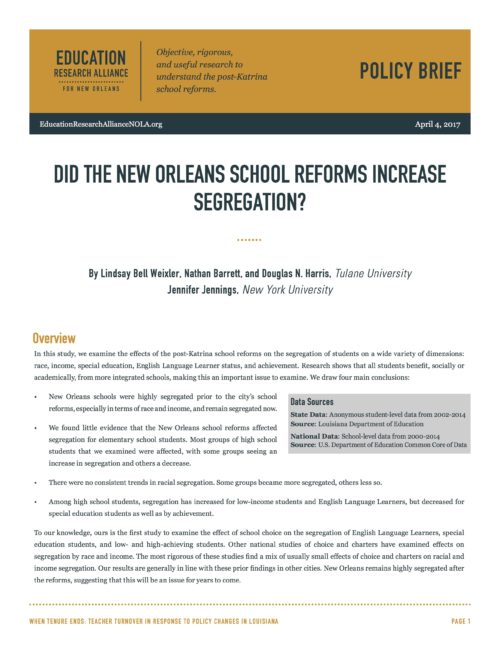
A new study from the Education Research Alliance for New Orleans at Tulane University examines how the post-Katrina school reforms affected segregation in New Orleans publicly funded schools.
Researchers analyzed changes in segregation across a number of student demographics, including race, income, special education participation, English Language Learner status, and achievement.
New Orleans schools were highly segregated prior to the reforms, especially in terms of race and income, and the study finds that segregation levels remain high post-Katrina. The authors find little evidence that the reforms affected segregation for elementary school students, but most groups of high school students they examined were affected.
The authors, Lindsay Bell Weixler, Nathan Barrett, Douglas Harris, and Jennifer Jennings, also find no consistent trends in racial segregation, as some student groups became more segregated and others less so. Among high school students, segregation has increased for low-income students and English language learners but decreased for special education students. The study also finds that segregation by achievement levels has generally declined since Katrina.
“Integrating schools has been a long-standing challenge for districts,” Weixler said. “Our results for New Orleans confirm the broader national pattern that very few school systems—whether traditional or those with choice-based reforms—have had much success in integrating schools.”
Policy Brief Cover
In this study, we examine the effects of the post-Katrina school reforms on the segregation of students on a wide variety of dimensions: race, income, special education, English Language Learner status, and achievement. Research shows that all students benefit, socially or academically, from more integrated schools, making this an important issue to examine. We draw four main conclusions:
  • New Orleans schools were highly segregated prior to the city’s school reforms, especially in terms of race and income, and remain segregated now.
  • We found little evidence that the New Orleans school reforms affected segregation for elementary school students. Most groups of high school students that we examined were affected, with some groups seeing an increase in segregation and others a decrease.
  • There were no consistent trends in racial segregation. Some groups became more segregated, others less so.
  • Among high school students, segregation has increased for low-income students and English Language Learners, but decreased for special education students as well as by achievement.
To our knowledge, ours is the first study to examine the effect of school choice on the segregation of English Language Learners, special education students, and low- and high-achieving students. Other national studies of choice and charters have examined effects on segregation by race and income. The most rigorous of these studies find a mix of usually small effects of choice and charters on racial and income segregation. Our results are generally in line with these prior findings in other cities. New Orleans remains highly segregated after the reforms, suggesting that this will be an issue for years to come.
This spring, the Education Research Alliance for New Orleans is also releasing a series of papers that focus on New Orleans teachers. The first study in this series, which explored the effects of Louisiana’s teacher tenure reform, was released in February. Forthcoming studies will examine the implementation of the statewide teacher evaluation system known as Compass, as well as changes in teachers’ perceptions of New Orleans schools from those who taught before and after Hurricane Katrina.New Report Released: "Did the New Orleans School Reforms Increase Segregation?" · News · Education Research Alliance for New Orleans:


Public School Numbers Games Hide What Matters | Re:education in Baltimore

Public School Numbers Games Hide What Matters | Re:education in Baltimore:

Public School Numbers Games Hide What Matters
I drafted this piece on Saturday, March 25, 2017, when no one knew if or how much money Governor Larry Hogan would “give” to Baltimore City Public Schools in his second supplemental budget. My child’s school was facing a 20 percent cut to our budget. I updated it on the 27th, when Hogan announced his add for City Schools. Now it looks like my child’s school budget will be cut 5 percent. I’ll just leave this here. I have been told it deserves to be shared.
On March 27, the governor of Maryland announced a plan to allocate to Baltimore City Public Schools an additional $23.7 million, which represents a small fraction of a multi-million dollar budget gap. For advocates like me, a big trick of fighting for  funding has been figuring out what to show to illustrate projected losses: a dollar sign, a percentage, an image of a classroom with 25 students next to the same one with 40?
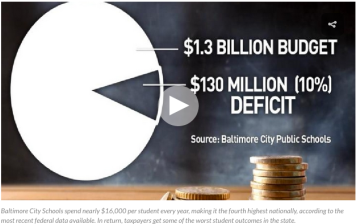
The figure Baltimore City Public Schools CEO Sonja Santelises presented, and then leaders of the Downtown Baltimore Family Alliance ran with, and now Fox45 News is promoting to particularly misleading effect, is $130 million. That is the amount – rounded up by one to the nearest 10 – of the structural deficit that City Schools lacks the revenue to fill this year, and next year, and the year after that. Screen Shot 2017-04-03 at 10.17.55 PM.pngDivided by the average teacher salary, it signifies more than 1,000 positions, rounded down by hundreds. In a panic that elided the need for a three-year fix, DBFA branded a campaign #releasethe130. In a simple pie chart, Fox45 reduced the 130 to a sliver – 10 percent – of the school system’s $1.3 billion budget.
Fox45’s coverage hands rural Marylanders ammunition to fight spending on the big city. “Baltimore City Schools spend nearly $16,000 per student every year, making it the fourth highest nationally, according to the most recent federal data available,” Fox asserts. “In return, taxpayers get some of the worst student outcomes in the state.” Countless “school reform” pushers and county politicians have used the same talking point, neglecting to mention that Baltimore has the highest rate of concentrated poverty, the highest percentage of students with special needs, the highest number of lead poisoned children. Their point: Money is wasted on Baltimore.
Also lost in the discussion of $130 million are the figures by which Baltimore City Public Schools have been underfunded for years. City Schools would have no deficit at all if the state had not cut the inflation adjustment nine years ago. If not for a decade of flat funding and rising costs, we would have at least $290 million more revenue this year, from the state alone. That does make $130 million seem small, not to mention $23.7 million.
Moreover, a state study released in late 2016 found that Baltimore City Public Schools would need an additional $350 million from the state to meet a funding level adequate to enable students to meet state standards. In three years, when the commission working on a revised state funding formula arrives at one that is fair and equitable, one can only hope for the sake of all students in Maryland that the governor fully funds it.
What no one in the media has looked at is what happens to the 10 percent district-level deficit when you distribute it across schools. It balloons.
My child goes to a Pre-K–Grade 8 public school in Baltimore City with more than 700 other students. The school touts low teacher turnover, a middle school Ingenuity program, a recently won E-GATE certification for gifted and advanced learning instruction, Public School Numbers Games Hide What Matters | Re:education in Baltimore:


Trump’s Authoritarian Vision - Los Angeles Times

Trump’s Authoritarian Vision - Los Angeles Times:

Trump’s Authoritarian Vision

Image result for Trump’s Authoritarian Vision
PART I Our Dishonest President

 PART II Why Trump Lies

 PART III Trump's Authoritarian Vision

 PART IV Wednesday

 Standing before the cheering throngs at the Republican National Convention last summer, Donald Trump bemoaned how special interests had rigged the country’s politics and its economy, leaving Americans victimized by unfair trade deals, incompetent bureaucrats and spineless leaders.
He swooped into politics, he declared, to subvert the powerful and rescue those who cannot defend themselves. “Nobody knows the system better than me, which is why I alone can fix it.”
To Trump’s faithful, those words were a rallying cry. But his critics heard something far more menacing in them: a dangerously authoritarian vision of the presidency — one that would crop up time and again as he talked about overruling generals, disregarding international law, ordering soldiers to commit war crimes, jailing his opponent.
Trump has no experience in politics; he’s never previously run for office or held a government position. So perhaps he was unaware that one of the hallmarks of the American system of government is that the president’s power to “fix” things unilaterally is constrained by an array of strong institutions — including the courts, the media, the permanent federal bureaucracy and Congress. Combined, they provide an essential defense against an imperial presidency.
Yet in his first weeks at the White House, President Trump has already sought to undermine many of those institutions. Those that have displayed the temerity to throw some hurdle in the way of a Trump objective have quickly felt the heat.
Consider Trump’s feud with the courts.
He has repeatedly questioned the impartiality and the motives of judges. For example, he attacked the jurists who ruled against his order excluding travelers from seven majority Muslim nations, calling one a “so-called judge” and later tweeting:

It’s nothing new for presidents to disagree with court decisions. But Trump’s direct, personal attacks on judges’ integrity and on the legitimacy of the judicial system itself — and his irresponsible suggestion that the judiciary should be blamed for future terrorist attacks — go farther. They aim to undermine public faith in the third branch of government.
The courts are the last line of defense for the Constitution and the rule Trump’s Authoritarian Vision - Los Angeles Times:

Beyond ‘1984’: George Orwell’s prophetic take on high-stakes tests - The Washington Post

Beyond ‘1984’: George Orwell’s prophetic take on high-stakes tests - The Washington Post:

Beyond ‘1984’: George Orwell’s prophetic take on high-stakes tests

Many people were introduced to author George Orwell because as students they were required to read “Animal Farm” or “1984,” the 68-year-old dystopian novel that is now experiencing something of a revival. Sales spiked after the inauguration of President Trump, and it remains a fixture on required reading lists in many English classes.
Margaret Sullivan, The Washington Post’s media columnist, referenced Orwell’s theme of how the truth is subverted in totalitarian regimes when she wrote the following in January:
Anyone — citizen or journalist — who is surprised by false claims from the new inhabitant of the Oval Office hasn’t been paying attention. That was reinforced when Trump adviser Kellyanne Conway told “Meet the Press” Sunday that Spicer had been providing “alternative facts” to what the media had reported, making it clear we’ve gone full Orwell.
Although Orwell is best known for his novels about the dangers of totalitarianism and how societies slide into such a system, he wrote much more, including poetry, literary criticism and polemic journalism. Many of his essays rank with the best of his work, according to literary critics, and one of them shows him to have been prophetic in education, specifically high-stakes tests.
In an autobiographical essay titled “Such, Such Were the Joys,” Orwell tells stories about his own experiences when he was 8 to 13 years old, from 1911 to 1916, and a student St. Cyprian’s, a preparatory school in Suxxex, England. The essay was first published in 1952 but was thought to have been written years earlier, although there is no consensus about exactly when.
He writes about his disdain for using a single test to determine a student’s future, and how some subjects get ignored when other subjects are deemed more important for testing purposes. Sound familiar? That has been one of the most destructive results of the standardized test-centric era of school reform that began with President George W. Bush’s No Child Left Behind law and continued with President Barack Obama’s Race to the Top initiative.
Here’s the relevant passage, in which Orwell also writes about “the greatest outrage of all … the teaching of history. You can read the entire essay here:
For my first two or three years I went through the ordinary educational mill: then, soon after I had stated Greek (one started Latin at eight, Greek at ten), I moved into the scholarship class, which was taught, so far as classics went, largely by Sambo himself. Over a period of two or three years the scholarship boys were crammed with learning as cynically as a goose is crammed for Christmas. And with what learning! This business of making a gifted boy’s career depend on a competitive examination, taken when he is only twelve or thirteen is an evil thing at best, but there do appear to be preparatory schools which send scholars to Eton, Winchester, etc. without teaching them to see everything in 
Beyond ‘1984’: George Orwell’s prophetic take on high-stakes tests - The Washington Post:


Not the Onion: Campbell Brown Involved in Project to Protect Journalistic Integrity | Diane Ravitch's blog

Not the Onion: Campbell Brown Involved in Project to Protect Journalistic Integrity | Diane Ravitch's blog:

Not the Onion: Campbell Brown Involved in Project to Protect Journalistic Integrity

Campbell Brown made her reputation calling public school teachers “perverts” and attacking teachers’ unions for “protecting” any member accused of a crime (even if the accusation was false). She then went on to attack teachers’ rights to due process in the courts of two states. She is a close friend of Betsy DeVos, who funds Campbell Brown’s “The 74.” Brown is contemptuous of public schools and advocates for privatization via charters and vouchers. Like DeVos, she never attended a public school and never sent her children to one.
After collecting $12 million from the Billionaire Boys Club to start the pro-privatization website “The 74,” Brown was hired by Facebook to manage its partnerships with other news organizations.
Now get this. CUNY Graduate Center is creating a “News Integrity Initiative” to protect the integrity of journalism. Brown is the Facebook representative.
The Initiative could begin with The 74, which was created to slime a democratic institution–the nation’s public schools–which enroll nearly 90% of the children in this country and which is a foundational part of our democratic society, welcoming all children, including those with profound disabilities and children who don’t speak English.Not the Onion: Campbell Brown Involved in Project to Protect Journalistic Integrity | Diane Ravitch's blog:


Mike Klonsky's SmallTalk Blog: DeVos' resume

Mike Klonsky's SmallTalk Blog: DeVos' resume:

DeVos' resume

The family tree


Betsy DeVos' appointment as Sec. of Education had less to do with her competency, adroitness, or knowledge of the field than it did with massive donations to the Trump campaign and her family's ties to a web of international intrigue centered around her brother, Blackwater founder and secret Trump attaché, Erik Prince. 

That's the only conclusion I could draw, especially after reading the WaPo story about Prince's secret Seychelles meeting to establish a Trump-Putin back channel.


Though Prince had no formal role with the Trump campaign or transition team, he presented himself as an unofficial envoy for Trump to high-ranking Emiratis involved in setting up his meeting with the Putin confidant, according to the officials, who did not identify the Russian.
Prince was an avid supporter of Trump. After the Republican convention, he contributed $250,000 to Trump’s campaign, the national party and a pro-Trump super PAC led by GOP mega-donor Rebekah Mercer, records show. He has ties to people in Trump’s circle, including Stephen K. Bannon, now serving as the president’s chief strategist and senior counselor. Prince’s sister Betsy DeVos serves as education secretary in the Trump administration. And Prince was seen in the Trump transition offices in New York in December.
 Prince is best known as the founder of Blackwater, a security firm that became a symbol of U.S. abuses in Iraq after a series of incidents, including one in 2007 in which the company’s guards were accused — and later criminally convicted — of killing civilians in a crowded Iraqi square. Prince sold the firm, which was Mike Klonsky's SmallTalk Blog: DeVos' resume:


Minnesota Court of Appeals Holds that Education Quality Suit Raises Nonjusticiable Political Question - Education Law Prof Blog

Education Law Prof Blog:

Minnesota Court of Appeals Holds that Education Quality Suit Raises Nonjusticiable Political Question

In a case of first impression in the Minnesota appellate courts, the state court of appeals recently reversed a trial court's refusal to dismiss to dismiss a class-action lawsuit that claimed that economic and racial segregation led to students being denied their state constitutional right to an adequate education. The Minnesota Court of Appeals found that the suit's claims required the court to define what was an adequate education, which in the court's view presented a nonjusticiable political question. The class action plaintiffs alleged that hyper-segregated schools” throughout Minnesota is a per se violation of the Minnesota State Constitution's Education Clause (article XIII, sec. 1) and that children of color and children in poorer districts receive an inadequate education by "any objective standards." The district court below refused to dismiss the plaintiffs' claims on the merits. In reversing that decision, the court of appeals wrote that the definition of adequate education is a standard specifically assigned to the state legislature and would require the court to make an initial policy decision in an area under legislative control. Citing precedent, the appellate court noted, "we deem[] judicial review of educational policy inappropriate." The case is Cruz-Guzman v. State, No. A16-1265, 2017 WL 957726 (Minn. Ct. App. Mar. 13, 2017).Education Law Prof Blog:


Media fails to properly report on Malloy plan to destroy Connecticut’s community college system - Wait What?

Media fails to properly report on Malloy plan to destroy Connecticut’s community college system - Wait What?:

Media fails to properly report on Malloy plan to destroy Connecticut’s community college system

In a stunning development yesterday, Governor Malloy’s former chief of staff – who know serves as the President of the Connecticut State University and Community College System – proposed a devastating plan that would undermine Connecticut’s Community College System and remove important independent functions of Connecticut’s State Universities.
In the initial news coverage of this breaking news, Connecticut media outlets have failed to focus on the proposal’s negative impacts, instead parroting the empty rhetoric and broad generalities contained in the Malloy administration’s press release.
The CT Mirror reported,
“The Board of Regents for Higher Education will be asked Thursday to endorse a framework for saving at least $41 million annually through the administrative and operational consolidations of institutions that have remained autonomous since the merger in 2011 of the state’s 12 community colleges, four regional state universities and the online college, Charter Oak.”
As for the dramatic plan to strip each college community college of its leadership and administrative teams the news story only adds,
Facing a shrinking college-age population and growing budget gaps, the system’s president, Mark Ojakian, released an outline Monday for an “operational consolidation” unifying the community colleges into a centrally managed institution that would retain its dozen campuses while shedding administrators at an annual saving of $28 million.
“Unifying the community college system” is hardly an adequate explanation of the extraordinary negative impact that would occur by eliminating the community college presidents and campus based Media fails to properly report on Malloy plan to destroy Connecticut’s community college system - Wait What?:

VAM, Teacher Bashing, and Unintended Outcomes: “[A]ll [teacher] exits increased under the new evaluations” | radical eyes for equity

VAM, Teacher Bashing, and Unintended Outcomes: “[A]ll [teacher] exits increased under the new evaluations” | radical eyes for equity:

VAM, Teacher Bashing, and Unintended Outcomes: “[A]ll [teacher] exits increased under the new evaluations”


Research analysis at Shanker Blog is among the very best available online, notably the work of Matthew Di Carlo.
The posts there are predictably nuanced and careful, dispassionate—to a fault. As a critical educator, I am on edge when I read these careful explications of educational research because they tend to stand so far back from drawing critical conclusions that they leave a great deal of room for forgiving awful and baseless policy.
Teacher Evaluations And Turnover In Houston is an extremely important post as it unpacks new research on the current era of teacher evaluations spawned during the Obama years, notably the increased use of value-added methods (VAM) that link teacher quality to student test scores.
I highly recommend reading the post in full, but here I want to add a few annotations to address both my concerns the analysis tip-toes when it should stomp and to emphasize a few key takeaways well addressed by Di Carlo.
Let me share a few passages, and I will boldface what I want to address; first, the opening:VAM, Teacher Bashing, and Unintended Outcomes: “[A]ll [teacher] exits increased under the new evaluations” | radical eyes for equity:


Could fragile peace between political rivals ultimately lead to changes in California's charter school oversight? | 89.3 KPCC

Could fragile peace between political rivals ultimately lead to changes in California's charter school oversight? | 89.3 KPCC:

Could fragile peace between political rivals ultimately lead to changes in California's charter school oversight?


The California Charter School Association and the state's teachers unions may deeply disagree on a lot of issues, but they at least agree on this: charter schools ought to be subject to the state's open records law, just like any other public school.


That agreement-in-principal forms the basic framework of two bills that have surfaced recently in Sacramento, raising the possibility that California lawmakers might enact changes to the state's structure for charter school governance and oversight this session.
Both bills formally apply a trio of open government laws — the California Public Records Act; the Political Reform Act, which deals with ethics and conflict-of-interest policies; and the state's open meetings laws — to the handful of charter schools that don't follow them already.
But from there, the proposals diverge, and so do the teachers unions and the charter association.
Assemblyman Reggie Jones-Sawyer (D-Los Angeles), who authored the bill the teachers union supports, AB 1478, said he's hoping to find common ground between his proposal and the Senate legislation the charter association supports.
But a spokeswoman for the California Teachers Association also made clear the state's largest teachers union had deep reservations with the charter association-backed bill, SB 806.
Similarly, while the California Charter Schools Association's Carlos Marquez said his side had made progress with Jones-Sawyer, he's cautious in assessing the chances that the two sides ultimately reach a compromise.
"We will take him at his word that he is open to amendments," said Marquez, the charter association's senior vice president of government affairs. "Ultimately, CTA will have to decide whether they are supportive of those amendments or if they want to walk away."
If the recent past is any indication, it's conceivable that there are still enough votes in the legislature to approve a charter oversight package of some kind. A bill nearly identical to Jones-Sawyer's AB 1478 passed both chambers last year, but Gov. Jerry Brown vetoed the bill, citing many objections the charter association had raised.
"We do think if both [bills] go through, if both pass, we know which one is going to get signed," Marquez said. "They [teachers union leaders] know which one is going to get signed."
The major sticking point has been "Government Code 1090," the state law preventing public officials from "self-dealing" — that is, from having a financial stake in any contracts or deals involving the government entity for which they work.
California Teachers Association officials prefer AB 1478 because it clarifies these Could fragile peace between political rivals ultimately lead to changes in California's charter school oversight? | 89.3 KPCC:


With A Brooklyn Accent: Carl Paladino's Racism: A Test of Political Courage for the NY State Education Department

With A Brooklyn Accent: Carl Paladino's Racism: A Test of Political Courage for the NY State Education Department:

Carl Paladino's Racism: A Test of Political Courage for the NY State Education Department

As long as Carl Paladino remains on the Buffalo School Board, the State Education Commissioner and the Regents will be so tainted by complicity with racism that their positions other issues will be compromised

Imagine what it must be like to be a student attending Buffalo schools and know that a key member of the Buffalo School Board, arguably the most powerful person in Western New York, organized a rally where White Supremacists were welcome and the Confederate Flag was displayed


The majority of the Buffalo School Board, thinking of the well being of those children, has called on Commissioner Elia and the Regents to remove Mr Paladino from the Board. That they have thus far failed to do so shows an astonishing lack of political courage.,With A Brooklyn Accent: Carl Paladino's Racism: A Test of Political Courage for the NY State Education Department:
 Image result for grow a pair

Public Schools Transformed by Stable Leadership, Challenging Curriculum and Caring Relationships | janresseger

Public Schools Transformed by Stable Leadership, Challenging Curriculum and Caring Relationships | janresseger:

Public Schools Transformed by Stable Leadership, Challenging Curriculum and Caring Relationships

Recently I listened online to a lecture sponsored by the American Educational Research Association in which Dr. Charles Payne, a sociologist and professor of urban education at the University of Chicago explains what public schools can do to help their students thrive academically even despite what we know are the constraints posed when their families and their neighborhoods are extremely poor.  Poverty, Payne says, poses enormous challenges to children’s thriving at school, but if the curriculum is extremely challenging and the children are known by the adults at the school and feel supported by these relationships, many children can thrive academically.
Payne documents his address from the academic research literature, but what might be seen as a case study for his theory of school improvement appeared in Sunday’s NY Timesan article by David Kirp, the University of California at Berkeley public policy professor who has been visiting public schools in the Union Public School District, located in the eastern part of Tulsa, Oklahoma.
Beneath the improvements in Union Public School District—how the District has made its curriculum more rigorous and created a web of relationships that support students—Kirp highlights an additional factor that usually gets less attention. The superintendent who transformed and strengthened this school district retired in 2013 after 19 years and the new superintendent isn’t looking to move on.
In contrast to the theory of disruption that has pervaded corporate school reform and that is also at the heart of Betsy DeVos’s belief in privatization is stable, deliberate, and incremental Public Schools Transformed by Stable Leadership, Challenging Curriculum and Caring Relationships | janresseger:

The Business of School Choice | BustED Pencils

The Business of School Choice | BustED Pencils:

The Business of School Choice


What the Proponents Say 
The idea of school choice rests on the premise that students can receive a better education if their parents have the opportunity to choose a school that is the best fit for their child. This sounds like common sense and rather benign, especially if the local schools are run down and rowdy with jaded and overworked teachers in loud, rambunctious classrooms, not conducive to learning. Given that set of options, I would send my kids out of the area for school as well if it were feasible. Who wouldn’t want to take a voucher or use  private school scholarship aid to ensure their child can have access to the best education they can get. The competition will cause better performing schools to attract more clients (students), while the poor performing schools will lose or shut down. How do we judge the performance of schools? Standardized tests scores (product), of course.
Education should perhaps mimic the private sector and seek to limit the influence of organized labor. Teachers’ unions are an impediment to change and innovation in the public school system. They have a vested interest in keeping things the same, of course they want to keep their jobs and do not want any competition. At every turn, they stifle new ideas and educational models that may lead to more success for our children. School choice will likely  lead to the weakening or eventual dismantling of the unions and allow management (administration) to get rid of bad teachers (employees) without all the lengthy due process.
If one is not educated on the issues, it is quite easy to fall for this line of reasoning. I am the The Business of School Choice | BustED Pencils:

Who Needs Reformers When You Have David Kirp? | Gary Rubinstein's Blog

Who Needs Reformers When You Have David Kirp? | Gary Rubinstein's Blog:

Who Needs Reformers When You Have David Kirp?


Miracle school debunking has been my most important contribution to the ed reform debate.  The first miracle school I ever debunked was Urban Prep in Chicago after Arne Duncan touted it at the 2011 Teach For America 20 year alumni summit.  I’ve probably debunked over 100 such schools and districts over the past 6 years.
A miracle school is one that has managed, with no additional resources but just harder working teachers with higher expectations, to beat the odds and get students in a high poverty school to get exceptional standardized test scores, thus proving that lazy teachers who have jobs for life and the unions who represent them, are the cause of the achievement gap.  Debunking a miracle school claim is important since the existence of a miracle school will be used as Exhibit A by reformers as evidence that the other 99.99% of schools must be failing.
Most alleged miracle schools are charter schools.  Since charter schools must have PR to attract students and wealthy donors, it would make sense that they would find ways to make it look like they have some secret to raising test scores.  Usually it turns out that the test scores are not very good, after all, and when the test scores are good it is because of massive attrition of the weaker students.
About four years ago I wrote my most widely criticized blog post ever called ‘The Status Quo Miracle District.’  The post was an analysis I did of a miracle district touted in the New York Times by David Kirp.  He had written about a traditional miracle district in New Jersey called, most ironically, Union City.  Even though many of my public school supporting friends had been enthusiastic about this article because it showed that a traditional district can be a miracle district too without resorting to reforms like charters and TFA, I did my fact-checking to find that the test scores at that district were not impressive.  My post was not well received.  People called me a traitor and an ally of the reformers.
I had to write another post defending my first post, explaining that a district can have low test scores and even low ‘growth’ scores byWho Needs Reformers When You Have David Kirp? | Gary Rubinstein's Blog: