Latest News and Comment from Education

Thursday, March 9, 2017

Sample letter to your legislator about establishing screen time guidelines | Parents Across America

Sample letter to your legislator about establishing screen time guidelines | Parents Across America:

Sample letter to your legislator about establishing screen time guidelines 

Image result for screen time guidelines

We are so pleased that a committee of the Maryland state legislature is considering a bill to establish health and safety guidelines for the use of digital devices in schools. This is a great model for other states.
We suggest that you contact your state legislators (and you could also try local city officials) asking them to introduce a similar bill.
Here’s a sample email:
Dear (legislator)
We would like to request that you consider sponsoring a bill in this or the next legislative session that would address the growing exposure to digital devices that our children are experiencing in many schools.
The dangers of overexposure to digital devices are just beginning to be defined and tracked. The national group Parents Across America, of which I am a member, recently published an extensive collection of information and opinion on the dangers of misuse and overuse of digital devices which raises a number of serious concerns.
As parents, we take full responsibility for the amount of time our children spend on devices at home, but we need your help to address the growing use of digital devices and screen time in schools.
We are pleased that the Maryland legislature is considering a bill to establish health and safety guidelines for the use of digital devices in schools, and ask that you consider introducing a similar bill as soon as possible.
The Maryland bill has broad bipartisan support. Here is its simple language:
House Bill 866
Guidelines and procedures for the use of digital devices in public school classrooms.
(a) ThDepartment of Health and Mental Hygienein consultation with the Departmentshall develop health and safety guidelines and procedures for the use of digital devices in public school classrooms.
(b) Beginning in the 2018 – 2019 school year, each county board shall implement the health and safety guidelines and procedures for the use of digital devices in public school classrooms specified in 5subsection (a) of this section
I would be pleased to speak with you or your staff about this important subject. Thank you for your attention.


 Our Children @ Risk: PAA reports detail the dangers of EdTech | Parents Across America - http://parentsacrossamerica.org/?p=6320

Image result for big education ape Parents Across America

Teacher to Ohio Gov. Kasich: ‘You are in the dark about life in the classroom’ - The Washington Post

Teacher to Ohio Gov. Kasich: ‘You are in the dark about life in the classroom’ - The Washington Post:

Teacher to Ohio Gov. Kasich: ‘You are in the dark about life in the classroom’

Ohio Gov. John Kasich’s stewardship of the public schools in his state has not been without problems. During his tenure, issues facing public schools in Ohio have included the growth of a charter school sector as scandal-ridden as any in the country, funding cuts for traditional public schools while charter schools and voucher programs got more state money, a problem-plagued teacher evaluation system and the troubled administration of a new Common Core test.
Recently it came to light that the governor had buried in his 3,512-page fiscal 2018-2019 budget proposal a mandate that all new teachers applying for a license — and all working teachers applying for license renewal in Ohio — get some “on-site work experience with a local business or chamber of commerce.”
Why? Ryan Burgess, director of Kasich’s Office of Workforce Transformation, told reporters that it would help teachers get a better idea for what jobs are available to students and what skills employers need.
Well, Julie Rine is one teacher who begs to differ. She wrote and sent a letter to the governor that appeared on Plunderbund and that she gave me permission to publish. Rine has been teaching in Ohio for more than 20 years. She is now in the Minerva Local School District, teaching Honors English I, Honors English II, Honors American Literature and English III at Minerva High School. She was born in Ohio, earned a bachelor’s degree from Ohio State University and a master’s degree at Marygrove College in Michigan.
Here is her strong letter to Kasich:
Dear Governor Kasich,
Your proposal in the budget to require teachers to complete an “on-site work experience” with a local business as a condition of renewing our teaching licenses is baffling. Even the state legislators in your own party didn’t seem to see the value in it, and have indicated that they most likely will not support it. What exactly did you hope to accomplish by our spending time observing or even participating in a field outside of education? Despite a lot of press coverage, we were given few details about the thinking behind this mind-boggling mandate, 
Teacher to Ohio Gov. Kasich: ‘You are in the dark about life in the classroom’ - The Washington Post:


The Death Tax on Failing Schools/Bad Teachers and TrumpCare - The Wordsmith - The New York Times

The Wordsmith - The New York Times:

The Death Tax on Failing Schools/Bad Teachers  and TrumpCare - The Wordsmith 


When I use a word,” Humpty Dumpty said, in rather a scornful tone, “it means just what I choose it to mean- neither more nor less.”
— Lewis Carroll, Through the Looking Glass

Big Education Ape: Media Consensus on ‘Failing Schools’ Paved Way for DeVos | By Molly Knefel | Common Dreams - http://bigeducationape.blogspot.com/2017/03/media-consensus-on-failing-schools.html

Your new 28-page memo, “The Language of Health Care,” was sent to Republicans in Congress and recommends that they speak about health care reform in ominous phrases. For instance, you suggest that they refer to “a Washington takeover.”
“Takeover” is a word that grabs attention.
Is it a correct description of the president’s plans for reform? 
 We don’t know what he is proposing. We want to avoid “a Washington takeover.”
But that’s not at issue. What the Democrats want is for everyone to be able to choose between their old, private health-insurance plan and an all-new, public health-insurance option. 
 I’m not a policy person. I’m a language person.
If you write the words of the policy, shouldn’t you believe in the content of the policy? 
 That’s why I agreed to write this memo. I deeply believe in patient-centered health care. My whole family was in the dental profession. I grew up with medicine all around me.
Would you describe yourself as a Republican pollster? 
 I’m a pollster, but no one ever cites my polling. Ninety-five percent of my work is as a communications specialist. My mother used to tell people that I was an upholsterer. She would joke that she didn’t understand the difference between pollster and an upholsterer.
Who paid you to write the health care memo? 
 It’s not relevant.
A pharmaceutical company? 
 No pharmaceutical company was involved.
You have devised many phrases to help sell Republican policies to the public. Like “energy exploration” instead of “drilling for oil” in the Arctic. What are some of your other coinages? 
 It’s “death tax” instead of “estate tax” or “inheritance tax.” It’s “opportunity scholarships” instead of “vouchers.” It’s “electronic intercepts” rather than “eavesdropping.”

Photo

CreditBrad Jones for The New York Times

That’s a lot of e’s. 
 Words that begin with b, p or t are words to express anger. I call them spitting words. You actually spit on people as you are saying them.
What if I call someone a bunny? That’s not angry. 
 If I wanted to demonize a bunny, I would use a word like rabbit. The rabbit will ravage your garden. This is a language pivot. A bunny is cute; a rabbit that ravages your garden is a pest.
What do you think of Dick Cheney’s new identity as a TV regular? 
 My issue with Cheney is that he was at one time a great communicator. But when he was asked the question “Over 70 percent of Americans disagree with this war, what is your response?” do you remember what his reaction was?
He said, “So what?” 
 Even worse than that. “So.” So! One-word answer, one syllable, two letters. To the American people it was a slap in the face.
When is your next book coming out? 
In September. It’s called “What Americans Really Want … Really: The Truth About Our Hopes, Dreams and Fears.”
It’s better without the subtitle, which detracts from the wit of the two “really” ’s. 
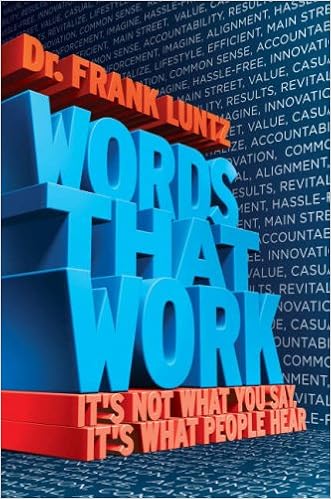
Well, I wrote “Words That Work,” and the subtitle is “It’s Not What You Say, It’s What People Hear,” and that is the most important single line I have ever written.
Where did you grow up? 
 Who cares?
Are you married? 
 No. I may have perfected the language that gets people to vote certain ways, and buy certain products, but I haven’t perfected the language to get some woman to buy me.
It might help if you didn’t speak about yourself, not to mention health care, as a product to be bought and sold. 
 It’s a throwaway line, that’s all. In politics it’s called a pivot. It’s a pivot to a topic I am more interested in. Not all words have equal meaning.interview conducted, condensed and edited byDeborah Solomon
INTERVIEW CONDUCTED, CONDENSED AND EDITED BY DEBORAH SOLOMON


 The Wordsmith - The New York Times:

Common Core Advocates' New Boogeyman: Twitterbots | Truth in American Education

Common Core Advocates' New Boogeyman: Twitterbots | Truth in American Education:

Common Core Advocates’ New Boogeyman: Twitterbots


Bill Gates had to find an explanation as to why Common Core has become increasingly unpopular. He funded a study that found the source of Common Core advocates’ woes.
Twitterbots.
Yes you read that right – Twitterbots are to blame.
The Consortium for Policy Research in Education decided it would look at how social media impacted Common Core so it launched the #CommonCore Project. Apparently that was more important than actually, I don’t know, studying how Common Core has shaped public policy.
Has social media impacted the education debate? Absolutely.
Are Tweetbots to blame? Well that’s the new narrative now.
For several years, university researchers have been watching how the debate surrounding Common Core has played out on Twitter. Between 2013 and 2016, they analyzed about 1 million tweets to understand how the social network was changing political discourse in America ― not only as it related to Common Core, but in a much larger sense.
Their discovery wasn’t pretty. Three years before “fake news” became a mainstream issue, fabrications and misinformation had already intensified the degree of 
Common Core Advocates' New Boogeyman: Twitterbots | Truth in American Education:

Media Consensus on ‘Failing Schools’ Paved Way for DeVos | By Molly Knefel | Common Dreams

Media Consensus on ‘Failing Schools’ Paved Way for DeVos | By Molly Knefel | Common Dreams:

Media Consensus on ‘Failing Schools’ Paved Way for DeVos


The nomination of billionaire voucher enthusiast Betsy DeVos for secretary of Education comes after nearly two decades of a largely bipartisan consensus around “education reform.” That consensus, repeated for years in the pages of the New York Times and the Washington Post, posits, first and foremost, that public schools are failing.
They are, the narrative goes, especially failing the nation’s most vulnerable students. That failure is presented, by education reformers and corporate media pundits alike, not as a result of inequality or poverty or resource scarcity, but of public education itself. The solution, pioneered by pro-privatization reformers and repeated by newspapers since the George W. Bush years, sounds both innocuous and innovative: school choice.
As a result of the uncritical consensus around school choice, major papers like the Times and the Post are unable to report on an extremist figure like DeVos—whose pro-voucher and pro-charter advocacy fits comfortably within the school-choice ethos—without ceding even more ground to the corporate education reform movement. “School choice” is not as value-neutral as it sounds: It is a buzzword not only for the expansion of charter schools and vouchers, but for the divestment of public funds away from public education and into the private sector.
The spectrum of opinions on DeVos presented in corporate media range from skepticism to enthusiasm, but school choice itself is unquestioned. The basic premise of education reform—that privatization is the solution—is taken as a given when papers repeatedly use the language of corporate reform. This leaves them questioning only the extent of that privatization, by way of charters or vouchers or both.
Even where coverage of DeVos has been critical—and much of it has, especially since her confirmation hearing—major papers parrot the language of corporate ed reformers. From the New York Times (1/12/17):
But school choice means different things to different people. Many educators and groups that support charter schools—which are public—do not support vouchers, which steer public money away from public schools by giving families money to spend on private school tuition.
That charter schools are “public” is a talking point put forward by the charter sector. Oversight of charter school performance varies widely state by state. They are run by non-profit organizations and sometimes for-profit companies. Their employees do not have the same rights as public-sector employees. They do not serve proportionate numbers of students with disabilities. They suspend black students at four times the rate of white students, and suspend students with disabilities at rates 2–3 times higher than their non-disabled peers, as the Times itself reported last year (3/16/16).
For the Times to repeat the claim that charter schools are public is an ideological choice, one that erases what makes public schools “public”—particularly, their requirement to serve all students. So-called “public charter schools” may be free, but they aren’t public institutions in terms of funding, employment, regulation or the populations they serve.
Ed reformers and their mouthpieces in corporate media present school choice as the great equalizer. “The only people who do not enjoy this right are those who are too poor to move out of neighborhoods where public schools are failing,” wrote Washington Post editorial page editor Fred Hiatt (1/1/17). He suggested that the federal government should Media Consensus on ‘Failing Schools’ Paved Way for DeVos | By Molly Knefel | Common Dreams:


Linda Darling-Hammond: Education for Sale? | The Nation

Education for Sale? | The Nation:

Education for Sale?

School choice and the future of American education

By Linda Darling-Hammond

Hammond-DeVos_rt_img


On February 7, Betsy Devos was confirmed as the nation’s new education secretary after a contentious 50-50 vote in the Senate, with Vice President Mike Pence breaking the tie. Coming to the job with no experience in public education—either as a student, parent, educator, or board member—DeVos’s only stated commitment is to expand “choice” nationally through charter schools and private-school vouchers, as she worked to do in her home state of Michigan.
There, DeVos was a key player in expanding a free-market system that features the largest number and percentage of for-profit charter schools in the nation: 79 percent of Michigan’s charters are for-profit. This is highly unusual, as more than 80 percent of charters nationwide are nonprofit. DeVos has also owned shares in K12 Inc., the nation’s largest operator of for-profit charter schools. In 2000, she helped fund an unsuccessful effort to change the state constitution in order to permit private-school vouchers.
In a recent interview about her goals as education secretary, DeVos stated that she intends to expand on this vision of choice, saying: “I expect there will be more public charter schools. I expect there will be more private schools. I expect there will be more virtual schools. I expect there will be more schools of any kind that haven’t even been invented yet.”
“Choice” has become a popular mantra in education-reform circles, used primarily to describe initiatives to increase the number of charter schools, which are publicly funded but privately operated, and to increase funding for private schools through voucher systems. The presumption in both of these instances is that they will expand high-quality options for parents and students.
Yet even among ardent charter-school supporters, DeVos’s approach to choice is controversial. In an unexpected twist, the Massachusetts Charter Public School Association opposed her nomination because of concerns about the low quality of many charters under Michigan’s lax accountability rules. In addition, one of the nation’s leading proponents and funders of charter schools, billionaire Eli Broad, sent a strongly worded letter to Senate majority leader Mitch McConnell and Senate minority leader Chuck Schumer stressing his opposition to DeVos. “At the risk of stating the obvious,” Broad wrote, “we must have a secretary of education who believes in public education and the need to keep public schools public.”
Clearly, the issues surrounding school choice are more complex than the typical pro-charter/anti-charter battle lines might suggest. The central question for a public-education system in a democratic society is not whether school options should exist, but whether high-quality schools are available to all children. The fact that choice doesn’t guarantee quality should be clear each time we flick through 500 cable-TV channels without finding a single good viewing option. In public education, this kind of choice is not an acceptable outcome.
The key question, therefore, is whether we can create a system in which all schools are worth choosing and all children are chosen by good schools. How might DeVos’s agenda affect these goals?
THE STATE OF EDUCATIONAL CHOICE
Despite the association of choice with privately operated charter schools and voucher programs, the vast majority of schools of choice are operated by public-school districts. Since the 1960s, districts have sponsored alternatives like magnet schools, themed schools (e.g., schools dedicated to the arts, law, or health professions), language-immersion schools, and Education for Sale? | The Nation:

Trump Education Secretary Betsy DeVos: A Win for the Christian Right - Rolling Stone

Trump Education Secretary Betsy DeVos: A Win for the Christian Right - Rolling Stone:

Betsy DeVos' Holy War
Her appointment as education secretary marks the crowning achievement of the Christian right's campaign to infiltrate America's secular institutions


A few weeks after September 11th, 2001, with the nation reeling from the terrorist attacks on New York and Washington, D.C., about 400 or so of the country's leading Christian conservative investors convened at the luxury Phoenician resort in Scottsdale, Arizona. They were there for the 17th annual meeting of the Gathering, a four-day, invitation-only philanthropic and networking event for the Christian donor class, whose members often describe themselves, simply, as "believers." The perks awaiting them in their off hours included a 27-hole golf course, nine crystalline swimming pools and a luxury spa. At dusk, the ruddy hues of the desert rippled across the stone patios where, warmed by fire pits, some of the most important funders of Christian charity, and the Christian right, sipped cocktails and talked about expanding the Kingdom of God.
Politics was one facet of a much larger effort the DeVoses called the Shfela. This is the biblical name for the fertile crescent of land between Israel's Judaean Mountains and the coastal plain, where David fought Goliath and other historic battles were waged between the Israelites and the Philistines. During a recent trip to Israel, the DeVoses had been highly impressed by a story about an archeological dig that unearthed a trove of ancient pig bones in layers of soil dating to the eras when the pagan Philistines held sway. But in other layers of the Shfela, the archeologists found no pig remains at all, suggesting that during these times, the Jews, who kept kosher, had come down from the mountain to spread their religious values among the people. For the DeVoses, the Shfela offered an essential metaphor of the challenges facing modern America. As Dick put it: "How do we get the pig bones out of our culture?"
In the 16 years since that meeting, the DeVos family – which includes 91-year-old patriarch and Amway co-founder Richard "Rich" DeVos Sr., his wife, Helen, their four children and their spouses – has been one of the driving forces behind a stealth campaign powered by a small group of Republican billionaires to chip away at America's secular institutions: the pig bones, so to speak, of our society. According to a recent analysis by the Center for Responsive Politics, the family, whose net worth is estimated at $5.6 billion, gave $10 million to national GOP candidates and committees during the 2016 cycle alone. But this amount pales to the gargantuan sums they have channeled into state and local races, evangelical and free-market think tanks, advocacy groups, foundations, PACs, Super PACs and other dark-money organs that have effectively created a shadow political party within the GOP.
Regular attendees at the Koch brothers' biannual summits, the DeVoses have been healthy benefactors of several Koch-seeded groups that advance an anti-tax, anti-regulatory agenda, including the charitable arm of Americans for Trump Education Secretary Betsy DeVos: A Win for the Christian Right - Rolling Stone:

Confronting, Finally, Obama as Centrist, Incrementalist—Never The Socialist | radical eyes for equity

Confronting, Finally, Obama as Centrist, Incrementalist—Never The Socialist | radical eyes for equity:

Confronting, Finally, Obama as Centrist, Incrementalist—Never The Socialist


It is certain, in any case, that ignorance, allied with power, is the most ferocious enemy justice can have.
James Baldwin, No Name in the Street (1972)
The Right, specifically the Republican Party, has never been too bright, but it has always depended on the ham-fisted logic of the U.S. public.
As political maneuvering, the Right maintained a persistent drumbeat throughout Obama’s presidency, painting him The Socialist.
Yet, over the past few days, that same Right has unwittingly unmasked both Obama and themselves by noting the similarities between past comments by Obama and recent controversial claims by Ben Carson (slaves as immigrants) and Republican Rep. Jason Chaffetz (iPhones and healthcare).
First, let’s be clear that calling enslaved people “immigrants” and demonizing people trapped in poverty are categorically wrong—regardless of who makes the claims.
And let’s also clarify that although the ends do not justify the means, Obama’s calloused comments were in the context of quite different goals than similar comments made from Republicans: Obama seeking equity and expanding healthcare by working within the system and long-held but false American Myths versus Republicans denying racial inequity (Carson) and working to cast impoverished and working citizens out of the guarantees of publicly funded healthcare and into the dog-eat-dog world of the free market.
But, second, and possibly more importantly, Obama has been unmasked as a centrist, an incrementalist—what we may admit is Ben Carson-light in rhetoric, but not political goals—by the very Right who falsely portrayed him as The Socialist.
As I have detailed in the Big Lie about the Left in the U.S., there simply is no viable or influential Left in this country, not in our two major political parties and not even on our university campuses; the leftwing professor cartoon is just as false as Obama The Socialist.
The Democratic Party in the U.S. is a centrist, leaning right, party; college professors are moderate progressives, comfortable members of the leisure class who are in no way dedicated to upsetting the status quo.
And everyone in power—even Bill Clinton and including Obama—remains trapped in narratives about race and social class that are both enduring and provably false.
Political leadership in the U.S. on both sides of the aisle speak to and perpetuate “get tough on crimes” rhetoric, despite decades of dropping crime rates; “fearing foreigners,” despite ample evidence that homegrown terrorism is far more dangerous; and “lazy minorities” as well as “lazy poor” characterizations beneath bootstrap language, although the bootstrap myth is a lie and systemic inequity remains powerful (racism, classism, sexism) on the lives of many Americas.
We don’t need the Right to pick through Obama’s legacy to highlight that he was never The Socialist, but it certainly would go a long way toward an equitable nation if we all would confront the moral vacuum that exists in U.S. politics because we have no political Left.
Publicly funded—universal healthcare, public education, roads and highways, judicial system and police force, military—is not about giving Confronting, Finally, Obama as Centrist, Incrementalist—Never The Socialist | radical eyes for equity:


Connecticut Alliance for Privacy in Education speaks out against changes to new student privacy law - Wait What?

Connecticut Alliance for Privacy in Education speaks out against changes to new student privacy law - Wait What?:

Connecticut Alliance for Privacy in Education speaks out against changes to new student privacy law

Image result for Connecticut Alliance for Privacy in Education

As explained in the Wait, What? post entitled,  ALERT – Legislation seeking to undo student privacy protections now before CT Legislature’s Education Committee, legislation has been introduced that would undermine Connecticut’s new student privacy law.
In legislative testimony this week, the Connecticut Alliance for Privacy in Education explained why the change is unnecessary and inappropriate.
Parents should take a moment to read this important information.
CAPE testified;
HB 7207 would delay student data privacy protections enacted last year until July 1, 2018. HB 7207 would undermine protections that students, from prek through grade 12 currently have as a result of the committee’s hard work last year when it enacted PA 16-189 with bi-partisan support.
The proposed bill would keep parents in the dark regarding the release of their children’s records. It would keep parents in the dark regarding contractors who have access to their children’s records. It would keep parents in the dark even in the event of breach of student data. The proposed bill undermines several sections to the law that was passed overwhelmingly by legislators and supported by parents, educators and other critical voices representing children. It undermines security requirements for contractors and operators of websites and apps and delays the implementation of a breach policy. It leaves unaddressed the fact that a task force created last year to address ongoing issues was never convened. It would leave children in Connecticut less protected than those in other states where 73 laws on student data privacy have been enacted.
We can see no reason that any part of this law, let along the entire law, should be delayed. At a time when security and 
Connecticut Alliance for Privacy in Education speaks out against changes to new student privacy law - Wait What?:
 Image result for Connecticut Alliance for Privacy in Education


How a Supreme Court Ruling on Playground Covering May Open the Door to School Vouchers

How a Supreme Court Ruling on Playground Covering May Open the Door to School Vouchers:

How a Supreme Court Ruling on Playground Covering May Pave the Way for School Vouchers

Before she was appointed U.S. Secretary of Education, Betsy DeVos spent the better half of two decades on an expensive, dogged crusade to bring school vouchers to her home state of Michigan. Bankrolled by the limitless financial resources of the DeVos Family Foundation, her efforts helped fuel other school choice initiatives – namely lifting caps on charter school expansion – but no amount of political contributions or slick marketing campaigns was enough to do the same for vouchers.
So what got in the way?
Aside from the fact that the idea of funneling public taxpayer money to pay tuition for private schools, including religious institutions, is an enormously unpopular and harmful idea, a sizeable share of the credit has to go to a provision in Michigan’s constitution.
Michigan is one of 38 states that has strict state constitutional prohibitions against state or local financial assistance to non-public schools. In most of those states, the prohibition is specifically against aid to religious institutions, including schools. These prohibitions were adopted in many of these states in the nineteenth century as part of the common school movement and were intended to prevent public funding of religious schools.
In recent years, opponents of these provisions have sought to recast them as anti-Catholic provisions and tagged them as “Blaine amendments” after a failed 1875 effort by Congressman James G. Blaine to amend the federal constitution to prohibit governmental aid to religious organizations.
While the federal Blaine amendment effort was clouded by anti-Catholic bias, the state constitutional prohibitions against aid to religion were not and cannot be dismissed summarily, as voucher proponents would have it, by tarring them as mini “Blaine amendments.”
The Supreme Court will soon weigh in on the strength of such state “No Aid” provisions. By June of this year the Supreme Court  – particularly if it is joined by a ninth member  – could decide that interpreting these provisions to prevent religious institutions from receiving public funds violates the federal Constitution. This could push the door open for school vouchers on a national scale, giving an enormous and timely boost to Donald Trump’s and Betsy DeVos’ ambitious school privatization agenda.
It’s an agenda, says NEA President Lily Eskelsen García, that siphons off taxpayer How a Supreme Court Ruling on Playground Covering May Open the Door to School Vouchers:


What's behind all the big spending on the LA school board primary | 89.3 KPCC

What's behind all the big spending on the LA school board primary | 89.3 KPCC:

What's behind all the big spending on the LA school board primary


Outside political groups have already spent more on this year's Los Angeles School Board campaign than they’ve ever spent on an L.A. Unified primary election before.

Independent expenditure groups — most with ties to either L.A.'s teachers union, United Teachers Los Angeles, or the political arm of the California Charter Schools Association — spent a primary-record $5.5 million on outside ads, phone-bankers and canvassers in hopes of swaying the races for three seats.
And Tuesday's results mean the campaign isn't even over yet. In two of the three races, no candidate won a majority of votes, meaning the top two vote-getters will face off in a May 16 runoff — an election that's likely to push the outside spending totals from charter school groups and labor unions even higher.
"I think this is going to be a dog fight," said Rapheal Sonenshein, executive director of the Pat Brown Institute for Public Affairs at California State University L.A. "I'm getting out of the prediction business ever since election day in November, but I would say more money is going to come in, I would imagine."
The narrative of charter groups and teachers unions battling over school board seats has gotten so familiar in L.A. — Sonenshein likens the decades-long, protracted back-and-forth to the medieval War of the Roses — that it's easy to forget why the battle exists, and why it matters to families.

The total of "independent expenditures" outside political groups have poured into this year's Los Angeles School Board campaign has already set a record for outside money in an L.A. Unified primary election. Candidates have also raised more for their own campaigns ahead of the primary in 2017 than was collected during the primary and general elections in every year since 2007.
The total of "independent expenditures" outside political groups have poured into this year's Los Angeles School Board campaign has already set a record for outside money in an L.A. Unified primary election. Candidates have also raised more for their own campaigns ahead of the primary in 2017 than was collected during the primary and general elections in every year since 2007.KPCC

For the uninitiated in this debate, let's back up: a charter school receives public funding like any other public school. They're unlike traditional district-run schools in that they're run by an outside group — most often, a non-profit organization — which hires teachers and recruits students to attend it. There are more than 220 independent charter schools operating in L.A. Unified.
To open, though, these schools need the permission of an "authorizer" which holds the school accountable for its academic performance and monitors its finances — and in Los Angeles, most often, that authorizer is the L.A. Unified School Board. To remain open, charters must go before the board every few years for renewals.
And here's where the importance of the school board's makeup becomes critical.
L.A. Unified board members have approved most charter school applications and renewals with few public questions in recent years. But the board's infrequent decisions to deny a bid for a new charter or to reject an existing charter's renewal request have caused friction.
As Joshua Pechthalt, president of the state's second-largest teachers union, the California Federation of Teachers, put it, the state's charter school advocates "don't want any constraints placed on the opening of charter schools."

This chart compares the pace at which outside groups made independent expenditures in 2017 and 2013 — the year that previously held the record for outside spending in an L.A. Unified School Board primary election campaign.

But skeptical board members can serve as a check on charter school growth.
Here's an example: in late 2015, a document leaked from the Eli and Edythe Broad Foundation outlined plans for a massive expansion of L.A. Unified's charter school sector.
But in Jan. 2016, the school board passed a resolution denouncing the plan. In February, current board president Steve Zimmer told KPCC he was scrutinizing charter applications more than he was before. (The foundation downplayed the leaked document's importance; it has also since shifted its strategy.)
That extra scrutiny hasn't necessarily resulted in an uptick in denials for charter petitions.
Zimmer — who has United Teachers Los Angeles' endorsement and benefitted from What's behind all the big spending on the LA school board primary | 89.3 KPCC: