Latest News and Comment from Education

Thursday, March 9, 2017

Trump's education adviser promotes private schools - ABC News

Trump's education adviser promotes private schools - ABC News:

Trump's education adviser promotes private schools


A senior presidential aide said Wednesday that American families should have various school options for their children, including private schools.
Jason Botel, Donald Trump's education adviser, told a National PTA conference that some children may not thrive in traditional public or charter schools and should have an opportunity to attend private schools.
"We need an education landscape that offers high quality options to all students and parents," Botel told the conference.
Botel, who has worked in both traditional public and charter schools, told the story of some of his students who were only able to succeed academically after going to private schools. "We are committed to ensuring that students and parents of all backgrounds for whom public school may not be the best option have access to high quality private schools," he added.
Botel's message highlighted the focus of the Trump administration on school choice. Education Secretary Betsy DeVos is a longtime charter school advocate, and Trump recently visited a small, private Catholic school in Florida to promote private-school voucher programs. The administration has talked about expanding voucher programs, which are publicly funded scholarships for low-income families to attend private schools, and tax credits to give more children access to private schools.
Some in the audience did not appreciate the message.
"Our stance is that public money should not go to funding private education," said Rebecca Gawsyszawski with the Ohio PTA. "It's part of our democracy that every child should be allowed free public education."
But Cindy Gerhardt, president of the Florida PTA, said she was inspired by Botel's background and his understanding of both traditional schools and other school options.
"His history and his career ... makes me feel more confident in his ability to direct the conversation in his position because of his history of knowing PTA and knowing what we stand for and being a part of that and being an educator as well," Gerhardt said.
Shannon Sevier, vice President of advocacy for National PTA, was skeptical of Botel's agenda.
"PTA is not for private schools that would marginalize students, that would divert funds from public schools, that would remove private liberties from students, that would not have accountability or transparency," Sevier said. "So if he's got a model that doesn't do that and he will show it to us, I am most interested in seeing it."
In the end, Sevier said, PTA is ready to wait for political winds to change.
"Political climate changes and we are strong enough and we have the longevity to outlast a four or an eight-year term," she said.Trump's education adviser promotes private schools - ABC News:

The State of State Teachers’ Pension Plans - The New York Times

The State of State Teachers’ Pension Plans - The New York Times:

The State of State Teachers’ Pension Plans


The Plans Received Low Marks

The Urban Institute has graded America’s state-run pension systems on their performance in a few areas: their financial strength; how well they provide retirement security to short-term or long-term workers; the workplace incentives they offer various age groups; and whether participating branches of government are funding them properly. Grades for all types of public pensions are available on the Urban Institute’s website, where they can be filtered for individual strengths and weaknesses.

Overall grades for state teachers’ pension plans
A
B
C
D
F
(none)
Wash.
Me.
Mont.
N.D.
Minn.
Vt.
Ore.
N.H.
Mass.
Wis.
Idaho
S.D.
N.Y.
Mich.
R.I.
Wyo.
Conn.
Iowa
Pa.
Neb.
N.J.
Nev.
Ohio
Ill.
Ind.
Del.
Utah
Colo.
W.Va.
Md.
Mo.
Va.
Kan.
Calif.
Ky.
N.C.
Tenn.
Okla.
Ariz.
Ark.
S.C.
N.M.
Ga.
Ala.
Miss.
Tex.
La.
Alaska
Fla.
Hawaii
Source: The Urban Institute and Bellwether Education Partners
No states got an A and only six states received a B: Arkansas, Delaware, Florida, New York, Oregon and Wyoming. Most states — 33 — received a C, while six got a D. The last six — Connecticut, the District of Columbia, Kentucky, Massachusetts, Ohio and Rhode Island — each received an F.
Getting an F could mean the plan offers few rewards for younger workers, is less than 60 percent funded or pays meager retirement income relative to salary, among other problems. Rhode Island improved its plan enough in 2013 to get a B on the new version, but it still has so many people in the older, failing plan that the overall grade was an F.

How Plans Encourage Teachers to Retire in Their 50s

The typical teachers’ pension plan is backloaded, meaning teachers build up benefits slowly in their early years, then speed up and earn the biggest portion just before they retire. But teachers also contribute to their plans at a steady rate, and in the early years of a teacher’s career, a person’s contributions are often worth more than the pension credits earned. If teachers stay on long enough, they will eventually hit a break-even point, where the value of the pension that has been earned is greater than what was paid for it. Few teachers are able to do this, research shows.


Going in the Wrong Direction

To save money, many states have reformed their teachers’ pension plans. In most cases, these changes have pushed the break-even point farther out into the future. In Massachusetts, they pushed it so far out that no teacher can ever earn a pension greater than the value of one’s contributions, no matter how long he or she works.The State of State Teachers’ Pension Plans - The New York Times:

School Privatization Means Loss of Public Investment to Profits and Sacrifice of Students’ Rights | janresseger

School Privatization Means Loss of Public Investment to Profits and Sacrifice of Students’ Rights | janresseger:

School Privatization Means Loss of Public Investment to Profits and Sacrifice of Students’ Rights


Here is how political scientists Jacob Hacker and Paul Pierson begin their newest book, American Amnesia, that explores the subject of America’s capitulation to the belief that government is the problem, not the solution to our society’s concerns: “This book is about an uncomfortable truth: It takes government—a lot of government—for advanced societies to flourish. This truth is uncomfortable because American’s cherish freedom. Government is effective in part because it limits freedom—because, in the language of political philosophy, it exercises legitimate coercion. Government can tell people they must send their children to school rather than the fields, that they can’t dump toxins into the water or air, and that they must contribute to meet expenses that benefit the entire community. To be sure, government also secures our freedom. Without its ability to compel behavior, it would not just be powerless to protect our liberties; it would cease to be a vehicle for achieving many of our most important shared ends… Government works because it can force people to do things.” (American Amnesia, p. 1)
Exactly how our turning away from government has affected public schools is the subject of a fascinating analysis by Alex Molnar, Dismantling Public Education: Turning Ideology into Gold.  Molnar—a Research Professor and Publications Director of the National Education Policy Center at the University of Colorado—painstakingly traces the history of the development of public education as “an egalitarian institution that was redistributive in its effects… Public education in the United States has from its earliest days been structured to embody and strengthen representative democracy by inculcating democratic values….”  But, “The major education reforms of the past 35 years—education vouchers, charter schools, tuition tax credits, and education savings accounts—all seek to remove public schools from the control of elected bodies, to subject them to the ‘laws’ of the ‘market’; and to put them at the service of the economic elite.  The world being called into existence is based on the belief that anyone, but not everyone, can succeed—a world of winners and losers, each of whom has earned his or her fate.” It is also a world where “the progressive edifice that RooseveltSchool Privatization Means Loss of Public Investment to Profits and Sacrifice of Students’ Rights | janresseger:

Former Jeb Bush Foundation Staffers Working at Trump's Ed. Dept. - Politics K-12 - Education Week

Former Jeb Bush Foundation Staffers Working at Trump's Ed. Dept. - Politics K-12 - Education Week:

Former Jeb Bush Foundation Staffers Working at Trump's Ed. Dept.

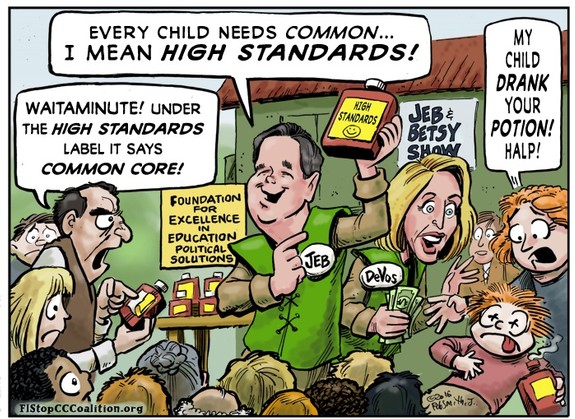
Image result for jeb bush betsy devos


At least three staffers who are part of the initial Trump administration team at the U.S. Department of Education appear to have, at one point or another, worked for the Foundation for Excellence in Education. That's the education reform organization started by former Gov. Jeb Bush, a Republican from Florida and President Donald Trump's one-time GOP primary rival. 
They include:
  • Josh Venable, who has played a key role in the transition, spent almost two years as the national director of advocacy and legislation at the foundation;
  • Andrew Kossack, who did a seven-month stint at the foundation as a deputy policy director;
  • Neil Ruddock, who appears to have served as the foundation's regional advocacy director for the past four years.
Bush's foundation advocates for school choice, requiring students to demonstrate literacy at the end of 3rd grade, and digital education, among other issues.
We've previously reported that Venable and Kossack were part of the inital "beach head" team at the...Former Jeb Bush Foundation Staffers Working at Trump's Ed. Dept. - Politics K-12 - Education Week:


DeVos praises Orthodox Jewish group that strongly backs public funding for religious schools - The Washington Post

DeVos praises Orthodox Jewish group that strongly backs public funding for religious schools - The Washington Post:

DeVos praises Orthodox Jewish group that strongly backs public funding for religious schools


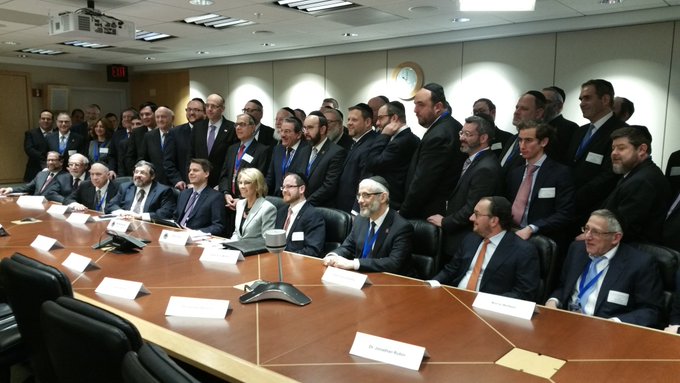
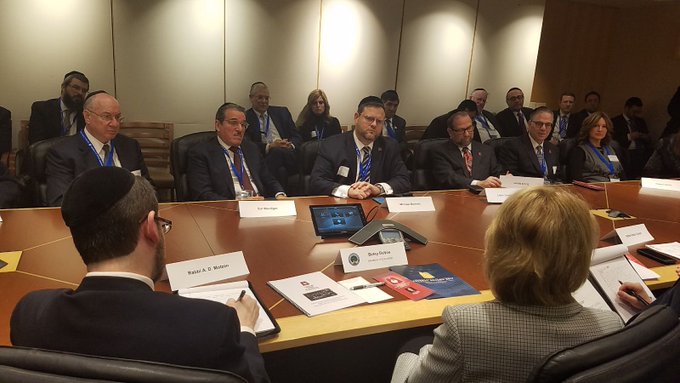
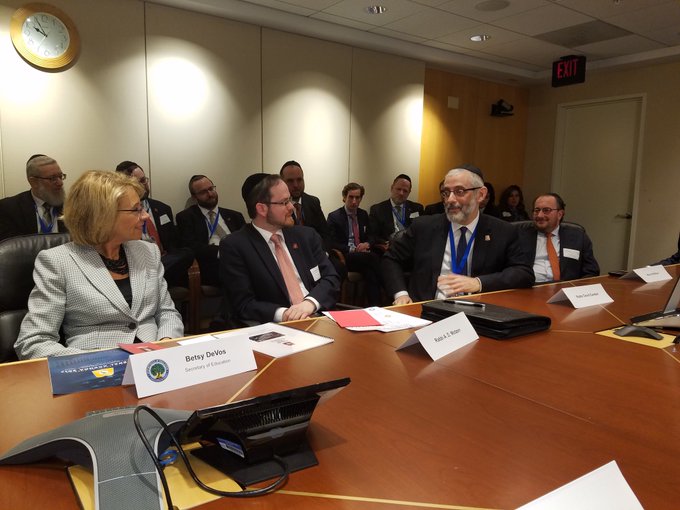
U.S. Education Secretary Betsy DeVos, who has made school “choice” a policy priority, met on Wednesday with leaders of an Orthodox Jewish group that has been instrumental in pushing voucher programs across the country. She praised their “leadership and commitment” in helping communities secure schools that “meet the academic and religious needs of their families” and said she looks forward to working with them.


View image on TwitterView image on TwitterView image on TwitterView image on Twitter

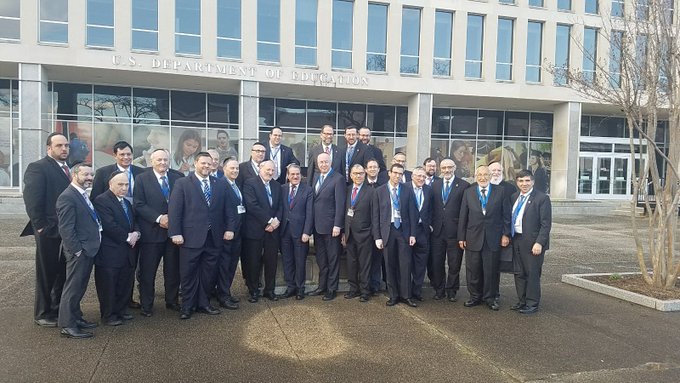
A truly historic meeting today at U.S. Dept of Education with the Secretary and Agudath Israel representatives. @BetsyDeVosED

DeVos met with leaders of Agudath Israel of America, which is based in New York and has active branches in more than 25 states, including Texas, Florida, California, Maryland and New Jersey. Its leaders have successfully lobbied for using public taxpayer dollars to subsidize religious schools in several states.
In a statement released Wednesday, March 8, 2017, about the meeting at the Education Department with Agudath Israel leaders, DeVos said:
I applaud Agudath Israel for their leadership and commitment to providing their community with access to educational options that meet the academic and religious needs of their families. Agudath is a terrific partner and advocate for their families, and I welcomed today’s discussion.
I look forward to continuing to work with Agudath Israel of America, the Orthodox Jewish community and all who believe that every child, regardless of where they live or their family’s income, should have an equal opportunity to a quality education.
DeVos and President Trump have made clear that expanding school choice is an education DeVos praises Orthodox Jewish group that strongly backs public funding for religious schools - The Washington Post:


Seattle Schools Community Forum: Levy Cliff Bill Passes

Seattle Schools Community Forum: Levy Cliff Bill Passes:

Levy Cliff Bill Passes

Image result for Levy Cliff Bill Passes
From Washington's Paramount Duty:

What an evening! The Senate passed Lisa Wellman's levy cliff delay bill! 

Huge thanks to all the parents, kids, educators, school board directors, superintendents, and administrators who tirelessly advocated. YOU made all the difference! This win is YOUR win! 

Many thanks to all the legislators who sponsored, supported, and voted for the levy cliff delay bill! 

Now, on to next challenge: meeting our constitutional paramount duty by amply funding public education!


From the News Tribune:
Senators approved Senate Bill 5023 on a 48-1 vote Wednesday, with only Sen. Michael Baumgartner, R-Spokane, voting no.

Read more here: http://www.thenewstribune.com/news/politics-government/article137342338.html#storylink=cpy

The caveat is that there is some amendment attached that the money cannot be used for "basic education."  Going to get details on that.

Here's the text of the so-called "accounting clause":


(13) For levies collected in calendar year 2018 and thereafter,
levy collections must be deposited into a local revenue subfund of the general fund to enable a detailed accounting of the amount and object of expenditures from the levy collections. The office of the superintendent of public instruction must collaborate with the office of the state auditor to develop guidance for districts to carry out this requirement.


(14) To ensure that levies for maintenance and operation support under RCW 84.52.053 are not used for basic education programs, beginning with ballot propositions submitted to the voters in calendar year 2018, districts must provide a report to the office of the superintendent of public instruction detailing the programs and activities to be funded through a maintenance and operation levy. Enrichment beyond the state-provided funding in the omnibus appropriations act for the basic education program components under RCW 28A.150.260 is a permitted use of maintenance and operation levies. The report required by this subsection must be submitted to, and approved by, the office of the superintendent of public instruction prior to the election for the proposition.
 On WPD Facebook comment says this:

Here's what both (13) and (14) mean: After January 1, 2018 (which is mid-year, next school year) local levy money will not/cannot be used for basic education. Period. And districts will need to go to OSPI first and ask the state's permission to fund various activities for locally approved levies before they ask voters to support it.

Yet another commenter said this:

I feel like this could create a weird dynamic where schools are suddenly arguing that things are not basic education so they can fund them through local levy dollars. Thus, diminishing the states responsibility. I supposed this fear comes from the other fear that we may not have an actual working solution at the end of this session. Am I alone on this?  
Seattle Schools Community Forum: Levy Cliff Bill Passes:


Tell Congress: "Don't cut Medicaid funding for services for disabled students." - Network For Public Education

Tell Congress: "Don't cut Medicaid funding for services for disabled students." - Network For Public Education:

Tell Congress: “Don’t cut Medicaid funding for services for disabled students.”


Did  you know that many schools use Medicaid funding to help cover the cost of services to students in special education? Medicaid funding is used for speech therapy, occupational therapy, special education providers, school-based health services and assistive devices, such as wheelchairs. In some states, Medicaid dollars are used by schools for vision and hearing screening for eligible students.
The American Association of School Administrators (AASA) estimates that districts receive about $4 billion a year through Medicaid funding. Read their informative booklet, which you can find here to find out how our most vulnerable students could be hurt by cuts.
Right now the House of Representatives led by Paul Ryan is debating whether to slash Medicaid or to shift it to a block grant as part of their “repeal and replace” the Affordable Care Act.  Neither choice is good for children. If a per-capita cap or block grant is enacted, schools would lose a dedicated funding source for services, and would have to compete with health care providers and hospitals for limited funds.
And all of this would be part of a budget package with large tax cuts for the rich.
We need you to act now.
1. Click here to send an email to your Congressperson.
2. Call todayCall your representative directly, or call the U.S. Capitol Switchboard at 202-224-3121.
The message is simple.
Tell Congress to keep their hands off Medicaid funds for kids.
Thank you for all you do.
Now please post this link on Facebook.
Tell Congress: "Don't cut Medicaid funding for services for disabled students." - Network For Public Education:

Education Lessons From A Sparkly District: PARCC Season Brings Desperate Actions by NJ Administrators. Again.

Education Lessons From A Sparkly District: PARCC Season Brings Desperate Actions by NJ Administrators. Again.:

PARCC Season Brings Desperate Actions by NJ Administrators. Again.


This time last year, as the NJ Department of Education (NJDOE) was cracking down on districts with high refusal rates, administrators across the state started doing some truly crazy and not well thought out things to students. I wrote two posts about it. You can read those posts here and here

Unfortunately, this year, we are already hearing stories from all over the state. Let me remind everyone this test still has not been validated. It's still hasn't even been run two years in a row. And, the supporting "evidence" of validity NJDOE claims, are not. You can read about that here

The story below was brought to my attention by parents who are deeply troubled by their children being used as pawns. Parental word should have been enough. What occurred goes to the very heart of trust. In this case, trust is now lost. Our children deserve so much better than this. 

In preparation for administering the PARCC test, many schools are testing their systems to see if it can handle the technology before the actual test. If you have not sent your letter in yet, the Save Our Schools NJ's refusal form (found here) has been used by parents for the past few years and it clearly states:


"I/we, ______refuse to allow our child(ren), ______, to participate in the following: PARCC Performance-Based Assessments, PARCC End-Of-Year Assessments, (and) Any test-prep activities, computer- or paper-based, associated with or designed to prepare for PARCC assessments". 
There is a growing group of angry parents in Washington Township (Gloucester County). Last year, this school district was first in South Jersey to write a resolution against the PARCC test. Several parents have tried to use the refusal form from the Save Our Schools NJ website and it Education Lessons From A Sparkly District: PARCC Season Brings Desperate Actions by NJ Administrators. Again.:


Badass Teachers Association: On Being Women by Delthea Simmons

Badass Teachers Association: On Being Women by Delthea Simmons:

On Being Women 

by Delthea Simmons

Being a woman is not a game
It's not about pussy hats
Not about cute t-shirts
Not about ironic or sarcastic memes

Being a woman is serious

it's not about a one day "strike"
It's not about chanting "77 cents"
It's not about a few women taking a day's leave from work while most woman dare not leave work for a day

Being a woman is hard

It's not about marching once and going home
It's not about selfies with celebrities on the National Mall
It's not about feeling inspired and proud and clapping hands and rocking bodies with arms locked to an old negro spiritual

Being a woman is continuous

Being a woman is work
It's about walking a gauntlet of cat calls and grabbing hands just to make it through a shift at work

It's about second hand stores and overrun bins and patches on patches for you so your kids can look decent at school

It's pleading with bill collectors and rent collectors and tax collectors for more time because your boss just can't seem to find the money that is your worth

It's being sick and tired of being sick and tired and risking the job you have to organized for the job you need

It's about jobs 2 and 3 that are not for extra money but I-Need-Every-Damn-Dime-to-Get-Through-the-Week money

It's about working sick, working hurt, running to the car on break to check on your kids because there is no money for childcare this week.

It's about running after buses everyday
It's about surveillance cameras and locker searches and peeing in a cup

It's about tears and fears and singing dirges and torch songs and every melody tuned to the blues searching for a deliverance gospel.

Being a woman is hard, and scarring, and scary and serious business.

And yet, ...

Women rise with every dawn and love on their kids and hug on their lovers and work on their jobs and laugh loud and draw crowds and find hidden joy even in the sorrow and never lose the hope of tomorrow and

Live on
Live on
Live on
Badass Teachers Association: On Being Women by Delthea Simmons:

California's Annual State Application for under Part B of the Individuals with Disabilities Education Act (IDEA) - Administration & Support (CA Dept of Education)

California's Annual State Application for 2017 - Administration & Support (CA Dept of Education):

California's Annual State Application for 2017

Annual State Application under Part B of the Individuals with Disabilities Education Act (IDEA) will be submitted by May 12, 2017, for federal fiscal year (FFY) 2017.

Image result for Individuals with Disabilities Education Act (IDEA)

The California Department of Education (CDE), Special Education Division, has completed its preliminary application for FFY 2017 federal funding under the Individuals with Disabilities Education Act (IDEA), as Amended in 2004, Public Law 108-446.
The state application is available for 60 days and public written comment will be accepted for at least 30 days prior to submission to the U.S. Department of Education, Office of Special Education Programs (OSEP). The date for written comments will be accepted and posted at a later time.
The IDEA established the content for the state’s application. Section I is comprised of the state’s Submission Statement for Part B of the IDEA. Section II of the state application includes a series of assurances and certifications of federal policies as detailed by the Education Department General Administrative Regulations (EDGAR). In addition, the state application also includes a chart indicating the allocation of federal funds (Section III); a list identifying any rule, regulation, or policy that is state-imposed, not required by IDEA or Federal regulations (Section IV). Maintenance of State Financial Support (Section V) is not part of the eligibility requirement for the state. OSEP requires the state to follow this application process for funding.
  • Section I - Submission Statement for Part B of IDEA and Section II - Assurances Related to Policies and Procedures(DOC; Posted 06-Mar-2017) 
    The state makes the assurances that it has policies and procedures in place as required by IDEA.
  • Section III - Description of Use of Funds Part B of IDEA (Posted 06-Mar-2017) and Excel Interactive Spreadsheet(XLS; Posted 18-Feb-2016) 
    This section will be updated at a later time.
     The estimate of how the state intends to utilize these funds. The final FFY 2017 allocation will be available after the California Legislature passes, and the Governor approves, the 2016–17 state budget. Until that time, the FFY 2016 Use of Funds Part B of IDEA is a preliminary estimate.
  • Section IV - State Administration (Posted 06-Mar-2017)
    List of state statutes, regulations, or policies that are state-imposed and are not required by the IDEA of 2004 or federal regulations. (Posted 06-Mar-2017)
  • Section V is not part of the eligibility requirement for the state. The state will provide the total amount of State financial support made available for special education and related services for children with disabilities by the most recent two State fiscal years (e.g. 2014–15 and 2015–16). At this time, the California Department of Education (CDE) has not calculated the final state special education apportionments for FY 2015 or 2016. Thus, the amounts shown for the Maintenance of State Financial Support for FY 2015 and FY 2016 are preliminary and based upon the most current certified special education appropriation amounts. Section V amounts will be provided later, when available.
Questions:   Jeffrey Reyes | PartBapp@cde.ca.gov | 916-327-3684


 California's Annual State Application for 2017 - Administration & Support (CA Dept of Education):

Women's Strike and International Women's Day is Tomorrow - Tips from Famous Protestor Bernardine Dohrn on Changing Policy

Women's Strike and International Women's Day is Tomorrow - Tips from Famous Protestor Bernardine Dohrn on Changing Policy:

How Women Can Strike Fear into the Patriarchy: Lessons from a 1960s Radicalist

Bernardine Dohrn, the most wanted woman in the world, on the power of protest.

Bernarndine Dohrn used to be a fugitive. After multiple arrests, she went into hiding and was on the lam for 11 years, even making it on to the FBI's Most Wanted List—one of the first women to appear there. All because she protested the U.S. government.

She's delighted that young women today are doing the same, she tells MarieClaire.com about the women's strike planned for March 8 and the women's march back in January. "I'm in awe of the young people who are showing up," Dohrn says. "Trump is a dangerous, dangerous, dangerous neo-fascist," she says. "Having somebody in office who said all of these hateful things about women, for example, or about Muslims, or about disabled people—the list goes on and on—is really frightening."
As a 20-something in the 1960s, Dohrn felt she was witnessing a frightening government abusing its power. She became a member of Students for a Democratic Society and later a leader of the Weather Underground. The radical left-wing organization bombed government buildings, incited violence, and organized "Days of Rage" in October 1969 encouraging protesters to smash windows and assault police officers.
On May 21, 1970, the group declared war on the United States; Dohrn was the one to read their statement to the press. "We've been trying to show how it is possible to overcome the frustration and impotence that comes from trying to reform this system," she said. "Tens of thousands have learned that protest and marches don't do it. Revolutionary violence is the only way." By the time she surrendered in 1980, most of the charges against her and her cohorts had been dropped due to the FBI's illegal methods of their pursuit.
The mother of the resistance, as she has come to be known, avoids comparisons between the protests of 1969 and today. "You live in your historical moment," she says. "One of the challenges that each person has is to name their historical moment so they can figure out where they fit, and therefore which issues or concerns have to be on their agenda." Still, she admits: "Young people today, by and large, they're more respectful than we were."
DOES DOHRN STILL STAND BY HER NOTORIOUS ASSERTION THAT "VIOLENCE IS THE ONLY WAY" TO BRING ABOUT CHANGE?
Modern protests thus far, while massive, have been remarkably peaceful—though it's imperative Women's Strike and International Women's Day is Tomorrow - Tips from Famous Protestor Bernardine Dohrn on Changing Policy:
Bernardine Dohrn FBI Wanted poster