Latest News and Comment from Education

Tuesday, March 7, 2017

Some Tax Credit Scholarships Have A Loophole For Wealthy Donors : NPR Ed : NPR

Some Tax Credit Scholarships Have A Loophole For Wealthy Donors : NPR Ed : NPR:

'Tax Credit Scholarships,' Praised By Trump, Turn Profits For Some Donors


President Trump has indicated several times now that his education agenda may feature a school choice program known as tax credit scholarships. He called it out in his first joint address to Congress last week, and followed that up with his first school visit as president this weekend: to a Catholic school in Florida which accepts several hundred students on the scholarships.
In these programs, sometimes called "neovouchers," people and companies earn tax credits by giving money to nonprofit scholarship funds. Students can use the scholarships to attend private schools, including religious schools. This is important because traditional school vouchers can run afoul of constitutional challenges if they allocate public money to religiously based organizations.
These programs have been growing quickly in the last few years, with a push by groups like the American Federation for Children and the American Legislative Exchange Council. They exist in 17 states and several more are currently considering them.
But as documented by Carl Davis of the Institute on Taxation & Economic Policy, and as advertised by financial advisors and the scholarship organizations themselves, in 10 of these states there is a quirk that allows individuals to turn a profit on their donations.


Here's how it works: Donors to these scholarship funds can offset their state tax liability by 70 to 100 cents for every dollar given. That's already generous compared Some Tax Credit Scholarships Have A Loophole For Wealthy Donors : NPR Ed : NPR:

Seattle Schools Community Forum: Dems Try Again on Levy Cliff; Republicans Say, "Time to Go"

Seattle Schools Community Forum: Dems Try Again on Levy Cliff; Republicans Say, "Time to Go":

Dems Try Again on Levy Cliff; Republicans Say, "Time to Go"

Image result for Time to Go

Here's how it played out (with the two major players here being Senator Marko Liias (D) and Senator Joe Fain (R).  

From Washington's Paramount Duty:


Thank you, Senate Democrats! Yesterday afternoon, they tried AGAIN to bring the Levy Cliff Delay Bill (SHB 1059) to floor via a 9th Order. How did the Senate Republicans respond? Instead of allowing a vote to save school districts from losing $500 million, the Senate Republicans adjourned at 5:09pm to avoid the vote. 

Here's what they recommend and I agree with one additional thing:

All state legislators need to hear from us: Democrats need a thank you and ask to NOT allow anything to pass until the Republican Senators allow a vote. Republicans need to hear: • It is inappropriate to hold our kids hostage like this.

• The Senate Republican plan requires $2.5 billion in unnamed cuts to other state services. That's unacceptable! It’s not a serious plan.
• We are not going to even consider the Senate Republicans’ plan until they pass the levy cliff bill.*
• We weren’t asking you to vote for it. We are telling you to vote for it, and we reject your reasons for not doing so.


*My change to that is to allow a vote.  It will pass if there is a vote. 


My add-on is that we should call the Governor and ask that he make it crystal-clear that he is not signing ANY bill until this one gets a vote.  

There is NO reason for this.  Voters HAVE already spoken on these levies and said yes to them and yes to their levy rates.  

And ANYONE who allows districts throughout the state to be hurt - with no 
Seattle Schools Community Forum: Dems Try Again on Levy Cliff; Republicans Say, "Time to Go":


Levy Cliff Impacts and GOP Senators
It can't be any clearer than this. Levy Cliff Impact: School District loss listed by Legislative District District 2 State Senator Randi Becker (R) Randi.becker@leg.wa.gov or 360 786-7602 School Districts Bethel$11.5M 

The 'Day Without A Woman' Strike Is Closing Schools Around The Country | The Huffington Post

The 'Day Without A Woman' Strike Is Closing Schools Around The Country | The Post:

The ‘Day Without A Woman’ Strike Is Closing Schools Around The Country
Schools are realizing they can’t operate without women.
Image result for “Day Without A Woman” strike

WASHINGTON ― Dozens of schools up and down the East Coast have announced they will be closed on Wednesday as their teachers, the vast majority of whom are women, participate in the “Day Without A Woman” strike to protest President Donald Trump.
All 16 public schools in Alexandria, Virginia, Chapel Hill-Carrboro City Schools in North Carolina, The New School in New York City and a preschool in Brooklyn, New York, have canceled classes for International Women’s Day on March 8, anticipating staff shortages. 
The Maple Street School in Brooklyn sent a letter to parents last week explaining that the preschool supports the political statement teachers are making by staying home. The school is still offering “backup care” that day to those who need it.
At Maple Street we have taught our kids, your kids, to have a voice, to use their words kindly but firmly, to always have a plan and think about the how and the why. We practice with them how to protest, how to march for a cause, the importance of giving back to their communities, how to identify injustice and we show them how much we love and truly support their diverse lives, personalities and family by embracing their individuality rather than pretending its not there.... [In] this spirit, we as a staff will show our kids that not only do we talk the talk but we do actually practice all that we teach them. 
The strike, created by the organizers of the historic Women’s March on Washington, asks women around the world to skip work, wear red and avoid spending money for a day. The purpose is not only to protest some of Trump’s offensive statements and policies regarding women, but to underscore how integral women are to the world economy. 
Wednesday’s protest will also remind the public how essential women are to education: More than three-quarters of kindergarten through high school teachers in the United States are women. Entire school districts are unable to operate without them. 
Alexandria City Public Schools’ website announced that more than 300 staff members requested leave for Wednesday, which “may be” attributed to observance of the strike. Though schools will be closed, many early childhood and afterschool programs will continue to meet. “This is not a decision that was made lightly,” the message reads.
Similarly, Chapel Hill-Carrboro City Schools announced last week that the district would be canceling classes because of the high volume of teachers interested in participating “Day Without A Woman.”
“I asked our school principals and central office department heads to survey staff to find out how many absences would occur,” Jim Causby, superintendent of the Chapel Hill-Carrboro City public school system, said in a statement. “The results came back, and the number was significant. In fact, it is my determination that we will not have enough staff to safely run our school district.”
The strike is also affecting higher education institutions. The New School, a university inThe 'Day Without A Woman' Strike Is Closing Schools Around The Country | The Post: 
Image result for “Day Without A Woman” strike

Pussyhat Global Virtual March
#pussyhatglobal

#Alex Hope..We ALL need hope!!

Connecticut’s ECS school funding formula should not be at the whim of the governor by Wendy Lecker - Wait What?

Connecticut’s ECS school funding formula should not be at the whim of the governor by Wendy Lecker - Wait What?:

Connecticut’s ECS school funding formula should not be at the whim of the governor by Wendy Lecker


In a recent commentary piece first published in the Stamford Advocate, education funding expert Wendy Lecker laid out the problems with Governor Dannel Malloy’s recently proposed school funding system.  Wendy Lecker writes.
Gov. Dannel P. Malloy spouts rhetoric about the “urgency” to make progress in finding a “fair” system for funding Connecticut’s schools. Unfortunately, his 2018-19 school funding proposals will take Connecticut backward in its struggle to adequately and equitably fund education.
A brief refresher on Connecticut’s funding formula, the Education Cost Sharing Formula (“ECS”): ECS is a foundation formula similar to that of many other states. It establishes a foundation amount, the amount of money necessary to educate a child with no special needs, then adjusts for poverty by adding a certain weight to that amount, and adjusts for the number of students in a district. It then uses a measure of town wealth to determine the state and local shares of the amount for each district. While a foundation formula is inherently sound, ECS has numerous flaws. The foundation amount was never based on the actual cost of educating a child, nor does the poverty weight reflect the true added cost of educating students living in poverty. Connecticut removed the weight for English Language Learners from the formula in 2013, though there is a recognized additional cost to educate these students. There was never a weight in the formula to account for the additional cost of educating students with disabilities.
The measurement of town wealth is also skewed.
These flaws drove CCJEF, in 2005, to commission an education adequacy cost study to determine the true cost of education in 
Connecticut’s ECS school funding formula should not be at the whim of the governor by Wendy Lecker - Wait What?:

So… What’s Wrong with School Choice (Privatization) at Public Expense? | janresseger

So… What’s Wrong with School Choice (Privatization) at Public Expense? | janresseger:

So… What’s Wrong with School Choice (Privatization) at Public Expense?

In his speech to a joint session of Congress last week, President Donald Trump extolled school choice, another name for offering students, at public expense, the opportunity to attend a privately operated school.  He asked Congress to “pass an education bill that funds school choice for disadvantaged youth, including millions of African American and Latino children. These families should be free to choose the public, private, charter, magnet, religious, or home school that is right for them.”  Betsy DeVos, the new education secretary, amplifies Trump’s preference for school choice with an adjective. She says families need a “robust” set of choices.
So what is wrong with school choice—school privatization—at public expense?  Here is some of what’s wrong.
FRAMING — First there is the deceptive framing by ideologues—inspired by economist Milton Friedman, and the foundation now called EdChoice, that he left behind as a legacy. Carl Davis of The American Prospect pays close attention to the language: “Politicians have long had a knack for framing policy proposals, however controversial, in terms that make them more palatable to voters… (S)chool voucher programs that funnel public money to religious schools are cast as ‘school choice,’ because underwriting parochial schools with taxpayer dollars is controversial. The ‘choice’ frame has heightened public awareness of school voucher programs, and helped their advocates make significant inroads in convincing states to allow the use of public dollars for private schools.”
DIVERSION OF TAX DOLLARS — Then there is the problem of diversion of tax dollars away from the schools that serve the mass of our children. Chalkbeat Indiana summarizes data about the large school voucher program launched six years ago by Governor Mitch Daniels and expanded later when Mike Pence was Indiana’s governor: “The state’s voucher program is one of the largest in the nation, and more than 34,000 students received vouchers in 2016-2017… To qualify for a voucher that is 90 percent of state tuition dollars, a family of four can’t earn more than $44,955 per year.  For a 50 percent voucher, a family of four can earn up to $89,910 per year… Indiana is expected to spend $146 million in 2017 and potentially $163 million in 2019 on vouchers due to higher anticipated participation.” Here is the most stunning fact: over half of the students in Indiana’s program—54.6 percent—have never attended a public school.  The state has simply begun paying for students to attend private schools.
WINDFALL FOR WEALTHY INVESTORS — Federal law permits large investors to claim state tuition tax credits as charitable donations and receive a federal income tax deduction.  Davis in The American Prospect explains: “Because taxpayers are also permitted to claim a federal charitable tax deduction on their donations to ‘neovoucher’ (state tuition tax credit) programsSo… What’s Wrong with School Choice (Privatization) at Public Expense? | janresseger:


Beware, SAT Season is Here | Truth in American Education

Beware, SAT Season is Here | Truth in American Education:

Beware, SAT Season is Here


Many school districts in the state of Washington administer the SAT to all of their 10th or 11th grade students.  School districts in other states may do the same.  Check your school and district calendars for SAT administration dates if it is administered at your local high schools.
Unwittingly, the majority of students provide personal information to the College Board that they don’t need to provide. It is supposed to be voluntary but students may not realize that or they don’t give any thought to what may be done with the information they provide. It is possible they are duped into providing this information.
Students may be asked to provide their social security number, religious affiliation, citizenship, family income, ethnicity, and other information that is not required in order to take the test.
The College Board eventually sells the student data they collect.
For more information read the Washington Post’s What your child needs to know before taking the SAT and ACT. This is also on the Parent Coalition for Student Privacy website.
I wonder if school administrators and school board members really know what information students are being asked to provide. If they really knew and cared, I would hope they would do something to stop this practice of data collection and protect student privacy. I wonder if taxpayers would support the administration of these tests in our schools if they knew the extent of the data being collected and that the College Board sells it.
  1. On Thursday or Friday, talk to your children about the importance of providing only the personal information necessary to take the test, and show them the SAT’s Student Search Service ™ screenshot below so they know what it might look like and which box to select (No, thanks.);
  2. Encourage them to go to bed early Friday night, get plenty of rest, and set the alarm (AM, not PM!);
  3. Serve a nutritious breakfast Saturday morning to your children and remind them to bring a photo ID, the “admission ticket,” NO. 2 pencils and an acceptable calculator from the College Board’s Test Day checklist;
  4. Remind them NOT to volunteer any personal information other than what is required like name, address, school, date of birth, etc., and that there is no reason to offer up their Social Security number, religious affiliation, family income, or other extraneous information. They should also CHECK the “No, thanks” box if there is one in the Student Search Service ™ section.
  5. Reassure them to relax and just do their best on the exam itself.
The Parent Coalition for Student Privacy also has Five Principles to Protect Student Privacy that you may want to become familiar with.
This article is being re-posted here with permission from The Underground Parent.Beware, SAT Season is Here | Truth in American Education:


"Decade of Betrayal": How the U.S. Expelled Over a Half Million U.S. Citizens to Mexico in 1930s | Portside

"Decade of Betrayal": How the U.S. Expelled Over a Half Million U.S. Citizens to Mexico in 1930s | Portside:

"Decade of Betrayal": How the U.S. Expelled Over a Half Million U.S. Citizens to Mexico in 1930s


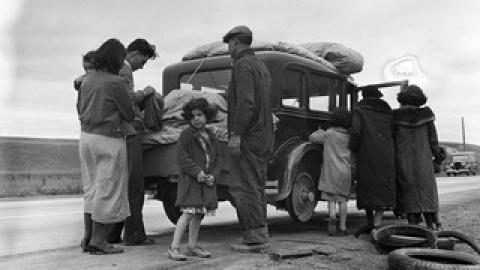
Mexican migrants on the road with flat tire, 1936. Looking for work in the peas. California.
President Donald Trump is slated to give his first presidential address to Congress today. Democratic lawmakers have begun giving their tickets away to immigrants as a protest against Trump’s push to increase deportations and to block residents from some Muslim-majority countries from entering the United States. Well, this is not the first time people of Mexican descent have been demonized, accused of stealing jobs, and forced to leave the country. During the Great Depression of the 1930s, more than a million people residing in the United States were deported to Mexico—about 60 percent of them were U.S. citizens of Mexican descent. We speak to the preeminent scholar on this often overlooked chapter of American history: Francisco Balderrama, professor of American history and Chicano studies at California State University, Los Angeles. He is co-author of "Decade of Betrayal: Mexican Repatriation in the 1930s."
AMY GOODMAN: "Deportee," this version sung by Joan Baez. The song was written by Woody Guthrie about a crash that killed 32 people, most of them migrant farmworkers who were being deported from California to Mexico. This is Democracy Now!, democracynow.org, The War and Peace Report. I’m Amy Goodman, with Juan González.
JUAN GONZÁLEZ: President Donald Trump is slated to give his first presidential address to Congress today. Democratic lawmakers have begun giving their tickets away to immigrants as a protest against Trump’s push to increase deportations and to block residents from some Muslim-majority countries from entering the United States. Last week, White House Press Secretary Sean Spicer said Trump wants to, quote, "take the shackles off" of the nation’s immigration agents.
PRESS SECRETARY SEAN SPICER: The president wanted to take the shackles off individuals in these agencies and say, "You have a mission. There are laws that need to be followed. You should do your mission and follow the law."
AMY GOODMAN: Last Thursday, President Trump called his deportation plans a military operation during a meeting with manufacturing CEOs.
PRESIDENT DONALD TRUMP: You see what’s happening at the border. All of a sudden, for the first time, we’re getting gang members out. We’re getting drug lords out. We’re getting really bad dudes out of this country and at a rate that nobody’s ever seen before. And they’re the bad ones. And it’s a military operation, because what has been allowed to come into our country, when you see gang violence that you’ve read about like never before and all of the things, much of that is people that are here illegally. And they’re rough, and they’re tough, but they’re not tough like our people. So we’re getting them out.
JUAN GONZÁLEZ: Well, this is not the first time people of Mexican descent have been demonized, accused of stealing jobs, and forced to leave the country. During the Great Depression of the 1930s, more than a million people residing in the United States were deported to Mexico. Some estimate as much as 60 percent of them were U.S. citizens of Mexican descent.
AMY GOODMAN: In 2003, then-California state Senator Joe Dunn held hearings in Sacramento, where survivors gave testimony about what happened to them during the forced expulsions, which the government called repatriations. This is Senator Dunn stressing the importance of the hearing.
SENJOE DUNN: The idea from which this nation was born was the promise to all of liberty and justice. Today we examine a tragic part of American history where we betrayed the justice part of that promise, and a betrayal that affected a staggering number of individuals. By some estimates, almost 2 million individuals were deported from the United States in the 1930s. Some estimate that almost 60 percent of those that were deported were United States citizens. And they were deported for but one reason: They just happened to be of Mexican descent.
AMY GOODMAN: The state of California went on to issue a formal apology for its role in the expulsions and built a memorial in downtown Los Angeles to "Decade of Betrayal": How the U.S. Expelled Over a Half Million U.S. Citizens to Mexico in 1930s | Portside:


Big Education Ape: Deportation inc | Ingles o español - http://bigeducationape.blogspot.com/2017/03/deportation-inc-ingles-o-espanol.html
Deportation inc


Betsy DeVos Shapes Denisha Merriweather’s Story into a School Choice Triumph | deutsch29

Betsy DeVos Shapes Denisha Merriweather’s Story into a School Choice Triumph | deutsch29:

Betsy DeVos Shapes Denisha Merriweather’s Story into a School Choice Triumph


One of the individuals present at Donald Trump’s address of Congress on Tuesday, February 28, 2017, was Denisha Merriweather, a graduate student who years earlier received a Florida Tax Credit Scholarship (i.e., voucher) that was delivered by the nonprofit administrator, Step Up for Students. (Merriweather also later worked for Step Up for Students as part of a growing career in advocating for vouchers.)


On March 03, 2017, following her visit with Trump to St. Andrew Catholic School in Orlando, Florida, DeVos issued this statement, which includes the following excerpt regarding Merriweather:
Denisha Merriweather, who was able to attend a private school when her public school did not meet her needs, exemplifies the hope and positive impact of school choice, and her story should serve as a model for the nation. [Emphasis added.]
According to DeVos, the story is this simple: A public school “did not meet” Merriweather’s “needs.” In a narrative that DeVos finds easy to market, the public school was (and is) the problem.
However, in Merriweather’s own testimony before the House Committee on Education and the Workforce in February 2016, she notes that she did not attend a single public school but was instead changing schools “constantly” as the result of her mother’s frequent moving:
When I was in elementary school in Jacksonville, Florida, my mother and I were moving around town constantly. That meant I kept changing schools, and I had a hard time re-adjusting to a new school, new teachers and new students every time we moved. Because we moved so much, I also missed several days of school, and when I got back into the classroom, it was hard to catch up. Needless to say, my grades were bad, and I didn’t understand most of my schoolwork. I got picked on by other kids because I was doing so poorly in school. And I kept getting into fights. I failed third grade. Not once, but twice. [Emphasis added.]
As Merriweather’s words attest, the underlying problem was not the quality of the public schools but the constant changing of schools that resulted in absences on top of having to frequently readjust to new school environments.
An important change in Merriweather’s life was the stabilization of her home situation, which occurred when she changed caregivers. At this point, in DeVos, voucher-selling Betsy DeVos Shapes Denisha Merriweather’s Story into a School Choice Triumph | deutsch29:


Text From My Speech at #March4EducationNY | The Jose Vilson

Text From My Speech at #March4EducationNY | The Jose Vilson:

Text From My Speech at #March4EducationNY

Image result for Text From My Speech at #March4EducationNY

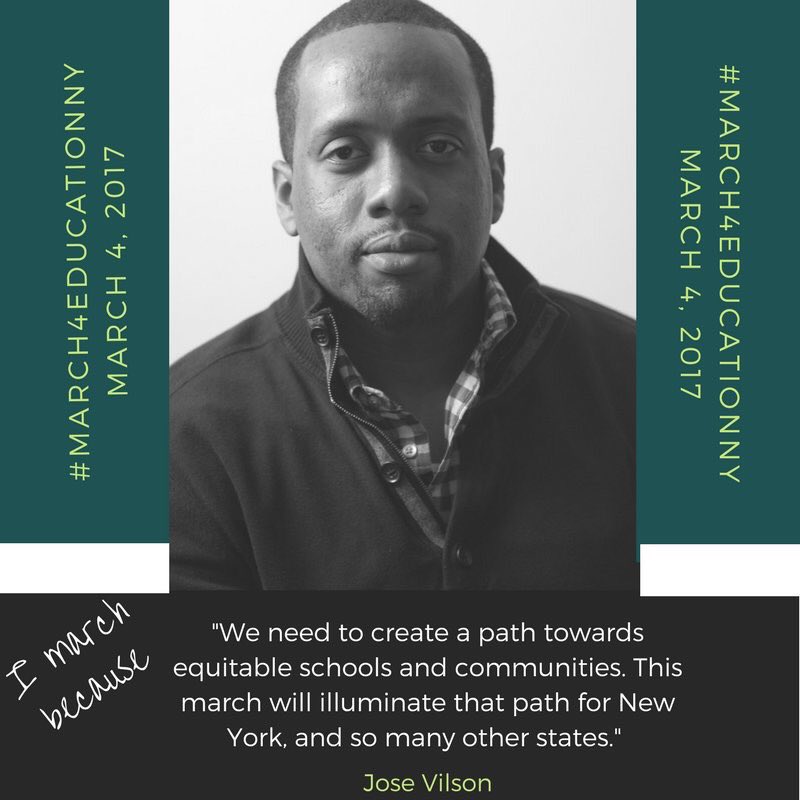
On Saturday, March 4th, 2017, The Alliance for Quality Education asked me to say a few words on behalf of educators across the state. Here is the video version of what I said. I forgot a few things, so here’s the text version of said speech. Thanks.
We are gathered here today to march for one of the most democratic experiments in the world: a public education and why it matters right now. As a teacher in New York City public schools, I’m used to defending our schools, our parents, and our kids: our kids who text their parents to make sure ICE didn’t issue a raid at their places of employ, our kids who have too many conversations about law enforcement in and out of school, our kids who are over tested and then called special when they don’t meet preordained standards, and our kids who are being told that all of this is normal. We cannot normalize these times, and that’s why we’re here today.
The current president of the United States, Donald Trump, says that public schools are a monopoly worth breaking up, and that our schools are part of the American carnage. Even though he never attended a public school in his life, and dodged public service with capitalist enthusiasm, he still blames us for the government’s failure to fully fund schools . Secretary of Education Betsy DeVos never went to public school either, but she says our teachers are in receivership, as if schools haven’t survived through the will and work of educators, parents, and students and not waiting for your favorite superhero. Governor Andrew Cuomo, who openly supports the pro-privatization rallies funded indirectly by donations from Ms. DeVos herself, this Andrew Cuomo believes children should be lucky enough to win a lottery for a well-funded school.
They believe in a market that doesn’t believe in us. The free market will not set us free. The free market can never be free if all of us aren’t.
We must resist the urge to agree. We march today because, regardless of where your children attend school, they must get equity in their educational opportunities. We must prioritize love, compassion, and resistance against forces that would do our students harm across race, gender, class, religious, and disability lines. We want great educational experiences for all children from the furthest tip of Long Island to the outskirts of Buffalo and everywhere in between, and it starts right here. We have to start now, and it starts with creating a safety net by which our most vulnerable can learn when we know lotteries will fail them. Not just a public education, but a truly democratic education.
We must not waste time. I’m a teacher. I’m ready to educate the kids and school these privateers.Text From My Speech at #March4EducationNY | The Jose Vilson:
Image result for Text From My Speech at #March4EducationNY

Badass Teachers Association: Banning Zinn's Books is White Washing History by Dr. Michael Flanagan

Badass Teachers Association: Banning Zinn's Books is White Washing History by Dr. Michael Flanagan:

Banning Zinn's Books is White Washing History 
by Dr. Michael Flanagan


An Arkansas legislator is attempting to have the writings of Howard Zinn, the author of A People’s History of the United States, banned from all public schools in the state. Republican State Representative Kim Hendren proposed the bill, HB 1834, last week to prevent Arkansas public schools from assigning any works from the legendary historian. This is not the first time a state has attempted to ban his books. Zinn, who died in 2010, was an inspiration for me personally when I was studying history. He wrote from the perspective of those who suffered from the slavery, genocide, racism and oppression of the imperialistic history of the United States. His writing is a counter to the revisionist rhetoric propagated by politicians and printed in public school textbooks throughout the nation’s public schools. He is a controversial figure among historians and academics, and the nature of his work spurs debate in any academic setting. At a time when our current presidential administration is running on the propaganda of “Make America Great Again” politicians in “red states” do not want students critically examining the factual history of our country.  


Censorship of political oppression and crimes against humanity is nothing new. The U.S. has a long history of banning books that conflict with the social, religious and political ideas of those in power. The most banned books in U.S. history are: The Adventures of Huckleberry Finn, Candide, Brave New World, 1984, The Catcher in the Rye, Lolita, I Know Why the Caged Bird Sings, The Anarchist's Handbook, The Satanic Verses, and the Harry Potter series. Besides literature, there have been many textbook publishers who have altered or deleted content in order to guarantee sales in a particular region.  


The Supreme Court has attempted to rule on book banning cases that Badass Teachers Association: Banning Zinn's Books is White Washing History by Dr. Michael Flanagan:

An Education Activist’s Dirty Little Secret « Dad Gone Wild

An Education Activist’s Dirty Little Secret « Dad Gone Wild:

An Education Activist’s Dirty Little Secret 

What I am most proud of is that this Blog has earned a sense of trust from educators. I am not a professional educator nor do I play one on TV. I’m just a parent that talks to a lot of educators and tries to convey their stories along with my observations as a parent. Every once in a while I get someone who asks if I would be willing to share something they wrote. I invariably say yes. The below was sent to me by an experienced teacher and it further explores the theme of not getting blinded by ideology.  The issues are seldom as simple as we like to paint them. Thank you Mary Jo Cramb.

I first got inspired to get involved in education advocacy and activism when I read Diane Ravitch’s Reign of Error, then saw her speak here in Nashville. I stated attending meetings of the Badass Teachers, Coalition Advocating for Public Education, Statewide Organizing for Community Empowerment, and other groups, and I’ve made some good friends through these organizations. Since having my second kid, this work comprises a good portion of the adult socializing I get to do outside of my job and family. But there’s one thing I haven’t been very open about with my fellow advocates. I’ve been hiding a dirty little secret, and it’s time I came clean.
I got into teaching through the Nashville Teaching Fellows program (NTF), which is a local chapter of The New Teacher Project (TNTP). Education advocates and teacher activists don’t like this program, or its better-known, more insidious sister, Teach for America (TFA). I know their criticisms now, and agree with them. These programs devalue the teaching profession and throw newbies into the classroom with little training or hope of success. In exposing my past involvement with this organization, I hope to explain why I made the choices I did, and what these programs expose about larger problems in teacher education.
NTF, and its national organization, TNTP, are less objectionable than TFA for several reasons. The goal of TNTP is to recruit and train people who will make teaching their career, while TFA aims at selecting people who will move on to “bigger and better things” after completing their two-year commitment. I’ve heard that expressing enthusiasm for An Education Activist’s Dirty Little Secret « Dad Gone Wild: