Latest News and Comment from Education

Monday, March 6, 2017

You’ll never think about mass media the same way again after watching this Noam Chomsky documentary

You’ll never think about mass media the same way again after watching this Noam Chomsky documentary:

You’ll never think about mass media the same way again after watching this Noam Chomsky documentary


Nearly 30 years before President Trump’s press gaggle last Friday, Noam Chomsky and Edward Herman authored ‘”Manufacturing Consent“, a book that radically redefined mass media’s relationship with the state.
Now, in the age of fake news and alt facts, Democracy Now! co-founder Amy Goodman and animator Pierangelo Pirak have teamed up to give new life to the world renowned linguist and media analyst’s famed work.
“Propaganda,” Goodman begins in her narration of the cartoon. “Many use the word when talking about countries like North Korea, Kazakhstan, Iran, Countries viewed as authoritarian through the lens of the western media. ‘Press freedom’. ‘Freedom of thought’. People use those terms when talking about countries like the United States, France, Australia. ‘Democracies’.”
In 1988, “Manufacturing Consent” “blasted apart the notion that media acts as a check on political power,” Goodman explains as a myriad of mouthy orange villains murmur ominously in a machine-like universe.
“That media inform the public, serve the public so that we can better engage in the political process,” Goodman continues. “In fact, media manufacture our consent. They tell us what those in power need them to tell us … so we can fall in line. Democracy is staged with the help of media that work as propaganda machines.”
The cartoon then shows a one eye monster instructing his minions in an assembly line process to churn out news.
“Media operate through five filters,” Goodman says, referencing Chomsky’s initial pillars in the book.
“The first has to do with ownership. Mass media firms are big corporations,” she explains. “Often, they are part of even bigger conglomerates. Their end game? Profit. And so it’s in their interests to push for whatever guarantees that profit.”
Naturally, critical journalism must take second place to the needs and interests of the corporation.
“The second filter exposes the real role of advertising,” Goodman tells us. “Media costs a lot more than consumers will ever pay. So who fills the gap? Advertisers. And what are the advertisers paying for? Audiences. And so it isn’t so much that the media are selling you a product — their output. They are also selling advertisers a product — YOU.”
The establishment then manages the media through the third filter.
“Manufacturing Consent” argues that “Journalism cannot be a check on power because the very system encourages complicity,” Goodman points out.
“Governments, corporations, big institutions know how to play the media game,” she notes. “They know how to influence the news narrative. They feed media scoops, official accounts, interviews with the ‘experts’. They make themselves crucial to the process of journalism. So, those in power and those who report on them are in bed with each other.”
In 1988, Chomsky and Herman offered a warning to journalists that has proven prescient in the age of Trump.
“If you want to challenge power, you’ll be pushed to the margins,” Goodman sums up. “When the media – journalists, whistleblowers, sources – stray away from the consensus, they get ‘flak’.”
This is the fourth filter.
“When the story is inconvenient for the powers that be, you’ll see the flak machine in action discrediting sources, trashing stories and diverting the conversation,” Goodman adds.
Hours before Friday’s press gaggle, President Trump heavily criticized anonymous sourcing in his CPAC speech, even though he’d repeatedly used the same tactics to discredit President Obama during his time in office.
“To manufacture consent, you need an enemy — a target,” Goodman revealed. “That common enemy is the fifth filter. Communism. Terrorists. Immigrants. A common enemy, a bogeyman to fear, helps corral public opinion.”
Watch:
You’ll never think about mass media the same way again after watching this Noam Chomsky documentary:


Seattle Schools Community Forum: Superintendent Nyland's Letter on Budget

Seattle Schools Community Forum: Superintendent Nyland's Letter on Budget:

Superintendent Nyland's Letter on Budget

Image result for Superintendent Nyland's Letter on Budget

I assume that many of you may have seen this but in case you have not, here is

Dr. Nyland's March 2 Letter to Families Regarding Budget Update.
 
(The highlighted area in red is mine indicating where I think the most people will see the impact.  I will have to ask about the class size reduction situation as I thought K-3 was protected.)
2017-18 Potential Budget Deficit Update

Dear Seattle Public Schools Families:

This is an update on next year’s budget situation. As you know, due to the state’s delay in fully funding education, Seattle Public Schools faces a $74 million budget shortfall for 2017-18.

As a district, we must advocate for both short and long term funding solutions. It is important the Legislature’s proposed solutions address our 2017-18 deficit as well as ensure we can offer our students a 21st century education for years to come.


Short Term Solution

Most of the 2017-18 budget shortfall is related to salaries and compensation, something the state should be fully funding, but $30 million of our deficit is because the state has reduced how much we can collect from already approved local levies. Unless the state Legislature takes action, our local levy authority will reduce before the state has provided additional funding to backfill for the decrease.
This misalignment of state activities is called the Levy Cliff. Our Seattle Legislative delegation has been working diligently to obtain temporary relief from the Levy Cliff. I want to thank our delegation for their good work and we remain cautiously hopeful there will be a positive solution for Seattle, but it is unclear when relief may be provided and how much funding will be restored. While a Levy Cliff bill has passed the House of Representatives, the Senate has not acted upon it.


Long Term Solution

There are four state education budget plans on the table right now: the governor’s education plan, House Democrats’ HB1843, Senate Republicans’ SB5607, and SB5825 sponsored by Senator Mullet. The good news is all Seattle Schools Community Forum: Superintendent Nyland's Letter on Budget:


These L.A. school board candidates have a message, but little money to get it out - LA Times

These L.A. school board candidates have a message, but little money to get it out - LA Times:

These L.A. school board candidates have a message, but little money to get it out 


In District 2, which includes downtown and nearby neighborhoods, veteran Roosevelt High teacher Lisa Alva, 56, proved to be a crowd favorite with an audience of mostly high school students during a recent campaign forum. She also successfully wooed the union representing district administrators, which endorsed her.
But her own union, United Teachers Los Angeles, held back, making no choice in the contest — possibly that’s because Alva has been critical at times of the union. Labor sources said they feared it would be wasting money to take on incumbent Monica Garcia, who has funding from charter backers and deep community ties.
At the campaign forum, Alva talked about classroom issues such as a district discipline program. She said it’s well-intentioned but poorly executed, sometimes making learning more difficult in the classroom. She’s raised $13,212 for her campaign.
Also in that race is Carl J. Petersen, 49, a father of five, including children with special needs.
“The district made me fight for the services that my daughters’ teachers agreed they required,” he said.
Overall, his views probably align more closely with the teachers union than any other challenger. As a parent activist, he’s repeatedly targeted alleged misconduct at charter schools, through blog posts and public records requests.
He is director of logistics at a company that makes high-definition security cameras.
Petersen ran unsuccessfully two years ago for the west San Fernando Valley board seat, then moved to District 2 to run again. He’s raised $2,999.
Three of the four candidates in District 4, incumbent Steve Zimmer and challengers Allison Holdorff Polhill and Nick Melvoin, have considerable outside financial backing. Gregory Martayan, who’s raised $71,475, is the other one.These L.A. school board candidates have a message, but little money to get it out - LA Times:

NPE Action Endorsements

 NPE Action


ALERT – Legislation seeking to undo student privacy protections now before CT Legislature’s Education Committee - Wait What?

ALERT – Legislation seeking to undo student privacy protections now before CT Legislature’s Education Committee - Wait What?:

ALERT – Legislation seeking to undo student privacy protections now before CT Legislature’s Education Committee


In this day and age of widespread data breaches, Governor Dannel Malloy, Attorney General George Jepsen and an overwhelming majority of Connecticut state legislators say they support privacy protections.  They’ve even passed laws that guarantee notification and required protection for those whose data has been breached.
But in an incredibly underhanded maneuver, a new bill is being considered by the Education Committee that would roll back critically important protections for parents and children if data collected at school is breached.
House Bill 7207 strips the protection that students currently have by repealing the existing requirement that parents be notified if their child’s information is released via a corporate breach.
One would think that elected officials would be outraged, but with industry lobbying seeking to turn back the clock on these important notification requirements there is only silence from Governor Dannel Malloy and Attorney General George Jepsen — both of whom publicly bragged about their commitment to protecting Connecticut residents from data breaches.
In fact, just two years ago, Malloy and Jepsen pushed for legislative action requiring companies to notify and protect residents in the case of a breach and last year Malloy signed the new education law (Public Act 16-189) which targeted companies that do business with public schools.
But now with the new push to undo those protections, Malloy and Jepsen are nowhere to be seen.
As the parent run Connecticut Alliance for Student Privacy explains,
This year’s proposed bill (HB 7207) delays the effective date of the law passed last session from October 1, 2016 to July 1, 2018. 


Stress, Race, Class, and School by Jonathan Glater - Education Law Prof Blog

Education Law Prof Blog:

Stress, Race, Class, and School 
by Jonathan Glater


With the advent of the new administration in Washington, levels of stress are rising for members of minority groups of various kinds – religions minorities, Latinos, African Americans, recent immigrants, to name just a few.  This has gotten me thinking about research on the effects of stress that perhaps has gone underappreciated in legal academy.
In a provocative article that came out in the American Psychologist this fall, a team of researchers at Northwestern University has suggested that stress related to race contributes to differences in academic performance between students who belong to racial minority groups and students who do not.  This paper is behind a pay wall for now, but much of the research that builds up to it is not, and a PowerPoint presentation that Prof. Adam used presenting the underlying data at Stanford last year is available here.
The article, Psychological and Biological Responses to Race-Based Social Stress as Pathways to Disparities in Educational Outcomes, begins with a concise survey of research on differences in academic performance among different racial/ethnic groups.  Disparities in academic performance track differences in class, defined by parental education and/or by income level, as well as race, but class does not explain all the difference.  The authors, a team consisting of Dorainne J. Levy, Jennifer Heissel, Jennifer A. Richeson, and Emma K. Adam, propose that response to stress may contribute to the explanation.
Psychological stressors, including stereotype threat and perceived discrimination, affect levels of cortisol, a hormone, in the body.  Sustained and elevated levels of cortisol can adversely affect executive functions, including attention and memory – both critical to good academic performance.  Race-based stress may also affect sleep patterns and less, or lower-quality, sleep also affects academic performance adversely.
The analysis and argument of the article builds upon a prior research project that involved all of the authors and Education Law Prof Blog:


Bye, bye food pyramid, welcome a new way to eat in school

Bye, bye food pyramid, welcome a new way to eat in school:

Bye, bye food pyramid, welcome a new way to eat in school

Image result for lily's blackboard

For decades, the food pyramid was our basic guide for healthy eating until it was replaced with…what?
The dedicated dieticians and dietary technicians, creative cooks, and other fantastic food service professionals who create nutritious recipes, prepare meals and serve millions of students every day know the answer. And you will, too—if you read to the end of this post.
March is National Nutrition Month, the annual reminder for us to turn away from the dessert table (at least most of the time) and develop healthier eating habits. And March 6-10 is School Breakfast Week, when parents, students and school employees are encouraged to “Take the School Breakfast Challenge” by starting each day with a healthy breakfast.
As a former lunch lady myself, I’m proud to give a shout out to the 40,000 NEA members who are food- service professionals, and all of the 256,000 food-service professionals in the K-12 workforce. Every day, they provide students with the fuel they need for the important work of learning.
Food-service professionals will be joining with other education support professionals next week for the 2017 NEA ESP Conference, March 10-12, in Dallas. They’ll participate in workshops on how to build stronger locals and organize members, develop leadership skills and enhance their advocacy skills for students.
Advocacy brought us the School Breakfast Program, which began in 1966 as a pilot program and provides funds to schools that serve free or reduced-price breakfast, and became permanent in 1975. But many schools, aware of the stigma that can be associated with receiving a free meal, provide universal breakfast programs for all students.
Research backs up what we know from our own experience: When you’re hungry, it’s hard to do anything that takes brainpower. The Food Research & Action Center says that academic problems, as well as behavioral and emotional problems, go up among kids who are hungry.
The Healthy, Hunger-Free Kids Act, which took effect in 2014, helps schools do more for hungry students. The act authorized more funding for subsidized school lunches, increasing the number of children served, and authorized the USDA to provide meals for after-school programs in high-poverty areas. It also provided resources for schools to use produce from local farms and gardens and gave the USDA authority to set new, healthier standards for food in lunches.
Now, back to the old food pyramid, our former guide for what we should eat. What replaced it? MyPlate, a place setting illustrating the food groups that are part of a healthy diet. Fruits and veggies cover half the plate, while grains and proteins take up about a quarter each. You’ll notice that there’s no dessert on MyPlate. But let’s be bold and split a slice of cheesecake—we just won’t tell anybody.


Bonus: Ten free things for National School Nutrition Month (and School Breakfast Week)

Bye, bye food pyramid, welcome a new way to eat in school:

Yes! Knowledgeable Charter Supporter Worries that Charter School Growth is Flat-Lining | janresseger

Yes! Knowledgeable Charter Supporter Worries that Charter School Growth is Flat-Lining | janresseger:

Yes! Knowledgeable Charter Supporter Worries that Charter School Growth is Flat-Lining


President Donald Trump and Secretary of Education Betsy DeVos have been down in Florida visiting a Catholic school where 291 of the school’s 340 students use the Florida Tax Credit Scholarship Program to pay all or part of their tuition. And on Friday, Diane Ravitch reported on her blog that Eva Moskowitz and her Success Academy Charter Schools chain has just rented Radio City Music Hall at Rockefeller Center in New York City for her schools’ annual test-prep rally. What Eva is paying to rent the hall isn’t known, although POLITICO New York reported that Success Academies spent $734,000 on their 2015 test-prep rally.
All this hype about privatization makes it seem that those of us who depend on our local public schools—the families of 90 percent of American children who are enrolled in public schools and the rest of us who count on these institutions as the anchors of our neighborhoods and our communities—have cause for despair. And despite that President Donald Trump has told us that public schools across America are “flush with cash,” the Center on Budget and Policy Priorities informs us that, “At least 23 states will provide less ‘general’ or ‘formula’ funding—the primary form of state support for elementary and secondary schools—in the current school year (2017) than when the Great Recession took hold in 2008.”
But here is a startling piece of good news from Robin Lake, one of the nation’s biggest supporters of the expansion of charter schools and the director of the Center on Reinventing Public Education at the University of Washington. Lake is worried. She and her colleagues have concluded that charter school growth is flat-lining.
Lake introduces her new article published in Education Next, a journal that endorses corporate school reform, with this warning: “A recently released annual update from the National Alliance for Public Charter Schools included a surprising fact: a mere 329 charter Yes! Knowledgeable Charter Supporter Worries that Charter School Growth is Flat-Lining | janresseger:


Mike Klonsky's SmallTalk Blog: WEEKEND QUOTABLES

Mike Klonsky's SmallTalk Blog: WEEKEND QUOTABLES:

WEEKEND QUOTABLES


Donald Trump

 “I love Caterpillar. I’ve been driving them for a long time.” -- Feds dig in: Agents raid Trump-touted Caterpillar 
Noble Charter School Teachers

“Today, we the Union of Noble Educators are announcing our effort to organize teachers and staff across the @benobleschools!” 
“We are passionate, committed, professional teachers and staff with diverse experiences in the Noble Network of Charter Schools,” they wrote in an open letter signed so far by 140 of more than 800 staffers. “We see our students every day and know they are better served by a lasting staff that can advocate for their schools. To this end, we seek a voice at Noble and beyond.” -- CBS Chicago
Jesse Jackson

The decision on private prisons reflects Trump’s desire to repeal all things Obama. It expresses the ideological bias of reactionaries like Sessions toward privatizing public functions. It also reveals the pervasive corruption already apparent in the Trump administration. -- Sun-Times
Danny Glover
Danny Glover at the March on Mississippi

"I don't abdicate my responsibility as a citizen. I don't need to abdicate (my responsibilities) for better education for kids and reading programs and all that other stuff. That's what a citizen does....that's what a human being does as part of a community." --  NBC
 Betsy DeVos makes course correction 

When DeVos addressed HBCU leaders directly the next day, she struck a different tone, saying: "Your history was born, not out of mere choice, but out of necessity, in the face of racism, and in the aftermath of the Civil War." -- nprED
Mike Klonsky's SmallTalk Blog: WEEKEND QUOTABLES:

With A Brooklyn Accent: Immigration Control Through Intimidation: Deportations The Trump Way

With A Brooklyn Accent: Immigration Control Through Intimidation: Deportations The Trump Way:

Immigration Control Through Intimidation: Deportations The Trump Way


It is not clear the ICE is deporting more people under Trump than it was under Obama. What is changed is who they are deporting and how. In a number highly publicized incidents that are now too numerous to be accidents, the Trump ICE is going after people who have committed no violent crimes, who are part of families well.established in local communities, and doing so with "shock and awe" tactics that spread fear among immigrants of color. The goal seems to be to create such fear that immigrants of color will chose to go home, or will cancel their plans to come to the US.I call this strategy "Immigration Control Through Intimidation." It has pitted neighbor against neighbor, traumatized tens of millions of people and made many others wonder what kind of country they are living in. Any policy whose conscious goal is to create fear in large number of vulnerable people deeply compromises the society which chooses to implement it.With A Brooklyn Accent: Immigration Control Through Intimidation: Deportations The Trump Way:


Big Education Ape: Deportation inc | Ingles o español - http://bigeducationape.blogspot.com/2017/03/deportation-inc-ingles-o-espanol.html

Deportation inc

Vouchers Are Not a Viable Solution for Vast Swaths of America – Center for American Progress

Vouchers Are Not a Viable Solution for Vast Swaths of America – Center for American Progress:

Vouchers Are Not a Viable Solution for Vast Swaths of America

President Donald Trump offered one major K-12 education proposal during the presidential campaign: a $20 billion plan that would reprioritize existing federal education funds to provide vouchers for private-school choice. And with his selection of Betsy DeVos as secretary of education, who has been referred to as the “four-star general of the pro-voucher movement,” he signaled the seriousness with which he intends to pursue this idea as a solution to what Trump has called “failing government schools” and DeVos has called a “dead end” public education system.
Much has been written about the devastating impact such a proposal would have on local communities, since $20 billion would subsume most federal K-12 education spending. Currently, that spending is specifically targeted to low-income students, students with disabilities, English language learners, and other vulnerable children. But little has been written about the fact that the proposal misses the mark when it comes to the real challenges facing the vast majority of school districts across the country. The simple fact is that most rural and suburban areas are either sparsely populated or organized in small districts where there are not enough schools for vouchers to be a viable or effective policy solution. In these districts, vouchers would be not just ineffective, but they could also dramatically destabilize public school systems and communities.
Underscoring this point is the fact that Republican Sens. Lisa Murkowski (AK), Susan Collins (ME), and Mike Enzi (WY) all used their limited time for questions during DeVos’ confirmation hearing to speak about the special challenges facing rural and frontier schools in their states.
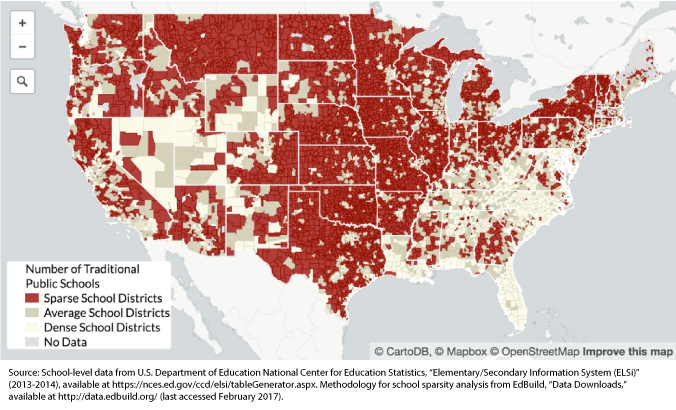
In order to examine the viability of vouchers throughout the nation, the Center for American Progress used data and visuals published by EdBuild, a national nonprofit focused on improving the way states fund public schools. The organization mapped data from the National Center for Education Statistics to visualize the density and diversity of America’s school districts. The goal was to get a handle on the number of schools in districts of varying size across the country and the locations of those districts. The interactive map allows users to see where districts are that fit into the following categories:
  • Sparse districts: a unified school district with four or fewer schools, an elementary-school-only district with three or fewer schools, or a secondary-school-only district with two or fewer schools
  • Average districts: a unified school district with five to eight schools, an elementary-school-only district with four to five schools, or a secondary-school-only district with three to five schools
  • Dense districts: a unified school district with nine or more schools, an elementary-school-only district with six or more schools, or a secondary-school-only district with six or more schools

Click here to view the full interactive map.


The findings underscore the severe limitations of President Trump and Secretary DeVos’ one-size-fits-all vision of nationalizing private-school vouchers. Public education in America is far from one-size-fits-all, and there is dramatic diversity within the more than 13,000 school districts across the nation—from the 1 million students in New York City’s more than 1,500 public schools, to the 60 students at the K-8 school on Beals Island, Maine, and its 100-student high school shared with the nearby town of Jonesport. Diversity can also be found among the 67 countywide districts in Florida educating more than 2.5 million students, the 545 districts in New Jersey educating nearly 1.3 million students, and the 413 districts educating fewer than 150,000 students in Montana.
When CAP staff members looked at the data, they found that there are:
  • Nearly 9,000 sparse school districts that have four or fewer schools where voucher proposals are highly unlikely to work and could decimate the public system
  • Another 2,200 average school districts that have five to eight schools where vouchers may not work and risk harming existing schools’ ability to serve millions of students
After excluding charter schools and regional agencies that are legally considered school Vouchers Are Not a Viable Solution for Vast Swaths of America – Center for American Progress:


Choosing Democracy: Republicans Pursue Vouchers and Privatized Education

Choosing Democracy: Republicans Pursue Vouchers and Privatized Education:

Republicans Pursue Vouchers and Privatized Education


The Choices in Education Act 2017 (HR 610), introduced Jan. 23 and now in the House Committee on Education and the Workforce, repeals the Elementary and Secondary Education Act which has provided federal funds to address inequities in public schools since 1965. In its place, block grants would go to states that have adopted voucher plans, enabling parents to use public funds to enroll their children in any public or private school. While over 100 bills are now in this committee and most will die there, the fact that this one embodies Secretary Betsy DeVos’s vision for education suggests it will likely be taken up.

This bill is misguided for several reasons. First, while evidence should guide policy, evidence does not show that voucher programs consistently improve student learning. Mark Dynarski of the Brookings Institute analyzed the research in a 2016 issue of Evidence Speaks Reports. He found mixed results: while some students benefited from the New York and Washington, D.C., programs, the same cannot be said of the Milwaukee program. The two most recent and largest studies found that public school students who received vouchers to attend private schools in Indiana and Louisiana, both with statewide voucher programs, actually achieved worse than their counterparts in public schools. Dynarski suspects one reason is that public schools have improved over the last few years, closing what previously had been an achievement gap between them and private schools.
A second reason this bill is misguided is that it requires states to adopt voucher programs, whether desired or not, in order to receive federal funds. California’s voters rejected private school voucher initiatives twice (1993 and 2000). Further, California’s Constitution prohibits using public funds to support “sectarian or denominational” schools, or schools not under public control. So, HR 610 would force California to change its Constitution to enable a plan voters have rejected, in order to prevent school districts, particularly in poorer communities, from losing federal funds.

Currently federal funds provide between 1 percent and 9 percent of the budgets of school districts in Monterey County. The largest earmark is for Title I, which funds services for students from low-income families. Title I as it has operated has shown mixed results. In a 2015 issue of Evidence Speaks Reports, Dynarski and Kainz suggest one problem is that the money is spread too thinly. About half of all school districts qualify, resulting in Title I adding only about 5 percent more money per student, not enough for robust services targeted to the neediest students. Another problem is that much of the money is not spent on interventions that have demonstrated making a difference, such as an intensive program in Chicago that is producing large achievement gains in mathematics among high Choosing Democracy: Republicans Pursue Vouchers and Privatized Education:


Blaine Amendment Challenge in Limbo at the US Supreme Court | deutsch29

Blaine Amendment Challenge in Limbo at the US Supreme Court | deutsch29:

Blaine Amendment Challenge in Limbo at the US Supreme Court


On March 04, 2017, I wrote a post about the Blaine Amendment, which was never incorporated into the US Constitution but variations of which have been adopted in 37 or 38 states.
In short, the purpose of a Blaine amendment is to restrict the use of public money in funding religious (“sectarian”) schools.
The strength of any state’s Blaine amendment depends upon the specificity and directness of the language. As noted in the March 04, 2017, post, the language of Blaine amendments in some states is so tight that there is no way to sidestep the amendment by, say, indirectly using public money to fund religious schools by giving the money to the parent first and then having the parent use the money to pay the religious school.
Interestingly, in 2011, a challenge to Colorado’s Blaine amendment, Taxpayers for Public Education vs. Douglas County School District, went all the way to the Colorado Supreme Court (June 2015) and then, a reshaped case in which petitioner became defendant, Douglas County School District vs. Taxpayers for Public Education, headed for the US Supreme Court in October 2015.
In June 2015, the Colorado Supreme Court declared unconstitutional the use of public money in the form of school vouchers to pay for religious schools.
Below are some salient excerpts from the Colorado Supreme Court ruling
 The Colorado Constitution features broad, unequivocal language forbidding the State from using public money to fund religious schools. Specifically, article IX, section 7—entitled “Aid to private schools, churches, sectarian purpose, forbidden”— includes the following proscriptive language:
Neither the general assembly, nor any county, city, town, township, school district or other public corporation, shall ever make any appropriation, or pay from any public fund or moneys whatever, anything in aid of any church or sectarian society, or for any sectarian purpose, or to help support or sustain any school, academy, seminary, college, university or other literary or scientific institution, controlled by any church or sectarian denomination whatsoever . . . . (Emphasis added.)
Although this provision uses the term “sectarian” rather than “religious,” the two words are synonymous. See Black’s Law Dictionary 1557 (10th ed. 2014) (defining “sectarian” as “[o]f, relating to, or involving a particular religious sect; esp., supporting a particular religious group and its beliefs”). That section 7 twice equates the term “sectarian” with the word “church” only reinforces this point. Therefore, this stark constitutional provision makes one thing clear: A school district may not aid religious schools.
Yet aiding religious schools is exactly what the CSP [Choice Scholarship Pilot Program] does. The CSP essentially functions as a recruitment program, teaming with various religious schools (i.e., the Private School Partners) and encouraging students to attend those schools via the inducement of 
Blaine Amendment Challenge in Limbo at the US Supreme Court | deutsch29:


We March For Education Justice by Luz Christina Ramirez Mooney - Badass Teachers Association:

Badass Teachers Association: We March For Education Justice by Luz Christina Ramirez Mooney:

We March For Education Justice 

by Luz Christina Ramirez Mooney


* Speech originally presented at the March For Education in Kingston, New York on March 4th, 2017

Greed and hate are evil and destructive forces, eating away at our nation today. But we have gathered here, to make it clear, that we will not turn a blind eye to what we see and we will stand up and fight back!
And although Governor Cuomo has been sounding real progressive on some issues, as of late. When it comes to public schools he has done far more harm than he's done any good. In fact, He and Trump, are one and the same. They both see the public school system as a monopoly, a business, that must be privatized. They want to replace our beloved buildings with private for profit charter schools and give millions away for religious vouchers.


One of the tools Cuomo will use to complete his evil plan is the Education Transformation Law passed in 2015 in which a school's evaluation is based 50% on unreliable high stakes tests. We must demand that our elected officials amend this law to stop the test and punish policies that are a detriment to all of our children.
High stakes testing is used to reinforce the false narrative that public schools are failing. That same false narrative is most damaging to our communities of color. Schools in these communities have been purposefully and grossly underfunded for years and it's not right! When agendas like those of Cuomo and Trump are being forced forward, our Badass Teachers Association: We March For Education Justice by Luz Christina Ramirez Mooney:


TBFURMAN: Just Say No To CMSA

TBFURMAN: Just Say No To CMSA:

Just Say No To CMSA

Image result for CMSA Gulen
Just reading through the extensive complaint filed with the CPS Inspector General agains CMSA and its affiliates. Dan Mihalopoulos covered it here. 

I believe CMSA is trying to pull a "charter amendment" expansion by 100 seats or so here in Rogers Park; there is no way this should be approved until the inspector general finishes an investigation.

Here's a little excerpt of the recent complaint. It's what I've been saying for five years.


In the span of a few years, Akgun and his Gülenist colleagues created a vertically integrated chain of businesses and vendors, all feeding upon a captive customer base of charter schools. In many ways, Concept's founders created a micro-economy whereby the vendor, Concept, can create its own customer base (the charter schools), systematically overcharge that customer base, and then use the resulting funds to create more customers. This micro-economy favors vendors within the Gülen Organization—they get the charter schools' contracts and business, regardless of procurement requirements designed to prevent sweetheart deals, and these vendors are then free to overcharge and underperform with impunity as the crony charter school governing boards do not hold them accountable. This pattern of exploitation, nepotism, and sweetheart deals to favor the Gülen Organization is plainly demonstrated by CMSA's dealings with both Concept and NPL. 

They're creating a little private economy, publicly funded, with no public oversight.

Meanwhile, the Gulenists are in it for the long haul; they've recently come after the most comprehensive Gulen research site, gulencharterschools.weebly.com, which was taken down by Weebly after a bullshit copyright claim from the Gulenists in Turkey. The whole thing is explained here. 

There isn't anyone who has researched the Gulen charter schools who hasn't used the now-censored site.

Follow CASILIPS for more information.  The Gulenists are not going to go away; they're relentless-- and despite the veneer of civility, these guys have never once been interested in 
TBFURMAN: Just Say No To CMSA: