Latest News and Comment from Education

Wednesday, February 22, 2017

One Teachers Union Is Talking to Betsy DeVos. The Other One Isn’t. Which Is Right? | New Republic

One Teachers Union Is Talking to Betsy DeVos. The Other One Isn’t. Which Is Right? | New Republic:
One Teachers Union Is Talking to Betsy DeVos. The Other One Isn’t. Which Is Right?
Image result for where we stand
Big Education Ape: Betsy DeVos called me. I sent her this letter - Lily's Blackboard - http://bigeducationape.blogspot.com/2017/02/betsy-devos-called-me-i-sent-her-this.html


Big Education Ape: DeVos to tour schools with teachers union head | TheHill - http://bigeducationape.blogspot.com/2017/02/devos-to-tour-schools-with-teachers.html


President Donald Trump and his advisers probably didn’t expect his choice for education secretary to cause much of a fuss. After all, Rick Perry was tapped to run the Department of Energy, which he once said he wanted to eliminate. Senator Jeff Sessions, who has spent his career attacking voting rights, was up for attorney general. Scott Pruitt, nominated to run the EPA, has sued the agency at least 14 times. Even Ben Carson was offered a job.
And yet, Betsy DeVos turned out to be Trump’s most controversial cabinet pick. It came as a surprise to many in Washington, but it didn’t come out of the blue.
Teachers unions, which have given hundreds of millions of dollars to the Democratic Party over the years, led the fightagainst DeVos, a billionaire Republican donor and education philanthropist. The National Education Association and the American Federation of Teachers released a joint letter decrying the “two decades she has spent attempting to dismantle the American public school system.”
“[DeVos] and her family have spent millions to promote failed private school vouchers and unaccountable for-profit charter schools while working to destabilize and defund public education,” the unions wrote. “This is a dangerous direction that will do nothing to help our most vulnerable students and will exacerbate glaring opportunity gaps.”

DeVos bolstered the case against her with a disastrous performance at her confirmation hearing. She was confused about basic education policy debates. She showed little familiarity with federal education law, and in some cases wouldn’t commit to enforcing it. In one viral moment, she even said schools might need guns to guard against “potential grizzlies.”
Ahead of DeVos’s confirmation vote, union leaders hammered her on cable news, and the NEA organized a million people to email senators in opposition to her nomination. At least 40,000 called the Capitol through a special switchboard the union set up.
DeVos was nonetheless confirmed by the Senate earlier this month, thanks to a tie-breaking vote from Vice President Mike Pence. Since then, she has only stumbledfurther, most egregiously after her visit two weeks ago to Jefferson Academy, a public middle school in Washington, D.C. Though she called the school “awesome” at the end of her tour, she later told the conservative publication Townhall that the teachers there were in “receive mode.” “They’re waiting to be told what they have to do, and that’s not going to bring success to an individual child,” she said. “You have to have teachers who are empowered to facilitate great teaching.”
Jefferson Academy promptly took her to school on Twitter.


Kaya Henderson, the former chancellor of D.C. Public Schools, also jumped to the school’s defense.


Few public school teachers, it seems, are willing to give DeVos the benefit of the doubt. That’s certainly true of Lily Eskelsen GarcĆ­a, the president of the National Education Association, the largest union of any kind in America (3.2 million members). “She will get no grace, and she deserves no grace,” Eskelsen GarcĆ­a told me on the eve of DeVos’s confirmation vote.
But Randi Weingarten, the president of the American Federation of Teachers (1.6 One Teachers Union Is Talking to Betsy DeVos. The Other One Isn’t. Which Is Right? | New Republic:


CURMUDGUCATION: The Lessons of Fordlandia

CURMUDGUCATION: The Lessons of Fordlandia:

The Lessons of Fordlandia


This week in the New York Times, Simon Romero took a fascinating visit (with photos) to one of Henry Ford's most monumental failures. It's reminder that billionaires who want to remake the world in their own preferred image are nothing new-- and their failures frequently come back to the same old lessons.


In the 1920s, Fordlandia was going to be Ford's solution to several problems. It would help break the British near-monopoly on rubber production, and it would allow Ford to set up his ideal American town. Even if it was going to be in the Amazonian forests of Brazil. It was a high aspiration, and it was doomed to failure.

Henry "History is bunk" Ford made no attempt to tap the expertise of people who knew about life in the Amazon. He dismissed the expertise of people who knew about how to cultivate and grow rubber trees. He made a series of rookie mistakes when it came to establishing his cash crop.

Ford also seriously overestimated his power to shape the lives of his workers (who were to live in made-in-Michigan bungalows). It was his growing belief that to fix the world, he would have to expand his horizons, creating not just factories, but entire cities and cultures in his image, all managed by an overseer who managed the city like a plant manager would manage a manufacturing floor.

Beyond producing rubber, Ford, an avowed teetotaler, anti-Semite and skeptic of the Jazz Age, clearly wanted life in the jungle to be more transformative. His American managers forbade consumption of alcohol, while promoting gardening, square dancing and readings of the poetry of Emerson and Longfellow.

But his workers just left town and procured alcohol anyway. And his vision of a world where workers 
CURMUDGUCATION: The Lessons of Fordlandia:


So far, Education Secretary Betsy DeVos is just what her critics feared - The Washington Post

So far, Education Secretary Betsy DeVos is just what her critics feared - The Washington Post:

So far, Education Secretary Betsy DeVos is just what her critics feared


Michigan billionaire Betsy DeVos has been U.S. education secretary for only a few weeks, but already she has shown herself to be exactly what her critics feared. In her brief time running the Education Department she has (among other things):
*insulted teachers at a middle school;
*bashed protesters, saying they are “hostile” to change and new ideas;
*said she would be fine if the department she runs is shut down;
*complained that critics want “to make my life a living hell;
*failed to participate in the first Twitter chat her department had for teachers on Feb. 21;
*suggested schools should be able to compensate for troubles children have at home, such as absent fathers;
*had U.S. Marshals protect her after protesters blocked her entrance to a D.C. school door;
*made a confusing statement about the Common Core State Standards;
*made crystal clear that a top priority will be pushing for alternatives to traditional public schools, otherwise known as “school choice.”
And, according to this Washington Post story, while she personally opposes plans by the Trump administration to withdraw  Obama administration guidance protecting the right of transgender students to use the bathroom of their choice, she did not say so publicly and was unable to persuade them to leave the guidance in place. Though Sen. Patty Murray (D-Wash.), issued a statement saying that she hoped DeVos “stands strong” and doesn’t “cave to pressure,” the New York Times reported that she was given the choice by Attorney General Jeff Sessions to go along with the move or resign — and she “relented.”
DeVos’s boss, President Trump, has come to her defense, saying that she has been unfairly So far, Education Secretary Betsy DeVos is just what her critics feared - The Washington Post:


Have We Lost Sight of the Promise of Public Schools? - The New York Times

Have We Lost Sight of the Promise of Public Schools? - The New York Times:

Have We Lost Sight of the Promise of Public Schools?

Image result for Promise of Public Schools?

In the days leading up to and after Betsy DeVos’s confirmation as secretary of education, a hashtag spread across Twitter: #publicschoolproud. Parents and teachers tweeted photos of their kids studying, performing, eating lunch together. People of all races tweeted about how public schools changed them, saved them, helped them succeed. The hashtag and storytelling was a rebuttal to DeVos, who called traditional public schools a “dead end” and who bankrolled efforts to pass reforms in Michigan, her home state, that would funnel public funds in the form of vouchers into religious and privately operated schools and encouraged the proliferation of for-profit charter schools. The tweets railed against DeVos’s labeling of public schools as an industry that needed to adopt the free-market principles of competition and choice. #Publicschoolproud was seen as an effort to show that public schools still mattered.
But the enthusiastic defense obscured a larger truth: We began moving away from the “public” in public education a long time ago. In fact, treating public schools like a business these days is largely a matter of fact in many places. Parents have pushed for school-choice policies that encourage shopping for public schools that they hope will give their children an advantage and for the expansion of charter schools that are run by private organizations with public funds. Large numbers of public schools have selective admissions policies that keep most kids out. And parents pay top dollar to buy into neighborhoods zoned to “good” public schools that can be as exclusive as private ones. The glaring reality is, whether we are talking about schools or other institutions, it seems as if we have forgotten what “public” really means.
The word derives from the Latin word publicus, meaning “of the people.” This concept — that the government belongs to the people and the government should provide for the good of the people — was foundational to the world’s nascent democracies. Where once citizens paid taxes to the monarchy in the hope that it would serve the public too, in democracies they paid taxes directly for infrastructure and institutions that benefited society as a whole. The tax dollars of ancient Athenians and Romans built roads and aqueducts, but they also provided free meals to widows whose husbands died in war. “Public” stood not just for how something was financed — with the tax dollars of citizens — but for a communal ownership of institutions and for a society that privileged the common good over individual advancement.
Early on, it was this investment in public institutions that set America apart from other countries. Public hospitals ensured that even the indigent received good medical care — health problems for some could turn into epidemics for us all. Public parks gave access to the great outdoors not just to the wealthy who could retreat to their country estates but to the masses in the nation’s cities. Every state invested in public universities. Public schools became widespread in the 1800s, not to provide an advantage for particular individuals but with the understanding that shuffling the wealthy and working class together (though not black Americans and other racial minorities) would create a common sense of citizenship and national identity, that it would tie together the fates of the haves and the have-nots and that doing so benefited the nation. A sense of the public good was a Have We Lost Sight of the Promise of Public Schools? - The New York Times:


John Thompson: Questions for candidates as OKCPS runoff begins - NonDoc

Questions for candidates as OKCPS runoff begins - NonDoc:

Questions for candidates as OKCPS runoff begins

OKCPS runoff
Stanley Hupfeld and Paula Lewis will square off in the OKCPS runoff election for chairperson on April 4. (NonDoc)


The top two candidates for the Oklahoma City Public Schools Chairperson were Elizabeth Warren and Betsy DeVos — or so it sometimes seemed based on what the voters asked about.
Seriously, it’s impossible to block national edu-politics out of local elections, and last year’s bitter fight over charter schools is fresh in everyone’s mind. As long as DeVos and President Donald Trump represent an existential threat to the principle of public education for all, voters must remain wary. I hope the OKCPS runoff election will feature a debate over our city’s individual candidates and our issues.
Not surprisingly, charter schools have been the campaign’s primary issue, even though the differences between the key candidates on that subject have been miniscule. The Oklahoma Gazette’s Laura Eastes reviewed the candidates’ positions. From her report:
“Charters are not the answer,” said [Stanley] Hupfeld, who supports the growth of enterprise schools within the district.
Enterprise schools operate with their own school board and hold unique spending and staffing rights.
As I have explained, unionized enterprise schools can combine the best features of charters without their downsides.
Paula Lewis, who will face Hupfeld in the runoff election April 4, expresses similar views. Questions for candidates as OKCPS runoff begins - NonDoc:


You’re Fired! – Have You Heard

You’re Fired! – Have You Heard:

You’re Fired!


The idea that schools can be fixed by firing teachers has become a fixation. In this episode of Have You Heard, Jack Schneider and I discuss the origins of the idea, which he has helpfully distilled here in this amazing graphic. We hear from three Boston teachers whose schools are about to be turned upside down, the lives of their immigrant students made even more chaotic in these unsettled times. As scholar Tina Trujillo explains, the turn-and-churn model of school reform reflects a larger erosion of the idea that public education is public good. Be sure to listen to the very end of the episode (or skip down to the bottom of the transcript below), where we announce our guest for episode #3. Fine, I’ll give you a hint. She was in the running to be Secretary of Education… If you have a question you want us to ask her, flag us on Twitter at @BisforBerkshire or @edu_historian, or leave a comment here. And if you missed episode #1 of this season, Vouchers: a Love Story, you can catch it on Soundcloud, or iTunes.


Transcript of episode #11: You’re Fired
Jennifer Berkshire:You’re Fired! – Have You Heard:

Welcome to another episode of have you heard. I’m Jennifer Berkshire

School management linked to teacher turnover :: SI&A Cabinet Report :: The Essential Resource for Superintendents and the Cabinet

School management linked to teacher turnover :: SI&A Cabinet Report :: The Essential Resource for Superintendents and the Cabinet:

School management linked to teacher turnover

Image result for bad bosses

(N.Y.) The high rate of teacher turnover in most schools serving low-income neighborhoods has generally been perceived as the result of the problems students from low-income families bring to class.
But an examination of six new studies focused on teacher employment suggests it is poor working conditions at those schools–rather than the students themselves–that rank as the biggest factor when teachers decide to move on.
“The poor working conditions common in America’s neediest schools explain away most, if not all, of the relationship between student characteristics and teacher attrition,” said Nicole S. Simon and Susan Moore Johnson in a report released Tuesday by the Teachers College Record, a publication of Columbia University.
“This is important because, unlike demographic characteristics of students, working conditions can be addressed,” the researchers said. “Policy makers and practitioners have many options for improving aspects of the school environment, and, although more research can inform this work, much is already known about what matters to teachers as they are deciding whether to continue teaching in their schools.”
About 500,000 of the nation’s 3.5 million teachers leave their schools each year. Of these, an estimated 40 percent transfer to another school while the rest leave the profession. The numbers are troubling–not just because of the impact they have on public education overall, but also because the rate of attrition is much higher than most “high-status, high-paying profession,” the Columbia report said.
Turnover is especially high in neighborhoods serving low-income families, where it can run as much as 50 percent higher than wealthier schools. According to a 2004 study, high-poverty schools in urban centers lose on average 20 percent of their faculty either to other schools or other professions.
Among middle school teachers in New York City, 66 percent leave within five years.
The research is also clear that schools having to keep up with constant turnover are less effective in School management linked to teacher turnover :: SI&A Cabinet Report :: The Essential Resource for Superintendents and the Cabinet:


UT/TT Poll: Education is pretty good, but Texans have some suggestions | The Texas Tribune

UT/TT Poll: Education is pretty good, but Texans have some suggestions | The Texas Tribune:

UT/TT Poll: Education is pretty good, but Texans have some suggestions

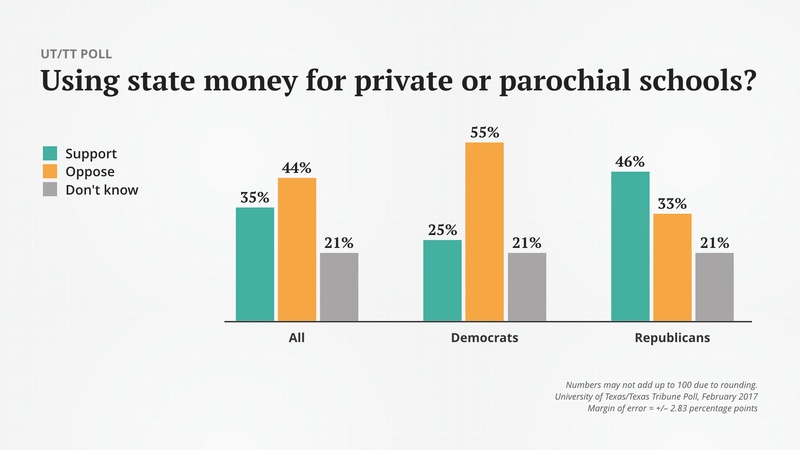
Texans don't like the standardized tests required of public education students, and they support a number of changes from higher spending to more pre-K classes, according to the new University of Texas/Texas Tribune Poll.


More Texans than not believe the quality of the state’s public education system is pretty good, but it’s not a majority point of view, according to the latest University of Texas/Texas Tribune Poll.
While 47 percent said schools are either excellent or good, 42 percent said they are either not very good or terrible. Excellent and terrible rankings were even, with each at 8 percent. Texans who have kids in schools have a higher regard for the quality of public education in the state: 56 percent rated the schools excellent or good, while 40 percent said they were not very good or terrible.
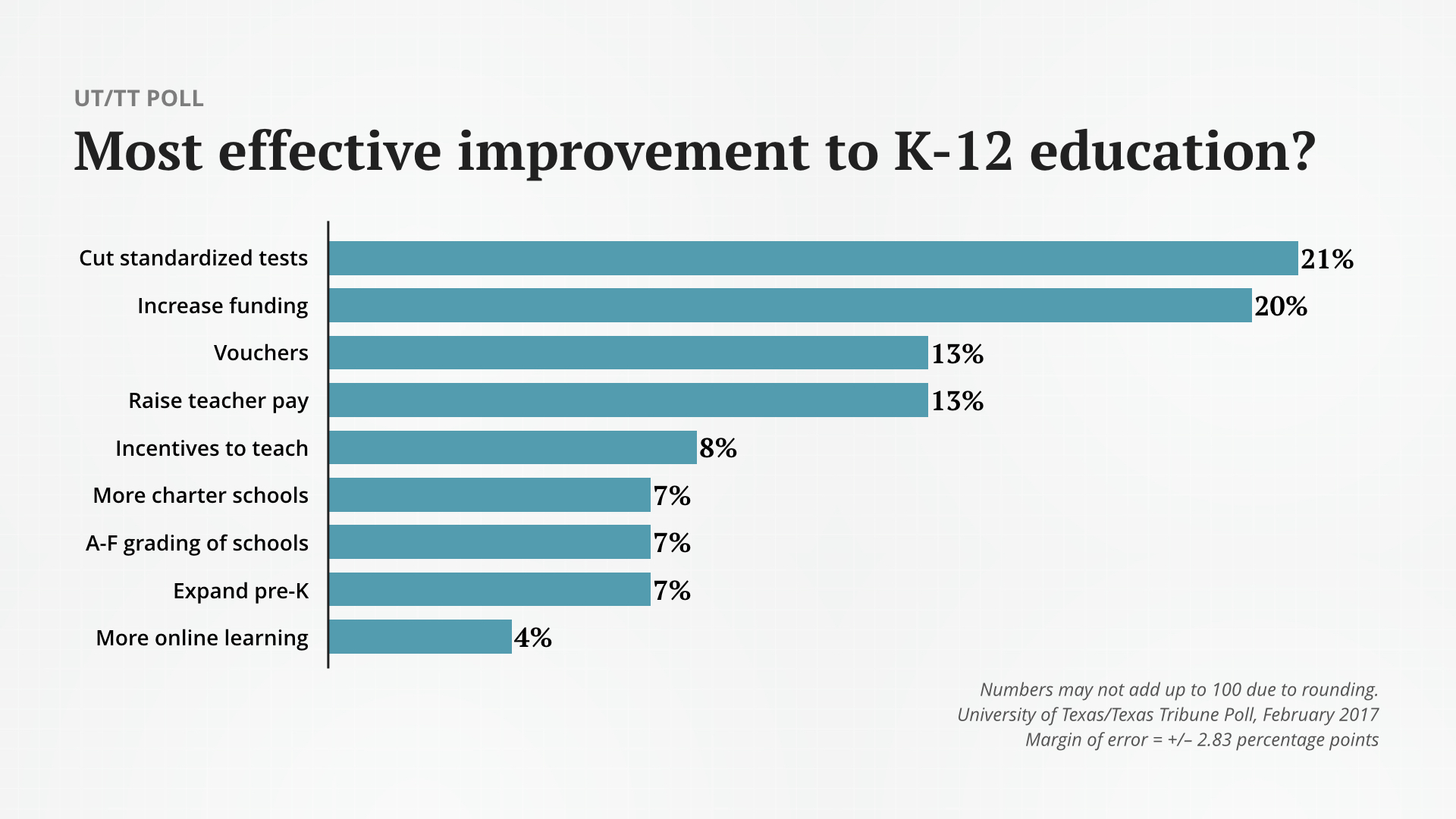
The most effective way to improve the schools, according to 21 percent of Texans, would be to cut the number of standardized tests students have to take. Increasing funding for public schools was the second-most-common answer, followed by creating a school voucher system and increasing the pay of public school teachers, which were tied.
 xxx
 Emily Albracht
The Texas Tribune thanks its sponsors. Become one.
“Nobody likes standardized tests, and everybody wants to give them more money,” said Daron Shaw, who teaches government at the University of Texas at Austin and co-directs the poll. That first option, he noted, would cost no money. “If you’re a legislator and you want to make people happy, reduce the number of tests.”
He said the answers also indicate the importance of education among voters. “These are markers for people’s general belief that if you commit more money, it shows your seriousness for an issue,” Shaw said. “These answers are UT/TT Poll: Education is pretty good, but Texans have some suggestions | The Texas Tribune:


REFERENCE MATERIAL

DeVos praises virtual schools, but new research points to problems - The Hechinger Report

DeVos praises virtual schools, but new research points to problems - The Hechinger Report:

DeVos praises virtual schools, but new research points to problems

A new study adds to the body of research showing that online-only schools don’t serve low-performing students

 It was the best of times and the worst of times for virtual schools, which allow students to go to school without ever stepping into a school building.
Online schools received yet another hearty endorsement last Friday from the new Secretary of Education Betsy DeVos, who doubled down on her opinion that these schools should expand – without any hint that she recognizes there are serious quality-control issues.
Meanwhile, an important study published last week in Education Researcher added to the growing pile of research that reveals that online-only schools tend to attract and harm the most vulnerable students. The study from RAND Corporation and New York University found that Ohio students with low test scores who enroll in online-only schools tend to fall even further behind. High-performing students fare better, but they still do worse than they would have done if they had not enrolled in a virtual school, according to the study.
The findings for the lowest achieving students are particularly troubling considering the high stakes for children who are already on the edge of failure. And, as it turns out, low-performing students tend to be drawn to cyber charter schools, the study found.
“If that’s a population they want to serve, then they need to design a system that is better for [those] students,” said Andrew McEachin, of RAND Corporation, an author of the new report.
Another idea: Traditional schools could look at this as an opportunity to create a more effective model for at-risk students. Educators could find out why students are lured to attend cyber schools, and then incorporate some of what students want into those DeVos praises virtual schools, but new research points to problems - The Hechinger Report:


 Image result for big education ape  virtual online charter schools
Image result for big education ape  virtual online charter schools