Latest News and Comment from Education

Monday, January 23, 2017

CURMUDGUCATION: Dem-ish Reformsters Play Both Sides

CURMUDGUCATION: Dem-ish Reformsters Play Both Sides:

Dem-ish Reformsters Play Both Sides


You know how it is. New school year starts, lunch time rolls around, and everyone has to decide who they want to sit with for the next year.  

Modern education reform has been fueled in part by folks pretending to be left-tilted Democrats while embracing right-tilted free market corporate-based policies. The sweet smoothie of neo-liberal conservatism has worked for years--it helped sell No Child Left Behind (Look! Bipartisan support For The Children!)  and it worked under the Obama neo-lib administration as well. Really, who cares about political labels and parties and tribes as long as corporate ed reform is still chugging along.

What, really, is the difference between a Democrat-flavored, left-tilted, self-identified progressive education reformster and the crew that just took over the big table in the DC cafeteria? 


Remember what Democrats for Education Reform honcho Whitney Tilson had to say about putting the D in DFER:

The main obstacle to education reform was moving the Democratic party, and it had to be Democrats who did it, it had to be an inside job. So that was the thesis behind the organization. And the name – and the name was critical – we get a lot of flack for the name. You know, “Why are you Democrats for education reform? That’s very exclusionary. I mean, certainly there are Republicans in favor of education reform.” And we said, “We agree.” In fact, our natural allies, in many cases, are Republicans on this crusade, but the problem is not Republicans. We don’t need to convert the Republican party to our point of view…

Then Donald Trump won the election, and a new President means a new year in the cafeteria.

This has presented reformsters with a dilemma. They can have pretty much everything they want
CURMUDGUCATION: Dem-ish Reformsters Play Both Sides:


Do charters and vouchers hurt public schools? The answer is "yes" - Network For Public Education

Do charters and vouchers hurt public schools? The answer is "yes" - Network For Public Education:

Do charters and vouchers hurt public schools? The answer is “yes”

Image result for Do charter schools, school vouchers and online schools really hurt our neighborhood public schools? You bet they do.

Do charter schools, school vouchers and online schools really hurt our neighborhood public schools? You bet they do.
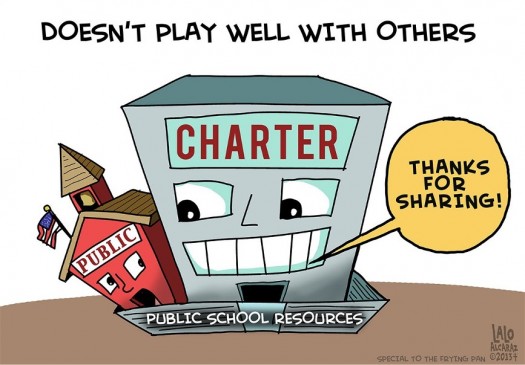
Charter schools, vouchers, and other “choice” options redirect public money to privately operated education enterprises, which often operate for profit. That harms public schools by siphoning off students, resources, and funding while reducing the ability of your public schools to serve the full range of student needs and interests.
This is why
The idea that “the money should follow the child” when students leave a public school for other options is a bad financial decision.
Schools have “stranded costs”. When a public school loses a percentage of students to charter schools or a voucher program, the school can’t reduce costs by an equivalent percent. The school still must pay the same utility, maintenance, transportation, and food services costs. The school must still carry the salary and benefit costs of administrative staff, custodial services, and cafeteria workers. The school may not be able to reduce teaching staff because the attrition will occur randomly across various grade levels, leaving class sizes only marginally reduced.
Students aren’t a “one-off” expense. The cost to educate each individual student varies a lot. Students with disabilities or who don’t speak English as their first language often cost significantly more to educate. So as a school loses students, it may often find itself left with a larger percentage of its highest-cost students.
When schools lose students, they have to cut services. Because schools can’t reduce expenses incrementally, they cut support staff – such as a reading specialist or librarian – and courses – such as art and music – that engage the diverse needs and interests of students.
Look at the facts
In Nashville, TN, an independent research firm MGT of America estimated the net negative fiscal impact of charter school growth on the district’s public schools result in more than $300 million in direct costs to public schools over a five-year period. [1]
Another study by MGT in Los Angeles, CA found district public schools lost $591 million due to dropping enrollment rates among students who leave and go to charters. [2]
A research study of school districts in Michigan found that choice policies significantly contribute to the financial problems of Michigan’s most hard-pressed districts. When the percent of students attending charter schools approaches 20 percent, there are sizeable adverse impacts on district finances. [3]
In New York, a study found that in just one academic year the Albany school district lost $23.6 – $26.1 million and the Buffalo district lost $57.3 – $76.8 million to charter schools. Because charters in both districts had smaller percentages of limited English proficient students, and charters in Albany enrolled fewer students with disabilities, the affected public schools were unable to reduce spending on English as Second Language and special education services. [4]
Privatizers Believe: Money should follow the child;  We Believe: Children should not have a price tag.
Privatizers Believe: Parents need choice; We Believe: Parents need a guarantee of high-quality schools, close to home, for every child.
Privatizers Believe: Parents should vote with their feet; We Believe: Parents should have a voice in schools that serve the whole community.
Privatizers Believe: School governance should be corporate; We Believe: Communities should govern schools by electing school boards.
The Bottom Line
In any policy discussion of education, the goal should be to provide the best possible system for all children, given the resources available. While alternatives to public schools may provide better options for some children, on the whole, charter and voucher schools perform no better than the public school system, and often worse. At they same time they have a negative fiscal impact on existing public schools, and are creating a parallel school system that duplicates services and costs. Let’s stop draining our public schools and work together to strengthen them instead.
[1] “Charter School Financial Impact Model Final Report,” MGT of America, September 11, 2014, http://nashvillepublicmedia.org/wp-content/uploads/2014/09/MNPS-Charter-Schools-Financial-Impact-Review.pdf
[2] “Review: Fiscal Impact of Charter Schools on LAUSD,” MGT of America, May2016, stofcharterschools.org/ccs/eir/
[3] “Which Districts Get Into Financial Trouble and Why: Michigan’s Story,” David Arsen, Thomas A. DeLuca, Yongmei Ni, and Michael Bates, Michigan State University, November 2015, http://www.education.msu.edu/epc/library/papers/documents/WP51-Which-Districts-Get-Into-Financial-Trouble-Arsen.pdf
[4] Fiscal Impacts of Charter Schools: Lessons from New York, Robert Bifulco and Randall Reback, Columbia University, New York, NY, http://www.columbia.edu/~rr2165/pdfs/nycharterfiscal.pdf


Do charters and vouchers hurt public schools? The answer is "yes" - Network For Public Education:

Democrats request another hearing for Betsy DeVos, Trump’s education pick, before confirmation vote - The Washington Post

Democrats request another hearing for Betsy DeVos, Trump’s education pick, before confirmation vote - The Washington Post:

Democrats request another hearing for Betsy DeVos, Trump’s education pick, before confirmation vote

Senate Democrats are formally asking Sen. Lamar Alexander (R-Tenn.) to hold a second confirmation hearing for Betsy DeVos, President Trump’s education nominee, arguing that they need an opportunity to further scrutinize her potential conflicts of interests and preparedness to lead the Education Department.
“Education is too important an issue, and the Secretary of Education is too important a position for the country and for this Committee, to jam a nominee through without sufficient questioning and scrutiny,” they wrote to Alexander in a letter Monday. “This is not about politics, it should not be about partisanship — it should be about doing the work we were elected by our states to do to ask questions of nominees on behalf of the people we represent.”
Those signing the letter included 10 Democrats and Sen. Bernie Sanders, the Vermont independent who caucuses with Democrats. They are all members of the Senate Committee on Health, Education, Labor and Pensions (HELP), which is overseeing DeVos’s confirmation.
Democrats complained when Alexander, chairman of the HELP committee, limited each member of the committee to one five-minute round of questioning during DeVos’s first hearing, on Jan. 17. Alexander was resolute at the time, and he has shown no signs that he is willing to have another hearing.
“Saying there was not enough time to ask questions is absolute nonsense,” Alexander said in a statement last week. “Betsy DeVos’s hearing on Tuesday was three and a half hours, about an Democrats request another hearing for Betsy DeVos, Trump’s education pick, before confirmation vote - The Washington Post:

Philly Educators Launch Black Lives Matter At School Week | I AM AN EDUCATOR

Philly Educators Launch Black Lives Matter At School Week | I AM AN EDUCATOR:

Philly Educators Launch Black Lives Matter At School Week

phillyblmatschool
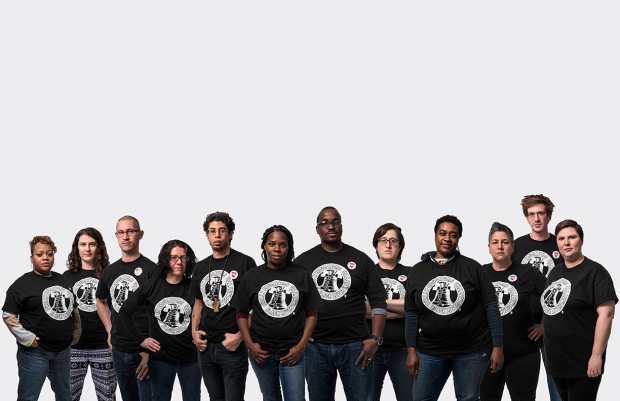
Today, educators in Philadelphia are launching the Black Lives Matter week of action, continuing to build the Black Lives Matter At School movement that has now reached school districts across the country. During this week-long campaign, teachers will dedicate more instructional time to issues of racial and social justice, diversity, and community building.
The #BlackLivesMatterAtSchool movement erupted in Seattle on October 19th of this school year when thousands of educators wore Black Lives Matter Shirts and many held discussions and taught lessons about institutional racism.   Now the Philly Caucus of Working Educators Racial Justice Committee has organized a powerful week of action to address the many intersectional identities within the Black community.
Here’s a list of the week’s activities and themes:
Jan. 23: Restorative Justice, Empathy, and Loving Engagement
A city-wide event starting in the classrooms, where all schools and educators are encouraged to allocate at least an hour of their school day/lesson plan for educating and empowering students on the Black Lives Matter movement.
Jan. 24: Diversity and Globalism (#EthnicStudiesPHL)
This first official meeting will create a work plan for educators and encourage the exploration and expansion of ethnic studies in the Philadelphia area. It will be held at 5 p.m. at St. Stephen’s Green, 1701 Green St.
Jan. 25: Transgender-Affirming, Queer-Affirming, and Collective Value
This event – titled “How to Bridge the Gap Between Parents/Families and Schools” – will be held as a town meeting at City Hall. Organizers say it will be a community conversation about the present disconnect and growing gap between parents and school staff.
Jan. 26: Intergenerational, Black Families, and Black Villages – screening of the movie 13th
The movie focuses on how the U.S. criminal justice system has unjustifiably and unequally imprisoned African Americans through the 13th Amendment, which made slavery and involuntary servitude illegal “except as a punishment for a crime whereof the party shall have been duly convicted.” After the movie screening, there will be a talkback discussion regarding intergenerational communities and the disruption of the Western nuclear 
Philly Educators Launch Black Lives Matter At School Week | I AM AN EDUCATOR:


The Trump Era Begins: Do We “Fight Back,” or Try and “Educate” the New President ? Which Side Are You On? | Ed In The Apple

The Trump Era Begins: Do We “Fight Back,” Regardless of the Economic and Social Consequences, or, Try and “Educate” the New President And Work Along Side of Him for the Betterment of the Nation? Which Side Are You On? | Ed In The Apple:

The Trump Era Begins: Do We “Fight Back,” Regardless of the Economic and Social Consequences, or, Try and “Educate” the New President And Work Along Side of Him for the Betterment of the Nation? Which Side Are You On?

50+ Organizations Working to Defend and Improve Public Education

On a gray, misty day Donald Trump put his hand on a Lincoln bible and become the 45th President of the United States. As he took the oath the rains began, perhaps a message from the heavens.
His inauguration address was brief and more of a campaign speech;  the verbiage was somewhat disturbing. The President used the term  “American First” a number of times, (“We assembled here today and are issuing a new decree to be heard in every city, in every foreign capital and in every hall of power. From this day forward, a new vision will govern our land. From this day forward, it’s going to be only America first— America first.”).  For those of us with a sense of history we remember that the “America First” movement was virulently  isolationist,  anti-war and sympathetic to Hitler.  An outspoken supporter of America First was Father Coughlin,
For years, Coughlin had publicly derided “international bankers,” a phrase that most of his listeners understood to mean Jewish bankers. In the days and weeks after Kristallnacht, Coughlin defended the state-sponsored violence of the Nazi regime, arguing that Kristallnacht was justified as retaliation for Jewish persecution of Christians.
Trump’s view of our nation as an “American carnage” is chilling,
… for too many of our citizens, a different reality exists. Mothers and children trapped in poverty in our inner cities, rusted out factories scattered like tombstones across the landscape of our nation, an education system flush with cash but which leaves our young and beautiful students deprived of all knowledge. And the crime, and the gangs, and the drugs that have stolen too many lives and robbed our country of so much unrealized potential. This American carnage stops right here and stops right now.”
If he followed the passage above with a program, with a plan of some sort he may have started a national dialogue, instead, a  dystopian view of our nation.  Frighteningly, he sounds like the Philippine leader Dutarte who is encouraging The Trump Era Begins: Do We “Fight Back,” Regardless of the Economic and Social Consequences, or, Try and “Educate” the New President And Work Along Side of Him for the Betterment of the Nation? Which Side Are You On? | Ed In The Apple:


Betsy DeVos’ Alternative Facts – EduShyster

Betsy DeVos’ Alternative Facts – EduShyster:

Betsy DeVos’ Alternative Facts


From Common Core to Neurocore, the right candidate for Trumpian times…
Image result for neurocore brain trainingAfter Betsy DeVos’ rocky confirmation hearing performance, she quickly became fodder for memes and late-night comic commentary. But what ya’ll are missing is that DeVos herself is in on the joke. As she prepares to take her spot in the *highest IQ cabinet ever assembled,* she’s the only cabinet member who has a real stake in raising your IQ—by 12 points. DeVos knows that in this, the age of alternative facts, no one gives a hoot about the difference between *proficiency* and *growth.* The testimonial is where it’s at. So Neurocore, the biofeedback company that she won’t be giving up on, has no research behind it. Who cares??? Neurocore changed Charles C’s brain and changed his life, and it helped football player Kirk Cousins take his game to the next level. If the plural of anecdote is data, then the plural of testimonial is franchises. To the brain rooms, reader, we’ve got qEEG data to collect and a national expansion to plan.
Before we get to how great Neurocore is, let’s take a quick look at how easy it is to retrain your brain. This won’t take long because it’s that easy.
At a Neurocore Brain Performance Center, our 45-minute neurofeedback and biofeedback sessions take advantage of your brain’s ability to change – its neuroplasticity. With neurofeedback, you watch a movie that plays only when your brain speed is within the therapeutic range. When it goes out of range, the movie pauses, which tells you that something is out of balance. During the 30-session program, your brain learns how to stop spiking out of range, and brain function improves. With biofeedback, you learn to breathe deeper and slower to maximize your heart function, allowing proper blood and oxygen flow.
I told you it was easy, and best of all it works! More than 10,000 adults and kids have been Neurocored for long-term improvements, including getting smarter and no longer having to take meds. But don’t take Neurocore’s word for how great Neurocore is, or the word of the, Betsy DeVos’ Alternative Facts – EduShyster:

What’s happening beyond the public eye in the Dept. of Education? - The Hechinger Report

What’s happening beyond the public eye in the Dept. of Education? - The Hechinger Report:

What’s happening beyond the public eye in the Dept. of Education?

How a key process works

Image result for how to privatize public schools
Here’s the question everyone’s asking: Will the new administration’s education department spur states toward voucher programs and relax regulation of for-profit higher ed?
Maybe the question should not be if these changes would be made, but how.
And that’s why more attention should be paid to one of the most important and direct mechanisms the department may use to change policy: the rulemaking process. “Rulemaking” refers to the process through which a government agency creates regulations that administer programs and implement legislation.
When statutory provisions are vague or key terms in legislation are undefined, this gives departments an opportunity to step in and define those terms or provide specific directions as to how legislation should be implemented.
Although the rulemaking process is rarely front-and-center in the eye of the general public, it is a process that gives the executive branch substantial power. For this reason, the process has been quite controversial, and the so-called “iron triangle” of legislators, interest groups, and agency personnel stay well-versed in the process so they can exert their influence when it touches their interests.
Rulemaking received some attention during DeVos’s confirmation hearing last week, when Senator Elizabeth Warren asked DeVos if, as secretary of education, she would commit to enforcing the Gainful Employment rule, a regulation of career education programs What’s happening beyond the public eye in the Dept. of Education? - The Hechinger Report:


Add New Haven Charter Schools to those that discriminate against English Language Learners and Special Education students - Wait What?

Add New Haven Charter Schools to those that discriminate against English Language Learners and Special Education students - Wait What?:

Add New Haven Charter Schools to those that discriminate against English Language Learners and Special Education students


As noted in the recent Wait, What? articles entitled, Hartford Charters fail to accept and educate Latinos and English Language Learners and  Bridgeport Charter Schools Discriminate Against Connecticut Children, the privately owned and operated, but publicly funded, charter schools located in Hartford and Bridgeport discriminate against Latino students, those who require assistance learning the English language and students who need special education services.
Data collected by the Connecticut State Department of Education further reveals that charter schools in New Haven are equally bad when it comes to accepting and educating their fair share of students who require these additional services.
Unlike true public schools that must accept every student that comes through the door, charter schools use a variety of underhanded and deceptive techniques to prevent a variety of needy students from enrolling in their schools, or once enrolled, use harsh disciplinary policies and other push-out strategies to rid their schools of what they perceive to be unwanted students.
The numbers are stark and disturbing.   The following chart highlights the level of discrimination in New Haven’s charter schools.
New Haven% English Language Learners% Special Education
New Haven Public Schools14%13%
Booker T Washington Charter0%0%
Common Ground Charter0%17%
Elm City Montessori Charter0%0%
Achievement First Inc. – Elm City Charter5%6%
Achievement First Inc. – Amistad Charter11%5%
The data further indicates that like charter schools in Hartford and Bridgeport, New Haven’s charter schools use what should be illegal tactics Add New Haven Charter Schools to those that discriminate against English Language Learners and Special Education students - Wait What?:
 

Legislative Analyst Office believes Brown is lowballing revenues | EdSource

Legislative Analyst Office believes Brown is lowballing revenues | EdSource:

Legislative Analyst Office believes Brown is lowballing revenues


Forecasters from the Legislative Analyst’s Office predicted in November that state revenues this year and next would be healthy, and they’re sticking to it in their latest budget outlook, despite economic pessimism underlying Gov. Brown’s proposed budget for next year. The difference could be a couple of billion dollars for K-12 schools and community colleges next year.
If Brown is right, K-12 schools will tread water next year, with little more than a 1.48 percent cost of living adjustment. For some districts, higher mandated costs for teachers’ and staff pensions alone will exceed new revenues. If the LAO’s forecast is closer, legislators and advocates will form a long line seeking more funding for early education, solutions to the teacher shortage, additional money for districts’ operating money through the Local Control Funding Formula and replenished funding to help county offices of education meet added responsibilities under the state’s new accountability system – to name a few.
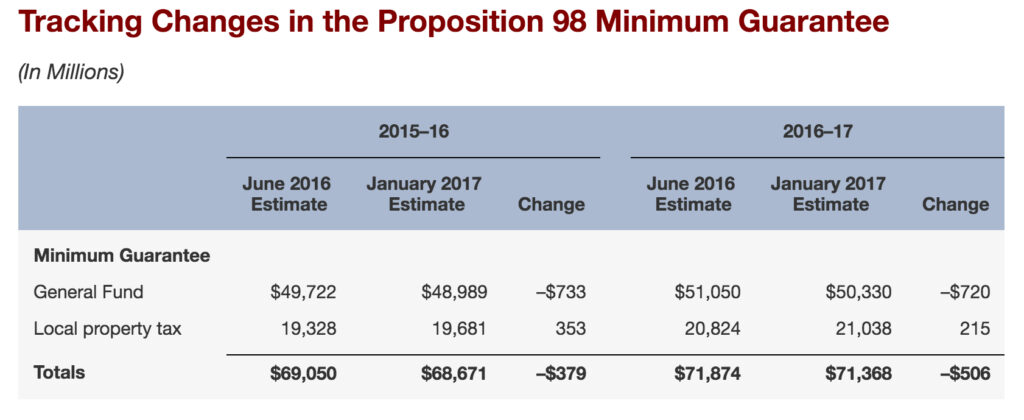
The current year’s state budget is based on revenue forecasts from last May, so, in proposing next year’s budget, the state Department of Finance always makes mid-year revisions to the current year and adjusts actual revenue from the previous year. Because revenues so far fell below projections, the department has revised how much schools should have gotten in 2015-16, are entitled to get this year, and can expect to receive next year under Proposition 98, the formula that determines how much of the General Fund goes to K-12 and community colleges.

K-12 schools and community colleges are funded by a combination of General Fund revenues and property taxes. Because of a drop in projected state revenue, the Department of Finances lowered the Prop. 98 funding by a combined $885 million over two years.
SOURCE: LEGISLATIVE ANALYST'S OFFICE.
K-12 schools and community colleges are funded by a combination of General Fund revenues and property taxes. Because of a drop in projected state revenue, the Department of Finances lowered the Prop. 98 funding by a combined $885 million over two years.

But schools already spent last year’s allocation and are midway through their Legislative Analyst Office believes Brown is lowballing revenues | EdSource:


An Open Letter to Senator Lamar Alexander Regarding Betsy DeVos | Diane Ravitch's blog

An Open Letter to Senator Lamar Alexander Regarding Betsy DeVos | Diane Ravitch's blog:

An Open Letter to Senator Lamar Alexander Regarding Betsy DeVos


From 1991 to 1993, I worked for Secretary of Education Lamar Alexander in the administration of President George H.W. Bush. I was Assistant Secretary in charge of the Office of Education Research and Improvement and also Counselor to the Secretary of Education. Lamar Alexander is now Senator from Tennessee and Chairman of the Senate Health, Education, Labor, and Pensions Committee (HELP), which is evaluating the qualifications of Betsy DeVos to be U.S. Secretary of Education.*
An Open Letter to Senator Lamar Alexander
Dear Lamar,
I hope you don’t mind my taking the liberty of writing you a public letter.
I was just reading your book of sayings, the “Little Plaid Book.” For those who don’t know, this is your book of “311 rules, lessons, and reminders about running for office and making a difference whether it’s for president of the United States or president of your senior class.”
The main lesson of the book for me is that you should be honest with people. You shouldn’t bore them. You shouldn’t lecture them or try to impress them. You should get to know them, listen to them, respect their concerns, and try to understand their problems.
Rule 151 is very important at this time in our national life. It says, “When stumped for an answer, ask yourself, ‘What’s the right thing to do?’ Then do it.”
Rule 168 says, “Read whatever Diane Ravitch writes about education.” It doesn’t say that anyone should agree with what I write, it just says you should read it.
So I am writing you this letter in hopes that you will read it and that I can persuade you to do the right thing.
When I worked for you in the early 1990s in the Department of Education, I absorbed important lessons about character and ethics in public life. You were a model of dignity, integrity, and respect for others. You never raised your voice. You smiled and laughed often. You were always well informed. You picked the best person for whatever job was open.
Now you are in the position of selecting a new Secretary of Education. I watched the hearings, and it was evident to all but the most extreme partisans that Ms. DeVos is uninformed, unqualified, unprepared, and unfit for the responsibility of running this important agency.
When asked direct questions about important federal issues, she was noncommittal or evasive or displayed her ignorance. She thinks compliance with the Individuals with Disabilities Act–which protects children with disabilities– should be left up to the states; she does not know it is a federal law and is not optional. When asked about higher education, she was stumped. She was unfamiliar with the basic terminology of education issues.
Her lack of experience leaves her ill-equipped to address the needs of the vast majority of America’s schools. I understand that she doesn’t like public schools and much prefers religious schools and privately managed charter schools, including those that operate for-profit. 
Frankly, it is unprecedented for a Secretary of Education to disapprove of public schools. At least eighty-five percent of American school children attend public schools. She has no ideas about how to improve public schools. Her only idea is that students should leave them and enroll in nonpublic schools.
She would be the first Secretary of Education in our history to be hostile to public education. I have written extensively about the history of public education and how important it is to our democracy. It seems strange to return to the early 19th century, when children attended religious schools, charity schools, charter schools, were home-schooled, or had no education at all. This is not “reform.” This is backsliding. This is wiping out nearly two centuries of hard-won progress towards public schools that enroll boys and girls, children of all races and cultures, children with disabilities, and children who are learning English. We have been struggling to attain equality of educational opportunity; we are still far from it. School choice promotes segregation and would take us further away from our national goal.
Since Michigan embraced the DeVos family’s ideas about choice, Michigan has steadily declined on the National Assessment of Educational Progress.
In 2003, Michigan ranked 28th among the states in fourth-grade reading; the latest results, in 2015, showed that Michigan had dropped to 41st.
In 2003, Michigan ranked 27th in fourth- grade math; by 2015, it had declined to 42nd among the states.
Michigan has hundreds of charter schools. About 80% of them are run by for-profit operators. The Detroit Free Press conducted a one-year review of the charter sector and concluded it was a $1 billion a year industry that operated without accountability or transparency and that did not produce better results than public schools. Last year, when the legislature tried to develop accountability standards for the charter industry, Ms. DeVos successfully lobbied to block the legislation.
Detroit is awash in charters and few of them perform as well as the public schools. Detroit is the lowest rated urban district in the nation on the NAEP. The proliferation of choice and charters has not improved education in that city.
As I am sure you are aware, Tenneesee’s “Achievement School District” has been an abject failure. The state’s lowest performing schools were taken over and given to charter operators. The leaders of the ASD claimed that these low performing schools would go from the bottom 5% in the state to the top 20% in five years. That was five years ago. Not one of the promises was kept. The schools are still among the lowest performing in Tennessee. There are actually research-based approaches that would have helped the children and the schools, like reducing class size and providing medical services. Charters are not a research-based reform.
As for vouchers, there have been many state referenda over the past 20 years, and the voters have rejected them every time, by large margins. When Ms. DeVos and her husband Richard led a movement to change the Michigan state constitution to permit vouchers for religious schools in the year 2000, the referendum was defeated by 69-31%. Even in deep red Utah, the public rejected vouchers overwhelmingly in 2007. Florida was the last state to reject vouchers, in a 2012 vote deceptively named the Religious Freedom Act; voters rejected it by 58-42%.
Time and again, the American public has said that they don’t want public money to be spent to pay tuition for religious schools. That is the responsibility of the family, not the state.
There is ample evidence about vouchers, which have been imposed by legislatures, not by popular vote. Milwaukee, Cleveland, and the District of Columbia offer vouchers, and these districts are among the lowest performing in the nation on national tests. Milwaukee and Cleveland have had vouchers for more than 20 years, and neither district has seen any improvement in its public schools, nor do the voucher schools outperform the public schools. When the taxpayers’ precious dollars are divided among two or three sectors, none of them flourishes.
I feel sure that you do not want your legacy to be that you aided in destroying the historic institution of universal public education in the United States. Every dollar that goes to a charter school or to vouchers is taken away from the budget of the community’s public schools. In a regime of free-market choice, public schools, which educate the great majority of students, will have larger classes and fewer programs, services, and electives, all in the name of a failed concept called “choice.” I need not remind  you that the origin of school choice was the sustained effort by racist governors and legislatures to preserve racial segregation in the South; the term was tainted by its origins for many years, but the effect remains the same: School choice will exacerbate racial, religious, and socioeconomic segregation without improving education. 
The Every Student Succeeds Act, which you worked so hard to produce in a bipartisan spirit, goes a long way towards devolving control of education to states. I, of course, would have liked to see the elimination of the federal mandate for annual testing, which has proven to be ineffective for 15 years.
But the best way to enable ESSA to work is to appoint a Secretary of Education who comes to the job with knowledge, experience, a strong devotion to civil rights and equality of educational opportunity, and a commitment to let districts and states nurture better ideas than those mandated by Washington.
With kind regards and great respect,
Diane Ravitch
*I posted this column yesterday at the Huffington Post in a slightly abridged form (I edit and revise constantly). Much to my surprise, the comments were remarkably positive. People are truly aware that Ms. DeVos is ill-suited for this job.
An Open Letter to Senator Lamar Alexander Regarding Betsy DeVos | Diane Ravitch's blog: