Latest News and Comment from Education

Wednesday, January 11, 2017

Digital Citizenship Week - Resources (CA Dept of Education)

Digital Citizenship Week - Resources (CA Dept of Education):

Digital Citizenship Week
The California Department of Education (CDE) in collaboration with Common Sense Media will celebrate CDE Digital Citizenship Week January 23 - 27, 2017.

Digital Citizenship

Photo of Superintendent Tom TorlaksonThe California Education Technology Blueprint titled: Empowering Learning (PDF) makes 19 recommendations. Recommendation 2 states: Ensure student safety by outlining policies and best practices to prevent cyberbullying and protect student data.
The blueprint calls to “ensure student safety by outlining policies and best practices to prevent cyberbullying and protect student data. It is important to teach students about the ethical, legal, and safe use of online information and resources. It is also important to help students learn about how they can protect themselves and their personal information in online environments.”
The goal is to identify resources that can help students learn 21st century skills such as digital citizenship, information literacy, and safe and legal Internet use (for example, those surrounding plagiarism and pirating music and movies).

Deliver Digital Citizenship Lessons

Common Sense Media organization offers free, research-based K-12 Digital Citizenship Curriculum External link opens in new window or tab. with lesson plans for you to teach students how to:
  • Manage their online information and keep it secure.
  • Protect their own online privacy while respecting others'.
  • Explore, examine, and protect their online reputations.
  • Reflect on their responsibilities and rights as creators online.
  • Identify, find, evaluate, and use information effectively.
  • Deal with a cyberbullying situation appropriately.
  • Stay safe online through positive connections.
The comprehensive digital citizenship lessons are aligned to the International Society for Technology in Education (ISTE) Standards for Students External link opens in new window or tab., include resources to share with families, can be delivered offline or in a blended format, and provide the option for student assessments. Additionally, Common Sense Media has invested in designing professional development resources to support educators with the implementation of the materials.

Certify Your School or District

Common Sense Media offers the ability for educators, schools, and districts to be Digital Citizenship Certified. See California certified schools and districts and learn how to join this growing list External link opens in new window or tab. (PDF). Common Sense Media’s Digital Citizenship Certification signifies that districts have engaged not only in providing instruction using a comprehensive, research-based curriculum, but that stakeholders have been engaged at every level from administration to families.

Meet CIPA Requirements

Common Sense Media offers CIPA Toolkits External link opens in new window or tab. for Administrators and Teachers. What is CIPA? The Children’s Internet Protection Act External link opens in new window or tab. is a federal law enacted by Congress to address concerns about access to offensive content over the Internet on school and library computers. CIPA imposes certain types of requirements on any school or library that receives funding for Internet access or internal connections from the E-rate program. Since July 2012, schools subject to CIPA are required by the Protecting Children in the 21st Century Act External link opens in new window or tab., to provide for educating minors about appropriate online behavior, including interacting with other individuals on social networking websites and in chat rooms, and cyberbullying awareness and response. The suggested lessons for California’s Digital Citizenship Week also provide suitable selections to meet the CIPA requirement for the 2016–2017 school year.

California Department of Education Digital Citizenship Week

The California Department of Education (CDE) in collaboration with Common Sense Media will celebrate CDE Digital Citizenship Week January 23 – 27, 2017. This will continue ongoing efforts to teach students how to make safe, smart, and ethical decisions in the digital world. Please view the weekly plan here.

Quick Links

Questions:   Geoff Belleau | gbelleau@cde.ca.gov | 916-324-9943


Digital Citizenship Weekly Plan


The weekly plan of events for Digital Citizenship week which provides Resouces and Family Resources links in English and Spanish.

Day/Theme

Monday - THIS IS YOUR DIGITAL LIFE

ResourcesFamily ResourcesModel School Library Standards
K2 - Follow the Digital Trail External link opens in new window or tab.
3-5 - Ring of Responsibility External link opens in new window or tab.
6-8 - Digital Life 101 External link opens in new window or tab.
9-12 - Oops! I Broadcast It on the Internet External link opens in new window or tab.
K-2:
K.2.3.a, K.3.1.a, K.3.1.b, 1.1.4.a, 1.3.1.b, 2.3.1.d, 2.3.1.e
3-5:
3.3.1.a, 3.3.1.b, 4.3.1.a, 4.3.1.b, 4.3.1.c, 5.3.1.b, 5.3.1.c, 5.3.1.d, 6.3.1.a, 6.3.1.b, 6.3.1.c, 6.3/1.e, 6.3.1.f, 6.3.3.a, 6.4.2.a
MS.3.1.a, MS.3.1.b, MS.3.1.c, MS.3.1e, MS.4.2.b
HS.3.1.d, HS.3.1.g

Tuesday - PRIVACY/SECURITY

ResourcesFamily ResourcesModel School Library Standards
K2 - Going places safely External link opens in new window or tab.
3-5 - Private and Personal Information External link opens in new window or tab.
6-8 - Scams & Schemes External link opens in new window or tab.
9-12 - Does it matter who has your data External link opens in new window or tab.
Common Sense on Online Security for Elementary, English External link opens in new window or tab. (PDF)
Common Sense on Online Security for Elementary, Spanish External link opens in new window or tab. (PDF)

K-2:
K.1.4.a, K.3.1.b, 1.1.4.a,, 1.3.1.b, 2.1.4.a, 2.3.1.d,
3-5:
3.3.1.b, 4.3.1.c, 5.3.1.e, 5.3.1.f
6-8: (7&8 = M)
6.1.4.a, 6.3.1.a
9-12 (HS):
HS.3.1.d, HS.3.1.e

Wednesday - COPYRIGHT & GIVING CREDIT WHERE IT’S DUE

ResourcesFamily ResourcesModel School Library Standards
K2 - My creative work External link opens in new window or tab.
3-5 - Whose is it anyway External link opens in new window or tab.
6-8 - Rework, reuse and remix External link opens in new window or tab.
9-12 - Copyrights and wrongs External link opens in new window or tab.
Common Sense on Respecting Creative Work for Elementary, English External link opens in new window or tab. (PDF)
Common Sense on Respecting Creative Work for Elementary, Spanish External link opens in new window or tab. (PDF)

K: 3.1, 1: 3.1.a , 2: 3.1.a, 2: 4.2.a 3-5:
3: 1.4.a, 3: 2.2.a,b,4: 3.1.a
5: 3.1.b,c,6: 1.4.b,6: 3.1.h
MS: 2.2.c, MS: 3.1.a,b,c,d,e
HS: 1.4.a, HS: 2.2, HS: 3.1.a,b,c, HS: 4.2.c
HS: 4.3.b

Thursday - CYBER BULLYING

ResourcesFamily ResourcesModel School Library Standards
K2 - Screen out the mean External link opens in new window or tab.
3-5 - The power of words External link opens in new window or tab.
6-8 - Reality of Digital Drama External link opens in new window or tab.
9-12 - Taking perspectives on cyberbullying External link opens in new window or tab.
2.3.1.e
3-5:
3.3.1.a,b, 4.3.1c, 5.3.1.b,d,e, 6.3.1.b,f
MS.3.1.b,c
HS.3.1.d

Friday - CELEBRATE

Diane Ravitch: Trump’s Nominee for Secretary of Education Could Gut Public Ed - In These Times

Diane Ravitch: Trump’s Nominee for Secretary of Education Could Gut Public Ed - In These Times:

Diane Ravitch: Trump’s Nominee for Secretary of Education Could Gut Public Ed
Billionaire Betsy DeVos will be great for private, religious and charter schools—and bad news for students and teachers.


If there’s an upside to her nomination, it’s that she may force policymakers to admit the U.S. is headed toward privatization of its education system.
It’s hard to imagine someone less qualified to oversee the nation’s schools than Betsy DeVos, the Trump nominee for secretary of education whose Senate confirmation hearing is set for Wednesday. DeVos did not attend public schools, nor did her children. She has never been a teacher, administrator, practitioner or scholar of education. In fact, one wonders whether she has ever actually set foot in a public school.
Instead, DeVos is a billionaire who grew up in the Christian Reformed Church and would like to see religious schools supported by public funding. She once described education reform as a way to “advance God’s kingdom.” Born into the powerful Prince family of Michigan, DeVos is part of the Christian right royalty in the United States. Her father, Edgar Prince, helped found the anti-gay Family Research Council. Her brother, Erik Prince, is founder of the mercenary group Blackwater Worldwide, which received large contracts from the government during the Iraq War. Betsy later married into the DeVos family, billionaires who founded the Amway company and also have deep ties to the Christian right.
The two families have contributed generously to anti-gay and anti-labor causes over the years, but Betsy DeVos and her husband, Dick, have shown a special passion for privatizing public education. In 2000, they used their clout to organize and fund a referendum in Michigan that would have allowed public money to flow to private and religious schools through the use of school vouchers, a practice the state constitution forbids. Michigan voters defeated the referendum resoundingly, 69-31 percent, but that didn’t end DeVos’ crusade.
She also chairs the American Federation for Children, a lobbying group that advocates for so-called school choice. DeVos has become a leading national proponent of school Diane Ravitch: Trump’s Nominee for Secretary of Education Could Gut Public Ed - In These Times:

What’s Behind Increased Teaching of Self-Regulation in Children?

What’s Behind Increased Teaching of Self-Regulation in Children?:

What’s Behind Increased Teaching of Self-Regulation in Children?

pexels-photo-596281

It’s normal to expect children to pay attention and learn good behavior. It’s part of growing up. But self-regulatory learning (SRL) forced on children so they will be computer learners is a different story.
Why is there such a drive to make children more independent and self-sufficient?
How is it justifiable to push students to have increased self-control—beyond what has been expected in the past—what is appropriate for their age and development?
Whether it’s mindfulness, direct instruction, or social-emotional learning SRL is a hot topic. It’s everywhere!
The drive is to get children on tech devices to do schoolwork. The goal is for them to be able to sit still, concentrate, and learn on their own, at home, or in the classroom with no human assistance.
You cannot sell parents on taking their children out of school and sticking them on the What’s Behind Increased Teaching of Self-Regulation in Children?:


To Kill a Mockingbird, White Saviors, and the Paradox of Obama and Race | radical eyes for equity

To Kill a Mockingbird, White Saviors, and the Paradox of Obama and Race | radical eyes for equity:

To Kill a Mockingbird, White Saviors, and the Paradox of Obama and Race

Image result for To Kill a Mockingbird, White Saviour, and the Paradox of Obama and Race


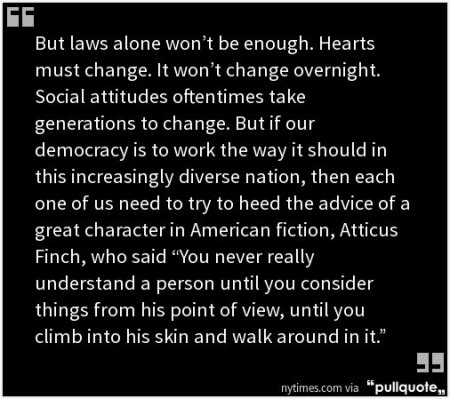
White progressives, academics, and book lovers were all atwitter on social media because in his farewell address, Barack Obama quoted from literature:
obama-af-tkam
Similar to my concern about Michelle Obama’s recent comments on education and teachers, my response to this excitement was tempered:
Obama quoting Finch/TKAM (white savior "race" novel) proves he remains anchored to appeals to white privilege, not dismantling it

During the praise tour for the Obamas, I have taken this stance on social media:
Praise for Michelle and Barack Obama has begun as Obama’s presidency comes to an end. That praise poses a few problems:
Praise is warranted, must be supported against the inherent racism that demands perfection from minorities and not from white males.
However Michelle and Barack have allowed, supported policies that contradict the often wonderful rhetoric, notably about education.
Michelle’s recent praise of teachers and the power of education is hard to let lie since Obama’s 8 years have been horrible for education.
The policies and rhetoric from the DOE/SOE have been horrible for black, brown, poor students since they have fed deficit ideology.
Let us be careful to honor but not idealize, not gloss over the failure of policy beneath the veneer of rhetoric.


Here, I want to deal directly with the paradox of race surrounding Obama’s presidency as that is reflected in Obama’s choice to quote Atticus Finch and not, for example, the essays of James Baldwin or the literature and public To Kill a Mockingbird, White Saviors, and the Paradox of Obama and Race | radical eyes for equity:

Why the racist history of school vouchers matters today

Why the racist history of school vouchers matters today:

Why the racist history of school vouchers matters today
Elizabeth Warren alluded to the disturbing roots of school vouchers. But what did she mean?
On Monday, Massachusetts Sen. Elizabeth Warren wrote a scathing letter to President-elect Donald Trump’s pick for education secretary, Betsy DeVos, questioning whether she had the expertise to run the department. Among Warren’s many criticisms of DeVos’ record — her unknown views on many aspects of higher education and civil rights issues, for example — Warren also mentioned the “racially charged history” of voucher programs.
Warren wrote:
“After Brown v. Board of Education and the court-ordered segregation of public schools, many Southern states established voucher schemes to allow white students to leave the education system and take taxpayer dollars with them, decimating the budgets of the public school districts. Today’s voucher schemes can be just as harmful to public school district budgets, because they often leave school districts with less funding to teach the most disadvantaged students, while funneling private dollars to unaccountable private schools that are not held to the same academic or civil rights standards as public schools.”
After the U.S. Supreme Court’s Brown v. Board of Education decision, several southern states embraced resistance to integration through the opening of private schools that became known as “segregation academies.” Governors in Virginia and North Carolina supported the closure of entire school districts that were ordered to integrate and use of private school vouchers as a way to push against integration.
Erica Frankenberg, associate professor in the Department of Education Policy Studies in the College of Education at Pennsylvania State University, said that although white students were affected by district closures, they had far more educational opportunities than black families left without a school district.
“Imagine all public schools in a district shutting down for a year or two and not having a school kids could go to,” Frankenburg said. Obviously for families that didn’t have the means, which predominantly fell to the black community because they didn’t have the power and the money to fund their own schools, there was a question of what do you do with your kids and how do you keep educating them?”
“There was a question of what do you do with your kids and how do you keep educating them?”
In Virginia, Gov. Thomas B. Stanley proposed the Stanley Plan, which was enacted in 1956. It allowed the governor to close any school under a Why the racist history of school vouchers matters today:


If Betsy DeVos is a friend of a NEA “friend of education” is she a friend too? | Fred Klonsky

If Betsy DeVos is a friend of a NEA “friend of education” is she a friend too? | Fred Klonsky:

If Betsy DeVos is a friend of a NEA “friend of education” is she a friend too?


Betsy DeVos, my stalker from the Education Action Group which DeVos funded and Senator Lamar Alexander, NEA’s Friend of Education.
I was on the phone this morning with a reporter for a national publication who was writing about Betsy DeVos. It was the latest of a number of calls I have received from reporters because of DeVos’ family foundation funding of  the Education Action Group, the Mackinac Center for Public Policy and the Michigan Republican Party.
The irony in the delay of the confirmation hearings for DeVos is that she has failed to produce the necessary records.
Ironic, because the Michigan organizations were the ones that were responsible for the Freedom of Information Act requests demanding all of my work emails and personnel files when I was teaching.
EAG got my files. But the confirmation committee is having difficulty getting hers.
Ironic, because the whole reason for the Freedom of Information Act was to put a check on the powerful like her.
It wasn’t intended to be used to try and intimidate volunteer local union presidents and K-5 teachers for their union activity.
“Did you hear from other local presidents who experienced the same thing,” the If Betsy DeVos is a friend of a NEA “friend of education” is she a friend too? | Fred Klonsky: