Latest News and Comment from Education

Thursday, January 5, 2017

Parents, Education Advocates Plan to Rally in D.C. to Block Betsy DeVos' Appointment as U.S. Education Secretary | Journey For Justice

Campaigns | Journey For Justice:

Parents, Education Advocates Plan to Rally in D.C. to Block Betsy DeVos' Appointment as U.S. Education Secretary
Image result for Block Betsy DeVos

CHICAGO  - Today, education activists from across the country announced a protest in Washington, D.C., to block the appointment of Betsy DeVos' appointment as U.S. Education Secretary. The controversial billionaire was chosen by President-Elect Donald Trump to head the post despite her ---record of destruction in Michigan and across the country. Parents from the nominee's home state of Michigan, along with people from across the nation, intend to converge on her confirmation hearing next week.

The Senate HELP Committee announced that following the January 11th hearing, an executive session will be scheduled for a vote on DeVos' nomination for education secretary. For two decades DeVos, along with her husband have funded a charter school lobby that shields  operators from oversight and accountability.

Jitu Brown, executive director of Journey for Justice Alliance (J4J), a coalition of scores of parent-led organizations across the U.S., said he has organized a caravan of activists, parents, students and others to demonstrate during DeVos' Senate Help Committee hearing on January 11th.  "We have no desire to see a person who has systematically destroyed public education in places like Detroit, carry that same agenda nationally as U.S. Education Secretary," Brown said. "Her polices have hurt black and brown children; disrupted teaching and learning in schools; and, her money has fueled 
a bevy of failed school reform experiments in school districts across the country."

The group will demand a meeting with Senate Help Committee Chairman Lamar Alexander (R-TN) and encourage members of the Congressional Black Caucus to join them in fighting the appointment by testifying on DeVos' well-documented record.

Brown comments come day after organizers in Detroit held a news conference to denounce DeVos' nomination and call on President-Elect Trump to pick a "nominee that will work in the best interests of all of America's children" rather than an ideologue with deep pockets. "She is the architect of one of the biggest education disasters in the country---so bad even charter proponents acknowledge her failures," the J4J activist noted. "

Journey for Justice (J4J) is an alliance of grassroots community, youth, and parent-led organizations in 21 cities across the country: Atlanta, Baltimore, Boston, Chicago, Detroit, Eupora, MS, Hartford, Los Angeles, Newark, Patterson, Camden, Jersey City and Elizabeth NJ, Minneapolis, New Orleans, New York City, Oakland, Philadelphia, Pittsburgh, Washington D.C., and Wichita. Its advocate for community-driven alternatives to the privatization of and dismantling of public schools systems.


CAMPAIGN FOR SUSTAINABLE SCHOOL SUCCESS

Slider11

For decades, schools that serve African American and Latino students have been denied their fair share of education resources.  Without libraries, without a full range of college, career and enrichment course offerings, without counselors or supported teachers, students in our urban districts have had little to no opportunity to meet their full potential.  Now, corporate education reformers are destroying our public schools altogether, closing them, turning them over to private management, firing our teachers and squeezing education budgets in the name of “reform.”  This assault on public education is happening almost exclusively in communities of color. It must stop.
Closures, charters, firing teachers and other “dramatic interventions” haven’t worked in the past, and they aren’t working now.
The Campaign for Sustainable School Success-J4J is organizing to insure that our proposal for Sustainable School Transformation replaces the four interventions for struggling schools in U.S. Department of Education Policy.

THE SUSTAINABLE SUCCESS MODEL REQUIRES SCHOOL DISTRICTS TO:

  1. Undertake a comprehensive needs assessment—done in partnership with parents, educators, students and community members—so that local solutions are tailored to local problems,
  2. Implement research-based instructional and educational reforms,
  3. Address essential social, emotional and physical needs of students, and
  4. Recognize parent, student, and community leadership as key to sustainable student success.
THE 3 PILLARS OF SUSTAINABLE SCHOOL SUCCESS FOCUS ON:
  1. A strong focus on school culture, curriculum and staffing,
  2. Wrap-around supports for every child
  3. Real collaboration with the community, to ensure local ownership and accountability.
CAMPAIGN GOALS:
  • J4J is organizing to implement our Sustainable School Success model locally in our communities (impacting local and state policy) as well as at the federal level.  (Sustainable School Success replacing the current interventions for struggling schools; closing, charter expansion, turnarounds and transformations).
  • J4J will  document the harm these policies have inflicted on impacted communities through Grassroots Voices Listening Projects and build a groundswell of support for a moratorium on all school closings, turnarounds, charter expansions and phase-outs.
J4J is organizing with parents, students and teachers to identify lawmakers to stand with us; we want community driven, sustainable school improvement; not smoke and mirrors.
CHARTER/CONTRACT SCHOOL ACCOUNTABILITY
Journey for Justice believes in strong, high quality neighborhood schools.  Parents are not customers, and our children are not products.  
We believe that the original intent of charters, as “center for innovation” that share best practices with the public sector has been mutated to an “education for profit” industry.  Now the vast majority of charters and contract schools no better or worse than traditional public schools, despite being able to pick the children they want and expel the children they don’t.  This is not reform; these are mediocre interventions and we will not sit back while profiteers use public money, our money for private interest.
  • J4J will work to advance legislation and policy that hold charter and contract school operators accountable to the public.  We support legislation that makes charter and contract operators follow the local discipline codes that all public schools must adhere to.  In addition, we believe that the money should follow the student; so if a child is removed from one of these schools, the receiving school receives the resources, not the school that kicked the child out.
  • J4J is in a national community/labor coalition that is developing a campaign strategy to realize the above mentioned goals.
Campaigns | Journey For Justice:

CURMUDGUCATION: A Lesson from China

CURMUDGUCATION: A Lesson from China: "A Lesson from China"
A Lesson from China


We're witnessing another lesson in how free market forces work, and how business interests often run contrary to the public interest. And the lesson is coming from China, of all places.


This is a lesson that started with Google, way back in 2006. That was the year that Google set aside the motto "don't be evil" for the more pragmatic "don't be shut out of the enormous Chinese market," and willingly provided the Chinese with a censored version of Google. The official rationale was something along the lines of "they're censoring us anyway," but it seemed more likely that the rationale was "do you have any idea how much money there is to be made, because, damn, it's a lot."

Google pulled out in 2010, over a Chinese attempt to hack gmail and other pieces of Google. That response (Google actually called it "retaliation") was remarkable, and it didn't last. Google is set to re-enter the Chinese market. 

Businesses looking to operate in countries with repressive, censorship-prone laws face a question-- 
CURMUDGUCATION: A Lesson from China: "A Lesson from China"


In Michigan, a test case for US public schools under Trump? - CSMonitor.com

In Michigan, a test case for US public schools under Trump? - CSMonitor.com:

In Michigan, a test case for US public schools under Trump?
Betsy DeVos, a billionaire philanthropist and prominent Republican fundraiser, has been among the nation’s foremost advocates for school choice. Her home state offers perhaps the best preview of free-market style education policies.

Last fall, Ben Edmondson, the charismatic new superintendent of the long-struggling public school district in Ypsilanti, Mich., received an unusual visitor. It was a representative from a for-profit charter school management company, offering to buy a district building that had previously been listed for sale.
“The guy comes in and says, ‘We’ll offer you $1 million,’ ” Dr. Edmondson recalls. “ ‘That’s more than what you want.’ ”
Ypsilanti had been losing some 300 kids per year, about half its student population. Most enrolled in area charter schools under Michigan’s Schools of Choice law, which allows K-12 students to use state funding to enroll in other public districts or charter schools. The visiting representative told Edmondson a new charter school in the area could enroll 300 in its first year.
Edmondson declined.
“I will not sell any building here to any organization that doesn’t help make this city better,” he says.
From his embattled vantage point, charter schools have robbed many of Michigan’s public schools of money, students, and vitality, all while showing doubtful evidence of academic achievement and virtually no accountability for the money they spend.
“A charter school’s not going to make [this city] better,” he scoffs. “Are you kidding me?”
But next week, congressional confirmation hearings will begin for a woman who has precisely the opposite vantage point. Betsy DeVos, a billionaire philanthropist and prominent Republican fundraiser, has been among the nation’s foremost advocates for giving parents the broadest possible options for where to educate their kids – whether in charter schools, private schools, or homeschooling. She is President-elect Donald Trump’s pick for secretary of Education.
Since her selection, analysts and families across the country have been wondering what a DeVos tenure might mean for the nation’s 50 million public school students. Her home state of Michigan offers perhaps the best preview of the free-market style education policies that could soon be getting a wider roll-out across America.
To supporters, the reforms she’s championed have allowed parents to “vote with their feet” and find the school that best meets their children’s needs. Moreover, they say, for-profit management has injected a valuable competitive business ethos.
But to critics, the state is impoverishing traditional public schools for very little gain – if any. The state exercises very little oversight over the $1 billion it gives to charter schools. Right now, Education Trust-Midwest points out in a new report, "not even the governor has the authority to shut down chronically low-performing charter authorizers in Michigan." 
The clearest losers, experts say, are the state’s neediest students – the ones other districts or schools don’t want, either because of their academic performance or the cost of meeting special needs. As money flows elsewhere, they are left in schools that lack the attention or funding to make much-needed improvements.
“The result of this, I believe, could be a dramatic reduction of dollars to our poorest schools and a transfer of taxpayer dollars to the free market,” says David Kirkland, a professor of urban education at New York University Steinhardt. “It’s detrimental to our most disadvantaged students.”
Michigan is, in many ways, a test case for how far school choice can be pushed.
  • It is home to two of the three US cities where a majority of children attend charter schools (Flint and Detroit, with New Orleans as the third).
  • About 80 percent of charter schools in the state are run by for-profit companies, according to a report by the National Education Policy Center. That’s more than twice the percentage of for-profits found in any other state.
  • About 10 percent of Michigan’s school-age children attend charter schools, compared with about 5.1 percent nationwide, according to the National Center for Education Statistics. Another 13 percent attend a traditional public school in another community, according to MLive.com, under the state’s Schools of Choice program.
“We have the highest percentage of for-profit organizations running charter schools in the country,” says Joshua Cowen, an associate professor of education policy at Michigan State University. “We tend to think of Michigan as a deregulated state.” 
DeVos’s influence in shaping Michigan’s educational experiment has been significant.

Strong advocate for school choice

The daughter of a wealthy Michigan businessman (her brother founded military contractor Blackwater), she married Richard DeVos Jr., who would later head Amway, the multibillion home sales company founded by his father. Together, the couple emerged as stalwarts of the state’s conservative establishment. She twice chaired the Michigan GOP; he lost a gubernatorial bid in 2006.
But the DeVoses’ bigger influence has come through lobbying and spending on conservative In Michigan, a test case for US public schools under Trump? - CSMonitor.com:


Are The PISA Education Results Rigged?

Are The PISA Education Results Rigged?:

Are The PISA Education Results Rigged?


The results of the most recent Programme for International Student Assessment (PISA) are out, and again reveal students from East Asian countries dominate in maths and sciences. The assessment, run by the Paris-based Organisation for Economic Co-operation and Development (OECD) every three years, tested around 540,000 15-year-old students in 72 countries and economies on science, reading, maths and collaborative problem-solving. In 2015, students from Singapore performed the best, followed by Japan, Estonia, Chinese Taipei, Finland, Macao (China), Canada, Vietnam, Hong Kong (China) and B-S-J-G (China).


 Western countries fared far worse, with concerns over declining educational standards seemingly confirmed. The U.S., the world's favorite destination for international university students, saw its scores remain close to the OECD average on each category. The 5,700 15-year-olds who took the test scored 496 in science and 497 in reading, and 470 in math—close to the OECD averages of 493, 493 and 490 respectively.

Some argue this may herald a new era of creative thinking in Asia, and look to replicate an Asian model of learning. Others point to a culture in Asia which values education highly and is driven by “Tiger Moms” who push their children to excel in their studies. In Vietnam, some students are reportedly too busy with school and studying to take meals at home and eat while on motorbikes. Still others argue government investment in educational infrastructure, such as building more schools and attracting the best teachers, yields the greatest results. But before we accept the results at face value, we should delve Are The PISA Education Results Rigged?:

Mastery exam task force report due soon — its findings ‘predetermined’ by John Bestor - Wait What?

Mastery exam task force report due soon — its findings ‘predetermined’ by John Bestor - Wait What?:

Mastery exam task force report due soon — its findings ‘predetermined’ by John Bestor

Image result for Mastery exam


John Bestor, an educator and education advocate, recently wrote a piece for the CT Mirror educating readers about the farce called the Mastery Exam Tax Force.  The following is his commentary piece which you can read and comment on at: http://ctviewpoints.org/2017/01/04/mastery-exam-task-force-report-due-soon-its-findings-predetermined/
Mastery exam task force report due soon — its findings ‘predetermined’
In a few days the Mastery Examination Task Force will be submitting its Final Report and Recommendations to the Connecticut Legislature’s Education Committee which had asked for a study of student assessment practices in our public schools. Having monitored the progress of this task force during its one-and-a-half years of meetings, I contend that their findings were predetermined at or even before the task force began its deliberations.
My reasons for this presumption lie in 1) the composition of committee membership serving on the task force, 2) the choice of topics discussed, and 3) the available evidence that was purposefully withheld from task force consideration.
Just why is the final report and recommendations of the mastery examination task force so important?
For starters, it is a perfect example of much of what is wrong in government today and certainly in how education policy is developed in our state. As the 2015 legislative session drew to a close, the Education Committee of the legislature passed 
Mastery exam task force report due soon — its findings ‘predetermined’ by John Bestor - Wait What?:


CURMUDGUCATION: Supremes May Decide How Much Education Is Enough

CURMUDGUCATION: Supremes May Decide How Much Education Is Enough:

Supremes May Decide How Much Education Is Enough


The case of Endrew F. vs. Douglas County School District has finally wended its way to the Supreme Court, and it could have some serious implications for school districts across the country.

Endrew F. is a studentwith autism and attention deficit/hyperactivity disorder (ADHD). With the help of an IEP, he attended pre-K through 4th grade in Douglas County Schools out in Colorado (if that sounds familiar, it's because they have been ground zero for some reformy shenanigans, as chronicled in the film Education, Inc.-- but that's unrelated to our story today other than it takes a real bunch of stubborn leaders to get a school district dragged into the highest court in the land like this). Going into fifth grade, Endrew's parents deemed his IEP Not Good Enough, and they placed him in a private school.


Now, the Individuals with Disabilities Act (IDEA-- no, I've never known where the damn E comes from--Correction-- it stands for Education, a word often dropped from some namings, which I should have known) says that if a district can't handle the education of a student with special needs, they have to foot the bill to send the student to some school that can deal. The child has to receive a "free appropriate public education."

The F's, however, apparently chose a Lexus for the child when the district only wanted to pay for a Kia, or maybe a Chevy Cruze. And it is over that business of exactly who is going to pay how much of which bill for Endrew's education that puts the matter in court.

This has, as you might imagine, come up before, and various lower courts have applied a some standards that are both inconsistent and vague. For instance, a couple of years ago, courts in Michigan declared that the state didn't have to get students an education-- just spend money on something called education, whether it worked or not. Here Joseph R. Smith explains the central issue of Endrew in a Denver Post op-ed:

The lower federal courts basically agree that the test should turn on how much the student 
CURMUDGUCATION: Supremes May Decide How Much Education Is Enough:


The Iceberg Effect Report - The National Superintendents Roundtable

The Iceberg Effect Report - The National Superintendents Roundtable:

The Iceberg Effect Report

Image result for The Iceberg Effect


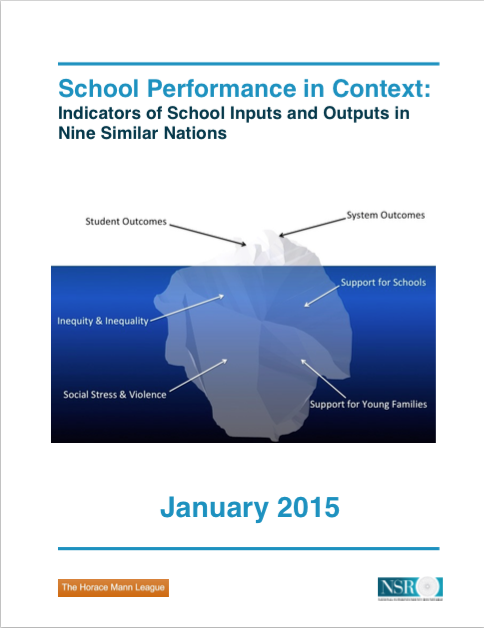
School Performance in Context: Indicators of School Inputs and Outputs in Nine Similar Nations is a joint project of the National Superintendents Roundtable and the Horace Mann League. Click below to download the full report and the summary report for free. Scroll down to purchase the full, four-color report and have it mailed to your door.
This report does what has been missing in international assessments like PISA and TIMSS…It provides a broader context to understand how education systems perform…simply an eye-opening reading experience!
— Palsi Sahlberg, Harvard University, author of Finnish Lessons

 Click to Download:

The Summary Report
The Full Report (with data)

An Introduction to the Report:


To embed the video on your website, use the following code: <iframe width=”560″ height=”315″ src=”//www.youtube.com/embed/MYYKQweh8Ck” frameborder=”0″ allowfullscreen></iframe>

Order a Hard-Copy of the Report:

Glossy, full-color. Max units per order: 10
Choose the price bracket in the drop-down menu to the right. The price listed is the unit price. Once re-directed to Paypal, be sure to manually enter the number of copies you wish to order.
Screen Shot 2015-01-11 at 3.13.52 PM

Bulk Discounts: Price per unit


Taking Stock of Educational Progress Under Obama - The Atlantic

Taking Stock of Educational Progress Under Obama - The Atlantic:

Taking Stock of Educational Progress Under Obama
Secretary John King’s exit memo offers a first look at what the administration thinks it has—and hasn’t—achieved.


As they prepare to leave office, members of President Barack Obama’s cabinet are beginning to file their exit memos. Partially a chance to take credit for progress made and partially a final opportunity to call for changes in policy they’ve yet to push through, the memos offer insight into what the administration’s top officials think they have—and haven’t—accomplished over the last eight years.

On Thursday, Education Secretary John King delivers his memo. Entitled “Giving Every Student a Fair Shot: Progress Under the Obama Administration’s Education Agenda,” the 14-page document is divided into two sections: One outlines notable progress and the other lays a framework for sustaining that progress.

Clearly, some of what King touts as “progress” (say, Race to the Top grant competitions), others (for instance, teachers’ unions and labor groups) see as mistakes or failures. But, as a whole, the memo paints an initial picture of what the administration—and King, personally—would like its education legacy to be. (Obviously, whether it receives the credit it is looking for remains to be seen and will vary depending on who is doing the evaluating.)


 King spends a good chunk of space noting work the department has done to expand access to preschool, pointing out that 31 states increased the percentage of 4-year-olds attending state-funded preschool between 2009 and 2015. He praises an early-learning Race to the Top competition for spurring programs that help the nation’s most vulnerable youngsters. It’s unclear how many states would have taken steps to expand preschool access without prodding from the administration, but the same way any good resume or report offers concrete examples of work done, King sprinkles his memo with anecdotes. Delaware used a 2012 grant from the administration, he reminds readers, to launch a new early-learning agency and screen nearly 20,000 students for health issues.

The secretary also touts record high-school graduation rates, a reduction in what the administration dubbed “dropout factories,” and the expansion of technology (as a tool for creating individualized learning plans) in classrooms. He lauds the fact that it has become easier to apply for federal financial aid to pay for college, and the development of a college “scorecard” to help students evaluate which colleges might be a good fit.
King devotes significant space to the hard-fought Every Student Succeeds Act, a rewrite of the nation’s main federal education law and a rare bipartisan effort. Predictably, the secretary sidesteps acknowledging that some elements of the law Taking Stock of Educational Progress Under Obama - The Atlantic:

The Rotten State of Charter Schools in Michigan: A For-Profit Bonanza, Sponsored by the DeVos Family | Diane Ravitch's blog

The Rotten State of Charter Schools in Michigan: A For-Profit Bonanza, Sponsored by the DeVos Family | Diane Ravitch's blog:

The Rotten State of Charter Schools in Michigan: A For-Profit Bonanza, Sponsored by the DeVos Family

Image result for The Rotten State of Charter Schools in Michigan: A For-Profit Bonanza, Sponsored by the DeVos Family

The confirmation hearings for Billionaire Betsy are scheduled to begin on January 11. It is assumed that she will breeze through because the DeVos family gives so much money to Republican politicians. That is usually enough to get a wealthy donor given an ambassadorship, but it is not typically the case for cabinet positions. Members of the president’s cabinet are expected to have some experience in the department and sector where they will take charge of federal policy. Billionaire Betsy has none. Her only involvement in education is as a lobbyist for private school choice. Since some 85% of children in the U.S. attend public schools, this means that she is totally out of touch with public education, for which she has repeatedly demonstrated hostility and contempt.
If she had her druthers, every child in America would attend a religious school, preferably evangelical Christian, to further her religious goals.
She and her husband tried and failed in 2000 to change the state constitution in Michigan, which forbids spending public money on religious schools. Voters turned down the revision overwhelmingly, by 69-31%.
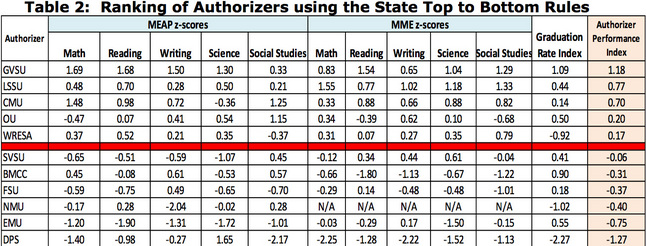
So Billionaire Betsy and her husband went all in for charter schools, the next best route to privatization. They stood firmly against any regulation of charter schools, and the result–according to a year-long investigation by the Detroit Free Press in 2014–is a sector that is dominated by for-profit charters, that has low quality and poor performance, and that wastes $1 billion of taxpayers’ dollars every year. (I will explain in the next post why I am not including a link to the DFP series about the incompetence and corruption of the state’s charter sector.)
A husband and wife team (the Cancilliaris) started multiple charter schools; she was a teacher, he was a contractor. They were charged with self-dealing and conflicts of interest for steering millions of dollars to their private, for-profit companies. But the law is so weak on conflict of interest that almost anything goes. He was paid $200,000 as facilities director; she was paid $250,000 as program director, while also running an off-site textbook company that she and her husband founded.
In 2008 and again in 2012, Central Michigan raised questions about insider dealings, mostly involving the Cancilliaris; Mike Witucki, the former Flat Rock schools superintendent whose company, Helicon Associates, was brought in to manage the Summit schools; and the schools’ lawyers. At issue:
■ Companies founded by Witucki and Dino Cancilliari received millions of dollars in school funds for janitorial and tutoring services.
■ Emma Street Holdings, another company founded by the two men, provided loans and sold real estate to the schools.
■ Lawyers for the schools’ boards incorporated several of the Dino Cancilliari and Witucki companies, but CMU said they failed to disclose those relationships to the boards.
■ A company owned by Dino Cancilliari and his brother got construction contracts worth millions of dollars.
■ Helicon Associates paid Alison Cancilliari for consulting work, even as the two schools, with her at the helm, paid Helicon fees for managing the schools.
An expert on ethics says she sees ‘conflicts of interest at every turn
Authorizers.jpg

How Serious Is The Threat of School Privatization under Donald Trump and Betsy DeVos? | janresseger

How Serious Is The Threat of School Privatization under Donald Trump and Betsy DeVos? | janresseger:

How Serious Is The Threat of School Privatization under Donald Trump and Betsy DeVos?

Image result for How Serious Is The Threat of School Privatization

Over the past couple of decades school privatization has been normalized.
Here is Carol Burris, chair of the Network for Public Education: “The drive to privatize the public education system under the guise of ‘choice’ is well underway—and can be expected to pick up steam when Donald Trump becomes president.  He chose as his education secretary a Michigan billionaire named Betsy DeVos… who has said the public education system is a ‘dead end.’…. (P)ublic education has been the frog in the pot of water, as school privatizers and ‘education reformers’ have slowly turned up the heat.  Over 1 million students receive a taxpayer-funded voucher to attend a private school , and close to 3 million attend charter schools.  Whether the adjective ‘public’ is in front of the word ‘charter’ or not, charters are at the forefront of school privatization.”  Of course 50 million children and adolescents across America are enrolled in traditional public schools, but that is harder to remember in the avalanche of rhetoric.
Jeff Bryant of the Education Opportunity Network reflects further on the way promoters of privatization have used language to cloud our thinking: “Education marketers have rebranded ‘public schools’ to mean any institution that gets tax dollars.  And the phrase ‘doing what’s best for kids’ has been turned into an empty PR slogan.  The operative political term of the day is ‘what parents choose for their children,’ which has become a de facto argument to justify any kind of education option—even if parents are being suckered into bad choices or are being forced into situations where high quality education options are practically unobtainable.”
David Dayen, writing for The NATION, warns that we are likely to see a rapid increase in privatization with Donald Trump’s administration: “Trump’s advisors all fall in a comfortably snug ideological range, with a dedication to doctrinaire conservative economic beliefs about tax cuts and deregulation.  And another area of consensus sticks out: the idea that government should outsource public functions to private industry.  In the Public Interest, a research organization monitoring privatization, has complied a list of 32 different members of the Trump transition team or formal nominees for top agencies who have either close ties to How Serious Is The Threat of School Privatization under Donald Trump and Betsy DeVos? | janresseger:


Will the Last 5 Traditional Public Schools in New Orleans Become Charters? | deutsch29

Will the Last 5 Traditional Public Schools in New Orleans Become Charters? | deutsch29:

Will the Last 5 Traditional Public Schools in New Orleans Become Charters?


Image result for Will the Last 5 Traditional Public Schools in New Orleans Become Charters?

On December 09, 2016, Danielle Dreilinger of nola.com published an article entitled, “Last 5 New Orleans Public Schools Expected to Become Charter Operations.”
As one might imagine, such a headline could be a surprise and a shock to teachers, parents, and students at the five Orleans Parish School Board (OPSB) schools in question. The word I have from a teacher at one of the five schools affected is that it was a shock and that teachers from at least one of the schools found out about the chartering possibility just before Dreilinger’s article was published on the evening of December 9th.
The charter conversion “expectation” hinges upon the following sketchy details in the nola.com article:
Orleans Parish Superintendent Henderson Lewis Jr. announced Friday (Dec. 9) he had “received informal expressions of interest from current school and charter leaders to convert some or all of our remaining five network elementary and high schools to charter schools authorized by OPSB.”
The five schools currently under school board control this would affect: Ben Franklin Elementary, Eleanor McMain Secondary, Mahalia Jackson Elementary, Mary Bethune Elementary, and McDonogh No. 35, comprising a middle and high school. …
Lewis offered no further details, saying only, “We are beginning the process of informing school board members, staff, principals, teachers and families. When that process is completed early next week, we will be in a better position to provide more details.”
The School Board is scheduled to meet Tuesday [December 13, 2016].
The article hints at “interest from current school and charter leaders”; however, in the article, the public is offered no specifics regarding who these leaders are. Too, as cited in the article, Superintendent Henderson Lewis’ words about “informing” Will the Last 5 Traditional Public Schools in New Orleans Become Charters? | deutsch29:


How This Educator Handles Trolls (Bob and Weave Em) | The Jose Vilson

How This Educator Handles Trolls (Bob and Weave Em) | The Jose Vilson:

How This Educator Handles Trolls (Bob and Weave Em)

Image result for ali (Bob and Weave Em)

Last week, #EduColor had a chat on education research. It seems like a benign topic outside of the education sphere. Most folks in this chat should be people genuinely interested in talking about higher education. Mildred Boveda and Grace Chen put together the questions, prompting people to rethink praxis from PK-12 and beyond.
Yet, because it reached #8 on Twitter worldwide, we also unwillingly hosted a plethora of trolls, vagabonds, and also-rans, the usual folks who want to make America great again or whatever.
At first, my reaction was “Who are you and why are y’all always up in the conversations?” My second thought was “BLOCK, REPORT, BLOCK BLOCK BLOCK REPORT!” My third thought was “Let’s see if they can stand the heat.” So while Mildred and Grace graciously hosted, I played provocateur in the hashtag. An hour after the chat was over, I was still having to tell these hooligans to read books and watch anything other than FOX News. Friends would refer to my legendary patience as Jedi-like. I laughed from this side of the screen.
No one should feel obligated to volunteer their tweets for the service of people intent on rejecting their humanity, but I looked at my watch and said I got time for this today. If the education field has taught me anything, it’s that anyone can catch a lesson given the proper teacher.
Annie Tan recently said “organizing is humanizing.” Indeed, teaching as an act of organizing means that we know what it’s like to ask hard questions, delve deeper, and ignore the run reflex. Too many people mistake standing firm with standing still. Too many people mistake quiet for silence. Conversely, too many people mistake noise for action, too. There is dirty work that needs to get done, and for those that can engage, we should. For those that can’t, y’all need to examine why. For those that don’t know how we do it, please know that might never be enough to confront the institutional structures that How This Educator Handles Trolls (Bob and Weave Em) | The Jose Vilson:

New bedfellows in education: Bill Gates and Donald Trump | Seattle Education

New bedfellows in education: Bill Gates and Donald Trump | Seattle Education:

New bedfellows in education: Bill Gates and Donald Trump

trump-quote-about-climate-change
Exactly how far will Bill Gates go in furthering his agenda of privatizing public schools and ensuring that Common Core Standards is instituted in every classroom across the country? Apparently farther than most of us could imagine.
In late December, Bill Gates made the trek to the Trump Tower in New York City to meet with Donald Trump and had some kind words to say about the president-elect.
Bill Gates was quoted in MarketWatch as saying: 
‘In the same way President Kennedy talked about the space mission and got the country behind that. … I think whether it’s education or stopping epidemics … [or] in this energy space, there can be a very upbeat message that [Trump’s] administration [is] going to organize things, get rid of regulatory barriers, and have American leadership through innovation.’
The term “Innovation” has been used time and time again by Gates’ paid disciples when describing everything from charter schools (which certainly have no “regulatory barriers”) to the Common Core Standards and Race to the Top.
In reality, Gates hasn’t done anything innovative since he developed Windows and Microsoft New bedfellows in education: Bill Gates and Donald Trump | Seattle Education:


Why Schools Should NOT Be Run Like Businesses | gadflyonthewallblog

Why Schools Should NOT Be Run Like Businesses | gadflyonthewallblog:

Why Schools Should NOT Be Run Like Businesses

school-closures
America loves business.
We worship the free market. Nothing is more infallible – not reason, not morals, not even God.
Money is the true measure of success – the more you have, the better a person you are.
This perverted ideology has taken over much of American life. Where we once cared about our country, justice and fair play, today it has all been reduced to dollars and cents.
Every problem can be answered by business. Every endeavor should be made more business-like. Every interaction should be modeled on the corporate contract, and every individual should try to maximize the outcome in his or her favor. Doing so is not just good for you, personally, but it’s what’s best for everyone involved. And this dogma is preached by the high priests of the market who claim that as they, themselves, get wealthier, one day we too will reap the same rewards – but that day Why Schools Should NOT Be Run Like Businesses | gadflyonthewallblog: