Latest News and Comment from Education

Tuesday, December 20, 2016

On Lies, Bullying, and America’s Greatness: “the true horror of lost status” | the becoming radical

On Lies, Bullying, and America’s Greatness: “the true horror of lost status” | the becoming radical:

On Lies, Bullying, and America’s Greatness: “the true horror of lost status”

Image result for lost status


When Nora experiences her existential epiphany and decides to be no longer a doll in Torvald Helmer’s house, it is Torvald’s response that has always fascinated me.
“Oh, you think and talk like a heedless child,” Torvald responds before becoming desperate: “But can’t we live here like brother and sister–?”
A Norwegian playwright dramatizing well over a century ago the sexism and misogyny inherent in social norms such as marriage—what could this possibly have to do with the U.S. in 2016?
Torvald, in fact, is a dramatization of what Toni Morrison recognizes in the rise of Trumplandia; Morrison’s confrontation of racism speaks as well to sexism: “These sacrifices, made by supposedly tough white men, who are prepared to abandon their humanity out of fear of black men and women, suggest the true horror of lost status.”
We see in Torvald the embodiment of “the true horror of lost status.”
Teaching A Doll’s House was challenging in the rural conservative South, but so was asking my students to confront Thomas Jefferson, whose letters reveal a past president of the U.S. who rejected:
The immaculate conception of Jesus, His deification, the creation of the world by Him, His miraculous powers, His resurrection and visible ascension, His corporeal presence in the Eucharist, the Trinity, original sin, atonement, regeneration, election, orders of Hierarchy, etc. (letter to William Short, 31 October 1819) [1]
These central beliefs of Christians, Jefferson labeled “artificial systems,” and my students were usually stunned because their upbringing had mostly idealized the Founding Fathers as traditional Christians who formed the U.S. as a Christian nation.
The general public is often as misinformed about presidential elections, which have historically been nasty. Jefferson was often vilified in his presidential campaigns, but we can imagine that he could have never been On Lies, Bullying, and America’s Greatness: “the true horror of lost status” | the becoming radical:


SF district to provide pathway to teaching credentials - SFGate

SF district to provide pathway to teaching credentials - SFGate:

SF district to provide pathway to teaching credentials

The San Francisco school district is going into the teacher credentialing business, offering courses and training typically administered on a college campus.Click through this slideshow to see the best and worst states to be a teacher.  Photo: Kimberly Veklerov
The San Francisco school district is going into the teacher credentialing business, offering courses and training typically administered on a college campus.


Hoping to make it easier, faster and cheaper to become a teacher, the San Francisco school district is going into the teacher-credentialing business, offering courses and training typically administered on a college campus.
Only a handful of districts across the state have internal credentialing programs, in which staff do the teaching instead of college professors. Los Angeles and Mount Diablo, in Contra Costa County, are among the few. Such programs require state authorization from the California Commission on Teacher Credentialing.
In San Francisco, the goal is to recruit, train, credential and hire teachers, district officials said, in a bid to alleviate an ongoing teacher shortage and ensure that those hired are specifically prepared to teach in city schools.


“We’re going to tailor that preparation so that these folks are as prepared as possible for these (job) opportunities,” said Chris Canelake, the district’s executive director of professional learning and leadership.
“Since we have connections with these folks, we’re able to recruit them directly and offer them an alternative that might for many people get them past some of the barriers they might find when they’re trying to get their teaching credential,” he said. “We’re also recruiting SF district to provide pathway to teaching credentials - SFGate:

White House Looks to Cement Its School-Discipline Legacy - The Atlantic

White House Looks to Cement Its School-Discipline Legacy - The Atlantic:

School Discipline in a Post-Obama World
It’s unclear whether the Trump administration will also see the issue as a matter of civil rights.


Education Secretary John King is a generally soft-spoken, thoughtful guy. It’s hard to imagine him as a kid giving his teachers any trouble. But the topmost education official in the United States actually got booted from Phillips Andover Academy, an elite boarding school north of Boston, back when he was a high-school student there in the early 1990s. King, whose parents had both passed away by the time he was 13, felt “unhappy and overwhelmed” by the school’s unfamiliar culture and strict rules.
After boarding school, he went to live with his aunt and uncle, a former Tuskegee Airman who provided a sense of stability. Always strong academically, King, who grew up in Brooklyn, rebounded, and ultimately completed his undergraduate work at Harvard before earning a law degree from Yale, and a master’s in social studies and education from Columbia; he worked full-time and raised two small girls with his wife, Melissa, while he was getting his advanced degrees. Agree with his progressive politics or not, he’s clearly achieved some level of personal and professional success.

But things could’ve gone so differently.
“I often say I’m the first secretary of education to get kicked out of high school, but I hope I’m not the last,” he said during a recent phone conversation from Phoenix, where he’d just finished a roundtable with civil-rights organizations. “Part of why I am here today, why I’m doing the work that I’m doing today, is because folks gave me a second chance.” As he explained to my colleague earlier this year, as a black, Latino male student who was suffering from instability and family loss, King could've easily been dismissed by his teachers as a lost cause. “But instead,” he told me, “they chose to invest in me and support me and give me a second chance, and that helped me to get my life back on track.”


 As the Obama administration comes to a close, King and other top officials are calling on schools and nonprofits to make sure kids like him don’t fall through the proverbial cracks—getting suspended or even expelled when tough circumstances prompt them to act out—moving forward. It’s unclear how much of a priority the White House Looks to Cement Its School-Discipline Legacy - The Atlantic:

Shanker Blog: Three Important Details When Discussing School Segregation | National Education Policy Center

Shanker Blog: Three Important Details When Discussing School Segregation | National Education Policy Center:

Shanker Blog: Three Important Details When Discussing School Segregation

Big Education Ape: This Mostly White City Wants To Leave Its Mostly Black School District : NPR Ed : NPR - http://bigeducationape.blogspot.com/2016/12/this-mostly-white-city-wants-to-leave.html


 It sometimes seems as if school segregation is one of those topics that is always “in fashion” among education policy commenters and journalists. This is a good thing, as educational segregation, and the residential segregation underlying it, are among the most important symptoms and causes of unequal opportunity in the U.S.

Yet the discussion and coverage of school segregation, while generally quite good, sometimes suffers from a failure to make clear a few very important distinctions or details, and it may be worthwhile laying these out in one place. None of the three discussed below are novel or technical, nor do they represent a comprehensive list of all the methodological and theoretical issues surrounding segregation (of any kind).
They are, rather, just details that should, I would argue, be spelled out clearly in any discussion of this important issue.
The first thing that should always be specified is the “type” of segregation – that is, which groups are being analyzed. This is a very obvious point, and probably goes without saying, but it bears mentioning anyway. The most common groups in the education context are those defined by income (usually using subsidized lunch eligibility as a rough proxy) and race and ethnicity. Schools, on the whole, are segregated by both race and ethnicity and income, and the two are interrelated, but the levels and trends can be different (e.g., Owens et al. 2014).
Moreover, particularly when it comes to segregation by race and ethnicity, the most common measures can be applied to different combinations of groups. For example, one can measure segregation between individual groups (e.g., Black from white students), or combinations of groups (e.g., minorities from white students). It is important to make clear such specifications and, perhaps, to note that different combinations/groups can yield different results (e.g., Reardon et al. 2000). This is particularly salient given the increasingly multiracial composition of U.S. public school students.
A second, and related distinction that should be highlighted in any discussion of school segregation is the type of segregation measure used. There are many different ways to measure segregation, school and otherwise. The two most common approaches are:
  1. Exposure: This is a measure essentially of contact or interaction between groups. For example, one might calculate the percentage of the typical higher income student’s peers who are lower income. These indicators are sensitive to compositional change (e.g., a change in the number of lower income students);
  2. Evenness: This type of measure focuses not on how many members of a given group there are, but rather how evenly they are distributed (e.g., between schools or districts). If, for instance, every school in a given district has roughly the same proportion of lower income students common evenness measures Shanker Blog: Three Important Details When Discussing School Segregation | National Education Policy Center:

Teachers in Wealthy Districts Get Bulk of Indiana's Performance Payouts - Teacher Beat - Education Week

Teachers in Wealthy Districts Get Bulk of Indiana's Performance Payouts - Teacher Beat - Education Week:

Teachers in Wealthy Districts Get Bulk of Indiana's Performance Payouts

The Indiana Department of Education has announced how it will divvy up $40 million that state lawmakers set aside in 2015 to reward teachers who are rated effective and highly effective. Those bonuses will disproportionally go to teachers in wealthy districts, a fact that has many in the state up in arms.
Carmel Clay Schools, where just 9 percent of their 16,000 students qualify for free or reduced-price lunch, will get the most— $2.4 million or roughly $2,422 per teacher. Another well-off Indianapolis suburban district, Zionsville Community Schools, where fewer than 5 percent of students qualify for the free and reduced-price lunch program, will receive about $2,240 per teacher. Meanwhile, Indianapolis, the state's largest district will receive just around $330,875, or $128.40 per educator. So teachers in those wealthy suburban districts will get bonuses nearly 20 times larger than effective and highly effective educators in Indianapolis.
Indiana State Teachers Association President Teresa Meredith calls it a "flawed" system.
"While educators at well-resourced schools performed well and received a much-deserved bonus, the educators teaching in some of the most challenging districts where socioeconomic factors can Teachers in Wealthy Districts Get Bulk of Indiana's Performance Payouts - Teacher Beat - Education Week:


Hoosier School Heist TV is Doug Martin's channel featuring videos of his book tour across Indiana speaking on the corporate takeover of public education. Order Hoosier School Heist at http://hoosierschoolheist.com/.
Follow Hoosier School Heist on Facebook: https://www.facebook.com/HoosierSchoolHeist
Tweet with Doug Martin at: https://twitter.com/DougMartinED

I know you are upset about privatizing public schools, but please keep your voice down. | Fred Klonsky

I know you are upset about privatizing public schools, but please keep your voice down. | Fred Klonsky:

I know you are upset about privatizing public schools, but please keep your voice down.


Betsy DeVos.
It is odd the way corporate school reformers obsess about the tone of conversations.
I know that I have been known to raise my voice now and then. But that has more to do with the fact that I frequently forget to put in my hearing aids and I talk louder when that happens.
There are things I am passionate about, however. I am for preserving public education, which many of us consider a basic component of a democratic society.
Defending and expanding democracy seems more important than ever these days.
There is this debate between the corporate reform Fordham Foundation’s Robert Pondisco and former Arne Duncan advisor Peter Cunningham. It’s appears in Education Next, a website that promotes privatization and is run by the usual corporate reform suspects like Frederick Hess, Michael Petrilli, and Chester Finn.
Peter Cunningham runs a site of his own, funded with more corporate money (there seems to be an endless supply), that supports charters and “choice.” Cunningham’s I know you are upset about privatizing public schools, but please keep your voice down. | Fred Klonsky:

Success Academy’s First State Audit: Let the Pouting Begin | deutsch29

Success Academy’s First State Audit: Let the Pouting Begin | deutsch29:

Success Academy’s First State Audit: Let the Pouting Begin


On December 19, 2016, New York Deputy Comptroller Marjorie Landa released this financial audit of Eva Moskowitz’s Success Academy charter schools.
In March 2014, Moskowitz sued to prevent then-Comptroller Thomas DiNapoli from auditing her schools, and a Manhattan judge ruled in her favor. The judge declared that the Comptroller did not have authority to audit New York charter schools because the schools are not “units of the state.” This meant that Moskowitz could receive state funds and public accounting for such funds was now out of view of the public.
In April 2014, the law changed; New York State charter schools would no longer escape audit, and in October 2014, Success Academy charter schools made the list of those to be audited.
No surprise.
The audit has taken two years and spans July 01, 2012, to June 30, 2015– or fiscal years 2013 to 2015.
In a letter that summarizes Landa’s findings regarding fiscal management of Success Academy schools, Comptroller Scott Stringer tells the public that Success Academy “did not adequately oversee its fiscal affairs,” including “bill[ing] the Department of Education (DOE) for special education services that were not documented.”
The full audit document is 81 pages long and includes a 27-page response from Success Academy. (The inclusion of a written response from the audited party addressing the auditor’s findings is usual procedure.)
I was especially interested in the Success Academy response, primarily because Eva Moskowitz is so controlling that I did not expect her to be sloppy with finances.
Here is where I write what might surprise many of my readers:
After reading the Success Academy response to the irregularities cited in the audit, I believe that Success Academy has accounted well for such seeming discrepancies.
Success Academy believes it has been unfairly treated and that the comptroller was not being “objective.” An excerpt from Success Academy’s response:
It has become increasingly clear that the Comptroller is not conducting this investigation in an impartial and objective matter. The Comptroller’s standard operating procedure is to share a Preliminary Draft Report with the entity being audited and then conduct an Exit Conference at which the entity may propose corrections and provide additional documentation. In every single case over the last six months in which the Comptroller has issued an audit report indicating the date of the Preliminary Draft Report and Exit Conference, the Comptroller has allowed the entity being audited at least 10 business days to prepare for the Exit Conference after issuing its Preliminary Draft Report. In the case of the sole charter school with such information to be audited during this period, the exit conference did not take place until 21 business days after the Preliminary Draft Report….
However, with respect to Success Academy, the Comptroller issued a 31-page Preliminary Draft Report on the afternoon of November 23, the day 
Success Academy’s First State Audit: Let the Pouting Begin | deutsch29:


CURMUDGUCATION: Teaching in the Machine Age (Or Not)

CURMUDGUCATION: Teaching in the Machine Age (Or Not):

Teaching in the Machine Age (Or Not)


The Christensen Institute is devoted to "disruptive innovation," or as a five-year-old might put it, new and creative ways to kick over the big stack of blocks.

For the big stack of blocks that is public education, Christensen has the big boot of personalized computer-driven education-favored product. And a new part of their pitch is the recently released report/PR prospectus, "Teaching in the Machine Age: How Innovation Can Make Bad Teachers Good and Good Teachers Better" by Thomas Arnett.


Hi! I'm your new teacher, and here's my human assistant.

Arnett is a Senior Deep Education Thinker at Christensen, which is impressive since it was only five years ago that he was finishing out his two years with Teach For America in Kansas City. He then spent three months at Achievement First in 2012, and moved on to Senior Education Research Fellow at Christensen in 2013.If we dig deeper, we find that between 2002 and 2009 he was at Brigham Young earning a BS in Economics, and later did some graduate work at Carnegie Mellon's Tepper School of Business, including (and you'll want to remember this) Data Mining, Applications of Operations Research,Management of Software Development for Technology Executives, Innovation Ecosystems, plus Commercialization and Innovation: Strategy. So, no education.

This is the guy who's going to tell us how The Machines will help us do our jobs. Yay. But I have read this so you don't have to, because this trend toward Personalized Competency-Based Software-Centered Education has been poised to become the Next Big (Money-making) Thing, so we need to 
CURMUDGUCATION: Teaching in the Machine Age (Or Not):


Patchogue-Medford School District (NY) Board of Education Passes Resolution to Oppose the Nomination of Devos - Badass Teachers Association

Badass Teachers Association:

Patchogue-Medford School District (NY) Board of Education Passes Resolution to Oppose the Nomination of Devos


Whereas, the Board of Education of the Patchogue-Medford School District has been elected by the residents of the Patchogue-Medford Union Free School District to determine policy and approve programming for the students of the district, within the confines of both federal and state statutes governing education, and


Whereas, this Board of Education, on many occasions, has expressed its displeasure with the requirements of the No Child Left Behind Act and the Every Student Succeeds Act, as well as the implementation of the Common Core and Annual Professional Performance Review and the high stakes testing which accompany these mandates, and

Whereas, the Board of Education envisions the inauguration of Donald Trump as the President of the United States, on January 20, 2017, as an opportunity for a renewal and re-visioning of public education in the United States of America in a way which creates opportunities for students of all ages to learn in Badass Teachers Association:


What did you read, talk about in 2016? Here's the list - Lily's Blackboard

What did you read, talk about in 2016? Here's the list - Lily's Blackboard:

What did you read, talk about in 2016? Here’s the list

Are you wondering what articles from this blog were the most read, shared, talked about in 2016? Here they are! (Yes, you can still comment and share your favorites).

Instead of “going back to school” let’s do this!
“Going back” marks a return, a gearshift into reverse. That’s not for us! We’re going forward into unchartered territory, because every year is different from years past. Whether we’re teachers, school bus drivers, counselors, faculty members, financial aid administrators, or lunch ladies, we have a gift: the chance to start over every single year, to “do it all again but even better.” Is this a great profession, or what? Full article here.
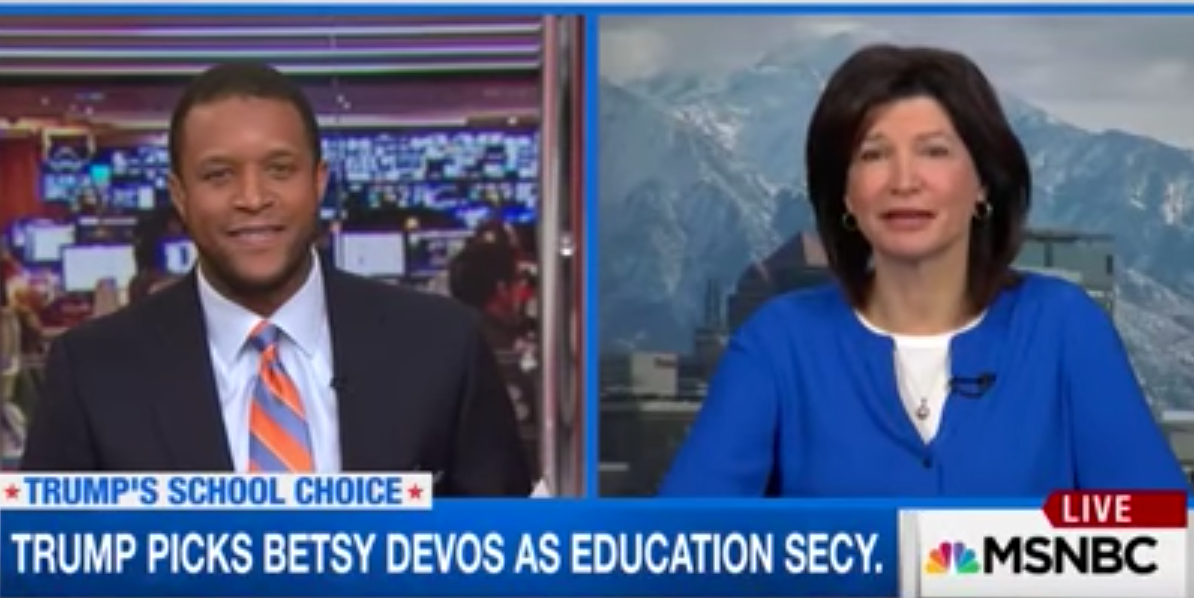
MSNBC: Lily on Betsy DeVos’ nomination as Education Secretary.
Lily spoke with MSNBC’s Craig Melvin to discuss President-Elect Trump’s nomination of Betsy DeVos to lead the Department of Education. Yes, the word "horrible" was used. Watch the video. 
What will we tell our children this time?
(Richard Tsong-Taatarii/Star Tribune via AP)
NEA members are public service professionals, and we have a special bond with the men and women who devote their lives to securing the safety of all of us. But we are also concerned about institutional racism and the way minorities are sometimes viewed and treated by police. Read more here.
The absence of teachers of color, isn’t just a problem for non-white students.
The absence of teachers of color – some refer to it as a “disappearance crisis” – isn’t just a problem for non-white students; it is a problem for all students.  Full article here.
When a student asks: Am I going to die?
One after another, these educators told me their stories. Stories of their own families and stories of the students. For over a year, the residents of Flint – the What did you read, talk about in 2016? Here's the list - Lily's Blackboard:

Network for Public Education DeVos/Trump toolkit – Cloaking Inequity

Network for Public Education DeVos/Trump toolkit – Cloaking Inequity:

Network for Public Education DeVos/Trump toolkit


I received an email from Carol Burris, Executive Director of the Network for Public Education. She asked if I would share this important toolkit for the upcoming confirmation of Betsy DeVos at the Secretary of Education.
You are someone who understands the vital role that public education plays in democracy. You understand that a patchwork quilt of for-profit charters, charter chains, online schools, and vouchers schools cannot work in a democracy. You understand that public schools will be starved and become the “dumping ground” for children no one wants.
Which brings us to Betsy DeVos, who has made it clear that only the “free market” matters, not quality. She claims to be on a mission from God.  That is extremism we cannot have at the helm of our education system.
During the next few months the Network for Public Education will be involved in a campaign to accomplish the above. Here is a link to our toolkit. 
 
It is designed to use the holiday recess as a time when Senators are bombarded with pressure to vote no on DeVos.
 
It provides sample letters, phone scripts and a letter to the editor.
We will be tracking how many engage in these actions so that we have feedback on effectiveness to share with other organizations.
Our senate email campaign motivated near 100k to send an email. But that was easy, these actions take more time. However, they are also far more effective.
Take the time to do them yourself and then share the link. Post the link everywhere.  There will be future NPE Actions. This is our first and we will learn from it. Trump will pass. But if he destroys public education that will undermine our Democracy for generations.
Here is that link again🙂


 Network for Public Education DeVos/Trump toolkit – Cloaking Inequity:


DeVos' hostility to public schools should be a disqualifier