Latest News and Comment from Education

Wednesday, November 30, 2016

TBFURMAN: Here We Go With The Charters

TBFURMAN: Here We Go With The Charters:

Here We Go With The Charters


Do you remember the $42m federal grant that Heather Steans, Ron Sandack, Bruce Rauner, and the charter people got from Arne Duncan?

(In the grant proposal, they used an IFT research piece as a support document, even though the IFT did not support--- or even know about-- the grant proposal and would have opposed it.)

The main thrust of the grant is to pay for new charter school proposals and to defray some of the initial costs of charter startups--- it's not an ongoing grant to pay for the longterm costs of charters, which are paid for via a reduction in services and choices available to students in democratically controlled public schools.

It's weird to me that even the very planning and design of charter schools--- which have a sort of free-market sales pitch to them--- are now leaning on federal funding. But there it is.

The RFP for the start up proposals is about to go out in January, according to Tony Smith.


In September 2015, the Illinois State Board of Education was awarded a federal Charter Schools Program Quality School Options Grant in the amount of $42 million for a five-year term. These funds are intended to provide financial assistance to new charter schools for allowable activities during the program design phase and start-up costs in the first two years of operation. This competitive grant will be awarded through multi-cohort competitions throughout the term of the grant. The second cohort Request for Proposal will be released in January 2017. High-quality applications may be awarded up to $950,000 for up to three years for the design and implementation of a new charter school. 


So, that will be interesting. Someone should keep an eye on it.

Obviously there was a first cohort, and I'm not 100% sure, but I think those were not the design/implementation grants. They were smaller grants for materials requested by existing charter schools.

I FOIA'd those grants, and I believe I have the material from the four or five charters that were awarded money. They're not very interesting, but if you want those, I have them. It's basically just requests for new programs and what have you. Online curricula, that sort of thing. If you read a lot of grants you start to see the same thing over and over again. The word "utilize" is in there a lot. There's nothing new under the sun.

It's this next round that will be interesting.TBFURMAN: Here We Go With The Charters:


Preview of Coming Attractions 


Where is Evidence that School Closures Actually Help? - Living in Dialogue

Where is Evidence that School Closures Actually Help? - Living in Dialogue:

Where is Evidence that School Closures Actually Help?


By John Thompson.
The latest report by the Education Research Association on New Orleans school reform, “Extreme Measures: When & How School Closures & Charter Takeovers Benefit Students, is consistent with the solid scholarship that informs its previous research. And it includes the important qualifying statement that, “prior evidence suggests that schools that are effective in generating high test scores are not consistently more effective with other student outcomes.” When the ERA released its landmark “What Effect Did the Post-Katrina Reforms Have on Student Outcomes?,” a diverse variety of scholars participated in the discussion of its findings. Moreover, previous research included qualitative research such as Huriya Jabbar’s “How Do School Leader’s Respond to Competition?” Fewer dissenting opinions were expressed when this new paper was released.
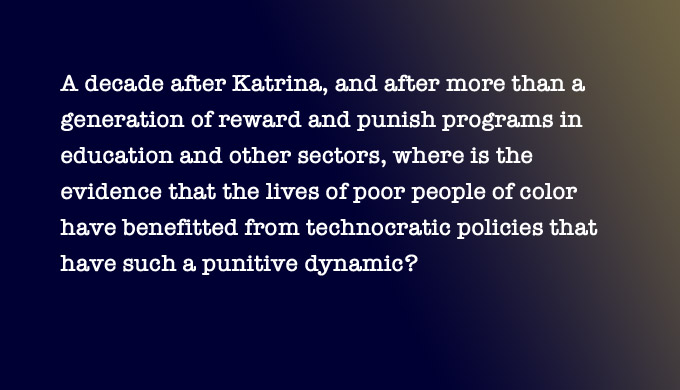
Fortunately, panelist Andre Perry articulated a broader view of the issues involved in evaluating school closures and takeovers in New Orleans and elsewhere. Perry explained that black people have already faced more than their share of punitive policies in terms of education, criminal justice, housing, and social welfare. He acknowledged that school closures and other state interventions are sometimes necessary. But, trust is required for school improvement and people of color can no longer trust the accountability-driven, technocratic experiments that are being imposed. Rather than tinker with the reward and punish approach of the last generation, we should focus on capacity-building.
Douglas Harris began his presentation with a mention of President Obama’s advocacy of school closures and takeovers. However, the President was not solely responsible for the misguided mass closure, turnaround, and transformation approach. It was the larger corporate reform community which pushed for the administration’s dubious Race to the Top (RttT), School Improvement Grant (SIG)s, and his other, risky, competition-driven policies. It was true-believers in charter schools and “disruptive innovation” that made the case to Obama that these experiments must be rapidly scaled up. Many of them will continue to use and misuse the ERA’s research to advance their agenda.
Harris’s characterization of closures and takeovers as “rare” is accurate, but they along with school Where is Evidence that School Closures Actually Help? - Living in Dialogue:
 Image result for Katrina Reforms

What Trump Really Means When He Talks About "Government Schools" | Mother Jones

What Trump Really Means When He Talks About "Government Schools" | Mother Jones:

What Trump Really Means When He Talks About "Government Schools"
The origins of the Overton window and the coming war on public education.

About halfway through Glenn Beck's 2010 "paranoid thriller" The Overton Window, his protagonist discovers a slide deck detailing a secret leftist plot to gradually subvert the American Way and take over the United States. The conspirators (who include the protagonist's dad) are employing an insidious, if somewhat wonky, tactic. As Beck's hero explains, "It's called the Overton Window. My father stole the concept from a think tank in the Midwest; it's a way of describing what the public is currently ready to accept on any issue, so you can decide how best to move them toward what you want."
That's a pretty good distillation of the Overton window, a concept that's suddenly gotten a lot of attention as Donald Trump and his allies have pushed the boundaries of acceptable political discourse. "On key issues, [Trump] didn't just move the Overton Window, he smashed it, scattered the shards, and rolled over them with a steamroller," National Review's David French noted with a mix of dismay and admiration in late 2015. Trump's disregard for mainstream conservatism has also emboldened his boosters on the extreme right. The day before he announced his run for Louisiana's Senate seat, ex-Ku Klux Klan leader and Trump fan David Duke tweeted about squeezing through the Overton window into a federal office. "If you want to radically shift the Overton window, you need that far-right flank," Richard Spencer, the white nationalist credited with coining the term "alt-right," told Mother Jones.
As Trump continues to push policies and embrace figures that would have been anathema not so long ago, we're about to see the Overton window shift to accommodate the defenestration of progressivism. One area to pay close attention to is education, where Trump has a direct link to the origins of the Overton window concept—and where the Trump administration will likely promote policies that would blow up public education as we know it.
Trump's connection to the Overton window starts with Betsy DeVos, his pick for secretary of education. She's married to Dick DeVos, heir to the multilevel marketing giant Amway and a leading bankroller of Republican and conservative causes and candidates in their home state of Michigan. The DeVoses have also been major funders of the Mackinac Center for Public Policy, a conservative think thank that has long pushed for deregulation, privatization, and weakening labor unions. (Dick DeVos has also served on the center's board of directors.) The Mackinac Center is also the birthplace of the Overton window.
The concept is named after its creator, Joseph Overton, the late senior vice president of the center. In the mid-'90s, Overton developed the idea to describe how a think tank might shift public opinion to consider ideas beyond the realm of conventional wisdom. Since politicians would not entertain these risky ideas for fear of rocking the boat, it was up to political outsiders and the public to nudge What Trump Really Means When He Talks About "Government Schools" | Mother Jones:


In education, greater choice doesn’t always mean better outcomes - The Washington Post

In education, greater choice doesn’t always mean better outcomes - The Washington Post:

In education, greater choice doesn’t always mean better outcomes


President-elect Donald Trump nominated Betsy DeVos, a Republican billionaire from Michigan, to be secretary of education last week. The choice of someone well known for her views on K-12 education sent college officials scrambling just before the long Thanksgiving weekend to find anything DeVos might have said about higher education.
They didn’t have much success. As Neal McCluskey, director of the Cato Institute’s Center for Educational Freedom, wrote in his analysis of the pick: “I have no idea where DeVos stands on early-childhood or higher education issues, and the latter, especially, is gigantic.”
But DeVos’ career spent promoting school choice so families can use taxpayer dollars to pay for private and religious K-12 schools provides clues to her thinking about the $80 billion Washington investment in higher education and the federal role in education overall.
In her home state of Michigan, DeVos has closely followed an ideology that promotes the idea that school choice — either through market-based vouchers or privately run charter schools — improves outcomes and forces poor-performing schools to either get better or close. As Kevin Carey, director of the education policy program at the New America Foundation noted after DeVos’ nomination, she has lobbied on all fronts in the school-choice movement, and she has been a particularly strong advocate for privatizing public education as much as possible.
If DeVos arrives at the Education Department intent on pursuing that agenda at a national level, she might have second thoughts after she learns more about the American system of higher education. In some ways, U.S. colleges and universities follow the market-based approach DeVos imagines for the structure of K-12 schools. Students are free to apply to any college or university, and most schools accept the vast majority who apply. Federal aid, in the form of grants and loans, follows the student.
But the availability of federal dollars for choice in higher education – one that has led 20 percent of students to enroll in private colleges — hasn’t necessarily led to better outcomes. Only slightly more than 50 percent of American students who enter college leave with a bachelor’s degree. The reasons why are varied, but two in particular provide lessons for choice advocates at the K-12 level.
For one, students and families still lack good comparable consumer-friendly information about outcomes among colleges they are considering. Whether students stay in college, graduate, get a job, and how much they earn after graduation, differs widely between colleges and even within schools based on a student’s major. In recent years, thanks in large part to efforts by the Obama administration and several foundations, families have been given more access to outcome data by school and major, mostly about salaries after graduation. In turn, that data has formed the basis of several new rankings put out by Money magazine, the Economist, and others.
Even so, the presence of more information in the hands of consumers sometimes confuses them rather than helps them make better choices. Research has shown that smart students from low-income backgrounds, for example, frequently “undermatch” when enrolling in college — meaning they don’t go to the best college they can get into and end up dropping out of a less-selective school with fewer resources to help them succeed.
In theory, choice in higher education means being able to apply to any one of a several thousand colleges across the country. But in reality, most students go to college near their home, and as a result, their choices are limited. Freshmen who enroll in public four-year colleges typically attend an institution that is less than 100 miles from home; for those attending private four-year colleges, the distance is about 250 miles.
In K-12, student choices are even more limited. As Carey noted in his analysis of the DeVos nomination, outside of urban areas, families have few, if any, options for charter or private In education, greater choice doesn’t always mean better outcomes - The Washington Post:


The good — and very, very bad — education news of 2016 - The Washington Post

The good — and very, very bad — education news of 2016 - The Washington Post:

The good — and very, very bad — education news of 2016


Every year veteran teacher Larry Ferlazzo writes a list of the best/worst education news of the year. Here is his 2016 version, which includes “bad” news that includes the consequences of the 2016 presidential election, in which Donald Trump defeated Hillary Clinton. See what you think.
Ferlazzo teaches English and social studies at Luther Burbank High School in Sacramento, California.  He has has written numerous books on education, writes a teacher advice blog for Education Week Teacher and has his own popular resource-sharing blog.
Ferlazzo says that he doesn’t presume that his list is all-encompassing, and he hopes readers will share their own ideas about what 2016 brought to the world of education.  In his list below, he first looks at the best news and then the worst — but does not rank them within these categories.

By Larry Ferlazzo
The Best Education News Of 2016
A ballot initiative to raise the cap on charter schools in Massachusetts was defeated in a major victory for district schools, students and their families who would have been harmed by an expansion.
* California voters approved three major education initiatives on the ballot raising billions of dollars for schools and expanding bilingual education.
* High school graduation rates reached a record high across the board, but substantial opportunity gaps remain for those in low-income community, particularly students of color.
* Interest in restorative practices in schools as an alternative to student suspensions and other punishments (which disproportionately impact students of color) has been increasing.  Unfortunately, research on best practices in high schools like the one where I teach is still lacking.  We’re trying our best and hope more studies will come out in the near future.
* Surprise, surprise – not! Research sponsored by the U.S. Department of Education found that teachers working in lower-income communities were comparable to those in higher-income ones, so a difference in teacher quality was not responsible for disparity in student academic achievement.  Though I’m not holding my breath, it would be nice if these findings would result in creating social and economic policies that would impact the factors that have been found to impact student achievement, such as economic, health and housing issues, as well as reduce the number of times we teachers are blamed for things that are beyond our control.
Efforts to expand ethnic studies classes in schools picked-up steam, with California passing a law to create a model curriculum for these courses and new research showing major student academic gains as a result of participating in them.
* A major effort to decimate teachers unions and, in fact, all public employee unions, was defeated when the U.S. Supreme Court deadlocked in the Friedrichs case.  However, the victory may very well be short-lived when President-elect Trump and the Republican Senate fills the vacant U.S. Supreme Court seat.
* This expected setback to teachers unions is somewhat ironic considering the results of  new research which finds:
… that, compared to districts with weak unionism, districts with strong unionism dismiss more low-quality teachers and retain more high-quality teachers. The empirical analysis shows that this dynamic of teacher turnover in highly unionized districts raises average teacher quality and improves student achievement.
* A California appeals court overturned the infamous Vergara decision attacking teacher tenure in the state and dealing a setback to anti-union reformers.
* In a pleasant surprise, the Supreme Court refused to weaken efforts by colleges and universities to promote student diversity and supported the University of Texas’ affirmative action program.
* Millions of students had great learning experiences in their schools this year.

The Worst Education News Of 2016
* The election of Donald Trump sparked a “hate spike” targeting immigrants and students of various ethnic, religious and racial groups in schools.  Even where harassment was not present, teachers reported fear and uncertainty creating high-levels of stress among students and families across the country, though some critics inaccurately accused educators of “fueling student anxieties.”
Campaign promises made by Trump during his campaign to promote vouchers — among other things — and his decision to nominate billionaire Betsy DeVos, who has been behind disastrous charter school and school choice  initiatives in Michigan, spells bad news for America’s public schools.
* Police shootings of African-Americans hit close to schools again this year when “adored school cafeteria manager”  Philando Castile was killed by a Minnesota police officer who has been charged with manslaughter.  The shooting, as well as others,  pushed more educators to grapple with ways to engage with their students on race and racism, and to organize and confront its institutional aspects.  Black Lives Matter also initiated plans to challenge education policies.
* Recovery? What recovery? A new report finds that 23 states are spending less per student now than they were in 2008 when the Great Recession hit.
* Though more teachers of color are being hired,  they are leaving more quickly.  Even with an increasing  public recognition of this problem, more must be done.
* As incredible as it may seem, schools in twenty-one states still use corporal punishment in schools.  U.S. Education Secretary John B. King, Jr. called for its abolishment, but it’s unclear what effect a lame-duck administration will have on policies in those states.
* Despite abundant research on the effectiveness of school desegregation for all students, and the availability of many effective strategies to achieve it,  few efforts are continuing to be made in order to achieve it.
Changes in the GED, the high school equivalency test, have been disastrous for students, with the numbers of people taking and passing it plummeting since Pearson took it over.  Fortunately, the company has come to its senses and made some adjustments that should help.
* Millions of students should have gotten a better education than they did this year.

The Most Important Education News Of 2016 That Isn’t Good or Bad
* The federal government is working with states to try to figure out how to implement The Every Student Succeeds Act.  It seems like it could be an improvement on No Child Left Behind, but it’s still too early to determine if this is going to be bad or good for teachers, students and their families.  There is hope that it will bring positive change to our classrooms.  However, as they say, the devil is in the details — and it is unclear what the upcoming Trump administration will do in regards to enforcing it.
You might also be interested in previous editions of this list:
The good — and very, very bad — education news of 2016 - The Washington Post:

Valerie Strauss covers education and runs The Answer Sheet blog.

Charter challenges appellate ruling to state Supreme Court - The San Diego Union-Tribune

Charter challenges appellate ruling to state Supreme Court - The San Diego Union-Tribune:

Charter challenges appellate ruling to state Supreme Court


Northern California charter school has turned to the state’s highest court to review and potentially reverse an appellate court ruling that calls into question the legality of hundreds of satellite charter campuses.
California’s charter school industry suffered a major blow in October when a state appellate court ruled that a charter school cannot operate mini-campuses outside its home district in its resident county. Growth in satellite charters has stirred turf wars and costly litigation locally and throughout San Diego County and state.
Tens of thousands of California students attend satellite charter schools that operate in shopping malls, office parks and other unlikely campus venues within boundaries of school districts that did not authorize them. The appellate court decision puts at stake the education of students and millions of dollars in revenue generated by the charters for privately run organizations.
The Shasta Secondary Home School (now Shasta Charter Academy) filed a petition for review with the California Supreme Court on Tuesday.
“This case involves an important question of law because the Court of Appeal’s decision threatens harm to thousands of public school children that have not been successful in traditional classroom settings and calls into question the very statutory foundations upon which nonclassroom-based charter school education is based,” attorneys wrote in the 25-page petition.  
The request for review is part of an effort to get reversed the 3rd District Court of Appeal’s Oct. 17 decision that overturns a lower court ruling in a lawsuit filed by the Anderson Union High School District near Redding claiming the Shasta charter illegally opened a satellite campus in its jurisdiction.
“The appellate court decision was a surprise,” said Julie Umansky , vice president of legal advocacy for the California Charter Schools Association. “It effects thousands of students. To disrupt their education — and ignore a whole body of law —  is something that concerns us.” 
The appellate ruling has been in effect since November 16, and reverses the lower court decision, which sided with the charter that was authorized by the nearby Shasta Union High School District. The lower court said it was legal for a charter to operate a resource center, as such schools are officially called, in the neighboring Anderson district to give its independent-study students who live there a chance to use computers, receive tutoring and work on assignments in a classroom setting.
Under the State Education Code, independent-study charters are allowed to operate satellite campuses in their home district and in neighboring counties. However, the law is largely moot about whether a charter can operate satellite centers outside their home district and within their county.
Megan Macy, a lead attorney representing the Anderson district, said the case is about the strict reading of statutes in the California Charter Schools Act.
Even so, she said the case has raised issues about how districts can provide oversight of schools in their boundaries, and is being closely watched by charter school advocates and critics nationwide.
“There is a significant interest on the part of school districts to make sure there is accountability. That is what is central to this case,” Macy said. “Many of these charter schools offer great programs that education students very effectively, but there are others that are likely in it to make money.”
The San Diego Unified, Grossmont and Sweetwater Union High School districts have sued the Julian Union Elementary School District and its Julian Charter School over resource centers that have cost those districts students and state attendance funds. The districts have said they are unable ensure academic or financial oversight at the storefront centers they did not authorize. 
“We believe the Court of Appeal decision in the Anderson case was very well reasoned and should be upheld, however It remains to be see whether the Supreme Court will even take up review of the case,” said Andra Donovan, San Diego Unified’s chief attorney. “In either case, a final decision in the Anderson case will have a significant impact on the outcome of all litigation currently pending on this issue.”  
The Anderson school district will have a chance to respond to the review request, as will interested parties on both sides, in the coming weeks and months before the justices decide whether to review the decision. 
Without a reversal from the state’s highest court, charters have limited options for their growing web of resource centers.
Among the options: petitioning the resident school district, county board of education, or the State Board of Education to approve a charter that essentially converts a resource center into a full-fledged charter school. The authorizing agency would gain oversight of the charter and collect up to 3 percent of the charter’s revenue for that service.
Some charters could maintain their satellite schools with a reorganization. Charter organizations with schools in multiple counties could redistribute management of their campuses as charters are allowed to operate storefront centers in adjacent counties under the law. The San Diego-based Altus Institute operates several charters — including Audeo, Audeo II, and the Charter School of San Diego — and their resource centers in several counties.
New legislation could allow charters to continue the practice of operating resource centers outside their authorizing districts within their county.
Of California’s roughly 1,200 charter schools, more than 275 are “non-classroom based” programs — including 43 in San Diego County.
The petition filed with the state Supreme Court states that more than 63 percent of students enrolled in satellite charters are poor and more than 46 percent are Latino or African American. The mini campuses employ roughly 2,000 employees, most of whom are mostly teachers, attorneys said.
Charters are publicly funded schools that are independently operated and free of state and local education rules in exchange for a promise to raise student achievement with innovative means. 
The court case involves non-classroom-based charters, which offer a hybrid education that typically combines independent-study with classroom instruction. In 2008, 72,459 California students attended such schools, a figure that nearly doubled to 141,752 last year.
Nearly 40,000 students in California are estimated to be attending satellite campuses affected by the lawsuit.
About 20 percent of San Diego Unified students have transferred to charters, with the district projecting that figure to reach 30 percent in a decade — largely due to growth of independent-study charters.
San Diego Unified and other districts have expanded online programs to compete with charters and make use of technology that makes it easier to supplement classroom instruction with teacher-guided independent-study programs.
Dozens of far-flung charters and resource centers have been authorized by East County districts, including some that that were forged mostly for the money.
Steve Van Zant was convicted of a felony violation of the Political Reform Act earlier this year for abusing his position as superintendent of the Mountain Empire Union School District.   
Under his leadership, Mountain Empire approved 13 charters (all but one were non-classroom-based) to operate in other districts between 2008 and 2013, with some of them going on to hire his EdHive charter consulting business. In addition, he personally received stipends equivalent to 5 percent of the district’s charter revenue under his employment contract negotiated with the school board.
Twitter:@MaureenMagee
Charter challenges appellate ruling to state Supreme Court - The San Diego Union-Tribune:

Image result for satellite charter school

ECOT loses court appeal as e-schools ask legislature to excuse giant attendance issues | cleveland.com

ECOT loses court appeal as e-schools ask legislature to excuse giant attendance issues | cleveland.com:

ECOT loses court appeal as e-schools ask legislature to excuse giant attendance issues


COLUMBUS, Ohio - ECOT, Ohio's largest online school, has lost a court appeal that would have blocked the state from trying to"claw back" as much as $65 million the school received last year, while e-schools across Ohio are asking state legislators to protect their funding.
The schools are asking state legislators to add a "hold harmless" provision to another bill in the next few weeks to stop the state from using attendance reviews of the schools to take millions of dollars of state funding away from them.
Nine other online charter schools could also have to return portions of their state funding after they could not meet new state expectations for documenting how many students they have taking classes.
House Education Committee Chairman Andrew Brenner said schools have asked to be excused from penalties while legislators debate a better way to fund online schools next year.
"There's been a couple of discussions, but nothing is concrete," said Brenner, a Powell Republican.. 
"This is an issue that's more widespread than just ECOT," he added. "This impacts a ton of schools. It something we've got to have a good conversation on."
The e-schools are also appealing the attendance reviews to the state school board.
ECOT, the Electronic Classroom of Tomorrow, will start hearings Monday for that administrative appeal before a hearing officer, who will present his findings to the full state school board.
At issue is how the state funds online charter schools - schools in which students take classes entirely online and usually from home. In the past, the state has required schools to show only that they provide students a computer and that they offer classes to students.
So long as a student logs on periodically to avoid being declared truant, the state paid the schools more than $6,000 per student each year without tracking how long students spent online or what lessons they completed.
That changed this year when the Ohio Department of Education started demanding data showing how much time students spend online. That meant that students could no longer just be offered classes, but had to take them.
The Ohio Department of Education and ECOT, the state's biggest e-school, had a fight in court this week over attendance records. Here's what's at stake.
For ECOT, the state found that it had documentation of online time for just 6,300 of its 15,300 students. That left 9,000 students without proper documentation and put more than $60 million of ECOT's state funding for 2015-16 at risk.


The state also ordered Provost Academy in Columbus to repay $800,000 after finding that it had the equivalent of just 35 full-time students, not the 160 it had claimed. And it found that Akron Digital Academy could not document 80% of its students and that the Buckeye Online School for Success could not document any of its 900 students.
ECOT challenged the new expectations in Franklin County Common Pleas Court as unfair and retroactive, but Judge Jennifer French disagreed. She denied ECOT's request to stop the state's attendance review and any attempts to recover money.
ECOT then appealed French's ruling to the 10th Ohio district appeals court, which rejected ECOT's appeal on Nov. 22.
Judges Susan Brown and Lisa Adler dismissed the appeal, saying they did not have the power to overturn French's ruling because it's a temporary one. Because the state has not issued an order for ECOT to return any money and ECOT is still free to challenge any such order before French, French's ruling is not a final one.
That makes French's ruling out of the appeals court's jurisdiction to decide, the judges found.
Judge Jennifer Brunner dissented with no comment.
Orders to return money would come from the state school board, who will have to decide what to do after receiving reports from hearing officers. Ohio Department of Education spokesperson Brittany Halpin did not have dates for all appeal hearings, but said several of the affected schools have applied.
ECOT spokesman Neil Clark said the school still believes that the Ohio Department of Education "created new rules for e-schools and then applied the new rules retroactively."
He added: "No targeted e-school was able to meet ODE's new demands because no school was prepared to comply with rules that didn't exist.  Meanwhile, ODE continues to hold e-schools to more stringent attendance standards than bricks-and-mortar schools."
Judge French had ruled, however, that the state has had authority since at least 2010 to request data on how long students spent online.
"The Court finds that ECOT cannot claim to have been unfairly surprised when ODE requested such data," French ruled in September.  
Whether any attempt in the legislature to prevent any harm from the audits will gain support is unclear. The "hold harmless" request has not been discussed widely in the state Senate, said the spokesmen for both Republican and Democratic leadership.
John Fortney, spokesman for Republican Senate leadership, said members expect to discuss e-school funding next year but he doubts there would be strong support for throwing out the attendance audits.
And Mike Rowe, spokesman for Democratic leaders in the Senate, said his members would be against giving ECOT and others a pass.
"I don't think our members would be very receptive to that at all," he said. "Would they be allowed to escape with $60 million that doesn't belong to them?"
He added: "We know these kids weren't being educated. I can't imagine just letting them off the hook."ECOT loses court appeal as e-schools ask legislature to excuse giant attendance issues | cleveland.com:

THE DEBATE OVER CHARTER SCHOOLS

ECOT loses court appeal as e-schools ask legislature to excuse giant attendance issues | cleveland.com: