Latest News and Comment from Education

Wednesday, November 30, 2016

Educators say parental rights bill could harm trust with students | The Texas Tribune

Educators say parental rights bill could harm trust with students | The Texas Tribune:

Educators say parental rights bill could harm trust with students

State Sen. Konni Burton filed a bill that would broaden the requirements for what school officials have to share with parents, but LGBT activists say it could force educators to out gay or transgender students.
Image result for outing gay or transgender students.

A state senator’s bid to expand parental rights to information about their students is drawing spirited criticism from educators and LGBT activists who argue it does not protect students at risk of abuse if teachers or school officials out them to their families.
State Sen. Konni Burton, R-Colleyville, filed Senate Bill 242 this month requiring schools to share all knowledge about students if parents ask — instead of just written records and reports. If a teacher has "personal, direct or incidental knowledge," the bill requires them to share it with parents if they inquire.
While the legislation does not specifically mention lesbian, gay, bisexual and transgender students, critics argue the language is too vague to be effective and could harm the trust between educators and students.
Education association spokespeople said Burton's bill does not allow educators to use professional judgment about disclosing sensitive information to parents.
State law already requires schools to share academic records, admissions applications, health information, teacher evaluations, behavioral reports and psychological records with parents.
Burton’s bill adds to that list “other records relating to the child’s general, physical, psychological, or emotional well-being,” unless school officials are talking with law enforcement about suspected child abuse in a student’s home.
Educators who try to hide, or encourage a student to hide, “general knowledge” from parents can be fired or suspended without pay, the bill reads. “For purposes of this section, ‘general knowledge’ means personal, direct or incidental knowledge,” it says.
Texas State Teachers Association spokesman Clay Robison said he worries educators are being asked to come between parents and students.
“It’s information that could be unsubstantiated rumors, potentially,” he said. “Basically, this is asking for teachers to a certain extent to intrude into the parental-child relationship and to a more significant extent than they already do now in terms of academic records.”
TSTA has not yet taken an official position on the bill, but its members “do have concerns,” Robison said. “If a parent really has concerns about a child or doesn’t trust their child, why doesn’t the parent directly bring that up with their child?” he said. “I think most responsible parents do.”
The Texas Tribune thanks its sponsors. Become one.
The proposed bill is a direct response to guidelines the Fort Worth Independent School District implemented last spring to support transgender students, allowing teachers and staff to withhold information about a student’s gender identity from parents, according to Burton.
Texas Attorney General Ken Paxton issued an opinion saying the district’s officials may violate state law by keeping information from parents. So Forth Worth ISD revised the guidelines,striking that passage and instead requiring parents to be involved in developing a support plan for transgender students.
Burton wrote in a statement that Fort Worth ISD’s original guidelines “treated all parents as potentially dangerous and completely marginalized their role in their child’s life.” But, she stressed, her bill does not directly focus on sexuality or gender. And it only applies when parents ask educators for information.
"The distortion and outright false portrayal of this legislation has prevented any serious discussion on an issue, which is broadly supported, as evidenced by the reaction in my Senate district when parental rights were threatened,” she wrote to the Tribune in a separate statement.
The limits of the current law are not well understood, since there has been very little litigation around school disclosure to parents, said Paul Tapp, managing attorney for the Association of Texas Professional Educators.
Tapp said he advises teachers to be careful and never promise students they can keep information confidential from their parents. This bill would also require educators to tell parents anything they might overhear about their students, if parents ask for related information. “It limits the discretion of the educator to decide, ‘OK, I heard two students talking in the hall about a third student making comments about their sexual preference. I’m not going to take that seriously,’” Tapp said.
Not all school officials would be required to adhere by the provisions in this bill. The state health code allows a licensed mental health professional working in a school to exercise discretion on when to keep information confidential from parents, Tapp said. The bill would not override that confidentiality, he said.
But having two conflicting pieces of legislation would “put people in an uncomfortable position of being unsure of what law to follow,” said Will Francis, government relations director of the National Association of Social Workers’ Texas chapter. Unless students are planning to harm themselves or others, social workers believe “the client ultimately should be the one disclosing personal issues about themselves, no matter what the client’s age,” especially when the issues deal with sexuality and gender.
The Texas Tribune thanks its sponsors. Become one.
Burton’s bill is an example of “government overreach” and a “bad precedent,” he said. “It would truly harm the mental health services in schools” if students did not feel they could trust their psychologists.
LGBT rights organization Equality Texas CEO Chuck Smith, a vocal critic of the bill, said he is worried about parents abusing students after finding out they are gay or transgender.
“What happens if the disclosure of this specific information is the cause of abuse or neglect?” he said. “What we know from reality, and sadly from experience, is that it does happen when kids either come out to their parents as gay or transgender, that sometimes those children are beaten or emotionally abused or kicked out of the house and made homeless.”
Students may feel more comfortable revealing their sexual identity to a teacher or counselor than to a parent, he said.
Smith said the bill could benefit from the inclusion of a clause allowing an educator to “make a professional judgment” whether to disclose information to parents if they believe the disclosure would result in a student being harmed at home. An Equality Texas petitionopposing the bill garnered more than 2,200 signatures as of Tuesday morning, he said.
The editorial board of the Fort Worth Star-Telegram backed Burton in an article, arguing the law already protects students at risk of abuse. “If there is reason to believe a student would be kicked out of the house, neglected or in any way their safety is undermined, that would fall under the child abuse exemption and schools should protect the student,” the board wrote.
Read related Tribune coverage here:
  • The Fort Worth Independent School District issued new guidelines for accommodating transgender students, pleasing Lt. Gov. Dan Patrick and Attorney General Ken Paxton.
  • In an advisory opinion, Paxton said the Fort Worth school superintendent exceeded his authority — and may have run afoul of state law — by issuing a policy to accommodate transgender students.
Disclosure: The Texas State Teachers Association and the Association of Texas Professional Educators have been financial supporters of The Texas TribuneA complete list of Tribune donors and sponsors can be viewed here. 
Educators say parental rights bill could harm trust with students | The Texas Tribune:

Groups document more than 860 hate incidents since elections | McClatchy DC

Groups document more than 860 hate incidents since elections | McClatchy DC:

Groups document more than 860 hate incidents since elections


American Federation of Teachers President Randi Weingarten, right, on stage with Wade Henderson, President and CEO of The Leadership Conference on Civil and Human Rights, left, speaks during a news conference at the National Press Club in Washington, Tuesday, Nov. 29, 2016. Weingarten and others called on President-elect Donald Trump to publicly denounce racism and bigotry.
American Federation of Teachers President Randi Weingarten, right, on stage with Wade Henderson, President and CEO of The Leadership Conference on Civil and Human Rights, left, speaks during a news conference at the National Press Club in Washington, Tuesday, Nov. 29, 2016. Weingarten and others called on President-elect Donald Trump to publicly denounce racism and bigotry. Susan Walsh AP Photo

Post-Election Hate Crimes Continue
Inform

Read more here: http://www.mcclatchydc.com/news/politics-government/national-politics/article117693413.html#storylink=cpy
Groups document more than 860 hate incidents since elections | McClatchy DC:

Education in the Age of Globalization » Stop Copying Others: TIMSS Lessons for America

Education in the Age of Globalization » Blog Archive » Stop Copying Others: TIMSS Lessons for America:

Stop Copying Others: TIMSS Lessons for America

Image result for monkey see monkey do animated gif

TIMSS[1] has become one of the two most influential international testing programs in the world today, the other being PISA. First introduced in 1995, TIMSS is conducted every four years to assess math and science learning in fourth and eighth grade. It has had significant impact on math and science education in the world over the last 20 years. Its impact on the U.S. education policies and practices over the last two decades cannot be overstated. According to the TIMSS 2015 Encyclopedia:
In the late 1990s, when the results of the Third International Mathematics and Science Study were released, TIMSS became a standard policy citation to emphasize that US student performance in mathematics and science was not leading the world. Between 1999 and 2002, state and national educational reformers across the country regularly used the results of TIMSS 1995 and TIMSS 1999 to make this point in editorials and articles.i During these years, more than three dozen congressional statements, debates, and bills cited TIMSS results to justify passing specific education bills, or to call for reforms in education to keep the United States internationally competitive.
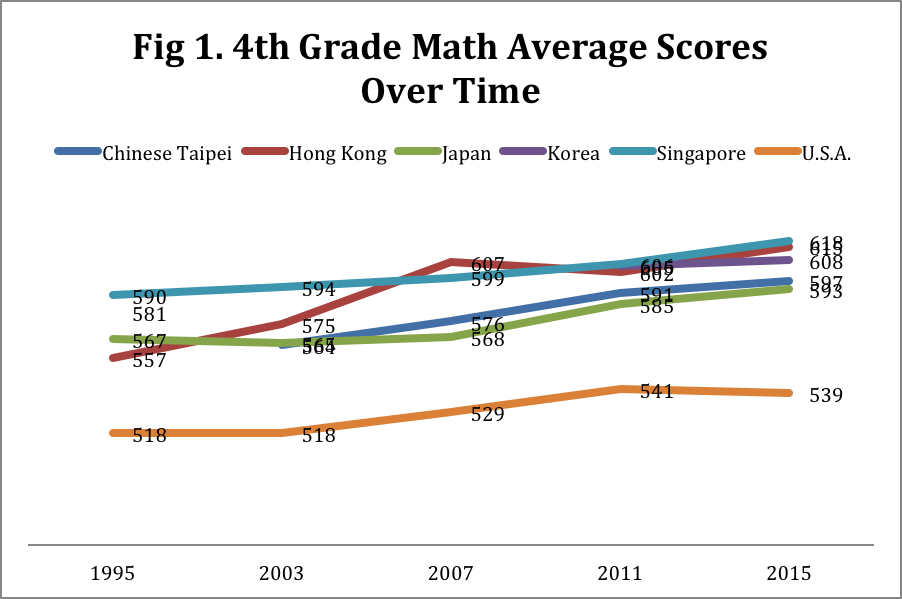
So after 20 years of learning from TIMSS, what has the U.S. achieved? (All data from TIMSS publications.)
The gap in scores remains.
In terms of test scores, the U.S. has certainly improved, but so have other countries. So the gap between U.S. students and East Asian students remain as large as 20 years ago (Figs 1 & 2).
As test scores went up, students’ confidence and attitude toward math came down.
While both students in the U.S. and East Asian education systems all improved over the last two decades, their confidence in math declined. Likewise, not as many students valued math in 2015 as in 1995. Figures 3, 4, and 5 capture this trend[2].
But the U.S. still has more students reporting confidence in math and valuing math than East Asian students.
More students in the U.S. reported having more confidence and valuing math more than students in East Asian countries in 20 years ago. It is still so despite the global decline.
U.S. seems to have learned all lessons suggested by TIMSS but …
Two of the biggest lessons from TIMSS for the U.S. were curriculum and teachers. It was suggested that the high performance of East Asian education systems, Singapore in particular, was the result of a much better curriculum and better teachers.
Curriculum benchmarking
The U.S. has been benchmarking its curriculum against the high performing systems. The Common Core is just one example, after many states tweaked their math curricula. As a result, the 2015 TIMSS results Education in the Age of Globalization » Blog Archive » Stop Copying Others: TIMSS Lessons for America:


Building Firewalls: Protecting Public Schools in the Trump Era by David Sciarra Education Law Prof Blog

Education Law Prof Blog:

Building Firewalls: Protecting Public Schools in the Trump Era by David Sciarra

With the selection of Betsy DeVos as Education Secretary, Donald Trump has made good on his promise to do everything possible to undermine and weaken America's public education system. President-Elect Trump made few promises about his education agenda during the campaign, but what he did promise - $20 billion in federal funding taken from public schools to be used for private and religious school vouchers - foreshadowed his pick of a conservative billionaire who has donated considerable sums to promote charters and vouchers at the expense of the public schools and the children they serve. Ms. DeVos's track record in Michigan provides a clear picture of her priorities as Education Secretary. She and her husband have funded campaigns to increase the number of charter schools, including for-profit charters, especially in high poverty communities such as Detroit and Flint. They have funded this effort despite the fact that Michigan's expansive charter sector is among the least accountable and worst performing in the nation. Ms. DeVos also bankrolled an attempt to bring vouchers to Michigan, but those efforts were stymied due to a constitutional amendment passed in 1971 prohibiting public funding for private schools.
The bottom line is this: the Trump Administration will do nothing to support public education across the country. Instead, federal funding will be used as a carrot, or perhaps a stick, to force states to accelerate the unregulated growth of charters and expand existing voucher programs or enact new ones to facilitate the flow of tax dollars from public schools to private and religious schools and other private providers.
What we can also expect is a wholesale retreat from federal enforcement of civil rights protections for vulnerable student populations, from LGBTQ to ELL students. In short, it is not an exaggeration to call the Trump-DeVos education agenda an all-out assault on our public schools, the centerpiece of which is the diversion of billions of dollars from public education to private spending.
What can the vast majority of Americans who care about public education do?
This is a good time to remind ourselves that public education has always been - and will continue to be - the obligation of the 50 states and the District of Columbia. This obligation is embedded in the guarantee of a public education in state constitutions. It is the states, not the federal government, that control access, quality, governance, student rights and the bulk of funding for their public education systems.
A storm of policy and public relations to promote educational inequity and disparity across the nation will emanate from Washington under the new administration. But if we turn our full attention to the states, we can - and must - energize existing coalitions and campaigns of parents, educators, students and community organizations to protect and defend the public schools. Let's start now to erect state and local firewalls to safeguard our schools.
Here are a few ways we can begin:
1) We must press our congressional delegations to oppose the Trump anti-public education agenda, starting with the DeVos appointment but continuing to block other proposals, from dismantling the Office of Civil Rights (OCR) to diverting Title I funding for vouchers under the guise of "portability."
2) If a state constitution prohibits the use of public funding for other purposes, it's time for advocates and activists to get ready to stand behind it. Some state constitutions contain such prohibitions or have been interpreted by courts to do so. If state law is unclear, it's time to propose a law to "lockbox" and protect public school funding. Most states already underfund their public schools, and what our children don't need is the federal government trying to divert any amount of that funding to private and religious schools.
3) This is the right time to start state-level conversations about rejecting offers of federal funding that come at the price of defunding public education and causing even more inequity and disparity of opportunity for students, especially low-income students, students with disabilities, English language learners and students of color.
4) Legislative campaigns for charter school reform must be reinvigorated. In many states, an overhaul of charter school laws is long overdue to ensure full accountability with regard to student access and school performance, as well as the use of public funds. Segregation of students based on disability, the need to learn English, academic risk or other factors must be fought in statehouses, including moratoriums to prevent funding loss and student segregation resulting from uncontrolled charter growth.
5) We must review state-level student and civil rights protections and develop an agenda to strengthen that critical framework. This must include enhancing anti-discrimination and anti-bullying laws; school discipline reform; open admissions for homeless children, youth in foster care, and un-documented students; and other measures to safeguard the rights of students.
On the one hand, a Trump Administration offers the opportunity to join the many advocates laboring to ensure equal and quality education for all children in their states, often in extremely challenging political environments. On the other hand, Trump's election is a wake-up call about a fundamental, enduring lesson: education equity advances or regresses primarily through state action on funding, essential resources and programs, and students rights. Actions taken by the federal government, even those intended to promote equity in the states, can only go so far. And sometimes those actions impede progress.
Let's not get distracted by "inside the beltway" prognostications or rarefied debates over how bad things may be. Those of us working in the states know what's coming. It's time to renew and redouble efforts to protect public education in our states and communities. Millions of children are depending on us.
David G. Sciarra is Executive Director of the Education Law Center, where he serves as lead counsel in the landmark Abbott v. Burke school funding litigation and directs ELC's advocacy on behalf of the nation's public school children. Education Law Prof Blog:

Mike Klonsky's SmallTalk Blog: No more blockades

Mike Klonsky's SmallTalk Blog: No more blockades:

No more blockades

Havana yesterday

A step backwards...Shame on POTUS for not sending an official delegation to Fidel's funeral. Even though he has taken important steps forward in normalizing relations between our two countries, and ending the failed blockade, this snub will be taken as another insult to the Cuban people and the people of Latin America and the Caribbean for whom Fidel is a symbol of independence and anti-colonialism. 

It shows that Obama is still too worried about what the Trumpy Republicans think about him to do the right thing. It's that fear, which helped paralyze his administration up until this, his last year in office, that will forever remain as part of his legacy.

It will now be left to the Republicans to move pastTrump's alt-right rhetoric and finish the job of normalization (and take credit for it). If they fail and cave into Trump's campaign promises to roll back Cuba policy to the Cold War era, this country -- and not Cuba -- will be the losers. Chinese and European competitors will more than fill the void.

Remember, it was IL Republican Gov. George Ryan who lead our state's delegation to Cuba in 1999. The trip made the Republican Ryan the first sitting U.S. governor to travel to Cuba since the revolution 40 years earlier.

Ryan initially described the five-day trip as a way to foster a trade relationship someday between Cuba and Illinois, but the Bush regime frowned on that. It later was billed as a 
Mike Klonsky's SmallTalk Blog: No more blockades:


National Advocacy Group Launches Charter School Legal Defense Fund - Charters & Choice - Education Week

National Advocacy Group Launches Charter School Legal Defense Fund - Charters & Choice - Education Week:

National Advocacy Group Launches Charter School Legal Defense Fund


The nation's largest charter advocacy group has launched a legal action and defense fund. 
The National Alliance for Public Charter Schools describes its new Charter School Legal Defense Fund as a "watchdog and resource" that will help defend charters in lawsuits and further charter causes through litigation.
Although charter schools have made significant inroads across the country in the last 25 years through legislation—43 states and the District of Columbia now allow for charter schools to operate—the alliance said in a statement released earlier this month that it now needs to focus more attention on the judicial branch.
One recent high-profile loss for advocates happened last year when Washington state's supreme court ruled the state's charter law was unconstitutional based largely on how charter schools were funded.
The lawsuit was backed by a coalition of groups including the Washington Education Association, the state's largest teachers' union. 
Charter advocates, including NAPCS, helped revive the law through new legislation, which lawmakers passed earlier this year, to address some of the issues raised by the supreme court.
But the rewritten law was promptly challenged by a group of parents backed by several organizations including the WEA.
The legal fight over the constitutionality of charter school funding in Washington state may have inspired a separate lawsuit in Mississippi led by the Southern Poverty Law Center. Like Washington state, Mississippi is another recent comer to the charter sector.
As its first action, the Charter School Legal Defense Fund filed an amicus brief with the U.S. Supreme Court last week backing the petitioner, a child with autism, in Endrew F. v. Douglas County School District— a case that will have significant impact on federal special education law
It jointly filed the brief with the National Center for Special Education in Charter Schools.
Related stories:
National Advocacy Group Launches Charter School Legal Defense Fund - Charters & Choice - Education Week:


How Did We Forget That We’re All Stakeholders in the Public Schools | janresseger

How Did We Forget That We’re All Stakeholders in the Public Schools | janresseger:

How Did We Forget That We’re All Stakeholders in the Public Schools


In the November election, by a startling margin of 60 percent to 40 percent, voters defeated Georgia’s constitutional amendment to allow the establishment of a state-takeover school district.  During the campaign as voters learned that the state would likely operate struggling schools through huge, private, charter management companies, they turned against the plan. It’s amazing that anybody except right-wing ideologues thought the Georgia Opportunity District was a good idea in the first place, but maybe until the campaign for Amendment 1 got under way, people were relatively uninformed. Unless we are teachers or parents, we may not be paying close enough attention to public education these days to understand the ins and outs of any particular school governance plan.  When was it that so many of us stopped really considering ourselves active stakeholders in the way our community educates its children?
Myra Blackmon, writing for the Atlanta Journal-Constitution, considers the role of the public in the defeat of Governor Nathan Deal’s Georgia Opportunity School District: “Liberals and conservatives, rural and urban residents, people of all races decided that a state takeover of local schools deemed poor performers is not a tolerable solution. At the same time, there was no ballot initiative that let people weigh in on exactly how they want to improve education.”  Blackmon explains that people gathered together when they were informed enough to fear a bad plan. She encourages people to stay engaged and work together to improve the schools that would have been turned over to the state: “Georgians have a unique opportunity to continue to work across partisan and demographic lines to address problems in schools that serve large populations of poor people in communities that often lack resources. There are several possibilities for this unusual alliance to continue its newfound influence.”
What kind of information did it take to get voters’ attention and defeat Amendment 1 in Georgia?  A fact sheet about state takeover school districts from the Alliance to Reclaim Our Schools provides some of the disturbing data about such districts that are already  operating in three states—Louisiana, Michigan and Tennessee:
  • “Most schools, once absorbed by the state district, are converted to charters.  Although all 3 state takeover laws provided for other options, 107 of the 116 schools currently operating have been converted to charter schools.”
  • “Of the 44,000 students enrolled in these schools, 96% are African American or Latino.”
  • “Student results have not justified the takeovers. In Louisiana where the Recovery School District (RSD) is the nation’s first all-charter district, 41% of the schools received a D or F grade under the state’s accountability system. In Tennessee, student results under the Achievement School District (ASD) lagged behind those of students in schools that were being supported by the local district… In Michigan’s Educational Achievement Authority (EAA) 79% of students either showed no improvement, or lost ground on state assessments.”
  • Finally there is the issue of rapid turnover of teachers—in Michigan, a turnover rate of 50 percent in the first two years.  In Tennessee, after the first year, 46% of teachers left their jobs.
The Alliance to Reclaim Our Schools instead prescribes some research-based reforms that are “consistently associated with stronger student outcomes”—all of them directed at improving How Did We Forget That We’re All Stakeholders in the Public Schools | janresseger:

The AltSchool: Progressivism Redux (Part 3) | Larry Cuban on School Reform and Classroom Practice

The AltSchool: Progressivism Redux (Part 3) | Larry Cuban on School Reform and Classroom Practice:

The AltSchool: Progressivism Redux (Part 3)

SOMA plaque.jpg

Located in the South-of-Market district (SOMA) of San Francisco this micro-school of 33 middle schoolers is a few blocks away from Yerba Buena (see Part 2). I spent a morning there speaking with the Head of School, Emily Dahm (who also is in charge of Yerba Buena), observing two lessons taught by “core educators” James Earle (social studies/English) and Eman Haggag (science), and interviewing Katie Berk, a product manager, from the technical side of the “micro-school.”
Facing busy Folsom Street, AltSchool space is divided into four large carpeted rooms two of which were used that morning for lessons (no class I observed was larger than 15). The other two spaces include a room with desktop computers and commons area for the entire school to meet. Software engineers and staff (coders, designers, and product managers) were located in a large space in the back of the building adjacent to the classrooms and commons area.
Each classroom space has wall-mounted cameras and microphones hanging from the ceiling–called Altvideo–that produce data for teachers to view later privately about the lesson they taught.  The technical staff has produced an app that teachers can use to find the precise part of the lesson they want to see. This self-evaluation occurs during the school day and other times.
On November 7, 2016 I arrived at 8:00 AM and interviewed the Head of School and both core educators. School began at 9:00 with a “morning meeting.” There were 21 twelve to fourteen year-olds sitting in a circle with Eman Haggag counting down from 10 to 0 to secure quiet for the “morning meeting” to begin. On a whiteboard are listed announcements:
Good Morning,
How are you? I am quite marvelous. Cupa’ tea?
Few things:
–Feynman bring phones to class powered off (students are in different groups–(the internationally known physicist Richard Feynman)–is name of one group of students)
Field trip Wednesday–Altschool shirts + pencil + paper
–Ceramics class 11/17, 11/18/,11/22
Students ask logistics questions about upcoming field trip, teachers answer their questions.These morning meetings are to inform students of daily activities and The AltSchool: Progressivism Redux (Part 3) | Larry Cuban on School Reform and Classroom Practice:


Donald Trump, Rebekah Mercer, Betsy DeVos, Milton Friedman, and the Education Business | deutsch29

Donald Trump, Rebekah Mercer, Betsy DeVos, Milton Friedman, and the Education Business | deutsch29:

Donald Trump, Rebekah Mercer, Betsy DeVos, Milton Friedman, and the Education Business


President-elect Donald Trump’s plan for US education:
School choice.
The voucher.
The charter school.
Forced competition for the neighborhood school.
However, Trump does not have an established history for supporting charters and vouchers. He is new to this bandwagon. Nevertheless, as of August 17, 2016, Trump began clearly supporting school choice.
The timing appears to be tied with the involvement of hedge fund heiress Rebekah Mercer as part of his campaign.
Let’s start with Mercer.
As the September 15, 2016, Daily Beast observes:
Trump’s brand spanking new focus on charter schools coincides with the growing clout of the Mercer family in his presidential campaign. On Aug. 17, The Hill reported that billionaire family—who had previously supported Ted Cruz—was behind major staffing shifts that Trump made. Politico and The Washington Post have also explored the Mercers’ substantial influence on him.
Rebekah Mercer, who runs the family’s charitable foundation and homeschools her four children, is known as a strong supporter of school-choice policies. Her foundation is a generous supporter of the Moving Picture Institute, which has made movies that support the school-choice movement. Their foundation also gave almost $1 million to the Barry Goldwater Institute from 2011 to 2014. That organization is known nationwide for its role in supporting Arizona’s school-choice policy overhauls. Mercer is also a board member of a conservative think tank called the Manhattan Institute, which has drawn ire from national teachers unions for its support of charter schools.
And as the November 21, 2016, Politico reports:
Rebekah Mercer, a 42-year-old who homeschools her young children, rarely visits Trump Tower and has a relatively narrow official portfolio in Trump’s transition effort. Her influence comes instead from her close relationships with the people and groups carrying out the day-to-day work of building Trump’s administration and political apparatus, some of whom have been the beneficiaries of millions of dollars of funding from her family.
Mercer’s influence in Trump’s transition effort — detailed here for the first time — calls into question Trump’s campaign trail boasts that his own fortune, which he used to partly fund his campaign, would make him independent from deep-pocketed donors and special interests he railed against on the campaign trail. …
“It would be difficult to overstate Rebekah’s influence in Trump world right now,” said one GOP fundraiser who has worked with Mercer and people in the campaign. “She is a force of nature. She is aggressive, and she makes her point known.” …
Beyond Mercer’s own direct line to Trump, she played a pivotal role in persuading him to bring into his inner-most circle several close allies whose efforts her family has financed to the tune of tens of millions of dollars, Donald Trump, Rebekah Mercer, Betsy DeVos, Milton Friedman, and the Education Business | deutsch29:


CURMUDGUCATION: Slowing Down

CURMUDGUCATION: Slowing Down:

Slowing Down

Image result for Indiana Jones giant boulder. animated gif


For the past several years, I have sometimes felt like Indiana Jones just a few feet in front of the damn giant boulder.

This is not entirely the result of various education reforms. We've been through some changes locally, including but limited to some schedule changing that has resulted in slightly shorter periods, and some changes in staffing that have led to slightly larger classes.


But of course like many other schools, we are being trickled down upon by the dripping ooze of school reform. We have lots of additional paper-- well, computer work that is meant to show how we're aligning our instruction to the standards (spoiler alert-- mostly by completing computerized paperwork). We spend time worrying about the numbers and part of my week is now set aside for sitting and fretting over various slabs of data. And when you add up all the days I lose to testing, or pre-testing, or practice testing, it all adds up to days and weeks of school during which I don't get to actually teach.

Meanwhile, the mountain of material that I feel I should be getting through looks more and more like, well, like two mountains, piled on top of each other and sitting on top of a third mountain that has been smushed into the ground so far that I'll have to dig it all out before I can deal with it. And so there is a voice yammering away in my ear, strained and urgent, reminding me that I only have X days left and if I don't hammer through this stuff today, and quickly, I'll never get to the other material which I really need to get to because these students are less than two years away from going out into a world that will demand every possible skill set from them and oh my good lord in heaven how am I ever going to get anything done if they want to talk about stuff and holy crap the boulder is right on my heels-----

It has become almost routine for me. Maybe it happens when I'm home unwinding with family and vacation, or maybe it happens when I suddenly see what I'm doing and realize I am losing the 
CURMUDGUCATION: Slowing Down:

Education Lessons From A Sparkly District: What Will Happen To Special Education?

Education Lessons From A Sparkly District: What Will Happen To Special Education?:

What Will Happen To Special Education?


Yet another reason to be concerned about Jeff Sessions as US Attorney General. Special Education. Back in 2000, when he was an Alabama state senator (formerly the state's attorney general), Sessions made an utterly ignorant, and now potentially dangerous, statement about special education and the federal law which guarantees the rights of students with disabilities, the Individuals with Disabilities in Education Act (IDEA). You can read his whole statement here

It's difficult to pull quotes out of the text because the entire statement is so heinous. Yes, students with disabilities have rights. No, those rights, and those exercising those rights are not "a big factor in accelerating the decline in civility and discipline in classrooms all over America." The disqualifier at the beginning of that paragraph does not excuse the ridiculousness of the statement either. So glad to hear that he didn't want to end IDEA.

Sessions quotes parts of letters written to him by teachers who are frustrated by their students and what they described as problems with the Individuals with Disabilities in Education Act (IDEA). While I am sure there are teachers who are frustrated by what they see in their schools, to blame students with disabilities for those frustrations is absurd. 

Sessions does give a nod to the lack of funding associated with IDEA. It has never been fully funded, nor has it come close to the goal of 40% funded. Ever. He should have been railing against a system that purposely defunds, or underfunds, education mandates, no matter whom they directly effect. To blame the students and IDEA is absurd. 

As I read through Sessions' statement and the statements by teachers, I saw what, in my opinion, is violation after violation of those students' rights. IDEA is not a permission slip for students to behave badly. It does not prevent "discipline." It does not require students to be mainstreamed with their neurotypical peers. 

What IDEA does do is requires states, and therefore school districts, to place students in a Least Restrictive Environment (LRE). It requires them to conduct Functional Behavior Analyses, using those results to create Behavior Plans for exactly the scenarios which are described in Sessions' statement. This is not rocket science. This appears to have been completely lost on every one of those teachers and their administrators and Sessions. It also appears to be lost on these people that wrong classroom settings, inappropriate placements, and lack of services contribute to inappropriate behavior - in any setting. 

Before someone piles on here, yes, there are students, unfortunately, who do act out and have 
Education Lessons From A Sparkly District: What Will Happen To Special Education?:


The Long Game of Betsy DeVos – EduShyster

The Long Game of Betsy DeVos – EduShyster:

The Long Game of Betsy DeVos


To understand Betsy DeVos’ vision for education, you have to know where she comes from…
devos1I first laid eyes upon Trump’s pick for Secretary of Education, Betsy DeVos, at Campbell Brown’s forumfor GOP presidential contenders. It was the summer of 2015, back when Trump was little more than a punchline, and Jeb Bush, despite drooping in the August heat that day, still seemed like the real contender. Because the event wasn’t an official debate, Bush, Walker, Vindal, Fiorina et al couldn’t appear on stage together—which meant that Brown asked the same questions of each, and got similar pablum-esque non-answers, in an endless *conversational* format. And then suddenly there was Betsy DeVos, a Brown chum, holding forth about an education *moonshot.* It wasn’t what she said that interested me so much as what she represented. Could the education reform coalition’s major selling point, its bipartisan-ness, really stretch to incorporate the extreme right-wing views of DeVos? Mightn’t it be better for her to remain in the favored domain of the DeVos family, the shadows, or at least in Michigan?
What went down in Detroit
The private consternation felt by so many reform advocates over the DeVos pick is not due to her penchant for dropping *government* in front of *public school,* but rather the outsized role she has played in shaping Detroit as an, um, education laboratory in which an out-of-control lab fire now burns. First, though, a bit of historical context. We are so used to thinking of Detroit as America’s urban hell hole that it can be hard to comprehend the optimism that took hold there two years ago as the city was coming out of bankruptcy. Finally it seemed as though the Motor City might be on the cusp of a real revival. And not the kind of comeback driven by hipsters opening cupcake shops or the rebranded subsistence farming known as *urban gardening,* but a real deal renaissance where middle-class residents return to Detroit.
It was out of this spirit of hopefulness that the Coalition for the Future of Detroit’s Schoolchildren emerged back in 2014. And it was a for realz coalitionImage result for coalition for detroit schoolchildrenAFT was there, but so was the reform-minded Excellent Schools Detroit and the city’s pro-charter mayor, along with members of the corporate and civic elite. People who’d been, if not at war, at deep odds, had finally gotten together around a single, shared point of agreement: if Detroit doesn’t have some way to oversee its schools—both what remains of the district schools and the fast-growing, completely unregulated charter sector—the city can forget about the future. Bankrolled by a local philanthropy, the Skillman Foundation, the coalition had the wind at its back and the political wherewithal necessary to get a bill through the state senate, even gaining the support of Governor Rick Snyder, aka @OneToughNerd. 
But the feel-good story screeched to a halt last summer thanks to a wall of GOP opposition. Except that *wall* and *opposition* make it sound as though there were a whole bunch of people involved in the kneecapping that went down. There was a The Long Game of Betsy DeVos – EduShyster: