Latest News and Comment from Education

Tuesday, November 29, 2016

NYC Proposal Frames School Segregation as a Human Rights Issue - SchoolBook - WNYC

NYC Proposal Frames School Segregation as a Human Rights Issue - SchoolBook - WNYC:

NYC Proposal Frames School Segregation as a Human Rights Issue

Image result for NYC Proposal Frames School Segregation as a Human Rights Issue

In an effort to illuminate root causes of segregation in New York City public schools, a City Council bill seeks to create an office within the New York City Commission on Human Rights tasked specifically with studying the issue.
As Councilman Ritchie Torres, the primary sponsor of the bill, envisions it, an Office of School Diversity would report annually on the prevalence and causes of racial segregation in the schools. The office would also make recommendations for addressing underlying causes. 
"The conventional wisdom, and the misconception of segregation, is that it’s purely a product of housing patterns," said Torres, adding that, of course, segregated neighborhoods are a contributing factor in school segregation.
"But segregated schools within integrated neighborhoods are hardly explained by housing patterns," he said, "and so what are the policy choices that are contributing to phenomenon of segregated schools within otherwise integrated neighborhoods?"
2014 study from the UCLA Civil Rights Project found that New York City has some of the most segregated schools in the country. A WNYC analysis of student enrollment for the 2015-2016 school year showed that half of the city's schools had student bodies that were more than 90 percent black and Latino. 
Torres said that he placed the proposed Office of School Diversity within the Commission on Human Rights to preserve its independence from the Department of Education. Besides, he argued, approaching school segregation as a human rights issue would force the city to consider how its expansive human rights law applied to school enrollment.
"Human rights law protects against discrimination not only in terms of intent but also in terms of impact," he said. "So the New York City public school system has a disparate impact on, and therefore discriminates against, African-Americans and Latinos."
The bill is co-sponsored by Councilman Brad Lander. It is being introduced during Tuesday's City Council stated meeting. Education officials said they will review the proposed legislation. 
Mayor Bill de Blasio's administration has called diversifying schools a priority, though the mayor and education officials have balked at implementing district-wide or city-wide reforms. The city initiated a "diversity in admissions" pilot program last school year with seven schools. It expanded the program this year to another 12 schools.
Also this year, during a school rezoning on the Upper West Side, the city for the first time stated that "promoting diversity" was a goal when redrawing zone lines. And education officials said they would share a broader plan for addressing school integration by June.
Critics — including researchers, historians, community groups, parents and educators — have taken issue with the city's baby-steps approach. The public advocate, Letitia James, earlier this month called for the Department of Education to create a chief diversity officer to help address systemic issues of segregation.
WNYC has reported extensively on historic and present-day segregation in New York City schools. WNYC and BRIC are hosting a town hall on Thursday, Dec. 1 called Class Divide: Breaking the Pattern of School Segregation. NYC Proposal Frames School Segregation as a Human Rights Issue - SchoolBook - WNYC:


Civil Rights Advocates React Warily to Betsy DeVos, Trump's Pick for Ed. Sec. - Politics K-12 - Education Week

Civil Rights Advocates React Warily to Betsy DeVos, Trump's Pick for Ed. Sec. - Politics K-12 - Education Week:

Civil Rights Advocates React Warily to Betsy DeVos, Trump's Pick for Ed. Sec.

Betsy DeVos, the major Republican Party donor who's been nominated by President-elect Donald Trump to be his education secretary, is best known as an advocate for school choice of various kinds, including vouchers and tax-credit scholarships. But her views on civil rights issues for students and protections for disadvantaged learners and other student groups aren't as clear.
In a speech given at the 2016 annual meeting of the American Federation for Children, the school choice advocacy group she chairs, DeVos cast vouchers, charters, and scholarships as upholding students' rights in the context of educational opportunity, saying, "School choice is the pathway for millions of children to get the education they deserve." In the same speech, she also said choice advocates "fight for kids who don't fit in." You can watch her speech at the top of this blog post.
But how have traditional civil rights advocacy groups involved in education and others responded to Trump's nomination of DeVos? Several of them expressed concern about how school choice by itself does not address inequities and discrimination faced by minority and other communities. In fact, a few worried that school choice programs often undercut protections for students. We've rounded up some of their reactions below. Let us know in the comments if you think we're missing reactions from any notable groups or individuals. 
Education Trust: DeVos has a chance as education secretary to continue the "upward trajectory" of providing more and better opportunities to all students, the advocacy group says. But the Education Trust warns they'll fight against any proposal to "divert resources from the students who need them the most" and away from those students enrolled in public schools. 
"[T]here is a very real risk of undoing this hard-won progress if resources are diverted from the young people who most need them, or if the federal government fails to uphold its responsibility to protecting the needs and interests of all students—especially the most vulnerable," the group said in a statement. 
GLSEN: Speaking somewhat more bluntly than the Education Trust, the LGBT student group said it is "deeply concerned" that DeVos' support for vouchers and tax-credit scholarships flies in the face of civil rights protections for students.
"We have seen time and time again that so-called 'school choice' undercuts civil-rights enforcement and drains public education systems of desperately needed funds," GLSEN said in a statement. "True educational equity requires schools that serve the most at-risk students, including students of color; students with disabilities; lesbian, gay, bisexual, transgender, queer and/or questioning (LGBTQ) students; and English-language learners. Vouchers and tuition tax credits do not advance this cause."
Thumbnail image for Thumbnail image for Trump-Devos-blog.jpgDerrell Bradford: The executive director of the New York Campaign for Achievement Now struck a much different note.
Writing at The 74, Bradford said that while the first belief of voucher supporters is that vouchers create the right environment for creating and regulating successful schools, "The second guiding belief is that there is something fundamental in the right to choose and in the ability of the right school to actualize human potential, in particular for low-income kids of color ... Which is to say, there is a moral imperative about the future of children who traditionally don't have access to great schools that animates the support of the policy."
NAACP-Legal Defense and Educational Fund: The organization highlights DeVos' support for the effort to allow vouchers in Michigan, but also her support for overturning affirmative action in higher education in the state.
"The Department of Education's mission 'is to promote student achievement and preparation for global competitiveness by fostering educational excellence and ensuring equal access,'" the Legal Defense and Educational Fund said in a statement. "Policies that improve all students' access to quality educational opportunities have enjoyed bipartisan support in previous administrations. But too many of America's students are still educated in racially-isolated, and woefully underfunded schools and school districts."
Advancement Project: One of the strongest condemnations came from the Advancement Project Executive Director Judith Browne Dianis, who said appointing DeVos as education secretary would amount to appointing "a fox to guard the henhouse." Vouchers have left a destructive trail in the communities they are ostensibly meant to serve, Dianis said, with effects including school closures, while also failing to adequately serve minority students. 
"While Donald Trump remained consistently nebulous on his education plans during his campaign, we can only deduce from his desire to appoint a champion of school privatization that he systemically intends to divest from schools accountable to the public, and invest in strategies that ultimately close schools and put education under the control of a few corporate leaders," Dianis said in her statement.
Communities for Just Schools: Allison Brown, the group's executive director, said in an email there are successful schools of all kinds, and that, "The role of education leaders, including and especially the U.S. Secretary of Education, is to identify those curricular practices, school climate components, teaching methods, and more that work to make those schools excellent regardless of their structure." These include addressing implicit bias and an over-reliance on exclusionary disciplinary policies, she said.
Brown said DeVos had the opportunity to unite separate education reform and educational equity communities, which Brown said are "not at war." However, she also issued a warning of sorts to DeVos, saying there's often a disconnect between wealthy backers of choice and the families these choice programs are intended to serve: "To blindly promote one structure of education over another, particularly when that promotion ensures the transfer of public dollars to enrich individuals and organizations rather than to guarantee success for young people and their families, is irresponsible."
Staff Writer Evie Blad contributed to this post. 

Don't miss another Politics K-12 post. Sign up here to get news alerts in your email inbox.


#NCTE2017: Call for Roundtable | the becoming radical

#NCTE2017: Call for Roundtable | the becoming radical:

#NCTE2017: Call for Roundtable


After a very inspiring roundtable at #NCTE2016, many of us are energized to propose a related by more hands-on roundtable for #NCTE2017.
Below is a draft proposal for NCTE 2017. Please email me ASAP (paul.thomas@furman.edu) if you are interested in offering a roundtable that is a workshop related to educators developing their public voices in a wide variety of media and purposes. The current roundtables below reflect the focus of the session, but different media and perspectives are strongly encouraged to join.
2017 NCTE Annual Convention
Teaching Our Students Today, Tomorrow, Forever: Recapturing Our Voices, Our Agency, Our Mission
St. Louis, MO
November 16-19, 2017
Proposal: Roundtable
Co-Chairs: Chris Goering, University of Arkansas, and P. L. Thomas, Furman University
From Advocacy to Agency: Workshopping Our Public Voices
This roundtable session will offer participants concrete and hands-on opportunities to investigate the “how to” of writing and speaking in a public voice that reflects our professional agency. Tables will address writing Op-Eds and letters to the editor, starting and maintaining a professional blog, participating in social media (Twitter, Instagram, Facebook, etc.) as a professional educator, and creating and producing podcasts/radio programming. Additionally, participants will be given guidelines for blending scholarly and public work as well as how to integrate our professional advocacy-as-agency with our demanding work as classroom practitioners.
Tables:
Exploring the Op-Ed: Two Public Essayists Share Their Process for Writing in the Op-Ed Genre
Christina Berchini and Peter Smagorinsky
This table will discuss their process for identifying topics, locating a suitable publication outlet, and understanding and writing within the op-ed/blog genre. Participants will also be alerted to the risks and rewards of writing in the public forum.
Adventures in Edublogging: Finding and Developing a Public Voice
P.L. Thomas and Angela Dye
Blogging remains a misunderstood form of communication along with many types of social media. This table will discuss and workshop how to create a professional blog and social media presence while helping participants with the “how” and “why” of creating that professional voice for the public.
Guinness Stew in the Ozarks: The How and Why of Professional Writing Retreats for Teachers
Christian Z. Goering and Nikki Holland
This roundtable offers a rationale and practical advice for gathering teachers in a retreat setting to write for professional audiences. One way that teachers can develop agency in the larger conversations swirling around the punch bowl of education is by writing for professional audiences—broadly defined. The act of doing so is complicated, something that takes time, nourishment, and courage. But aren’t retreats expensive and elitist? The low cost, low maintenance model shared in this roundtable can be adapted and adopted by a wide range of teacher groups or even offered as professional development by a school district.
Blogging Advocacy in the New Latinx South
Bobbi Siefert
Blogging Advocacy in the New Latino South – In this roundtable session, presenters will discuss beginning and maintaining a TESOL Blog in the context of the New South. Discussion will center on initial steps to beginning a blog, responses to challenges, focus and direction, and sustaining momentum in an increasingly xenophobic regional and national environment. We argue that blogging is a virtual platform for our professional advocacy for Latino Transnationals K-12.
Writing Radio Commentaries for Local Stations
 Rebekah Buchanan
Local NPR affiliates can be an effective way of reaching the public about education issues in our communities. Based on my experience recording monthly radio commentaries, this roundtable will present ways to start writing for the radio, coming up with topics, and presenting commentary ideas to local stations.
What Will Attract and Persuade Blog Readers?
Patricia A. Dunn
Academics are used to writing for a particular audience with discipline specific expectations about academic evidence, research, and citation—the very elements that potential blog readers may avoid. How can we attract readers to our public writing, get them to rethink an issue in our blog, and get them to share it? We’ll look at some topics, titles, and formats of several blogs that have been shared widely. We’ll talk about selecting links for providing evidence, keeping the blog lively (and short), and using effective analogies.
Who wants to be the Village Explainer? Opening Conversations, Not Closing Them
Patricia Waters, Daneell Moore, and R. Buchanan
In rural areas the English teacher is often in the invidious position of being The Village Explainer: how can the professional communicate with non-professional audiences by meeting people where they are? How do we not lose sight of urgency but also not alienate where we need allies most?#NCTE2017: Call for Roundtable | the becoming radical:


Historian Assesses Attorney General Nominee, Jeff Sessions’ Civil Rights Legacy | janresseger

Historian Assesses Attorney General Nominee, Jeff Sessions’ Civil Rights Legacy | janresseger:

Historian Assesses Attorney General Nominee, Jeff Sessions’ Civil Rights Legacy


In case you missed it over the holiday weekend and amidst all the press about President-elect Donald Trump’s nomination of Betsy DeVos as Secretary of Education,  you might want to check out Thomas Sugrue’s column about Jeff Sessions.
Thomas Sugrue, a 20th century urban historian, won the Bancroft Prize in American History in 1998 for The Origins of the Urban Crisis: Race and Inequality in Postwar Detroit.  A passage from Sugrue’s preface to the book’s 2005 Classic Edition demonstrates the depth of Sugrue’s grasp of the role of race and inequality—subjects deeply connected to the rise of Donald Trump and to Jeff Sessions, about whom Sugrue will tell us more in a few moments.
Sugrue’s specialty is race and inequality in the North. In The Origins of the Urban Crisis, he explains: “Despite more than half a century of civil rights activism and changing racial attitudes, American cities (particularly the old industrial centers of the Northeast and Midwest) remain deeply divided by race.  Poverty rates among people of color in major American cities are staggeringly high. Vast tracts of urban land lie pockmarked with boarded-up buildings, abandoned houses, and rubble-strewn lots. At the same time, hundreds of thousands of acres of marshland, meadow, farm, and forest on the periphery of major metropolitan areas get gobbled up each year for vast tracts of new housing, shopping malls, and office parks. City governments struggle with shrinking tax bases and ever-increasing demands on public services, while wealthy suburban municipalities enjoy strong property tax revenues, excellent public services, and superb schools.”  Sugrue defines three forces whose “combined effect… reshaped American cities in ways that still affect us today. First was the flight of jobs, particularly the relatively well-paying secure, and mostly unionized industrial jobs that dominated the postwar urban economy.  Second was the persistence of workplace discrimination despite remarkable legal and political gains accomplished by the struggle for black civil rights. The third was intractable racial segregation in housing, segregation that led to the uneven distribution of power and resources in metropolitan areas, leaving some places behind while others thrived.” (The Origins of the Urban Crisis, pp. xvii-xviii)
While Donald Trump directed his campaign to mostly white small town and rural voters, the inequality and racial divisions Sugrue describes constitute the foundation for much of the resentment to which Trump appealed—including bitterness in and around metropolitan Rustbelt cities. The bigotry and anger the campaign encouraged created an opening for Trump to nominate a Southern racist to enforce our civil rights laws as Attorney General.
In last week’s column, Sugrue reminds us that Jeff Sessions was nominated by Ronald Reagan as a federal judge, although Sessions was eventually denied confirmation: “In 1986, the Republican-dominated Senate Judiciary Committee torpedoed Ronald Reagan’s nomination of Jeff Sessions to the federal bench. As sworn testimony there revealed, Mr. Sessions, then the United States attorney for the Southern District of Alabama, had referred to the NAACP and Historian Assesses Attorney General Nominee, Jeff Sessions’ Civil Rights Legacy | janresseger:


Mother Crusader: DeVos Removes Controversial Twitter Photo But Conflict Of Interest Concerns Continue

Mother Crusader: DeVos Removes Controversial Twitter Photo But Conflict Of Interest Concerns Continue:

DeVos Removes Controversial Twitter Photo But Conflict Of Interest Concerns Continue


Late last week I posted about Betsy DeVos's Twitter header photo, which appeared to show Donald Trump's nominee for Secretary of Education shilling boxed water sold by a company in which she had invested. In the post I posited that, like Trump, DeVos may have her own conflicts of interest to grapple with.

At some point this afternoon, the header photo I challenged was taken off of Betsy DeVos's Twitter account. 

Coincidence? I think not. 

Here's the new photo:


Thanks to some clever cropping, this image seems more appropriate, but it still falls pretty far short for a nominee for a cabinet position. 

You see, I checked out DeVos's website, which is plainly linked on her Twitter account. On the website there is a page for contact and media inquiries. There you will find a line that says:


To download photos of Betsy DeVos for editorial purposes, please click here.

So of course I clicked there, and here's what I found.

The uncropped version of the new header photo is titled "Betsy in a Meeting 3". Here is the entire image, with some commentary from yours truly.


And here are "Betsy in a Meeting 1" and "Betsy in a Meeting 2".


The new photo may be less outwardly problematic, but my goodness, really? With her self reported "28 years involved with education issues" her people can't find one photo of her where she's actually doing something related to, oh, I don't know, educating kids?

Where did I find that fascinating tidbit about 28 years in education, you may ask? On the newly 
Mother Crusader: DeVos Removes Controversial Twitter Photo But Conflict Of Interest Concerns Continue:


Help us fight to protect children’s privacy on #GivingTuesday | Parent Coalition for Student Privacy

Help us fight to protect children’s privacy on #GivingTuesday | Parent Coalition for Student Privacy:

HELP US FIGHT TO PROTECT CHILDREN’S PRIVACY ON #GIVINGTUESDAY

Parent Coalition for Student Privacy

The Parent Coalition for Student Privacy is thrilled to take part in #GivingTuesday on November 29, 2016, a day dedicated to kick off the charitable season. We realize there are many causes worthy of your support but this year, we hope you will consider helping us so we can continue our urgent work.
If you look at a typical American classroom today, you will see students using laptops, tablets, smartboards and other devices. What you won’t see is the hundreds or more pieces of student data being collected by this technology and put at risk from breach, hack, misuse and commercialization. Federal and state laws too often lack the guardrails necessary to protect this treasure trove of student data. And boy is it valuable — worth an estimated $8 billion dollars per year.
While the software industry and organizations like the Gates Foundation give millions of dollars to dozens of professional organizations to promote the increased use of ed tech and collection of student data, our Coalition works on a shoe-string budget and need your support to keep going.
Since forming in Summer of 2014, we’ve been busy:
  • testifying before the U.S. House Education & the Workforce Committee on the need to require more transparency around disclosure and security protections for student data;
  • speaking at state forums and national conferences to promote our privacy principles;
  • coordinating with advocates across the country to introduce strong state-level and federal legislation;
  • providing fact sheets on student privacy rights under existing  law;
  • helping parents write FERPA complaints when their schools violate those rights;
  • raising awareness through articles and op-eds; and
  • alerting parents on how to comment on new policies that further threaten student privacy — like the revived push to overturn the ban on the federal collection of personal student data.
Right now, we’re working on a Parent Student Privacy Toolkit, to be released early next year in partnership with the Campaign for a Commercial-Free Childhood – which will include practical steps and best practices to ensure that your child’s personal information is protected while at school and at home.
Please give to the Parent Coalition for Student Privacy, so we can keep fighting to protect every child’s most precious possession – his or her privacy.
You can donate online here or send a check to:
Class Size Matters  •  124 Waverly Place  •  New York, NY 10011
*Please be sure to write “Designated to PCSP” on the check or the online form. Your contribution is fully tax-deductible.
Thank you for all that you do to support student privacy,
Leonie and Rachael
Help us fight to protect children’s privacy on #GivingTuesday | Parent Coalition for Student Privacy:

CURMUDGUCATION: Online Teaching Credentials

CURMUDGUCATION: Online Teaching Credentials:

Online Teaching Credentials


Want to be a teacher, but just don't have the time or money to do all that, you know, college degree getting stuff? Well, you're in luck. Meet Teach-Now!

It's the Teach-Now Educatore difference (no, I didn't mistype "educator")! "Become certified to teach in virtually every subject, at virtually every level, in virtually every state" though it's more than that, because the company is international in its reach-- they have created "several strategic global partnerships that expanded our presence to Europe, Asia, Africa and Latin America." It is the "most direct and cost effective pathway to teaching in the digital age."


Nice to know this product is still available today

You can keep doing what you're doing, squeezing this streamlines approach into your spare hours. You'll use the same "project-based learning technologies and project-based curriculum you will us" when you have your own classroom. You will get feedback through online streaming and working in a virtual classroom. Just nine months and about $6,000 and you can end up with a shiny new Masters Degree in education. The program does focus on people who are already grown up and out in the world; one entry requirement is to have a bachelor's degree.

This nifty business idea comes from education entrepreneur and former nun Emily Feistritzer, who in this laid-back PBS interview talks about her first job-- selling statues of the Virgin Mary that glowed in the dark. I swear that I am not making any of this up. Feistritzer became a nun at nineteen, left the convent at age thirty-one, landed a PhD in education, and began several decades worth of education-flavored business.

She became founder/CEO of the National Center for Education Information in 1979. Next she became founder/CEO of the National Center for Alternative Certification in 2003. Finally, she launched Teach-Now in 2011. According to the PBS interview, she launched that when she "plopped down a half-million dollars of her own money," and it now has fifteen full-time employees, revenues of around $4 million and a profit margin of around 20%. So the business of quicky internet teacher certification is apparently pretty healthy.

Back in 1985 she was behind a piece of federally-funded research that asked teachers about their sexual habits and their attitudes toward abortion. NCEI occasionally publishes surveys of teacher info, which, not surprisingly, look particularly at training pathways. And Feistritzer also took the 


Badass Teachers Association: Better Education for Kids!

Badass Teachers Association: Better Education for Kids!:

Better Education for Kids!

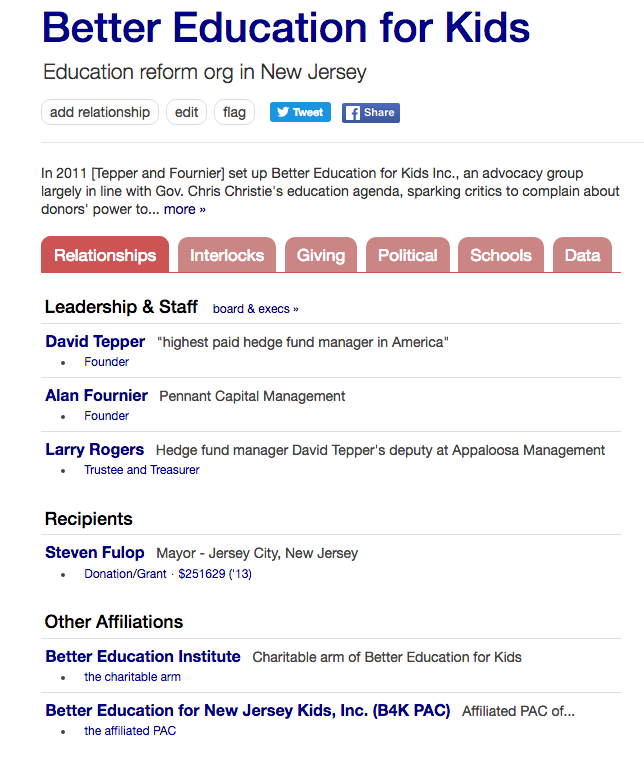
Screen Shot 2016-11-27 at 8.55.32 PM.png

“Better Education for Kids!” Now, who does not want a better education for kids?

This was what I saw when I started to look at information about Better Education for NJ Kids. I started this research after reading a NY Post article that blamed the teacher’s union for the current NJ Pension crisis.

The NJEA...not the governor that has failed to fund the pension...not the hedge fund managers that have profited from the fees of managing the pension portfolios...not the legislators that have failed to hold the state accountable for honoring the commitment of Chapter 78 to make the required pension payments…

Looking at the B4KNJ website, their section about teachers makes this claim:

Research has shown that no in-school factor – not class size, not school attended, not facilities has a greater impact on student performance than a great teacher, and we believe that every New Jersey student should have the opportunity to learn from a great teacher.

So, am I to believe that if you put the best teacher in a room of 30 students within a rundown classroom with little resources that this teacher will be able to create miraculous results and achieve success with every student in the class? After all, this is the best teacher, right?

Their website also states:

Put simply, our teachers are the single most important part of the NJ public education system, and itBadass Teachers Association: Better Education for Kids!:


A Teacher on Teaching: Heroes Who Never Fight: U. S. Secretaries of Education (Betsy DeVos Edition)

A Teacher on Teaching: Heroes Who Never Fight: U. S. Secretaries of Education (Betsy DeVos Edition):

Heroes Who Never Fight: U. S. Secretaries of Education (Betsy DeVos Edition)


Back in 2011, when I first started on this blog, I complained about school reformers who talked and talked about leading a battle to fix the nation’s schools but didn’t ever seem to do the actual fighting.

Now, with Betsy DeVos the latest choice to lead the U. S. Department of Education I can almost recycle the whole article. 

(I have also blogged about bicycling across the United States to raise money for the Juvenile Diabetes Research Foundation.)
 It's a beautiful country. Get out there and see it.
(Grand Teton National Park.)


Anyway, here’s what I said five years ago. Almost every syllable still applies:

I TAUGHT FOR 33 YEARS, SO I INTEND TO USE MY BLOG to defend good public school teachers whenever possible. 

Still, you’d have to be blind, deaf and dumb not to know there are bad teachers. We used to joke of a colleague at my school that you could replace him with a cardboard cutout and students wouldn’t notice a difference. 

So, yeah, we need to do more to weed the dandelions in the classroom. 

When I started researching for a book about education, however, I was stunned to find how little time our nation’s “leading” reformers have devoted to the classroom. On November 30, 1979, President Jimmy Carter appointed Shirley Hufstedler first United States Secretary of Education. It was start of a bizarre trend.  

Hufstedler was charged with saving U. S. education. But in 1979, starting my fifth year in a classroom, I had more teaching experience than the Secretary of Education. In fact, I had her beat by four years, two months. Hufstedler never taught a minute. She probably knew as much about teaching as I did about driving a car at the Indianapolis Speedway or playing concert piano with the London Symphony. 

Mr. Carter plucked her from the federal bench. 

Terrel Bell, appointed by President Ronald Reagan, came next. Bell was actually tasked with dismantling the Department of Education, an idea most teachers might now support. Bell, at least, had tried his hand at teaching and had been a principal and superintendent in the Idaho public schools. 

William Bennett, Reagan’s second appointee and third to hold the position of Education Czar was another teaching virgin. Big Bill didn’t come out of any classroom. He came striding out of a think tank and immediately started lecturing teachers about their failings. Later he wrote a thick book about “virtue” for adults.

Then he wrote a thinner volume: The Children’s Book of Virtues.  

Later still, he admitted a serious gambling addiction and blowing eight million dollars in Las Vegas. 

Lauro Cavazos Jr. was fourth in line, coming to the Department of Education straight from the university level, having never spent a day in his life working with K-12 level students. He didn’t last long either. Cavazos was forced to resign after an investigation into misuse of frequent flier miles. 

Lamar Alexander was fifth. His first taste of Washington, D. C. life had not come working in a public A Teacher on Teaching: Heroes Who Never Fight: U. S. Secretaries of Education (Betsy DeVos Edition):

yong zhao: It must be chopsticks: The Less Reported Findings of 2015 TIMSS and Explaining the East Asian Outstanding Performance

Education in the Age of Globalization » Blog Archive » It must be chopsticks: The Less Reported Findings of 2015 TIMSS and Explaining the East Asian Outstanding Performance:

It must be chopsticks: The Less Reported Findings of 2015 TIMSS and Explaining the East Asian Outstanding Performance

TIMSS (Trends in International Mathematics and Science Study) beat PISA by two weeks. It just released its 2015 results. Within hours of the release, Google News has already collected over 10,000 news stories reacting to the results from around the world, some sad, some happy, some envious, and some confused. The biggest news is, however, nothing new: Children in East Asian countries best at maths. They were the best 20 years ago when TIMSS was first introduced in 1995. They were the best in all subsequent cycles.
Singapore, Hong Kong SAR, Korea, Chinese Taipei, and Japan are the top performers. In 4th grade, the lowest East Asian country is 23 points above the next best country, Northern Ireland for 4th grade, the same gap as was in 2011, and in 8th grade, a whopping 48 points lead ahead of the next best country, Russia, a 17 point increase from 31 in 2011. (See below).
Much of the coverage is about how well the East Asian students performed and conversation will be about what lessons we can draw from the East Asian education systems. Frankly I am not sure what, if anything, can be learned these studies but below are a few observations I have after a quick read of the 2015 math report. These findings are less likely to be covered by the media and talked much by pundits.
  1. East Asian parents are not “very satisfied” with their schools. In 4th grade, only 7% of students’ parents in Japan reported that they were “very satisfied,” the lowest of all participating countries, 17% for Korea, 47% for Chinese Taipei, 55% for Hong Kong, and 58% for Singapore, all below the international average of 59%. The US, Australia, and England did not have enough participation to be reported.
  2. East Asian schools do not necessarily put a “very high emphasis” on academic success. According to the principals reports, in 4th grade, only 3% of Japanese students’ principals put a “very high emphasis” on academic success, 7% for Hong Kong, 11% for Singapore, 12% for Chinese Taipei, and 26% for Korea, compared with 19% for Canada, 18% for New Zealand, 14% for the US and England, and 12 for Australia. In 8th grade, English schools top the world in emphasis on academic success with 26% of students’ principals reported so, while Jan had only 2%, Hong Kong 6%, Chinese Taipei 7%, Singapore 10%, and Korea 17%. The U.S. has 8% and Australia 14%, on par with Canada’s 13%. Teacher reports show a similar pattern.
  3. East Asian teachers are not “very satisfied” with their jobs. In 4th grade, Japan is at the bottom with only 23% of its students’ teachers reporting “very satisfied,” Hong Kong is third from the bottom, with 33%. Singapore has 37%, while Chinese Taipei has 46%. Korea is the exception with 55%. Countries reporting the most “very satisfied” teachers are Iran, Qatar, Oman, and United Arab Emirates. In 8th grade, the situation seems to worsen: Japan, England, Singapore, and Hong Kong are bottom Education in the Age of Globalization » Blog Archive » It must be chopsticks: The Less Reported Findings of 2015 TIMSS and Explaining the East Asian Outstanding Performance: