Latest News and Comment from Education

Tuesday, November 15, 2016

The Real Power Behind Trump is White Fear | gadflyonthewallblog

The Real Power Behind Trump is White Fear | gadflyonthewallblog:

The Real Power Behind Trump is White Fear

screen-shot-2016-11-15-at-9-14-00-am
White people are terrified.
Shaken, panicked, scared beyond our capacity for logical thinking.
We’re so apprehensive, we elected Donald Trump, a reality show clown, to the White House.
Yeah, I know. Hillary Clinton wasn’t exactly inspiring. And the Democrats dropped the ball ignoring the populist mood of the country and the needs of middle class workers.
But 58% of white folks supported Trump. He only got 21% of nonwhite voters. In fact, Whites is the only major group he won – not black people, not Hispanics, not any other race or nationality.
Just white folks.
Trump bragged about sexually assaulting women – and yet 53% of white females voted for him.
Trump is an admitted serial monogamist who cheated on various ex-wives – and yet 65% of white Christians voted for him.
Trump promised to bring back outsourced manufacturing jobs while his own The Real Power Behind Trump is White Fear | gadflyonthewallblog:


The Tough Road Ahead - Bridging Differences - Education Week

The Tough Road Ahead - Bridging Differences - Education Week:

The Tough Road Ahead

Image result for Tough Road Ahead for democracy


Deborah Meier continues her conversation with Harry Boyte. To read their full exchange, please visit here.
Dear Harry and friends,
It's hard at the moment to continue the thread of our discussion. But maybe the following is, in its way, in keeping, even if not a response to your last blog. Note also that I'm writing as though none of our readers are happy with the election results (that itself is part of the problem I face—I don't want to get into their heads)!
I sit here thinking of what to say. I have two contrary instincts. One, to reassure and continue the tough task of rebuilding a democracy movement, and two to focus on protecting the truly vulnerable who shouldn't be reassured. There are too many out there who have reasons to fear for their lives. How can we combine these—do we have the resources (in time and money) to protect those in imminent danger and put together a "winning coalition" for us all!
Democracy (as I define it!) rests on an assumption of community that's missing in America. My anger, even hatred, for many of the Trump supporters (and Trump) makes it hard for me to feel the empathy needed, as I noted above, to imagine them as members of my beloved community. Yet...I suppose I must.
Dilemma. Yes, reactionaries (including many conservatives) interpretation of the Constitution and our founding principles are not entirely wrong—historically the founding fathers did not agree to the idea that even all men are created equal, nor that the rulers of the nation should represent any white women. Still they were less fussy than many today about what who could enter the U.S. and which men could vote: as long as they were white men with sufficient property they were, even begrudgingly, counted as citizens. My grandmother crossed the border without any visas. She was thoroughly undocumented as were millions and millions of white immigrants (even Jews! And Papists!) when America was "great". Many of the white Trump supporters actually wouldn't have qualified to vote—for lack of sufficient property. And women. And... and... and... (Not to mention people of another color—who were barely considered human). It's a complicated history.
The founding fathers created a system that could temper short-lived passions, "mob rule", and thus that wouldn't endanger their privileges. We've fiddled with it for 250 or so years and created a messy combination of principles, sometimes in conflict with each other. And, maybe wisely, they aren't easily changed. I'm not sure right now that I'd like some of the changes that might be victorious in today's climate.
Yes, we won a slim plurality, probably not a majority. Still, more people who voted wanted Clinton than Trump. And based on who didn't vote, probably that's true of them too. Besides, who knows how the voter suppression that resulted from the Court's ruling against the Voters Rights Act impacted who voted. Maybe "we" lost by something appalling about American culture—so few bother to participate (and how hard it is to do so in many places). The loss of so-called millennials in this last election, and the cynicism and alienation, possibly, among so many Black voters (who didn't turn out in the numbers we anticipated), made the electoral victory of Trump possible. But, even more—the lack of participation in the basic daily politics of democracy that you have been fighting for all your life may be the root cause.
The anger of some white workers over their imperiled status—and privileges—could be an asset if targeting the even less privileged wasn't the first (and second) response. 
Am I naïve to think that if kids spent 12 years having to deal with democracy and its conundrums in school—especially schools that were more integrated—rather than spending those 12 years in a thoroughly authoritarian institution we might produce a differently empowered citizenry? Pete Seeger's song "This Land is My Land, This Land is Your Land" maybe has to be experienced: "This School Belongs to You and Me."   
I both find myself reassuring others at the same time that I want to ring a bell of alarm. How do I fuel the indignation of our allies while also keeping us from making permanent enemies of all those who voted for Trump?
After-thought: The other enormous factor in our loss is the gradual disappearance of an organized working class. (Note how, for the first tie in years, the media is using the phrase "working class"). The workplaces of yore were once where, in one way or another, ordinary Americans got to know each other. And it was in unions that they experienced what it meant to stand shoulder to shoulder on behalf of their common problems. Maybe if the unions had been more democratically organized internally we would not be facing the crisis we're in. If our unions hadn't too often forgot that means determine ends, and that democracy is not a luxury even and maybe especially when facing "the enemy."   


Schools Matter: The Anti-Otis As the New White House Minister of Hate

Schools Matter: The Anti-Otis As the New White House Minister of Hate:

The Anti-Otis As the New White House Minister of Hate


Those readers who are cool enough to be fans of the old Andy Griffith TV show will remember Otis Campbell, the lovable and good-hearted town drunk who made a habit of visiting the bootlegger, getting bombed, and turning himself in at the Mayberry jail, where he regularly locked himself into "his" own cell.

Donald Trump has just appointed the hateful and sinister Anti-Otis, Steve Bannon, as the new Chief Strategist and Chief Counsel to the President of the United States.

Now that it is sinking in that Trump has appointed the first white nationalist to a key White House position, the reaction has been swift, hard, and deep.  In the coming days, weeks, and months, alt-right media mogul, Steve Bannon, will be examined from historical and contemporary angles by journalists and bloggers, and his nazi values and policy influence will be clearly exposed at every turn.

Here is the police report that led Bannon to be charged with domestic violence 20 years ago.  According to Rachel Maddow's researchers, Bannon's wife later reported threats to their children if she appeared in court, and that is how the case ended in a dismissal. From Politico:


On Feb. 22, 1996, a complaint was filed against Bannon by the Santa Monica District Attorney’s office for misdemeanor domestic violence, battery, and dissuading a witness, according to Los Angeles County court dockets obtained by POLITICO.
The counts issued against Bannon in the domestic violence section include count 273.5(A), which according to the Schools Matter: The Anti-Otis As the New White House Minister of Hate:

Trump considering wildly unpopular cabinet choices for Education Secretary – Missouri Education Watchdog

Trump considering wildly unpopular cabinet choices for Education Secretary – Missouri Education Watchdog:

Trump considering wildly unpopular cabinet choices for Education Secretary


Earlier in the election cycle, candidate Trump leaked some possibilities for his choice for Education Secretary. On the list were people like Ben Carson (talented surgeon, but not a student of education policy or process) and William Evers (who already served once in the U.S. Department of Education in the George W Bush administration.) Those across the country who fought Common Core were enthusiastic about someone like Evers being appointed. He has long been a fellow warrior against the Core and should have been an obvious choice for a candidate who campaigned saying Common Core was terrible and he would get rid of it.
So it was somewhat of a surprise to read yesterday that President Elect Trump has now placed Michelle Rhee and Eva Moskowitz on his list of potential appointees to the Education Secretary post, and that is putting it mildly. The nation of warriors against Common Core is spitting mad that he would even consider Rhee, a watergirl for the Core from the very beginning. Search the web for Rhee and Common Core and you will find dozens of articles showing her spouting CCSSI talking points, with conviction, even just two years ago, well into the revolt against the national standards.
Gretchen Logue wrote on MEW about her appearance on Fox & Friends talking about Common Core remarking, “She wasn’t listening a whit to what several people had said about the standards or the interviewer relaying other horror stories from citizens about the standards.  She clearly doesn’t care.  She is defending an agenda and could care less what it is doing to teachers or children.”
The New York Times wrote this about Ms. Rhee in 2011 when Washington DC schools were under investigation for the high rate of erasures and suspiciously high test-score gains. In one school the percentage of answers erased and changed to correct answers was 97%.
“Ms. Rhee, the chancellor of the Washington public schools from 2007 to 2010, is the national symbol of the data-driven, take-no-prisoners education reform movement…  These days, as director of an advocacy group she founded, StudentsFirst, she crisscrosses the country pushing her education politics: she’s for vouchers and charter schools, against tenure, for teachers, but against their unions.”
Rhee’s greatest success has been her ability to raise money to become an education lobbyist for businesses who want to make money off of public education. Take Friends of Bedford, a private contractor who she brought in to fix Dunbar Senior HS in New York. FOB was not successful in turning around the failing school which, as most public schools do, had to take all eligible students, not just the ones they wanted as FOB had done at the much touted Bedford Academy. Valerie Strauss at the Washington Post wrote that it was unlikely one success would translate to another for FOB. “The schools have little in common, but there’s this: The head of Friends of Bedford, Chief Executive George Leonard, shares an ignore-the-parents management philosophy employed by Rhee when she ran D.C. schools.”
It seems Gretchen was right about Rhee’s complete disinterest in parent’s needs or perspective.
And this is someone Trump is considering for Education Secretary?
Then there’s Eva Moskowitz head of the vaunted Success Academy charter school corporation and at one time potential mayoral candidate in New York City.  Her schools are noted for are two things: test scores and discipline. The test scores are high. The level of discipline is also high. This exchange between PBS’s John  Merrow and Moskowitz paints a pretty clear picture of life inside a Success Academy school.Trump considering wildly unpopular cabinet choices for Education Secretary – Missouri Education Watchdog:
Rhee-lated $tory: Michelle Rhee answers Ravitch in New Book

al$o $ee Rhee-lated $toryExcerpts from "Rhee The Art of the Deal" a new $tory about Corporate Education Reform and the Woman that make$ it Happen!
 Big Education Ape: Success Academy Scrubs Their Public Video Page | Gary Rubinstein's Blog - http://bigeducationape.blogspot.com/2016/09/success-academy-scrubs-their-public.html


Spotlight on BAGLY: Dignity, Leadership and Bravery | Schott Foundation for Public Education

Spotlight on BAGLY: Dignity, Leadership and Bravery | Schott Foundation for Public Education:

Spotlight on BAGLY: Dignity, Leadership and Bravery

In honor of #GivingTuesday on November 29th, the Schott Foundation has reached out to some of our grantee partners to get the low-down on what they do, who they’re doing it for, and the challenges that they handle like rockstars every day.
The Schott Foundation began partnering with BAGLY in 2014 to support their work around school climate and the LGBTQ youth experience in Massachusetts.
Today, we’re talking to Kurtlan Massarsky, Director of Development & Marketing.
WHO: Boston Alliance of Gay Lesbian Bisexual and Transgender Youth (BAGLY)
WHERE: Boston, MA
WHAT: LGBTQ Youth Leadership
THEIR FICTIONAL CHARACTER OF CHOICE: “I would have to characterize BAGLY as a unicorn. Together we are strong, magical, and beautiful.”
SF: Tell us about the organization – how did it get started, and why?
KM: Formed in 1980, BAGLY is likely the oldest youth-led, adult-supported LGBTQ youth organization in the country. BAGLY’s creation was a response to the unique barriers, challenges, and need for community amongst LGBTQ youth. Through the decades, BAGLY has been here to respond to and support LGBTQ youth through triumphs and heartache, ranging from the AIDS crisis to the legalization of marriage equality. True to our roots as an organization formed by youth and for youth, youth leadership remains a cornerstone of BAGLY’s programming and vision, even as the work has changed throughout the years.
What are the main objectives of the organization?
At its core, BAGLY exists to lift up and support LGBTQ youth communities and individuals. A large part of that work goes to nurturing LGBTQ youth leaders. We have a saying that we aren’t here for “tomorrow’s leaders,” because LGBTQ youth are already leading, today.
At BAGLY, we envision a future for LGBTQ youth that is free of oppression and harassment – but, more than that, we see a future that has incorporated the needs and potential of LGBTQ youth into the fabric of a successful society.
What are the core services/activities of the organization?
“We have a saying that we aren’t here for “tomorrow’s leaders,” because LGBTQ youth are already leading, today.”
BAGLY has grown a lot in the last 37 years, and so has our programming. We’re still the hub for Greater Boston’s LGBTQ youth, and have retained our iconic Wednesday Night activities, ranging from monthly potluck dinners to vogue contests and mini-functions. In 2013 BAGLY opened the doors of its Community Center on Beacon Hill, which houses a free clinic, library, and cyber center, and hosts support groups, special events, and even a new Dungeons and Dragons cadre!
Statewide, BAGLY funds and provides technical assistance to the AGLY Network, comprised of 15 independently-run LGBTQ youth groups across Massachusetts. In addition to supporting the AGLY Network, BAGLY hosts several statewide events, including an LGBTQ-friendly college fair, The BAGLY Prom, and MA Youth Pride.
Outside of direct service, BAGLY is deeply involved in advocacy efforts on policy issues ranging from addressing LGBTQ youth homelessness to public accommodations access for the trans communities.
What are the challenges facing the organization? 
Articulating the complex work of a social justice organization that serves LGBTQ youth is both an energizing task and a daunting challenge. As social attitudes and laws have changed for LGBTQ people, there’s a prevailing sense that LGBTQ youth don’t experience the same barriers and hardships of generation’s past – and sometimes that’s true. As the resources, time, and energy that poured into the marriage equality fight dissipate, it has become harder to remind the larger LGBTQ community of the need and disparities faced by today’s LGBTQ youth.
How would you describe the people you serve/advocate for? What is important to them?
Being an adult working at an LGBTQ youth organization is equal parts nostalgic and mind-blowing. The young people who take advantage of BAGLY’s programs and services are some of the most inspirational leaders I’ve come across in my personal or professional life. BAGLY prioritizes working with homeless LGBTQ youth, LGBTQ youth of color, and young trans people – and seeing their leadership, drive, and compassion constitutes a daily lesson in humility. Sometimes what’s important to BAGLY youth is as simple as having a warm place to do homework and get a snack in our community center, and other times it’s protesting outside of the Massachusetts Statehouse with a bullhorn and hundreds of their peers chanting for change.
“It has become harder to remind the larger LGBTQ community of the need and disparities faced by today’s LGBTQ youth.”
Sitting in BAGLY’s community center, as I write this, are 10 youth who come here regularly. I asked them what they find important, in their lives and at BAGLY, and three words seemed to come up again and again: dignity, leadership, and bravery. I think those three words say more than I could in 3 more paragraphs.
One last question, Kurtlan – what do you love most about this work? 
Not every organization can provide the experience of impacting individual lives and help to direct progressive and inclusive policies at the state level. Working at BAGLY allows all of us who work here to learn and grow with the very people who attend our programs. Whether someone has just earned their GED, gotten their first job, or testified in front of the legislature, we are here, in the community center, to see their successes and triumphs.
#GivingTuesday is a chance for all to support incredible work happening around the country. Don’t forget to keep BAGLY in mind on November 29th!
Check out BAGLY’s website, and follow them on Facebook and Twitter to keep up-to-date!
Spotlight on BAGLY: Dignity, Leadership and Bravery | Schott Foundation for Public Education:

Tougher Times For Latino Students? History Says They've Never Had It Easy : NPR Ed : NPR

Tougher Times For Latino Students? History Says They've Never Had It Easy : NPR Ed : NPR:

Tougher Times For Latino Students? History Says They've Never Had It Easy

Lincoln Elementary School for "Mexican" children in Orange County, Calif., 1930s.
Courtesy of "Fire in the Morning"/National Museum of American History


There's been lots of chatter on social media and among pundits, warning that the treatment of immigrant kids and English language learners is going to "get worse" under a Donald Trump presidency.
Some people on Twitter are even monitoring incidents in which Latino students in particular have been targeted.
But I wonder: When were these students not targeted? When did immigrant students and their families ever have it easy?
People are often surprised to hear that many of these children, with brown skin and "foreign-sounding" names, are U.S. citizens by birth. Yet 95 percent of Latino students in U.S. public schools are American citizens, according the latest survey by the National Council of La Raza.
Immigration is no longer the primary factor driving Latino population growth. In fact, since 2009, the number of Mexican immigrants leaving the U.S., voluntarily and involuntarily, has exceeded the number of new arrivals.
I've been reporting on education for 27 years and covered lots of stories about this population, especially this year as we've set out to report on how the nation can educate the nearly 5 million students who are learning English. And I can't imagine things getting that much worse, especially for Latinos who arrived as toddlers or were born in this country.
In 1947, Gonzalo and Felícitas Méndez, pictured here with their daughter, Sylvia, battled in the courts for the right to equal education in California.
Courtesy of "Fire in the Morning" /American History Museum
Just look at our history.
Before Brown v. Board of Education, there were schools throughout the southwest that were explicitly created to keep U.S.-born children of Mexican descent separate from white children. As the school superintendent of Garden Grove, Calif., wrote in defense of white-only schools in 1945: "Most children of Mexican descent cannot speak English, have no proper health habits and need training in morals, manners and cleanliness." A school board member in nearby El Modena added, "If we educate the Mexicans better, who would pick our crops?"
Sure, that was a long time ago. Let's fast forward to 1988, the year Lauro Cavazos, a sixth-generation Texan, became the first Latino to serve as Secretary of Education. He drew controversy for berating and blaming Latino immigrant parents for their kids' dismal education. He questioned their values and suggested that education was not a priority for poor Latino families.
From his bully pulpit, Cavazos did little to highlight the awful treatment of these kids at the hands of some uncaring educators and closet segregationists who oversaw education policy at the state and local level. Today, Latinos are among the most segregated students in America.
Secretary of Education Lauro Cavazos, the first Hispanic cabinet member in the United States government, and President Ronald Reagan in the 1980s.
Corbis via Getty Images
Then there was President Bill Clinton, who aspired to be the first "education president." For eight years his administration offered little as southern states like his home state of Arkansas struggled to deal with a massive influx of Latino immigrants who took up jobs nobody else would do.
Like the Mexicans in Gainesville, Ga., who were recruited by the poultry industry. I remember how schools in that community were overwhelmed — often they had no Spanish-speaking teachers and as a result Latino students wound up, essentially, warehoused in classrooms with little if any progress toward assimilation — or transition to English.
I remember meeting a gifted, 12-year-old in Pennsylvania, who was classified as "learning disabled" and kept isolated, doing little but memorizing things like the names of kitchen utensils because she didn't know English. She turned out to be a math whiz.
In 2000, George W. Bush came along with his slogan, "the soft bigotry of low expectations," denouncing the education system's penchant for expecting little of these children. He sought to reverse the poor quality of instruction for black and Latino immigrant kids like those his own state — Texas — had long neglected.
Fourteen years of No Child Left Behind followed. While there was some progress on achievement and improving graduation rates, NCLB hardly put a dent on what many would see as the biggest problem: the enormous gaps in resources between affluent schools and those in impoverished neighborhoods.
To this day, little or no meaningful preparation for college or work takes place in many of these "majority-minority" schools. "Persistent disparities" — that's how researchers at the U.S. Education Department today describe the yawning gaps in educational quality and opportunity for Latino and non-English-speaking kids.
Those children are less likely to have access to college-prep classes in math and science. They're less likely to be enrolled in talented and gifted programs and more likely to go to a school where school cops outnumber guidance counselors.
No Child Left Behind? I don't think so, but you have to admit it was a catchy slogan.
Big Education Ape: East L.A. Blowouts: Walking Out for Justice in the Classrooms | KCET - http://bigeducationape.blogspot.com/2015/03/east-la-blowouts-walking-out-for.html

‘I’m a Normal Kid’: Transgender Students Thrive in Supportive Schools

‘I’m a Normal Kid’: Transgender Students Thrive in Supportive Schools:

‘I’m a Normal Kid’: Transgender Students Thrive in Supportive Schools

transgender students

(To protect the rights, privacy, and safety of the people interviewed for this story, NEA Today has altered or change their names. Only one source specifically asked to be identified.)
MJ, a 14-year-old teen from Virginia, was up late one evening. It was March, 2016, and he was watching YouTube videos, trying to learn if “this is a real thing.” The more he watched, the more he realized he needed to tell his mother something. He stepped into her room and woke her with these six words, “Mommy, I feel like a boy.”
Prior to this night, MJ went by another name and was referred to with female pronouns. But the stress of his birth-assigned sex weighed heavily on him. “It was building in my chest, I felt heavy, like I was carrying something 24/7.”
When he shared his gender identity with his mom, he was slightly worried about what she would think. “We never talked about that kind of stuff,” he says, but he knew she was open-minded.
While his mother acknowledged that she didn’t really know what feeling like a boy meant, she fully supported MJ. “He knows I would move mountains to make sure he gets his needs met,” she says.
So far, moving mountains has been unnecessary. MJ has a supportive system at school.

Doing What’s Right For Students

The teen’s high school is in an exurban community in Virginia—a high-income, homogenous, and conservative town too big to be rural, too small to be suburban.
The pale school building stretches across a few blocks of farmland. Within its walls, however, educators are boldly answering the call to include and uphold the rights of transgender students.
While the school has no official policy for transgender students, administrators and educators have adopted informal practices designed to respect MJ’s gender identity.
“My school does what’s right for students,” says a 20-plus year educator who asked ‘I’m a Normal Kid’: Transgender Students Thrive in Supportive Schools:


25 percent of California teachers who were teaching in the state in 2013/14 will retire by 2023/24 - Education Research Report

Education Research Report: 25 percent of California teachers who were teaching in the state in 2013/14 will retire by 2023/24:

25 percent of California teachers who were teaching in the state in 2013/14 will retire by 2023/24


A new report updates a previously published report by projecting California teacher retirements, at the state and county level and by specific teaching fields, during the period from 2014/15 through 2023/24. Teacher retirement projections are based on the current ages of teachers and historical age- and county-specific retirement rates.

The study finds that 25 percent of all of California's 2013/14 teachers are projected to retire by 2024. Great variation exists across counties in the proportion of the 2013/14 teacher workforce projected to retire by 2024, with a low of 19 percent projected to retire in Sutter County to a high of 61 percent in Sierra County.

This suggests that counties across the state will confront very different staffing situations over the 10-year period due to projected retirements. In terms of the geographic distribution, the more rural counties that are projected to have higher retirement rates tend to lie along the state's northern coast and along the state's northern and eastern borders; lower proportions of retirements are projected in and around the metropolitan areas of San Francisco, Sacramento, Orange County/Los Angeles, and Fresno.

This report also projects teacher retirements within specific teaching fields, including math, science, English language arts, and special education. Results from these field-specific projections show that, at the state level, from 22 to 26 percent of teachers in these various fields are projected to retire over the 10-year period. However, within these particular fields there is wide variation across counties in projected retirements. With research showing that graduates of teacher preparation programs tend to prefer living close to their hometowns, coupled with a projected statewide shortage of college-educated adults through at least 2025, careful local workforce planning will be essential, particularly in counties projected to experience high proportions of teacher retirements.


projects similar statewide retirement rates (23–26 percent) for math, science, English language arts, history, special education, and elementary school teachers. However, projected teacher retirements vary considerably across California's 58 counties. Higher retirement rates are projected for rural counties, especially along the state's northern coast and near the state's northern and eastern borders, and lower retirement rates are projected in and around metropolitan areas such as San Francisco, Sacramento, Orange County/Los Angeles, and Fresno. Education officials in other states could apply this study's methodology to project teacher retirements in their state or district.
Education Research Report: 25 percent of California teachers who were teaching in the state in 2013/14 will retire by 2023/24:


“Act like an adult.” No thanks. | Fred Klonsky

“Act like an adult.” No thanks. | Fred Klonsky:

“Act like an adult.” No thanks.

la-me-student-protests-los-angeles-pictures-005
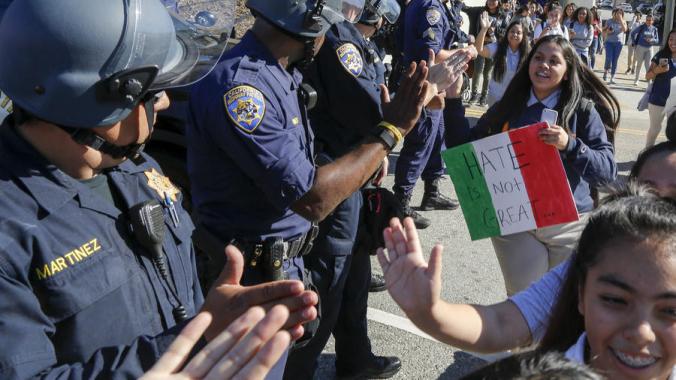
Hundreds of students walk off their East Los Angeles and Boyle Heights high school campuses to protest President-elect Trump.
hsprotest_0011479152291
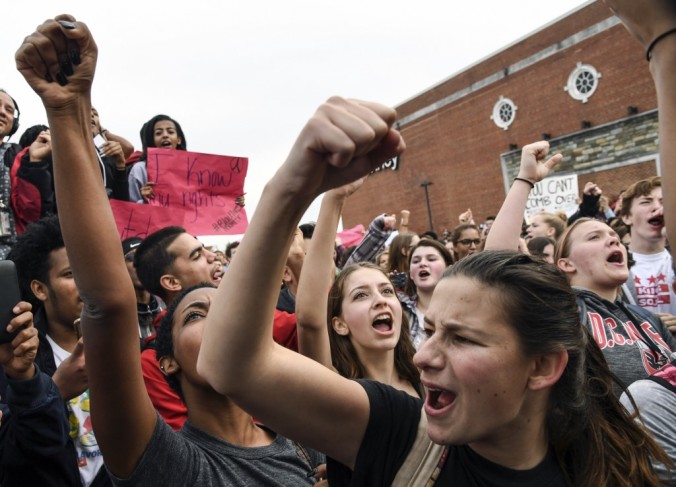
Montgomery Blair High School junior Lyla DiPaul, 16, joins other students in a small rally in a parking lot at Westfield Wheaton Mall on their way to downtown Silver Spring marching to protest the election of Donald Trump.
20161114_protests_school_walk_out_rm-3602_loccv4
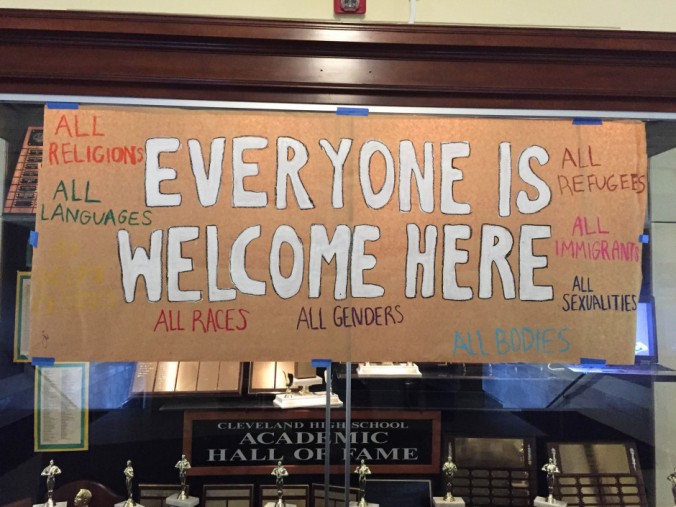
Cleveland High School hung a message of welcoming, as students returned from the Veterans Day break, Nov. 14 2016. About 100 Cleveland students took part in an anti-Trump walkout.
20161109_sbhs_school_protest_18_t479
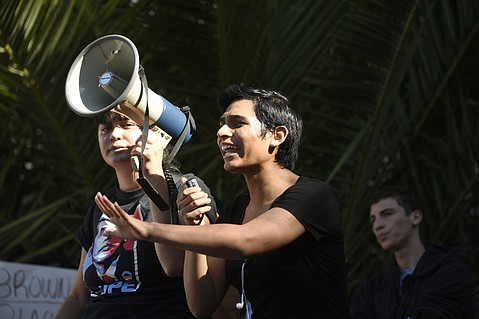
Student Anna Ariel exhorts the crowd to keep working for  “Act like an adult.” No thanks. | Fred Klonsky:


Steve Bannon is a shameless racist. Haters won’t be posted on this site. | Fred Klonsky

Steve Bannon is a shameless racist. Haters won’t be posted on this site. | Fred Klonsky:

Steve Bannon is a shameless racist. Haters won’t be posted on this site.

steve-bannon

Trump advisor Steve Bannon.
In all the years that I have been blogging I have had pretty flexible rules on comments in the comment section.
I screen them, of course. I have never allowed explicitly racist, sexist or homophobic comments.
Yet this is not a Facebook site. I can’t stop anyone from sending me a comment. All I can do is screen them. I can’t unfriend a reader or block a racist from writing me.
I do have a following of trolls. Of course, they don’t include their email address.  They never use their real name. They use pseudonyms or their posts are unsigned.
Some suggest threats.
They have been working overtime since Trump’s election. They think this is a personal defeat for me instead of a potential catastrophe for the world.
This goes along with the increase in hate crimes since Trump’s election that even Voice of America has been  forced to report on.
In the past I would pull a few of the more stupid comments together  every couple of months in a column I called “We Get Letters.” Their comments would included some snarky response from me.
Many readers told me that they loved the snark.
Others thought I shouldn’t give the hate trolls even this much attention.
I have decided to go with those who think I shouldn’t give them any attention.
I won’t read them. I won’t ever post them. I know who they are, so I won’t even be selective and allow the more benign comments through.


Schooling in the Ownership Society: Gwen Ifill interviewed George Bush in 2004 about the 'ownership society'

Schooling in the Ownership Society: Gwen Ifill interviewed George Bush in 2004 about the 'ownership society':

Gwen Ifill interviewed George Bush in 2004 about the 'ownership society'


We are deeply saddened by the loss of one of the great, path-breaking journalist, Gwen Ifill, who died yesterday at the age of 61. Much too soon.

I'm happy I got to meet Gwen once in D.C. and tell her personally how much I thought of and respected her.

She appears in our book, Small Schools: Public School Reform Meets the Ownership Society which highlights her 2004 give-and-take with Pres. George W. Bush on theJim Lehrer Newshour, in which Ifill credits Bush and V.P. Dick Cheney with coming up with the term, Ownership Society. 


GWEN IFILL: During the campaign, President Bush and Vice President Cheney coined a new phrase to describe the economic promise of a second term. They said they would create an “ownership society,” one that would lower taxes and shift more of government’s burden to individuals.
PRESIDENT GEORGE W. BUSH: I believe our country can and must become an ownership society. When you own something, you care about it. When you own something, you have a vital stake in the future of your country. 
The ownership society terminology was coined to reassure Bush's relatively small, but single-minded Republican base that "free market" reforms, including the privatization of public space, would be pushed aggressively in the 2004 election campaign.Schooling in the Ownership Society: Gwen Ifill interviewed George Bush in 2004 about the 'ownership society':

Image result for ownership society