Latest News and Comment from Education

Saturday, November 12, 2016

My Election Day Heart Attack: Lessons for Moving Forward | gadflyonthewallblog

My Election Day Heart Attack: Lessons for Moving Forward | gadflyonthewallblog:

My Election Day Heart Attack: Lessons for Moving Forward

img_5937
I had a heart attack on Election Day.
This is not hyperbole.
I literally went to the polls, went to my doctor and then went to the hospital.
I didn’t know Donald Trump would win. Like most of us, I thought the nation would heave a big sigh, eat its vegetables and vote for Hillary Clinton.
But the election had been weighing on my mind (and apparently my body) for a long time.
How can we have narrowed it down to these two candidates nobody wants? How can these really be the only choices we get here in America? If either one of them wins, we all lose just in different ways.
So as I write this from my hospital bed, I’m left pondering lifestyle changes. I’ve got to start eating healthy. I need to exercise. I need to start taking care of myself.
But this kind of introspection is also what we need as a nation. After a disasterous election like the one we just had, the country is at least as sick as my ailing heart. We need to sit down with each other and decide how we’re going to move forward, how we’re going to prevent a national disaster like this from ever happening again.
Here’s what I’ve come up with so far:
1) Admit Who’s to Blame
Donald Trump was just elected President of the United States. That is unbelievable! This clown, this buffoon is now the “leader of the free world.” How did this happen?
There are many factors leading up to this, but politically the blame must be placed with the Democratic Party.
They put up a candidate – Hillary Clinton – who could not beat someone as odious as Trunp. The people made it clear during the primary that they wanted a populous candidate, someone who wasn’t part of the establishment, yet the DNC ignored them. In fact, party elites did everything they could to tip the scales in Clinton’s favor.
We must always remember this lesson: when you rig the primary, you lose the general.
Bernie Sanders packed stadiums while Clinton could barely pull together rallies. He polled double digits ahead of Trump while Clinton was much less competitive. He would have beaten Trump in a landslide.
So if you want someone to blame, blame the DNC. Every party leader should immediately be fired. We must regain control of the party. If the Democrats refuse to be a real progressive institution, they will continue to lose and we will have to look elsewhere for political affiliation.
So admit the truth, it wasn’t third party voters with 3-4% of the vote, it wasn’t 45% of registered voters who didn’t show up at the polls because we gave them no one to vote for. It was the DNC. Period.
2) Understand the relationship between Race and Class
There are lots of folks out there blaming the election results on the racism of Trump voters. There are lots of folks blaming it on working class people choosing Trunp over Hillary.
They’re both right.
Racism has always been a tool of the rich in this country. It’s a way of throwing a bone to poor whites so they will support the 1%.
Don’t go after us as we cheat you out of a living wage, they say. We’ll give you whole swaths of people you can lord it over.
White privilege is the grease that keeps our economy running. Without it, poor whites might look to the rich and see how much they’re being swindled.
Heck yeah Trump ran as a racist. Heck yeah he ran as a populist. But the only thing poor whites will get from him is a license to be racist.  No jobs. No better wages. No better education. Just go ahead and subjugate brown people.
We must understand this relationship. As anti-racists we must also fight for the middle class. As activists for the middle class we must also fight racism. These are two sides of the same coin, and we must address both if we are ever to achieve real positive change.
3) Acknowledge Sexism
That a nation of grown adults would pick a boorish misogynist against an educated, intelligent woman speaks wonders. Hillary Clinton was far from my first choice,  but compared to Trump she was obviously less odious.
There is no doubt that sexism played a part in this. Even white women chose Trump over Clinton. So many of Trump’s policies were anti-woman. He was an admitted serial groper. He’s on trial for child rape!
And if that’s not enough, I can’t even recall how many times I heard women tell me that a person of their gender doesn’t belong in the Oval Office.
This is something we have to overcome, and frankly I think we are. Millennials are not nearly as sexist as the rest of us. As the population ages and today’s kids become tomorrow’s adults, I think sexism will be left behind. Trunp’s election is the last gasp of this antiquated prejudice. But we must recognize it for what it is.
4) Unions need to represent the rank and file
I’m a big supporter of labor unions, but in many cases they let us down in this election. Trump was no champion of the working stiff, but he got an aweful lot of union votes. Why?
Many of our unions prematurely endorsed Clinton even though she has a spotty relationship with them and didn’t support many natural union initiatives like the fight for 15.
On the other hand, Sanders was the union candidate. He was the natural fit, yet union leadership like the American Federation of Teacher’s Randi Weingarten offered to attack other unions that didn’t fall in line behind Clinton. Both big teachers unions, the AFT and the National Education Association endorsed Clinton early in the primary without truly democratically polling membership. It doesn’t matter if they broke by-laws or not. If unions really represent the rank and file, these leaders should be held responsible.
In short, we should fire leaders like Weingarten and the NEA’s Lily Eskelsen Garcia immediately. Our union leaders must show a healthier respect for the rank and file or else they jeopardize the entire entireprize of workers rights.

These are just some of the ways we can move forward in the days and weeks ahead. It will be a rough road  but I’m sure we can come out of it together.
Just like my aging body, our nation is ill. For me, the result was a heart attack. For us, the result is President Trump.
Will we turn it around?
I’m sure going to try.
*****************
FULL DISCLOSURE: I didn’t vote for either Clinton or Trump. I happily voted for Jill Stein. My Election Day Heart Attack: Lessons for Moving Forward | gadflyonthewallblog:


All Things Education: Post 2016 Election Post

All Things Education: Post 2016 Election Post:

Post 2016 Election Post

Image result for Post 2016 Election


I have long outgrown (I hope) shaming, scolding, and ranting.  I am sobered, I am humbled, and I am devastated.  I will say that, yes, more empathy, compassion, and understanding is needed, but this goes both ways.  If people like me should understand why others voted for Trump (and I agree that we should), they need to understand why people like me find that vote threatening--threatening to us, to people we love and to people we've never even met (especially to non-white, non-Christian, non-straight, non-cis male people), to our society and the world, and to our values.  For more of what might articulate what I am thinking and feeling, read this twitter thread by Michael Schur

As for education, I don't have some detailed post on what a Trump presidency would mean for education; I am only able to string together some thoughts and recommendations.

1.  I am leaving the details of why Trump happened to others, but I will say that ultimately there are many reasons Trump won and that social science can help to tell us what those were.  And we need both quantitative and qualitative research to tell us.  Quantitative can tell us what and who but it can't tell us why.  We can also examine the policies that impact voting and see where they were oppressive and where they were facilitative.  Otherwise, while we know the extent of racism, sexism, homophobia, bigotry, and xenophobia in our country is great, we don't know what each American eligible to vote was thinking when they went into the voting booth or made a choice not to vote, or neglected to register in the first place.  But that can and should be studied.

Recommendation #1: Read, respect, and support high quality social scientific research that studies people of all groups and researchers that represent people of all groups.


2. Although I won't, others have written generally about what a Trump presidency might mean for education.  A good place to start is this straightforward piece from Mike Petrilli of the Fordham Institute.  Mike is a Republican and people like him would know best what Republicans might try to implement.  The most comprehensive, yet concise piece I have read on what education policy might look like is this by one of my favorite education journalists, Emma Brown of the Washington Post.  Otherwise, there is tons of stuff up at Education Week, this, for example.  As we have found out, we need to support journalism, especially investigative journalism, more than ever.  I have said this for a long time.  I am an education news junkie.  I don't pay for all of my content, but I happily pay for a lot of it.

Recommendation #2: Read people who you don't agree with and who make you uncomfortable--they can tell you things you won't pick up on by only reading people you agree with.

Recommendation #2a: If you don't already, invest in journalism. I repeat: read, support, and pay for journalism, especially investigative journalism.  Demand that journalists be of diverse backgrounds and groups and that coverage reflect that diversity.


3. If you read the links in #2, you will see, according to what he said on the campaign trail and who is advising him on education so far, that Trump supports the current traditional Republican agenda, that is privatization, school "choice," and the complete elimination of education as a public good.  In my opinion, those are not good policies--they are not good for public education but they also are not good for our society.  Public schools are flawed and as an institution have been tools of segregation and oppression but they are our best model for sustaining a pluralistic democracy.  Public schools are where kids (hopefully) from all kinds of backgrounds and families come together and navigate the world.  Privatization and "choice" will end that.  Keep in mind that privatization and school "choice" are part of what we've been contending with for a long time, including from the Obama administration, though most centrist Democrats do draw the line at vouchers. 

And education is a matter that is largely left to states and localities.  Trump has indicated that he would leave education to the states and localities to a even greater extent than ESSA does.  However, at the same time, he has said things such as that he wants to abolish Common Core, which is a state matter.  He has no record of governing (he has never held office), has no demonstrated expertise or knowledge of policy, is unpredictable, is, and is especially interested in amassing power.  Education does not appear to be much on his radar screen.  So some of what happens will depend upon his education-related appointments, but otherwise, who knows how much he will leave education to states and localities and how much he will want to control himself?  Who knows what he will do?

Recommendation #3: If you are not already, now is the time to get engaged in your local and state governance.  That is the only thing that is left.  Learn all about your local and state governing bodies, including your school boards. Learn about the issues and policies.  Get informed.  Talk with your fellow community members about the issues and policies.  Comment publicly on what your local and state governing bodies are doing and what you as a citizen, taxpayer, and constituent want them to do.  Cherish those public democratic institutions and work to preserve them and keep them healthy.  Work to get people from diverse backgrounds and different groups elected and appointed to such bodies. Serve in those bodies yourself. Contribute and be a participant.  I can't stress this enough.  I have long said that local and state governance is the most important and this is more true than ever.  Neo-liberals have demonstrated disdain for institutions and matters of local and state governance.  Obama's principal Secretary of Education Arne Duncan thought school boards were dysfunctional and a nuisance.  Do not follow this example.  Set a new one.  When you fail to engage with your local and state institutions, you leave a void for others or nobody to fill.  Local and state political leaders are obligated to serve their constituents and they need to be held accountable. We have to make them serve the public, ALL members of the public.


4. Going back to federal education, while I stated that much of what Trump has said about education aligns with current initiatives in education generally, there will be a large, devastating difference from the Obama administration in terms of the focus of the Department of Education.  Trump may work to eliminate the Department of Education, he may completely redirect the way federal funds for education are used (Title I, for example, and Pell Grants).  Civil rights components and integration initiatives will be gutted.  So much of the work that has been done towards establishing even just a fragile understanding of white supremacy and just a small start to countering and dismantling it will likely be lost.  This will have devastating effects.

Recommendation #4: Get involved and be present in your community's schools, in your children's schools. Advocate for diverse school staffs and diverse curricula. Tell your local educators that you know that they can't control what kids learn at home, but that once in school, you expect everyone be treated with respect and dignity and to be kept safe.  If you hear something or see something, say something.  Right now, there are many kids in schools (including many traditional public schools) who are just trying to survive. Read this --it's alarming but you must read it.  It's always been this way on some level, especially for Muslim, black, Latino, LGBT, and immigrant students and students with disabilities, but now it's even worse and female and all other non-Christian students are also in more danger. They are being bullied, intimidated, provoked, and in some cases attacked. They need your support and protection.

It isn't much, but that's all I got. Stay safe and remember to breathe. 
All Things Education: Post 2016 Election Post:


Friday, November 11, 2016

Repairing Our Civic Discourse – Teachers’ Role | Daniel Katz, Ph.D.

Repairing Our Civic Discourse – Teachers’ Role | Daniel Katz, Ph.D.:

Repairing Our Civic Discourse – Teachers’ Role


When I woke up on November 9th, I had to explain to my children, aged 7 and 9, that Donald Trump is going to be the next President of the United States.  They cried.  They cried because they know, at most, a fraction of the horrible things he has said in his campaign and that was enough to convince them that he should not be President.  They cried because although they are young, they believe that America is a country for everyone and that Donald Trump has attacked that ideal.  They cried because they have friends and people they care about who are terrified that a Trump administration will break apart their families.  They cried because we have taught them to value kindness and respect and to abhor bullies.
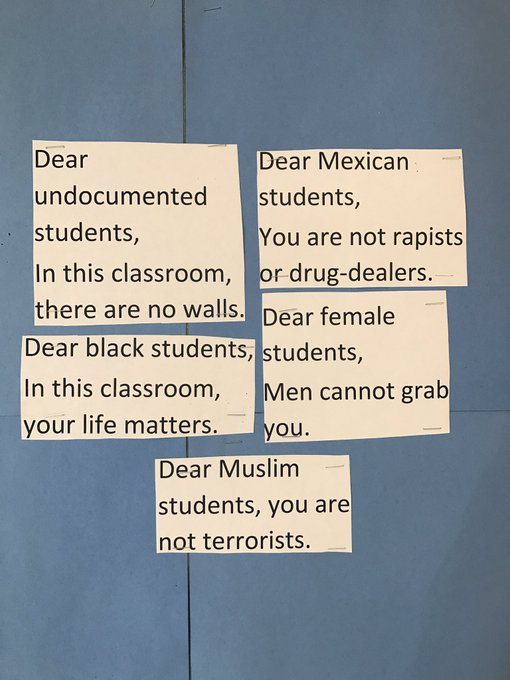
I cried with them and told them that we would always protect them and that our job now is to make certain if our new President tries to hurt anyone that we protect them.  My children are fortunate, though – their fear quickly subsided probably because they have never personally experienced the injustices promised by the incoming administration, and because as children of white, professional parents they are inclined to believe that they have strength in our society.  Friends of mine who teach in schools with minority, immigrant, and Muslim children had much harder work trying to allay their students’ genuine apprehension about what might be coming.  And my friends are not alone in New York City or elsewhere for that matter.  A teacher in Chicago set up this message for students:
As they are almost always called upon to do, teachers this week have been seeking ways to help anxious and shocked students to cope with circumstances that are both beyond their control and threatening to their well being.  I do not need to reiterate the ways in which a Trump Presidency is poised to harm millions of our students – his campaign promises make that crystal clear as does the bigoted and inflammatory rhetoric with which he made those promises.  His enablers assure us that he intends to be the President for “all” Americans, but many of his supporters appear to have very clear ideas of what his victory means, so even if President Trump takes a softer stance than candidate Trump, he has unleashed Repairing Our Civic Discourse – Teachers’ Role | Daniel Katz, Ph.D.:


My Last Thoughts About the Election | Diane Ravitch's blog

My Last Thoughts About the Election | Diane Ravitch's blog:

My Last Thoughts About the Election

Click on picture to Listen to Diane Ravitch


Several readers have written to say that they were very disappointed that I have spoken ill of the President-elect. They said they would not read the blog any more because I do not share their admiration for our next President. I hate to lose readers, but part of the point of this blog is that I write what I believe and I invite readers to do the same. I will not change my views to pander to readers.
I did not support Donald Trump for the Presidency. I thought he was unqualified to serve, had no relevant experience, and had repeatedly expressed bigotry towards many fellow Americans. I supported Hillary Clinton after she won the Democratic primaries. I would have supported Bernie Sanders with equal zeal had he won the primaries. I did not want Trump to be elected. Okay, he was elected, and I am a loyal American. I respect the office, and I watch with concern as he decides how to staff his administration and which of his campaign promises he will keep.
This is a blog devoted to “a better education for all.” Its central purpose is to support public education as a public good. I oppose privatization of public schools. That much has been clear to anyone who has read the blog on any given day. Donald Trump has pledged to direct federal funding to privately managed charter schools, to vouchers for religious schools, and to homeschooling. He has no problem with for-profit schools. Those are reasons enough for me to oppose his candidacy and to worry about his presidency. I worry that he will damage public education irreparably in the next four years, with his party in control of the Congress and equally committed to privatization of public education.
Thus, if a reader says I will stop reading your blog because you didn’t support Trump, I don’t think they understand that Trump’s promise to privatize public schools is directly in conflict with the essential purpose of this blog.
I opposed him because of the horrible things he said during the election campaign about women, immigrants, Muslims, Mexicans, and others. I opposed him because of his campaign’s use of anti-Semitic images. I opposed him because of the many years he devoted to proving that President Obama was not an American, a charge he retracted during the campaign, with little remorse. Since his election, in a very few days, there have been many incidents of hatred towards people who are nonwhite, Muslim, Hispanic, or “Other.” Just yesterday, CNN played a clip of middle-school students in the Midwest chanting “Build the wall, build the wall,” to intimidate their Hispanic schoolmates.
David Remnick, editor of the New Yorker, says that Trump’s election is nothing less than “an American tragedy.”
He wrote on the day after the election:
The election of Donald Trump to the Presidency is nothing less than a tragedy for the American republic, a tragedy for the Constitution, and a triumph for the forces, at home and abroad, of nativism, authoritarianism, misogyny, and racism. Trump’s shocking victory, his ascension to the Presidency, is a sickening event in the history of the United States and liberal democracy. On January 20, 2017, we will bid farewell to the first African-American President—a man of integrity, dignity, and generous spirit—and witness the inauguration of a con who did little to spurn endorsement by forces of xenophobia and white supremacy. It is impossible to react to this moment with anything less than revulsion and profound anxiety.
There are, inevitably, miseries to come: an increasingly reactionary Supreme Court; an emboldened right-wing Congress; a President whose disdain for women and minorities, civil liberties and scientific fact, to say nothing of simple decency, has been repeatedly demonstrated. Trump is vulgarity unbounded, a knowledge-free national leader who will not only set markets tumbling but will strike fear into the hearts of the vulnerable, the weak, and, above all, the many varieties of Other whom he has so deeply insulted. The African-American Other. The Hispanic Other. The female Other. The Jewish and Muslim Other. The most hopeful way to look at this grievous event—and it’s a stretch—is that this election and the years to follow will be a test of the strength, or the fragility, of American institutions. It will be a test of our seriousness and resolve.
I am an Other. Probably many of you who read this are Others. I hate to hear the words he uses about women. I hate to hear what he says about women in the locker room or on the bus with the boys. I have grown up with sons and grandsons, and that is not the language they ever use. I hate what he said about Mexicans. I hate the idea that he proposed banning all people of one religion from entering our country. I am afraid that he will remove all regulations on guns, and we will all be armed and suspicious of one another. I am afraid that he will remove all regulations on drilling and fracking, and the air and water will be polluted, and oil rigs will be permitted in our national parks and everywhere else.
I will no longer engage in any arguments about which Democrat might have been a better candidate than Hillary. That’s over. Now we must deal with the fact that the man who will be our President for the next four years has been elected on a platform and promises that resurrect nativism, racism, white nationalism, and division.
He will be our President, and, as I said, I respect the Office of the Presidency. But I cannot endorse any of the appeals to bigotry and bias. I cannot endorse his rejection of the science about climate change. I do not agree that our nation should abolish all controls on guns.
I will watch and wait to see if President-elect Trump moderates his views and policies. I will hope for the best. I want America to be a land of hope and dreams, of idealism and mutual respect, of e pluribus unum, not just unum. We are a quilt of many colors and it is a beautiful quilt. We all belong here. I will wait to see if President-elect Trump is willing to speak to and for all of us and not just for his rabid movement.
I want America to be America. I want it to be a land of liberty and justice for all. I want my grandchildren to learn what I tried to teach my children: kindness, compassion, a commitment to fairness, a love of justice, and a willingness to defend the underdog. I want them to aspire to be good people. I want them to treat others with respect for their individuality and humanity.
If you have read this far, and you hate what I have written, don’t read the blog. Unsubscribe. Delete.
I have always said that I will speak as honestly as I know how, and I would write from the heart. This is written in honesty, from the heart. You don’t have to agree. This is what I wanted and needed to say.My Last Thoughts About the Election | Diane Ravitch's blog:

Thursday, November 10, 2016

Senator Warren: 'We stand up and we fight back' | MSNBC

Senator Warren: 'We stand up and we fight back' | MSNBC:

Senator Warren: 'We stand up and we fight back' 


Massachusetts Senator Elizabeth Warren talks with Rachel Maddow about the election of Donald Trump, what non-Trump voters can do to assuage their despair, and the path forward for Democrats.Duration: 9:35

Warren on Trump: We've got some places where we could overlap


Massachusetts Senator Elizabeth Warren talks with Rachel Maddow about where she sees common ground with President-elect Donald Trump that they could work on together. Duration: 8:24


Image result for howard zinn peaceful revolution

Today, we woke up feeling like strangers in a foreign land, because yesterday Americans expressed their views that are clearly inconsistent with the values of the people of California.

Joint Statement from California Legislative Leaders on Result of Presidential Election - Speaker Anthony Rendon Representing the 63rd California Assembly District:

Today, we woke up feeling like strangers in a foreign land, because yesterday Americans expressed their views that are clearly inconsistent with the values of the people of California.

Image result for Californians overwhelmingly rejected politics fueled by resentment, bigotry, and misogyny.


SACRAMENTO – California Senate President pro Tempore Kevin de León (D-Los Angeles) and California Assembly Speaker Anthony Rendon(D-Paramount) released the following statement on the results of the President election:
Today, we woke up feeling like strangers in a foreign land, because yesterday Americans expressed their views on a pluralistic and democratic society that are clearly inconsistent with the values of the people of California.
We have never been more proud to be Californians.
By a margin in the millions, Californians overwhelmingly rejected politics fueled by resentment, bigotry, and misogyny.
The largest state of the union and the strongest driver of our nation’s economy has shown it has its surest conscience as well.
California is – and must always be – a refuge of justice and opportunity for people of all walks, talks, ages and aspirations – regardless of how you look, where you live, what language you speak, or who you love. 
California has long set an example for other states to follow. And California will defend its people and our progress. We are not going to allow one election to reverse generations of progress at the height of our historic diversity, scientific advancement, economic output, and sense of global responsibility.
We will be reaching out to federal, state and local officials to evaluate how a Trump Presidency will potentially impact federal funding of ongoing state programs, job-creating investments reliant on foreign trade, and federal enforcement of laws affecting the rights of people living in our state. We will maximize the time during the presidential transition to defend our accomplishments using every tool at our disposal.
While Donald Trump may have won the presidency, he hasn’t changed our values. America is greater than any one man or party. We will not be dragged back into the past. We will lead the resistance to any effort that would shred our social fabric or our Constitution.
California was not a part of this nation when its history began, but we are clearly now the keeper of its future.
###
Hoy despertamos sintiéndonos extranjeros en tierra extraña, porque ayer los estadounidenses expresaron sus opiniones sobre una sociedad pluralista y democrática que es claramente inconsistente con los valores de la gente de California.

Nunca nos hemos sentido más orgullosos de ser Californianos.

Por un margen de millones de votos, los californianos rechazaron abrumadoramente la política alimentada por el resentimiento, la intolerancia y la misoginia.

El estado más grande de la unión y la locomotora de la economía de nuestra nación ha demostrado que también tiene su conciencia más tranquila.

California es - y debe ser siempre - un refugio de justicia y oportunidades para las personas de todos los orígenes, lenguas, edades, y aspiraciones - independientemente de su apariencia, dónde vivan, qué idioma hablen, o a quiénes amen.

California, por mucho tiempo, ha sido un ejemplo a seguir  para otros estados. Y California defenderá a su gente y nuestro progreso. No vamos a permitir que una elección sea un revés para el progreso de generaciones en la cima de nuestra histórica diversidad, el avance científico, la generación económica y un sentido de responsabilidad global.
Estaremos comunicándonos con los funcionarios federales, estatales y locales para evaluar cómo una Presidencia Trump podría afectar potencialmente los fondos de programas estatales en curso, las inversiones creadoras de empleos que dependen del comercio exterior y la aplicación de las leyes federales que afectan los derechos de las personas que viven en nuestro estado.
Estaremos utilizando al máximo el tiempo durante la transición presidencial para defender nuestros logros, usando cada herramienta a nuestra disposición.

Aunque Donald Trump haya ganado la presidencia, no ha cambiado nuestros valores. Estados Unidos es más grande que cualquier hombre o partido. No seremos arrastrados de vuelta al pasado. Lideraremos la resistencia a cualquier esfuerzo que destruya nuestro tejido social o nuestra Constitución.

California no era una parte de esta nación cuando comenzó su historia, pero ahora somos claramente los encargados de mantener su futuro.
Joint Statement from California Legislative Leaders on Result of Presidential Election - Speaker Anthony Rendon Representing the 63rd California Assembly District:


Election Inflections: Why California’s Deep-Pocketed Charter School Backers Went for Broke – Capital & Main

Election Inflections: Why California’s Deep-Pocketed Charter School Backers Went for Broke – Capital & Main:

Election Inflections: Why California’s Deep-Pocketed Charter School Backers Went for Broke

Yesterday the subscriber-only political almanac California Target Book reported that spending by all independent expenditure committees (IECs) on Sacramento legislative races in the general election had topped $41 million. That brought the year’s total of outside money for state Assembly and Senate seats, including primary races, to $70 million.
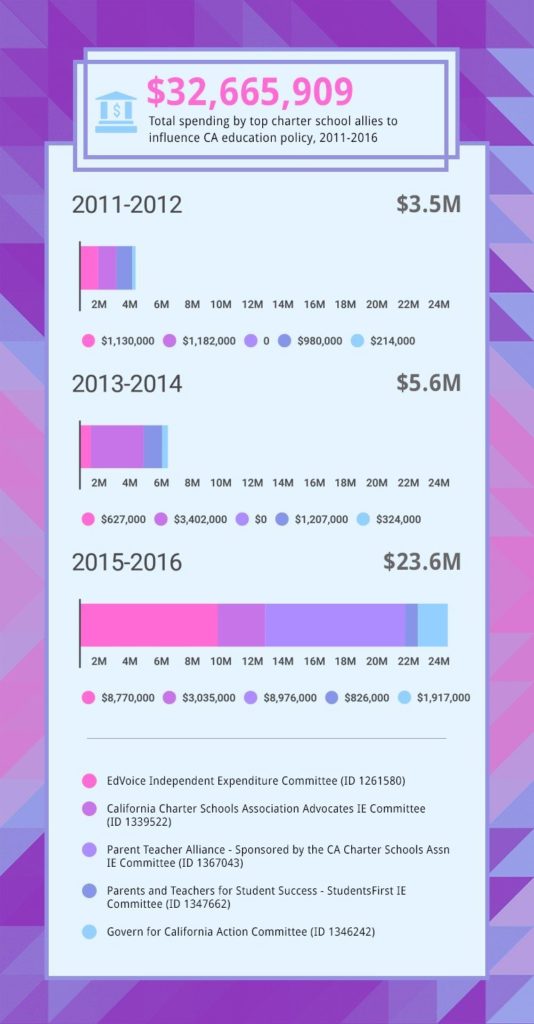
But the real surprise of this election was just how much of 2016’s independent expenditure spending can be attributed to a handful of committees tied to charter school groups. According to the California Secretary of State’s Cal-Access website, charter IECs pumped close to $24 million into about 35 Assembly and Senate races, along with school board races in Alameda and Sacramento counties in the north, to Riverside and San Diego counties in the south.
Under state law, an independent expenditure is any campaign spending that is “outside” the control the candidates whom it is benefiting or opposing. An IEC can funnel unlimited amounts of money from corporations, nonprofits and wealthy donors, as long as it does not coordinate the spending activity with candidates, who are under strict, albeit voluntary campaign limits.
California’s “school choice” movement has always benefited from generous subsidies by a narrow spectrum of big-spending entrepreneurs, many of whom are billionaires. Their wealth has helped give the state the highest number of charter schools in the U.S., even as their election largess has left it with the nation’s most expensive school board elections.
Capital & Main’s analysis of the latest campaign-finance records for the five largest charter school IECs reveals that those same personal fortunes are at the center of the charters’ apparent attempt to buy some Sacramento political insurance against a growing resistance among both lawmakers and the public to the industry’s unbridled expansion in the state.
The amount spent by charter IECs represents about $40 for each of California’s 581,100 charter school students, and a 300 percent jump from 2014 charter election spending — about 570 percent over 2012. (See infographic below.)
info2
Click to enlarge
Why did California’s charter industry choose this election to spend its way into the electoral fray? The answer depends on whom one asks.
“They were tired of getting beat,” Democratic political consultant Gale Kaufmann asserted in an email. “They had lost nearly every election in past years and obviously this year, their strategy became, 1: Let’s see how much money our billionaire donors can put in; and then, 2: Let’s see how much can we spend to buy some legislative and school board seats. The charter industry spent $11 million in the primary and had an impact, so they [. . .] doubled down in the general election.”
Twenty-six open legislature seats — 12 in hotly contested swing districts — shared the ballot with 17 statewide propositions. With early-voter turnout already setting records, Democrats stood poised to reclaim the legislative supermajority they lost in 2014.
But the election would also decide the political complexion — and the progressive-stopping power — of the informal group of bill-killing “moderate” assembly members so friendly to big business that it has been informally dubbed the “corporate Democrats caucus.”
Charter schools are privately managed but taxpayer-funded schools that are virtually free from most of the laws — and much of the accountability or transparency — under which traditional public schools operate. Protecting that status quo, public school supporters insist, drove this year’s independent expenditure spending spree.
“Charter schools used to be a boutique thing,” Cal State Sacramento education and policy studies professor Julian Vasquez Heilig said. “Now they have incredible money and power behind them: They have Eli Broad’s very deep pockets; the Gates Foundation has spent $300 million on charter schools in the last couple years; the Walton Family Foundation. … Parents and families and civil rights folks that are asking the charter schools to reform are really the underdog in this conversation, because the money and power is on the side of charter schools.”
Most of the charters’ IE spending (88 percent) was directed by three committees that served as the 501(c)(4) political arms of industry lobbyists California Charter School Association (CCSA) and EdVoice, the charter school advocacy nonprofit founded by Netflix CEO Reed Hastings: CCSA’s California Charter Schools Association Advocates IE Committee, and the Parent Teacher Alliance (sponsored by the CCSA’s IEC); and the EdVoice Independent Expenditure Committee. (Neither EdVoice nor CCSA responded to requests to comment for this article.)
The remainder was distributed by the Govern for California Action Committee, a PAC controlled by anti-public-pension gadfly and neoliberal Democrat David Crane; and by Parents and Teachers for Student Success – StudentsFirst, the IEC of the national pro-charter group founded by Michelle Rhee.
“They’re investing heavily in maintaining a deregulated environment,” said United Teachers Los Angeles Secretary Daniel Barnhart before the election. “This really isn’t about kids. In their own words, they say it’s about market share.”
He may be right. Though the teachers union spent nearly $33 million on the election, the bulk of that (around $20 million) went to Proposition 55, the education-funding measure that aimed to benefit all California classrooms — both charter and public school students. The charter IECs spent solely on pro-charter legislative and school board candidates.
In Sacramento, where charters are represented by CCSA, the 2015-16 legislative session was a mixed bag for the industry. Lobbyists succeeded in killing two big reforms: AB 1084, a Susan Bonilla (D-Concord) bill that would have outlawed for-profit Election Inflections: Why California’s Deep-Pocketed Charter School Backers Went for Broke – Capital & Main:

Mike Klonsky's SmallTalk Blog: Resist!

Mike Klonsky's SmallTalk Blog: Resist!:

Resist!

Shortly after Donald Trump delivered his victory speech, about 2,000 people rallied against the election at UCLA. (Los Angeles Times)
Trump and the Republicans were able to tap into a wave of deep-seeded white anger and frustration the likes of which I haven't seen since the violent reaction to the black freedom movement in the south, 50 years ago. Only this time, it was expressed through the ballot box. Will the reaction stay constrained? Or are we in for another wave of violent, racist, anti-immigrant attacks that Trump is more than capable of unleashing?


Van Jones made an emotional and powerful statement on CNN last night, wondering what he should tell his children about the election of a neo-fascist to the highest political office in the land.
“This was a white-lash,” he said. “This was a white-lash against a changing country. It was a white-lash against a black president in part, and that’s the part where the pain comes.”
 If you don't know Van, in 1996, he founded the Ella Baker Center for Human Rights. He was appointed Obama's Special Advisor for Green Jobs in '08, but soon came under attack from the far right (Mike Pence) was deemed "too radical" and thrown under the bus by the Dems.

As someone who grew up in a left-wing household during the McCarthy period, survived the repression and political assassinations of the '60s, and endured the Nixon, Reagan, and Bush years, Trumpism is no stranger to me. The tears, the eerie quiet, and then anger that befell Clinton's "victory party" in N.Y. around midnight, are things I have experienced too many times.

Trump's election victory was a devastating blow, not only to the Clinton dynasty, but for all of us who value democracy and social-justice. Now comes a brief, hopefully thoughtful and introspective period in which to gather ourselves and prepare for the reactionary winter that's about to be unleashed.

It's too soon to begin assessing blame for the loss or settling accounts. That time will come and we all have our lists.  But first, we need to let the dust settle and see what we're really up against here. There's also a lot we can learn about organizing election campaigns in the modern era -- besides not nominating the most hated, untrustworthy (even by her own supporters) candidate in party history.

We can also anticipate lots of spontaneous anti-Trump protests breaking out, starting today.

Agenda Topics from now until January...Who will be part of Trump's new ruling coalition and how will it rule? What are the inevitable divisions within it? What's left of the Democratic Party and progressive forces and how badly are they in disarray? How swiftly will Trump move on his campaign promises to round-up millions of immigrants in deportation centers? What will happen when he tries to smash the Affordable Care Act, pulling health care from some 20 million citizens? What about the Supreme Court and the future of same-sex marriage and Rowe v. Wade? And what will happen to public space (including what's left of public education) and public decision making?

And then, most importantly how do we resist?Mike Klonsky's SmallTalk Blog: Resist!:


A Time to Think About The Future, Our Kids, Education and Our Country


A Time to Think About The Future, Our Kids, Education and Our Country

Image result for reaction to trump victory quotes

See Ya Soon