Latest News and Comment from Education

Monday, November 7, 2016

Feds offer guidance on new Title IV funding :: SI&A Cabinet Report

Feds offer guidance on new Title IV funding :: SI&A Cabinet Report :: The Essential Resource for Superintendents and the Cabinet:

Feds offer guidance on new Title IV funding

Image result for big education ape well-rounded education


(District of Columbia) A new federal block grant aimed at helping schools provide a “well-rounded education” can be used in a wide variety ways–from nutrition and health care, to music and foreign language instruction, according to new guidance issued by the U.S. Department of Education.
In constructing the Every Student Succeeds Act, Congress consolidated several small programs to create Title IV, otherwise known as the Student Support and Academic Enrichment program. As designed, funding under Title IV can be used by local educational agencies to:
  • Provide all students with access to a well-rounded education;
  • Improve school conditions for student learning; and
  • Improve the use of technology in order to improve the academic achievement and digital literacy of all students.
But in non-regulatory guidance released by the Education Department late last month, district managers will find Title IV money is highly flexible in support of the Congressional mandate.
Improving instruction in science, technology, engineering and mathematics is one option highlighted by federal officials.
Among the approved activities would be efforts to increase access for groups of underrepresented students to high-quality STEM courses; supporting participation in nonprofit competitions in robotics or math competitions, for example,; providing students hands-on learning and exposure to STEM, including through field-based and service learning; or supporting the creation and enhancement of STEM-focused specialty schools.
Arts and music are also emphasized, which includes dance, media arts, theater and visual arts. The new guide points to a clearinghouse developed by the Education Commission of the States–called ArtsEdSearch–which provide a database of research on programs and services in the many areas of artistic instruction.
The Title IV funding can also be used to support drop-out prevention. Federal officials highlighted a national nonprofit–Jobs for the Future–which has helped start or design nearly 250 early college schools that currently serve more than 75,000 students nationwide. JFF has seen increased graduation rates with 90 percent of early college students graduating high school, compared to the national rate of 78 percent, the report said.
ESSA authorized $1.65 billion for the new block grant, although Obama’s 2017 budget would only allocate $500 million for the program.
The award given to states is formula-driven, based on what they are already getting in Title I money. The subgrants to LEAs is also based on the Title I allotment.
For a district receiving more than $30,000 of Title IV money, federal law imposes three conditions:
  • At least 20 percent of funds for activities to support well-rounded educational opportunities (ESEA section 4107);
  • At least 20 percent of funds for activities to support safe and healthy students (ESEA section 4108); and
  • A portion of funds for activities to support effective use of technology (ESEA section 4109).
While local school boards are encouraged to look to leverage other state and federal grants to broaden well-rounded education services.
“For example, Title I, Part A (Title I) of the ESEA may be used to promote supportive school climates to reduce the use of exclusionary discipline practices in a Title I schoolwide program,” the guidance paper said. “Likewise, LEAs may use Title II funds to provide training for school personnel to address issues related to school conditions for student learning, such as safety, peer interaction, drug and alcohol abuse, and chronic absenteeism.”
The Education Department was also careful to point out that Title IV cannot be used to replace an existing funding source–that is, the long-standing federal prohibition on supplanting is in play here.Feds offer guidance on new Title IV funding :: SI&A Cabinet Report :: The Essential Resource for Superintendents and the Cabinet:





Demand the Impossible! (final excerpt) | Bill Ayers

Demand the Impossible! (final excerpt) | Bill Ayers:

Demand the Impossible! (final excerpt)

Image result for DEMAND the IMPOSSIBLE! bill ayers

Bill Ayers -- Demand the Impossible!: A Radical Manifesto | Haymarket Books -http://www.haymarketbooks.org/pb/Demand-the-Impossible


[This is my final (tenth) posting of excerpts from Demand the Impossible! published by Haymarket Books in Chicago in 2016, and now available everywhere]

What is to be done? Struggling with that question illuminates the strongest argument the [science deniers] have, even as it exposes their point of greatest vulnerability: seriously engaging the environmental catastrophe, and taking the necessary steps to solve it, will mean—I’ll just spit it out here—overthrowing capitalism. This is the real choice in front of us: the end of capitalism or the end of the habitable earth, saving the system of corporate finance capital or saving the system that gives us life. Which will it be?

In Don DeLillo’s grimly funny and super-smart novel White Noise…Jack Gladney, a professor of “Hitler Studies” at a small midwestern college…sleepwalks through his life to the dull background sounds of TV and endless radio, the Muzak of consumerism and electronics, unrestrained advertising and constant technological innovation, appliances and microwaves… When a train derails outside of town creating what is at first described officially as a “feathery plume” but later becomes a “black billowing cloud” and finally an “airborne toxic event,” everything becomes a bit unhinged. Jack’s response to an official evacuation order is disbelief: “I’m not just a college professor,” he complains. “I’m the head of a department. I don’t see myself fleeing an airborne toxic event. That’s for people who live in mobile homes out in the scrubby parts of the county, where the fish hatcheries are.”

Well, not anymore, Jack. Our own feathery cloud has turned toxic at breathtaking speed, and those folks in the mobile homes might be our best natural allies after all.

The great rebel Rosa Luxemburg, jailed for her opposition to World War I, lived her life to that rhythm. She sent a letter from prison to a friend and comrade who’d complained to her that their revolutionary work was suffering terribly without Luxemburg’s day-to-day leadership. First, Red Rosa wrote, stop whining—excellent advice in any circumstance, [and advice that resonates powerfully for US radicals today]. She went on to urge her friend to be more of a menschOh, I can’t define mensch for you, she said, but what I mean is that you should strive to be a person who loves your own life enough to appreciate the sunset and the sunrise, to enjoy a bottle of wine over dinner with friends, or to take a walk by the sea. But you must also love the world enough to put your shoulder on history’s great wheel when history demands it. Working that out may become for each and all of us a collective daily challenge—it’s also the way forward toward commitment and balance.

Choose life; choose possibility; choose rebellion and revolution.

Be a mensch!

Demand the impossible!
Demand the Impossible! (final excerpt) | Bill Ayers:

 Image result for that's all folks animated gif

An extraordinary battle over charter schools is consuming this state - The Washington Post

An extraordinary battle over charter schools is consuming this state - The Washington Post:

An extraordinary battle over charter schools is consuming this state

Image result for big education ape Question 2
Fights over charter schools have become commonplace, but the one being waged right now in Massachusetts — which has long had as fine a public education system as any state in the country — isn’t your ordinary battle.
Question 2, an initiative on Tuesday’s ballot to approve the raising of the state’s cap on charter schools, is the most expensive ballot initiative in the country — with at least $35 million reportedly raised by both sides — and it’s been as bitter as any. The campaign in support of Question 2 seemed sure to be a success when it started, enjoying bipartisan support, but as time went on, opposition grew.
And now, whatever happens on Tuesday in Massachusetts could affect the national fight over the growth of charter schools,  which supporters say give parents more educational choices for their children, and which critics say drain resources from traditional public schools, typically under-serve the highest-needs students and are not accountable to the local communities.
There are now nearly 80 charter schools in Massachusetts, some of them among the highest-achieving schools in the state. Massachusetts has capped the total number at 120 charter schools, but Question 2 seeks to raise that cap, allowing the state to authorize 12 new or expanded charter schools to open every year, effectively blowing the idea of a cap.
The maneuvering over Question 2 has brought all of the elements we’ve come to expect in charter wars: big money from outside the state; concerns about the use of “dark money;” Wall Street involvement; charges of arrogance from both sides; a nasty advertising campaign, marked by pro-charter ads created by the firm that made the infamous “Swift Boat” 2004 ads against then-Democratic presidential candidate John F. Kerry; and a split among Democrats about the virtues and drawbacks of more charters.
President Obama hasn’t weighed in, but his secretary of education, John King Jr., did, telling the Boston Globe that if he lived in Massachusetts, he would vote “yes.” Obama’s former secretary of education, Arne Duncan, supports it too, as does the Democrats for Education Reform advocacy group. The Boston Globe’s editorial board agrees, as does Republican Gov. Charlie Baker, who said in a pro-charter ad: “Imagine if your kid was trapped in a failing school. Public charter schools give parents a choice and are a pathway for these kids.”
But the opposition is strong, too. Dozens of local school districts have come out against the initiative, as has the Massachusetts Parent Teachers Organization. Massachusetts Sen. Elizabeth Warren opposes Question 2, saying in a recent statement that while “many charter schools in Massachusetts are producing extraordinary results for our students,” she is concerned that traditional public schools could be harmed An extraordinary battle over charter schools is consuming this state - The Washington Post:
Image result for big education ape Question 2

The Burden of Being a Black School Teacher in America - The Atlantic

The Burden of Being a Black School Teacher in America - The Atlantic:

The Burden of Being a Black Teacher

Many African American educators say they don’t feel respected or empowered at their schools.

Image result for back of the bus


As classrooms across the United States become more diverse, schools are working to hire more teachers of color, particularly black teachers. Some have actually done a reasonable job of bringing more African American educators in the door. Yet the vast majority of teachers remain white women, in part because many black teachers leave just a few years into the job. Federal data suggests that in 2012-13, nearly 22 percent of black public-school teachers moved schools or left the profession altogether, compared to only about 15 percent of white, non-Hispanic teachers. 


The result is that only around 7 percent of the country’s teachers are black, despite the fact that African Americans make up around 16 percent of the overall student population. I’ve written about why that matters, but the upshot is that children benefit when they see and hear people who come from different backgrounds. Students learn to collaborate and compromise, and they prepare for the inevitably global nature of their future jobs. When schools have a diverse teaching force, they may also be able to limit the effects of implicit bias. A recent study found that white teachers have lower expectations than black teachers for the same black students. Having more teachers of color might help mitigate that imbalance.The Burden of Being a Black School Teacher in America - The Atlantic:

Districts grapple with superintendent turnover along with new reforms | EdSource

Districts grapple with superintendent turnover along with new reforms | EdSource:

Districts grapple with superintendent turnover along with new reforms

Image result for big education ape broad clones
At a time when California schools are introducing a range of landmark reforms, there is a continuing churn in the leadership of many of the state’s largest districts.
An EdSource survey of the state’s 30 largest districts indicates that in 17 out of 30 districts, the superintendents have been in office for three years or less. In nine of those districts, superintendents have served for less than a full year. Three are interim appointments during ongoing searches for permanent appointments.  
Only seven of the surveyed superintendents have been leading their districts for five years or more.   Only two – Michael Hanson in Fresno and Chris Steinhauser in Long Beach – have been in their posts for 10 or more years.
The survey results in these districts are not intended to be representative of California’s nearly 1000 school districts, but they highlight the extent of  leadership turnover in the state’s largest, mostly urban districts.  The combined enrollments of the 30 districts total about one-third of the state’s 6.2 million public school students.
Education experts worry that continuing turnover in school leadership could hamper implementation of a basket of  reforms, including the state’s new accountability system and the Common Core standards in math and English, along with their potential to improve student academic outcomes.
For interviews with four California superintendents appointed in 2016, go here.
“I don’t think nearly enough superintendents have the time to make both dramatic and lasting improvements in their districts,” said Becca Bracy Knight, executive director of the Broad Center for the Management of School Systems in Los Angeles. “We have to ask ourselves what is keeping people from staying in their jobs longer. If you want big change, and big improvements for your students, and you want it to be sustainable, that simply takes time.”
Irvine Unified Superintendent Terry Walker, appointed to his post in 2011, said experience translates into a far more effective school leader.
“There is so much going on (in the district) that you can’t help but be a better decision maker,” said Walker, who after six years on the job is one of the more experienced superintendents in the state. “You are far less likely go ‘ready, fire, aim’ when you have a better sense of how all the parts fit together.”
While much attention has been paid to teacher turnover, there has Districts grapple with superintendent turnover along with new reforms | EdSource:
 New superintendents seek continuity as they reflect on challenges ahead

Image result for big education ape broad clones
ne of the superintendents in the state’s 30 largest districts were appointed to their posts in 2016. EdSource interviewed four of them to get their thoughts about their experiences during their early months on the job. They were interviewed by EdSource’s Michael Collier and Louis Freedberg. EdSource plans to follow up with them as their tenure unfolds to hear about their successes and challenges. 
For an overview of superintendent turnover in California’s largest school districts, go here.

ELISEO DƁVALOS

DISTRICT:  STOCKTON UNIFIED

START DATE: JULY 2016


Stockton Unified Superintendent Eliseo DavalósEliseo DĆ”valos served most recently as assistant superintendent of curriculum/instruction and accountability at San Bernardino City Schools. He has worked in K-12 public education since 1979, as high school teacher, migrant education resources teacher and community college teacher. He spent nine years at the Corona-Norco Unified District as director of instructional support and student services.
What do you think is the impact of superintendent turnover on districts?
I believe that superintendent turnover has a negative impact on the district and the entire community. It contributes to the inability of a district to define and implement a shared vision for the district, to establish clear goals and expectations and to provide continuity in all aspects of the district. It also undermines any strategic long-term planning that the district might want to engage in.
How has your district responded to your superintendency so far?
When I introduce myself to someone from the district and community, instead of hearing “nice to meet you,” I hear, “so, how long are you here for?” My response is that I am here to stay, not going anywhere. That seems to calm them. Then I get the “nice to meet you.”
What is the impact of turnover on teachers and principals?
I believe that instability of superintendent tenure in a district contributes negatively to day-to-day life at the schools. Principals are more likely to support status quo practices rather than innovation. Teachers are more likely to believe that the direction and leadership the superintendent provides is of no consequence to them. They are waiting to add the next name to their list of leaders who have passed through the organization.
What are some positive outcomes when a new superintendent arrives?
The stability of a superintendent in a district can give the entire school community a feeling of being respected and valued, while at the same time a sense of comfort, in knowing that there is someone at the helm who is focused on the day-to-day, but also on the future of the district.
***

NANCY ALBARRƁN

DISTRICT:  SAN JOSE UNIFIED

STARTING DATE:  APRIL 2016

San Jose Unified Superintendent Nancy AlbarrĆ”nNancy AlbarrĆ”n began her career as a teacher in the Los Angeles and Oakland Unified districts. She joined San Jose Unified in 1999  as a bilingual teacher, and later became director of bilingual education and special programs. In 2010, she was appointed director of elementary curriculum and in 2012 she became assistant superintendent of instruction. 

¡Llegó la hora! ¡Todos a votar! - Lily's Blackboard

¡Llegó la hora! ¡Todos a votar! - Lily's Blackboard:

¡Llegó la hora! ¡Todos a votar!


No sĆ© tĆŗ, ¡pero yo estoy bien emocionada! (Y no solamente porque los cachorros de Chicago ganaron la Serie Mundial despuĆ©s de esperar mĆ”s de 100 aƱos.) ¡Estoy emocionada porque vamos a hacer historia! El momento que hemos estado esperando ha llegado. Vamos a votar el martes, 8 de noviembre.
Estoy súper contenta que después de todas las llamadas que hemos hecho, los votantes que hemos registrado, las puertas que hemos tocado, y los zapatos que hemos desgastado (y ni se diga de los pies adoloridos), finalmente ha llegado el día de las elecciones.
¡QuĆ© alivio!3004595893_cd96feac42_o
Me imagino que pensarĆ”n que les voy a decir que sigan adelante y continĆŗen trabajando hasta llegar a la meta final. A lo mejor pensarĆ”n que les voy a volver a decir lo importante que son estas elecciones – no solamente la contienda presidencial, sino tambiĆ©n las otras contiendas, especialmente en estados claves como Virginia, Carolina del Norte, y Ohio. Si eso es lo que piensas, me conoces demasiado bien. Tienes toda la razón.
Pero mayormente te voy a motivar, presionar, rogar para que salgas a votar. Los estudios seƱalan que si haces planes para ir a votar, es mĆ”s probable que sigas con los planes y acudas a las urnas.
Conoce tu centro de votación. Si tienes alguna pregunta sobre si estĆ”s registrado para votar, por favor visite este sitio web.
Y acuĆ©rdate que si estĆ”s en la fila en tu centro de votación antes que cierre, deben permitirte votar. Si tienes dudas sobre cuĆ”l es tu centro de votación o el horario, averigua eso ahora.
SĆ© que estĆ”s cansado. De verdad que lo entiendo. He tocado tantas puertas que ni me acuerdo como es la puerta mĆ­a. Pero estamos bien cerca de una victoria. Tenemos que marchar hacia adelante; nuestros niƱos dependen de nuestro voto.
Por eso cuando te canses, haz como yo hago: cÔmbiate de ropa, tómate una taza de café y cómete un pedacito de chocolate, y sigue adelante. Robert Frost, uno de los grandes poetas de Estados Unidos, lo dijo mejor que nadie:
Los bosques son hermosos, oscuros y profundos,
Pero tengo promesas que mantener,
Y millas por recorrer antes de dormir,
Y millas por recorrer antes de dormir.
Todos a las urnas ¡vamos!
¡Llegó la hora! ¡Todos a votar! - Lily's Blackboard:

Evidence for the Disconnect Between Changing Test Scores and Changing Later Life Outcomes - Education Next : Education Next

Evidence for the Disconnect Between Changing Test Scores and Changing Later Life Outcomes - Education Next : Education Next:

Evidence for the Disconnect Between Changing Test Scores and Changing Later Life Outcomes

Image result for big education ape standardized test

Over the last few years I have developed a deeper skepticism about the reliability of relying on test scores for accountability purposes.  I think tests have very limited potential in guiding distant policymakers, regulators, portfolio managers, foundation officials, and other policy elites in identifying with confidence which schools are good or bad, ought to be opened, expanded, or closed, and which programs are working or failing.  The problem, as I’ve pointed out in several pieces now, is that in using tests for these purposes we are assuming that if we can change test scores, we will change later outcomes in life.  We don’t really care about test scores per se, we care about them because we think they are near-term proxies for later life outcomes that we really do care about — like graduating from high school, going to college, getting a job, earning a good living, staying out of jail, etc…
flickr/timlewisnm
flickr/timlewisnm
But what if changing test scores does not regularly correspond with changing life outcomes?  What if schools can do things to change scores without actually changing lives?  What evidence do we actually have to support the assumption that changing test scores is a reliable indicator of changing later life outcomes?
This concern is similar to issues that have arisen in other fields about the reliability of near-term indicators as proxies for later life outcomes.  For example, as one of my colleagues noted to me, there are medicines that are able to lower cholesterol levels but do not reduce — or even may increase — mortality from heart disease.  It’s important that we think carefully about whether we are making the same type of mistake in education.
If increasing test scores is a good indicator of improving later life outcomes, we should see roughly the same direction and magnitude in changes of scores and later outcomes in most rigorously identified studies.  We do not.  I’m not saying we never see a connection between changing test scores and changing later life outcomes (e.g. Chetty, et al); I’m just saying that we do not regularly see that relationship.  For an indicator to be reliable, it should yield accurate predictions nearly all, or at least most, of the time.
To illustrate the un-reliability of test score changes, I’m going to focus on rigorously identified research on school choice programs where we have later life outcomes.  We could find plenty of examples of disconnect from other policy interventions, such as pre-school programs, but I am focusing on school choice because I know this literature best.  The fact that we can find a disconnect between test score changes and later life outcomes in any literature, let alone in several, should undermine our confidence in test scores as a reliable indicator.
I should also emphasize that by looking at rigorous research I am rigging things in favor of test scores.  If we explored the most common use of test scores — examining the level of proficiency — there are no credible researchers who believe that is a reliable indicator of school or program quality.  Even measures of growth in test scores or VAM are not rigorously identified indicators of school or program quality as they do not reveal what the growth would have been in the absence of that school or program.  So, I think almost every credible researcher would agree that the vast majority of ways in which test scores are used by policymakers, regulators, portfolio managers, foundation officials, and other policy elites cannot be reliable indicators of the ability of schools or programs to improve later life outcomes.
With the evidence below I am exploring the largely imaginary scenario in which test scores changes can be attributed to schools or programs with confidence.  Even then, the direction and magnitude of changing test scores does not regularly correspond with changing later life outcomes.  I’ve identified 10 rigorously designed studies of charter and private school choice programs with later life outcomes.  I’ve listed them below with a brief description of their findings and hyperlinks so you can read the results for yourself.
Notice any patterns? Other than the general disconnect between test scores and later life outcomes (in both directions), I notice that the No Excuses charter model that is currently the darling of the ed reform movement and that New York Times columnists have declared as the only type of “Schools that Work” tend not to fare nearly as well in later outcomes as they do on test scores.  Meanwhile the unfashionable private choice schools and Mom and Pop charters seem to do much better on later life outcomes than at changing test scores.  I don’t highlight this pattern as proof that we should shy away from No Excuses charters.  I only mention it to suggest ways in which over-relying on test scores and declaring with confidence that we know what works and what doesn’t can lead to big policy mistakes.
Here are the 10 studies:
1. Boston charters (Angrist, et al, 2014) – Huge test score gains, no increase in HS grad rate or postsecondary attendance. Shift from 2 to 4 yr
2. Harlem Promise Academy (Dobbie and Fryer, 2014) – Same as Boston charters
3. KIPP (Tuttle, et al, 2015) – Large test score gains, no or small effect on HS grad rate, depending on analysis used
4. High Tech High (Beauregard, 2015) – Widely praised for improving test scores, no increase in college enrollment
5. SEED Boarding Charter (Unterman, et al, 2016) – same as Boston charters
6. TX No Excuses charters (Dobbie and Fryer, 2016) – Increase test scores and college enrollment, but no effect on earnings
7. Florida charters (Booker, et al, 2014) – No test score gains but large increase in HS grad rate, college attendance, and earnings
8. DC vouchers (Wolf, et al, 2013) – Little or no test score gain but large increase in HS grad rate
9. Milwaukee vouchers (Cowen, et al, 2013) – same as DC
10. New York vouchers (Chingos and Peterson, 2013) – modest test score gain, larger college enrollment improvement
– Jay P. Greene
Jay P. Greene is endowed chair and head of the Department of Education Reform at the University of Arkansas.Evidence for the Disconnect Between Changing Test Scores and Changing Later Life Outcomes - Education Next : Education Next:

Image result for big education ape standardized test

New York Dark Money, Pro-Charter Group pours another $15,000 into Connecticut legislative races - Wait What?

New York Dark Money, Pro-Charter Group pours another $15,000 into Connecticut legislative races - Wait What?:

New York Dark Money, Pro-Charter Group pours another $15,000 into Connecticut legislative races

Image result for New York Dark Money


Called the Real Reform Now Network, a New York based charter school front group, that won’t reveal the names of its donors, is expanding its effort to convince Connecticut voters to vote for pro-charter school candidates in this year’s general election.
Connected to the Northeast Charter School Network, the Real Reform Now Network pumped another $15,000 into Charters Care late last week.  Charters Care is a political action committee that is also tied to the Northeast Charter School Network.
In their latest filing, the PAC reports that their expenditures continue to be made in support of State Senator Steve Cassano (D-Manchester).
As noted in an earlier Wait, What? post, the Center for Responsive Politics defines Dark Money organizations in the following way;
Politically active nonprofits – principally 501(c) (4) s and 501(c) (6) s – have become a major force in federal elections over the last three cycles. The term “dark money” is often applied to this category of political spender because these groups do not have to disclose the sources of their funding – though a minority do disclose some or all of their donors, by choice or in response to specific circumstances.
These organizations can receive unlimited corporate, individual, or union contributions that they do not have to make public, and though their political activity is supposed to be limited, the IRS – which has jurisdiction over these groups – by and large has done little to enforce those limits.
New York Dark Money, Pro-Charter Group pours another $15,000 into Connecticut legislative races - Wait What?:


Teachers Union, CPS Read Charter School Cap Differently | WBEZ

Teachers Union, CPS Read Charter School Cap Differently | WBEZ:

Teachers Union, CPS Read Charter School Cap Differently

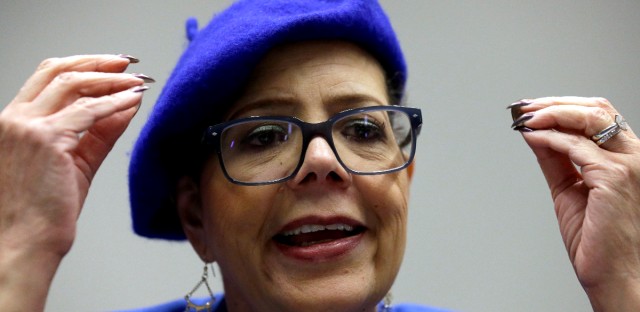
Chicago Teachers Union president Karen Lewis answers a question from media after a news conference on Wednesday, March 23, 2016, in Chicago. The Chicago Teachers Union has voted approve a one day walkout on April 1, 2016.
Chicago Teachers Union president Karen Lewis answers a question from media after a news conference on Wednesday, March 23, 2016.


Chicago Teachers Union officials have touted a provision in the newly approved teachers contract that limits the growth of controversial charter schools, saying it’s one of the biggest wins for union members. 
But Chicago Public Schools officials said the cap does not necessarily mean there’s a district-wide moratorium on expanding charter schools. 
“There’s plenty of room for high quality charter operators to apply and to go through our process,” said CPS CEO Forrest Claypool. “There is not a moratorium and there’s room under the cap for high quality charter operators.” 
Charter schools are publicly funded, privately run schools that have long been criticized by the Chicago Teachers Union. 
The new contract negotiated between CPS and the union states there will be no net increase in the number of charter schools approved by the Chicago Board of Education, the governing body overseeing CPS. The agreement also says the number of students enrolled at charter schools by the end of the 2018 to 2019 school year will not exceed 101 percent of the total number of students in charters during the 2015 to 2016 school year. 
On the surface, this might sound like CPS won’t open any more charter schools or let charter schools add any students from now til the end of the contract.
But CPS officials have a different interpretation. 
For one, Chicago teachers worked for a year without a contract, so the start of this contract is technically July 1, 2015. 
At that time, CPS had 106 charter schools. Now it has 97. That means CPS could open nine charter schools and still keep its promise to the union.
The other key phrase in the side letter is “total student enrollment capacity.” This term has nothing to do with how many students can fit in a building, nor does it have anything to do with how many students actually are enrolled in a school. 
Instead, enrollment capacity is a number negotiated by the charter operator and the school district, usually based on how many students the charter school thinks it can handle and how many students the district wants to send there. 
So, for example, Legacy Charter School’s enrollment capacity is 554 students. This year, it has 470 students enrolled in a building that could accommodate 780 students. 
All together, CPS officials said the enrollment capacity is 75,945. 
Currently, charter enrollment is 52,877. This means CPS could let charters take in thousands of additional students. 
Claypool said the school district will only open new charters where there is overcrowding or no quality option. 
“This is prudent,” he said. 
When asked about the district’s interpretation of the side letter, CTU President Karen Lewis noted that no other teachers union has gotten a school district to agree to such a provision. 
What’s more, she says, charter schools don’t work. 
“They are not doing a better job at a cheaper rate, which is what they promised,” she said.
Sarah Karp is an education reporter for WBEZ. You can follow her @SSKedreporterTeachers Union, CPS Read Charter School Cap Differently | WBEZ:
 Charter Schools - Dividing Communities since 1991

The Education Implications of an Election When Education Isn’t Mentioned | janresseger

The Education Implications of an Election When Education Isn’t Mentioned | janresseger:

The Education Implications of an Election When Education Isn’t Mentioned


This blog will be back with a new post on Thursday, November 10.  I will be taking off Tuesday to help get out the vote and taking off Wednesday to consider the election results.
When a public education system that serves 50 million children is not even really discussed in a national election, that says something about the problems in this political season, doesn’t it?
And this is at a time when rapid growth of school privatization has been extremely controversial, when we have been punishing the schools in our poorest communities and their teachers but when at the same time we have neglected to increase support for the public schools that serve communities where poverty is concentrated. I’ll just remind you—in case Donald Trump’s misogyny, racism, xenophobia, failure to pay his taxes, and propensity to cheat the people who have provided services for his businesses aren’t enough to turn you off—that Trump has announced his education plan would expand vouchers and charters—nothing beyond that.  Trump came to a very low-performing charter school in Cleveland, Ohio in early September to announce his plan: “The Republican presidential nominee used his appearance at the Cleveland Arts and Social Sciences Academy to announce that his first budget would redirect $20 billion in federal funding to create a state-run block grant that he said he hoped would help poor children in low-performing public schools to enroll at charter and private schools. ‘I’m proposing a plan to provide school choice to every disadvantaged student in America.'”
Hillary Clinton was endorsed early on by both of the teachers unions and she has consistently described education-related priorities including expanded child care and preschool, and relief from college debt.  Clinton has been a little vague about plans for K-12 schooling, but she has promised that “(E)ducators will have a partner in the White House, and… always have a seat at the table.”  That in itself is pretty radical language in these days when many people agree that current public education accountability has been done to,  not done with, school teachers. Neither the federal No Child Left Behind Act nor its replacement, the Every Student Succeeds Act, has added significant funding to help schools in the poorest communities.  In fact the Center on Budget and Policy Priorities recently explained that between 2010 and 2016, the federal government reduced the Title I program by 8.3 percent; federal funding for programs under the Individuals with Disability Education Act fell by 6.4 percent (both The Education Implications of an Election When Education Isn’t Mentioned | janresseger:


How one school created a ‘safe, comfortable place’ for students and teachers - The Washington Post

How one school created a ‘safe, comfortable place’ for students and teachers - The Washington Post:

How one school created a ‘safe, comfortable place’ for students and teachers

Students at Hilllsdale High School (Provided by Hillsdale High School)

This is the second in a series of posts about schools that were named as honorees in the 2015-16 Schools of Opportunity project. You can find the first one here.
If you listen to the school reform debate these days, you would be forgiven for thinking that public schools across the board are failing students and that schools that are struggling can only improve if they fire all of their staff, become a charter school or let the state take them over. It’s just not so.
This is clear in a project called the Schools of Opportunity, which was launched a few years ago by educators who wanted to highlight public high schools that actively seek to close opportunity gaps through 11 research-proven practices and not standardized test scores (which are more a measure of socioeconomic status than anything else).
The project assesses how well schools provide health and psychological support for students, judicious and fair discipline policies, high-quality teacher mentoring programs, outreach to the community, effective student and faculty support systems, and broad and enriched curriculum. Schools submit applications explaining why they believe their school should be recognized.
The project started in 2014 as a pilot program in New York and Colorado, and went national in 2015-2016, with gold and silver winners coming from states including Maryland, Georgia, California and Oregon. It is the brainchild of Kevin Welner, director of the National Education Policy Center at the University of Colorado at Boulder and a professor specializing in educational policy and law; and Carol Burris, a former award-winning principal in New York who is now executive director of the nonprofit Network for Public Education.
Twenty schools were named as honorees for the 2015-16 school year — eight gold winners and 12 silver — and you can see the list here. This is the first of a series of posts I will publish that highlight why each of the schools was chosen to be honored. It is important to note that each school found success in ways that met the needs of their own communities.
Here is a post about Hillsdale High School in California, a 2016 Gold medal School of Opportunity:

By Kevin Welner and Carol Burris
High School: Hillsdale High School
City and State: San Mateo, CA
Principal: Jeff Gilbert
Superintendent: Kevin Skelly
Enrollment: 1,400
Economically disadvantaged students: 16 percent
For the past 15 years, Hillsdale High School has worked in partnership with Stanford University’s School of Education and other groups such as the nonprofit National Equity Project to develop small learning communities that are challenging, engaging and equitable. That work has paid great dividends for the Hillsdale students.
Hillsdale High is a comprehensive public school of nearly 1,400 students in San Mateo, California, located 20 miles south of San Francisco. It used a teacher-led Smaller Learning How one school created a ‘safe, comfortable place’ for students and teachers - The Washington Post: