Latest News and Comment from Education

Wednesday, October 26, 2016

Mike Klonsky's SmallTalk Blog: Trump is a pipeline profiteer. Clinton remains silent.

Mike Klonsky's SmallTalk Blog: Trump is a pipeline profiteer. Clinton remains silent.:

Trump is a pipeline profiteer. Clinton remains silent.

“We have roadblocks like you’ve never, ever seen – environmental blocks, structural blocks,” he said. “We are going to allow the Keystone pipeline and so many other things to move forwards. Tremendous numbers of jobs and good for our country.” -- Donald Trump
The difference between the two candidates in a nutshell.

Hillary Clinton has promised to "stop fracking" when she's elected. But only "when any locality or any state is against it," "when the release of methane or contamination of water is present," and "unless we can require that anybody who fracks has to tell us exactly what chemicals they are using."

But she remains silent on the Dakota Access Pipeline even as oil company construction crews continue to ravage Lakota sacred lands, while the piping of fracking oil threatens a big part of the nation's water supply, and while madman Sheriff Kirchmeier escalates his assault on peaceful protesters and journalists.

This, even though back in February, the Clinton camp posted to its website the candidate's policy platform for Native Americans. In it, Clinton declares that she "will continue to stand for 
Mike Klonsky's SmallTalk Blog: Trump is a pipeline profiteer. Clinton remains silent.:


What We Don’t Learn About the Black Panther Party—but Should | I AM AN EDUCATOR

What We Don’t Learn About the Black Panther Party—but Should | I AM AN EDUCATOR:

What We Don’t Learn About the Black Panther Party—but Should

bpp_logo_50anniv-315x300
By Adam Sanchez and Jesse Hagopian, first published at the Zinn Education Project
Fifty years ago this month, the Black Panther Party was born. Its history holds vital lessons for today’s movement to confront racism and police violence, yet textbooks either misrepresent or minimize the significance of the Black Panthers.
bpp_newspaper_collage-501x550The first issue of the Black Panther newspaper, which at its height had a weekly circulation of 140,000 copies, asked, “WHY WAS DENZIL DOWELL KILLED?” Helping Dowell’s family demand justice in Richmond, California, was one of the first major organizing campaigns of the Black Panther Party. Anyone reading the story of Denzil Dowell today can’t help but draw parallels to the unarmed Black men and women regularly murdered by the police. The disparity between the police’s story and the victim’s family’s, the police harassment Dowell endured before his murder, the jury letting off Dowell’s killer, even the reports that Dowell had his hands raised while he was gunned down, eerily echo the police killings today that have led to the explosion of the Black Lives Matter movement.
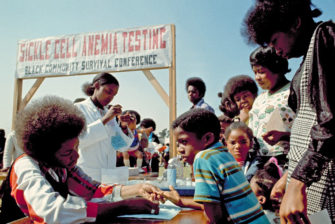
Yet when we learn about the early years of the Panthers, the organizing they did in Richmond—conducting their own investigation into Dowell’s death, confronting police who harassed Dowell’s family, helping mothers in the community organize against abuse at the local school, organizing armed street rallies in which hundreds filled out applications to join the party—is almost always absent. Armed with a revolutionary socialist ideology, as the Panthers grew, so did what they organized around. They fought in Black communities across the nation for giving the poor access to decent housing, health care, education, and much more.
This local organizing that Panthers engaged in has been erased in the textbooks, yet it is precisely what won them such widespread support. By 1970, a Market Dynamics/ABC poll found that Black people judged the Panthers to be the organization “most likely” to increase the effectiveness of the Black liberation struggle, and two-thirds showed admiration for the party. Coming in the midst of an all-out assault on the Panthers from the white press and law enforcement, including FBI Director J. Edgar Hoover’s claim that the Panthers were “the greatest threat to the internal security of the country,” this support is remarkable.

The Textbook Version of the BPP

A few of the major textbooks don’t even mention the Black Panthers, while most give the organization only a sentence or two. Even the small number that do devote a few paragraphs to the party, give little context for their actions and distort their ideology.Textbooks often associate the Panthersbpp_sicklecellenemiatesting-335x224with violence and racial separatism. For example, Teacher Curriculum Institute’s History Alive! The United States reads,
Black Power groups formed that embraced militant strategies and the use of violence. Organizations such as the Black Panthers rejected all things white and talked of building a separate black nation.
While ignoring that the Panthers believed in using violence only in self-defense, this passage also attempts to divide the Panthers from “nonviolent” civil rights groups. The Panthers didn’t develop out of thin air, however, but evolved from their relationships with other civil rights organizations, especially the Student Nonviolent Coordinating Committee (SNCC). The name and symbol of the Panthers were adopted from the Lowndes County Freedom Organization (LCFO), an independent political organization SNCC helped organize in Alabama, also called the “Black Panther Party.” Furthermore, SNCC allied with the Panthers in 1968 and while the alliance only lasted five months, it was a crucial time for the growth of the Panthers.
The passage from History Alive! also incorrectly paints the Panthers as anti-white, erasing their important work building What We Don’t Learn About the Black Panther Party—but Should | I AM AN EDUCATOR:

Malloy claims $5.7 million state budget deficit … But $400 million is closer to the truth - Wait What?

Malloy claims $5.7 million state budget deficit … But $400 million is closer to the truth - Wait What?:

Malloy claims $5.7 million state budget deficit … But $400 million is closer to the truth


Early last summer the Connecticut General Assembly adopted a budget agreement that had been negotiated between Governor Dannel Malloy and the Democratic leaders of the Connecticut State Senate and State House of Representatives.
In truth, the new state budget was out of balance the day it was signed into law and the situation has only gotten worse over the last four months.
Connecticut Income Tax revenues are down.
Connecticut Sales Tax revenues are down
Of the $209 million in “lapse” savings required in the state budget, Malloy has yet to identify $61 million in cuts.
And while the budget plan required about 2,000 layoffs in order to balance, the governor has only implemented about half that number.
Meanwhile, the poorly developed Malloy/Democratic austerity budget will lead to a variety Malloy claims $5.7 million state budget deficit … But $400 million is closer to the truth - Wait What?:

Uncovering Lasting Lessons from Decades of Education Reform - Living in Dialogue

Uncovering Lasting Lessons from Decades of Education Reform - Living in Dialogue:

Uncovering Lasting Lessons from Decades of Education Reform 


By John Thompson.
Learning from the Federal Market-based Reforms: Lessons for the Every Student Succeeds Act (ESSA), edited by William Mathis and Tina Trujillo, details the numerous “opportunity costs” that resulted from a generation of test-driven, competition-driven reform.  The money and energy devoted to the test, sort, reward, and punish approach to school improvement precluded a serious commitment to holistic and humane science-based efforts.  The market-driven reform movement ignored decades of social science research. Often it has devolved into “magical thinking.”
Mike Rose begins the anthology by considering “how this economic focus, blended with the technology of large-scale assessment, can restrict our sense of what school ought to be about: the full sweep of growth and development, for both individuals and for a pluralistic democracy.” Rose notes that “this narrowing of discourse, this pinching of what we talk about when we talk about school,” has defined down what we discuss in the broader public sphere. He challenges us to, “Think of what we don’t read and hear.” He calls for:
Public talk that links education to a more decent, thoughtful, open society. Talk that raises in us as a people the appreciation for deliberation and reflection, or for taking intellectual risks and thinking widely—for the sheer power and pleasure of using our minds, alone or in concert with others. We need a discourse that inspires young people to think gracefully.
As Gary Orfield explains in “A New Civil Rights Agenda for American Education,” we must first Do No Additional Harm. We must reject the judging and punishing of teachers using metrics that are invalid and encourage teach-to-the-test. “We should fund no more intentionally segregating charter schools,” writes Uncovering Lasting Lessons from Decades of Education Reform - Living in Dialogue:

PAA comments on ESSA at Wyoming Community Roundtable | Parents Across America

PAA comments on ESSA at Wyoming Community Roundtable | Parents Across America:

PAA comments on ESSA at Wyoming Community Roundtable 

Image result for Julie Woestehoff


 PAA interim executive director Julie Woestehoff presented a brief version of the following comments to members of the U.S. Department of Education at a community roundtable on the Every Student Succeeds Act held today in Casper, Wyoming:

Parents Across America Comments on ESSA
Presented at the Community Roundtable on ESSA held in Casper, WY
on October 26, 2016
Good morning. My name is Julie Woestehoff. I am a resident of Evanston, WY, and the interim executive director of Parents Across America, a national network of parents from all backgrounds across the United States who share ideas and work together to improve our nation’s public schools. PAA is committed to bringing the voice of public school parents – and common sense – to local, state, and national education debates. We currently have forty-five chapters and affiliates in twenty-six states.
U. S. Education Secretary John King recently spoke about “What School Can Be,” at the Las Vegas Academy of the Arts. Secretary King reflected on the school programs and experiences that had the greatest impact on him — had, in fact, saved his life. The programs he talked about as so transformative and critical for him and other students included performing on stage, going to the zoo and museums, playing in an orchestra, dancing, and going out into the community to tackle real and needed projects – what Secretary King calls a well-rounded education.
A couple of years ago, PAA prepared a position paper, “What is a Quality Education?”, which is quite similar in tone and aspiration. Our vision is that quality education is child-centered, requires skilled professionals, and promotes justice, equity and democracy.
We appreciate the fact that the new federal education law proclaims the fundamental importance of family and community vision and values in setting education goals and making key decisions about the best ways to support and strengthen schools. It was right and necessary to move those decisions back to the state and local level.
Unfortunately, the influence of corporate reform and the push for the monetization and privatization of democratic public education, which has been so strongly opposed by families, communities and educators, remains far too prominent in parts of ESSA and the draft regulations and guidance the department has published so far. These documents continue to misrepresent the real interests and concerns of most parents, using these misrepresentations to justify ineffective, harmful, and expensive programs such as expanded funding for charter schools, misuse and overuse of standardized tests, punitive school labeling, and, more recently, heavy promotion of digital instruction without including adequate protections for student health and data privacy, and all at a time when public education budgets are under severe strain.
Accountability
PAA submitted comments on the draft accountability guidance in July. Briefly, we objected to:
  • The extensive, punitive regulations surrounding the requirement that 95% of all students take state accountability tests, which undermine parents’ rights to opt our children out of these tests, even in cases where such tests are misused or overused.
Image result for Parents Across America:

Nearly Half the States Persist in Starving Public Education | janresseger

Nearly Half the States Persist in Starving Public Education | janresseger:

Nearly Half the States Persist in Starving Public Education

Image result for Starving Public Education

It is October, when the Center on Budget and Policy Priorities (CBPP) updates its report on overall school spending across the states. In this year’s version, released last week, CBPP presents new numbers (in inflation-adjusted dollars) depicting general fund, school-formula funding lagging in 23 states behind what those states were spending in the 2007-2008 school year, just prior to the Great Recession.  This is a slight improvement; last year school funding formulas remained below 2008 levels in 25 states. But in a country that relentlessly declares that no child will be left behind and every student will succeed, our rhetoric rings hollow when nearly half the states have reduced basic aid for schools over the past decade.
The Center on Budget and Policy Priorities sums up the state fiscal picture: “States cut K-12 funding—and a range of other areas, including higher education, health care, and human services—as a result of the 2007-2009 recession, which sharply reduced state revenue.  Emergency fiscal aid from the federal government prevented even deeper cuts but ran out before the economy recovered, and states chose to address their budget shortfalls disproportionately through spending cuts rather than a more balanced mix of service cuts and revenue increases.  Some state have worsened their revenue shortfalls by cutting taxes… And because property values fell sharply after the recession hit, it’s been particularly difficult for local school districts to raise significant additional revenue through local property taxes….”
On average, according to the new report, states provide 47 percent of funding for public schools while local school districts cover 45 percent of the cost. The federal government averages less than 10 percent. Because federal funds pay for services for children whose needs are greatest, cuts in federal funding undermine schools serving the poorest students Nearly Half the States Persist in Starving Public Education | janresseger:
 Image result for big education ape Starving Public Education

Why the History of School Reform is Essential for Policymakers, Practitioners, and Researcher | Larry Cuban on School Reform and Classroom Practice

Why the History of School Reform is Essential for Policymakers, Practitioners, and Researcher | Larry Cuban on School Reform and Classroom Practice:

Why the History of School Reform is Essential for Policymakers, Practitioners, and Researcher


Image result for learn from history

History, as nearly no one seems to know, is not merely something to be read.  And it does not refer merely, or even principally, to the past.  On the contrary, the great force of history comes from the fact that we carry it within us, are unconsciously controlled by it in many ways, and history is literally present in all that we do.  It could scarcely be otherwise, since it is to history that we owe our frames of reference, our identities, and our aspirations.
James Baldwin, 1965
The quote from essayist, novelist, and civil rights activist James Baldwin captures the essential truth about the importance of the past in our living each day of each year and making sense out of what we encounter. As it (was) and is true now about white-black relations, so it is true of coming to grips with the history of school reform in the midst of grand efforts to envision the high school of the future and “personalized learning” through technology.
There is, of course, nothing wrong about these aspirations for fundamental change in a two-century old institution. What is awry is the staggering amounts of money invested in altering these community institutions harnessed to the conscious indifference to the past when similar efforts by earlier generations of  just as dedicated reformers unfolded. As Baldwin pointed out:  “history is literally present in all that we do.  It could scarcely be otherwise, since it is to history that we owe our frames of reference, our identities, and our aspirations.”
Seems to me that current well-funded efforts to launch and sustain such changes upon U.S. schools should, at the minimum, be informed by similar experiments that occurred in the past.
Were well-intentioned reformers now to tap that wisdom and study the history of similar reforms it would not lead to pessimism, throwing in the towel, or similar acts of giving up. It would, I believe, lead to more informed strategies and outcomes for current reforms. A greater concern for solid incremental changes, implemented fully, that accumulate into moving an institution from here to there. But that is not the case now.
The current crop of school reformers have a full agenda of Common Core standards, test-driven accountability, expanding parental choice through charters, spreading virtual teaching and learning, and ridding classrooms of ineffective teachers based upon students’ test scores. These reformers have their eyes fixed on the future not the horrid present  where schools, in their charitable view, are dinosaurs. These reformers are allergic to the history of school reform; they are ahistorical activists that carry the whiff of arrogance associated with the uninformed.
*They do not know what happened in schools when political coalitions between the 1890s-1940s  believed that there was a mismatch between student skills and Why the History of School Reform is Essential for Policymakers, Practitioners, and Researcher | Larry Cuban on School Reform and Classroom Practice:

The Battle Between Teachers Pay Teachers and OERs - The Atlantic

The Battle Between Teachers Pay Teachers and OERs - The Atlantic:

How the Internet Is Complicating the Art of Teaching

Educators design lots of lessons and other learning resources, and increasingly they’re being shared online—often free of cost and in ways that are too personalized to be universally applicable.

Image result for share my lesson
Share My Lesson | Free Lesson Plans & Teacher Resources - https://sharemylesson.com/

A time-honored nugget of the political stump speech is the anecdote about the teacher who brings breakfast for a hungry student in need, or maybe the one who purchases supplies out-of-pocket for an underfunded classroom. These are sweet stories that build on teachers’ well-deserved reputations for sharing with students, but teachers’ work also thrives on the amount of behind-the-scenes sharing they do with one another. Whether it is a homework assignment, a rubric, or a classroom game, teachers build a lot of their curricula on shared materials, authored and tested by experienced peers.
In my first year teaching, I was saved by the binders upon binders of activities, quizzes, and other tools that seasoned teachers shared with me. I tailored what I found in these treasure troves to fit my own style of teaching and the needs of my specific classes. As the years passed and my larder of teaching materials grew fat, I started sharing digital copies of my tried-and-true materials with newer teachers over Google Drive, where they could easily edit to fit their needs and developing teaching styles. Digital platforms have use beyond just ease of editing, though: They are helping teachers bring their best ideas and materials to audiences much larger than the tight-knit communities of copy rooms and teacher’s lounges. As great assignments grow in their reach, though, it is hard to keep the personalization that individual teachers bring to the table from getting lost in translation.
As educators continue sharing with wider audiences, it will be important to figure out how teacher-generated resources will be received into the world of Open Educational Resources (OERs). According to the Department of Education, all OERs must be three things: digitized, free, and editable. Many commercially produced digital textbooks and resources are licenced for use in only one classroom, school, or district at a time. Digitized historical documents are wonderful assets to the open curriculum, but are rarely editable and therefore hard to loop into a classroom-friendly curriculum. The Google Drive scenario of sharing between colleagues represents an OER ideal on a small scale, but both effectiveness and ethics are become more complicated as teachers try to replicate similar exchanges with a larger district, the wider world, and otherwise for-profit technology giants. When suddenly laboratories of ideas need to take the form of finished products, both personalization and collaboration can get subsumed by The Battle Between Teachers Pay Teachers and OERs - The Atlantic:


Malfaro: Charter schools may be tax-funded, but ‘public’ means... | www.mystatesman.com

Malfaro: Charter schools may be tax-funded, but ‘public’ means... | www.mystatesman.com:

 Charter schools may be tax-funded, but ‘public’ means...

Image result for big education ape Charter schools may be tax-funded, but ‘public’ means...
Houston-area State Rep. Harold Dutton’s recent column about charter schools ignored many facts regarding how charter schools perform and operate, and it failed to address the reasons why the National Association for the Advancement of Colored People passed a resolution calling for a moratorium on new charter schools.
The NAACP’s call for a charter school moratorium is a position informed by NAACP members who attend school board meetings, engage with state legislatures and support students, parents and teachers in their communities. The NAACP is not calling for an end to charter schools but is demanding that before more charters are opened at taxpayer expense, charter schools:
  1. Be subjected to the same transparency and accountability standards as public schools;
  2. Cease taking funding away from traditional neighborhood schools;
  3. Cease pushing out/expelling students for behavior or performance and sending them back to public schools; and
  4. Stop perpetuating de facto segregation by selecting higher-performing, lower-needs students and screening/pushing out harder- or more-expensive-to-educate students.
Charter schools proclaim themselves public schools, but the only thing public about them is that they are publicly financed. Charters are governed by unelected boards and lack the transparency that traditional, democratically elected school boards are required to maintain. Lack of public oversight has often produced dismal results here in Texas, where dozens of charter schools have had to close in recent years due to financial mismanagement, low performance and in some instances fraud. Some charters, including one here in Austin, have even shut their doors abruptly, leaving students scrambling and public schools picking up the pieces.
Children First charter, which operated schools in Houston and Dallas, was shut down by the Texas Education Agency for taking millions of dollars without properly documenting attendance, failing to perform required background checks on employees, issuing a $4 million construction contract without a bid and paying hundreds of thousands of dollars to relatives of the superintendent for work TEA says was not performed.
Larger chain charter schools operate within an opaque and tangled web of financial relationships where the lines between nonprofit and for-profit become blurred. Appointed board members often have financial interests in companies that do business with the charter chain. Chain charters like IDEA Public Schools pay exorbitant salaries and bonuses to a CEO (the IDEA CEO earns $430,000 a year) while also paying large amounts of money to superintendents and deputy superintendents.
Chain charters receive millions of dollars in startup support from billionaires and corporate foundations whose agenda is to privatize public education. IDEA, which got its start in the Rio Grande Valley and has schools in Austin and San Antonio, recently received a $16 million dollar gift from a local philanthropist. This private money will give IDEA a financial launchpad to continue marketing its schools to Austin parents and will ultimately drain taxpayer money from our neighborhood public schools. Several years ago, Austin residents rebelled when former Austin ISD Superintendent Meria Carstarphen turned over two Austin ISD campuses to IDEA. The issue was resolved when three new school board members were elected with broad community support and canceled the IDEA contract.
Regarding the performance of students who attend charter schools, claims of charter superiority don’t stand up to the facts. Charter school students in Texas underperform their peers in public schools, and ongoing studies from the Texas Education Agency and other groups have confirmed this year after year. Under state accountability measures, charter school systems are three times more likely than traditional school districts to receive a substandard rating. When you look at statistics for economically disadvantaged kids, charters do not perform better than traditional public schools, even though the students they attract (remember, students have to apply to be admitted) tend to be higher-performing than the general population from which they come.
We applaud the NAACP for its recognition that we can’t afford a segregated system with public schools fighting for much-needed funding while charters run on a for-profit model with little transparency and accountability for taxpayer dollars. We can afford and should be investing more in our true public schools, which are the foundations of our communities and neighborhoods.Malfaro: Charter schools may be tax-funded, but ‘public’ means... | www.mystatesman.com:


Malfaro is president of the Texas branch of the American Federation of Teachers, which represents more than 65,000 public school employees statewide.


 Image result for big education ape Charter schools may be tax-funded, but ‘public’ means...
Image result for big education ape Charter schools may be tax-funded, but ‘public’ means...

More Right Wing Propaganda: Unlike Their Neighbors Charter Schools - AEI

Unlike Their Neighbors Charter Schools - AEI:

Unlike Their Neighbors: Charter School Student Composition Across States

Image result for koolaid man
Executive Summary
The national debate over charter schools has been fueled by two competing narratives about the kinds of students charters serve. Opponents claim charters unfairly select the most advantaged students, draining resources from traditional public schools and avoiding accountability. Proponents paint a different picture, claiming many charters purposefully serve the most disadvantaged students who have languished in failing public schools. Both characterizations have some merit, but neither accurately describes charter schools writ large. As cataloged in a previous report, Differences on Balance, charter schools nationwide dis­play a variety of balanced differences in student com­position, compared with their neighboring public schools.

However, charters are governed by the states, and some states’ charter schools display a much less bal­anced set of differences. In some states, charter schools look much more like their opponents’ characterizations, serving far fewer historically disadvantaged students than their neighbors. Other states have charter sectors that look like charter proponents often suggest, serving more disadvantaged students.

Several states are on the extremes of this spectrum, but most fall somewhere in between, reflecting the diversity of not only charter schools but also charter sectors across states. These individual reports profile each state’s charter sector to promote a more nuanced national portrait of charters and a more informed dis­cussion of state charter policy.

Report
National debate over charter schools has hit a fevered pitch this year. Teachers unions and many classical Democrats have opposed charters—with this wing successfully stiffening anti-charter language in the Demo­cratic National Committee’s official platform. Even more extreme, the NAACP and the Movement for Black Lives Matter called for a complete national moratorium on charter schools.1

However, the charter debate does not cleave along a simple left/right divide. While those on the right tend to support charters, groups on the left fall on both sides of the issue. Teachers unions, traditional Democrats, and some civil rights organizations oppose them, but Presi­dent Barack Obama and many civil rights organizations have been strong charter supporters. Other groups, including the Democrats for Education Reform (DFER), the Black Alliance for Educational Options (BAEO), and hundreds of civil rights leaders2, have specifically dismissed calls for a moratorium, with BAEO Presi­dent Jacqueline Cooper calling the NAACP resolution "ill-conceived and based on lies and distortions about the work of charter schools.3

The divide is rooted in two competing narratives about what charters are and what students they serve. Opponents paint charter schools as "public-private" schools run by independent groups that seek to profit from public funds without accountability and that use various means to select the most advantaged students for their schools.4 Hillary Clinton illustrated that view last year when she said, "Most charter schools, they don’t take the hardest-to-teach kids, or, if they do, they don’t keep them."5

Supporters paint a very different picture. They tend to think of charters as hope-filled alternatives for his­torically disadvantaged students who have long been failed by traditional public schools (TPSs). As Shavar Jefferies of DFER argued, "In communities of color throughout our country, public charter schools are pro­viding pathways to college and careers that previously were not available."6

A national conversation begs for a simple idea of what charters are and who they serve, and these two narra­tives are competing to define that idea. That competi­tion has thrived in part because of limited evidence on charter student selectivity. Some evidence has had a national scope but used faulty comparisons between all charters and all TPSs. This is problematic because it ignores the fact that most TPS students have no charter choices. Other studies have used more nuanced meth­ods but in small areas, which means that the results do not generalize to all charters.


States with data are highlighted on the map below. Clicking on the state will bring you to the individual report.

I tried to bridge this divide in a recent report that compared the student composition of charter schools to that of the TPSs that neighbor them.7 This approach affords a viable look at student selectivity in all brick-and-mortar charters nationwide by removing the majority of TPSs—whose students do not have viable access to charter options—from the comparisons. By examin­ing how often, how much, and in what directions char­ter schools’ students differed from those in neighboring TPSs, I found that, nationally, charters frequently differ from neighboring TPSs on many characteristics, but not in uniform ways.

Student poverty is a perfect example. Charters are often assumed to serve more poor students than TPSs. Compared to their neighboring TPSs, many charters do serve substantially more poor students; however, just as many serve fewer poor students, and both groups differ by comparable amounts.

Clarifying these national differences between char­ters and TPSs is worthwhile for a national debate. How­ever, that clarity may be even more important at the state and local levels, where charter policies are articu­lated. Across the nation, charters differ from both their neighboring TPSs and other charter schools. Some of those differences are balanced nationally, but that is not the case in all states. Looking across states can also show how the charter sectors in one state can look very different from another.

In addition, charter schools are accountable to state and local authorizers, which granted their charters and can take them away. Clear evidence on how charter schools differ from their neighboring TPSs in a given state are vitally important when high-stakes decisions are being made, such as the upcoming voter referendum in Massachusetts that will decide whether the state cap on charter schools will be lifted.

This report provides that state-specific context. It compares charter and neighboring TPSs at the state level, using the same methods as the national report. The first section provides a brief summary of the methods used to identify neighboring TPSs and compare them to charter student populations and explains how to inter­pret the findings. The next section contains reports for each state that had at least 50 charter schools that could be matched to five neighboring TPSs.


New CEEP report analyzes how school vouchers are funded: IU Bloomington Newsroom: Indiana University Bloomington

New CEEP report analyzes how school vouchers are funded: IU Bloomington Newsroom: Indiana University Bloomington:

New CEEP report analyzes how school vouchers are funded

Report presents in-depth analysis of funding for private K-12 schools and its impact on public education finance

Image result for school vouchers


BLOOMINGTON, Ind. -- A new publication from the Center for Evaluation & Education Policy at the Indiana University School of Education compares the funding mechanisms of school voucher programs in ArizonaIndianaLouisianaOhioWisconsin and the District of Columbia and the interaction of these mechanisms with overarching school funding formulas.
The cross-case review is part of a larger report, including detailed profiles of each individual case and data visualizations.
The publication, "Follow the Money: A Comprehensive Review of the Funding Mechanisms of Voucher Programs in Six Cases," examines the impact of policies on voucher funding, contrasts eligibility criteria and considers the impact of these criteria on state spending and district revenues. The review is co-authored by CEEP research associate Molly S. Stewart and graduate research assistant Jodi S. Moon.
The methods of funding school vouchers are of particular policy concern since they entail using government money to pay tuition to private schools. Publicly funded voucher programs -- money awarded to a student for the purpose of private school tuition -- have become considerably more prevalent in recent years. The funding design of each voucher program differs, and each program interacts with its respective state-level school funding formula to create a variety of impacts on funding sources such as state aid and local district tax revenues.
“The impacts on state and local expenditures and revenues are more complex than previous aggregate economic analyses have suggested,” Stewart said. “Policymakers need to be aware of how specific voucher policy designs can impact funding at multiple levels.”
Moon said, “The way a school district’s student count interacts with voucher funding varies depending on the state’s policy regarding how school enrollment is counted, and the available data allow us to unpack these relationships in most cases. The impact is less clear as it pertains to the relationship between student counts and categorical funding, such as special education and poverty-based assistance. We believe more research is warranted in this area.”
The review provides cross-case findings and conclusions about the financial impacts of different voucher programs, conceptual background on how public school systems and voucher programs are funded, and detail on the study methodology and limitations.
Key findings regarding the impact of voucher programs on public education finance fall into three primary categories:
  • Savings and/or losses at the state and local levels.
  • The impact of enrollment and student count, including categorical funding and weights based on student characteristics.
  • Fiscal accountability policies.
These three categories in the data demonstrate how finance policies interact with each other to create fiscal impacts that are significantly more complex than the savings calculations employed by most other research on voucher finance.
Public accountability and transparency are issues even in terms of access to primary data sources.
“We find a wide variation in the availability of data across our cases,” Stewart said. “While this is perhaps in part due to limitations of federal privacy law, the level of available, detailed information in some cases as compared to others suggests that federal privacy law is not the limiting factor in data availability, which means that government entities could likely be more transparent when it comes to publishing school voucher data.
"We also find variance in the accountability policies and monitoring practices across states, with some requiring minimal monitoring and weak enforcement mechanisms and others requiring a high level of transparency and strong enforcement of fiscal accountability policies. Given that these programs are publicly funded, and that taxpayers have an interest in knowing how their tax revenues are being used, this is of note.”
In terms of policymaking and political support, the policy details of voucher programs are highly significant. Policymakers should understand the potential impact that the school voucher provisions they make can have on state and local revenues, the authors say. This in turn should help them make informed decisions about whether a voucher program design meets their individual or constituents’ expectations.
About Center for Evaluation & Education Policy
One of the country's leading nonpartisan program evaluation and education policy research centers, the Center for Evaluation & Education Policy promotes and supports rigorous evaluation and research primarily, but not exclusively, for educational, human services and nonprofit organizations and agencies. Center projects address state, national and international education questions. CEEP is part of the Indiana University School of Education.

New CEEP report analyzes how school vouchers are funded: IU Bloomington Newsroom: Indiana University Bloomington:

Image result for school vouchers

The Return Of Bilingual Education In California? : NPR Ed : NPR

The Return Of Bilingual Education In California? : NPR Ed : NPR:

The Return Of Bilingual Education In California?

Image result for love in many languages

Nearly two decades after California banned bilingual education, voters next month will have a chance to restore it. Proposition 58 would officially end the era of English-only teaching and re-introduce instruction in English and a second language as an option.
About 1.4 million English Language Learners, or ELLs, make up roughly 23 percent of California's public school students. Most are Spanish-speakers.
Critics of bilingual instruction say it delays kids' ability to read, write and speak proper English because they spend too much time learning in their native language. That view was widespread in 1998, the year that 61 percent of voters passed Proposition 227, ending what was called "transitional bilingual education."
Prop 227 did not outlaw all bilingual education programs. It did, however require that parents sign a waiver if they wanted to keep their children in a bilingual classroom. Without a waiver, ELLs were automatically placed in English-only classes.
A lot has changed in 18 years though. Public support for programs that help children master two languages has grown significantly in California. More and more parents see biliteracy as a crucial skill that will open doors for their children. And districts like San Francisco and Los Angeles have created sizable bilingual programs using that waiver provision.
One influential supporter of Prop 58 is Shelly Spiegel-Coleman. She's head of Californians Together, a Long Beach nonprofit that's behind the so-called "biliteracy movement" in California. She says knowing at least two languages now is as important as being proficient in math, science and reading.
Advocates of Prop 58 point to a 2014 Stanford University study of 18,000 ELLs in San Francisco. It found that, by fifth grade, ELLs who had gotten waivers to remain in The Return Of Bilingual Education In California? : NPR Ed : NPR:

School reform will not be a priority for the new president | The Economist

School reform will not be a priority for the new president | The Economist:

School reform will not be a priority for the new president

The era of regulation-driven reform is coming to an end

Image result for big education ape School reform will not be a priority for the new president

FOR a president, making education policy can be like running a school with thousands of unruly pupils. He can goad states and coax school districts, offering gold stars to those who shape up. But if a class is defiant he can do little. Just 12.7% of the $600bn spent on public education annually is spent by the federal government. The rest is split almost equally between states and the 13,500 districts. Many presidents end up like forlorn head teachers: America spends more per child than any big rich country but its pupils perform below their peers on international tests.
Despite the constraints, George W. Bush and Barack Obama both used the regulatory power of the federal government to spur reform. Through the No Child Left Behind (NCLB) Act of 2001, the Republican president launched a flurry of standardised tests, sanctioning schools whose pupils failed to progress. Through his “Race to the Top” initiative, announced in 2009, the Democratic one offered cash to states in exchange for reforms such as higher standards and evaluating teachers based on pupils’ results. Similar policies were implemented by 43 states in exchange for federal waivers from the testing mandates of NCLB. Mr Obama has also championed charter schools, the part-publicly funded and independently run schools hated by teachers’ unions.
But the era of regulation-driven school reform is now coming to an end, for two reasons. The first is the Every Student Succeeds Act (ESSA), passed in December as a replacement for NCLB. ESSA hands back power to states over standards and tests, making it hard for a future president seeking to micromanage school reform.
In any case, neither Donald Trump nor Hillary Clinton are inclined to imitate the past two presidents. Mr Trump is “totally against” and “may cut” the Department of Education. Declaring that “it is time to have school choice”, in September he pledged to give states $20bn to fund school vouchers for parents of poor children. Mrs Clinton has also been keen to defer to states. This is partly because she knows ESSA shrinks her room for manoeuvre. But she has also made a political calculation. Unlike Mr Obama, she is backed by teachers’ unions. They oppose tying teacher evaluations to pupils’ results and want to keep the caps on charter schools in place in the 23 out of 43 states that permit these schools. (On November 8th Massachusetts will vote on whether to raise its cap. Polls are finely poised.)
Mrs Clinton has been studiously ambiguous on such limits, to the regret of reformist Democrats, who note that in most cities charter schools outperform ordinary public schools. Though she has sent Tim Kaine, her vice-presidential nominee, to mollify funders of charters, they are braced for a change of tone. Charters will still expand. But they will receive less federal support. “We reformers have had a big tailwind under Obama, which School reform will not be a priority for the new president | The Economist:


How Greed Is Destroying Our K-12 Education System | Alternet

How Greed Is Destroying Our K-12 Education System | Alternet:

How Greed Is Destroying Our K-12 Education System

Educational cuts eat away at the seed-corn of our democracy: educated children.

Image result for big education ape How Greed Is Destroying Our K-12 Education System
We now know the results of rampant greed among the politicians in those states that are cutting education budgets in their K-12 school systems. They would rather preserve the wealth of the wealthiest one percent than see any value in governments or governing of any kind. The cuts are for the most part in red states, causing their educational systems to crumble, which destroys the seed-corn of our democracy: educated children.
The Center on Budget and Policy Priorities has just published a study on what has happened to our public school systems in many of those states.
“At least 23 states will provide less “general” or “formula” funding—the primary form of state support for elementary and secondary schools—in the current school year (2017) than when the Great Recession took hold in 2008, our survey of state budget documents finds,” said the CBPP. “Eight states have cut general funding per student by about10 percent or more over this period. Five of those eight —Arizona, Kansas, North Carolina, Oklahoma, and Wisconsin enacted income tax rate cuts costing tens or hundreds of millions of dollars each year rather than restore education funding.”
And this is when there are 1.1 million more K-12 students to educate. The poster child for this red-state backlash is Governor Scott Walker’s Wisconsin, which because of an all-Republican legislature and majority Supreme Court has been able to enact draconian budget-cutting policies, as well as cutting taxes of the wealthiest—that included a ban on public employees collective bargaining (except for police and fire), and cutting the University of Wisconsin’s budget in order to turn it into a ‘trade school’, in his words. The result is projected to be a $2.2 billion state budget deficit over the next 2 years.
A total of 19 states have made new cuts in their public education system, even though the Great Recession is over. This means less educated children, and without adequate educational opportunities there is no functioning democracy, period.
It’s a no-brainer. Keeping their constituents less-educated has been a hallmark of conservative policies in the red states. And the results are painful for their future, says the CBPP.
• Weakening a key funding source for school districts. Some 47 percent of K-12 spending nationally comes from state funds (the share varies by state).[2] Cuts at How Greed Is Destroying Our K-12 Education System | Alternet: