Latest News and Comment from Education

Monday, October 24, 2016

Garfield High School Goes on Bended Knee for Black Lives | I AM AN EDUCATOR

Garfield High School Goes on Bended Knee for Black Lives | I AM AN EDUCATOR:

Garfield High School Goes on Bended Knee for Black Lives
bendedkneeblacklives
By Jesse Hagopian, first published at The Progressive.
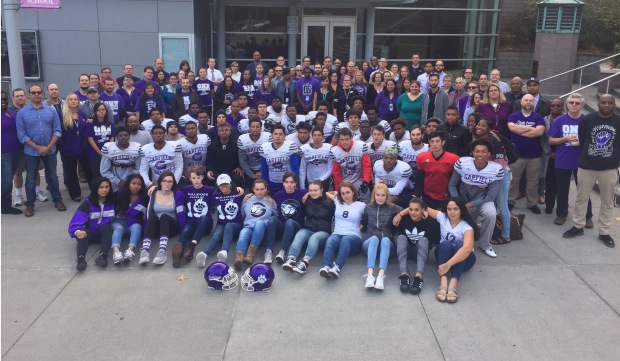
The Jocks.The marching band. The cheerleaders. The Black Student Union. The teachers. And the administration. These disparate high school groups rarely come together.
But at times of great peril and of great hope, barriers that once may have seemed permanent can collapse under a mighty solidarity. The crisis of police terror in black communities across the country is just such a peril—and the resistance to that terror, symbolized by San Francisco 49ers quarterback Colin Kaepernick taking a knee during the national anthem—is just such a hope.
On September 16th, the entire football team of Garfield High School, the school I teach at in Seattle, joined the protest that Kaepernick set in motion by taking a knee during the playing of the national anthem. While the Garfield Bulldogs were among the first high schools to have an entire team protest the anthem, it has since spread to schools around the nation. Their bold action for justice made headlines around the country. Their photo appeared in the issue of Time Magazine that featured Kaepernick on the cover CBS news came to Garfield to do a special on the protest. And in the New York Times, Kaepernick himself commented on the Garfield football team saying, “I think it’s amazing.”
It was a rejection of the rarely recited third verse of the “Star Spangled Banner,” which celebrates the killing of black people, the ongoing crisis of state violence against black people, and an affirmation that black lives matter. As the Garfield football team said in a statement they later released,
“We are asking for the community and our leaders to step forward to meet with us and engage in honest dialogue. It is our hope that out of these potentially uncomfortable conversations positive, impactful change will be created.”
And those conversations led them to analyze the way racism is connected to other forms of oppression and the way those forms of oppression disfigure many aspects of their lives, including the media and the school system.  Yes, football players publicly challenging homophobia may be rare, but the bulldog scholar athletes aren’t having it.
Here is the teams’s six-point program to confront injustice and oppression:
1. Equality for all regardless of race, gender, class, social standing and/or sexual orientation—both in and out of the classroom as well as the community.
2. Increase of unity within the community. Changing the way the media portrays crime. White people are typically given justification while other minorities are seen as thugs, etc.
3. Academic equality for students. Certain schools offer programs/tracks that are not available at all schools or to all students within that school. Better opportunities for students who don’t have parental or financial support are needed. For example, not everyone can afford Advanced Placement (AP) testing fees and those who are unable to pay those fees, are often not Garfield High School Goes on Bended Knee for Black Lives | I AM AN EDUCATOR:


Nevada: Andre Agassi Charter School Is A Failing School, Along with Many Other Charters | Diane Ravitch's blog

Nevada: Andre Agassi Charter School Is A Failing School, Along with Many Other Charters | Diane Ravitch's blog:

Nevada: Andre Agassi Charter School Is A Failing School, Along with Many Other Charters


Angie Sullivan sent the following message. The charter schools of Nevada are performing far worse than the public schools. As Angie asks, how can more charters be the answer when they are the problem? Should the failing charters be handed over to another charter? Or should they be closed so the students return to the more successful public schools? Unfortunately, as the law is written, only low-scoring public schools can be closed, not failing charter schools. Another irony: The Andre Agassi Charter school is listed by the state as a “failing school,” yet Agassi and his business partner Bobby Turner are opening Andre Agassi charter schools in many other cities. Why? To make money, not to make better schools.
Angie writes:
We have 39 charters in the state of Nevada and 14 of them are on the lowest performing list. 36% of Nevada Charters are in the lowest of the low in the state.
We have 359 schools in Clark County School District. 2 of the schools listed are alternative schools that teach credit retrieval and adult education. 17 schools in the lowest of the low in the state. That is 5% of CCSD schools.
Can someone explain to me how charters are the solution and not the problem in my state?
Frankly the public schools are doing much much better than the charters – even according to this invalid and weird data.
Also . . . keep in mind these rural schools which are failing represent a huge percentage. If Elko has 22 schools and 5 are failing – that is 23% of all their schools.
Comparatively, Clark County School District is doing better than the rest of the state and especially better than the charters.
CCSD is serving the most disenfranchised and likely to fail communities – we are doing better than the rest WITH the least amount of per pupil money. Everyone else in the state – including charters gets more.
Just think what we could do if we funded near the middle?
Yet the Nevada Department of Education keeps threatening public school staff with turnaround and now the Achievement School District. Schools without textbooks or supplies have to have entire staffs interviewed right before holiday break?
I think we need to start having a REAL discussion about education our state.
We need to demand REAL and timely data if that is what is driving this vehicle – not this sketchy fly-by-night multiple list craziness.
Tomorrow the Charter Authority will be meeting with the Las Vegas City Council at noon.
Those in power need to have a REAL discussion about closing these failing charters and a REAL discussion about the other costs charters have in our communities.
Like receivership – with receivers from Washington DC getting paid $25,000 a month to come out and reorganize charters: Quest and Silver State Schools. Who makes $25,000 a month?
_________________
I recieved the following message from a concerned parent today:
The details how this charter school set itself up is a scam.
It is part of an eviction case.
Then the receiver gets paid $25,000 a month to rehabilitate it. Plus $35,000 for a report.
And the state is soliciting for MORE receivers!!!! (On the charter school authority page.)


Denied: Disabled kids forced out to meet special ed target - Houston Chronicle

Denied: Disabled kids forced out to meet special ed target - Houston Chronicle:

Denied: Schools push students out of special education to meet state limit

Image result for Denied: Schools push students out of special education to meet state limit


LAREDO – A few days before school began here in 2007, district administrators called an emergency staff meeting.
The Texas Education Agency had determined that they had too many students in special education, the administrators announced, and they had come up with a plan: Remove as many kids as possible.
The staffers did as they were told, and during that school year, the Laredo Independent School District purged its rolls, discharging nearly a third of its special education students, according to district data. More than 700 children were forced out of special education and moved back into regular education. Tweet this link Only 78 new students entered services.
"We basically just picked kids and weeded them out," said Maricela Gonzalez, an elementary school speech therapist. "We thought it was unfair, but we did it."
Gonzalez's account, confirmed by two coworkers and district documents, illustrates how some schools across Texas have ousted children with disabilities from needed services in order to comply with an agency decree that no more than 8.5 percent of students should obtain specialized education. School districts seeking to meet the arbitrary benchmark have not only made services harder to get into but have resorted to removing hundreds and hundreds of kids, the Houston Chronicle has found.
In San Felipe Del Rio CISD, in West Texas, officials several years ago stopped serving children with one form of autism.
In Brazosport ISD, on the Gulf of Mexico, employees were instructed in 2009 to end tutoring forDenied: Disabled kids forced out to meet special ed target - Houston Chronicle:

A Chronicle Investigation

In Texas, unelected state officials have devised a system that has kept thousands of disabled kids out of special education. Read other installments in the series here.


City school's transition brings chaos

City school's transition brings chaos:

City school's transition brings chaos
Camera icon DAVID MAIALETTI / STAFF PHOTOGRAPHER
Tinze James (from left), Octavia Abney, Ty-Shone Mitchell, Debra Eddy, Tasha Mitchell, Shereda Cromwell and Lorraine Falligan outside Kenderton Elementary in Philadelphia.

Shereda Cromwell stood in front of an auditorium, tears in her eyes. She didn't know where else to turn.
She wanted people to know what was happening at Kenderton Elementary, the North Philadelphia school her three children attend: the fights and the children walking the hallways, even first graders. The mess. The deep academic problems.
"Our school needs help," Cromwell told the School Reform Commission. "These kids need help."
Kenderton has ping-ponged between operators multiple times in the last two decades, a product of the Philadelphia School District's myriad reform initiatives. For a time in the early 2000s, it was operated by Edison Schools, a for-profit education firm. In 2013, the Philadelphia School District gave it to Scholar Academies Inc. to run.
But the charter operator abruptly abandoned Kenderton in June, blaming the high cost of educating the school's large special-education population. For a time, Mastery Charter Schools was in talks to take over Kenderton, but Mastery was unable to handle the full school population, and it reverted to district control.
The school system had less than 90 days to get Kenderton up and running before the start of classes.
Superintendent William R. Hite Jr. is well-aware of the rocky transition at the Tioga school: He has visited multiple times, ordered a long list of supports, and has directed the assistant superintendent responsible for the school to visit daily.
"We realize that something significant has got to change, and we are working to do that," said Cheryl Logan, the district's chief of academic support.
But for now, Octavia Abney worries about sending her two daughters, a third and a sixth grader, to Kenderton, at 15th and Ontario.
"It's complete chaos," Abney said.
The K-8 school has struggled to get basic rules in place, some parents say: Some of its City school's transition brings chaos:
Charter Schools - Dividing Communities since 1991

Equality Utah files lawsuit over what it calls 'anti-gay school laws' | Deseret News

Equality Utah files lawsuit over what it calls 'anti-gay school laws' | Deseret News:

Equality Utah files lawsuit over what it calls 'anti-gay school laws'

Image result for anti-gay school laws
SALT LAKE CITY — A federal lawsuit by Equality Utah accuses the Utah State Board of Education, its superintendent and three school districts of enacting "anti-gay school laws" targeting LGBT students and prohibiting positive talk about homosexuality.
The lawsuit filed late Friday in Utah's U.S. District Court outlines the experiences of three students — in elementary, middle and high school — and claims the board of education's policies regarding homosexuality and LGBT student organizations violate constitutional rights of equal protection and free speech, as well as Title IX protections.
The effect is an environment the chills would-be supportive teachers, creates an unaccpeting climate for LGBT teachers, and leaves isolated LGBT students vulnerable to bullying and unable to fully participate in school activities, according to the lawsuit.
The lawsuit is the first in the U.S. to challenge anti-gay school policies, according to a joint press release from the Equality Utah advocacy group, the National Center for Lesbian Rights and the global Ropes & Gray LLP law firm.
"These are some of the last remaining anti-LGBT laws that are currently being enforced in the country, and they're especially odious, because they explicitly apply to school classes on every subject," Equality Utah Executive Director Troy Williams said in a prepared statement. "These laws send a message that our lives are shameful and must be hidden and censored. They create a deadly culture of silence and non-acceptance, causing harms that can never fully be undone."
Emilie Wheeler, spokeswoman for the Utah State Board of Education, declined comment Saturday, saying the board has not yet had time to review the lawsuit.
However, Dave Thomas, vice chairman of the school board, called the lawsuit an "unfortunate" attempt to gain publicity.
"I know that Equality Utah has been pushing a pro gay rights agenda, which I personally oppose," Thomas said Saturday, adding that he believes the organization is using the schools as a platform.
Thomas emphasized he does not believe the state has any school policies that are Equality Utah files lawsuit over what it calls 'anti-gay school laws' | Deseret News:


L.A. Unified takes a harder look at its charter schools. Critics blame politics - LA Times

L.A. Unified takes a harder look at its charter schools. Critics blame politics - LA Times:

L.A. Unified takes a harder look at its charter schools. Critics blame politics


Some years back, when administrators at a group of Los Angeles charter schools ordered the entire instructional staff to cheat on state standardized tests, the charter division at the Los Angeles Unified School District was at first willing to forgive what had happened and move on. 
But last week, the L.A. Board of Education followed the recommendation of the charter division and voted to shut down three charters, ostensibly because their parent organization had been sluggish in providing requested paperwork that was important but not crucial to the schooling of students.
Although district officials insist they’ve been consistent and diligent, some pro- and anti-charter forces perceive a charter division that demands more from — and favors fewer — charters.
Within its boundaries, L.A. Unified authorizes these independently managed schools and then evaluates whether to renew them every five years. At the same time, the district is competing intensely with these charters over student enrollment and the education dollars that come with it. 
“Renewals have become a public trial before the school board,” with rules and arguments over what evidence can be reviewed and impassioned testimony from charter supporters, said Charles Kerchner, senior research fellow at Claremont Graduate University. “The structure of this process is unworkable for both the district and charter operators.”
Last week the school board voted to notgrant renewals to schools that it had approved twice before: three campuses operated by Magnolia Public Schools and two others run by Celerity Educational Group. Academically, all are performing acceptably or better, according to L.A. Unified’s criteria. 
The interaction between charters and L.A. Unified is complex and often strained. For much of the last two decades, the district grudgingly approved charters; it had to under state law, provided that a prospective charter properly completed a lengthy application process.
With support from private philanthropy, the number of charters in L.A. Unified has exploded to 225, the most in any American school system, attracting about 16% of enrollment. Powerful pro-charter reformers, including local philanthropist Eli Broad, want rapid growth to continue, even in the face of declining overall enrollment.
Many educators in traditional schools worry that this expansion could force L.A. Unified  L.A. Unified takes a harder look at its charter schools. Critics blame politics - LA Times:

California: Court Decision Stuns Charter Industry and Threatens Stealth Charters | Diane Ravitch's blog

California: Court Decision Stuns Charter Industry and Threatens Stealth Charters | Diane Ravitch's blog:

California: Court Decision Stuns Charter Industry and Threatens Stealth Charters


I recently posted Carol Burris’s analysis of a court decision in California that blocked the sneaky expansion of charters into districts outside the one where they were authorized; the new charters called themselves “resource centers” and were infiltrating districts that did not want them.
Here is a report by the San Diego Union-Tribune on the same decision.

California’s booming satellite charter school industry that has persevered through lawsuits, scandals and turf wars suffered a blow this past week when a state appellate court ruled hundreds of the campuses are illegally operating outside their districts.
At issue now is how 150,000 California students — including 25,000 in San Diego County — will continue their education. The court decision also puts at stake millions of dollars in revenue generated by the charters for privately run organizations.
The 3rd District Court of Appeal overturned a lower court decision in a lawsuit filed by the Anderson Union High School District near Redding claiming the Shasta Secondary Home School (now Shasta Charter Academy) illegally opened satellite charter campus, which are officially called resource centers, in its jurisdiction.
Filed Monday and set to go into effect Nov. 16, the appellate decision reverses the lower court ruling, which sided with the charter that was authorized by the nearby Shasta Union High School District. The lower court said it was legal to operate a resource center, as such schools are officially called, in the neighboring Anderson district to give its independent-study students who live there a chance to use computers, receive tutoring and work on assignments in a classroom setting.
Of the state’s 1,200 charter schools, 275 are “resource centers,” many of them storefronts where students show up from time to time. That means that unless this decision is overturned by the state’s Supreme Court, more than 20% of California’s charter schools will cease to operate or seek some other option to survive.
San Diego public schools will welcome the return of the students in these “non-classroom-based” charters:
Andra Donovan, general counsel for the San Diego Unified School District, offers another option: Returning to district and its expanded catalog of independent-study programs.
San Diego Unified “is fully prepared and has sufficient capacity to absorb those students currently attending these charter schools, with fully robust, higher quality independent study and online learning programs as well as traditional and blended programs,” Donovan said. “Our graduation rate far exceeds that of many of these them and our district provides integrated support not available from these charters.”
These “resource centers” are locations intended to coordinate online instruction, which has repeatedly been shown to be a farce, educationally, an easy way to collect credits without getting an education.
Some districts opened resource centers because it was easy money.


Online instruction offers flexibility to students who want an alternative to traditional schools, and big revenue to charter organizations and California: Court Decision Stuns Charter Industry and Threatens Stealth Charters | Diane Ravitch's blog:

Diversity in Children’s Literature Key to Understanding Today's Civil Rights Issues

Diversity in Children’s Literature Key to Understanding Today's Civil Rights Issues:

Diversity in Children’s Literature Key to Understanding Today’s Civil Rights Issues

diversity in childrens literature


How can we initiate discussions with our students about violence in the headlines? How can we help dispel misconceptions often passed from the adult world down to children? How can we help increase acceptance and tolerance?
With books!
That was the message of a panel of some of America’s most popular children’s authors during the Virginia Children’s Book Festival in Farmville, Virginia, last week. The panel, Civil Rights in Children’s Literature — which included writers Greg NeriLulu DelacreRita Williams-GarciaSharon FlakeNeal ShustermanLamar GilesTim Tingle and Quraysh Ali Lansana — was held at Farmville’s  Moton Museum, the former all-black Robert Russa Moton High School and the birthplace of America’s student Civil Rights movement.
“The struggle for civil rights isn’t something that just started midway through the century, and clearly isn’t over in this one,” said Heather Maury, Youth Services Director at the Appomattox Regional Library System, who moderated the panel. “Reading about civil rights issues of the past can better prepare kids to deal with the civil rights issues of the present and future.”
Diverse books go hand in hand with issues of civil rights, and Maury says diverse books can be a safe way for children to explore difficult topics, empower them to form their own opinions, and help children who feel different to not feel so alone.
She kicked off the discussion by pointing out how difficult it is to shield children from the atrocities happening around the world and asking how young is too young to learn and talk about such events.
“I write for many ages, but my sweet spot is middle school,” said Greg Neri, a Coretta Scott King honor-award winning author of teen, young adult and middle grade fiction, including Ghetto Cowboy and the recent Tru and Nelle. “I write books that deal with serious topics like gang violence, poverty and other difficult issues facing the inner city, and when I do school visits the kids get into the topics pretty deeply pretty quickly, sometimes even as young as grade four. I find that they have no problem going there.”
Rita Williams-Garcia, winner of the Newbery Honor Award and two-time winner of the Coretta Scott King award, spoke about her book No Laughter Herewhich deals with the extremely sensitive topic of female genital mutilation.  She said people often assume it would only be appropriate for students ages 14 or 15 and up, but it’s actually about two 10-year-old girls and the tone of the book is appropriate for Diversity in Children’s Literature Key to Understanding Today's Civil Rights Issues:


Mike Klonsky's SmallTalk Blog: WEEKEND QUOTABLES

Mike Klonsky's SmallTalk Blog: WEEKEND QUOTABLES:

WEEKEND QUOTABLES


Tom Hayden R.I.P.
Tom Hayden (1939-2016)
If we appear to seek the unattainable, as it has been said, then let it be known that we do so to avoid the unimaginable.” -- Port Huron Statement
Water protector, Chepa Cubias
 “I engaged in this action as part of my responsibility to my mother. If you see your mother violently attacked you run to put your body between her and the violent perpetrator. [Dakota Access was] right on burial grounds sacred to my Lakota relatives." -- Sacred Stone Camp
 Standing Rock Sioux Tribal Chairman Dave Archambault 

The DOJ should be enlisted and expected to investigate the overwhelming reports and videos demonstrating clear strong-arm tactics, abuses and unlawful arrests by law enforcement. Preventing government agencies from stripping protestors and tribal members of their constitutional rights to organize and protect our sacred places and water is paramount to both U.S. citizens and tribal sovereignty." -- West Dakota FOX 
 NAACP Chair Roslyn M. Brock

“We are moving forward to require that charter schools receive the same level of oversight, civil rights protections and provide the same level of transparency, and we require the same of traditional public schools. Our decision today is driven by a long-held principle and policy of the NAACP that high-quality, free, public education should be afforded to all children.” -- Salon
Mike Klonsky's SmallTalk Blog: WEEKEND QUOTABLES:

U.S. Department of Education Fails Utterly In Its Responsibility to Oversee Charter School Sector | janresseger

U.S. Department of Education Fails Utterly In Its Responsibility to Oversee Charter School Sector | janresseger:

U.S. Department of Education Fails Utterly In Its Responsibility to Oversee Charter School Sector

Image result for big education ape charter school accountability gif

On Saturday, the Washington Post‘s Emma Brown reported that Carl Paladino, a Buffalo, NY real estate developer and surrogate for Republican presidential candidate Donald Trump, went to the annual meeting of the Council for the Great City Schools and told the leaders of the nation’s largest school districts that a President Donald Trump, “would seek to do away with ‘corrupted, incompetent’ public school systems in America’s cities, replacing them with charter schools and vouchers for private schools. Such an approach would ‘encourage competition in the marketplace and eventually dismantle the corrupted, incompetent urban school districts that we have in America today.'” One can imagine that—while such words would impress Jeb Bush and others who love vouchers and would please Arne Duncan and our current Secretary of Education John King, who have promoted of the explosive growth of charter schools—Paladino and Trump’s market-based vision of education was poorly received in a room filled with big city school superintendents.
While we can hope that after November 8, we will not have to take seriously the threats of Donald Trump, attacks on government and prescriptions for privatization remain at the center of our political rhetoric. These days market-based education strategies dominate the public policy of both political parties.
In their recent book, American Amnesia, Yale political scientist Jacob Hacker and Berkeley political scientist Paul Pierson remind us of what we have forgotten during the past forty years—the important role of government: “This book is about an uncomfortable truth: It takes government—a lot of government—for advanced societies to flourish.  This truth is uncomfortable because Americans cherish freedom. Government is effective in part because it limits freedom—because, in the language of political philosophy, it exercises legitimate coercion… We live in an era of profound skepticism about government.  Contemporary political discourse portrays liberty and coercion as locked in ceaseless conflict.  We are told that government is about ‘redistribution’ and the private sector about ‘production,’ as if government only reshuffles the economic deck rather than holding many of the highest cards… We suffer, in short, from a kind of mass historical forgetting, a distinctively ‘American Amnesia.'” (p. 1-2)
While Hacker and Pierson’s book does not examine the history of the vast privatization of education that has expanded right along with attacks on government more generally, the lessons of this profound book speak directly to many of the problems with school choice. For example, Hacker and Pierson explain, while modern societies are complex, the market fails to inform citizens accurately and adequately: “(W)here informational demands are high, the sources of market failure grow.”  Behavioral economics has identified the problem of “consumer myopia,” a widespread inability of people to discern their own best interests—and something that the marketers of charter schools know how to manipulate as parents look for schools: “We are easily distracted by shiny objects and thus vulnerable to being ‘primed’ to attend to particular aspects of a choice situation… We are overconfident, typically expecting our own experience to be better than average… We are biased toward avoiding losses rather than achieving gains. We are very bad at assessing risks… We are prone to inertia.” (p. 81)
How should we expect government to correct for this widespread problem? “In a culture that U.S. Department of Education Fails Utterly In Its Responsibility to Oversee Charter School Sector | janresseger:
Image result for big education ape charter school accountability gif

Video: Why Public Schools are Far Better than Charters – Troy LaRaviere's blog

Video: Why Public Schools are Far Better than Charters – Troy LaRaviere's blog:

VIDEO: WHY PUBLIC SCHOOLS ARE FAR BETTER THAN CHARTERS

WHAT MAKES CHARTER SCHOOL POLICY SO TOXIC?
If you’re concerned about schools, watch this video. Complete with visuals and data from Chicago and around the country.
“Regardless of how you feel about ‘school choice’ the more important point is that government has no business subsidizing a model for schooling that produces poor options for parents to choose from.”
You can explore the student academic growth data this talk is based on at:


Video: Why Public Schools are Far Better than Charters – Troy LaRaviere's blog:

Noam Chomsky on the Perils of Market-Driven Education | BustED Pencils

Noam Chomsky on the Perils of Market-Driven Education | BustED Pencils:

Noam Chomsky on the Perils of Market-Driven Education


More on why-we’re-doing-what-we’re-doing. Sometimes the best way forward is to take a step back to examine the landscape of where we are now,  think about where we want to be, and consider how we plan on going about getting there.
From Noam Chomsky: “The market-driven education tendencies that you mention are unfortunately very real, and harmful. They should, I think, be regarded as part of the general neoliberal assault on the public.”
Read it here.


Noam Chomsky on the Perils of Market-Driven Education | BustED Pencils:

Image result for big education ape  market driven education reform