At election time, New Jersey homeowners make a plea: “reduce or at least stabilize my local property taxes.”
Municipal candidates usually claim to be cost effective with a sharp eye and pencil on the local budget. Some may even duck and refer to the community’s education budget.
So if pressure is exerted on that local school board, do we ask: has it sufficiently contained costs, effected economies, or regionalized services? (These are the same questions you first addressed to your municipality.)
Instead of these effective strategies, when faced with the need to restrain budgets, school boards are tempted to axe the arts because they are “frills.”
Yes, the myth that arts are frills may still exist. Has the case been made how germane the arts are to the development of learning and skill acquisition that serve the individual throughout his or her life?
Our students need:
+–to effectively internalize learning,
+–to develop life-long employability skills, and
+–to improve the quality of their lives and that of their communities.
The arts give students access to success, their own creativity, and help in the development of self-esteem–all factors which are known to contribute to intellectual growth.
Basic skills (reading, writing, arithmetical computation and mathematical reasoning listening, and speaking ) were the traditional functions required of schools. But new demands of the workplace identify thinking skills and personal qualities as equally prized in a world facing economic changes.
While basic skills are considered irreducible minimums for low-skill jobs, they do not guarantee a career or access to a college education. Thinking skills which permit the individual to analyze, synthesize and evaluate complexity will enable individuals to master their work. To be exact, thinking skills are:
1. Creative Thinking. Uses imagination freely. Combines ideas and information in new ways. Reshapes goals for new solutions and efforts.
2.Decision Making. Specifies goals and constraints. Generates alternatives. Considers risks. Evaluates and chooses best alternatives.
Brett Bigham Speech at Oregon Safe Schools Communities Coalition
Oregon BAT Brett Bigham and Cali BAT Mel House at SOS Coalition for Action March for Education and Social Justice, Washington, DC
I wanted to share my keynote speech from today with you all. I was asked to speak at the Oregon Safe Schools Communities Coalition at their OSSCC Awards ceremony, honoring community members for their efforts to stop bullying.
My speech is political and expresses my feelings and my feelings alone. I represent no-one but myself in them.
Good Afternoon Everyone, It is wonderful to be here today to honor Oregonians who have stepped up to stop bullying in this state.
In these modern times, with our 24-hour a day modern media you don’t have to look far to see examples of bullying. A simple youtube search will bring up countless videos of people being harassed, called names, being physically intimidated and threatened.
No, I am not talking about the Presidential debates. But I do believe the debates show a good example of what bullying is. And sadly, they are setting an example to today’s youth of acceptable behavior. I wonder how many girls and young women were called “nasty” this week. I wonder how many Mexican kids were taunted with “Build A Wall” or called “Miss Housekeeping.”
These are the facts about bullying. Over 73% of kids in a recent GLSEN survey reported being bullied in the past year. It is a fact that being bullied damages that young ego that is developing. These damages can be life-long—statistics show being bullied is related to drinking and taking drugs at a younger age, it contributes to stress and dropping out of school.
But we also know that just being a witness to bullying causes damage to the person who sees it. Just being in the hallway and seeing someone being bullied becomes part of who you are. I understand that.
When I was younger I was walking on the sidewalk looking at this girl eating an ice-cream cone. She was cute, blond, wearing this little sun dress. And then the guy next to her suddenly punched her in the face. That was 30 years ago and it is frozen in my mind, like a short movie that plays over and over every time something triggers it. I’m still haunted by the look on her face, the cone hitting the ground, and ribbons of blood from her nose running over the ice cream that was smeared across her face.
I am right now feeling the emotions of that day as if it were yesterday.s I felt that day. Perhaps I still feel them because I know she probably does too.
I’m sorry to put that image into your mind on such a beautiful day. But that is why we are here. Because to fix the problem of bullying we have to understand the damage it does. By witnessing that act of violence I have been forever changed. To this day whenever I see a girl with an ice-cream cone it triggers that movie in my head. The Dairy Queen by my house had a giant picture of a strawberry sundae with the strawberry sauce drizzling down the vanilla icecream. I couldn’t look at it without seeing her.
That’s just one example. I have more. You have more. I would guess every person in this room probably has at least a little bit of damage from bullying.
But bullying does not just damage the person being bullied and the person who sees it, it damages the bully. It creates a life-long pattern of cruelty and friendlessness and creates an adult who continues to damage the people around them.
I would bet every person in this room knows an adult that they think is a bully. A past boss, a Badass Teachers Association:
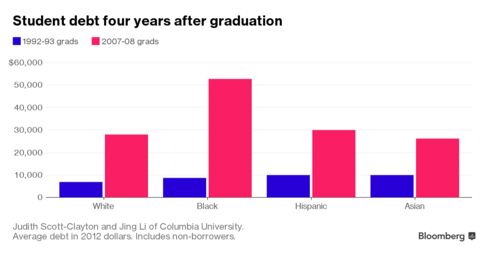
Student Debt May Be Contributing to Racial Inequality Black college grads owe more on their student loans while being paid less than their white counterparts.
The pursuit of higher education may be exacerbating gaps in financial well-being between blacks and whites, rather than narrowing them.
Black Americans who recently graduated college owe close to twice as much on their student loans as whites, a racial gap that has climbed nearly 14-fold over the past 15 years.
Blacks who graduated with bachelor's degrees in 2008 owed $52,726, on average, on their student debt four years later, compared with $28,006 among whites, according to a new study made public Thursday by a pair of Columbia University researchers. Black graduates, on average, were more likely to fall behind on their education loans.
"Students of color," Judith Scott-Clayton and Jing Li said in their study, "disproportionately bear the burden of student debt."
The new findings add to a growing body of evidence that that higher education might not be the great equalizer. "There is this popular notion that student debt is good," said Mark Huelsman, senior policy analyst at public policy organization Demos. "But it's actually fostering inequality rather than mitigating it." said Mark Huelsman.
The federal Consumer Financial Protection Bureau is investigating the issue, with a focus on how debt collectors and loan servicers are treating black borrowers, who default at much higher rates than their white counterparts. Officials also worry that too much student debt among black Americans could be preventing economic mobility.
For example, black graduates' cumulative student loan balances increased 6 percent in the four years after they left school, while whites owed 10 percent less, according to the study by Columbia researchers.
When For-Profit Colleges Prey on Unsuspecting Students Without access to counseling in high school, many ambitious yet disadvantaged students still end up in schools where they’re most likely to drop out and accrue lots of debt.
The most common image of Baltimore, Maryland’s largest city, is a place racked by crime, poverty, and despair—a perception largely fueled by the news mediaand popular television shows like The Wire and Homicide: Life on the Street. Now comes a research report that debunks the prevailing view of young people from Baltimore’s impoverished neighborhoods as “thugs” and “criminals.” It reveals a striking picture of black Baltimore youth striving, persevering, and working persistently to get ahead—only to find themselves undereducated and underemployed.
As part of a decade-long longitudinal ethnographic study that began in 2003, the sociologist Stefanie DeLuca closely followed the life course of 150 black youth growing up in Baltimore’s public-housing projects whose families participated in a federal housing experiment. Researchers wanted to gain a deeper understanding of these young people’s lives to investigate the notion that intergenerational poverty is unsolvable. But as the study wrapped up in 2013, with the youth on the brink of adulthood, an unexpected theme emerged with respect to their college experiences.
Looking for a quick path to steady work and income, these young adults were consistently drawn to for-profit trade schools. But what made this option appealing—a fast track to a new career—was also their downfall. Through in-depth interviews and fieldwork, the study’s findings offer a glimpse at what attracts disadvantaged youth to for-profit occupational programs and why they seldom complete certifications.
“Fewer than one out of five of the kids in our study ever turned to the street. These are young people who are trying to adhere to mainstream norms and values, and … their hard work still doesn't pay off,” said DeLuca, an associate professor of sociology at Johns Hopkins University and co-author of Coming of Age in the Other America, a book that resulted from her research. “The barriers are not just about four-year schools [but] at this other level, this newish part of the landscape … for-profit trade schools.”
Increasingly, for-profit schools have come under scrutiny from regulators and critics for leaving students—disproportionately black and Latino young adults—with heavy debts, poor graduation rates, and weak job prospects. Corinthian Colleges, one of the largest for-profit chains, closed its doors last year following a U.S. Education Department investigation and a Consumer Financial Protection Bureau lawsuit that charged the company with falsifying its job-placement rates. Last month, ITT Technical Institutes also shut down operations after 50 years in business, apparently buckling under “allegations of fraud, deceptive marketing and steering students into predatory loans,” as reported by The Washington Post.
Here's Why ESSA Might Direct More Federal Dollars to Private Schools
The Every Student Succeeds Act makes plenty of changes to education policy, including several key ones that provide more control to states. But here's one that's been largely overlooked in discussions about ESSA: the possibility that the law will ultimately enable private schools to obtain more federal aid to K-12 than they have previously.
Here's what we mean: As with the No Child Left Behind Act, ESSA requires that districts provide "equitable services" to certain students in private schools, after consulting with private school officials. This can impact migrant students in private schools, students who are English-language learners, and others. (The delivery of equitable services has been complicated by the growth of school choice programs, according to a recent report from the federal Government Accountability Office.)
A summary of ESSA spending and fiscal rules provided by the Council of Chief State School Officers states that under equitable services requirements, "Expenditures for eligible private school children must be equal, taking into account their number and educational needs, to the expenditures for participating public school children."
So how does ESSA change equitable services for private school students?
• There's a change from NCLB to ESSA in the calculation of how much Title I money districts must distribute to private schools for equitable services. In essence, the share of money that districts must draw on for equitable services money for private schools has grown under ESSA. That GAO analysis on equitable services studied a few districts in four states, and the most amount of money spent on those services for any one district was $35 million in Title I money for about 6,500 private school students in a large, urban Wisconsin district (the district was not identified).
• ESSA creates a new ombudsman at the state level who oversees the distribution of these federal funds by districts to private schools, in order to comply with the equitable services requirement. The state education agency appoints this ombudsman.
• Under ESSA, private schools can ask the ombudsman to have the state provide these services instead of the school district, if these schools can show that the district has not been providing money for equitable services as required.
• This ombudsman must also notify private schools about the amount of federal aid they are entitled to through equitable services.
• There's also a specific change to Title II dollars for teachers and professional development that should be noted. Under NCLB, districts had to provide money for equitable services to private schools only out of Title II dollars spent on professional development. Under ESSA, "there is no specification that the amount spent on equitable services is tied to the amount spent on professional development," according to CCSSO.
So what does all that mean? The first bulleted item we mentioned above could pretty directly lead to a greater share of public dollars for private schools, said Sheara Krvaric, an attorney with the Federal Education Group, which consults with states and districts on K-12 finance.
But the ability for private schools to appeal for more funds to new state-level ombudsmen could create a new political dynamic around federal money available for equitable services at private schools. And the changes appear to "put more teeth into the provision of equitable services," Krvaric said.
"Lots of private schools were complaining about this," Krvaric said of the setup under NCLB.
ESSA includes important provisions championed by the private school community to improve equitable services to private school students and teachers. For example, under Title I, which provides assistance to school districts to help high-need students do well in school, a school district now has to calculate funds for services to private school students based on its total Title I allocation, without excluding certain expenditures for other purposes, which it was allowed to do in the past.
However, Krvaric did note that the exact impact of some of these changes won't be known until the U.S. Department of Education weighs in.
Under NCLB, private schools did have the option of seeking more money for equitable services by appealing directly to the Education Department, she noted.
Don't miss another Politics K-12 post. Sign up here to get news alerts in your email inbox.
Feds release guidance for block grants to support a 'well-rounded' education
Moving away from the no-frills, test-driven approach to education of the No Child Left Behind era, U.S. Secretary of Education John B. King Jr. on Friday released guidance about new federal block grants designed to fund a more varied curriculum, a more positive school environment and a more integrated use of technology.
The newly authorized Student Support and Academic Enrichment Grants are intended to provide schools the flexibility to fund programs they feel are most crucial to well-being and intellectual curiosity of their students. Created under the federal education law known as the Every Student Succeeds Act, the grant program consolidates targeted grants that were used under the previous federal education law, No Child Left Behind.
Courses such as civics, technology, music and the arts, “aren’t luxuries that are just nice to have,” King said in a statement. He added, “For me and for so many students, a wide range of possible subjects in school, powerfully and creatively taught, can be exactly what it takes to make the difference between disengagement and a lifelong passion for learning.”
The three areas identified for funding in the grants, which are also known as Title IV grants, are so broad as to encompass nearly everything a school would like to fund, from mental health counseling to an art class. The categories are: safe and healthy students, integrating technology to improve learning, and access to a “well-rounded education.”
The term ‘‘well-rounded education’’ is defined in the Elementary and Secondary Education Act of 1965 as “courses, activities, and programming in subjects such as English, reading or language arts, writing, science, technology, engineering, mathematics, foreign languages, civics and government, economics, arts, history, geography, computer science, music, career and technical education, health, physical education, and any other subject, as determined by the state or local educational agency, with the purpose of providing all students access to an enriched curriculum and educational experience.”
“For me and for so many students, a wide range of possible subjects in school, powerfully and creatively taught, can be exactly what it takes to make the difference between disengagement and a lifelong passion for learning,” said U.S. Secretary of Education John B. King Jr.
The “safe and healthy students” category includes nutritional and physical education, creating systems to prevent bullying and harassment, and supporting re-entry programs for students who have been involved in the juvenile justice system. The umbrella of “well-rounded” educational opportunities also Feds release guidance for block grants to support a ‘well-rounded’ education | EdSource:
Tom Hayden, Civil Rights and Antiwar Activist Turned Lawmaker, Dies at 76
Tom Hayden after announcing he would run for the Democratic nomination for the United States Senate from California in 1976.CreditWalter Zeboski/Associated Press
Tom Hayden, who burst out of the 1960s counterculture as a radical leader of America’s civil rights and antiwar movements, but rocked the boat more gently later in life with a progressive political agenda as an author and California state legislator, died on Sunday. He was 76.
His wife, Barbara Williams, confirmed the death to The Associated Press. Mr. Hayden had been suffering from heart problems and fell ill while attending the Democratic National Convention in Philadelphia in July.
During the racial unrest and antiwar protests of the ’60s and early ’70s, Mr. Hayden was one of the nation’s most visible radicals. He was a founder of Students for a Democratic Society, a defendant in the Chicago Seven trial after riots at the 1968 Democratic National Convention, and a peace activist who married Jane Fonda, went to Hanoi and escorted American prisoners of war home from Vietnam.
As a civil rights worker, he was beaten in Mississippi and jailed in Georgia. In his cell he began writing what became the Port Huron Statement, the political manifesto of S.D.S. and the New Left that envisioned an alliance of college students in a peaceful crusade to overcome what it called repressive government, corporate greed and racism. Its aim was to create a multiracial, egalitarian society.Like his allies theRev. Dr. Martin Luther King Jr.and SenatorRobert F. Kennedy, who were assassinated in 1968, Mr. Hayden opposed violent protests but backed militant demonstrations, like the occupation of Columbia University campus buildings by students and the burning of draft cards. He also helped plan protests that, as it happened, turned into clashes with the Chicago police outside the Democratic convention.
In 1974, with the Vietnam War in its final stages after American military involvement had all but ended, Mr. Hayden and Ms. Fonda, who were by then married, traveled across Vietnam, talking to people about their lives after years of war, and produced a documentary film, “Introduction to the Enemy.” Detractors labeled it Communist propaganda, but Nora Sayre, reviewing it for The New York Times, called it a “pensive and moving film.”
Later, with the war over and the idealisms of the ’60s fading, Mr. Hayden settled into a new life as a family man, writer and mainstream politician. In 1976, he ran for the Democratic nomination for the United States Senate from California, declaring, “The radicalism of the 1960s is fast becoming the common sense of the 1970s.” He lost to the incumbent, Senator John V. Tunney.
But focusing on state and local issues like solar energy and rent control, he won a seat in the California Legislature in Sacramento in 1982. He was an assemblyman for a decade and a state senator from 1993 to 2000, sponsoring bills on the environment, education, public safety and civil rights. He lost a Democratic primary for California governor in 1994, a race for mayor of Los Angeles in 1997 and a bid for a seat on the Los Angeles City Council in 2001.
He was often the target of protests by leftists who called him an outlaw hypocrite, and by Vietnamese refugees and American military veterans who called him a traitor. Conservative news media kept alive the memories of his radical days. In a memoir, “Reunion” (1988), he described himself as a “born-again Middle American” and expressed regret for “romanticizing the Vietnamese” and for allowing his antiwar zeal to turn into anti-Americanism.
A conversation about vision and courage around great education must have at its core respect for, and even veneration for, the teachers and educators who are our classroom warriors.
For one of the first times in California history, we are suffering a severe teacher shortage. And, as bad as that is, we now, also, have a significant substitute teacher shortage.
There are not enough backup troops, but that should not be surprising either. For too long, we have belittled, besmirched, discredited and disparaged our teachers, especially our substitutes. Just as educators became more important than ever, we have vilified them.
Budgets, whether family, local, state or national, should be statements of values. There is a crisis in California insofar as our values. It was fostered recently in an environment of short-term thinking when balancing the books dominated the conversation about our budgets, rather than a long-term discussion of values. A decision was made to get by on the cheap, regardless of what is right for the future.
Thus, while California has risen to No. 1 in per prisoner expenditures, we are number 41 in per pupil expenditures. Mind you, the state Constitution explicitly calls on our leadership to make education our priority, but some in Sacramento either do not know Article 16, Section. 8, or choose to ignore it. As a direct result, class size is the largest in America, and teacher morale is flagging. I have said that the lack of morale emanates from an attitude that seems to be, “The floggings will continue until morale improves.”
As most thoughtful people know, the backbone of our education system is our educators, especially our classroom teachers. Teachers are the most important determinant of a child’s education (except for parents and guardians if they are present and engaged). To begin with, as many know, our substitutes are required to have teacher credentials but do not receive benefits and are paid less per day than regular teachers.
There is typically an uncertainty about where and when a substitute will be given work. And costs of commuting are often significant. Goofier still, in many places a substitute teacher must receive an authorization to substitute district by district, at a cost of $100 per district, paid to the Department of Justice for fingerprinting. Some county Offices of Education are now providing a Help wanted: California teachers - San Francisco Chronicle:
WHY CORPORATE ED REFORM LIES ARE BETTER THAN THE TRUTH
(A SCIENTIFIC COMPARISON TEST)
I. Credibility
All Lies are designed to seem true. The expert liar carefully uses elements that seem probable and logical and are therefore easy to believe. On the other hand, The Truth is often illogical, wildly improbable and hard to explain.
Lies are more believable than The Truth.
II. Reliability The Truth is spontaneous, accidental and unpredictable. Lies, however, can be planned in detail long in advance and are thus guaranteed to turn out as predicted. Lies are more dependable than The Truth.
III. Economy To be The Truth, an account of a given event must be completely accurate. This requires painstaking resourcefulness, expensive research, time-consuming attention to detail, complex logistics and thoroughness. In spite of all that, some people will believe it and others will not. A Lie will produce identical results without all the fuss and bother. Lies are simpler than Truth; Lies cost less than Truth in time, money and effort.
IV. Value The Truth can be found anywhere; it belongs to anybody who finds it, absolutely free. Lies are custom-made! often by experts, and the best ones are highly polished works of art. Lies are worth more money than Truth. Have you ever heard of anybody
bribing a witness to tell The Truth?
V. Respectability A. Great fortunes have been made by selling Lies to the public. The people who sell these Lies are often grateful to the gullible consumers, so they endow libraries and universities and cultural centers. B. Nobody ever made a fortune selling The Truth. First of all, as already stated, The Truth is free. The only people who will pay money for The Truth are people who are being blackmailed-and they are only buying The Truth so they can hide it before anybody else sees it. Lies lead to libraries and universities, while The Truth leads to black- mail.
VI. Stability
A. Take one thousand parts Truth, add one part Lie. Result: a Lie. B. Take one-thousandth part Lie, add one part Truth. Result: again, a Lie. C. Note that you can make a Lie out of The Truth, but you
can't make The Truth out of a Lie.
Lies are stronger and last longer than The Truth.
VII. Imagination In reporting The Truth, a person must research the precise facts and stick to them exactly as they occurred. The liar can report the same incident without doing any research, merely saying what ever comes to his mind and filling in "details" according to his fancy. Lies are more creative than Truth.
VIII. Recognizability People are accustomed to hearing Lies all the time. If you tell The Truth, people will think you are lying. If you convince them you are telling The Truth, they will become suspicious. Why is he suddenly telling The Truth? What's going on? ,
IX. Supply and Demand A. In describing any given incident, only one version can possibly be The Truth, whereas the number of Lies possible is unlimited. Obviously Lies are in far greater supply than Truth. B. There is a great demand for Lies, if they are flattering, if they build up one's hopes, if they help one escape reality or if they promise health, wealth, power or potency. Nobody is very anxious to hear The Truth. The only people who demand The Truth are those who are investigating something (lawyers, etc.)-and they only want The Truth to prove somebody is lying. Lies are the acceptable medium of exchange in our society. They are in good supply and the demand for them remains strong. The Truth is in extremely short supply, but even this tiny supply far exceeds the demand. Thus, in our society, Truth occupies a position identical to that of dinosaur shit. Conclusions: Lies are superior to Truth in numerous ways. Lies are more ingenious; Lies make the world seem more pleasant; Lies are less embarrassing than Truth, and less frightening. Furthermore, in fields such as diplomacy, statesmanship, merchandising, advertising, public relations and bookeeping, The Truth is an out-and-out handicap. In friendship, Truth is harmful; in love, it is disastrous. My prediction is that The Truth will be phased out of our society, almost unnoticed, in less than a generation. It will becomea curio like the two-dollar bill. Probably there will be museums where samples of The Truth will be displayed for the benefit of curious children who want to know what it was like. One can only hope that the curators of these Truth Museums will have the good taste not to fake the exhibits. The Truth is that The Truth has become old-fashioned. It's full of odd-shaped little nooks and crannies, like so many old fashioned things, some people find them fascinating, but most people find them a pain in the neck. For those who care, it is a wonderful feeling to hold The Truth in your possession, to keep it and cherish it, never to misuse it, then to pass it along freely to anyone who wants it, giving it to them undamaged, unpainted, un added to and unsubstracted from and every bit as glowingly alive as ever. To find all those joys in the handling of The Truth is a labor of love, but most of us in today's society have no time for such things.
The book was the subject of much publicity, when it appeared, due to both its subject and author. Despite his ill health at the time, Sherman went on a two-week media tour to promote The Rape and appeared on many radio shows.[3] He died on November 20, 1973, just two months after the book was published.