Latest News and Comment from Education

Saturday, October 1, 2016

Connecticut Budget Deficits - As far as the eye can see! - Wait What?

Connecticut Budget Deficits - As far as the eye can see! - Wait What?:

Connecticut Budget Deficits – As far as the eye can see!


Despite the political spin that he had put Connecticut’s fiscal house in order, Governor Dannel Malloy has presided over a continuous sea of red ink when it comes to the Connecticut state budget.
As Keith Phaneuf explains in a recent CT Mirror article entitled, CT budget closes in deficit again; little reserves left for this year,
“The governor insisted throughout his 2014 re-election campaign that nonpartisan deficit forecasts were wrong, and that growth projections for Connecticut’s economy — and correspondingly for state revenues — were too conservative.
But state government has had nothing but deficits since the governor’s re-election. Connecticut closed the 2015 fiscal year with the General Fund $113.2 million in the red.
Malloy began to acknowledge in the summer of 2015 that the economic growth he’d predicted was lagging, and by January 2016 he’d begun declaring repeatedly that Connecticut faced a “new economic reality” of modest growth. The Democratic governor’s Republican critics say this economic shift was evident years earlier and that the governor would not admit it until after he had won a second term.”
The actual numbers paint a stark and depressing picture:
Connecticut’s string of budgets in deficit:
Fiscal Year15   $113 Million Deficit
Fiscal Year16   $170 Million Deficit
Fiscal Year17   Present year – Deficit (To Be Admitted)
Fiscal Year18   $1.3 Billion Deficit (Projected)
Fiscal Year19   $1.6 Billion Deficit (Projected)
Despite two record tax increases and unparalleled budget cuts over the last six years, Connecticut Budget Deficits - As far as the eye can see! - Wait What?:


The propaganda behind Jeb’s Harvard “teaching” job | The Edvocate Blog

The propaganda behind Jeb’s Harvard “teaching” job | The Edvocate Blog:

The propaganda behind Jeb’s Harvard “teaching” job

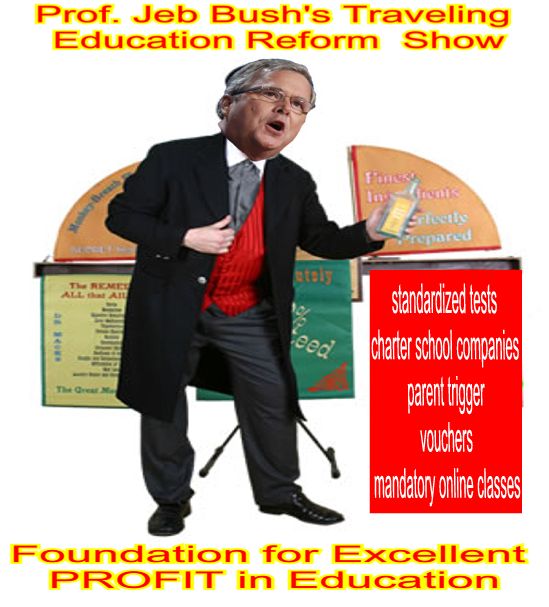
Image result for big education ape Jeb Bush

After years of devising and pushing legislation to disrespect and harm professional educators, Jeb Bush is going to “teach” at Harvard. The irony cannot be overstated. To be clear, Jeb is no teacher and this is no job.
Jeb will act as a visiting fellow in the Program on Education Policy and Governance – an organization where he served as chairman of the Advisory Board for several years beginning in 2011. Other members of the advisory board have included John KirtleyPhil HandyGerard RobinsonJoel Klein and Corey Booker. PEPG funders include the Lynde & Harry Bradley Foundation, Bill & Melinda Gates Foundation and the The Walton Family Foundation. The Milton Friedman Foundation was among the earliest funders, dating back to 1997, the program’s inaugural year.
PEPG delivers many of the “studies” Jeb, ALEC and others use to justify privatizing public schools. One such study, The Effects of Early Grade Retention on Student Outcomes over time: Regression discontinuity evidence from Florida was written by Martin West, Deputy Director of PEPG but released to the media deceptively by The Brookings Institute.  The study conveniently concluded “evidence that early retention leads to adverse academic outcomes is misleading due to unobserved differences between retained and promoted students.” 
Studies like this allowed Jeb and his friends to aggressively convince 18 states to implement mandatory third grade retention, despite overwhelming evidence that retention is a proven drop-out predictor.
So, PEPG has asked Jeb to deliver its 2016 Godkin Lecture as a “visiting” academic. This is just another effort by public education “reformers” to use the Harvard Kennedy School as a beard to promote a political agenda.
It’s essential to fully understand what Harvard’s Program on Education Policy and Governance does. Far from an objective research center, PEPG is an ardent proponent of the Milton Friedman vision of privatization of public schools using vouchers, for-profit charters, and a vast array of vendors.
Predictable, recurring themes such as mandatory third grade retention, teacher evaluations, U.S  students being unable to compete internationally, investing less on public education while expecting increased returns, class-size doesn’t matter and the ever-expanding push to digital learning are front and center.
Of course, once a “study” is released, PEPG boasts about all the media coverage.  The only thing this proves is that, like many other institutions, the The propaganda behind Jeb’s Harvard “teaching” job | The Edvocate Blog:
Image result for big education ape Jeb Bush

Charter School Scourge Invading Sweetwater | tultican

Charter School Scourge Invading Sweetwater | tultican:

Charter School Scourge Invading Sweetwater


Chula Vista, California
On Monday evening (9/26/2016), the board of the Sweetwater Union High School District (SUHSD) had petitions from three charter schools; two requesting charter renewals and one for a new school. The two renewals are co-located charters that were started by SUHSD’s previous board (four of the five resigned as part of plea deals) and the new petition is for an independent study charter.
My first teaching job was in SUHSD as a paid certificated intern, teaching 3 out of a possible 5 classes a day while completing a master’s in education at UCSD. At my new job, I was soon regaled with stories of corruption in Sweetwater instigated by superintendent, Ed Brand. I never witnessed direct evidence of this widely and firmly held belief. Brand’s first stint as SUHSD Superintendent was from 1995 to 2005.
It was surprising in 2011, when the SUHSD Board brought Brand back. He had resigned as Superintendent of San Marcos Unified in 2006, less than a year after leaving Sweetwater to assume that position.
An article in the San Diego Union speculated that Brand was pushed out in San Marcos for unethical hiring and political practices. It says in part:
“… accounts have emerged of other things not in keeping with San Marcos Unified’s image. They include Brand’s ordering the hiring of a teacher, whose husband is a state education official, even though a panel of elementary school principals in charge of hiring voted not to offer her a job; a staff party for management aboard a 112-foot historic yacht; and two outsiders infusing cash into a school board candidate’s campaign.”
The state education official was Scott Himelstein then Deputy Secretary of Education/Chief of Staff and later Acting Secretary of Education for the State of California. In that capacity he served as chief policy advisor to Governor Arnold Schwarzenegger on K-12 and higher education.
William D. Lynch was a source of outside money and according to the Union article cited above, “The High Spirits yacht, where Himelstein hosted the party, is owned by multimillionaire businessman William D. Lynch….” Lynch is an ally of Brand’s and of state Secretary of Education Alan Bersin, former superintendent of San Diego city schools. Lynch is also a philanthropist who runs the William D. Lynch Foundation for Children, which promotes literacy. Scott Himelstein is the foundation’s former president.
Given who he associates with it was not surprising to learn that Ed Brand promotes privatizing public schools. Upon returning to Sweetwater, he started working on a new charter school idea. His dream was to develop a k-16 charter system and with support from several long time cronies, he had a charter proposal written. Susan Mitchell who has an almost forty-year working relationship with Brand was the lead petitioner for the school originally named Ivy League Prep Academy but soon renamed Stephen H. Hawking Math and Science Charter School.
Like Mitchell, most of the stated charter school founders also had similar long term associations with Brand. Before the courts and voters replaced the SUHSD school board, Brand was able to open a second charter school named Stephen W. Hawking II Science, Technology, Engineering, Art and Math Charter. The schools Charter School Scourge Invading Sweetwater | tultican:

Charter Schools - Dividing Communities since 1991


A Word If You Please, Governor Christie | Daniel Katz, Ph.D.

A Word If You Please, Governor Christie | Daniel Katz, Ph.D.:

A Word If You Please, Governor Christie


We are a month into the 2016-2017 school year in New Jersey.  Public school children across the Garden State have met their new teachers and learned the expectations for the year.  My teacher friends (many of whom are former students) have set up their classrooms, welcomed their students, and begun the long process of getting to know the young people in their care and helping them learn.  In many of these schools, veteran teachers have welcomed student teachers as well, slowly giving them more responsibility as they begin the most intensive part of their preparation to become licensed teachers themselves.  After years of studying both pedagogy and content, of combining that knowledge in planning for both learning and assessment of learning, and of demonstrating their combined skills in supervised field placements, these young people are ready to take the final steps on their journeys.
In my own classes, I have had the great pleasure of welcoming the Class of 2020 to their first class in our teacher preparation program.  I have to be honest: after 23 years of teaching at every level from seventh grade to graduate school classes, this is my favorite time of any year.  My students are both excited and nervous, and they are only just beginning to learn what it means to become a teacher.  After thousands and thousands of hours of watching teachers teach, they have a great deal to learn about what goes into that work that they never saw, and they will have to learn how to translate their passion for their content and for learning into effective teaching.  They also happen to be great people, a conclusion I draw basically every year.  My students are bright, passionate, diligent, incredibly hard working, selfless, and they are giving up many of the traditional distractions of college life for their chosen profession.  This time with us in university based teacher preparation is really a gift.  Sandwiched between their thirteen years in K-12 classrooms and their future decades of work in a profession of millions, we have four short years to help them get their career journey off to a great start.
So I really have to ask you, Governor Christie:  Exactly from where do you think our future teachers are going to come?
This is no idle question at this point.  Concerns about the teacher pipeline have been brewing for some time, and while the phenomenon is complex, there is also no doubt that we’ve made it much harder for young people to imagine a positive future as a teacher:
And we have to admit that Governor Chris Christie has been a leader in this trend since he began his time in office.  Chris Christie ran for office promising teachersto leaves their pensions alone, a promise he swiftly broke with a pension reform bill that he has steadfastly refused to fund – even as he turned the state’s pension fund over to Wall Street buddies who tripled fees without improving returns.  Governor Christie slashed school aid and has never fully restored it, leaving districts underfunded according to the state’s own school aid law.
While financial esoterica may escape the attention of today’s school children –although the cumulative impact of $6 billion of lost funding surely has an impact– Governor Christie’s continued and vicious attacks on the Garden State’s teachers is impossible to ignore.  Governor Christie plainly hates the New Jersey Education Association, having opened his failed candidacy for the Republican Presidential nomination by saying NJEA needs to be “punched in the face,”  but the governor takes that hatred out in public on any teacher who dares to stand up for her profession while he slathers contempt upon the state’s schools and teachers.  Governor Christie has accused the state’s teachers of using their students like “drug mules” for a civics lesson, and he has whined that the NJEA claimed that he hates children for a fairly mild billboard:
NJEA billboard 2011
He has screamed at a teacher in public for daring to question him:A Word If You Please, Governor Christie | Daniel Katz, Ph.D.:


Tennessee school board removes section on Islam from social studies curriculum — Quartz

Tennessee school board removes section on Islam from social studies curriculum — Quartz:

Fearing “indoctrination,” parents in one US state are succeeding in removing Islam from a school curriculum

Image result for what you dont know wont hurt you
Most educators agree that studying major religions helps people understand the world. But some parents in the US fear that teaching about Islam, the religion of 1.6 billion people, is akin to “indoctrination”—and they want the faith stricken from school curriculums. In recent months, outraged parents in Georgia confronted a local school board over lessons on Islam, while a school district in Virginia was closed for a day due to furor over a lesson on Arabic calligraphy. But in Tennessee, their efforts are succeeding.

The Tennessee State Board of Education published a draft of new state social studies standards for review on Sept. 15. Students currently learn about Islam in their seventh grade social studies curriculum, but the proposed new standards have omitted the section “Islamic World, 400 AD/CE—1500s” from the draft. The sections that touch on Christianity, Judaism, Buddhism, Hinduism and other religions were left unchanged.

The new draft standards follow a March bill passed by the Tennessee state legislature, which allows local school boards to decide how they want to teach religion. The bill stemmed from a heated debate in Maury County, where parents of seventh grade students were upset that students learned about the Five Pillars of Islam, one of the basic elements of the Muslim faith.

The board of education has said that students will still learn about Islam (including basics, like the Five Pillars), but that the standards have been “streamlined.” Under the proposed standards, the board says students will learn about Islam in the history section titled “Southwest Asia and North Africa: 400-1500s CE.” But previous subjects like the origins of Islam, the life of its founder Muhammad, the differences between Sunnis, Shi’ites and other sects, the connection between Islam and Christianity and Judaism and other subjects will no longer be covered.
“Overall, some of the streamlining was trying to take in account that standards weren’t age-level appropriate or went into too much detail,” Laura Encalade, board of education director of policy and research, told the Tennessean.

Critics of the new standards say they minimize the subject and virtually eliminate it from the curriculum.

Michael Hughes, the chairman of Tennessee’s board of education in Sullivan County, said that parents don’t want Islam covered in school. “They’re in favor of just (taking it out of the standards). I don’t believe they want it taught at all,” he told the Kingsport Times News.

Linda K. Wertheimer, a Boston-based education writer and author ofTennessee school board removes section on Islam from social studies curriculum — Quartz:


Education a Key Issue in Down-Ballot Elections - The Atlantic

Education a Key Issue in Down-Ballot Elections - The Atlantic:

Education's Key Place in Down-Ballot Elections
Despite not receiving much attention in the presidential race, the issue is top-of-mind in certain contests around the country.


With so much attention focused on the campaign between Hillary Clinton and Donald Trump, voters could be forgiven for forgetting they’ll be asked to decide plenty more in November. And the stakes are high for K-12 education in state-level elections, including races for governor, state education chief, and legislative seats, plus ballot measures on education funding and charter schools.
In Massachusetts, a fierce campaign is being waged over whether to lift the state cap on opening more public charter schools, with millions being spent on dueling TV advertisements. Education is proving a key issue in governors’ contests in Indiana, Montana, and North Carolina, to name a few. Plus, state superintendents are on the November ballot in five states, including Indiana and Montana.

Just this week, the candidates in the Indiana governor’s race engaged in their first debate. The topic? Education. New life was injected into the race after Governor Mike Pence stepped down to join the GOP presidential ticket. The main contenders, Republican Lieutenant Governor Eric Holcomb and Democrat John Gregg, have differing views on school choice, expanding preschool, and student testing.


State-level elections take on extra weight for education this year given that the fresh rewrite of the main federal K-12 education law—called the Every Student Succeeds Act—hands substantial authority back to states.
“The federal government has loosened the reins on testing issues, on state accountability systems,” said Andy Smarick, an education expert at the American Enterprise Institute, during an Education Writers Association panel on the elections last month.
“Who’s going to be making these calls over the next several years?” asked Smarick, who was an education official under President George W. Bush and is now president of the Maryland state board of education. “Well, it’s going to be state boards of education, governors, state superintendents, state legislatures.”
Twelve governors’ races are in play this year, plus thousands of seats in state legislatures. Ballotpedia, a nonpartisan organization that tracks elections, ranked the top 20 state legislative chambers across the U.S.—of the 86 holding elections this year—that “might, realistically” see a change in party control. On the list were states including Colorado, Michigan, and New York.
Lily Eskelsen García, the president of the National Education Association, said recently that her union is paying close attention to governors’ races, and singled out elections in Montana and North Carolina as examples.
In Montana, Steve Bullock is “a Democratic governor who has really invested in public schools,” she said at the EWA elections forum. While in North Carolina, the NEA president is hoping Attorney General Roy Cooper, a Democrat, will unseat Republican Governor Pat McCrory.


Eskelsen García argues that a push by Governor McCrory for “huge tax cuts, with corporations not paying their fair share, and not investing in their public schools,” leaves him “very vulnerable to his Democratic challenger, who is talking about public-school funding.”
But McCrory touts his record on education on his campaign website, including what he says are increases in state spending—including teacher pay raises—plus additional money for textbooks and a reading initiative.
“This fall, it’s going to get ugly in Massachusetts.”
“Governor Pat McCrory has made the rise of teacher pay a centerpiece of his bid for re-election,” WUNC reported in August. The news outlet finds that while the governor has overseen a substantial rise in educator salaries, the increases are not as dramatic as McCrory suggests, and in the governor’s first year in office, salaries actually declined.
* * *
The Massachusetts ballot measure, which would allow up to 12 new charter schools to open each year, has pitted teachers’ unions, school superintendents, and other charter critics against Republican Governor Charlie Baker, pro-charter advocacy groups, and others, including wealthy supporters from the business community in Massachusetts and beyond.
As a story in Boston Magazine recently warned: “This fall, it’s going to get ugly in Massachusetts. We’re prepping for a projected $30 million public fight with all Education a Key Issue in Down-Ballot Elections - The Atlantic:


Brown vetoes bill requiring charters to comply with conflict of interest, open records laws | EdSource

Brown vetoes bill requiring charters to comply with conflict of interest, open records laws | EdSource:

Brown vetoes bill requiring charters to comply with conflict of interest, open records laws


Gov. Jerry Brown vetoed a bill Friday, pushed hard by the California Teachers Association, that would have required charter schools to comply with the state’s open meetings, public records and conflict of interest laws.
Brown’s rejection of Assembly Bill 709, authored by Mike Gipson, D-Carson, was expected. Brown vetoed an almost identical bill two years ago, and, as aSenate Education Committee analysis noted, the bill “does not include any substantive changes that seek to address” the issues Brown raised then.
In his veto message on Friday, the deadline for acting on hundreds of bills, Brown quoted from his 2014 veto letter: “While I support transparency, this bill goes further than simply addressing issues of potential conflicts of interest and goes too far in prescribing how these boards must operate.”
“That’s still my view,” Brown concluded. A longtime advocate and, as governor, protector of charters, Brown started two charter schools in Oakland before his re-election as governor in 2010.
The California School Boards Association, the Association of California School Administrators  and other school management groups supported the bill, but the CTA made it a high-profile campaign as part of its escalating opposition to charter schools. On a new website, Kids Not Profits, it highlighted incidents of mismanagement and fraud by charter schools and their administrators, as well as discriminatory admission policies by some charters that violated the state charter school law. Gipson’s bill would extend vital requirements for accountability and transparency to charter schools, it argued.
CTA President Eric Heins expressed disappointment on Friday. “It is unfortunate that given all the reports showing fraud, waste, mismanagement and unequal access to students, Governor Brown would veto such important legislation that simply required the same standards of accountability and Brown vetoes bill requiring charters to comply with conflict of interest, open records laws | EdSource:
Big Education Ape: Governor Jerry Brown Vetoes Bill to Establish Minimal Charter Accountability | Diane Ravitch's blog - http://bigeducationape.blogspot.com/2016/09/governor-jerry-brown-vetoes-bill-to.html


He created the ‘theory of multiple intelligences.’ What if Howard Gardner were U.S. education secretary? - The Washington Post

He created the ‘theory of multiple intelligences.’ What if Howard Gardner were U.S. education secretary? - The Washington Post:

He created the ‘theory of multiple intelligences.’ What if Howard Gardner were U.S. education secretary?


A new president will take the oath of office early next year and will likely appoint a new secretary of education (though the current man with the job, John King Jr., could be tapped). We can only speculate on who each presidential candidate could pick, but for now, let’s pursue another thought experiment. Author C.M. Rubin has asked six people prominent in the world of education what they would do if they had the job, and this is the third of six posts that will reveal their answers.
The first interview, conducted by author C.M. Rubin, was with Andy Hargreaves, author and Thomas More Brennan Chair in Education at the Lynch School of Education at Boston College. The second was with Randi Weingarten, president of the American Federation of Teachers, the second largest teachers union in the country. This, the third, is with Howard Gardner, Hobbs Professor of Cognition and Education at Harvard University’s Graduate School of Education and creator of the famous theory of multiple intelligences.
The other three people being interviewed by Rubin are  Diane Ravitch, education historian, best-selling author and co-founder of the Network for Public Education; Charles Fadel, author, inventor and the founder and chairman of the Center for Curriculum Redesign; and Julia Freeland Fisher, author and director of education research at the Clayton Christensen Institute.
Gardner revolutionized the fields of psychology and education more than 30 years ago when he published his 1983 book Frames of Mind: The Theory of Multiple Intelligences,” which detailed a new model of human intelligence that went beyond the traditional view that there was a single kind that could be measured by standardized tests. (You can read his account of how he came up with the theory here.)
Gardner’s theory initially listed seven intelligences which  work together: linguistic, logical-mathematical,  musical, bodily-kinesthetic, spatial, interpersonal and intrapersonal; he later added an eighth, naturalist intelligence and says there may be a few more.
Gardner holds positions as adjunct professor of psychology at Harvard University and senior director of Harvard Project Zero, an educational research group composed of multiple, independently sponsored research projects with the aim of understanding and enhancing high-level thinking and learning across disciplines. Gardner received a MacArthur Prize Fellowship (1981), the University of Louisville’s Grawemeyer Award in Education (1990), the Prince of Asturias Award for Social Sciences (2011), and the Brock International Prize in Education He created the ‘theory of multiple intelligences.’ What if Howard Gardner were U.S. education secretary? - The Washington Post: