Latest News and Comment from Education

Friday, September 9, 2016

CURMUDGUCATION: Leave Those Kids Alone

CURMUDGUCATION: Leave Those Kids Alone:
Leave Those Kids Alone


Pre-K is the growth sector of the privatized school industry. There's no existing institutional structure to sweep aside, and there's near-universal agreement that a good Pre-K foundation is important for all future success, coupled with research indicating that many of our children are already behind on the first day of kindergarten.

Unfortunately, "good Pre-K foundation" is a phrase that has been interpreted in some not-very-helpful ways by not-very-clever people with a not-very-deep understanding of what is developmentally appropriate for a four-year-old. Google "kindergarten is the new first grade" and you get over 5,000 results. Because some folks are just certain that what three- and four-year-olds need is academic preparation, direct instruction, and, of course, tests that let us measure the outcomes.

The research on the effectiveness is a huge muddy mess (made more muddy by the continued absence of a reliable and meaningful measure of school effectiveness in general). Some of the research has been rather alarmingly headline-generating, like the Stanford study that suggests that delayed kindergarten enrollment reduces the possibility of developing ADHD.

Now the folks at Defending the Early Years have published a short piece by Lilian Katz that provides a useful framework for explaining and understanding why some approaches to early childhood education are not useful.

Lilian Katz is professor emerita of early childhood education at the University of Illinois at Urbana-Champaign as well as principal investigator for the Illinois Early Learning Project. Her study of and advocacy for early childhood education is extensive and spirited.


"Lively Minds: Distinctions between academic versus intellectual goals for young children" is a four page report with one page of cover and another one of endnotes-- so we can cut to the chase 
CURMUDGUCATION: Leave Those Kids Alone:

The Devil is in the Details, Utah

The Devil is in the Details, Utah:

The Devil is in the Details, Utah

devil sign

Some Utah parents are worried about afterschool Satan Clubs. I don’t blame them. However, and I’m no religious expert by any means, if there is a devil, I think it is always sneaking into town when and where you least expect.
Utah, in my opinion, has some devil-like programs designed to eliminate public-schools.
First, there’s social impact bonds or “pay-for-success” programs. These sound nice and enticing at first. Here is a description from the Stanford Social Innovation Review:
The plan called for United Way of Salt Lake to work with area partners, including StriveTogether (a national network of cross-sector community partnerships focused on improving public education), to expand high quality preschool opportunities in high-need communities, and for Goldman Sachs and J.B. Pritzker to provide $7 million in up-front funding to pay for the program. If the children who had been identified as potentially eligible for government-funded special education (beginning in kindergarten and often lasting through high school) were able to avoid tapping those services, then, ultimately, the state of Utah would pay investors their principal plus a financial return. (Because state legislation had not been passed in 2013, for the first cohort of children the investors are paid by United Way of Salt Lake and Salt Lake County).
The problem is that some children have disabilities for life that teachers, no matter how great miracle workers they might be, cannot fix. They can help the child improve, of The Devil is in the Details, Utah:

Low Test Score: Get the Hell Out - More Victims of High Stakes Testing - The Washington Post

School informed parents of low-performing students they could opt out of state tests - The Washington Post:

School informed parents of low-performing students they could opt out of state tests


As schools were busy readying students for state exams, teachers at Cora Kelly School for Math, Science and Technology, a high-poverty school in Alexandria, were poring over data to determine which students would probably not do well on the tests.
But according to a school district investigation, the effort wasn’t aimed at giving those students extra help. Instead, Principal Brandon Davis allegedly told teachers this spring to call the parents of students who appeared on the brink of failing the exams to inform them of their right to opt out of the tests, according to the investigation. Three dozen parents decided to pull their children from the state Standards of Learning exams; no parents at the school had done so the previous year.
The move, which meant those students’ scores would not be considered for state accreditation purposes, probably artificially inflated the school’s overall performance and masked the fact that some students were not performing up to standards. It also means the data used to evaluate the school is potentially flawed and presents evidence that a new Virginia law allowing students to opt out of tests without it affecting a school’s rating could compromise the ability to assess schools.
The findings of the report, which the Virginia Department of Education released to The Washington Post on Thursday, come a week before the state publishes its accreditation ratings. The state Department of Education reported that there has been a rise in the number of opt-outs as a result of the new Virginia law.
Alexandria school officials said Davis told teachers “to identify students who may not do well on the SOL test, and contact parents of these students regarding their right to refuse SOL testing.” The students whose parents were contacted had scored 425 or below on exams; a 400 is the passing rate.
Helen Lloyd, a spokeswoman for the district, said that teachers told parents only about their right to opt out and about the state law, passed in the spring, which would mean their child’s score of zero would not negatively impact the school’s accreditation rating. The report does not explain why Davis would instruct teachers to place calls only to parents of students who were on the brink of failing.
Lloyd said Davis was disciplined, but declined to comment further, citing personnel confidentiality. Davis remains the principal at Cora Kelly.
“ACPS regrets that this happened,” Superintendent Alvin L. Crawley said in a statement Thursday. “ACPS believes the principal exercised poor judgment, and we took the appropriate actions as a result.”
Davis did not respond to a request for comment. In a statement released in July in response to inquiries from the Alexandria Gazette Packet — which reported that Davis was being School informed parents of low-performing students they could opt out of state tests - The Washington Post:

Schools Matter: Facts about Los Angeles Charter Schools

Schools Matter: Facts about Los Angeles Charter Schools:

Facts about Los Angeles Charter Schools


from Carl Peterson: 

On Saturday, July 30, 2016, I presented at Charters, Privatization and the Defense of Public Education, a California Education/Action Conference at Richmond High School in Richmond, California. My speech asked “If the charter law was passed to improve education through competition, why isn’t the LAUSD School Board playing to win?” and is based on the following paper:
Men associating with crooks and gamblers could expect no leniency
 Schools Matter: Facts about Los Angeles Charter Schools:


Carl J. Petersen for LAUSD School Board 2017 http://www.changethelausd.com/

The Power of Citizens Over Public Education - Bridging Differences - Education Week

The Power of Citizens Over Public Education - Bridging Differences - Education Week:

The Power of Citizens Over Public Education

Image result for The Power of Citizens Over Public Education


Deborah Meier continues her conversation with Harry Boyte. To read their full exchange, please visit here.
Dear Harry and friends,
Why do I have ambivalent feelings about the word citizen? I think probably because it has so often been used as a synonym for dutiful rather than powerful.
Like you, I know voting is but a small part of democracy. But it's also a critical part because it relates to the power to throw the rascals out without the blood and drama, or revolution. It's precisely the undramatic nature of voting that appeals to me. Its ordinariness!
But it can also be meaningless—and a lot in-between that and truly representing the will of "the people."
Of course, citizenship is a contested word itself—or concept. Not everyone living within a certain domain is a citizen of it. Women, people of color, and sometimes immigrants in general may be equally affected by the laws and policies of the city, state or nation they live in—but not be citizens. Throughout most of western history that has been commonplace, if not universally true.
Still, there were citizens going back to ancient times—but they were only a minority of "the people."
I want to emphasize the power that comes with being a citizen and the powerlessness of not truly being one. We have found a way in the U.S. (and many other places) to provide citizenship without power. The power of money, connections, information, and leisure belong to a precious few and make our "right to vote" sometime irrelevant. Or nearly so.
It's in that context that I see education playing a major role—one of providing a model of greater equality of power or of how democracy invokes the word, including voting, to describe a sham. Neither teachers, parents nor students have real power in schools—from pre-K through college! They are brought up in part by public institutions which don't belong, in a meaningful sense, to the public. Yes, democracy and schooling connect in many roundabout ways in America, meaning the money is allotted by an elected legislature, the rules are determined by authorities authorized to act by some elected person or body. But then this is true of arms contracts—funded publicly but built by private profit-making firms.
But for the constituents of that school and the community which it directly serves, power is entirely lacking. The one-time power of locally elected school boards has been almost entirely wiped away. Even when they remain elected bodies they have less and less power to make important decisions about what is to be studied and how, who teaches and how they are certified, hired or fired, how the school will be assessed, and the consequences that follow such assessment. Even issues of how students are graded, sorted, and disciplined are frequently not in the hands of anyone who knows the students at all. 
How might Public Achievement be used both to expose this reality and to make changes in it? That's the job facing us. When and where should we say "no"—engage in nonviolent resistance of one sort or another?
The "Opt Out" movement is one such way. The builders of the Opt Out movement are trying to persuade parents throughout the country to refuse to have their children take high stakes tests designed for purposes that are not student and learner-friendly. They are making inroads in both expected and unexpected places.
The efforts to curtail or eliminate private schools with public monies is another political fight today, and it is gaining ground in circles that had previously been enthusiastic "privatizers"—although the vehicle they favored (charter schools) have not always been synonymous with external control by outside private parties. But skepticism is growing around the substantial role of money-interests in profiteering with public monies, and replacing public schooling with market-place incentives. 
Are these efforts that Public Achievement can join with?  How best might we join together the various movements seeking to re-democratize America?

Mike Klonsky's SmallTalk Blog: Standoff at Standing Rock as we await court ruling

Mike Klonsky's SmallTalk Blog: Standoff at Standing Rock as we await court ruling:

Standoff at Standing Rock as we await court ruling

With Defenders of Water School principal Elena and teacher Theresa.
I finally found my calling after all these years. I want to come back here and be the basketball coach at the Defenders of Water School at the Standing Rock Sioux encampment. Susan and I showed up early at the school yesterday, to see if we could help out. Susan spent the morning trying to salvage school supplies that were washed out in Wednesday's downpour, putting remaining usable materials in plastic bins.

I played hoops -- a no-rules 3-on-3 pick-up game with 9-year-olds with players shuffling in an out. An Australian photog took pictures (with permission) and promised to send me some as soon as he could find some a wi-fi connection. I'm still waiting.

Early yesterday morning, a group of activists out on the front line set out to block the Dakota Access bulldozers. But the confrontation never materialized because the 'dozers were inoperable. The torrential rainstorm the day before had left them in a sea of mud. The rest of the day turned into an eerie peace. A standoff with company spotters up on the ridge watching the protesters and taking pictures while activists watched back. "We watch them watching us," said a guy camping at the front line. He had come from Arkansas to be part of this. "They watch us watching them watch us." There's a song lyric in there somewhere.


Approaching the roadblock on 1806.
Today, a federal judge is scheduled to rule on the Standing Rock Sioux lawsuit, a ruling that could stop the pipeline in its tracks or give a green light to DAPL The tribe’s lawsuit contends that the Dakota Access pipeline violates several federal laws, including the National Historic Preservation Act, and threatens the region’s water supply and sacred ancient sites outside of the 2.3 million-acre reservation.

Yesterday came word that Gov. Dalrymple had activated the National Guard in anticipation of the ruling. Dalrymple is avid Trump supporter, solidly behind Dakota Access and the pipeline Mike Klonsky's SmallTalk Blog: Standoff at Standing Rock as we await court ruling:


Michael Sentance Is Exactly What the BCA Ordered - Badass Teachers Association

Badass Teachers Association:

Michael Sentance Is Exactly What the BCA Ordered


By:  Terri Michal, Alabama BAT
Originally published on Left in Alabama here  http://leftinalabama.com/michael-sentance-is-exactly-what-the-bca-ordere


 What do appointed school boards, charter schools, high stakes testing and the (maybe) soon to be appointed Alabama State Superintendent, Michael Sentance, have in common?

They are all bad for our high poverty kids….and they are all exactly what the BCA (Business Council of Alabama), Sen. Marsh and Rep. Collins would like to have in Alabama.
I’m an edugeek. I admit it. My idea of a good time is reading education legislation, or researching charter schools, or compiling data on test scores and graduation rates.
I’m not the only one. I know teachers and advocates from all across this country that spend much of their free time just like I do, 57,754 of them to be exact. At any given time if I have a question about, oh I don’t know, let’s say Massachusetts education reform for example, all I have to do is log on to the BAT (BadAss Teacher) FB page and post my question. I then get answers from folks that have first-hand experience about what’s REALLY happening in their state.
So with all of the talk in Alabama about the Massachusetts Miracle that Michael Sentance helped kick off in 1993, I figured, who better to ask than actual TEACHERS from the state of Massachusetts?
Here is what I’ve learned:
Read this report, written by the Citizens for Public Schools, about the 20th anniversary of the ’93 reform. You will see it predominately affected three areas: standardized testing, charter schools, and funding. It failed in two out of the three areas. http://www.citizensforpublicschools.org/wp-content/uploads/2013/06/CPS-20th-Anniversary-of-ERA-Report-Executive-Summary-Online-6-10-13.pdf
In part the report states: “Massachusetts ranks 31st of 49 states for the gap between Black and White student graduation rates (with 1st meaning that the gap is the smallest) and 39th of 47 states for the size of the gap between Hispanic and White student graduation rates. For Badass Teachers Association:

Judge locks up 4 more principals for robbing students: 'They deserve better'

Judge locks up 4 more principals for robbing students: 'They deserve better':

Judge locks up 4 more principals for robbing students: 'They deserve better'

Image result for Judge locks up 4 more principles for robbing students: 'They deserve better'


One by one, the convicted principals pleaded for mercy, insisting they lived for their students and had suffered enough already.
One called himself “a hero.”
But the judge sentenced them all to prison — longer than the defendants preferred, but shorter than what prosecutors had hoped — for helping a millionaire businessman cheat the state’s poorest schoolchildren out of $2.7 million in supplies.
“They need to know that they all deserve better than what these principals gave us,” U.S. District Judge Victoria Roberts said Thursday in sentencing four more Detroit principals to prison for stealing from the students they were supposed to protect.
In a sensational school corruption trial that has triggered public outrage and planted a bull's-eye  on Detroit’s struggling schools, Roberts handed down sentences that ranged from six months to one year to four ex-principals who took kickbacks fromvendor Norman Shy as rewards for approving his phony invoices. The scheme, prosecutors said, cheated DPS out of $2.7 million in school supplies that were paid for but never delivered.
Prosecutors had argued for stiffer penalties — in some cases double what the defendants got — but Roberts took into account the principals' otherwise clean records and years of good deeds.
For Spain Elementary Principal Ronald Alexander, whose school won a $500,000 giveaway on the Ellen DeGeneres talk show in February, any prison sentence was too severe. At least that’s what he argued to the judge as he called himself “a hero”who lived for his students and school community.
“All I have ever done is give my best to these children,” Alexander said. “I buried three students because the kids’ parents didn’t have money — out of my own pocket … I love this school. It think it's unfair."
Alexander, who received a one-year prison sentence for accepting $23,000 in kickbacks from Shy and a $23,000 restitution order, blamed his legal troubles on the vendor.
"Mr. Shy — he did me wrong. He was saying he gave me donations," Alexander said, referring to the gift cards and checks that Shy gave him over the years.
Alexander said he spent it on the kids.
"I did not pad my pockets … some of the gift cards are still at home,"  he said later, blaming Shy again. "He's a known crook and he's been doing it for years."
Alexander also stressed that he needed to stay out of prison so that he could care for his 87-year-old mother. He also talked about his army of supporters — students, staff, religious leaders and the parent association at Spain Elementary School, which wrote the judge a letter saying it wants Alexander back.
"Nobody knows how bad I feel to have to go out from my job like this," Alexander said. ,
"I'm sad. I'm hurt. I feel bad. … I should be judged by the life I have lived. … I'm not the bad person that the federal (government) has accused me" of being.
Roberts reminded him that he had pleaded guilty.
"Despite your guilty plea, it sounds to me that you think you're guilty of nothing," said Roberts, who then quoted Alexander's plea agreement, in which he admitted that he approved fraudulent invoices "for school supplies that were never delivered to Spain Elementary."
"This is verbatim from your (plea) agreement," Roberts said. "This court and government doesn't have to make up anything. You signed it."
Roberts also rebuffed Alexander’s claim that he was hoodwinked by Shy.
"You are not blameless. You had everything in your hands," Roberts said. "Mr. Shy did not make you commit a crime."
Roberts also handed down a one-year sentence to former principal Gerlma Johnson, who came to court dressed in all black and sobbed after learning her punishment for accepting $22,884 in kickbacks from Shy.
Johnson, 60, the former principal at Charles Drew Academy and Earhart Elementary-Middle School, pleaded guilty to bribery in May and said she spent her kickbacks in two ways: buying jewelry, perfume and clothing for herself and helping her school.
In addition to the year behind bars, Roberts ordered Johnson to pay $22,884 in restitution to DPS.
“You essentially robbed Peter to pay Peter. It was their money,” Roberts said, referring to the students who were cheated out of school supplies.
Johnson said she was sorry.
"I apologize to DPS, and most of all, I apologize to my students,” she said.
Former principal Tanya Bowman also was apologetic as she received a nine-month prison sentence for accepting $12,500 in kickbacks from Shy.
The former principal of Osborn Collegiate Academy of Mathematics, Science and TechnologyJudge locks up 4 more principals for robbing students: 'They deserve better':
 

DETROIT PUBLIC SCHOOLS SCANDAL

Trump Promises $20 Billion to Destroy Public Schools

Trump Promises $20 Billion School Choice Offensive | The Daily Caller:

Donald Trump Promises $20 Billion School  Offensive Choice


Republican presidential candidate Donald Trump promised a bold federal push on education Thursday, saying if he is elected president he will spend $20 billion to expand school choice around the country, and calling for an end to tenure at the K-12 level.
Trump used a visit to a charter school in Cleveland, Ohio, as an opportunity to offer more details on his education plan. A core part of that plan is to re-allocate $20 billion in federal funds as a block grant to the states for the sake of promoting school choice.
Other than this general mission, the grant would give states substantial leeway to use the money however they wish. Trump said the money would have to benefit individual low-income students (rather than schools), and that the grants would favor states that have enacted strong school choice laws.
“There’s no failed policy more in need of urgent change than our government-run education monopoly,” Trump told the crowd in Cleveland. ”
In a statement issued alongside his speech, Trump’s campaign said his presidency would make it a national priority to provide a choice of schools to every low-income child in the country.
“The parents will be so happy,” Trump said. “They’ll walk their children to schools they want to be at.”
Trump’s education plan also calls for replacing the “failed tenure system” of K-12 schools with a system of merit pay for all teachers.
Trump’s speech was one of the few times the candidate has focused on K-12 education since clinching the Republican nomination last May, but it meshed well with his recent efforts to reach out to non-white voters. Polls have shown black and Hispanic voters consider education a major issue and are typically in favor of
Read more: http://dailycaller.com/2016/09/08/donald-trump-promises-20-billion-school-choice-offensive/#ixzz4JlkI0K8o


'Limited Access Letters' Used Unfairly to Ban Parents From Schools: Critics - East Village - DNAinfo New York

'Limited Access Letters' Used Unfairly to Ban Parents From Schools: Critics - East Village - DNAinfo New York:

'Limited Access Letters' Used Unfairly to Ban Parents From Schools: Critics

 East Village mom Stephanie Thompson with her son.
East Village mom Stephanie Thompson with her son. Stephanie Thompson


MANHATTAN — A little-known letter that's supposed to be used to protect schools from unruly parents in the wake of aggressive incidents is actually being used to unfairly silence outspoken parents in low-income black and Hispanic schools, critics say.
"Limited access letters," which anEducation Department staffer advised should only be used in case of a “serious incident at the school that required the involvement of School Safety Agents,” have been given out without any apparent oversight or supervision to parents across the city, DNAinfo New York has learned.
The letters, which effectively serve as temporary restraining orders against parents, can be given out by principals or superintendents who feel a parent has threatened them or a staffer in some way.
Once a parent has been given the letter, the school has the right to restrict that parent's access to the school for as long as they see fit. That means parents who receive them must call a school to make an appointment any time they want to visit — and they must register at the front security desk and remain there until a staff member can escort them around.
For those dropping off or picking up their kids at school, they must leave their child with the School Safety Agent at the front desk, according to a sample letter.
But unlike restraining orders, limited access letters don’t need to be vetted by a judge and have no apparent recourse for parents to appeal them.
Many fear these letters are sometimes doled out to push families out of a school and that they are overwhelmingly given to low-income parents of color, who may not know their rights or how to navigate the system on their kids’ behalf.
“White parents don’t know about limited access letters,” said East Village mom Stephanie Thompson, who is black and sits on the racially diverse Lower East Side/East Village District 1 Community Education Council with other parents.
A white man on her CEC board asked her recently why she remained quiet during so many public meetings. She told him, “When you say stuff as a white man, you’re seen as expressing yourself. You’re passionate. You’re smart and challenging. Whenever I do anything, I’m seen as an angry black woman and aggressive. I’m a 'pit bull.'”
She added that she's been given three limited access letters in the past three years, including once for complaining about her principal and another time for criticizing her superintendent within earshot.
“I’m young and by myself — and think they can run over me,” said Thompson, 25. “The schools bank on us not knowing things and taking advantage of it.”
Department of Education officials did not respond to requests for comment and 'Limited Access Letters' Used Unfairly to Ban Parents From Schools: Critics - East Village - DNAinfo New York:


California's schools won't be judged only by their test scores, school board votes - LA Times

California's schools won't be judged only by their test scores, school board votes - LA Times:

California's schools won't be judged only by their test scores, school board votes

Image result for it's hard being green
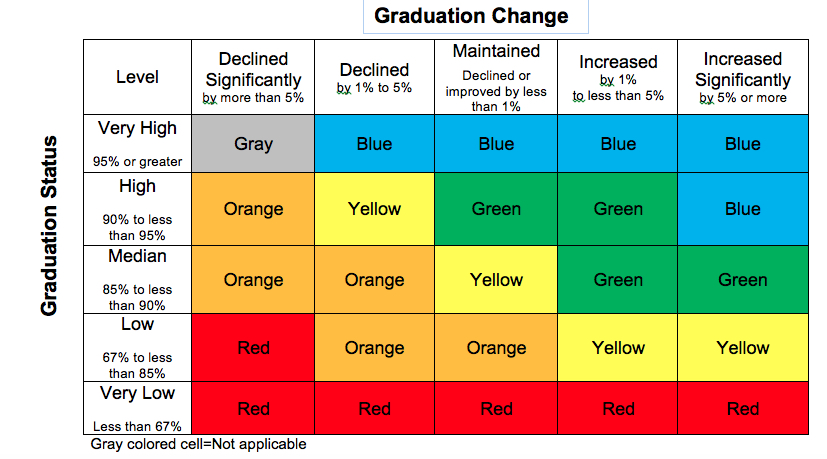
The proposed benchmarks for the high school graduation rate indicator show the interplay between the current year's performance, listed vertically, and the improvement or decline over the past three years. A high school that graduated between 85 and 90 percent of its students in the latest year, in the middle level, could be rated orange (the second lowest ranking) or green (second highest), depending on how much it improved or slipped over the past three years. High schools or districts that rank red would receive technical assistance.

lifornia is officially done with telling parents that schools are only as good as their test scores.
The state Board of Education voted unanimously Thursday to rate schools using an evaluation that includes many more factors — among them academics, graduation rates, college preparedness and the rates at which non-native speakers are learning English.
The evaluations will incorporate scores on new science tests when those tests are ready. Attendance data also will factor in eventually.
But unlike in the past, schools will not get an overall rating. Instead, they’ll receive results on how they’re doing across the new categories, for different groups of students. The results will focus not just on how they’re doing now but how they’ve progressed from year to year.
The vote marks the end of a long philosophical shift away from judging schools using only their test scores, as more people agree that numbers alone can never capture the complexity of classrooms.
In 2013, the Legislature passed the Local Control Funding Formula, which finances education by allotting a certain amount of money for each child, plus extra if that child had special needs. 
In Thursday’s vote, the board satisfied a requirement that by Oct. 1, 2016, there be a statewide system for evaluating schools along the lines of the funding formula’s eight priorities, which include parent engagement and school climate. If a school district’s performance and progress in two or more priorities are low, the corresponding county education office is supposed to intervene.
The new system replaces the Academic Performance Index, the state’s test-based accountability system that gave each school a one-number rating.
The shift in direction, officials said, should make the accountability process more broadly useful. “There are many functions of accountability, not just finding schools and districts that are not meeting performance standards,” board President Mike Kirst said.
More than 100 parents, students and others spoke about the plan before the board voted. Laurie Benn, who lives in Altadena, left her house at 4 a.m. Thursday to fly to Sacramento.
The mother of seven, whose children attend school in Pasadena, said she made the trip because she needed the board to know the type of information she is looking for as she tries to determine which schools are best.
The state board discussed presenting an array of factors — test scores, suspension rates. But Benn wanted something else: a single rating for each school, which, she said, “would give me an idea of which school I would like to look at” before she investigated further. 
Benn came with Parent Revolution, a group that organizes parents to take control over who leads those schools deemed to be failing. Determining which schools fit this bill might be more difficult with the new less clear-cut, many-layered assessments. 
Advocates and some parents hope that the decision about whether to use a single rating or not isn’t necessarily final. They contend that the board will have to revisit accountability California's schools won't be judged only by their test scores, school board votes - LA Times:
Big Education Ape: State board poised to take new direction in school accountability | EdSource - http://bigeducationape.blogspot.com/2016/09/state-board-poised-to-take-new.html
Big Education Ape: Parent Revolution: Another Fiasco for Reformers | Diane Ravitch's blog - http://bigeducationape.blogspot.com/2016/09/parent-revolution-another-fiasco-for.html


What if Randi Weingarten were U.S. education secretary? (Part 2 in a series.) - The Washington Post

What if Randi Weingarten were U.S. education secretary? (Part 2 in a series.) - The Washington Post:

What if Randi Weingarten were U.S. education secretary? (Part 2 in a series.)

A 2014 photo of American Federation of Teachers President Randi Weingarten at her union’s convention. (AP Photo/Damian Dovarganes, File)

A new president will take the oath of office early next year and will likely appoint a new secretary of education (though the current man with the job, John King Jr., could be tapped). We can only speculate on who each presidential candidate could pick, but for now, let’s pursue another thought experiment. Author C.M. Rubin has asked six people prominent in the world of education what they would do if they had the job, and this is the second of six posts that will reveal their answers.
The first interview, conducted by author C.M. Rubin, was with Andy Hargreaves, author and Thomas More Brennan Chair in Education at the Lynch School of Education at Boston College. This interview is with Randi Weingarten, president of the American Federation of Teachers, the second largest teachers union in the country. Weingarten has been a forceful presence in the education reform debate for years. In 2009, my colleague, the unrivaled Post education reporter Jay Mathews, wrote a column suggesting that Weingarten should be named D.C. schools superintendent after Michelle Rhee because “she is a practical and imaginative leader who likes to defy conventional wisdom.”
The other four people who will be featured in future interviews are Howard Gardner, Hobbs Professor of Cognition and Education at Harvard University’s Graduate School of Education and creator of the famous theory of multiple intelligences; Diane Ravitch, education historian, best-selling author and co-founder of the Network for Public Education; Charles Fadel, author, inventor and the founder and chairman of the Center for Curriculum Redesign; and Julia Freeland Fisher, author and director of education research at the Clayton Christensen Institute.
C.M. Rubin is the author of two widely read online series for which she received a 2011 Upton Sinclair award, “The Global Search for Education” and “How Will We Read?” She is also the author of three best-selling books, including “The Real Alice in Wonderland,” as well as the publisher of CMRubinWorld, which launched in 2010 to explore what kind of education students need in a rapidly changing world. She is also a Disruptor Foundation Fellow. You can follow her on Twitter: @cmrubinwor

Here’s the interview by C.W. Rubin, with Randi Weingarten:
Q) Randi, what will be the legacy of Race to the Top and Barack Obama’s other education initiatives?
A) President Obama should get credit for ushering us out of recession with the ARRA [the American Recovery and Reinvestment Act of 2009]. Although it included Race to the Top, which, combined with waivers, exacerbated the test-fixation under No Child Left Behind, President Obama and Secretary Duncan both acknowledged late in the administration that “there are too many tests that take up too much time.”
If we could turn back the clock, we would like to have seen a greater emphasis on our biggest What if Randi Weingarten were U.S. education secretary? (Part 2 in a series.) - The Washington Post: