Latest News and Comment from Education

Tuesday, September 6, 2016

DIVIDED AMERICA: In recovery, many poor schools left behind | State and Regional | herald-review.com

DIVIDED AMERICA: In recovery, many poor schools left behind | State and Regional | herald-review.com:

DIVIDED AMERICA: In recovery, many poor schools left behind


WAUKEGAN, Ill. (AP) — Consider Waukegan and Stevenson, two Illinois school districts separated by 20 miles — and an enormous financial gulf.
Stevenson, mostly white, is flush with resources. The high school has five different spaces for theater performances, two gyms, an Olympic-size pool and an espresso bar.
Meanwhile Waukegan, with its mostly minority student body, is struggling. At one school, the band is forced to practice in a hallway, and as many as 28 students share a single computer.
___
EDITOR'S NOTE — This is part of Divided America, AP's ongoing exploration of the economic, social and political divisions in American society.
___
Last year, Stevenson spent close to $18,800 per student. Waukegan's expenditure? About $12,600.
And the gap has only been getting wider — here in the suburbs north of Chicago, and in many places across the nation. In the years following the 2008 financial crisis, school districts serving poor communities generally have been hit harder than more affluent districts, according to an Associated Press analysis of local, state and federal education spending.
The result has been a worsening of America's rich schools, poor schools divide — and its racial divide, because many poor districts are also heavily minority. It also perpetuates the perception that the system is rigged in favor of the haves, at the expense of the have-nots — a major driver of America's angst in this election year.
The AP found that aid to local districts from the federal government surged after the economic downturn, as part of the stimulus, but then receded. Schools were left to rely more on state funding that has not bounced back to pre-recession levels. And poorer districts that cannot draw on healthy property tax bases have been left in the lurch.
The effects vary widely across the 50 states. Each has its own unique funding formula.
For example, per-pupil spending in poorer Missouri districts fell behind richer districts in 2013 — the first time in a well over decade.
Most rich districts have seen a steady increase in revenue while poorer districts — such as Louisiana RII, a predominantly white district 80 miles northwest of St. Louis — have seen cuts since 2010. That rural district has started waiting longer to replace textbooks, and it will likely abandon initiatives to distribute new computers and to bring wireless internet into classrooms. Todd Smith, the superintendent, said the district will likely seek a tax increase or a bond sale because there isn't enough money for basic maintenance.
"We find ourselves more and more dipping into our reserves," Smith said.
In Connecticut's largest city, Bridgeport, schools have struggled with cuts in state and federal grants, Superintendent Frances Rabinowitz said. And the gap widens between her district and neighboring, affluent Fairfield County towns with smaller class sizes and students with far fewer needs.
The result? No aides for kindergarten classrooms, or guidance counselors for elementary schools.
"I feel like I am cutting the lifeblood of the system," said Rabinowitz, whose schools are more than 80 percent black or Hispanic.
The impact can be long-lasting, researchers say. A study for the nonprofit and non-partisan National Bureau of Economic Research tracked students enrolled in districts where there was a prolonged increase in school funding.
Students educated in flush times finished more years of school, were less likely to live in poverty as adults, and made about 7.25 percent more in wages.
The widening funding gap that favors richer schools in Illinois is an extreme example.
For schools in the poorest 25 percent of Illinois districts, as measured by child poverty rates, per-pupil funding stalled at around $13,500 in 2014, the most recent year for which full data are DIVIDED AMERICA: In recovery, many poor schools left behind | State and Regional | herald-review.com:
Image result for big education ape corp weapons
 Image result for big education ape starving schools to death

State board poised to take new direction in school accountability | EdSource

State board poised to take new direction in school accountability | EdSource:

State board poised to take new direction in school accountability

Image result for it's hard being green


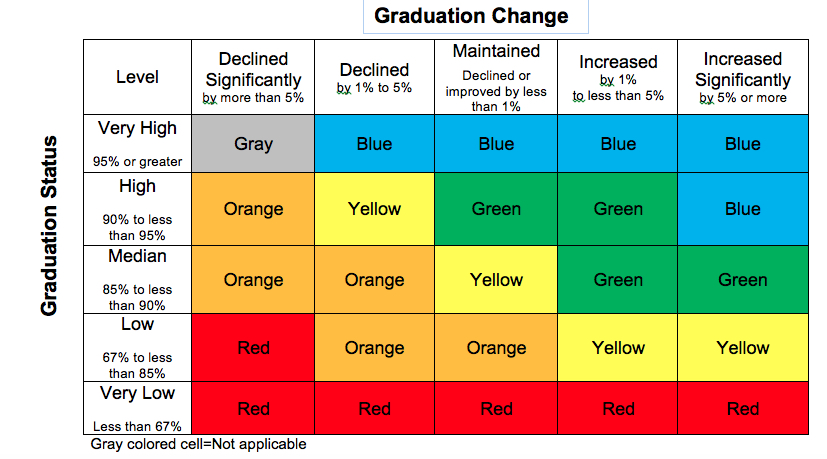
The proposed benchmarks for the high school graduation rate indicator show the interplay between the current year's performance, listed vertically, and the improvement or decline over the past three years. A high school that graduated between 85 and 90 percent of its students in the latest year, in the middle level, could be rated orange (the second lowest ranking) or green (second highest), depending on how much it improved or slipped over the past three years. High schools or districts that rank red would receive technical assistance.
CALIFORNIA STATE BOARD OF EDUCATION
The proposed benchmarks for the high school graduation rate indicator show the interplay between the current year’s performance, listed vertically, and the improvement or decline over the past three years. A high school that graduated between 85 and 90 percent of its students in the latest year, in the middle level, could be rated orange (the second lowest ranking) or green (second highest), depending on how much it improved or slipped over the past three years. High schools or districts that rank red would receive technical assistance.

After months of drafting, revising and debating how best to measure and improve schools, the State Board of Education this week will adopt key elements of a new and distinct school accountability system.
The series of votes on Thursday will meet the Legislature’s Oct. 1 deadline and will mark 2½ years since the state board suspended its simpler predecessor, the Academic Performance Index. The board expects to change components of the system in coming years.
The new system shifts from a one-dimensional school rating under the API and the federal No Child Left Behind Act, based on test scores, toward a broader picture of what constitutes a quality education. It combines measures of underlying conditions, ­such as teacher qualifications and student suspension rates, and academic outcomes, including gauges of college and career readiness and standardized test scores.
A multi-dimensional system that includes some hard-to-quantify measures like school climate is, by nature, complex, and some parent groups and advocates of  test-score focused accountability are urging the adoption of a summative ranking, like the API’s numerical rating, that is understandable at a glance.
“As parents and community leaders throughout California, we call on our public officials to give families a clearer school rating system that includes an overall assessment of school quality in addition to the currently proposed multiple measures,” reads a petition that the Los Angeles-based nonprofit Families in Schools is circulating.
The staff of the state board is wrestling with how to display on a one-page report card multiple measures of performance that include an “equity report” with results of subgroups of students. Stung by criticisms of early drafts, the board has farmed out the design to the consulting agency WestEd. A new online display won’t be ready until January.
But unless the federal government forces states to adopt a single rating, the board will use a dashboard of data. The board believes that will better enable the public to understand their schools and hold them accountable. And it will highlight achievement gaps that a single rating would gloss over. “A single number is not sufficient to evaluate an employee or buy a house. Similarly, we shouldn’t depend on just one indicator to understand school performance,” board President Michael Kirstwrote in an EdSource commentary last week.
With multiple measures, the board is following the Legislature’s orders. In the Local Control Funding Formula, legislators set eight priorities that school districts must address. They include implementing academic standards, involving parents in school decisions, creating an engaging school climate and raising student achievement. The Legislature left it up to the board to figure out how to measure progress in all eight priorities, and determine which low-performing districts need help.
That’s the overview. Here are some details; additional information can be found in the board’s agenda.

WHAT WILL THE BOARD ADOPT ON THURSDAY?

Called evaluation rubrics, it’s an accountability tool with several components:
  • A set of statewide and district performance indicators measuring the eight priorities identified by the funding formula.
  • Benchmarks that define levels of performance by districts, schools and student subgroups for each state indicator. For example, high schools that suspended more than 10 percent of their students last year and failed to reduce their rate over the past three years would be in the lowest level.
  • Criteria for determining which low-performing school districts would need technical help from a county office of education and which would State board poised to take new direction in school accountability | EdSource:


Teachers unions launch ads criticizing political spending by charter advocates | 89.3 KPCC

Teachers unions launch ads criticizing political spending by charter advocates | 89.3 KPCC:

Teachers unions launch ads criticizing political spending by charter advocates

127085 full
Leaders of California's largest teachers union have launched a new ad campaign, but this time they're not battling for hearts and minds on school policy. They're competing against charter school advocates to get politicians elected to office — with some schoolyard name calling.
In the months leading up to the June primary, the two largest charter school groups spent more than $10.4 million in "independent expenditures" on fourteen races — the most they have spent in this type of political influence in any election cycle since at least 2002.
The spending was an overt strategy to influence primary races.  And it was aided by several major donors, including philanthropist Eli Broad who gave more than $1 million dollars. Among the other wealthy donors are Netflix CEO Reed Hastings and Wal-Mart heirs Alice, Jim and Carrie Walton.
The ad campaign the union launched in response last week, dubbed "Kids Not Profits," denounces these contributions; one radio spot claims rich donors are "paying to push their agenda on the rest of us."
"These are very deep pockets," California Teachers Association president Eric Heins said.
The union has only spent $236,000 so far this election season, on two state legislative races, according to data from the Secretary of State's office.
But charter advocates said unions are being hypocritical.
"They have historically, significantly outspent what you have seen us spending thus far in this cycle, for example," said Gary Borden, executive director of the California Charter Schools Association's political arm, CCSA Advocates. "The notion that [the unions] don’t have the capacity to spend significantly in these races is, I think, certainly a fallacy."
The teacher's union is certainly a juggernaut in Sacramento politics, commonly ranking among the biggest campaign donors. But there's conflicting evidence about whether charter school backers have mustered the money to unseat CTA from this perch.
The union is right that charter groups have spent more in 2016 on independent expenditures — that is, spending on a race by an outside group that isn't coordinated with the affected candidates. It is also true that the union has donated much more in direct contributions to candidates and causes than charter school advocates have.
The two most active pro-charter groups, EdVoice and the California Charter Schools Association, have together given around $475,000 in direct contributions to candidates, campaigns or other political action committees this year. The CTA has contributed around $1.6 million in direct contributions in 2016. Its smaller counterpart, the California Federation of Teachers, has made around $880,000 in contributions.
In 2013 and 2014, the two teachers unions contributed more than $21.7 million to campaigns. They also spent $7.5 million in 2014 through an independent expenditure committee the CTA set up specifically to support their favored candidate for state schools superintendent, Tom Torlakson.
Borden said CCSA Advocates made a strategic decision to spend heavily during the primary races — especially in state legislative campaigns — because they feared a Teachers unions launch ads criticizing political spending by charter advocates | 89.3 KPCC:

Inside the California border town where one-third of students are homeless | Fusion

Inside the California border town where one-third of students are homeless | Fusion:

Inside the California border town where one-third of students are homeless

It’s sunny and dusty and hot on this nearly-barren strip of land to the south of San Diego. From the top of every little incline here you can see thousands of houses on Tijuana’s hillsides, and an enormous Mexican flag waving in the wind. If it weren’t for the 20-foot-tall wall made of rusted metal and concrete cutting off one country from the other, you might think you were in Mexico.
Veronica Medina, the student and family services manager for the San Ysidro School District, is doing what she normally does before the school year starts: driving around in her large Ford pickup truck down long stretches of road and touching base with some of the thousands of families who live in this district. As many as one-third of the kids in San Ysidro’s eight middle and elementary schools are homeless. Despite the seriousness of her job, Veronica is always smiling and laughing, making jokes with the families she encounters. She’s 42, she’s lived here for nearly her whole life, and she seems to have learned that when things are so dire, they could use a little levity.
We pass gas stations and used car dealers, then a small airport for private jets. We turn onto a dirt road towards a sprawling junkyard. The carcasses of cars and trucks stretch in every direction, separated by corrugated metal walls demarcating the boundaries of the several junk companies that operate here. Veronica snakes through the maze of lots, passing security guards looking suspiciously at her truck. She’s trying to find a family that lives here. But she can’t find them. They move lots frequently. She’s about to give up when we’re stopped by a security guard. He tells Veronica in Spanish that the family no longer lives here.
“These students are invisible. They blend in, their families are afraid to come forward, especially if they’re undocumented.”
Veronica dials up a number she has saved in her cell phone and Jennifer Gutierrez picks up. Gutierrez, her husband, and her 13-year-old daughter do indeed live in one of the lots. Later, I find out why: The going rate for a two-bedroom apartment in the San Diego area is about $1,300, plus her husband’s mom is sick back in Mexico, so they have to live there to save money. Gutierrez cleans houses a few days a week, but her hours were cut recently. Her husband works at the junkyard crushing cars. Both are undocumented. It’s hard to find better work. They keep their daughter occupied with dance lessons (salsa) and school (she’s an A student). The plan is to wait until their daughter gets a little older and more independent, maybe a year from now, and then start working one or two more jobs so they can save for a real apartment. But for now, this is fine. The trailer has a stove, a refrigerator, a little table for dinner and homework. It’s their mini house; it’s their home.
Veronica asks if we can come to their lot, but Gutierrez says the junkyard will kick them out if they find out anyone from the government (Veronica) or a reporter (me) is there—it’s happened before to another family. So over the phone Veronica reminds Gutierrez that school starts tomorrow, tells her there’ll be an event on Saturday where parents can pick up free backpacks and other school supplies, and turns her truck around.
The visit takes about 20 minutes. Veronica’s hoping to do a couple dozen more before school starts. She can’t visit all of her families, though, because in this school district of about 5,000 students, roughly 1,600 are homeless.
The problems of the San Ysidro school district are in some ways completely unique. San Ysidro is technically a part of San Diego, but it might as well be a separate city. The center of San Diego is about a 30-minute drive away, and its poverty rate is about half of San Ysidro’s. The two cities share little in the way of culture, architecture, or infrastructure. San Ysidro feels closer to Mexico than San Diego, which makes sense, since it’s literally as close as you can get to Mexico without being inside of it. The San Ysidro border crossing is the world’s busiest, with about 30 million crossings a year, and more than 90% of its approximately 30,000 residents are Hispanic.
In other ways, this place is like a lot of places in the U.S.: Since the Great Recession, student homelessness has doubled, Inside the California border town where one-third of students are homeless | Fusion:

Monday, September 5, 2016

Michigan-Missouri-Hawai'i Grassroots Education Network - Network For Public Education

Michigan Grassroots Education Network - Network For Public Education:

Michigan-Missouri-Hawai'i Grassroots Education Network


Introducing NPE Grassroots Education Network

State and Local Banner Grass and National

Dear friend and ally in the fight to save public education,
We would like to invite you to participate in an exciting Network for Public Education (NPE) service initiative, called the NPE Grassroots Education Network. We believe that it is our obligation to better serve allied groups in the struggle to preserve, promote, improve and strengthen our public schools. We are reaching out to leaders of local, state and national organizations across the country in order to foster communications and connections among groups that share common interests and concerns.
Your participation in the NPE Grassroots Education Network will not only help your organization reach more people who care about your issues, but we are confident that it will also serve to strengthen the national movement to save our schools.
What does participating in the NPE Grassroots Education Network mean for your organization? First and foremost, this is a service initiative on the part of the Network for Public Education. If you participate you are fully autonomous; your group is not a member or chapter of NPE. We will not charge you and we are not receiving a financial benefit for creating this initiative. We want to help you amplify your voice and forge alliances as we fight together to strengthen and preserve our public schools.
 Texas Grassroots Education Network - Network For Public Education -http://wp.me/p3bR9v-1O2

Virginia Grassroots Education Network - Network For Public Education -http://wp.me/s3bR9v-6951

Wisconsin Grassroots Education Network - Network For Public Education -http://wp.me/s3bR9v-6957

Tennessee Grassroots Education Network - Network For Public Education -http://wp.me/s3bR9v-6940

South Carolina Grassroots Education Network - Network For Public Education -http://wp.me/p3bR9v-1NQ

Rhode Island Grassroots Education Network - Network For Public Education -http://wp.me/s3bR9v-6928

Oregon Grassroots Education Network - Network For Public Education -http://wp.me/s3bR9v-6921

Ohio Grassroots Education Network - Network For Public Education - http://wp.me/p3bR9v-1Ns

North Carolina Grassroots Education Network - Network For Public Education -http://wp.me/s3bR9v-6905

New Hampshire Grassroots Education Network - Network For Public Education -http://wp.me/p3bR9v-1Ne

Introducing NPE Grassroots Education Network - Network For Public Education:

Gates funded “independent” media cheers Gates plan to privatize public education in Liberia - Wait What?

Gates funded “independent” media cheers Gates plan to privatize public education in Liberia - Wait What?:

Gates funded “independent” media cheers Gates plan to privatize public education in Liberia

Image result for big education ape Bill Gates

In stunning expose written by Adam Johnson of Fairness and Accuracy in Reporting (FAIR), it becomes undeniably clear that Bill Gates has reached the point where his billions not only fund the myriad of corporate education reform initiatives that are sweeping the country and the world, but his investment in the media taints much of the coverage of these developments.
The Guardian (8/31/16) published a broadly positive report on Liberian education, which is handing over the reins of 120 primary schools to a consortium of private education companies and NGOs in a pilot program exploring privatization of the West African nation’s schools. One passage in particular was especially glowing:
The deputy minister [of Education], Aagon Tingba, is reading The Bee Eater, a biography of Michele Rhee, a polarizing educational reformist and former chancellor of Washington, DC, public schools.
“She changed the lives of children in Washington, but people complained her methods were controversial. But she made a difference. So why can’t we do that here?”
What the piece failed to note—other than the fact that Rhee’s tenure left DC’s schools “worse by almost every conceivable measure” (Truthout, 10/23/13)—is that multi-billionaire Bill Gates is both the major investor of the company administering the Liberian education overhaul and the principal of the Gates Foundation, sponsor of the Guardian’s Global Development vertical, where the story appeared.
The story clearly labels the Gates Foundation as its sponsor. What it never mentioned is that Bill Gates is a major investor of the firm at the heart of the story, Bridge Academies International, having pitched in, along  Gates funded “independent” media cheers Gates plan to privatize public education in Liberia - Wait What?:


Why the presidential election matters for immigrant students

Why the presidential election matters for immigrant students:

Why the presidential election matters for immigrant students

DACA and deportations aren’t the only issues on the line

Kemberly Gil, a DACA recipient, DREAMer and college student rallies for immigrant rights in a 2014 protest in New York. Photo: U. Roberto Romano, courtesy of Rural & Migrant Ministry


 mberly Gil came to the United States from Colombia when she was 3 years old. She was with her parents, her older brother, and her younger sister. Like most undocumented immigrants in this country, Gil and her family crossed the border legally — on a tourist visa. After six months, however, the visa expired, and they lost their right to stay.

That was in 1999.
The family has lived in New York state since they arrived in the U.S. and, while Gil’s parents were always honest with her about the fact that she was undocumented, it wasn’t until she attended an immigrant’s rights rally when she was in fourth grade that she realized being undocumented was a problem, and one that affected a lot of people. Though she was only a child, she volunteered to speak to the crowd, calling on lawmakers to understand undocumented immigrants are people, too.
“I remember that I cried that day,” Gil said. “But no one heard me. The people there heard me, but the people who make decisions … nothing happened.”
Then, in the summer of 2012 President Barack Obama announced the Deferred Action for Childhood Arrivals (DACA) program, which he created by executive order. Gil and her siblings became eligible for driver’s licenses, work permits and protection from deportation for two-year, renewable terms.
The federal government approved 819,512 DACA requests from the program’s inception through March 31, 2016. An additional 539,000 people have renewed their original two-year reprieves.
But this fall, the presidential election could mean the end of DACA. Donald Trump has not only promised to build a wall between the U.S. and Mexico, the Republican presidential candidate has said he would also eliminate the program. It is, perhaps, the most prominent immigration policy at stake when Americans go to the polls. And that’s not the only way a Trump administration could affect the lives of one of the fastest-growing populations in U.S. schools. In fact, the contrast between two presidential candidates on immigration policy has quite possibly never been so stark.
Immigrants have grown from just 4.7 percent of the U.S. population in 1970 to an estimated 13.3 percent in 2014, according to Census data, and the number of immigrant students has grown accordingly. Both the actions and the possible inaction of the next president will have far-reaching consequences on these students in U.S. schools.
The next president will have a say in how unaccompanied minors are treated once they get to this country, how the federal government handles deportation or combats civil rights violations against immigrant students, and how much federal funding will be given to support 4.5 million English language learners — a growing portion of Why the presidential election matters for immigrant students:

Audio: Preschool suspensions really happen — and that's not OK | 89.3 KPCC

Audio: Preschool suspensions really happen — and that's not OK | 89.3 KPCC:

Preschool suspensions really happen — and that's not OK

139403 full

This story is part of a series from NPR Ed exploring the challenges U.S. schools face meeting students' mental health needs.
Every year, thousands of children are suspended from preschool.
Take a second to let that sink in.
According to the U.S. Department of Education, 6,743 children who were enrolled in district-provided pre-K in 2013-14 received one or more out-of-school suspensions.
And that's just public pre-K. Still more children were likely suspended from the nation's many privately-run preschools and day cares.
While most suspensions come as the result of a child's disruptive, sometimes violent, behavior, experts and advocates now argue that suspending a 3- or 4-year-old, no matter how bad the behavior, is a bad idea.
"Expelling preschoolers is not an intervention," according to a policy statementissued earlier this year by the National Association for the Education of Young Children and endorsed by the American Academy of Pediatrics. "Rather, it disrupts the learning process, pushing a child out the door of one early care and education program, only for him or her to be enrolled somewhere else, continuing a negative cycle of revolving doors that increases inequality and hides the child and family from access to meaningful supports."
But what to do?
Answer: Study Connecticut.
First, lawmakers there took a rare vote last year, limiting out-of-school suspensions for children from preschool through second grade.
More importantly, though, the state has spent more than a decade pioneering an intensive, classroom-level intervention — one that new research from Yale suggests is making a powerful difference in preschools across Connecticut.
The boy with the orange socks
Children bound from wall to wall through a small YMCA gymnasium in a low-income neighborhood of Bridgeport, Conn. While most play tag, one boy wearing bright orange socks heads straight for a crate in the corner. There, among the foam Audio: Preschool suspensions really happen — and that's not OK | 89.3 KPCC:

Charter Schools: Two Weeks Filled with Scathing Critiques | janresseger

Charter Schools: Two Weeks Filled with Scathing Critiques | janresseger:

Charter Schools: Two Weeks Filled with Scathing Critiques


Today is Labor Day. This blog is returning after a two-week break—two weeks filled with probing criticism of the controversial charter school education sector.
In a Labor-Day-related commentary, Harold Meyerson, executive editor of the American Prospect, explores the growing anti-union, anti-democratic power of the charter lobby: “Funded by billionaires and arrayed against unions, it is increasingly contesting for power in city halls and statehouses where Democrats already govern… This abrupt elevation (or self-elevation) of today’s charter school entrepreneurs into tomorrow’s civic leaders may seem surprising, but it’s part of a larger pattern… In future decades, historians will have to grapple with how charter schools became the cause celebre of centrist billionaires—from Walton to Bloomberg to Broad—in an age of plutocracy.  The historians shouldn’t dismiss the good intentions behind the billionaires’ impulse: the desire to provide students growing up in poverty with the best education possible. But neither should they dismiss their self-exculpation in singling out the deficiencies, both real and exaggerated, of public education as the central reason for the evisceration of the middle class.”
Meyerson continues: “By spending sufficiently to shift the composition of Democratic caucuses in legislatures, city councils or school boards to the right, they (the charter school lobby) can undermine public education… In their mix of good intentions and self-serving blindness, the billionaire education reformers have much in common with some of the upper-class progressives of a century ago, another time of great wealth and pervasive poverty.  Some of those progressives, in the tradition of Jane Addams, genuinely sought to diminish the economy’s structural inequities, but others focused more on the presumed moral deficiencies and lack of discipline of the poor. Whatever the merits of charters, the very rich who see them as the great equalizer are no closer to the mark than their Gilded Age predecessors who preached temperance as the answer to squalor.”
Then there was comedian John Oliver’s much publicized take-down of charter schools, created as less regulated and, hence, supposedly more creative and innovative than their public school counterparts that are castigated by charter proponents as hamstrung by bureaucratic oversight.  If you haven’t watched Oliver’s amazing and carefully researched comedy critique, I urge you to check it out.
I also urge you to follow up by reading Jeff Bryant’s piece that expands upon Oliver’s ridicule. Bryant notes that because Oliver’s broadcast was so widely viewed, charter school advocates have rushed to criticize Oliver and defend their pet project. But, declares Bryant, “None of Oliver’s critics seriously refuted the crux of his argument that there might be something fundamentally wrong by design, rather than by implementation or intent, with the idea that a ‘free market’ of privately operated and essentially unregulated schools is a surefire way to improve education opportunities for all students… (W)hat charter advocates generally won’t admit is that many of the problems these schools cause are reflective of what inevitably seems to happen when an essential public service is privatized… Numerous experts point out charter schools blur the line from what it means to be a public institution providing a public good and that, by their very design, they expand opportunities to profiteer from public tax dollars and private public assets… Over the years, the U.S. Department of Education has rewarded charter schools with over $3.3 billion in federal funds, and with passage of the most recent federal education law, the Every Student Succeeds Act, USDoE will send $333 million more to these schools before the current fiscal year is over.”
In the Washington Post, columnist Valerie Strauss published the transcript of Oliver’s critique and some of the response from charter school supporters.  Strauss also responded to Oliver’s comedy riff by publishing an analysis from Carol Burris, the award-winning, now retired New York City high school principal who serves as executive director of the Network for Public Charter Schools: Two Weeks Filled with Scathing Critiques | janresseger: