Latest News and Comment from Education

Wednesday, August 3, 2016

How Media Coverage of Charter Schools Changed in the Past Decade - AEI

How Media Coverage of Charter Schools Changed in the Past Decade - AEI:

How Media Coverage of Charter Schools Changed in the Past Decade


Key Points

  • In this analysis, we compare the tone of press coverage of charter schooling in 2005 with that in 2015.
  • Charter coverage became more opinionated and more negative between 2005 and 2015.
  • In 2005, 73 percent of articles were neutral and 12 percent were negative, whereas by 2015, 53 percent were neutral, and 28 percent were negative. This occurred despite public opinion of charter schools becoming dramatically more positive during that time.
  • Opinion pieces made up a much larger share of charter school coverage in 2015 than in 2005. In addition, race became much more prominent in charter school coverage over time, with the share of articles that mentioned race rising from 7 percent in 2005 to 16 percent in 2015.
Read the PDF.

Introduction

In a recent brief, we explored the question of how the press covers charter schooling. We found that the tenor of 2015 coverage was broadly mixed, but more negative than positive. On the whole, the analysis suggested little support for oft-heard claims that the media are strongly biased for or against charter schools.

One question raised by that analysis is whether the tenor of charter school coverage has shifted over time. After all, public opinion of charter schooling has become much more favorable over the past decade. In 2005, Gallup reported that the public supported charter schools by a relatively narrow margin of 49 to 41 percent. By 2015, support for charter schooling had ballooned to 64 to 25. In other words, the margin of support grew from 8 points in 2005 to 39 points a decade later.1 Did the media coverage reflect this shift? In the following analysis, we examine that question, comparing the tone of coverage in 2005 with that in 2015.

Charter coverage became more opinionated and more negative between 2005 and 2015. This occurred despite public opinion of charter schools becoming dramatically more positive during that time. Credit: Twenty20
Coverage in 2005 and 2015

We previously analyzed articles from 2015 in national, mainstream newspapers (the New York Timesand Washington Post); education outlets (Education Week and Chalkbeat New York); online magazines (Slate and Salon); and various smaller, regional newspapers (taken from the LexisNexis database).2 In 2005, however, Chalkbeat New York did not exist, and the Slate and Salon archives for
that year were not searchable. Therefore, those three outlets are not included in the following analyses, which offer an “apples-to-apples” comparison of how the same outlets covered charter schooling in 2005 and 2015.3


For the following analysis, “coverage” was defined as news stories or opinion pieces that included the phrase “charter school” in the body or title. Stories were coded as opinion if they used first-person pronouns, made opinionated statements without quotations from interviewed sources, or had a separate author byline at the beginning or end of the article. Between 1 and 5 percent of the coverage from each outlet was sampled, depending on how many articles were written in a given year. Articles were coded on a scale of 1 to 5, with a 1 indicating the story was highly unfavorable toward charter schools (a strong, persistently negative characterization), a 3 reflecting a neutral or generally balanced tone, and a 5 being highly favorable toward charters (a strong, persistently positive depiction).4Stories were coded only if charter schools were the main focus of the article in question.

Altogether, 132 articles were coded from 2005 and 154 articles from 2015. Figure 1 shows the results.

In 2005, more than 70 percent of the articles were neutral in tone. Of the remainder, just over half were positive in their depiction of charters. In 2015, on the other hand, barely half of the articles had a neutral tone, and the remainder were more negative than positive by a margin of 28 to 19. In other words, the results suggest that coverage of charter schooling became more opinionated and more negative over time.

Was this pattern true for all the outlets examined, or was there significant variation in how the tenor of coverage changed from 2005 to 2015 in different outlets? Figure 2 reports the average score for articles from each outlet, coded on a scale of 1 to 5.

In 2005, the New York Times was the most positive of the outlets examined. The Washington Post and the sample of coverage drawn from LexisNexis sources were fairly neutral, while Education Week was mildly negative. In 2015, the general interest media (the New York TimesWashington Post, and outlets in LexisNexis) were all more negative. The outlier was the K-12 education newspaper of record,Education Week, which became noticeably more positive.

Was the generally negative trend evident in both news and opinion coverage, or was it driven
more by one or the other? Figure 3 focuses solely on the news coverage, excluding op-eds and editorials.


The share of charter school stories that were opinion pieces nearly tripled between 2005 and 2015 (from 7 percent to 19 percent). In 2005, news stories were more likely to be neutral and, when they did lean one way or the other, were as likely to be positive as negative. By 2015, news stories were substantially less likely to be neutral, and when they were not, they were more likely to be negative than positive.

Read the full report.
How Media Coverage of Charter Schools Changed in the Past Decade - AEI:


Report says state too lenient on charter schools | Albuquerque Journal

Report says state too lenient on charter schools | Albuquerque Journal:

Report says state too lenient on charter schools


ALBUQUERQUE, N.M. — A new report raises questions about whether the New Mexico Public Education Commission is allowing some poor-performing charter schools to continue operations when they are not reaching their targets.

The National Association of Charter School Authorizers’ review, released Friday, ranked PEC “minimally developed” on holding schools accountable for academic performance.
PEC recently renewed six schools’ charters, though none met their charter goals or received an A or B state grade, “the loosely defined ‘standard’ for renewal,” the report states, adding that PEC gave conditional renewals based on promises of improvement.
Legally, charter schools must make “substantial progress,” but PEC has not outlined what that means. As a result, charters face few repercussions for poor performance, according to the report.
Currently, 32 percent of the commission’s 57 charter schools have D or F grades from the Public Education Department.
NACSA recommended that PEC formalize requirements for renewal and only grant it to schools that meet the standard.
“Because the PEC has not defined the standards for renewal, the PEC has not attempted to close a school for poor academic performance,” the report states.
PEC Chairwoman Patricia Gipson countered that PEC is serious about educational quality and accountability.
“We are not supporting the continuation of schools that are under-serving or under-performing,” she said.
The problem, Gipson said, is a lack of complete data on some schools. NACSA agreed that the commission could not fully evaluate multiple schools that did not submit all their data.
Gipson said PEC and PED have discussed the issue and gotten on the right track.
According to the report, the two entities have a contentious relationship, which undermines their “capacity to make good decisions about charter schools.”
“The schools feel like the children of a bitter custody battle,” it states.
PEC and PED work together closely. The 10 elected commissioners are responsible for voting on whether to grant new charters or to shutter low-performing institutions, but they have no budget.
PED’s charter school division staff provide the commission with support and recommendations – though the commissioners sometimes disagree with their conclusions.
In one instance, PEC sued after PED asked it to reverse a school closure decision.
Gipson said she feels relations have improved since NACSA’s visit in March. She backed the organization’s recommendation that PED and PEC discuss their respective responsibilities, roles and authority.
In a prepared statement, PED spokesman Robert McEntyre said NACSA “generally outlines a path that could help make charter schools in New Mexico stronger.”
The report will be presented at the Aug. 17 meeting of the Legislative Education Study Committee.Report says state too lenient on charter schools | Albuquerque Journal:


Some California charter schools discriminate in admissions, ACLU report says - LA Times

Some California charter schools discriminate in admissions, ACLU report says - LA Times:

Some California charter schools discriminate in admissions, ACLU report says


m Brown was scrolling through his news feed on Monday afternoon when he found the school he runs on a list that made him gasp.
Ceiba College Preparatory Academy in Watsonville, south of Santa Cruz, wasone of 253 California charter schools flagged for discriminatory admissions practices in anew report by the American Civil Liberties Union of Southern California and Public Advocates. The school was one of just 22 the report singled out for discriminating based on “academic performance.”
The report, released Monday, was the latest in the ongoing research back-and-forth over charter schools, which are publicly funded but can be privately run. 
State law requires charter schools to take in all students. ACLU and Public Advocates started investigating the schools’ admissions policies after hearing from parents that they might not be doing so. 
Researchers used a rubric to grade the schools’ policies, as expressed on their websites. They looked for different types of discrimination: bias against English language learners; requirements for essays, interviews, auditions or academic performance; mandates for parents; and practices that could drive away students who are in the U.S. illegally. 
“We thought it was pretty concerning,” said Victor Leung, an ACLU of Southern California attorney who worked on the project. “There’s no central authority for charter schools so we wanted to shine a light on it.”
Many of the schools on the report’s list asked for essays or required parents to pitch in or used language that might discourage some immigrant students.
Coding the violations can be complex, Leung said, so researchers did not include schools they deemed close calls on the list. 
When Brown saw his school was flagged, he immediately scanned Ceiba Prep’s website to try to figure out what was wrong. He noticed a reference to “sibling preference for students in good academic standing,” which he said didn’t gel with his school’s policy.
He removed the language, then wrote to the ACLU, asking if anything else was wrong.
Leung said he was encouraged to see a school changing its policy based on the report’s findings.
In a written response to the report, the California Charter Schools Assn. urged its member schools to revise their policies, saying, “charter schools must be open to any student interested in attending.” 
“We’ve heard from members who are definitely interested in getting more information … about the specific language they found problematic,” said Ricardo Soto, the charter group’s attorney. 
L.A. Unified has the largest number of charter schools in the country, but relatively few of them — 24 — were flagged, Leung said, because the school system “has a pretty good understanding of the law.”
The nation’s second-largest school system is in the middle of a battle over its future, with energy flowing into a campaign to create more charter schools. 
The district recently held a meeting aimed at making it easier for charter and district educators to coexist.
Though California has more than 1,200 charter schools, the study measured only 1,000 of Some California charter schools discriminate in admissions, ACLU report says - LA Times:


Union Chief to Dems: You Have Our Votes, We Need You to Fix Schools | TakePart

Union Chief to Dems: You Have Our Votes, We Need You to Fix Schools | TakePart:
Union Chief to Dems: You Have Our Votes, We Need You to Fix Schools
Randi Weingarten, the president of American Federation of Teachers, says national education policy has to start with listening to teachers.


In national politics, teachers unions and the Democratic Party usually go together like blackboard erasers and chalk dust: It’s nearly impossible to have one without the other. It’s no surprise, then, that both major teachers unions have endorsed Hillary Clinton, the Democrats’ presidential nominee.
Yet union president Randi Weingarten acknowledges she wanted to make President Barack Obama, a two-term Democrat, stay after school and clap the erasers for his early support of education reform through testing and teacher accountability, dovetailing Bush-era education reform policies she says did more harm than good.
“That has been the education policy for the last decade. And as much as I love President Obama, he participated in it to some extent,” Weingarten, president of the 1.6 million-member American Federation of Teachers, said in a wide-ranging, one-on-one interview with TakePart last week at the Democratic National Convention.
“[But] he’s changed. He’s given us a mea culpa because he’s seen how it demoralized educators. It has given people an excuse not to invest in education, and our kids, by over-testing and under-teaching, when half of our kids are in poverty,” Weingarten said.
Now, education advocates on both sides of the political aisle—perhaps inspired by grassroots protests, scandal, and local pushback—have broken their “fixation” with timed, fill-in-the-bubble tests in public schools, she said.
Policy makers “understand you need to focus on the whole child instead of a testing fixation. We need to actually invest in strategies that we know will work. Starting from pre-K, we need to engage in kids [in the classroom] and adjust in their well-being,” Weingarten said. “We have to nurture, sustain, and support a teaching course building their capacity. So there’s much more of a consensus, policy-wise, in terms of what we have to do.”
Still, there’s a long way to go to turn around the nation’s public schools, she said.
“The damage has been done, between austerity and demoralization and demonization and de-professionalization” of the teaching profession, Weingarten said. “And we’ve actually kind of opened up the doors to privatization and destabilizing schools, throughout the community and throughout the country” through the promotion of taxpayer-funded charter schools.
Weingarten spoke to TakePart the day after she delivered a full-throated endorsement of Clinton during the DNC in Philadelphia last week. She touted the former secretary of state’s long history of child advocacy work, pointed to Clinton’s plan for early-childhood education and her desire to “reset” national education policy to focus less on testing and more on critical thinking skills.
In the interview, however, Weingarten identified the biggest long-term challenges for the public education system: school resegregationteacher burnout, unequal school funding, and poor kids struggling with needs that teachers alone can’t fill.
On the campaign trail during the last year, “college has gotten most of the play,” with proposals on the left and right to help bring student debt under control, Weingarten said. But the education agenda has to include things like “multiple pathways to high school graduation, ensuring that STEAM—science, technology, engineering, the arts, and math—is baked into it, really nurturing teachers, supporting them, honoring them, making sure we don’t misuse testing, focusing on how we turn around segregation again. So I think a lot of things are on the table,” she said.
Because her organization leans to the left, it’s not surprising that Weingarten isn’t happy with the Republicans’ education agenda. “They don’t have anything to say, because [starting with No Child Left Behind] every one of their ideas has been on display in the last 10 years or so, and they’ve failed miserably,” she said. She prefers Democrats’ plans Union Chief to Dems: You Have Our Votes, We Need You to Fix Schools | TakePart:

'New Economy,' Old Injustices - And School Reform

'New Economy,' Old Injustices - And School Reform:

‘New Economy,’ Old Injustices - And School Reform


Toni Wagner sees an economy in shambles and calls for innovators. Yong Zhao sees a nation at risk and calls for entrepreneurs. Tom Van der Ark sees competition and complexity and calls for project based learning.
I nod my head. I endorse the pedagogy.
School reformers often champion progressive teaching practice as the path for student to success in the “new economy” - which is also called the “innovation economy,” the “knowledge economy,” the “information economy,” the “idea-based economy,” the “21st century economy.”
The reformers tell us that the world is globalized, fast and competitive; information is at our fingertips; robots and foreign labor do what Americans once did - and if we’re going to compete to win, our schools must prepare children for the expanding high-skill sectors of the new economy.
But this “new economy” is troubled by very old injustices. Why is there so little acknowledgement of this? We don’t just need graduates who will succeed in today’s economy. We need graduates who will make it more fair.
Last year I met with a student, David, and his mom. David’s a tough guy, but this morning his eyes were glassy - because even a tough guy can tear-up when his mom cries. She says it is difficult to find time to spend with him. Working afternoons and evenings now in a low pay service sector of the healthcare industry, her schedule also makes it hard to arrange time to meet with us at school. Week to week, her manager keeps her guessing about her shifts.
This working-poor family is part of the “new economy.” And so are the homeless kids and their moms. This is an economy, says Richard Kirsch, “where even workers with a good education are barely making it and most Americans don’t have a prayer of living the American Dream.”
That our economy crushes so many people is a reality too often left out of the school reform conversation. Rather, it’s not left out, it’s acknowledged complacently, taken for granted: the low-wage fate and unfair odds that you try to help a few kids beat.
It’s certainly exciting to envision our graduates joining the ranks of the high-skill labor force. But it’s sobering to be told that if a student like David doesn’t get to college and persist he just won’t make it. He’ll struggle to find work, or he’ll ending up in low-pay job like his mom. As Tony Wagner puts it in The Global Achievement Gap, “In order to earn a decent wage in today’s economy, most students will need at least some postsecondary education.”

Yes, we want our graduates to earn a decent wage, to live with decency. The reformers call for a paradigm shift in schools. We must graduate critical-thinking entrepreneurs - and masses of them. The reformers believe that if schools can 'New Economy,' Old Injustices - And School Reform:


Tuesday, August 2, 2016

Turks Can Agree on One Thing: U.S. Was Behind Failed Coup - The New York Times

Turks Can Agree on One Thing: U.S. Was Behind Failed Coup - The New York Times:

Turks Can Agree on One Thing: U.S. Was Behind Failed Coup


ISTANBUL — A Turkish newspaper reported that an American academic and former State Department official had helped orchestrate a violent conspiracy to topple the Turkish government from a fancy hotel on an island in the Sea of Marmara, near Istanbul. The same newspaper, in a front-page headline, flat-out said the United States had tried to assassinate President Recep Tayyip Erdogan on the night of the failed coup.
When another pro-government newspaper asked Turks in a recent poll conducted on Twitter which part of the United States government had supported the coup plotters, the C.I.A. came in first, with 69 percent, and the White House was a distant second, with 20 percent.
These conspiracy theories are not the product of a few cranks on the fringes of Turkish society. Turkey may be a deeply polarized country, but one thing Turks across all segments of society — Islamists, secular people, liberals, nationalists — seem to have come together on is that the United States was somehow wrapped up in the failed coup, either directly or simply because the man widely suspected to be the leader of the conspiracy, the Muslim cleric Fethullah Gulen, lives in self-exile in the United States.
“Whenever something shocking and horrific happens in Turkey, the reflex is conspiracy,” said Akin Unver, an assistant professor of international relations at Kadir Has University in Istanbul.
That response goes back almost a century, to the end of World War I, when the West carved up the defeated Ottoman Empire. A Western plan to divide what became modern Turkey failed after Mustafa Kemal Ataturk, the country’s founder, waged war against the occupiers. But the effort forever ingrained in the Turkish psyche a fear of Western conspiracies.
In the case of the failed coup, there is much more at play than fanciful conspiracy theories, many Turks say, because of the nearly universal conviction that it was engineered by Mr. Gulen, who for 16 years has lived in a secluded compound in the Pocono Mountains in Pennsylvania.
In various interviews and statements, Mr. Gulen has strongly denied involvement in the coup. Yet because he lives in the United States, and because of other salient facts — including that a former C.I.A. official and a former American ambassador to Turkey helped Mr. Gulen receive a green card — many Turks believe Mr. Gulen is an American agent. From there, itTurks Can Agree on One Thing: U.S. Was Behind Failed Coup - The New York Times: 

Big Education Ape: KILLING ED: 120 American Charter Schools and One Secretive Turkish Cleric -http://bigeducationape.blogspot.com/2016/01/killing-ed-120-american-charter-schools.html
Big Education Ape: Reading, writing and religion? Dallas-area charter schools come under fire (again). | Dallas Morning News - http://bigeducationape.blogspot.com/2016/08/reading-writing-and-religion-dallas.html
Big Education Ape: United States must extradite Fethullah Gulen to Turkey: Ankara mayor | The Indian Express - http://bigeducationape.blogspot.com/2016/07/united-states-must-extradite-fethullah.html
Big Education Ape: Texas Opens Probe Into Gulen Connection to Charter Schools - WSJ - http://bigeducationape.blogspot.com/2016/07/texas-opens-probe-into-gulen-connection.html
Big Education Ape: TBF: Charter Schools Tied to Turkey’s Gulen Movement Grow in Texas - The New York Times - http://bigeducationape.blogspot.com/2016/07/tbf-charter-schools-tied-to-turkeys.html
Big Education Ape: Fethullah Gulen: Moderniser or Wolf in Sheep’s Clothing? « CSS Blog Network - http://bigeducationape.blogspot.com/2016/07/fethullah-gulen-moderniser-or-wolf-in.html
Big Education Ape: Coup-attempting Gülenist group operates near 140 charter schools in US - Daily Sabah - http://bigeducationape.blogspot.com/2016/07/coup-attempting-gulenist-group-operates.html
Big Education Ape: The Gulen Movement’s Collision Course With The Turkish State -http://bigeducationape.blogspot.com/2016/07/the-gulen-movements-collision-course.html

Big Education Ape: US Commander Campbell: The man behind the failed coup in Turkey -http://bigeducationape.blogspot.com/2016/07/us-commander-campbell-man-behind-failed.html

Big Education Ape: Turkey’s Failed Coup Puts Spotlight on a Rural Pennsylvanian Town - WSJ - http://bigeducationape.blogspot.com/2016/07/turkeys-failed-coup-puts-spotlight-on.html

Big Education Ape: TBFURMAN: Who's Running These Schools? Part 3 -http://bigeducationape.blogspot.com/2016/07/tbfurman-whos-running-these-schools_24.html

Big Education Ape: Turkish rivalry comes to San Jose amid allegations about Magnolia charter schools - Mercury News - http://bigeducationape.blogspot.com/2016/07/turkish-rivalry-comes-to-san-jose-amid.html

Big Education Ape: Apple Education Services Posts Its Privacy Policy… in Latin | deutsch29 -http://bigeducationape.blogspot.com/2016/07/apple-education-services-posts-its.html

Big Education Ape: What Would it Take for US to Extradite Muslim Cleric to Turkey? -http://bigeducationape.blogspot.com/2016/07/what-would-it-take-for-us-to-extradite.html

Big Education Ape: Yo Campbell Brown Cat got your tongue? I Guess There is NO Talking Turkey w/ YOU! -http://bigeducationape.blogspot.com/2016/07/yo-campbell-brown-cat-got-your-tongue-i.html

Big Education Ape: TBFURMAN: Who's Running These Schools? -http://bigeducationape.blogspot.com/2016/07/tbfurman-whos-running-these-schools.html

Big Education Ape: Video shows Gülen urging followers to secretly infiltrate Turkish state institutions - Daily Sabah - http://bigeducationape.blogspot.com/2016/07/video-shows-gulen-urging-followers-to.html

SKrashen: Too little discussion about education

SKrashen: Too little discussion about education:
Too little discussion about education


(Re: California State Election.)

I have dedicated my entire working life to education. As a result, it is particularly important to me, and, I am sure, to all citizens, that candidates for the state senate and assembly include strong and specific campaign statements regarding their views on education.  One of the primary responsibilities of state government is education, but other than pious pronouncements that education is "important," the candidates in my district rarely mention it.

A few candidates argue for increased investment in preschool. Although some preschool programs are very helpful, many other preschool programs these days are very academically oriented, in order to prepare children for kindergarten, now called "kindergrind" by some educators.  There is no evidence that this kind of tough love is effective. In fact, in an article last May, Psychology Today reviewed child development research and concluded that "early academic training produces long-term harm."

Very young children are being pushed into excessive amounts of science, technology, engineering and math ("STEM") regardless of their personal interests, just as university students are, because of the widespread belief that there is a shortage of American experts in these fields. Several studies have shown, however, that this is not so.  

Are the candidates aware of this issue?:

Some candidates propose more funding for technology, another two-edged sword. A  recent major review of computer use in 70 countries done by the Organization for Economic Organization and Development concluded that providing schools with computer technology has no academic 
SKrashen: Too little discussion about education:


Top state education officials detail objections to federal regulations | EdSource

Top state education officials detail objections to federal regulations | EdSource:

Top state education officials detail objections to federal regulations


California’s top two education officials on Monday spelled out their complaints with proposed federal regulations that they said would conflict with and undermine the state’s new plan to help schools improve and hold them accountable for student achievement.
In a 10-page letter, State Board of Education President Michael Kirst and State Superintendent of Public Instruction Tom Torlakson stated that the draft rules for the new federal education act, unless changed, “will derail the significant progress being made in our state towards creating a single, aligned system” that would meet both federal and state requirements. Without more flexibility than the rules allow, the state won’t be able to effectively shift from a school improvement system defined by standardized tests results to one that evaluates a broad range of factors, like school climate, that affect student achievement, they said.
The letter was one of a flurry of comments on the final day of a 60-day comment period for the federal regulations proposed under the new Every Student Succeeds Act. Although Kirst and Torklanson said they were writing on behalf of the state’s 6.2 million students, 14 California education advocacy groups also submitted a letter Monday that supported some of the provisions that Kirst and Torlakson criticized. They also blamed the state, not the new federal law or regulations, for not yet developing a unified accountability system.
“Whether inaction on these issues is because the state does not have the will or lacks the technical capacity to address them,” strong regulations are needed to ensure state compliance with the new federal law, the letter said. EdVoice, Children Now, the California Charter Schools Association, United Way of Greater Los Angeles and Education Trust-West are among those who signed the letter.
Congressional passage of the Every Student Succeeds Act in December 2015 reflected a bipartisan agreement to move federal education policy from a Top state education officials detail objections to federal regulations | EdSource:


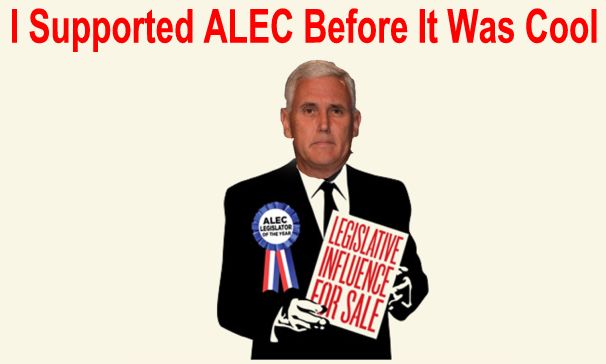
Mike Pence Set To Strengthen Ties To ALEC And Corporate-Driven Education Reform

Mike Pence Set To Strengthen Ties To ALEC And Corporate-Driven Education Reform:

Mike Pence Set To Strengthen Ties To ALEC And Corporate-Driven Education Reform


Republican vice presidential nominee and Indiana Gov. Mike Pence is reportedly scheduled to speak Friday at the annual meeting for the American Legislative Exchange Council (ALEC), which takes place in Indianapolis, IN, this year. The meeting, which typically determines the legislative priorities of the corporate-funded bill mill for the coming year, runs from July 27 through July 29. Pence was originally scheduled to speak at a July 27 ALEC event co-sponsored by the conservative-leaning Center for Education Reform but later pulled out, citing conflicts with the Trump-Pence campaign schedule. The Indianapolis Star reported that Pence rescheduled his ALEC appearance, however, and will speak at the annual meeting on July 29.
ALEC is a corporate-funded “membership organization that connects right-wing state legislators across the country with model legislation that represents “the principles of limited government, free markets and federalism” and corresponds with corporate interests on a given policy issue. ALEC’s corporate-minded -- and conservative -- model policies tackle issues from K-12 education to “academic freedom” in higher education, as well as tax reform, social programs, environmental and infrastructure policies, and health care. Its corporate-sponsored model legislation on education issues is heavily focused on scholarship tax credits, vouchers, and other “school choice” programs that would lessen support for traditional public school systems. In line with the right-wing agenda, ALEC is also behind so-called “right to work” legislation that severely weakens unions -- including teachers unions -- and has so far been adopted in 26 states, although the law was struck down as unconstitutional by a Wisconsin state court in April.
ALEC is funded by several philanthropic organizations founded or supported by the oil billionaires David and Charles Koch -- including the Charles Koch Foundation, “dark money ATM" DonorsTrust, and Donors Capital Fund -- as well as several other staunchly right-wing private foundations. It boasts having “nearly 300 corporate and private foundation members,” who pay for memberships in order to influence the proposed model policies, and lists partnerships with several right-wing education privatization groups.
Pence’s education policies as Indiana governor have closely mirrored ALEC priorities. In fact, Pence wrote the introduction to ALEC’s annual “Report Card on American Education” in 2014, which graded Indiana highest in the nation for education policy that year. In his introduction, Pence touted Indiana’s school voucher system, which boosts federal funding for students to attend private schools, a long-standing ALEC priority. A recent Mike Pence Set To Strengthen Ties To ALEC And Corporate-Driven Education Reform:

Building California schools now big business, big money and big politics | The Sacramento Bee

Building California schools now big business, big money and big politics | The Sacramento Bee:

Building California schools now big business, big money and big politics


Building and refurbishing the schools that house 6 million California kids has become very big business.
Over the last few decades, the state has issued about $45 billion in school bonds, mostly for K-12 schools, some for colleges, and repaying lenders costs the state nearly $3 billion a year. With interest, retiring the bonds will have cost about twice their face value, or some $90 billion.
Local school districts have issued many billions more in voter-approved bonds to match state grants, and property taxes have been hiked to pay for them.
The school construction tab is likely to increase even more because a $9 billion bond issue has been placed on the Nov. 8 ballot by a coalition of school groups, developers and the construction companies that profit from school contracts.
If it passes, the state’s tab for repayment would increase by another half-billion dollars a year, and Gov. Jerry Brown has been highly critical, saying the system for allocating bond money is fatally flawed.
Pointedly, the bond measure, Proposition 51, preserves an arcane formula that protects developers from having to fully pay for school construction serving their residential tracts as long as the state has bond money.
In a sense, therefore, it preserves a subsidy from taxpayers – or, taking the contrary view, avoids making housing prices even higher than they are now.
Another very questionable aspect of Proposition 51 is that bonds repaid over 35 years may be used for reroofing, air conditioning, playground equipment and other maintenance and operational projects that won’t last nearly that long.
There is another aspect to the school construction picture.
Last week, state Treasurer John Chiang and county treasurers jointly declared that if municipal bond houses – the firms that underwrite bond issues – provide campaign money or other assistance to local school bond issues, they will be barred from doing bond business with the state.
“Not only are these pay-to-play arrangements unlawful, they rip off taxpayers and endangerBuilding California schools now big business, big money and big politics | The Sacramento Bee:


Read more here: http://www.sacbee.com/news/politics-government/politics-columns-blogs/dan-walters/article93143177.html#storylink=cpy

Stand for Tennessee Floods School Board Races with Money | Nashville Scene

Stand for Tennessee Floods School Board Races with Money | Nashville Scene:

Stand for Children Floods School Board Races With Money
The pro-charter group's independent expenditure campaign is responsible for the effort

Pro-charter school group Stand for Children poured more than $230,000 into Nashville school board races in the month of July, according to campaign finance disclosures, an unprecedented independent expenditure into local educational politics.
Stand for Children also lists nearly $160,000 in expenses for polling and advertising not itemized by a particular race. The group has spent another $8,763 on canvassers for school board races.
When reached for comment, Dan O'Donnell, the Nashville director for Stand for Children Tennessee, said that he was not responsible for the spending but would put the Scene in contact with Krista Spurgin, who works for Stand for Children's Independent Expenditure committee and is listed as part of Stand for Children's national staff. O'Donnell made a distinction between the two groups: Stand for Children Tennessee's political action committee has been an advocate for a number of policies, including expanded pre-K as well as charter schools, and has been a longtime presence in Nashville education circles. The Independent Expenditure Committee is run by "someone else entirely" and "I found out about the disclosures when you did."
"These are incredibly important school board races on the most important issue in Nashville and advocacy groups are going to advocate in the best way that they know how," O'Donnell says. "There's nothing unusual about having a political action committee and an independent expenditure campaign."
Highlighting the confusion between the two is the fact that both list 1207 18th Ave. S as their address.
Predictably, the targets of the money were angered by the expenditures.
“My children go to the very schools these crooks are trying to buy,” incumbent Amy Frogge says. “They have spread malicious lies about me, all the while secretly acknowledging that I have an ‘army of moms’ supporting my campaign. They are like Stand for Tennessee Floods School Board Races with Money | Nashville Scene: