Latest News and Comment from Education

Thursday, July 14, 2016

For LGBTQ Students, Author Says, Safety Is 'Not Enough' : NPR Ed : NPR

For LGBTQ Students, Author Says, Safety Is 'Not Enough' : NPR Ed : NPR:

For LGBTQ Students, Author Says, Safety Is 'Not Enough'

Gay-straight alliance school bus at Seattle Pride, 2008.
Flickr user jglsongs/Flickr Creative Commons

Across the country there are stories like this: In a high-poverty area of Honolulu, a high school social worker helps her Asian-Pacific Islander students talk with their families about being LBGTQ.
At a time when LGBTQ concerns in schools are increasingly visible — and often debated — teachers and administrators are looking for new ways to support students.
In Puyallup, Washington, a third-grade teacher coaches her students on how to respond to language like "that's so gay" by starting discussions about respect for LGBTQ people in the classroom.
And in a Utah, a socially conservative state, students at a high school with supportive staff connect over social media with students in communities that are less accepting of LGBTQ lifestyles.
Michael Sadowski brings us these stories in his new book,Safe Is Not Enough: Better Schools for LGBTQ Students.
Safe Is Not Enough
Safe Is Not Enough
Better Schools for Lgbtq Students
Paperback, 232 pages
purchase
He's an expert in adolescent identity development, focusing on LGBTQ (lesbian, gay, bisexual, transgender, and queer) students. For the book, Sadowski talked to educators around the U.S. to find out how they're integrating LGBTQ-inclusive policies into the curricula and cultures of their schools.
In doing so, Sadowski criticizes strategies that aim for safety as their end goal. Safety is an important goal, he writes— "a critical baseline from which all subsequent work must follow."
But, he tells NPR, "would we accept safety as the one and only goal for any other population of students? Why do LGBTQ kids have to settle for safety as the only thing they can expect from the adults who run their schools?"
Here's our Q&A with Sadowski, edited for length.
Note: NPR normally uses the acronym LGBT to refer to "lesbian, gay, bisexual and transgender" persons. Sadowski adds a "Q" for "queer." We're doing that as well for this report.
You raise a critical question about "safe spaces" in schools such as those labeled by stickers and posters: "If a certain place in the school is designated as a safe space, what does that say about the rest of the building?"
We're in a different political reality than we were in the 1980s and '90s. I think there are many educators out there now who want to make their schools not just safe, but affirming and empowering for their LGBTQ students. They just don't know where to start. The amazing teachers, administrators, counselors, and kids I met while researching the book show how a lot of people are already For LGBTQ Students, Author Says, Safety Is 'Not Enough' : NPR Ed : NPR:

'Get to green:' California wants to grade school performance with colors instead of a single number - LA Times

'Get to green:' California wants to grade school performance with colors instead of a single number - LA Times:

'Get to green:' California wants to grade school performance with colors instead of a single number


 r the last 15 years, a number between 200 and 1,000 told parents in California how good their child’s school was.

Up next: They might have to decipher performance through a series of colored boxes.
California is in the process of redefining its system for rating public schools, in a way that is both transparent for parents and more precise than just using test scores. The changes come after the number system, called the Academic Performance Index, was suspendedand as the state tries to satisfy the Every Student Succeeds Act, the federal government’s replacement of No Child Left Behind.
The latest proposal, presented Wednesday at a meeting of the State Board of Education in Sacramento, is “the California Model,” a display of 17 colored boxes that summarize how a school is doing in such categories as math or career readiness, both in terms of current status and progress over time.
Performance is rated on indicators set by state and federal law as well as those evaluated under the state’s new school funding formula.
Though officials cautioned the draft was preliminary, it engendered a long debate over graphics, with one board member begging to move away from “Easter egg” colors because one pastel-tinged draft.
A school in the red on graduation means that too many students are dropping out; the best color ranking would be blue. To understand what each color means in a particular category, parents could refer to a “lookup table,” a grid of 25 colored boxes explaining in more detail what it means to be labeled a certain color. 
Eric Crane, a designer of the mock-up from the nonprofit consulting firm WestEd, 'Get to green:' California wants to grade school performance with colors instead of a single number - LA Times:

Paying Back School Kids on the Installment Plan – PA Budget Shenanigans | gadflyonthewallblog

Paying Back School Kids on the Installment Plan – PA Budget Shenanigans | gadflyonthewallblog:

Paying Back School Kids on the Installment Plan – PA Budget Shenanigans

allowance2
Hey, Kids!
We’re your Pennsylvania Legislature, and we’re here to help!
We just passed a new state budget that puts $200 million more in your classrooms! Isn’t that great!?
Yeah. We know. Your public schools are crumbling to dust, and your school books are falling apart, and you’re stuffed into overcrowded classrooms, and…
But here’s some more money so it’s all better now!
Um. No. It actually doesn’t heal that huge chunk of cash we slashed from public schools six years ago. We’ve been giving you back about $100-200 million a year for a while now, so with this new budget… uh… We’re actually about $150 million short. But we’re good for it!


The Failure of U.S. Schools as “Guardians of Democracy” | Larry Cuban on School Reform and Classroom Practice

The Failure of U.S. Schools as “Guardians of Democracy” | Larry Cuban on School Reform and Classroom Practice:

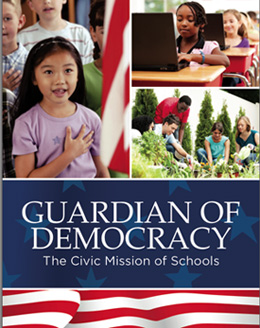
The Failure of U.S. Schools as “Guardians of Democracy”


“If 50 percent of a school district‘s graduates could not read, we‘d fire the superintendent. Yet regularly less than half our graduates vote. In our ―accountability era, no superintendent has been fired for failing in this core mission of our ―’guardian of democracy.’ ”
The  quote comes from a paper written by Michael Johanek in 2011 about the century-old history of civic education in the U.S.. However,  since the early 1980s business-minded state and federal reformers “re-purposed”  K-12 schools into building  a stronger, globally competitive economy through higher academic standards, increased testing, and tougher accountability for student results; the traditional goal of civic education has become a “Second Hand Rose.” That has been the case for the past three decades.
Relegated to applause lines in graduation talks, making students into citizens who are engaged in their communities gets occasionally resuscitated by national commissions, occasional reports and books, and pronouncements from top officials (see herehere, and here), but the sad truth is that until the dominant  rationale for schooling the young shifts from its current economic purpose to its historic role as “guardian of democracy,” only   fleeting references to the civic purpose of schooling will occur.
I do not know whether such a shift will occur in the immediate future. I surely want it to occur.  Trimming back the prevailing economic purpose for tax-supported schools and correcting the current imbalance in preparing children and youth for civic participation is long overdue. Consumerism  has enveloped public schools over the past three decades. The role of schools to teach democratic values and skills and insure that students have opportunities to practice the skills and values in their communities has been shoved aside. Were such a political change to occur,  it will be gradual as more and more parents, taxpayers, and policymakers come to see the harmful imbalance among the multiple aims for schools in a commerce-driven democracy. Were that political shift in purposes to occur, the crucial question of what kind of a citizen does the nation want will re-emerge as it had in earlier generations of school reformers.
That question of what kind of citizen has been around since tax-supported public schools were founded two centuries ago. No one answer has sufficed then or now because there are different ways of viewing a “good” citizen (see here and here). Nor has any answer in the 1920s, 1940s, 1960s–when schools were expected to prepare students to participate and engage in the community–sufficed. Arguments over the kinds of citizenship that should be practiced in and out of The Failure of U.S. Schools as “Guardians of Democracy” | Larry Cuban on School Reform and Classroom Practice:
 

Priorities Gone Wrong: Prison Spending Skyrockets, Leaves School Spending Behind | janresseger

Priorities Gone Wrong: Prison Spending Skyrockets, Leaves School Spending Behind | janresseger:

Priorities Gone Wrong: Prison Spending Skyrockets, Leaves School Spending Behind


The U.S. Department of Education just released a report, State and Local Expenditures on Corrections and Education, that reinforces what is known about the alarming explosion in the rate of incarceration in the United States.
The Education Department’s report is about budgets—across states and localities: “From 1979-80 to 2012-13, public PK (PreK)-12 expenditures increased by 107 percent (from $258 to $534 billion), while total state and local corrections expenditures increased by 324 percent (from $17-$71 billion)—triple the rate of increase in education spending…  All states had lower expenditure growth rates for PK-12 education than for corrections, and in the majority of the states, the rate of increase for corrections was more than 100 percentage points higher than the rate for education… In 24 states, the growth rate in per capita corrections spending was more than 100 percentage points higher than the rate for per-pupil PK-12 education spending.”  Finally, “At the postsecondary level, the contrast was even starker: from 1989-90 to 2012-13, state and local spending on corrections rose by 89 percent while state and local appropriations for higher education remained flat.”
The new report confirms the trend in K-12 education spending reported last winter by the Center on Budget and Policy Priorities: “At least 31 states provided less state funding per student in the 2014 school year (that is, the school year ending in 2014) than in the 2008 school year, before the recession took hold.  In at least 15 states, the cuts exceeded 10 percent.”  State governments are spending less on public education than they used to.  Most of the increases in education spending in the past few decades have been for special services mandated under the Individuals with Disabilities Education Act.
The new report from the Department of Education further confirms the reality of the exploding rate of incarceration over recent decades: “(T)he number of people incarcerated in state and local correctional facilities more than quadrupled over the past few decades, rising from about 490,000 in 1980 to over 2 million in 2014, due in part to the enactment of Priorities Gone Wrong: Prison Spending Skyrockets, Leaves School Spending Behind | janresseger:

Diane Ravitch at SOS Rally - Living in Dialogue

Diane Ravitch at SOS Rally - Living in Dialogue:

Diane Ravitch at the SOS Rally, Washington DC, July 8, 2016


The Sanders Rebellion Pushes The Democratic Party Platform Toward A Big Fight Over Charter Schools

The Sanders Rebellion Pushes The Democratic Party Platform Toward A Big Fight Over Charter Schools:

The Sanders Rebellion Pushes The Democratic Party Platform Toward A Big Fight Over Charter Schools


Earlier this week my colleague Richard Eskow reported on the impact the populist progressive movement led by Bernie Sanders and others is having on the Democratic Party Platform to be voted on at the party’s national convention in Philadelphia later this month.
Eskow reports that during the Democratic Party Platform Committee meeting in Orlando, where the document underwent the final round of amendments, Sanders supporters “scored some impressive wins” on law enforcement and criminal sentencing reform, climate change and green energy, a living wage, and Social Security expansion.
What about education?
As I reported last week, the original platform document was tepid in its support for progressive education, lacking an overall vision for public education and falling short on providing specific proposals needed to ensure greater access to higher education, to support high-quality K-12 schools, and to address the threat posed by privatization and the charter industry.
Unfortunately, the amendment process in Orlando did not consider adding a progressive vision for public education to the platform, but many of the specifics in the document shifted to the left, thanks mostly to supporters of the Sanders campaign joining with Clinton supporters to press for progressive change.
Specifically, Chuck Pascal, a Sanders delegate from Pennsylvania who willnow support Hillary Clinton for the nomination, joined with Troy LaRaviere, the outspoken Chicago school principal who Sanders stood up for after he was ousted from his post by Chicago’s appointed school board, to insist on changes to the document’s positions on testing, school discipline, well-rounded curriculum, funding, and charter schools.
The Sanders supporters teamed up with Clinton delegates, including Randi Weingarten, the leader of the American Federation of Teachers, to deliver a platform that “now takes a stand against the high-stakes testing regime, opposes school closing based on test scores, opposes evaluating teachers by test scores, and emphasizes the importance of democratically-controlled public schools,” as education historian Diane Ravitch writes on her personal blog.
formal statement released by AFT hails the revised platform as “a refreshing sea change in its approach to public education.”
One way you can tell how much the document has been improved is by The Sanders Rebellion Pushes The Democratic Party Platform Toward A Big Fight Over Charter Schools:

Education Insider: Conservatives bummed by results of Ohio school-voucher study | The Columbus Dispatch

Education Insider: Conservatives bummed by results of Ohio school-voucher study | The Columbus Dispatch:

Education Insider: Conservatives bummed by results of Ohio school-voucher study


report last week by the pro-school-choice Thomas B. Fordham Institute on Ohio’s private-school voucher program showed that vouchers hurt the academic achievement of those students who use them but help those who don’t.
First, hats off to the conservative institute, which said it commissioned the study hoping to prove that voucher students were doing better. “Let us acknowledge that we did not expect — or, frankly, wish — to see these negative effects for voucher participants,” Fordham wrote.
Students who used vouchers to attend participating private schools on the taxpayers’ dime performed significantly worse on standardized tests than “they would have performed had they remained in the public schools,” the study found. Maybe private schools don’t teach to the test, or maybe the ones that accept vouchers aren’t really that great.
But the really shocking part was that the voucher students typically start out as higher-performing students compared with those who could have used a voucher but didn’t. Students don’t get vouchers unless the private school accepts them, the study noted. That allows private schools to turn away the lower-performing students.
The study also concludes that, even though voucher students got worse results, the voucher program was responsible for improving the public schools’ results. In a nutshell, the study used three methods: one found zero improvement in the public schools as a result of vouchers; another, using different assumptions, found that vouchers improved the public schools; and the “tiebreaker” also found improvement, but almost all of it was among white, more-affluent boys in middle school.
The study concludes that public schools improved because they were forced to compete against the poor-performing voucher schools. That sounds kind of like the Cleveland Browns concluding: We lose our games despite getting the No. 1 draft picks each year, but having us around causes the rest of the NFL to do better.

ECOT’s tough week in court

ECOT, the state’s largest online charter school, went to court Monday to argue that state lawmakers never intended to require that its students actually participate in school for a year in return for a year’s worth of state funding. It argued that students must only be “presented with” 920 hours of “learning opportunities” each academic year — they don’t actually have to do that much schoolwork.
The Ohio Administrative Code, the compilation of rules the state uses to enforce the law, says this about the minimum hours of required learning opportunities:
“‘Learning opportunity’ means classroom-based or non-classroom-based supervised instructional and educational activities that are Education Insider: Conservatives bummed by results of Ohio school-voucher study | The Columbus Dispatch:


Allegations Of Financial Misconduct Cast Doubt On Future Of 2 Stockton Charter Schools « CBS Sacramento

Allegations Of Financial Misconduct Cast Doubt On Future Of 2 Stockton Charter Schools « CBS Sacramento:

Allegations Of Financial Misconduct Cast Doubt On Future Of 2 Stockton Charter Schools


 STOCKTON (CBS13) — The future of two Stockton charter schools is in limbo amid accusations of financial misconduct.


The New Jerusalem Elementary School District planned to meet with parents Wednesday evening, but was threatened with legal action from the outside group running both charter schools.
A cease-and-desist letter was sent to the New Jerusalem Elementary School District Wednesday afternoon by the Tri-Valley Learning Corporation, which runs the Acacia Charter Schools in Stockton. In the letter, attorneys call the meeting a “shadow forum,” insinuating it was set up secretly, which they say is unprecedented.
David Thoming, New Jerusalem’s Superintendent, says, “Tonight’s meeting was supposed to be an open dialogue to share ideas and solutions about how to keep the schools open.”
Last September, Thoming says he uncovered 15 incidents of financial misconduct by the Tri-Valley Learning Corporation, the most egregious involving funding other charter schools with money from outside funding.
Thoming says money raised for one school is supposed to stay within that school.
The unusually low cash reserve in the corporation’s bank account is what made Thoming suspicious. The account only had $20,000 when it should have had more than $100,000.
“They just kept giving us different documents, and we started asking a lot of questions,” Thoming said.
School board held a meeting last week to decide whether it should revoke the Acacia schools, but Tri-Valley Learning Corporation gave the district a new set of financial records to inspect.
Thoming says the group gave the board a document containing approximately 2,000 pages, and it’s taking days for them to sort through.
If the schools shut down, Thoming says more than 500 students have no place to learn starting in August.

CBS13 made several attempts to speak to the Tri-Valley Learning Corporation Wednesday but received no response.
The board is set to discuss the final fate of the schools July 29.

SN&R prevails in yearlong First Amendment battle with Sacramento Mayor Kevin Johnson - Sacramento News & Review

Sacramento News & Review - SN&R prevails in yearlong First Amendment battle with Sacramento Mayor Kevin Johnson - News - Local Stories - July 14, 2016:

SN&R prevails in yearlong First Amendment battle with Sacramento Mayor Kevin Johnson

Judge orders K.J. to turn over remaining emails and records


Friday afternoon lumbered toward 5 o’clock as Sacramento Superior Court Judge Christopher Krueger patiently indulged Mayor Kevin Johnson’s attorney. The counsel, a dapper lawyer from Los Angeles named Scott Humphreys, wanted to retreat to the judge’s chambers, to discuss in private one final time why a few dozen mayoral emails from years ago should remain hidden from the public eye. But Krueger wasn’t having it. At one point, the judge even lifted his arms in a gesture of incredulity. And, later, flashed a smirk.
“Let me just tell you, the answer is no,” Krueger told the mayor’s counsel. “I’m not going to let this in chambers.” The judge then reminded Humphreys that SN&R and Johnson have had copious opportunity to debate the nature of the emails in question.
More than a year, in fact. But finally, this past Friday, Krueger ruled that Johnson and the city must make public 79 of the remaining 113 emails and records. Ballard Spahr, the firm that represents the mayor pro bono, needs to turn them over by July 18.
During the hearing, Humphreys was steadfast in his lobbying to keep some of the records secret. He contested that, since Ballard Spahr had reviewed firsthand many of the emails and attachments in question, they were clearly protected from disclosure because of “attorney-client privilege”—a phrase he repeated ad nauseam.
Eventually, Krueger schooled him on the law. “Every document that an attorney has seen does not fall under attorney-client privilege,” the judge explained—adding that this was legal fact no matter how many times Humphreys made a “talismanic recitation of those words.”
It was a memorable zing during a hearing that, after 16 months since the original request for emails, ended with a favorable ruling for SN&R.
This media company’s attorney called the judge’s order a big win for freedom of the press. “I was very Sacramento News & Review - SN&R prevails in yearlong First Amendment battle with Sacramento Mayor Kevin Johnson - News - Local Stories - July 14, 2016:


The Empire Strikes Back: The Sudden Rise and Ongoing Challenges of Democrats for Education Reform - AEI

The Empire Strikes Back: The Sudden Rise and Ongoing Challenges of Democrats for Education Reform - AEI:
The Empire Strikes Back: The Sudden Rise and Ongoing Challenges of Democrats for Education Reform


 Key Points

  • Still relatively new on the scene, DFER benefited enormously from its long-shot early endorsement of Barack Obama and the unprecedented national focus on Obama’s $5 billion Race to the Top grant program.
  • Conflicts with teachers unions and other traditional education stakeholders steadily heated up over the years, thanks in part to DFER’s dogged focus on charter school expansion (and charter school funders), challenges to sitting incumbents, and reform implementation challenges.
  • DFER became increasingly exposed when unions and others shifted their support for Common Core and began attacking the organization as part of a “corporate reform” movement led by white elites. Meanwhile, DFER was slow to broaden its agenda to include immigration, school discipline, and other social justice issues.
Introduction

Last summer, the cluster of interconnected organizations known collectively as Democrats for Education Reform (DFER) celebrated its eighth official anniversary and announced that longtime leader Joe Williams would be stepping down as executive director by the end of the year.
At the time, DFER’s full-time national staff numbered about 20 and spent about $12 million a year, according to Williams.[1] All six founding board members were still on board—a remarkable run of stability. With 13 active state chapters in addition to a federal lobbying and policy shop, the organization claimed to have helped 17 states reform teacher evaluation, 11 states include student achievement in teacher evaluation and tenure decisions, and 13 states expand charter school provisions.
“I feel good about what we did,” said Williams a few months after his departure, sounding relaxed. Typically self-deprecating, Williams explained the need for new leadership in simple terms: “I just ran out of tricks.”
During the previous eight years, especially from 2008 to 2012, DFER received enormous attention—both admiring and critical—and had been extremely active. Steven Brill captured much of its early success in his 2010 book Class Warfare, a generally favorable account of education reform issues and players in the 2008 election and first two years of the Obama administration. That same year, Diane Ravitch’s The Death and Life of the Great American School System told some of the same story from a more critical perspective.
For some education reformers, DFER’s intramural, Democrats-only focus had been a breath of fresh air. Its explicitly political focus—as opposed to policy or practice—was a welcome change.
Some believed that the organization’s influence during that period had been substantial: “There’s no doubt that the Democratic Party has moved significantly more towards the reform side, even with the turn back [away from some of DFER’s ideas] now,” said Drew University’s Patrick McGuinn in an early 2016 interview. DFER is “not the only reason but [it] has played a big role,” according to McGuinn, who penned a 2012 look at DFER’s policy leadership.[2]
Others believed that DFER had done little or had even been a destructive force within the Democratic Party. “I met the folks at DFER through John Petri at Gotham Capital,” recalled Daniel Leeds, a DC businessman and philanthropist who had helped found the League of Education Voters and who regularly convened a broad group of education funders. “I didn’t see how [their approach] was going to drive education attainment forward.”[3]
Taking the middle view were those who, while generally supportive of DFER’s aims, wondered why it hadn’t done more with the amazing luck and momentum that it had enjoyed. DFER “didn’t create a broad movement among Democratic lawmakers around revamping how schools work,” said former Michigan lawmaker Tim Melton, who moved over to work for StudentsFirst, a school reform advocacy group that recently merged with 50CAN.
After Williams’ departure, the question was whether DFER was “out of tricks,” too. Could DFER—founded to create a “safe place” for pro-charter, reform-oriented Democratic politicians to make much-needed changes to the education system—find ways to deepen and expand its successes without such a close ally in the White House as it had enjoyed during the Obama administration? Could DFER find new ways to influence the political process at the state and local levels, as it had done for a time federally?

DFER’S Accomplishments

The main question of this case study is to consider DFER’s influence and impact from 2008 to 2016. Some other key questions include:
  • How did DFER’s influence rise or fall during that time—and why?
  • What strategies and tactics did DFER use to influence the political process, and which ones worked better than others?
  • Did DFER—described in one AFT document as “an education privatization group started by hedge fund managers”—help to destabilize or enlarge the Democratic Party?
What seems clear is that DFER emerged in the right place at the right time—and backed the right horses, including Barack Obama and Cory Booker. In remarkably short order, DFER and its allies became among the only folks that Obama could turn to for advice on how to fulfil his promise as a reform-minded Democratic president. Then, when Race to the Top (RTTT) turned into a competition among states for scarce new federal education dollars, DFER basically went from not existing to helping shape federal policy in two years flat.
But even as DFER and its allies enjoyed incredible successes, its reputation for influence exceeded its real-world abilities, and the cracks in the model were already forming. The 2010 rise of the Tea Party, the push to implement both new standards and teacher evaluations at roughly the same time, and the emergence of a powerful new social justice movement all helped put DFER and its school reform allies in direct conflict with the teachers unions and a growing number of Democrats who identified as progressive or liberal.
The backlash against “corporate reform” nationally and in places like Newark would surprise DFER and its allies with its power and suddenness. They found their ideas—such as common standards for all children—used as a proxy to fight back against them.
By the time forces aligned to roll back the federal education law known as No Child Left Behind (NCLB), the unions and conservatives were teamed up on their own. DFER and its allies, used to being at the center of everything, were left somewhat to the side.
Even under new leadership, it’s hard to predict what happens to DFER in a post-Obama environment. DFER and its allies will need to rebrand themselves to make clear that they are trying to change attitudes and address broader issues rather than merely looking to pass another teacher evaluation bill. The next White House occupant isn’t likely to be a close ally. The action is going to be in the states. “They’ve never really existed without Obama,” said one close observer who didn’t want to be named. “That’s a question looming out there for them.”

Wednesday, July 13, 2016

Activists & Advocates make a dent in Democrats' Education Platform — PS connect

Activists & Advocates make a dent in Democrats' Education Platform — PS connect:

Activists & Advocates make a dent in Democrats' Education Platform

There has been much debate in the last week about whether the Democratic Party is signaling a change in education policy, and this weekend’s Convention Platform meeting provides the best measure.
Earlier in the week, Hillary Clinton spoke to the National Education Association and was well received, except for a comment distinguishing for-profit charters from nonprofit, as if there is a way to qualify the threat charters pose to public schools. Dana Goldstein wrote in Slate that “Hillary Clinton is changing the Democratic Party’s relationship with the school-reform movement.” But education advocates are not so sure.
Blogger Peter Greene is not believing it, saying Clinton is just parsing words. He has the best line ever written on the topic:  "...a modern non-profit charter school is just a for-profit school with a good money-laundering plan."  Jeff Bryant says, maybe and Diane Ravitch says, “time will tell,” advising, “we should all give Hillary Clinton a chance to change direction.” All that is speculation based on interpretation. Advocates are petitioning Clinton to meet with Ravitch for more assurance. The Network for Public Education made headlines for helping advocates with a grassroots push to influence the platform.
Yesterday’s amendments to the Democratic Party’s education platform are the first indication of anything concrete. Much of what was found in the amendments are also recommended by the Network for Public Education.
Of course, bloggers and activists will continue to debate. To help that discussion along, here is the text of the amendments andsome of the remarks made during the Committee’s consideration. (Quotation marks indicate direct quotes. Full remarks can be heard on the C-SPAN link, which is indexed and easy to navigate.)
The session started with higher education topics including eliminating college debt and increasing access to college. K-12 amendments were introduced by Chuck Pascal, a Bernie Sanders delegate from Pennsylvania, and AFT President Randi Weingarten, a Hillary Clinton supporter.
AMENDMENT 76 – Testing – passed unanimously
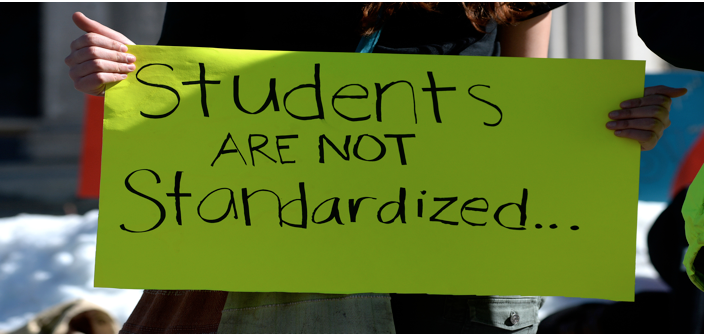
We are also deeply committed to ensuring that we strike a better balance on testing so that it informs but does not drive instruction. To that end, we encourage states to develop a multiple measures approach to assessment and we believe that standardized tests must meet American Statistical Association Standards for reliability and validity. We oppose high-stakes standardized tests that falsely and unfairly label students of color, students with disabilities, and English Language Learners as failing; the use of standardized test scores as a basis of refusing to fund schools or to close schools; and the use of student test scores in teacher and principal Activists & Advocates make a dent in Democrats' Education Platform — PS connect: