Latest News and Comment from Education

Wednesday, June 22, 2016

Five Myths Reformers Want You to Believe about Teachers – Save Maine Schools

Five Myths Reformers Want You to Believe about Teachers – Save Maine Schools:

Five Myths Reformers Want You to Believe about Teachers

Teachers are no strangers to having stories told about them in order to move political agendas forward. During the era of No Child Left Behind, tales of lazy and incompetent teachers helped pave the way for strict accountability measures. Now, as ESSA marches forward with its plans to commodify, digitalize, and outsource education, a new set of myths has begun to circulate. Here are some of the most common fables you’re likely to hear.
  1. We spend most of our time lecturing.

In a 2010 article titled Teachers Unions vs. Online Education, Katherine Mangu-Ward summed it up like this: “A child who was perfectly content with a video stream, an MP3, and a chart flowing past him is suddenly ordered to sit still, shut up, and listen while a grown-up scrawls on a blackboard and delivers a monologue.”
lecture-gif.gif
But here’s the truth: most teachers spend very little time lecturing. At the elementary level, most teachers are trained in the “workshop model” of instruction, where direct instruction is limited to a short “mini-lesson” only. Across all grade levels, most teachers combine discussions, projects, and group work into their daily lessons. Scrawling on blackboards while delivering monologues? Not so much.

 2) We make our kids memorize lots of stuff.

This one also makes a great foil for reform plans: while teachers simply jam a bunch of knowledge into kids’ brains…
6a012876c6c7fb970c01a73dfd8d3c970d-300wi.gif
…online and digital programs will actually teach kids how to think.
But again: this just doesn’t happenIn most contemporary education programs, teachers are taught to use the constructivist model of education, where knowledge is “co-created” between teacher and student, and memorization takes a back seat to meaning-making. Meanwhile, the end-of-year math and ELA assessments don’t actually require students to know any particular facts at all; instead Five Myths Reformers Want You to Believe about Teachers – Save Maine Schools:


The Disruption of America's (Broken) Education System - The Atlantic

The Disruption of America's (Broken) Education System - The Atlantic:

America's Not-So-Broken Education System

Do U.S. schools really need to be disrupted?


Everything in American education is broken. Or so say the policy elites, from the online learning pioneer Sal Khan to the journalist-turned-reformer Campbell Brown. As leaders of the XQ project succinctly put it, we need to “scrap the blueprint and revolutionize this dangerously broken system.”

This, they explain, is the sad truth. The educational system simply stopped working. It aged, declined, and broke. And now the nation has a mess on its hands. But there’s good news, too. As Michelle Rhee’s group, StudentsFirst, declares: Americans can “work together to fix this broken system.” All it takes is the courage to rip it apart.

This is how the argument goes, again and again. The system used to work, but now it doesn’t. And though nobody inside schools seems to care, innovators outside the establishment have developed some simple solutions. The system can be rebuilt, reformers argue. But first it must be torn down.

American education has some obvious shortcomings. Even defenders of the schools can make long lists of things they’d like to change. But the root of the problem is not incompetent design, as is so frequently alleged. Nor is it stasis. Rather, it is the twofold challenge of complexity and scale. American schools are charged with the task of creating better human beings. And they are expected to do so in a relatively consistent way for all of young people. It is perhaps the nation’s most ambitious collective project; as such, it advances slowly.

For evidence of this, one need look only to the past. If the educational system had broken at some point, a look backward would reveal an end to progress—a point at which the system stopped working. Yet that isn’t at all the picture that emerges. Instead, one can see that across many generations, the schools have slowly and steadily improved.


Consider the teachers in classrooms. For most of American history, teachers received no training at all, and hiring was a chaotic process in which the only constant was patronage. To quote Ted Sizer on the subject, the typical result was one “in which some mayor’s half-drunk illiterate uncle was hired to teach twelfth-grade English.” There were other problems, too. As late as the 20th century, for instance, would-be educators generally had little if any student-teaching experience prior to entering classrooms, and they received no preparation for teaching particular content areas. Even as recently as mid-century, prospective teachers had no background in adolescent cognition and received no training in The Disruption of America's (Broken) Education System - The Atlantic:


JACC: Ex-LA mayor Riordan fined by Ethics Commission - MyNewsLA.com

Ex-LA mayor Riordan fined by Ethics Commission - MyNewsLA.com:

Ex-LA mayor Riordan fined by Ethics Commission


Former Los Angeles Mayor Richard Riordan was ordered Thursday to pay an $11,250 ethics fine for failing to include required disclaimer language on communications supporting three candidates for Los Angeles Unified School District board seats.
The fines were approved by the Los Angeles City Ethics Commission, which found that Riordan violated rules aimed at ensuring people know who is spending money to send out campaign materials.
Riordan sent out electronic communications in 2013 expressing support for LAUSD board candidates Monica Garcia, Kate Anderson and Antonio Sanchez, but he neglected to include language saying those materials were not authorized by the candidates themselves and their committees, Ethics Commission investigators wrote in a report.
Riordan spent $30,000 on those messages, and sent them out to about 500,000 people, investigators said.
Riordan did disclose the independent expenditures and submitted copies of the communications to the Ethics Commission, investigators said.
Riordan has admitted to the violation and agreed to pay the $11,250, which is 75 percent of the $15,000 in possible penalties, investigators said. Each of the three violations carries a maximum penalty of $5,000.
The total fine amount is meant to “reflect the serious nature of the violations and Riordan’s prior enforcement history, while fostering cooperation with Ethics Commission Ex-LA mayor Riordan fined by Ethics Commission - MyNewsLA.com:


Appeals court: Parents’ rights trumps agency authority :: SI&A Cabinet Report

Appeals court: Parents’ rights trumps agency authority :: SI&A Cabinet Report :: The Essential Resource for Superintendents and the Cabinet:

Appeals court: Parents’ rights trumps agency authority

Appeals court: Parents’ rights trumps agency authority


(Calif.) In a ruling with implications for how disputes over special education services are resolved, the 9th U.S. Circuit Court of Appeals confirmed a parent’s right to a due process hearing regardless of potentially conflicting state laws.
The ruling, which was released unpublished but could have an influence throughout much of the western United States, also clarified that “related services” under the Individuals with Disabilities Education Act can include medically necessary occupational and physical therapy if it has been included as part of a student’s Individualized Education Plan.
The court finding is important to both school districts and state and county social welfare agencies that are often at odds over the need to provide related services to students with disabilities and, more to the point, who pays for it.
To some degree, prior legislative and court actions in many states have already established that occupational and physical therapy can be ordered by an IEP team for a student if deemed necessary.
In this instance, it was the California Department of Health Care Services that brought the case forward against the parents of a severely disabled 12-year-old boy enrolled in the Cupertino Union School District. One of the department’s programs, the California Children’s Services, provides physical and occupational therapy to low-income children with acute or chronic medical conditions.
For several years, the boy’s physical and occupational therapy were provided through the Children’s Appeals court: Parents’ rights trumps agency authority :: SI&A Cabinet Report :: The Essential Resource for Superintendents and the Cabinet:

UNO’s Rangel gets a slap on the wrist for charter scam. | Fred Klonsky

UNO’s Rangel gets a slap on the wrist for charter scam. | Fred Klonsky:

UNO’s Rangel gets a slap on the wrist for charter scam.

juan-rangel1
What happens to federal investigations of Chicago corruption?
Whatever happens when you read, “The feds are investigating?”
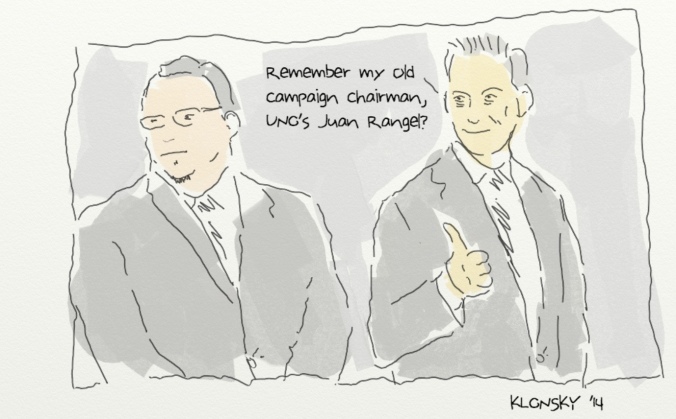
Yesterday Rahm Emanuel’s campaign chairman and former United Neighborhood Organization boss, Juan Rangel, got a slap on the wrist from the Securities and Exchange Commission for engaging in securities fraud.
UNO was one of the largest charter school operators in the state of Illinois. Money isn’t made by charters by charging admission. Gobs of money are made through contracts, kick-backs and bond sales to investors.
In the settlement with the SEC, Rangel got away with paying ten grand in exchange for admitting to doing nothing wrong.
Rangel gets to pay the ten grand in quarterly payments of $2500 dollars everyUNO’s Rangel gets a slap on the wrist for charter scam. | Fred Klonsky: 
Former UNO boss Juan Rangel broke securities law, SEC says | Chicago Sun-Times - http://wp.me/p7fJAs-10ji


Ex-Chicago charter school boss settles securities fraud case - http://www.dailyherald.com/article/20160622/news/306229957/ 


In the Newark schools, the second most powerful employee isn’t even an employee. Go figure. |

In the Newark schools, the second most powerful employee isn’t even an employee. Go figure. |:

In the Newark schools, the second most powerful employee isn’t even an employee. Go figure.

Wright: Who pays him?


Christopher Cerf, Gov. Chris Christie’s man in Newark, apparently thinks the city residents are stupid and do not deserve to know how or why or by whom his chief aide, De’Shawn Wright, is paid. That really is all anyone needs to know about why Cerf should not be the schools chief in New Jersey’s largest city–but, apparently, Cerf’s contempt for the city residents is just fine for most school board members and his ally, Newark Mayor Ras Baraka.
Wright, a champion of charter schools in Washington, DC, New York, and Newark, and  past associate of Cerf and Cerf’s protégé and predecessor, Cami Anderson, is  Cerf’s chief of staff, according to an organizational chart released at Tuesday night’s board meeting. Wright is paid a six figure salary but exactly how much is a secret–as is the source of his income.
Although Wright is probably the second most powerful figure in the Newark schools, he doesn’t work for the Newark schools.
Got that? Let’s repeat it: Although Wright is probably the second most powerful figure in the Newark schools, he doesn’t work for the Newark schools.
Who does he work for? Probably for the Fund for Newark’s Future–otherwise known as what’s left of the $100 million Facebook founder Mark Zuckerberg gave to the Newark schools. But that hasn’t yet been confirmed because the fund is a private organization and not subject to New Jersey’s Open Public Records Act (OPRA). Or some other private foundation devoted to the expansion of charter schools.
Conflict of interest?
This is what happened Tuesday night as most members of the once defiant and courageous school board sat back and allowed Cerf to drone on about how he and Anderson did marvelous things for the children of Newark for the last five years. The board members, most of them,  now have to shut up because Baraka and Cerf are best budsIn the Newark schools, the second most powerful employee isn’t even an employee. Go figure. |:

Marie Corfield: 7 Things Wrong with Gov. Christie's School Funding Proposal

Marie Corfield: 7 Things Wrong with Gov. Christie's School Funding Proposal:

7 Things Wrong with Gov. Christie's School Funding Proposal


There's an old joke that goes like this: 
Q: How do you know when a politician is lying? 
A: When their lips are moving.

I guess now that Christie's poll numbers are in the tank, his ego is pushing him to appear relevant. So what does he do when his back is against the wall? Attack public education of course. 

In true Christie style, he gave a speech yesterday that even Pinocchio would cringe at, ripping into the state's school funding formula—one of the most progressive in the nation—and vowing to change it to flat funding.

There are so many things wrong with it that it's hard to know where to begin. But let's start with this: Gov. Christie used the word 'unfair' seven times in his speech. So here are seven things that are unfair not only with his proposals, but with how he has treated public education over the past 6 years:

1. Gov. Christie has cut almost $7 billion in education funding statewide, and given away just about that much in corporate tax breaks, yet he has the nerve to claim that urban education is 'failing'.

2. Under Gov. Christie, urban charter schools have bled their host public school districts of hundreds of millions of dollars, which has forced massive layoffs and cuts to programs and vital services. 

3. Under Gov. Christie, segregation has skyrocketed in urban school districts as charters habitually skim the best and brightest (and least expensive to educate) Marie Corfield: 7 Things Wrong with Gov. Christie's School Funding Proposal:


Mike Klonsky's SmallTalk Blog: Don't wade in the water, children.

Mike Klonsky's SmallTalk Blog: Don't wade in the water, children.:

Don't wade in the water, children.


"We'll spend whatever it takes to remove any devices or any piping that might pose lead hazard risk. Whatever that is, however much it costs, we will do it to make sure that our water pipes are safe and that our children, your children, are safe." --  Forrest Claypool
Claypool sounds like a guy trying to get out of a bad marriage after he's been caught cheating.

Lots of questions here. What does he mean, "whatever it takes"? What if it takes billions, like in Flint for example? I mean, we're only beginning to get a handle on the problem. Right? And why is that?

Every day, the number of schools found with leaded water grows. CPS is still awaiting test results from dozens of buildings but has disclosed that at least 27 28 schools have dangerous levels of lead in their water fountains.

Does Claypool have some unlimited mountain of money stashed somewhere that he's not telling us about? I thought the system was "broke". At least that's what he's been telling the CTU as an excuse for not settling contract negotiations with the union.

Does "whatever it takes" include making things right for the potentially tens of thousands of students, former students, and teachers who have drunk from those toxic fountains for years?


And finally, how can parents trust that current and past lead testing is on the up and up? The Guardian names Chicago as one of 33 U.S. cities that have used water testing “cheats” that potentially conceal dangerous Mike Klonsky's SmallTalk Blog: Don't wade in the water, children.:


You Can't Make this Stuff Up: Online School Students Gather Virtually for K12 International Academy Graduation Ceremony

Online School Students Gather Virtually for K12 International Academy Graduation Ceremony:

Online School Students Gather Virtually for K12 International Academy Graduation Ceremony

Students living in 32 states and 27 countries who have earned their high school diplomas through the full-time, online school K12 International Academy, will gather online June 24th during a unique graduation ceremony to celebrate their academic achievements and bid farewell to their favorite teachers.
K12 International Academy is an accredited online private school for full- and part-time students in grades K-12. As an online school available to any student with an internet connection, K12 International Academy has a unique student population that represents every state in the U.S. and over ninety countries around the globe. Highly dedicated, certified teachers deliver a quality instruction using online lessons along with text books and lab materials that are shipped to the students. Most students take a college preparatory curriculum over a four year period, and each full-time student also has the support of an Academic Coach and College Counselor to ensure personal and academic success. Students graduate with a U.S. diploma recognized by colleges and universities.
"We are committed to bringing individualized learning to all kinds of minds," said Miriam Rube, Head of School for K12 International Academy. "We help students learn in the ways that are right for them, nurturing a joy for learning and a passion to pursue their interests. And the results are nothing short of amazing."
The virtual graduation ceremony will start with the Pledge of Allegiance, read by Heather Smith of Houston, TX, a member of the Class of 2016 and a recipient of both the Girl Scout Gold Award and the US Congressional Award Gold Medal. Graduating seniorAnnika Horne will provide a rendition of the National Anthem.  Annika is an award-winning singer and actress who has raised over $200,000 to benefit the UT Southwestern Children's Medical Center through a series of benefit concerts.
Big Education Ape: A new political strategy: throw online charters overboard to save the rest of the school privatization industry.| Alternet - http://bigeducationape.blogspot.com/2016/02/a-new-political-strategy-throw-online.html
Big Education Ape: CURMUDGUCATION: Pearson's Cyber-Kindergarten Sales Pitch - http://bigeducationape.blogspot.com/2016/06/curmudgucation-pearsons-cyber.html


CURMUDGUCATION: Charter vs. Charter Fight Heats Up - http://curmudgucation.blogspot.com/2016/06/charter-vs-charter-fight-heats-up.html


Big Education Ape: CURMUDGUCATION: Can Cyber Schools Be Saved? - http://bigeducationape.blogspot.com/2016/06/curmudgucation-can-cyber-schools-be.html


Big Education Ape: CURMUDGUCATION: PA: New Face for Old Pearson Scam - http://bigeducationape.blogspot.com/2016/06/curmudgucation-pa-new-face-for-old.html


We May Never Know the Real Michelle Rhee!

Ex-state Senator Ron Calderon enters guilty plea in bribery case | 89.3 KPCC:

Ex-state Senator Ron Calderon enters guilty plea in bribery case


Former state Sen. Ron Calderon pleaded guilty to mail fraud Tuesday afternoon in a bribery case that sullied the reputation of the Legislature and helped win the recent passage of a ballot measure on suspending lawmakers without pay for wrongdoing.
The plea, part of a deal with prosecutors announced last week, went before federal Judge Christina Snyder in U.S. District Court in downtown Los Angeles.
Snyder accepted the plea and set a sentencing date for Sept. 19. 
As part of the agreement, Calderon admitted to accepting thousands of dollars in bribes in exchange for supporting certain pieces of legislation. Prosecutors dropped more than 20 other charges in exchange for the agreement. 
The deal spares Calderon from a trial that had been scheduled for next month and could lead to a lighter sentence for the Montebello lawmaker, who served in the Senate and Assembly for a dozen years. Prosecutors have said they’ll ask for no more than 70 months in prison, far less than the maximum 20 years that is possible.
The court is not bound by the prosecutors' sentencing recommendation. 
In court, Snyder asked Mark Geragos, Calderon's attorney, whether the plea agreement is in his client's best interest.
“It’s definitely in his best interest…I do have issues with whether it’s in the interest of justice,” Geragos said. The attorney said outside of court that the government has too much power and can bring an unlimited number of charges against a defendant.
But given his client's age, he said the plea offer wasn't one they could pass on.
"When you're 58 and you're facing basically 200 some odd years, are you going to roll the dice or are you going to take basically an offer that you can't refuse?" Geragos said.
U.S. Attorney Eileen Decker countered that she believes the reason Calderon accepted the plea agreement was because he had no defense to pursue.
"If he had a defense, he would have presented it," she said. She added that the deal avoids a lengthy trial and allows her to focus her legal resources elsewhere.
According to the plea agreement, Calderon backed legislation that the government said helped a hospital owner maintain a massive health-care fraud scheme. In exchange, the hospital owner paid $30,000 to Calderon's son for three summers of work, the plea agreement stated.
The law in question was repealed in 2013, and the hospital owner was prosecuted, the Associated Press reported.
Calderon also acknowledged taking money from an undercover FBI agent who posed as an associate of a Los Angeles movie studio. He sought Calderon's help promoting an unsuccessful bill that would have expanded tax credits for the film industry. In Ex-state Senator Ron Calderon enters guilty plea in bribery case | 89.3 KPCC:
Big Education Ape: Why Has Michelle Rhee "Disappeared"? - http://bigeducationape.blogspot.com/2015/04/why-has-michelle-rhee-disappeared.html

 
Big Education Ape: Mark Geragos wants to know: Who leaked Calderon affidavit? | Michelle Rhee and the Calderon Scandal - http://bigeducationape.blogspot.com/2015/01/mark-geragos-wants-to-know-who-leaked.html

Big Education Ape: Calderon trial Update: Will Michelle Rhee Testify? | The Sacramento Bee The Sacramento Bee - http://bigeducationape.blogspot.com/2015/04/calderon-trial-update-will-michelle.html

With guilty pleas, Calderon brothers political legacy punctuated with corruption - http://www.whittierdailynews.com/government-and-politics/20160621/with-guilty-pleas-calderon-brothers-political-legacy-punctuated-with-corruption 

Will Hillary Clinton Turn Her Back on Public Education if Elected President? CT News Junkie

CT News Junkie | OP-ED | Will Hillary Clinton Turn Her Back on Public Education if Elected President?:

OP-ED | Will Hillary Clinton Turn Her Back on Public Education if Elected President?


It would appear more than likely that Hillary Clinton will be elected as the next president of the United States come next fall.
She can be thankful in no small part to the major role that the teacher organizations in the nation such as the National Educational Association (NEA) and the American Federation of Teachers (AFT) played in their early endorsement of her presidency. Public school teachers and parents are fighting the battle of their lives in attempting to hold off the forces of privatization along with the onslaught of charter schools in the nation.
Sadly, theses forces of privatization received major support from Arne Duncan, the former Secretary of Education appointed by President Barack Obama. No other Education Secretary, especially Democratic, has done more to privatize and weaken public education than Arne Duncan who was also obsessed with standardized testing. Under his regime, public schools across the nation experienced two failed programs with Race to the Top (RTTT) and Common Core State Standards (CCSS). His so-called “testocracy” grossly neglected the impact of childhood poverty on learning for children from impoverished homes.
Likewise, under Duncan’s time in office, we have witnessed the demise of the neighborhood school and the growth of charter schools, all with corporate sponsors. Hence, it was obvious that former Secretary of Education Arne Duncan was not a public school advocate but rather a paid shill who was in the pockets of the corporate reformers and the testing industry.
If Clinton is elected as president in 2016, it will not take very long for both the NEA and the AFT to know whether their early presidential endorsement has been wasted, as was the case following Barack Obama’s nomination eight years ago in his selection of Duncan as Secretary of Education. Whether Clinton chooses someone to serve as Secretary of Education who will undo the disastrous harm that Duncan has inflicted on public education in his eight years remains to be seen. Will she choose another corporate reformer or will she surprise everyone with an appointment of someone who will be a true advocate of public education and who is widely respected by the supporters of public education in the nation?
One who comes to mind as a possible choice and someone who has a proven track record over the years in her support of public education and teachers is Diane Ravitch, author of the best selling book, Reign of Error: The Hoax of the Privatization Movement and the Danger to America’s Public Education. Dr. Ravitch has had experience as Assistant Secretary of Education during the George W. Bush administration, so she possesses firsthand knowledge of the inner workings of the U.S. Department of Education. Ravitch has traveled the country giving speeches to teacher groups and parents. There is no other individual the corporate reformers fear more for she is, without question, the nation’s greatest public school advocate. Her blog, dianeravitch.com is read by millions of educators and parents throughout the nation.
Aside from being very knowledgeable and a huge advocate for public education, she is a highly competent and distinguished educator, who has a doctorate from Teachers College, Columbia University and is currently an historian of education and Research Professor of Education at New York University.
Indeed, if Hillary Clinton wishes to demonstrate her support for public education in the United States there is no better way to prove it to teachers and parents by appointing an individual such as Dr. Ravitch to be the next Secretary of Education and who will, undoubtedly, lead the charge of restoring public education to its rightful place in the United States.

What if teachers could talk to Bill Gates about schools like a Bolivian minister did about chickens? - The Washington Post

What if teachers could talk to Bill Gates about schools like a Bolivian minister did about chickens? - The Washington Post:

What if teachers could talk to Bill Gates about schools like a Bolivian minister did about chickens?
Chickens huddle in their cages at an egg processing plant in Atwater, Calif., in 2008.  (Marcio Jose Sanchez/AP)

Bill Gates has been upsetting teachers for years. He’s spent a fortune to push education initiatives that he liked — even though educators thought they were, at best, a waste of money. Now he’s insulted a Bolivian government minister by doing the same thing. But this time, it’s over chickens. And the minister reacted publicly in a way teachers simply do not.
Gates has poured billions of dollars over more than 15 years into major projects that he fervently believed would improve public schools. None have turn out quite as he had hoped.
There was, for example, the creation and implementation of the Common Core State Standards, which most states adopted years ago but that became so controversial that some states have dropped them and many more have moved away from the federally funded tests designed to go along with them. Gates, the chief executive of Bill & Melinda Gates Foundation, recently conceded that the organization made big mistakes with the Core implementation, something many teachers have been saying for a long time.
Gates’s love for data also led him to spend hundreds of millions of dollars to develop teacher evaluation systems that can supposedly figure out the “value” of a teacher with the use of student standardized test scores — a method that assessment experts said was unreliable for those purposes. Most state adopted these systems but more recently have started to drop them. Another effort gone awry.
This time, the philanthropist has come up with a way he thinks will people who live in extreme poverty in poor countries around the world can improve their lives. How? By raising chickens. He wrote about it here in a piece “Why I Would Raise Chickens,” which says in part:
If you were living on $2 a day, what would you do to improve your life?
That’s a real question for the nearly 1 billion people living in extreme poverty today. There’s no single right answer, of course, and poverty looks different in different places. But through my work with the foundation, I’ve met many people in poor countries who raise chickens, and I have learned a lot about the ins and 
What if teachers could talk to Bill Gates about schools like a Bolivian minister did about chickens? - The Washington Post:

Tuesday, June 21, 2016

A Sad Celebration | The Merrow Report

A Sad Celebration | The Merrow Report:
A Sad Celebration


In a few days, a  charter school organization will receive the $250,000 Prize for excellence from the Eli and Edyth Broad Foundation.  Three finalists– IDEA Public Schools, Success Academy Charter Schools and YES Prep Public Schools–were announced weeks ago. The winner will be made public at the annual meeting of the National Alliance for Public Charter Schools, in Nashville on June 27.  The four previous winners of the prize are KIPP, Noble Network, Uncommon Schools and Yes Prep.  
But there’s another, more important piece of the story.  Without much publicity and for the second year in a row, the Broad Foundation is not awarding the $1,000,000 Broad Prize for Excellence in Urban Education, which has been given to a public school district. It turns out that the NAEP scores of most of the Broad Prize winners have been flat for years. These districts have been living and dying by test scores, and it’s not working, or not working well enough for the Foundation’s judges.
Ben Weider of the blog 538 deconstructed the issue in a well-reasoned piece, “The Most Important Award in Public Education Struggles to Find Winners.” Not long after, the Foundation decided to ‘pause’ the $1 million award, citing ‘sluggish’ changes in urban schools.  No prize was awarded in 2015, nor will one be this year, the Foundation’s Director of Communications told me.  As Howard Blume of the Los Angeles Times has reported, billionaire philanthropist Eli Broad has shifted his focus to charter schools.
But that’s not really new news, as the Foundation’s own pie chart reveals. Since 1999, the Foundation has made $589,500,000 in education-related grants, and 24% of the A Sad Celebration | The Merrow Report:


Charter Advocates Demand that States Reform Failing Online Academies | janresseger

Charter Advocates Demand that States Reform Failing Online Academies | janresseger:

Charter Advocates Demand that States Reform Failing Online Academies

When the largest pro-charter school advocacy organizations publish a report demanding major reforms in the sector for which they are themselves the primary advocates, you have to pay attention. The National Alliance for Public Charter Schools, the National Association of Charter School Authorizers, and 50 CAN (the pro-charter, pro-school “reform” network of state astro-turf advocacy groups) just published a scathing report on the abysmal performance of virtual, online academies.
These pro-charter organizations explain that the huge online academies are failing to educate students at the same time they are cheating taxpayers:  “(T)he well-documented, disturbingly low performance by too many full-time virtual charter… schools should serve as a call to action for state leaders and authorizers across the country.  It is time for state leaders to make the tough policy changes necessary to ensure that this model works more effectively for the students it serves. It is also time for authorizers to hold full-time, virtual charter schools accountable for performance, using measures and metrics suited to their programs and closing those that chronically fail their students.”
The new report presents facts about the growth of the online charter sector: “Of the 43 states and D.C. that have enacted charter school laws, 35 states plus D.C. allow full-time virtual charter schools. The eight that do not allow these schools are Delaware, Maryland, Massachusetts, New Jersey, New York, Rhode Island, Tennessee, and Virginia…  As of August 2014, according to National Alliance research, there were 135 full-time virtual charter schools operating in 23 states and D.C….  According to National Alliance research, enrollment in full-time virtual charter schools is highly concentrated in three states—Ohio, Pennsylvania, and California—which collectively enroll over half of full-time virtual charter school students nationwide… Full-time virtual charter schools serve a higher percentage of white students (69 percent vs. 49 percent), a lower percentage of Hispanic students (11 percent vs. 27 percent), and roughly the same percentage of black (13 percent vs. 15 percent), Asian/Pacific Islander (2 percent vs. 5 percent), Native American (1 percent vs. 1 percent), and multi-racial (4 percent vs. 3 percent) students as compared with traditional public schools.”
The report’s scathing critique of online charter schools is grounded in a trio of reports by Charter Advocates Demand that States Reform Failing Online Academies | janresseger:

Schools Matter: Our Reform Proposal

Schools Matter: Our Reform Proposal:

Our Reform Proposal


by Stephen Krashen, Susan Ohanian, and Jim Horn

Research studies over the past half-century show the effects of poverty and segregation as major factors determining school achievement. Our proposal would protect children who are being harmed by the impact of poverty, segregation, and standardized tests. 

In order for no children to be left behind, then, we propose, 


No child left unfed: proper nutrition for all children for breakfast and lunch. No child without proper health care; 
No child segregated by ethnicity, ability, or economic class;
No child without access to a well-supplied library with a credentialed librarian; 
No child exposed to unsafe and unsecured technologies;
No unnecessary testing.
The best teaching in the world will have a severely limited effect if children are hungry, ill, segregated, and without learning resources.
AND of course we recommend: free espresso available in the teachers' lounge.


References
When we control for the effect of poverty, American test scores are near the top of the world: 

Payne, K. and Biddle, B. 1999. Poor school funding, child poverty, and mathematics achievement.
Educational Researcher 28 (6): 4-13. 

Bracey, G. 2009. The Bracey Report on the Condition of Public Education. Boulder and Tempe: Education and the Public Interest Center & Education Policy Research Unit. http://epicpolicy.org/publication/Bracey-Report

Berliner, D. 2011. The Context for Interpreting PISA Results in the USA: Negativism, Chauvinism, Misunderstanding, and the Potential to Distort the Educational Systems of Nations. In Pereyra, M., Kottoff, H-G., & Cowan, R. (Eds.). PISA under examination: Changing knowledge, changing tests, and changing schools. Amsterdam: Sense Publishers.

Tienken, C. 2010. Common core state standards: I wonder? Kappa Delta Phi Record 47 (1): 14-17. Carnoy, M and Rothstein, R. 2013, What Do International Tests Really Show Us about U.S. Student Performance.Washington DC: Economic Policy Institute. 2012. http://www.epi.org/

Negative effect of poverty on school achievement: 

Berliner, D. 2009. Poverty and Potential:  Out-of-School Factors and School Success.  Boulder and Tempe: Education and the Public Interest Center & Education Policy Research Unit. Retrieved [date] fromhttp://epicpolicy.org/publication/poverty-and-potential 

No unnecessary testing: 

Kohn, A. 2000. The Case Against Standardized Testing. Portsmouth, NH: Heinemann Publishing Company.Nichols, S., Glass, G., and Berliner, D. 2006. High-stakes testing and student achievement: Does accountability increase student learning? Education Policy Archives 14(1) 
 http://epaa.asu.edu/epaa/v14n1/

Segregation:

Rumberter, R. and Palardy, G. 2005. Does segregation still matter? The impact of student composition of academic achievement in high school. Teachers College Record 107(9): 1999-2045.

Rothstein, R.  2014.The Racial Achievement Gap, Segregated Schools, and Segregated Neighborhoods – A Constitutional Insult.  Economic Policy Institute. http://www.epi.org/publication/the-racial-achievement-gap-segregated-schools-and-segregated-neighborhoods-a-constitutional-insult/
  
Johnson, R.C. 2011. Long-run Impacts of School Desegregation & School Quality on Adult Attainments. NBER Working Paper No. 16664. Revised August 2015


 Schools Matter: Our Reform Proposal: