Latest News and Comment from Education

Friday, May 6, 2016

New Orleans' Katrina school takeover to end, Legislature decides | NOLA.com

New Orleans' Katrina school takeover to end, Legislature decides | NOLA.com:
New Orleans' Katrina school takeover to end, Legislature decides


The Louisiana Legislature is ready to close a chapter in New Orleans and Hurricane Katrina history. Both the Senate and House have voted to reverse the 2005 state takeover of most of the city's public schools.
By July 1, 2018 -- or 2019, at the latest -- 52Recovery School District charters will move back to the oversight of the Orleans Parish School Board, unifying the school system once more, emptying out the Recovery system in New Orleans and symbolically healing a wound torn open after the hurricane.
The measure, Senate Bill 432, squeaked out of the House Thursday (May 5) on a 55-16 vote. It needed at least 53 votes to pass. It's now headed back to the Senate briefly because of a technical change made on the House side, but that alterations is expected to be little more than a speed bump in the process.  
The Senate unanimously approved essentially the same bill as the House, minus one small technical change, on April 20. Gov. John Bel Edwards has said he will sign the legislation once the Senate approves it again. 
But the re-unified school system won't be the same as the old days. In the past decade, the Recovery system has become a realm of independent charter schools, mini-kingdoms run by non-profit, non-elected boards. Those boards will continue to reign after the transition, making their own decisions but to meet the Orleans Parish School Board's benchmarks. Currently they report to the Recovery district, which is a unit of the state Education Department, and to the Louisiana Board of Elementary and Secondary Education.
The School Board won't be allowed to meddle in charters' affairs. The bill says the board may not impede charters' control of calendars, personnel, collective bargaining, contracts and curriculum, among other areas.
"For all intents and purposes, the schools will continue to function exactly as they do now," state Rep. Walt Leger, D-New Orleans, told the House. 
Why now?
Exciting to some, the post-Katrina takeover was painful to others. Everyone agreed New Orleans schools were in deep trouble – academically, financially and politically -- even before the deep waters unleashed by the storm and the levee failures. The School Board hurt its cause after the storm by refusing to reopen schools immediately, even as some private schools and public ones in the suburbs were managing despite their losses.
As a result, the Recovery system seized four fifths of New Orleans public schools. That was all the schools that had been officially deemed failures and many that were simply scoring below the state average.
But the state seizure came from Baton Rouge, without community discussion, at New Orleans' Katrina school takeover to end, Legislature decides | NOLA.com:

How to Appreciate Teachers | Daniel Katz, Ph.D.

How to Appreciate Teachers | Daniel Katz, Ph.D.:

How to Appreciate Teachers


It is the national PTA Teacher Appreciation Week 2016, and there are a number of ideas hosted on the PTA’s website for how you can #thankateacher.  If you are a teacher, you can start a GoFundMe campaign for classroom supplies or, if you are a parent, to personally thank your children’s teachers. The PTA offers a toolkit so you can plan events to honor teachers in your schools as part of a celebration that has taken place in the first week of May since 1984.
(The National Alliance for “Public” Charter Schools also decided to schedule their “National Charter Schools Week” for the same week this year in what I am sure was not a deliberate effort to steal some free publicity at all.)
Teacher Appreciation Week is, of course, a lovely idea, and when it was launched in 1984, I doubt any of its founders could envision the issues facing teachers and teaching today.  Teachers across the country are getting cards, flowers, baked good, and some very well deserved naches.  Historically, teachers always have been highly motivated by the affective rewards of teaching – seeing children learn, gaining affirmation from their successes, building relationships with children and colleagues – but who can say no a nicely concentrated dose of positivity?
Gift baskets and flowers, however, don’t address the other 175 days of the school year, and those remain, as they have for some time now, unnecessarily stressfuland subject to policies and incentives that diminish teachers’ autonomy and satisfaction in their work.  Teachers remain with policies that reduce their ability to plan their own classrooms, subjected to evaluations based upon invalid statistical methods using standardized test scores, and blamed for everythingfrom being lazy to putting the future of the nation in jeopardy.  No wonder thatenrollments in teacher preparation programs have fallen steeply from a high of over 700,000 in 2009 to barely above 450,000 in 2014 – high school students have ears and eyes, after all.  If we keep appreciating teachers like this, we may not have very many of them left to appreciate.
How should we really appreciate our teachers all year long?  A few suggestions:
Actually Treat Teachers as Professionals.  Education reform has an unfortunate tendency to treat teachers as if they are hopelessly outdated, the equivalent of a quill pen and parchment in the digital age.  In that view, teacherHow to Appreciate Teachers | Daniel Katz, Ph.D.:

Survey: Nearly half of teachers would quit now for higher-paying job

Survey: Nearly half of teachers would quit now for higher-paying job:

Survey: Nearly half of teachers would quit now for higher-paying job


They may be smiling, America, but your public school teachers are a frustrated bunch.
About six in 10 are losing enthusiasm for the job, and just as many say they spend too much time prepping students for state-mandated tests. Nearly half say they’d quit teaching now if they could find a higher-paying job.
The grim findings come from a wide-ranging survey of K-12 public school teachers released Thursday by the Washington, D.C.-based Center on Education Policy, a centrist think tank. Maria Ferguson, executive director for the center, said the results show teachers are “constantly feeling yanked in a million different directions.”
In all, 3,328 teachers completed the 67-question online survey last fall. Among the findings:
  • 62% of teachers say they spend too much time prepping students for state-mandated tests.
  • 81% of teachers say students spend too much time taking those tests.
  • 60% of teachers say they “don’t seem to have as much enthusiasm now” as when they started teaching.
While 64% say they like their school and are part of “a satisfied group” of teachers, 49% say the stress and disappointments “aren’t really worth it.” And 49% also say they’d leave teaching “as soon as possible” if they could find a higher-paying job.
Some even share similar feelings as their students: 42% of teachers agreed with the statement “I think about staying home from school because I am just too tired to go.”
Frustration with standardized testing apparently goes all the way to the top. In herapplication to become the 2016 National Teacher of the Year, Jahana Hayes, a Waterbury, Conn., high school history teacher honored Tuesday by President Obama at the White House, said keeping schools accountable through tests is important. But students “should be able to articulate what they have learned in innovative and Survey: Nearly half of teachers would quit now for higher-paying job:


We Won’t Improve Education By Making Teachers Hate Their Jobs - In These Times

We Won’t Improve Education By Making Teachers Hate Their Jobs - In These Times:

We Won’t Improve Education By Making Teachers Hate Their Jobs

How can you improve education by attacking educators?

This post first appeared at Common Dreams.
Does this sound like a place you’d like to work?
The work environment is “depressing” … “morale is at an all-time low.”
“It feels like a lot of busy work and hoop jumping and detracts from the work.” “Every move … needs to be documented and noted.”
“We have to respond to feedback given by an administrator who did a one-minute walk through and thought they knew what was going on … but didn’t.”
“There is no time for conversations” … “my salary has been frozen for six years” … “everyone feels like losers.”
Probably not.
But this is how classroom teachers and school principals describe what it’s like to work in public schools.
The comments come from a new survey of K-12 educators nationwide that yielded responses from 2,964 teachers and principals from 48 states. The survey was conducted by the Network for Public Education, a grassroots public school advocacy group founded by public school advocates, parents, educators, and university professors, including education historian Diane Ravitch. NPE recently released the survey findings in a report titled “Teachers Talk Back: Educators on the Impact of Teacher Evaluation” at its national conference in Raleigh, N.C.
The survey findings add strong anecdotal weight to previous statistical surveys of teachers that have found their work dissatisfaction is at an all time high. A survey from 2012, found teacher job satisfaction has plummeted to 39 percent, its lowest level in 25 years, according to one review of the findings.
Findings from a more recent survey, published in 2015, revealed only 15 percent of teachers feel enthusiastic about the profession, and about three in four “often” feel stressed by their jobs.
One likely outcome of this high work dissatisfaction rate among teachers is that many states and school districts are now reporting acute teacher shortages. One major school system, Philadelphia, still struggles to fill teacher vacancies, even as the current school year nears end.
Meanwhile, other reports reveal record low numbers of college students enrolling into teacher preparation programs, foretelling even worse teacher shortages in the future.
Certainly, it doesn’t help that teacher salaries are stagnant. As an op-ed writer in a recentU.S. News and World Report noted, “Teachers haven’t gotten a raise in 15 years.” But poor teacher pay is a chronic problem that doesn’t by itself explain the shortages.
Teacher pension programs are also being chiseled away, but why would even short-timers—such as those coming from Teach for America, whose recruitment is down 35 percent over three years—be discouraged?
Indeed, the NPE survey reveals there are factors other than economics that are making teachers’ work-lives miserable.
What value added subtracts from teaching
As an article for Education Week explains, the NPE survey had a specific target in mind: to paint a qualitative, descriptive portrait of the effects of new teacher evaluation systems that are now in place in most schools.
“The new evaluation systems,” according to the EdWeek reporter, “were mostly developed as part of the U.S. Department of Education’s Race to the Top competition and NCLB-waiver projects” during the Obama administration. The evaluations combine the traditional practice of classroom observations with a heavy emphasis on student test scores. The test scores are fed into a computer-driven algorithm typically referred to as a value-added model, or VAM, which, according to the reporter, “attempts to estimate how much a teacher has contributed to student-achievement growth by factoring in the gains the student We Won’t Improve Education By Making Teachers Hate Their Jobs - In These Times:


Reformers Aim To Shake Up the New York City Teachers Union - Working In These Times

Reformers Aim To Shake Up the New York City Teachers Union - Working In These Times:

Reformers Aim To Shake Up the New York City Teachers Union

MORE members (including Jia Lee, second from left) at this summer's Labor Notes conference. (Labor Notes / Facebook)  

Manhattan special education teacher Jia Lee just couldn’t take it anymore.
New York state Common Core testing standards, implemented in January of 2011 under the first Andrew Cuomo administration, not only tied teachers’ careers to student scores, but forced those teachers to focus solely on taking exams and diverted all educational energy toward rote memorization.
“They’re little human beings, not test scores,” she says.
Lee was frustrated. But she says her union, the United Federation of Teachers (Local 2, the largest affiliate of the American Federation of Teachers) had agreed on implementing new testing requirements in order to negotiate with the state on how that regime would go forward.
When Lee announced that she and her colleagues would protest by not administering the required test in 2014, having pulled her own son out of testing as a parent activist the year before, the union regarded it as an unsanctioned action and gave her no support, she says. Lee claims they decided not to impose the test on their students, and no disciplinary charges from the school administration ever came down, either.
Her claims do, however, fly in the face of the UFT’s official stance on testing. UFT president Michael Mulgrew said as early as 2011 that testing requirements harmed students and teachers alike. “The relentless march onward of the testing obsession represents the complete triumph of ideology over evidence,” he stated.
Nevertheless, Lee was unimpressed with the union’s stance, and as a result of her activism, was invited to testify before the U.S. Senate Committee on Health, Education, Labor and Pensions on the subject of testing, which she said shifted all resources in education away from social studies toward rote memorization, and that arts and musical education rested on outside funding from parents. Now a public face in the nationwide movement of teachers and parents resisting rigorous testing in schools, she is vying to become the president of one America’s most important teachers unions.
This month, she’ll face off against two-and-a-half term incumbent Michael Mulgrew as the lead candidate for the Movement of Rank-and-File Educators, the local branch of the United Caucuses of Rank-and-File Educators that has affiliates throughout the country who are inspired by the reformers who took control of the Chicago Teachers Union and successfully led the 2012 strike.
Lee, 39, admits that the task seems insurmountable: the Unity Committee, or Unity Caucus, which Mulgrew is a member of, has held uninterrupted power in the UFT for five decades—in part through the key voting bloc of retirees. In most unions, retired members don’t vote in union elections.
But she’s hopeful despite the odds. “We see the election as an organizing tool,” Lee told me while taking a break from an all-day MORE organizing meeting earlier this year. “The real challenge is to build a rank-and-file movement.”
MORE formed a slate in 2013, and lost, with members from previous dissident caucuses. The difference with MORE is that it seems to build of the militancy in Chicago as well as the reform slate takeover of teachers unions in Los Angeles. As Lee sees it, the upcoming MORE push is the latest beachhead in a nationwide rank-and-file teacher reform movement.
Calling Mulgrew and AFT President and former UFT President Randi Weingarten “co-conspirators” in the privatization of public education, Lee cites the trend of accepting mayoral control of schools and defense of Common Core testing as a way to get a proverbial seat at the table to mitigate the impact of such proposals rather than oppose them outright. In the past, Lee says, both the UFT and the AFT received money from the Bill and Melinda Gates Foundation, compromising the unions’ ability to oppose privatization. (The foundation is one of the principal funders of free-market education reform efforts around the country.)
The union also rankled some of the city’s progressives in 2013, when it backed the most conservative and Wall Street-friendly Reformers Aim To Shake Up the New York City Teachers Union - Working In These Times:


Grand jury indicts company that led four Pinellas charter schools into financial peril | Tampa Bay Times

Grand jury indicts company that led four Pinellas charter schools into financial peril | Tampa Bay Times:

Grand jury indicts company that led four Pinellas charter schools into financial peril

A company that has been criticized for poor financial management at four Pinellas County charter schools has been indicted by a north Florida grand jury on charges of grand theft, money laundering and aggravated white collar crime.


The counts allege criminal activity at three now-closed charter schools in Pensacola.
Criminal summons have been issued to Newpoint Education Partners and three related companies that also were indicted — School Warehouse, Red Ignition and Epiphany Management Group. According to records recently obtained by the Tampa Bay Times, the related companies have sold hundreds of thousands of dollars worth of classroom supplies and technology services to Newpoint-managed schools in Pinellas.
All four companies could face fines, revocation of their business charters and restrictions on their activities, and could be ordered to make restitution. No individuals responsible for the companies have been charged.
Newpoint also managed Newpoint Tampa High School in Valrico until 2013, when it closed due to multiple concerns, including finances.
The indictments were handed up Wednesday by a grand jury in the First Judicial Circuit of Florida in Escambia County, but not released until Thursday. State prosecutor Russell Edgar said the jury charged the companies with laundering money and fraudulently billing schools for supplies, equipment and services with federal start-up grant funds for charter schools.
Investigators began receiving complaints about grade-tampering, teacher misconduct and misappropriation of supplies last year. In June, the Florida Department of Education visited three now-closed Newpoint-run charter schools in Escambia County and found at least 80 items that were purchased with federal grant money awarded to schools in other districts, including Pinellas.
Twelve tables found at those schools were purchased with grant money from Newpoint schools in Pinellas. The state also visited Windsor Preparatory Academy and East Windsor Middle Academy in St. Petersburg as part of its inquiry.
Edgar said prosecutors are investigating related incidents in Pinellas county, where Newpoint has recently sowed chaos using public money. Although charter schools use tax dollars, they are privately run with limited oversight from school districts.
Newpoint has run into major problems at four of the five schools it manages in Pinellas — Windsor Prep and East Windsor Middle Academy in St. Petersburg and Newpoint Pinellas Academy and Newpoint Pinellas High in Clearwater. All four are under pressure to tell the Florida Department of Education how they plan to address their "deteriorating" finances, the description used by Pinellas school officials.
Altogether, the schools enroll more than 700 students and receive $4.5 million in public funding, but have a total debt of $1.8 million according to audits.
In recent weeks as parents and volunteer board members at each of the schools have started to raise questions, Newpoint officials have disappeared from the scene. No one at the schools or the school district has been able to reach them, leaving parents and others to sort out bank accounts and legal issues.
"My overall assessment of the situation is it's not a surprise because this is what we've known all along," said Chris Wenzel, a Windsor Prep parent who joined the board overseeing Windsor Prep, East Windsor and Newpoint Pinellas Academy. "Something fishy was going on."
Pinellas County Schools spokeswoman Lisa Wolf said the district's legal staff is reviewing the indictments and "will take the appropriate next steps."
Newpoint, which also does business in Ohio as Cambridge Management Group, had been headquartered in Clearwater. Its most recent president was Eileen Quinlan, however the founder of the company is Marcus Nelson May, who has ties to the related companies listed in the indictments.
Neither Quinlan nor May responded to requests for comment Thursday.
The state attorney's office in Escambia County recently had subpoenaed records from Pinellas and other Florida counties where Newpoint has managed schools.
The company has opened 15 schools in six counties in Florida, including Hillsborough. Six have either Grand jury indicts company that led four Pinellas charter schools into financial peril | Tampa Bay Times:
 

Thursday, May 5, 2016

THE STORY BEHIND THE STORY: How and Why CPS Removed Me from My School – Troy LaRaviere's blog

THE STORY BEHIND THE STORY: How and Why CPS Removed Me from My School – Troy LaRaviere's blog:
THE STORY BEHIND THE STORY: HOW AND WHY CPS REMOVED ME FROM MY SCHOOL


You won’t believe this (Then again, if you know Chicago, you might)
After the mayor’s office had me removed from my school I wrote, “The corruption behind CPS’s actions that day was readily apparent. I intend to write about it soon.”
Well, here it is.
Take a deep breath. You’re in for one hell of a ride.


On Wednesday, April 20th I received a letter informing me that I’d been reassigned “to home” and that CPS would seek to suspend me without pay.  Several days later, I was given the charges CPS used to justify their actions.  I plan on addressing those charges in the very near future. The first step, however, is to understand how CPS attempted to remove me.  That requires an understanding of the events in the two months prior to my reassignment.
One of my favorite films is a martial arts epic entitled, Hero.  The film stars Jet Li as a nameless warrior who carries out a meticulous plan to rid his kingdom of a ruthless would-be emperor.  The film takes place in three acts with each act telling the same story from a different—and better informed—view point; just when you thought you understood what was going on, another small detail changes your entire perspective.
That is how Wednesday April 20th unfolded. It was a strange day, even by Chicago Public Schools (CPS) standards.  There are three groups of facts you should know in order to grasp the implications of what CPS did. Some may seem unrelated at first, but by the time you finish reading, you’ll see the connections and—more importantly—you’ll see the corruption.
Fact 1: An Unprecedented Inquiry
In late February, it was announced that I was nominated to run for president of the Chicago Principals and Administrators Association (CPAA).  Within days, the THE STORY BEHIND THE STORY: How and Why CPS Removed Me from My School – Troy LaRaviere's blog:


ED: No Records on Closed Charters Mentioned in Its "Commitment to Transparency," CMD Appeals | PR Watch

ED: No Records on Closed Charters Mentioned in Its "Commitment to Transparency," CMD Appeals | PR Watch:

ED: No Records on Closed Charters Mentioned in Its "Commitment to Transparency," CMD Appeals -


Today the Center for Media and Democracy (CMD) is filing its appeal from a claim by the U.S. Department of Education that it has no records about closed or never-opened charter schools referenced in its "Commitment to Transparency" press release.
On December 23, ED publicly issued a statement called "A Commitment to Transparency: Learning More about the Charter School Program."
That statement noted that it had funded more than 2,600 charter schools that were "operational" in the last full school year and that it had funded 430 charters that had "subsequently closed," along with 699 "prospective schools."
However, ED released data for only the operational charters schools and did not list the 1,129 charters that either closed or had not yet opened since 2006.
So, in January, CMD requested records about those other charters.  
In April, ED denied CMD's request saying it had searched and found no records about the closed or not-opened charters that had received federal taxpayer moneys, despite the specific numbers it used in its release.
CMD's appeal notes that:
It strains credulity and common sense that, despite spending billions in taxpayer dollars on charters and putting out this press release—among several—on the accomplishments of the Charter Schools Program, the Department claims to have no databases, no data analyses, and no internal communications about the program mentioned in its press release and charters that received funds but closed or never opened, nor any external communications with charter school grant recipients about the success or failure of those charters.
The Department’s article states that, “CSP planning and startup capital facilitated the creation of over 2,600 charter schools that were operational as of SY 2013-14; approximately 430 charter schools that served students but subsequently closed by SY 2013-14; and approximately 699 “prospective schools.” Yet the Department claims that it was unable to locate any lists of what schools those are, how much federal funding they received, or any correspondence or other records relating to that data.
Similarly, the Department claims that is has no records relating to an assessment of the suitability or eligibility for financial support of “prospective schools” and no correspondence regarding charter schools that closed or never opened.
Accordingly, the search conducted by the Department of Education’s Office of Innovation & Improvement for records responsive to our requests must have been inadequate.
As CMD was first to document last year, the federal government has spent more than $3.7 billion in taxpayer dollars
- See more at: http://www.prwatch.org/news/2016/05/13101/ed-says-it-has-no-records-re-its-commitment-transparency-charters-cmd-appeals#sthash.BwWgxRmr.T9eQciS5.dpuf


“Tests Great”–“Less Knowing” | The Merrow Report

“Tests Great”–“Less Knowing” | The Merrow Report:

“Tests Great”–“Less Knowing”

Remember those funny television commercials where two sports celebrities faux-argued about the benefits of Miller Lite beer?  One would shout and pound the table to make the point that Miller Lite “Tastes Great,” and the other would (supposedly) disagree by responding with equal fervor that it was “Less Filling.”

I’m suggesting an Education Reform version after a generation of high-stakes testing pressure brought on by No Child Left Behind and continued in the Obama Administration’s “Race to the Top” program.
If I were producing a series of ads, I would cast Arne Duncan, Michelle Rhee, Joel Klein, Kaya Henderson,  John King, Kati Haycock, Pearson Education President John Fallon, Eva Moskowitz, Campbell Brown and a few other prominent supporters of test-based reform.
One would pound the table and proclaim that our students “Test Great!”
Another would respond with equal fervor that our students are “Less Knowing!”
But yesterday I scrapped my plans for the campaign, because it turns out that, after years of test-based reform, our kids do NOT “Test Great,” although apparently they are “Less Knowing.”
Here’s what Jennifer Kerr reported for the Associated Press:
WASHINGTON (AP) — It’s not a promising picture for the nation’s high school seniors – they are slipping in math, not making strides in reading and only about one-third are prepared for the academic challenges of entry-level college courses.
Scores released Wednesday from the so-called Nation’s Report Card show one-quarter of 12th-graders taking the test performed proficiently or better in math. Only 37 percent of the “Tests Great”–“Less Knowing” | The Merrow Report:

If You Were Secretary of Ed for a Day, How would YOU Elevate the Teaching Profession? - Living in Dialogue

If You Were Secretary of Ed for a Day, How would YOU Elevate the Teaching Profession? - Living in Dialogue:

If You Were Secretary of Ed for a Day, How would YOU Elevate the Teaching Profession

By Anthony Cody.
This particular teacher appreciation week we seem to be getting an especially hard sell on the virtues of John King, who left behind a state full of angry parents and teachers in New York in order to seize the reins of President Obama’s Department of Education, just as the administration prepares to leave. The big theme we are hearing is that Secretary King wants to “elevate the teaching profession.” This story cites the Teach to Lead program, which is a Dept of Ed partnership with ASCD and the National Board. King says,
The idea is to empower teachers to lead from the classroom. Too often teachers feel that they have to leave the classroom to address policy issues. We wanted to create a pathway for teachers to develop initiatives while staying in the classroom.
In honor of Teacher Appreciation week, King released this statement. Much of it is the sort of praise we often hear from politicians. He also states:
…the Obama administration and I are invested in lifting up and honoring teaching. We understand that teacher voice is a crucial part of conversations that impact your classroom and your profession, and we are committed to ensuring you are supported so you can do your best work on behalf of our children every day. We believe strongly that teachers should have a voice in the policy decisions that affect you and your students.
This may not sound very new. King’s predecessor, Arne Duncan, also used his office to try to “elevate” teachers. In 2012 Duncan launched “Project RESPECT,” as described here. But for some reason teacher morale continued to plummet in spite of this. And we never seem to get policies that show evidence of real input from teachers.
At this point, in the eleventh hour of the Obama administration, I am not especially interested in trying to get teachers a “seat at the table,” since far too often this seems to be a symbolic gesture devoid of real meaning. Programs like “Teach to Lead” tend to confine teacher leadership to things like “help colleagues to implement the Common Core.” Support is rarely offered to leadership that actually challenges existing policies. For that sort of leadership, teachers need to get a bit outside the government and philanthropy-funded boxes, and work within their unions, or with groups like the Network for Public Education, or the BadAss Teachers.
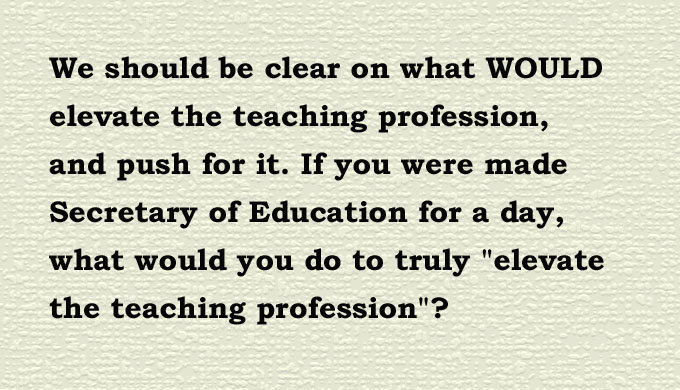
We should be clear on what WOULD elevate the teaching profession, and push for it. I want to see changes in policies that would be obvious to anyone who spent a week or two in a school. I posted this question on my If You Were Secretary of Ed for a Day, How would YOU Elevate the Teaching Profession? - Living in Dialogue:

The grifters of corporate ed reform: KIPP charter schools with the aid of the DOE | Seattle Education

The grifters of corporate ed reform: KIPP charter schools with the aid of the DOE | Seattle Education:

The grifters of corporate ed reform: KIPP charter schools with the aid of the DOE
KIPP6
KIPP is a taxpayer-subsidized school franchise that pays no taxes on its revenue and provides a tax-deductible vehicle for uber-wealthy families to promote the school “choice” agenda.
KIPP charter schools has been touted in Washington State as the savior of all black children.
Among those people is the now State Representative (Charter School) Chad Magendanz who, while active in the Washington State PTA back in the day, sang their praises whenattempting to put a plank in the PTA platform on charter schools. (Also see: The Washington State PTA Convention: Be There.)
Others chimed in although year after year KIPP charter schools proved to be far less than perfect.
See:
Of course, that didn’t stop the Washington State Charter School Commission, in their rush to get charter schools established in our state, from approving KIPP’s application to set up their green tent next to the highway.
Recently the following article was published by PR Watch and is well worth a read.
charter school oversight
By Lisa Graves and Dustin Beilke
Charter schools are big business, even when they are run by “non-profits” that pay no taxes on the revenue they receive from public taxes or other sources.
Take KIPP, which describes itself as a “national network of public schools.”
KIPP (an acronym for the phrase “knowledge is power program”) operates like a The grifters of corporate ed reform: KIPP charter schools with the aid of the DOE | Seattle Education: