Latest News and Comment from Education

Thursday, February 4, 2016

The Theft of a Great American School: JosƩ MelƩndez Ayala Elementary | gadflyonthewallblog

The Theft of a Great American School: JosƩ MelƩndez Ayala Elementary | gadflyonthewallblog:

The Theft of a Great American School: JosƩ MelƩndez Ayala Elementary

Screen shot 2016-02-03 at 10.48.49 PM
They came in the early morning like thieves in the night.
The predawn chill was still in the air.
But employees of Puerto Rico’s Department of Education (DOE) were already at work closing a beloved public school.
They sneaked into JosĆ© MelĆ©ndez Ayala Elementary Tuesday around 4 a.m. taking out desks, chalkboards and any equipment that could be repurposed. Then they loaded it all into trucks and zoomed off.
By the time the sun had risen, it was all over.
In the morning light, parents and children staggered to their neighborhood school in the ManatĆ­ region of the U.S. territory to find it an empty shell.The Theft of a Great American School: JosĆ© MelĆ©ndez Ayala Elementary | gadflyonthewallblog:


New York Teacher Sheri Lederman’s Lawsuit Update | VAMboozled!

New York Teacher Sheri Lederman’s Lawsuit Update | VAMboozled!:

New York Teacher Sheri Lederman’s Lawsuit Update

VAMboozled!
Recall the New York lawsuit pertaining to Long Island teacher Sheri Lederman? The teacher who by all accounts other than her recent (2013-2014) 1 out of 20 growth score is a terrific 4th grade, 18 year veteran teacher. She, along with her attorney and husband Bruce Lederman, are suing the state of New York to challenge the state’s growth-based teacher evaluation system. See prior posts about Sheri’s case herehere and here. I, along with Linda Darling-Hammond (Stanford), Aaron Pallas (Columbia University Teachers College), Carol Burris (Executive Director of the Network for Public Education Foundation), Brad Lindell (Long Island Research Consultant), Sean Corcoran (New York University) and Jesse Rothstein (University of California – Berkeley) are serving as part of Sheri’s team.
Bruce Lederman just emailed me with an update, and some links re: this update (below), and he gave me permission to share all of this with you.
The judge hearing this case recently asked the lawyers on both sides of Sheri’s case to brief the court by the end of this month (February 29, 2016) on a new issue, positioned and pushed back into the court by the New York State Education Department (NYSED). The issue to be heard pertains to the state’s new “moratorium” or “emergency regulations” related to the state’s high-stakes use of its growth scores, all of which is likely related to the political reaction to the opt-out movement throughout the state of New York, the publicity pertaining to the Lederman lawsuit in and of itself, and the federal government’s adoption of the recent Every Student Succeeds Act (ESSA) given its specific provision that now permits states to decide whether (and if so how) to use teachers’ students’ test scores to hold teachers accountable for their levels of growth (in New York) or value-added.
While the federal government did not abolish such practices via its ESSA, the federal New York Teacher Sheri Lederman’s Lawsuit Update | VAMboozled!:


Segregation Now, Segregation Tomorrow, Segregation Forever? - The Atlantic

Segregation Now, Segregation Tomorrow, Segregation Forever? - The Atlantic:

Segregation Now, Segregation Tomorrow, Segregation Forever?

Even if white people no longer openly promote having neighborhoods and schools to themselves, many of them continue to help make that happen.

Progress has undoubtedly been made since the days of explicit segregation, and most white people no longer openly advocate for segregation in neighborhoods, schools, and offices. When speaking to researchers, many even argue that integration is important and necessary. At the same time, old racial stereotypes die hard, and perceptions that black people are lazy, criminal, and dim-witted contribute to the maintenance of segregation and the inequalities that result from it. Despite laws prohibiting segregation—most notably the Civil Rights Act of 1964—it persists on several fronts today.
Some of the most striking studies done on present-day segregation have to do with how it’s connected to the ways families share money and other resources among themselves. The sociologist Thomas Shapiro, for instance, argues that the greater wealth that white parents are likely to have allows them to help out their children with down payments, college tuition, and other significant expenses that would otherwise create debt. As a result, white families often use these “transformative assets” to purchase homes in predominantly white neighborhoods, based on the belief that sending their children to mostly white schools in these areas will offer them a competitive advantage. (These schools are usually evaluated in racial and economic terms, not by class size, teacher quality, or other measures shown to have an impact on student success.) Shapiro’s research shows that while whites no longer explicitly say that they will not live around blacks, existing wealth disparities enable them to make well-meaning decisions that, unfortunately, still serve to reproduce racial segregation in residential and educational settings.
Black Americans, on the other hand, are much less likely to have access to transformative assets. As the sociologists Mary Pattillo, Douglas Massey, and Nancy Denton have shown, a consequence of this is that blacks are less likely to own homes. And when they do, they are more likely to live in neighborhoods thatare adjacent to poor black communities (and the less well-funded schools that are Segregation Now, Segregation Tomorrow, Segregation Forever? - The Atlantic:

The High Cost of Low Quality Teachers – Missouri Education Watchdog

The High Cost of Low Quality Teachers – Missouri Education Watchdog:
The High Cost of Low Quality Teachers


Missouri, like many states, is facing a teacher shortage. Before you run out to get a degree because you love teaching those little kiddies, know that we have a glut of K-6 teachers. What this means is that most people are only comfortable teaching what they learned before the age of 13. Where we need teachers are in the sciences and math, especially for middle and high school. What we need are people who really know that content.
We are not alone in our puzzling over how to get more qualified teachers in the classroom. Some districts are tempted just to get any teacher in the classroom, so alternatively certified teachers like those coming from Teach For America look mighty tempting. The fact that many of these kinds of teachers command a much lower price than veteran content area teachers is also tempting to financially struggling districts. But an article in the New Boston Post by Dr. Sandra Stotsky points out the added costs of under qualified teachers.

The high cost of academically under-qualified teachers

by Dr. Sandra Stotsky
It was once a matter of common sense that teachers cannot teach what they do not know. And research supports the view that a teacher’s knowledge of his or her subject area is, so far, the best and only predictor of student achievement.
In Massachusetts, common sense guided the state department of education’s revision of the Bay State’s teacher licensing regulations and licensure tests a decade earlier.
The results, judged by the scores on reputable assessments, speak for themselves. Average scores in both reading and mathematics, for grade 4 and grade 8, on National Assessment of Educational Progress (NAEP) tests in 2005, 2007, 2009, 2011, 2013, and 2015, were the highest or among the highest of all 50 states.
For Trends in International Mathematics and Science Study (TIMSS), the international test of curriculum-based achievement, Massachusetts entered as a separate country, tied with Singapore for first place in grade 8 science, and was among the top six countries in mathematics in grades 4 and 8 in both 2007 and 2013.
Yes, we had pre-Common Core standards for K-12 that had been judged to be among the most rigorous in the country in all major subjects. But, The High Cost of Low Quality Teachers – Missouri Education Watchdog:

Washington Post Report Highlights Problems with State Takeovers of Schools | janresseger

Washington Post Report Highlights Problems with State Takeovers of Schools | janresseger:

Washington Post Report Highlights Problems with State Takeovers of Schools


Earlier this week the Washington Post‘s Lyndsey Layton reported on the wave of attempts by Republican governors to seize local schools and school districts and turn them over to new state-run governance structures dubbed “recovery” or “opportunity,” or “achievement” school districts: “Governors in Michigan, Arkansas, Nevada, Wisconsin, Georgia, Ohio and elsewhere—mostly Republican leaders who otherwise champion local control in their fights with the federal government—say they are intervening in cases of chronic academic or financial failure.  They say they have a moral obligation to act when it is clear that local efforts haven’t led to improvement… Eleven states have passed or debated legislation to create state-run school districts in the past year… State takeovers were once a rarity, but they have become increasingly popular as the number of states controlled by Republicans doubled between 2010 and 2014.”
Layton cites a report from the Education Commission of the States, an organization that has historically leaned toward support of accountability-based school reform.  The Education Commission of the States describes the state run “recovery” districts this way: “In recovery districts, SEAs (state education agencies) gain legal authority to take over their lowest-performing schools and assume the LEA (local education agency) functions for those schools.  Schools in these districts are united not by geographic proximity, but rather by their status as underperformers.  The belief is that by grouping schools in this way, states can more seamlessly implement comprehensive and aggressive reform strategies in schools facing similar challenges.  Recovery districts tend to have a governance system in which ‘high-quality’ operators function in a charter-prevalent model.  Schools that are not run by charter operators are run instead by the state board or recovery district authority.”  Notice the Washington Post Report Highlights Problems with State Takeovers of Schools | janresseger:

New Orleans Charter Carver High broke special-education law by suspending student for nearly 5 weeks | The Lens

Carver High broke special-education law by suspending student for nearly 5 weeks | The Lens:

Carver High broke special-education law by suspending student for nearly 5 weeks

George Washington Carver Collegiate Academy charter high school got in serious trouble earlier this year for suspending a student with disabilities for nearly five weeks, more than double the time allowed by law.
The Louisiana Department of Education told the Collegiate Academies board it was in breach of it charter contract for violating federal law. The school returned to good standing last week after completing corrective action prescribed by the department.
The sanction was in the middle of the three available to the state Education Department if a charter school has significant financial, academic or organizational issues.. It can also issue a notice of concern, which is essentially a written warning, or it can begin a review process aimed at revoking the school’s charter.
The school’s problem stems from its suspension of a special-education student and its recommendation to expel, according to the notice from the state.
By district policy, the administration had five days to get the necessary paperwork to the city’s centralized Student Hearing Office. But it took them nearly a month. The school’s expulsion recommendation of Sept. 24 didn’t arrive at the hearing office until Oct. 22. The hearing office denied the expulsion request. .
In that time, the school didn’t let the student attend classes, and federal law limits students receiving special-education services to 10 days of suspension per academic year.
In total, the student missed 24 days before the first half of the academic year was over.
The student was not allowed to return to school until Oct. 29, according to the notice. The student missed 21 instructional days in this incident. Tack on a prior one-day suspension and a two-day suspension in December and the student missed 24 days as of the Jan. 6 notice.
It’s not the first time Collegiate has received unwanted attention for its discipline practices, drawing parent protests in the fall of 2013. In 2012-13, the network’s three schools had the highest suspension rates in the city.
The school serves about 425 high school students on its Reed Boulevard campus in eastern New Orleans, and it earned a C on the state accountability report card issued in November.
The department issues notices of breach when charter schools violate the state’s charter school performance compact. In order to avoid harsher penalties, which could include charter revocation, schools must complete a series of corrective actions specific to their problems to return to good standing.
In this case, Collegiate had to develop a plan to make up special education minutes owed to the student and outline a plan to educate Carver High broke special-education law by suspending student for nearly 5 weeks | The Lens:


How Much Federal Money Does Your State Receive? | Truth in American Education

How Much Federal Money Does Your State Receive? | Truth in American Education:

How Much Federal Money Does Your State Receive?

Photo credit: FEMA/Bill Koplitz (Public Domain)

How much education money does the Feds actually provide?
Photo credit: FEMA/Bill Koplitz (Public Domain)
The following document below is from FY 2013 provided by the Bluegrass Institute, but it will give you a pretty good picture that the Feds provide very little money to states in exchange for all of the mandates they place on the states.
It’s time for a change.

 How Much Federal Money Does Your State Receive? | Truth in American Education:

State sends mixed messages on Smarter Balanced test participation | EdSource

State sends mixed messages on Smarter Balanced test participation | EdSource:
State sends mixed messages on Smarter Balanced test participation

As California schools prepare to administer Smarter Balanced tests aligned to the Common Core State Standardsthis spring, they face a quandary when notifying parents about the assessments.
State law requires schools to inform parents they have the right to opt their children out of the tests, which will be administered in math and English language arts to students in grades 3-­8 and 11. But the federal No Child Left Behind law requires states to ensure that 95 percent of all students are tested – both statewide and districtwide.
Although the opt­-out movement has not taken hold as strongly in California as in other states, California was among several states that received a letter from the U.S. Department of Education warning that failure to meet the participation requirement could result in the loss of federal funds. California’s statewide average met the requirement but 21 districts tested fewer than 95 percent of their students.
The new Every Student Succeeds Act will replace No Child Left Behind when it goes into effect in 2017­-18. It will continue to require that 95 percent of students participate in the tests, but will allow states to determine what actions to take if districts fail to do so. The new law also requires districts that receive federal funding to annually notify parents of state laws allowing them to opt their students out.
“It leaves states like California jammed in the middle,” said Robert Schaeffer, spokesman for the National Center for Fair and Open Testing, or FairTest, noting that California is one of several states with a law that allows parents to opt out.
The seemingly contradictory requirements have led to mixed messages from the state and confusion among some districts about how to let parents know they can opt out of the tests, while ensuring that 95 percent of students take them. Last year, the state posted a template test notification letter for districts on its website, which informed parents about the tests, but failed to mention their opt­-out rights.
This year, the state again intends to omit opt­-out information from its template letter, which it plans to post on its website in the next few weeks, said Peter Tira, California Department of Education spokesman, in an email.
“We do not include language in our sample letter about parents’ ability to opt out because we want to encourage as much participation as possible,” Tira said. “The state has been required by federal law to meet a 95 percent participation rate, which we exceeded this past year.”
Schaeffer was surprised that California’s template letter for districts to parents did not include opt­-out language.
“At best, that’s inconsistent and it’s really questionable whether the state is failing to comply with its legal responsibility,” he said. “It’s like telling State sends mixed messages on Smarter Balanced test participation | EdSource:

Rally for Chicago teachers, kids and schools. | Fred Klonsky

Rally for Chicago teachers, kids and schools. | Fred Klonsky:

Rally for Chicago teachers, kids and schools.


12633740_1195373107159318_1907895810851852537_o


 Rally for Chicago teachers, kids and schools. | Fred Klonsky:

Teaching Democratic Politics and Other Habits - Bridging Differences - Education Week

Teaching Democratic Politics and Other Habits - Bridging Differences - Education Week:

Teaching Democratic Politics and Other Habits

Bridging Differences


Deborah Meier continues her conversation with Harry Boyte. To read their full exchange, please visit here.
Dear Harry and friends,
Interesting, interesting. Which means your comments lead to so many disparate thoughts.
Safe space. Having never been able to stop myself from jumping into disputes a bit too easily and starting trouble that sometimes I later regretted, I realize that my idea of safe space is not exactly everyone else's. What the young Black students in Missouri meant when they demanded what amounts to censorship is based on different life experiences. Maybe it would require a Dennis Donovan to help us build a safe space without imposing any form of censorship. What might have to happen for this to be resolved without censorship?
In formal parliamentary-style debate it's against the rules to get personal, and if you do personal privilege can be demanded immediately. But what parliamentary rules didn't have to tackle was what it meant to be "personal"—since they were invented for men who were all of the same race and class. A modern democracy faces a quite different dilemma—when racist and sexist remarks, for example, are personal even if no name is mentioned. Most of us don't have a lot of direct experience within democratic communities, and almost none in which the members belong to such diverse "tribes."
Schools could be the ideal place for us to learn how to engage in heated conversation, above all schools that include members of different SESs and races and ethnic histories. If we dared.
Maybe some of those heated encounters would even turn into quieter and more productive discussions if we had spent 12 years in schools practicing democracy.
My fierceness in debate was in fact partially a technique for testing out my own ideas for myself, and they often led to my changing my mind ... afterwards. I could have learned, however, to pay greater heed to those intimidated by my style. At best schools have tended to solve this problem by staying away from heated subjects, and/or pretending that we all agreed.
School are hardly designed to encourage "confrontations" over our strongly held views in ways that, over time, lead us to reconsider our own opinions. In the formal part of the school day we mostly either agree with the expertise of those in power or pretend to. And in the informal time we tend to cluster in groupings that don't challenge us, or in which we follow the leader. Even in integrated schools, the relationships that develop are often segregated. We (mostly males) may learn to play together in rule-bound competitive games, but where we go after, to "relax," is something else.
So—what makes for a safe school in this broader sense? What can we realistically do to create structures that help us deal with "touchy" subjects at least some of the time?
Politics and schools. Your comments raised for me the tricky question about what in an often polarized world we can do to introduce children to "politics," including politics that might get heated. Confused as we all are about the connections between politics and democracy itself, how can we possibly pass it on to our students? What kind of living experiences encourage us to think and act in a democratic fashion? How can schools introduce the young to the "politics" of democracy?
Most of the time we try to solve this by creating schools that are, for many reasons, relatively homogeneous. Housing segregation and choice are both vehicles for decreasing difference. Tracking is another. Dare we deliberately seek serious diversity in order to encourage democratic habits rather than spending so much time teaching kids the "right" answers? Our standardized testing mania is hardly designed to imbed habits of respect for probing into differences of opinion. What else would be required?

Charter School Network With Most Kindergarten Suspensions Says It Will Stop Them

School Network With Most Kindergarten Suspensions Says It Will Stop Them:
School Network With Most Kindergarten Suspensions Says It Will Stop Them


BOSTON — Kindergarten and pre-kindergarten students were suspended 78 times at schools operated by a single nonprofit school management company in the 2014-15 school year, according to state data.
Now, the Boston-based UP Education Network says it will ban suspensions for their youngest students starting Wednesday.
“As a result of an internal evaluation of our practices, UP has decided to no longer issue suspensions to students in kindergarten,” Victoria Criado, UP Education Network spokesperson, said by email.
UP Education Network specializes in school turnaround for formerly underperforming schools. Since 2010, the school network has restarted five schools in Boston and Lawrence. Some are in-district charters.
Boston’s UP Academy Holland dealt out 68 suspensions last year to their 117 kindergarten students. That’s three times more suspensions than any other school in the state — and over 10 percent of the state’s 603 kindergarten and pre-kindergarten suspensions last year.
UP Academy Holland staff also suspended pre-kindergarten students three times, according to state data.
In late 2013, the former Holland Elementary School was placed in state receivership after years of underperformance. The state named UP Education Network the school’s receiver, meaning that UP now runs the school under state oversight. As receiver, UP can hire leaders and teachers and can set the curriculum.
Unlike many other charter operators, UP often re-enrolls the entire student population at the schools it restarts. In Holland’s 2014 turnaround plan, UP said it would continue to serve students at the school, as well as an expanded kindergarten class.
Elementary and secondary education commissioner Mitchell Chester said in a statement that UP has begun instituting change at the school. But he also called the high number of suspensions “surprising.”
“I am concerned when I see a high reliance on suspensions, and these figures are a wake-up call for us,” said Chester. “I am confident that they will approach discipline for young students differently in the future.”
UP Academy Dorchester, an in-district charter school operated by the same network, suspended kindergartners six times and pre-kindergarteners three times in the 2014-15 school year.


Latest Trib poll: Chicago is a union town. We stand with our teachers. | Fred Klonsky

Latest Trib poll: Chicago is a union town. We stand with our teachers. | Fred Klonsky:

Latest Trib poll: Chicago is a union town. We stand with our teachers.


ct-tribune-poll-results-rahm-emanuel-on-educat-004
ct-tribune-poll-results-rahm-emanuel-on-education-20160203
If the pundits, the Sun-Times and Trib editorial boards and the Mayor were hoping the parents and voters of Chicago had deserted their teachers, this mornings Chicago Trib poll should put that bogus hope to rest.
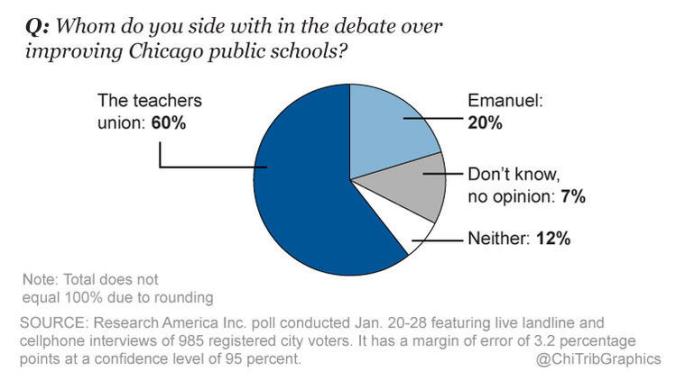
We citizens of Chicago side with the teachers in the current fight by a margin of three to one.
Three times as many Chicagoans side with the teachers union as with Mayor Rahm Emanuel on how to improve public schools at a time when the two sides remain locked in contentious contract negotiations, a Chicago Tribune poll has found.
The survey also found that Emanuel’s approval rating on education has fallen to a record low as the mayor and Chicago Public Schools CEO Forrest Claypool are slashing budgets and cutting jobs in the face of the latest massive budget shortfall. Voters’ displeasure with the mayor’s handling of education tracks with the similarly low marks they gave Emanuel on his overall job performance and handling of crime.
As CPS has faced surging pension costs and a plummeting credit rating — the district borrowed $725 million Wednesday at an extraordinarily high interest rate to stay afloat this year — Emanuel has sought budget relief from the state. Those efforts, however, have been caught up in the Springfield stalemate. And now Gov. Bruce Rauner is calling for a state takeover of CPS and suggesting the district file for bankruptcy.
Amid all that, Emanuel offered a new contract that would have provided teachers with modest raises while requiring them to pay 
Latest Trib poll: Chicago is a union town. We stand with our teachers. | Fred Klonsky:


School hits: Our ALEC-driven Legislature won’t relent on K-12 schools | Opinion | gctelegram.com

School hits: Our ALEC-driven Legislature won’t relent on K-12 schools | Opinion | gctelegram.com:

School hits: Our ALEC-driven Legislature won’t relent on K-12 schools


 Anti-public school forces in Kansas won’t give up.

Last year, ultraconservative state lawmakers led by Gov. Sam Brownback rammed through a two-year, fixed block-grant funding system for K-12 school districts that didn’t account for property value declines, enrollment increases and other uncontrollable costs.
The change meant reduced state dollars for K-12 public schools, which led many school districts to make significant spending cuts and raise property taxes to make up the difference (nearly 4 mills in Garden City USD 457, for example).
The block-grant scheme is a mess, and understandably ruled unconstitutional.
It was yet another policy crafted by the Koch-supported American Legislative Exchange Council, which writes model legislation for corporate interests.
Among its “free market” strategies, ALEC devises legislation designed to shortchange public schools and transition support to private, for-profit education.
One such pursuit in the last legislative session created corporate tax breaks for private school scholarships. Ultraconservatives now want to expand the program.
The tax breaks serve to accomplish the same thing as school vouchers, which raise legitimate questions over the constitutionality of using taxpayer funds for private and parochial schools that aren’t subject to the same accountability as public schools.
Offering tax credits is a sly way to divert dollars that otherwise would go to state-funded programs.
Instead of fixating on privatization — such reform efforts have failed miserably in other states — Kansas lawmakers should address current K-12 funding woes.
Also dredged up this session was last year’s ALEC plan to prosecute teachers for using curriculum deemed “harmful” to students, even though schools already have effective policies in place to address rare instances of questionable material.
Amid such senseless undertakings, Kansas is supposed to somehow be competitive in attracting teachers.
Instead, ultraconservatives determined to cripple public schools are succeeding, and giving teachers already here cause to leave.
Parents and others who value education should tell their lawmakers to reject such nonsense in a state with a long, proud tradition of good K-12 teachers and schools.
Voters in this year’s elections also need to remove blind ALEC followers from the Legislature, and support candidates who understand the state should support, not hinder, public education’s vital mission.School hits: Our ALEC-driven Legislature won’t relent on K-12 schools | Opinion | gctelegram.com:

Teachers union has triple the public support of Emanuel - Chicago Tribune

Teachers union has triple the public support of Emanuel - Chicago Tribune:

Teachers union has triple the public support of Emanuel

Karen Lewis and Rahm Emanuel
Chicago Teachers Union President Karen Lewis and Chicago Mayor Rahm Emanuel. (Terrence Antonio James and Anthony Souffle / Chicago Tribune)


 ree times as many Chicagoans side with the teachers union as with Mayor Rahm Emanuel on how to improve public schools at a time when the two sides remain locked in contentious contract negotiations, a Chicago Tribune poll has found.

The survey also found that Emanuel's approval rating on education has fallen to a record low as the mayor and Chicago Public Schools CEO Forrest Claypool are slashing budgets and cutting jobs in the face of the latest massive budget shortfall. Voters' displeasure with the mayor's handling of education tracks with the similarly low marks they gave Emanuel on his overall job performance and handling of crime.
As CPS has faced surging pension costs and a plummeting credit rating — the district borrowed $725 million Wednesday at an extraordinarily high interest rate to stay afloat this year — Emanuel has sought budget relief from the state. Those efforts, however, have been caught up in the Springfield stalemate. And now Gov. Bruce Rauner is calling for a state takeover of CPS and suggesting the district file for bankruptcy.
Amid all that, Emanuel offered a new contract that would have provided teachers with modest raises while requiring them to pay more toward their health care and pensions. A union bargaining team unanimously rejected it.
The poll found that 60 percent of Chicagoans said they side with the Chicago Teachers Union over improving schools while 20 percent backed Emanuel. Another 12 percent sided with neither, while 7 percent had no opinion.
City voters have never sided with Emanuel over the teachers union since the Tribune began polling on the issue in May 2012. The latest numbers are close to the previous high of 62 percent that sided with the teachers union in an August 2014 survey conducted as Emanuel prepared to run for a second term.
The union has sought to capitalize on the mayor's weakened public support after theLaquan McDonald police shooting scandal led to weeks of street protests, calls for Emanuel's resignation and a federal civil rights investigation into the Chicago Police Department. Last month the teachers union formally called for Emanuel to resign, proclaiming "the leadership of Rahm Emanuel contributed to the shocking and inexcusable murder of Laquan McDonald."
In mid-December the union said 88 percent of its membership voted to go on strike if an Teachers union has triple the public support of Emanuel - Chicago Tribune:

Pearson Rips Off Students with Tests Designed for Failure

Pearson Rips Off Students with Tests Designed for Failure:

Pearson Rips Off Students with Tests Designed for Failure


New York State, in partnership with Pearson Education, is making it increasingly harder and more expensive to become a teacher without evidence that their demands and tests will improve education in the state. Last April Governor Cuomosmuggled a requirement into the state budget without discussion or input from professional educators arbitrarily mandating that students admitted to Schools of Education have a minimum 3.0 undergraduate grade point average and take a nationally normed test. No one demonstrated that a 3.1 GPA makes you a better teacher than someone with a 2.9 GPA or how the tests align with performance as a teacher.
In addition, New York State requires that certification candidates complete four other exams either created or administered by Pearson. Three are written exams and one involves a complex portfolio submission. New York State has already been cited twice by a federal court for racial bias in its teacher certification requirements because of the "unlawful disparate impact" of its teacher certification exams.
The portfolio part of the teacher certification requirement is known as the edTPA. edTPA was created at Stanford University by a sub-division called SCALE and is administered and graded by Pearson. Essentially SCALE, Pearson, and New York State decided to replace student teacher evaluations by university field supervisors and cooperating teachers with an electronic portfolio, supposedly to ensure higher standards. The SCALE/Pearson edTPA electronic portfolio includes lesson planning, a discussion of student teaching placement sites, videos of candidates interacting with K-12 students, their personal assessment of the lesson, and documentation of student learning. While each piece by itself makes sense, the package, which focuses on just three lessons and can be sixty pages long, takes so much time to complete that it detracts from the ability of student teachers to learn Pearson Rips Off Students with Tests Designed for Failure:

Louisiana Voucher Program Leaves Students Behind, One Study Shows - US News

Louisiana Voucher Program Leaves Students Behind, One Study Shows - US News:

Louisiana Voucher Program Leaves Students Behind, One Study Shows

Participation in Louisiana's voucher program increased the likelihood of a failing score by 24 to 50 percent, study shows.

McDonogh #35 Senior High School graduates stand at their commencement at the Ernest N. Morial Convention Center on May 14, 2015 in New Orleans.

Students who won publicly funded vouchers to escape their failing public schools and enroll in private schools are doing worse academically than those who weren't awarded vouchers and remained in low-performing schools.
That's the startling new finding from a working paper that analyzed Louisiana's private school voucher program.
The team of researchers from University of California, Berkley, Duke University, and the Massachusetts Institute of Technology found that attendance at a private school significantly lowered students' math, reading, science and social studies scores, and, in particular, it increased the likelihood of a failing score by 24 to 50 percent.
The negative impacts, the paper notes, are consistent across income groups, geographic areas, and private school characteristics, and are larger for younger children.
"These results suggest caution in the design of voucher systems aimed at expanding school choice for disadvantaged students," the researchers wrote.
The paper, which is still a work in progress, comes as states across the country mull similar programs and the private school choice sector is hitting a stride: Since 2009, the number of students using vouchers has increased by 130 percent, according to the Alliance for School Choice.
Some potential explanations for the precipitous drop in student achievement include the fact that the researchers captured results that reflect a significant transition for students shifting from public to private school.
"We might expect a negative effect, but the size of the negative math impact is pretty large, so it could be more than just a short-term effect," says Patrick Wolf, education professor at the University of Arkansas, who also studies the impact of private school choice programs.
Wolfe has been leading a research team in a two-year longitudinal study of Louisiana's voucher Louisiana Voucher Program Leaves Students Behind, One Study Shows - US News:

Here’s a New Way to Judge Your State’s Schools | Mother Jones

Here’s a New Way to Judge Your State’s Schools | Mother Jones:

Here’s a New Way to Judge Your State’s Schools

"The best schools in the world don't operate on vouchers and charters."


 Last time I called Diane Ravitch, our country's leading education historian and one of the most vocal voices in education reform, she was on another call with the producers of The Daily Show. It was 2011, and The Daily Show was about to air a segment about the low salaries that teachers earn and Wisconsin's Republican Gov. Scott Walker's intentions to cut teachers pay and reduce workers' collective bargaining powers. The producers were calling to invite Ravitch to come on the show to talk to Jon Stewart about teachers and education reform.

At the time, reducing the power of teachers' unions, promoting charter schools, and using standardized test scores to weed out "bad teachers" and close "failing schools" had become the most popular silver bullets of the education reform movement. Michelle Rhee, the former chief of DC schools, had become the most prominentpublic face of these kinds of education reforms—ones that Ravitch was critiquing onThe Daily Show. Rhee had come out in support of Walker's policies.
In 2010, Newsweek published a cover story called "The Key to Saving American Education: We must fire bad teachers." That same year, on The Oprah Winfrey Show, Rhee announced that she was forming a national organization called Students First to promote her ideology among state policymakers. In 2013, Students First came out with "report cards" that graded each state's performance against the reform movement's education agenda. The report cards, like the policies Rhee and her allies pushed, received frequent—and fairly positive—media coverage.
When commentators and reporters needed a countervoice, Ravitch became the go-to progressive critic. She was not the only prominent academic who questioned the attacks on teachers, but she was the most vocal, thanks in part to her media savvy and punchy writing—and her 125,000 Twitter followers. In 2013, Ravitch and her allies launched the Network for Public Education, a nonprofit advocacy group that Here’s a New Way to Judge Your State’s Schools | Mother Jones: