Latest News and Comment from Education

Monday, January 11, 2016

John Thompson on Education and the Media | Diane Ravitch's blog

John Thompson on Education and the Media | Diane Ravitch's blog:

John Thompson on Education and the Media


John Thompson, historian and teacher in Oklahoma, writes here about a growing awareness in the mainstream media of the infusion of Big Money into education. The New York Review of Books is a major influence among highly educated people and has a reach far beyond professional educators.
The New York Review of Book’s Michael Massing, in “Reimagining Journalism: The Story of the One Percent,” proposes a new journalism to document and explain the effects of secretive corporate elites on our diverse social institutions. He basically calls for a very well-funded version of the Diane Ravitch blog.
O.K., it’s more complicated than that. Massing notes that “Education is but one area of American life that is being transformed by Big Money.” He wants a website that is staffed by top investigative journalists, and experts in the fields that are being taken over by “billionaires [who] are shaping policy, influencing opinion, promoting favorite causes, polishing their images—and carefully shielding themselves from scrutiny.”
Massing proposes a site, complete with reporters, editors, and “digital whizzes,” who “could burrow deep into the world of the one percent and document the remarkable impact they are having on so many areas of American life.” Similar to Ravitch’s blog, its purpose would be “tracking the major participants, showing the links between them, assessing their influence and impact, and analyzing the evidence on the performance of both public and charter schools.”
Moreover, Massing wants a site that:
Could also serve as a sounding board for people in the field, encouraging principals, teachers, parents, and grantees to send in comments about their dealings with these institutions. The most thoughtful could be edited and posted on the site, providing a bottom-up perspective that rarely gets aired.
Massing explains that “even amid the outpouring of coverage of rising income inequality … the richest Americans have remained largely hidden from view.” And, “journalists have largely let them get away with it.” We need sites that will cover more than education, but Massing, who has been influenced by the work of Mohammad Khan, Zephyr Teachout, and Ravitch, uses their work as a model for the 21st century journalism we need.
His website would:
Produce an ongoing record of the activities of the foundations and John Thompson on Education and the Media | Diane Ravitch's blog:

Friedrichs Case Threatens To Take Away Fairness - Lily's Blackboard

Friedrichs Case Threatens To Take Away Fairness - Lily's Blackboard:

Friedrichs Case Threatens To Take Away Fairness

ctaprez


The U.S. Supreme Court will hear oral arguments Monday in a case over whether teachers in California and 22 other states working under a union contract must pay union fees even if they are not union members. Friedrichs vs. California Teachers Association seeks to make it harder for educators to come together to bargain for smaller class sizes, safer schools and better learning environments for all students. It would overturn commonsense jurisprudence that allows states and localities to choose for themselves whether to require public employees to pay their share for the union representation they receive.
As educators, we are fearful about these consequences not just for us and our families, but for our communities and students.
The Friedrichs case is fundamentally about something we teach our students every day: fairness.
Read the rest of this San Francisco Chronicle op-ed by Eric C. Heins, an elementary school teacher in the Pittsburg Unified School District who serves as the president of the 325,000-member California Teachers Association
More on Friedrichs:
You don’t have to look far to see what happens when states outlaw fair share fees in an effort to weaken unions.The results have been lower wages and worse benefits for working people. In states without full union rights, the average worker makes $1,500 less per year, and workers are much less likely to have health insurance—let alone other benefits that help them support their families.


CURMUDGUCATION: DFER: Trust Clinton To Betray Unions

CURMUDGUCATION: DFER: Trust Clinton To Betray Unions:

DFER: Trust Clinton To Betray Unions

In his semi-regular email to supporters, allies, and hate-readers, Whitney Tilson led one item with this subheading:

Hillary (and Bill) have a long history of breaking with the teachers’ unions, which bodes well: 

Tilson is a leading light of DFER (Democrats for Education Reform), a group of faux Democrat, hedge fundy, union-hating, privateering reformsters. These are exactly the people who love Clinton when she's getting all Wall Street warm and corporate cozy, but who become alarmed when she starts talking crazy, like suggesting that charter schools don't actually serve all students.

But in his email, Tilson wants to re-assure everyone that Clinton can be counted on to break with unions just as soon as she's elected. Here are his historical supports:

…after Bill got elected governor four years later, many of his early boosters from labor felt betrayed. Specifically, the teachers unions were infuriated over the couple’s advocacy of an education reform proposal that mandated teacher testing. The National Education Association and its Arkansas affiliate worked against the Clintons after they backed the measure in 1983.
— Hillary’s first significant public role was heading an education commission for Bill, a precursor to her role as health care czar in his first term. The efforts she supported were heartily endorsed by the business community, including a dark-money nonprofit group funded by WalMart 
CURMUDGUCATION: DFER: Trust Clinton To Betray Unions:


4LAKids - Friedrichs v. CTA: 3 ARTICLES TODAY'S SUPREME COURT HEARING FROM THE NEW YORK TIMES

4LAKids - some of the news that doesn't fit: Friedrichs v. CTA: 3 ARTICLES ABOUT TODAY'S SUPREME COURT HEARING FROM THE NEW YORK TIMES:

Friedrichs v. CTA: 3 ARTICLES ABOUT TODAY'S SUPREME COURT HEARING FROM THE NEW YORK TIMES

  1. Issues and Implications inSupremeCourt’s Public Union Case

    WASHINGTON — The Supreme Court will hear arguments on Monday in a case that is making the labor movement nervous. Here is a look at the legal issues in the case and the possible consequences of a ruling, which is
     -  - U.S. - Print Headline: "Issues and Implications in Supreme Court’s Public Union Case"

    AtSupremeCourt, Public Unions Face Possible Major Setback

    WASHINGTON — The Supreme Court will hear arguments on Monday in a case that could deal a severe blow to organized labor. The justices will consider whether government workers who choose not to join unions may
     -  - U.S. - Print Headline: "At Supreme Court, Public Unions Face Possible Major Setback"

    SupremeCourtCase on Public Sector Union Fees Rouses Political Suspicions

    right-wing plotting remains as current on the left as, well, Mrs. Clinton. The most recent cause for concern is a case the Supreme Court will hear on Monday, Friedrichs v. California Teachers Association, which
     -  - Business Day - Print Headline: " Court Case on Union Fees Rouses Political Suspicions"
4LAKids - some of the news that doesn't fit: Friedrichs v. CTA: 3 ARTICLES ABOUT TODAY'S SUPREME COURT HEARING FROM THE NEW YORK TIMES:


Educators are Ready to Lead on ESSA Implementation - Lily's Blackboard

Educators are Ready to Lead on ESSA Implementation - Lily's Blackboard:

Educators are Ready to Lead on ESSA Implementation


We want to see more listening, not less.
More engagement, not less.
More stakeholder engagement, not less.
Read Lily’s testimony at the Department of Education on the implementation of the Every Student Succeeds Act
¡Buenos días! My name is Lily Eskelsen García and I am proud to be the President of the National Education Association representing about 3 million educators who are teaching students, serving nutritious meals, and transporting students safely as we speak.
In the months leading up to the enactment of The Every Student Succeeds Act, I heard loud and clear from my members what they wanted to see in a new law:
  • Ensure opportunity really matters in the accountability system
  • Guarantee educators’ expertise in decision-making
  • Reduce the volume and over-reliance on standardized testing
The new law delivers on all three, and paves the way for opportunity to become a real part of ‘what gets counted’ now, an historic development for our education system. The law also returns significant responsibility to states and schools districts to ensure students are learning. This shift offers the U.S. Department of Education the opportunity to focus on its enforcement authority to ensure students have equitable access to a robust and well-rounded education and to the supports they need to excel.
Thank you for kicking off the implementation process so soon in the New Year. This kind of monumental transition will require deep collaboration among multiple stakeholders, some of whom are not used to working together, and making sure more voices are at decision-making tables. None of us should be seeking a shortcut in this collaboration—that’s the only way the new law will work. There is built-in time for deep engagement of all stakeholders and we urge the U.S. Department of Education to set a good example by not rushing its part of the process for the sake of expediency.
The implementation process will be simultaneously developing at the national level, at the state level, at the district level, and ultimately in schools across this country as policies are updated. We implore the Department to ensure the regulatory process is infused with the best thinking, ideas, and concepts from across the Educators are Ready to Lead on ESSA Implementation - Lily's Blackboard:

Teacher Autonomy Declined Over Past Decade, New Data Shows - NEA Today

Teacher Autonomy Declined Over Past Decade, New Data Shows - NEA Today:

Teacher Autonomy Declined Over Past Decade, New Data Shows


 Not exactly breaking news: Teachers believe their classroom autonomy suffered during the No Child Left behind era. According to just-released federal data from theNational Center for Education Statistics (NCES), educators reported less classroom autonomy in school year 2011-12 compared to 2003-04. That teachers felt their independence wane during a decade marked by standardization and high-stakes testing won’t come as a surprise to most educators, but having real data (a nationally representative sample of more than 37,000 American public school elementary and secondary teachers) to support this widespread belief is nonetheless significant.

Studies have repeatedly shown that classroom autonomy is a major factor in determining level of job satisfaction, simply because, says Richard Ingersoll of the University of Pennsylvania, it speaks to whether educators are treated as professionals.
“The data consistently show us that a big issue is how much voice, how much say, do teachers have collectively in the school-wide decisions that affect their jobs?” Ingersoll explains. “Teachers are micromanaged. They have been saying for a long time that one size doesn’t fit all, all students are different. But they’re told to stick to the scripted curriculum, which might work for a weaker teacher but it drives good teachers nuts.”
The NCES took data from the School and Staffing Survey (SASS) from three school years (2003-4, 2007-08, and 2011-12) to compare responses to one central question: “How much actual control do you have in your classroom over specific areas of teaching and planning?” These specific areas include textbook selection, identifying contents and topics to be taught, selecting teaching techniques, evaluating and grading students, disciplinary measures, and the amount of homework assigned.
Teacher_Autonomy
Generally, eighteen percent of teachers perceived “low” autonomy in the 2003-04 school year, right as NCB was being implemented. That number increased to 23 percent four years later and again to 26 percent in 2011-12.  In all three years, a majority of educators reported “moderate” autonomy but at a slightly smaller percentage in 2011-12.
Across all three school years, no specific area was categorized as one in which teachers reported having a “great deal of control.” Teacher techniques, evaluating students, discipline and homework levels all were labeled as “moderate,” although Teacher Autonomy Declined Over Past Decade, New Data Shows - NEA Today:

Common Core’s Lasting Damage – Missouri Education Watchdog

Common Core’s Lasting Damage – Missouri Education Watchdog:

Common Core’s Lasting Damage


Have you ever watched Americans line up informally? An ex-CIA analyst once said the best way to tell if you are not in America is to watch if people line up to receive things without instruction. In other countries, large mobs will rush the distributor. In America people line up. And where no formal stanchions exist, we will form lines with unwritten but commonly understood rules. No cutsies. No shoving. You will follow the established serpentine. It is part of the American psyche.
So when someone comes in and establishes a new formation we are preconditioned to follow it to maintain order. This was and remains the danger of common core. Even though there were no official stanchions to make us get in its line, we lined up behind it anyway; buying textbooks and curriculum, paying for teacher training, etc. Once the que is formed, Americans, though complaining about the length of the line and what awaits us when we get to the front of it, are not easily moved out of the line.
Peter Wood, President of the National Association of Scholars, wrote in the Heartland blog about the effects of common core which he predicts will be with us for a long time. He says, “chances are it has robbed a generation” of education and opportunity. Wood provides an excellent answer to the question “Well what’s the harm with moving forward with what we have from Common Core?”

Common Core Damage Will Last for Years to Come

Common Core (CC) K–12 math and English standards are lingering, despite concerted efforts by concerned parents and taxpayers to remove them.
It is like a house with an underwater mortgage: The United States has invested so much in Common Core that it can’t easily get out. The investments include very large amounts spent on textbooks, computers to support the Common Core tests, and teacher training. The investment also includes some hard-to-quantify things: the squandered opportunity, the huge expenditure of political capital, the disaffection of millions of parents, and the psychological harm to students who face spending many more years living out the classroom consequences of a discredited educational experiment.
Students face those extra years of miseducation simply because there is no easy exit from Common Core. The textbooks and computers have been purchased, and the teachers have been trained. Even the states running for the exit door have a long wind-down ahead of them.
Undoing some forms of bad policy can take years. Build a road or a bridge in the wrong place and chances are it is a permanent mistake, but if the government builds the wrong curriculum, chances are it has robbed a generation.
Demoting Literature
Some of the specific harms are easy to see. The Common Core is making a mess of instruction in reading and writing. It demotes reading literature, Common Core’s Lasting Damage – Missouri Education Watchdog:

The Future of Big Data and Analytics in K-12 Education - Education Week

The Future of Big Data and Analytics in K-12 Education - Education Week:

The Future of Big Data and Analytics in K-12 Education


Are schools ready for the power and problems of big data?

Imagine classrooms outfitted with cameras that run constantly, capturing each child's every facial expression, fidget, and social interaction, every day, all year long.
Then imagine on the ceilings of those rooms infrared cameras, documenting the objects that every student touches throughout the day, and microphones, recording every word that each person utters.
Picture now the children themselves wearing Fitbit-like devices that track everything from their heart rates to their time between meals. For about a quarter of the day, the students use Chromebooks and learning software that track their every click and keystroke.
What you're seeing is the future of K-12 education through the eyes of Max Ventilla, the CEO of AltSchool, a Bay Area startup that represents the most aggressive, far-reaching foray into the world of big data and analytics that the K-12 education sector has seen to date.
Eventually, Ventilla envisions AltSchool technology facilitating an exponential increase in the amount of information collected on students in school, all in service of expanding the hands-on, project-based model of learning in place at the six private school campuses the company currently operates in Silicon Valley and New York City.
He sees all those torrents of data flowing from the classroom into the cloud, where AltSchool engineers will have built systems for merging the disparate streams into a single river of information. AltSchool software and algorithms created by Silicon Valley's top developers and data scientists would then search the waters for patterns in each student's engagement level, moods, use of classroom resources, social habits, language and vocabulary use, attention span, academic performance, and more.
The resulting insights—say, that 6th graders perform better in math after exercising, or that the girls in a particular science class are bored because boys use the lab equipment more frequently, or that Johnny is using new vocabulary words in conversations with his friends—would be fed to teachers, parents, and students via AltSchool's digital learning platform and mobile app, which are currently being tested. The information would be accompanied by scheduling tips, recommendations for more gender-neutral science activities, and a playlist of assignments customized to each student.
How those suggestions are used, and whether they make a difference in how well each student learns, would also be tracked, creating a never-ending feedback loop of insights, experiments, recommendations, and product tweaks.
"We don't want to improve some aspects of what schools do. We want a different kind of universe in which schools can exist 30 years from now," said Ventilla, a 35-year-old Yale University graduate who previously worked as the head of personalization at online-services-giant Google.
For better or worse, it's not just pie in the sky talk.
Over the past decade, big data and analytics have slowly crept into the world of public education. Versions of the unobtrusive, real-time, embedded-in-everyday-activities collection of student-learning data now being pioneered by AltSchool and others are touted in the federal government's new National Education Technology Plan. Many observers hope the next step is the type of systemwide change that has already transformed the financial sector, health care, consumer technology, retail sales, and The Future of Big Data and Analytics in K-12 Education - Education Week:


Teachers' unions unite to highlight 'national crisis' in profession | Education | The Guardian

Teachers' unions unite to highlight 'national crisis' in profession | Education | The Guardian:

Teachers' unions unite to highlight 'national crisis' in profession

Six unions call for pay increases above proposed 1% annual level, and warn more pupils are being taught by unqualified staff

Teachers’ unions are urging the government to ward off a “national crisis” in the profession, warning that increasing numbers of pupils face being taught by unqualified staff.
In an unusual joint submission to the School Teachers’ Review Body (STRB) – the pay review body for England and Wales – six unions, including the National Union of Teachers, have combined to call for pay increases above the 1% annual level the Department for Education (DfE) is seeking to offer over the next four years.
The letter highlights widespread concern within education over looming problems with recruitment, as schools report difficulties in attracting and retaining staff along with the squeeze on school budgets, which remain frozen in England despite being expected to fund pay increases.
“The STRB must accept that we are facing a national crisis, not ‘a challenge’ in teacher supply, which means more children will not be taught by teachers qualified in the subject they teach,” argues the submission, whose signatories include the National Association of Head Teachers and Undeb Cenedlaethol Athrawon Cymru, the national union of teachers of Wales.
“The public sector pay policy of the past five years has depressed teachers’ real earnings to the extent that recruitment and retention are being seriously harmed,” the letter concludes, saying that the DfE’s published data “has failed to capture the scale of the crisis”.
In response, the DfE said: “Unlike those who are constantly claiming there is a crisis and scaremongering, this government has worked with the profession to raise the status of teaching and is attracting the best and brightest to a career in the classroom, with the result that record highly qualified graduates and experienced career changers are now teaching in our schools.
“But we are determined to go further, and recognise that some schools find it harder to recruit the teachers they need, which is why we are expanding the great Teach First and Schools Direct [recruitment] programmes, and we are launching the national teaching service, which will mean more great teachers in schools in every corner of the country.”
The unions also claim that school budgets are “at breaking point”, requiring the government to fully fund pay increases and other costs such as national insurance increases coming in later this year.
“Four more years of pay austerity is a false economy,” said Brian Lightman, Teachers' unions unite to highlight 'national crisis' in profession | Education | The Guardian:


Detroit teacher 'sick-out' closes many schools - CNN.com

Detroit teacher 'sick-out' closes many schools - CNN.com:

Teacher 'sick-out' keeps thousands of Detroit students home from school


(CNN)Thousands of students were out of school Monday in Detroit after a planned teacher "sick-out" forced the school system to close nearly two-thirds of the city's public schools, according to alerts sent out by the district.
Detroit parents were warned Sunday night by the city's public school system to prepare for a "high number" of school closures on Monday. As of Monday morning, 62 schools had been shuttered for the day.
    The so-called "sick-outs" are a protest play reportedly organized by local labor leader Steve Conn.
    "Teachers are staying out and we're fighting back, and we are building for a citywide strike," Conn told reporters at a meeting Sunday night.
    The school system told parents in an alert Sunday that the protests were being planned by a "minority" of teachers.
    Detroit's main teachers union, the Detroit Federation of Teachers, said on Sunday that it was not planning on calling an official strike vote.
    "We haven't sanctioned the sick-outs, but I want everyone to understand the frustration," Ivy Bailey, interim president of the Detroit Federation of Teachers, told CNN affiliate WXYZ.
    Detroit public school teachers say working conditions in city schools, brought about by starved city and state budgets, are hurting students' education, WXYZ reported.
    "Our back is to the wall. We did not invent this situation, but we're going to solve this situation," Conn said.
    Conn calls himself "the elected DFT president," but Bailey said Conn was kicked out of that position in August for misconduct, WXYZ reported.
    The school system's emergency manager, Darnell Earley, said in a statement, "We understand and share (the teachers') frustration" but that "given the reality of the District's financial distress, it is becoming clearer every day that the only way that we are going to be able to address these serious issues in any way is through an investment in DPS by the Michigan Legislature."
    "Unfortunately," the statement continues, "obtaining that support becomes more challenging with each closure of a school due to a teacher sick-out."
    At least four city schools were closed last week as a result of "a high volume of teacher absences," Detroit teacher 'sick-out' closes many schools - CNN.com:

    Anaheim School Board Calls for Statewide Moratorium on Charter Schools | Alternet

    Anaheim School Board Calls for Statewide Moratorium on Charter Schools | Alternet:

    Anaheim School Board Calls for Statewide Moratorium on Charter Schools

    Saying no to privatization, profiteering and operating secretly.

    Editor's note: Across the country, a coalition of billionaires and entrepreneurs has been promoting and imposing charter schools on the traditional public school system. These schools are funded by taxpayers but are run like private corporations--for profit, in secrecy, with little transparency and public accountability. They typically over-emphasize tests, oppose teachers' unions and have been given authority by states and counties to ignore locally elected school boards. In December, the elected high school district board in the southern California city of Anaheim published the following op-ed calling on the state to suspend sanctioning new charter schools.
    In 1813, towards the end of their extraordinary lives, Thomas Jefferson and John Adams exchanged a series of remarkable letters reflecting on the meaning of the American Revolution, and as Jefferson said, it all came down to, “Whether the power of the people or that of the aristocracy should prevail.”
    Today, over 200 years later, billionaires are asserting their will over our public schools, institutions that Jefferson believed were necessary to uphold the foundation of democracy. And today, wealthy and disconnected elites -- the “1 percent” -- have successfully lobbied elected officials to pass overly permissive laws allowing “charter” schools, many of which operate on a business model whose main goal is to make money.
    Although there is nothing wrong with making money, when it comes to public education, our children should be our first priority. Yet while charter school proponents may say they care about kids, many operate in the shadows with no transparency, no accountability, and no public review.
    So we respectfully ask the public to consider: if kids really come first, why are charter schools continuing to hide their funding, ownership and financial relationships? Why not agree to the same accountability policies as public schools – policies that would build public trust?
    Yet time after time, charter schools have refused.
    For example: they won’t allow open access to financials, including budgets and Anaheim School Board Calls for Statewide Moratorium on Charter Schools | Alternet:


     brick cartoon

    We Have A New Education Secretary. Here's Why It Matters. | ThinkProgress

    We Have A New Education Secretary. Here's Why It Matters. | ThinkProgress:

    We Have A New Education Secretary. Here’s Why It Matters.

    It was a surprise to those working in education policy when Arne Duncan, who has served as the education secretary since the beginning of the Obama administration, announced he would step down by the end of last year. Now, with only one year to go until a new administration takes over, John King — who previously served as acting deputy secretary — is stepping in as acting education secretary.
    King only served in the role of acting deputy secretary for one year, which doesn’t leave a very long track record from which to understand his point of view on federal education policy. However, some of his recent remarks, as well as his time as New York education commissioner, which lasted a few years, and his experience co-founding the Roxbury Prep Charter School and working as the managing director of the Uncommon Schools, a nonprofit charter management operation, are fairly informative of his point of view on the issues that will shape students’ and teachers’ experiences moving forward.
    Here’s where King stands on the most important education issues in the country, and what he may move forward on during his time in his new role:

    Making sure all students receive a quality education

    In King’s letter on goals for 2016 that the department released last week, he wrote, “Our work in 2016 must be measured by the progress we make toward educational opportunity for all … My first priority is to build on this Administration’s strong focus on equity and excellence at every level of our education system, in every school.”
    King then noted the “persistent achievement gaps” that remain for students of color, students with disabilities, low-income students, and English Language Learners. When Democrats pushed for what they called the “accountability amendment” in the bipartisan rewrite of No Child Left Behind, or the Every Student Achieves Act, they advocated for federal guardrails to ensure there would be repercussions for states with wide achievement gaps between student groups. But the accountability amendment did not pass.
    Now, states will continue to track these student subgroups, but will be responsible for building their own accountability systems. That worries some education advocates, who say that states have historically proven they can’t be relied upon to check inequities in their own education systems and that federal oversight is necessary to ensure all students receive a quality education.
    If you read between the lines, John King’s letter indicates he will closely watch states. He writes, “As we support states in implementing this new law, we will work to create guardrails to enforce its We Have A New Education Secretary. Here's Why It Matters. | ThinkProgress:
     

    Sunday, January 10, 2016

    New York stumbles, California advances on Common Core implementation | EdSource

    New York stumbles, California advances on Common Core implementation | EdSource:

    New York stumbles, California advances on Common Core implementation


    If there is a prime example of how one state mismanaged the implementation of the Common Core standards, triggering massive opposition, and how another did it deliberately, with a relatively smooth implementation and considerable public support, look no further than New York and California.
    Unlike heavily Republican states where much of the opposition to the Common Core has emerged, New York and California have much in common. They both have large and diverse school populations (2.7 million students in New York, and 6.2 million in California). They are both heavily Democratic states. They both have progressive governors, with fathers who were iconic governors before them.
    But their experience with the Common Core standards — and how  Gov. Andrew Cuomo and Gov. Jerry Brown approached them — could not be more different, with potentially far-reaching consequences for the fate of one of the most significant education reforms affecting actual classroom instruction in the nation’s history.
    Two weeks before Christmas, a blue ribbon task force appointed by Cuomo and headed by former AOL Time Warner CEO Richard Parsons issued a harshly critical report, charging that “numerous mistakes were made” in New York’s implementation of the Common Core.  It recommended a “comprehensive review” of the more than 1,500 Common Core standards in English and math. Following the review, it called for “a modification, elimination, or creation of standards” in order to come up with “rigorous New York-specific standards.”

    The Washington Teacher: Did You Know?

    The Washington Teacher: Did You Know?:

    Did You Know?


    By: Candi Peterson, WTU General Vice President

    Statements or expressions of opinions herein 'do not' represent the views or official positions of DCPS, AFT, Washington Teachers' Union (WTU) or its members. Views are my own

    The recent emails you have received about me from Coach Spinner are accusations, half-truths and lies intended to mislead teachers as we approach union election season 2016. Coach Spinner continues to be a “campaign surrogate” for former president, Nathan Saunders. Remember they ran together and lost in 2013?  It seems dishonesty is a normal part of any election cycle.

    I have prided myself as an excellent communicator and have expressed my views about public education and our union for the past 8-½ years as The Washington Teacher education blogger starting during the Michelle Rhee era. I welcome you to check out my blog @ http://thewashingtonteacher.blogspot.com/

    I’m compelled to respond to many of the half truths and lies that have been written about me.

    DID YOU KNOW?

    Allegation: Peterson’s “lack of negotiation experience and inability to lead has created the poor state of affairs of the WTU.”

    Response:
    As the WTU General Vice President (GVP), I AM NOT A MEMBER OF THE WTU CONTRACT NEGOTIATIONS TEAM. The members of the Contract team are: Elizabeth Davis, Chief Negotiator, Rob Weil, AFT, Jason Edwards, AFT, Chris Bergfalk, Thomson ES,  Janice Brown, Speech Pathologist, Alicia Hudson, Wilson SHS, Mark Montgomery, Plummer ES, Signe Nelson, Whittier EC, and Michael White, Neval The Washington Teacher: Did You Know?:


    My New Year's Resolve | The Jose Vilson

    My New Year's Resolve | The Jose Vilson:

    My New Year’s Resolve

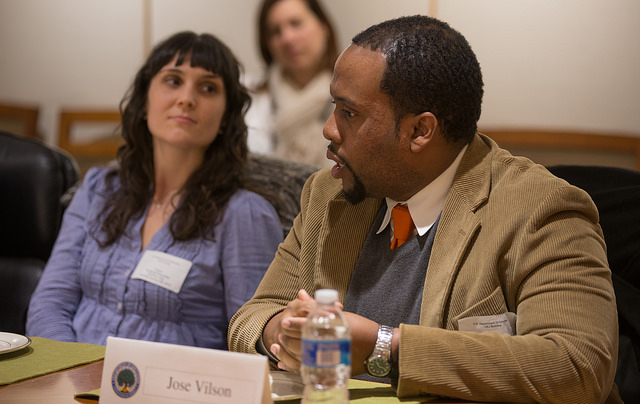
    Jose Vilson, US Department of Education
    I’m supposed to tell you that I want to lose weight. I’m rounder than ever, so that’s a lofty goal.
    But that’s no fun, and I’d rather not spend your time talking about dietary supplements and instead tell you about my visit to the US Department of Education, my second trip to Washington D.C. in as many months. This time, I got the chance to speak to Acting Secretary of Education John King, known primarily as former New York Commissioner of Education, his legacy tarnished by the mass opt-out movement across New York State. I had never met him until he got to D.C., so my only impression of him (mainly from articles, blogs, and memes) was that of New York Governor Andrew Cuomo’s puppet, placating to the hedge fund managers and charter school CEO’s wills and whims.
    Since moving to D.C., he’s gotten a chance to hear me speak to him three times, and in two of those My New Year's Resolve | The Jose Vilson:


    Second Charter School Fix is also a Framework for Fraud

    Second Charter School Fix is also a Framework for Fraud:

    Second Charter School Fix is also a Framework for Fraud


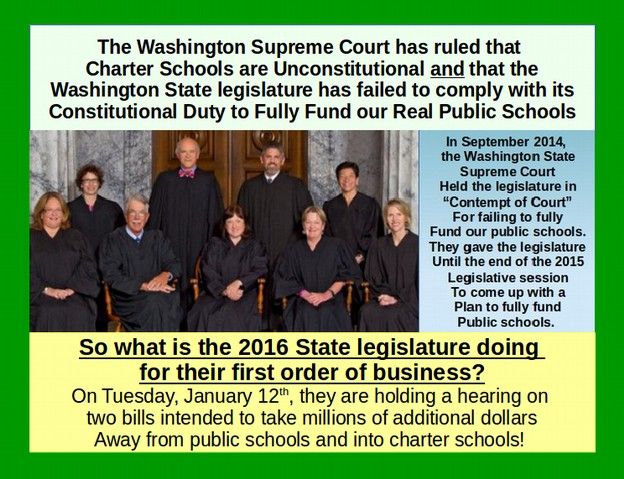
    Even though the Washington State Supreme Court ruled that charter schools are unconstitutional and ordered the State legislature to fully fund our real public schools, some of the leaders of the State legislature, in a blatant act of defiance, have decided to hold hearings on two "charter school fix" bills both of which would rob even more millions of dollars from our public schools. The hearing on the two charter school fix bills will be in Olympia on Tuesday January 12 2016 at 1:30 pm in the Senate Cherberg Building. Parents and teachers who want the legislature to focus on funding our real public schoolsinstead of funding charter schools should attend this hearing and let the Senators know that you oppose diverting any more money away from real public schools. 01
    This is the second of two reports I have written about the Charter School Fix bills to help parents and teachers better understand how the charter school fix bills would rob millions of dollars away from our real public schools. First, a quick review of how we got to this crazy place. In 2012, the Washington State Supreme Court found that the State legislature had failed to comply with their Constitutional Paramount Duty to fully fund our public schools and ordered the legislature to come up with a plan to fully fund our public schools. When the legislature failed to come up with a plan, in September 2014, our Supreme Court held the legislature in "Contempt of Court" for dragging their feet. In 2015, the legislature claimed that they added a billion dollars in school funding. But in fact, they merely restored funds that they had cut in previous legislative sessions. Therefore, in August 2015, the Supreme Court began fining the state legislature. Thus far, the legislature has simply ignored these fines. 

    Then on September 4, 2015, our Supreme Court ruled that the Charter School Initiative 1240, funded with millions of dollars by Bill Gates, was unconstitutional in part because charter schools would divert billions of dollars away from public schools and in part because public school funds would be handed over to private corporations rather than being controlled by publicly elected school boards. 

    In response to this Supreme Court ruling, in December 2015, a couple of fake groups, SFC and LEV, announced that they had formed a new PAC to provide a half million dollars in campaign contributions to legislators willing to "fix" the problem created when the Washington Supreme Court ruled that the Charter School Initiative 1240 was unconstitutional. On January 4, 2016, Senate Bill 6163 was submitted to the 
    Second Charter School Fix is also a Framework for Fraud: