Latest News and Comment from Education

Sunday, December 27, 2015

Spark Charter School Tragedy caused by lax County Office of Education oversight

Spark Charter School Tragedy caused by lax County Office of Education oversight:

Spark Charter School Tragedy caused by lax County Office of Education oversight


Parents and the media seemed surprised when Spark Charter School in Sunnyvale was forced to temporarily close down after one of its students was molested by staff person Jonathan Chow.  The school had failed to keep the required background checks or TB tests for the majority of its employees.  Sadly, the County Office of Education failed in it’s fiduciary responsibility to hold charters accountable, and this preventable tragedy should send a huge wake up call.  The parents of the student are filing suit against both Spark Academy and the County Office of Education.
The County board of education ignored the warning signs of this impending tragedy.
The Sunnyvale Unified School District Board, denied the charter, citing a number of serious problems.  When the Santa Clara County School Board approved the charter on a 4 – 3 vote, several of the Board members echoed those concerns.
Members of the County School Board questioned the validity of numerous aspects of the Spark petition including the financial analysis presented, the Special Education program, the English Learner program, and the testing of low-achieving students. When County School Board Members asked former Chief Strategy Officer Toni Cordova for her assessment, she stated that she did not believe the Spark Board of Directors or the school administrators had “the depth of experience in education or charter schools” necessary to “launch an education program.” In voting against approval, both Trustee Chang and Green expressed disappointment that a six-year effort had produced a petition they could not approve.  Trustee Song, who also voted against the petition, was more pointed when she directly asked parent leaders what would happen if the school was approved and then failed.  The Spark parents dismissed her questions insisting that they had the expertise to open and maintain a school despite the petition’s flaws.
The four trustees who voted to approve Spark Charter also had their concerns. Trustee Mah asked that the school be given a time-line to verify that the conditions stated in the petition were met.  Trustee Beauchman insisted that there be an “educational leader” to guide the school since an Executive Director had yet to be hired.  Trustee Di Salvo worried that he “might be setting a school and the Spark Charter School Tragedy caused by lax County Office of Education oversight:

Seattle Schools Community Forum: Work Session on Strategic Plan: Not As I Thought

Seattle Schools Community Forum: Work Session on Strategic Plan: Not As I Thought:

Work Session on Strategic Plan: Not As I Thought


This will be a bit rough as I am writing it on the fly.  I feel this is important to get out, though. because it has information on the thinking of every single Board member AND marks a significant change from previous Work Sessions.

Previously, I had heralded this Work Session as "vital"  and I continue to believe that but the meeting itself did not play out as I thought.

Clover Codd and Charles Wright lead the discussion.  Wright noted that it would be his last Work Session as the deputy superintendent (with his departure from the district coming.)  

As I also noted in my notice of this Work Session, the staff presentation was 45 pages long and I thought there would not be much time for discussion.  Codd stated that staff would present the overview and then ask for "warm" and "cool" feedback.  (Warm is "going well or you like the direction" and cool is for not so good.

Wright went thru the presentation in a rapid fashion, noting that, over time, staff realized/knew that a huge list of items in the Strategic Plan was unwieldy and not workable.  He said they got the list down from 90 items to about 33 but 
Seattle Schools Community Forum: Work Session on Strategic Plan: Not As I Thought:

CURMUDGUCATION: More Boston Charter Baloney

CURMUDGUCATION: More Boston Charter Baloney:

More Boston Charter Baloney


Massachusetts has shaped up to become an interesting laboratory for the reformy takeover of a state education system.

The state has specialized in not-even-trying-to-be-sneaky handoff of power to men who have far more interest in corporate education privateering than in serving the families, taxpayers and voters of Massachusetts. State Commissioner of Education Mitchell Chester chairs the governing board of corporate test peddler PARCC. Jim Peyser was the head of NewSchool Venture funds, a group devoted to turning public school tax dollars into Return On Investment for rich folks-- now he's the MA Secretary of Education. The revolving door between private industry and public service has been spinning so wildly that some of these folks are essentially suing themselves.

Because Massachusetts wants charters. Soooo much, it wants charters. At least, that's what all the guys in various leadership positions who have solid ties to the charter industry keep saying over and over.

Take Paul Grogan, head of the Boston Foundation, one of those cool foundations that allows civic minded rich guys a way to impose political pressure on serve their community. Grogan has one of those very special careers in which he never does, well, anything except run these kinds of 
CURMUDGUCATION: More Boston Charter Baloney:

Who closed the Bronx’s high schools? | JD2718

Who closed the Bronx’s high schools? | JD2718:

Who closed the Bronx’s high schools?


There’s a story that has to be told. It needs details. It needs to include conversations, arguments, protests, planning. It needs exact dates. I can’t do all of that. It needs to be told better than I can tell it. But I can start.
In recent years, nine Bronx academic comprehensive high schools were closed and three were down-sized, two sabotaged so badly that I assume they will be retargeted for closure. Also, three Bronx vocational high schools were closed, and the fourth was down-sized.
No large or medium-sized Bronx high school has escaped unscathed (save Bronx Science, which serves relatively few Bronx kids)
The usual narrative says that Bloomberg and Klein did this.
The usual narrative is (mostly) wrong.
Bloomberg and Klein completed, enthusiastically, viciously, work that was started by others. Let’s see who they were.
When I began teaching (substitute in March 1997), it was hard for me to wrap my head around the huge number of high schools in the Bronx. I came from a high school that served three towns. The city next door had three high schools for the whole city (plus a tiny alternative high school, plus a tiny arts school ).
But the Bronx! DeWitt Clinton, Walton, John F Kennedy, Christopher Columbus, Theodore Roosevelt, Evander Childs, Harry S Truman, Herbert Lehman, South Bronx, Morris, Adlai Stevenson. Then there were the vocational schools: Grace Dodge, Samuel Gompers, Alfred E Smith, Jane Addams. Each one of these schools was bigger than the entire district where I had been educated.
And there were more schools. Bronx Science, which I knew was mostly kids from other boroughs. There were Bronx Regional, University Heights, and a handful of small, alternative schools of one sort or Who closed the Bronx’s high schools? | JD2718:


Another side of goodwill is resentment | @ THE CHALKFACE

Another side of goodwill is resentment | @ THE CHALKFACE:

Another side of goodwill is resentment


I have always marveled at the kindness and optimism of veteran Chicago teacher, Michelle Gunderson. I cannot imagine how she is able to maintain this attitude given the struggles they’ve had in Chicago. It’s certainly a part of who Gunderson is as a person. Perhaps it is also that, even though Chicago is going through hell right now, they have a cast of thousands ready and willing to fight. That gives someone hope.
Gunderson has a post up about goodwill and compassion in teaching, things that are sorely lacking right now. Her situation sounds very much like mine in terms of teaching and reaching children in poverty. I too see students walking in without an adult. I have students who walk home with first and second grade siblings. My students follow the philosophy that if you are subject to injustice, then you are unjust in return.
My students rarely highlight the positive with each other and alternatively are quick to share what act of unfairness has been perpetrated against them. Our Kindergarten classroom is across the hall from children with significant emotional needs. Rather than giving these students what they need in terms of mental health counseling, staff in this classroom is told to lock them in and keep them there all day, for lunch and for recess. No matter how much furniture is thrown, KEEP THEM LOCKED IN.
In DC, we do not have a powerful union. Legally, we cannot strike. The WTU President seems more interested in a good relationship with the Chancellor than actual advocacy for teachers. Additionally, the strict evaluation system and merit pay structure–IMPACT–breeds competition, jealousy, and resentment Another side of goodwill is resentment | @ THE CHALKFACE:

An Incomplete (Yet Totally Terrifying) Ohio Charter School Scandal Chronology

An Incomplete (Yet Totally Terrifying) Ohio Charter School Scandal Chronology:

An Incomplete (Yet Totally Terrifying) Ohio Charter School Scandal Chronology

An incomplete chronology of recent charter school scandals revealing a pattern of indifference and cover-ups at the highest levels of state government.

chalkboard_curved


2013
Early summer, 2013
Dayton teacher Matthew Blair calls and emails the Ohio Department of Education to tell them about test tampering and other irregularities at the Horizon Science Academy of Dayton.  Blair said no one responded. Horizon schools are managed by the Chicago-based Concept schools and affiliated with the Gulen movement, named after Fethullah Gulen, a Muslim cleric living in self-imposed exile in Pennsylvania.
Aug. 2013
The Kasich Administration announces it is hiring David Hansen for the Ohio Department of Education’s newly created position of “executive director for the office of quality school choice and funding.’’ He will be paid $105,000 annually to improve state oversight of Ohio’s chronically embattled charter schools.
The Columbus Dispatch includes this in its piece on Hansen’s hiring:
Hansen, 56, has long been outspoken against teachers unions, and in 2007 he penned an op-ed for the Ashland Times-Gazette with the headline “Teacher unions hurt school competition.” In it, he said school districts should “fundamentally reform their teacher union contract policies to expand the reach of market accountability.”
Dec. 22, 2013
Under the headline “HOW CHARTER SCHOOLS BETRAY THEIR STUDENTS AND COMMUNITIES,’’ Matt Blair’s concerns are finally made public in a post he has written for Diane Ravitch’s blog. He tells of exposed wiring inside the school, test tampering by Turkish school administrators and unqualified teachers. 
2014
Jan 10, 2014
Bill Phillis sends Matt Blair’s blog post to every member of Ohio General Assembly
Jan 15, 2014 (ODE COVER-UP NO. 1 BEGINS)
Paul Preston from the ODE’s Office of Community Schools sends Matt Blair’s blog post to sponsors via an email that says Dr. Ross’ “office has asked us to solicit responses to the attached questions from their sponsors regarding allegations in the article. Please feel welcome to keep your responses brief and “positive….”

Does Bernie Sanders Offer Education Advocates Enough? Are We Feelin’ the Bern or Just Feelin’ Burned? | gadflyonthewallblog

Does Bernie Sanders Offer Education Advocates Enough? Are We Feelin’ the Bern or Just Feelin’ Burned? | gadflyonthewallblog:

Does Bernie Sanders Offer Education Advocates Enough? Are We Feelin’ the Bern or Just Feelin’ Burned?

150430-berniesanders-editorial


 You probably didn’t hear about this on the news.

To my knowledge no one covered it on TV, the newspaper or even on the blogosphere.
But Bernie Sanders may have made a reply to his Democratic Primary rival Hillary Clinton’s gaffe about closing public schools.
“I wouldn’t keep any school open that wasn’t doing a better than average job,” Clinton said at a campaign stop in Iowa on Dec. 22.
The media took this to mean Clinton is in favor of closing half the schools in the country. The comment has been much debated with calls for context andexplanation by the Clinton campaign.
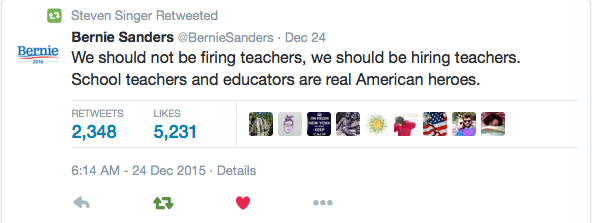
However, very quietly on Dec. 24, Sanders tweeted, “We should not be firing teachers. We should be hiring teachers. School teachers and educators are real American heroes.”
Screen shot 2015-12-26 at 8.06.51 PM
The @BernieSanders twitter account has more than 1 million followers, a little less than the @SenSanders account. But it does appear to be affiliated with the Bernie Sanders presidential campaign. If Sanders, himself, posted the tweet is unclear. The candidate used the same account to live tweet the Republican debates so he – at least Does Bernie Sanders Offer Education Advocates Enough? Are We Feelin’ the Bern or Just Feelin’ Burned? | gadflyonthewallblog:

DETROIT on the WAR REPORT PART 2: More from Detroit and Beyond


DETROIT on the WAR REPORT PART 2: More from Detroit and Beyond

PLEASE READ: Snyder's Man Made Disaster
SEPARATE & UNEQUAL - EDUCATIONAL APARTHEID
***********************************
DISPARATE IMPACT
Education levels the playing field, creates opportunity for all, and builds better communities in our country. However, the equal opportunity for education is being denied to Michigan's black, Hispanic and special education students via a man made disaster.
BROWN VS BOARD
Governor Rick Snyder is violating Brown vs. Board. A separate and unequal school system, an educational apartheid has been created in Michigan. This apartheid has the greatest impact on special education and minority students.
WHY SEPARATE?
Black school districts are under the authority of the Governor, and his appointees. White districts are under the authority State Board of Education and their local elected Governance.
WHY UNEQUAL?
Under Governor Snyder's management, educational test scores, and property values dropped in the districts he managed, in direct relationship to his policies. In addition, under Governor Snyder, individuals who complain have been retaliated against or discredited. Before Emergency Management, Detroit, enjoyed the highest test scores of any district in the nation for poor students.Now, the Governor's EAA has the worst test scores in the nation.
PATTERN OF RETALIATION & SUPPRESSION OF FACTS
This suppression of diverse opinions was also seen in the Flint Water Scandal, another man-made disaster where Governor Snyder's spokespersons discredited Dr. Mona Hannah-Attisha and Virginia Tech before the truth was finally revealed by leaked documents.
MAN MADE DISASTER IN DPS - 4 POINTS
SNYDER CREATES EDUCATIONAL REFUGEES
1. Through mismanagement and retaliation, Governor Snyder is further creating educational refugees by making the public schools so unacceptable, and the morale, benefits of teachers so low, that it is driving staff and students away into charters intentionally.
MAN MADE FINANCIAL DISASTER USES EDUCATIONAL FUNDS TO GIVE CORPORATE WELFARE
2. This financial disaster is artificial. DPS was solvent until state intervention.
Before State Control DPS Had:
- Rainy Day Fund of $70 million
- Bonding Authority of $1.5 billion
- Surplus of over $100 million
LET'S FOLLOW THE MONEY
---- Now, the district is $700 million in debt
---- To maintain control of Federal and local education dollars to have them to give corporate welfare to billionaires, and create more charters, he divides DPS in half by creating the EAA and proposing the DEC, the Detroit Education Commission. Meanwhile, here are some of the expenses under State control.
- $424 million of school funds to build a hockey stadium
- $40 million for marble and chandeliers at the Fisher Building
- $50 million per year to run his own district, the EAA
- $409 per square foot renovations, buildings closed the following year
- $350,000 settlement for student subjected to sexual solicitation
- $60 million to a out of town corporation to "evaluate teachers".
WHAT WE SACRIFICED
-- During this time, books were scarce
-- During this time, children went without transportation
-- Snyder tried to remove boiler engineers from DPS to save $5 million
-- During this time, teacher pensions were not paid
-- During this time, teachers took pay cuts.
DEC IS MORE STATE CONTROL - TAXPAYERS WANT A SCHOOL BOARD
3. Those who want a DEC, like the Skillman Foundation, Dan Varner, (Excellent Schools Detroit) and the Governor, simply want the power to have control over the lucrative contracts surrounding billions in Federal funds. It sounds nice to say, "we want excellent schools", but these words are merely subjective "fluff talk" which mean absolutely zilch policy wise and only covertly satisfies citizens, while bamboozling voters and tax payers, yet is ultimately accountable to no one. So let us be honest. In truth, the State Board ALREADY has the power to close failing charter schools in every district state wide. Unfortunately, the Governor has stripped and continues to strip the State Board of some control in minority districts. Democracy dies. Emails and other documents revealed in the discovery process of a suit against the State show that Skillman Foundation and other Coalition members were given directions to push students out of DPS and work to achieve a DEC-like appointed Board after voters rejected state control in 2005. Yet, we clearly see that giving appointed persons control over billions of dollars and public infrastructure compromised public safety and opened the door to corruption.
HOW THE D.E.C. PROPOSAL COMPROMISES DEMOCRACY
& LOCAL VOTING RIGHTS
A. Strips Neighborhood Voice Taxation without Representation.
Did you know every traditional public tax payer funded school that closes causes a $1000 drop in property value for every house in Detroit? Did you know every traditional public tax payer funded school that closed in your neighborhood caused a $20,000 drop in property value for homes in the neighborhood? Did you know that two schools closing in a neighborhood caused a $70,000 drop in property value for homes in the neighborhood? That said, when we are specific, then who should have a say in school closures: those who are directly elected to make that decision over their tax dollars by the residents, or appointed persons?
B. Other districts have charters and public schools, but no other district has a DEC. This is a clear sign of being treated unequally and this violates the guidelines of equal opportunity for all to enjoy a public education as well as violating the Voting Rights Act. Yet, many, unfortunately, are ready to compromise the democracy many gave their lives for.
SNYDER'S VIOLATIONS OF CIVIL RIGHTS & VOTING RIGHTS - Those who wish to destroy public education have participated in violating the civil rights of disabled children, educational staff, citizens, parents, and most of all vulnerable students.
---a. Retaliation against parents, staff
---b. Impact - Children raped on their way to school in the EDUCATION DESERT created by Snyder.
---c. Public Safety Compromised - Pedophiles allowed into the school by Emergency Managers
---d. Caused property values to plummet.
---e. Financially devastated the district.
WHAT WE WANT
- A RECEIPT FOR OUR TAX DOLLARS - A FORENSIC AUDIT
- A REFUND FOR MISMANAGEMENT - A CONSTITUTIONAL ADJUSTMENT
- RETURN TO DEMOCRATICALLY ELECTED GOVERNANCE
- RETURN EAA TO DPS
- PUT MONEY IN CLASSROOMS - Give money to teachers & kids!
- STRAIGHT TALK - No more fluff talk and covert and unethical power grabs over public institutions.
The War Report on Education Radio Show Will be Exploring These Issues at 5pm EST, today.http://bbsradio.com/thewarreport
Check Out True on Facebook  http://on.fb.me/1On8zL6

CURMUDGUCATION: When Business Doesn't Get It + ICYMI: December 27

CURMUDGUCATION:

When Business Doesn't Get It

Peter Elkind just published a "special report" in Fortune that is an illuminating read. "Business Gets Schooled" is the story of the rise and fall of Common Core from the perspective of the business interests that became involved, and I recommend that you read the whole thing yourself. It can be hugely instructive to see how things look from another vantage point.

But for right now, there are just a couple of specific points I want to pull out of the piece, and one truly amazingly awful quote.

Business Is Not Limber or Agile

When business interests backing CCSS found themselves under attack, they were simply unable to respond in any sort of quick or effective manner. The business world by and large doesn't get social media much, and it seems that the bigger the company and the more highly-placed the executive, the more deficient the understanding of how blogs and twitter and facebook can mount a damaging attack by lunchtime on any given day.

They are, as Elkind puts it, "used to exercising power through traditional channels," and so it made sense to work the political connections, work the personal power connections (the article opens with a dinner meeting between Bill Gates and Charles Koch), and when under pressure, to work big When Business Doesn't Get It

ICYMI: December 27


Two days after Christmas and it is currently warmer outside my home than inside it. But here are some pieces to read as you contemplate whatever strange weather you're facing today.

Will Hillary Clinton Go All in With Us or Wall Street
Closing Schools Is Not and Educative Option

Pretty sure that Hillary's quote won the Blogger Swarm of the Month award, with some reactions more reasonable than others. Julian Vasquez Heileg took a look at it.And so did Mitchell Robinson, who I think hit at what is most bothersome about the dumb thing that came out of Clinton's mouth.

The Least of Russ on Reading

Russ Walsh does a fun thing for his year-end post. Instead of his best or most popular posts, he lists some worthwhile posts that didn't pull quite the traffic as some others. Catch up on his overlooked gems.

Why Charter Schools Are Fraud Factories

Much of what's here is old news, but there's always something about seeing just how broad and deep and wide the world of charter school shenangians runs.


The Gift of Student Voice in New Orleans

Looking for some giving that will do some good? Edushyster has an inspiring and worthwhile project in New Orleans that actually promotes student voices. Take a look and wrap up your year by contributing to a worthy cause.

Merry Christmas, Ramone

Finally, Nancy Flanagan presents a story that is both heartbreaking and uplifting, looking at both what is awful and what is hopeful in the education world. ICYMI: December 27


4LAKids - EXPANDED LEARNING TIME FOR ENGLISH-LANGUAGE LEARNERS

4LAKids - some of the news that doesn't fit: EXPANDED LEARNING TIME FOR ENGLISH-LANGUAGE LEARNERS:

EXPANDED LEARNING TIME FOR ENGLISH-LANGUAGE LEARNERS

by Natalie Gross | Education Writers Association/Latino Ed Beat | http://bit.ly/1OeSCe0

December 22, 2015 ::  Can a longer school day help students who are learning English grasp the language faster and better? A new report from the National Center on Time and Learning suggests it’s a strategy worth considering.

The report from the Boston-based organization dedicated to increasing the time and quality of instruction in high-poverty schools highlights three elementary campuses in Massachusetts and Denver that have seen the expanded learning time model make a difference for their English-language learners (ELLs).

While all three schools are majority Latino, Godsman Elementary School in Denver had the most English-language learners at 86 percent of its student body. Nearly two-thirds of the students are native Spanish speakers of Mexican heritage. The school has reaped success from adding two and a half hours to its school day and implementing a dual-language model in which students get three hours of literacy-focused instruction every day.

Guilmette Elementary School in Lawrence, Massachusetts lengthened its school day by 90 minutes in 2013 and devotes an hour a day to targeting students’ individual achievement gaps. During that time, ELL students use Imagine Learning, a computer-based educational program that emphasizes oral language skills and vocabulary through videos, pictures and direct translation. Since also creating a position for an ELL coach at the school, the school’s performance on the annual state test for ELLs has skyrocketed, and Guilmette is now ranked among the top 15 percent in the state, according to the report.

The third campus evaluated for the study, Hill Elementary in Revere, Massachusetts, added 300 hours to its calendar, which translated to an additional week of the school year as well as a longer school day. The additional time has allowed for more collaboration among teachers — ELL specialists included — and up to three one-on-one sessions between ELL students and their specialized instructors.

As Corey Mitchell of Education Week points out, there were a few notable strategies that worked across the board for the students learning English in these schools.

·         Extended literacy blocks, with upwards of 2.5 hours per day focused on skills needed for reading and writing.
·         Using data to pinpoint areas where individual students struggle, then subdividing those students into small4LAKids - some of the news that doesn't fit: EXPANDED LEARNING TIME FOR ENGLISH-LANGUAGE LEARNERS:

Mike Klonsky's SmallTalk Blog: If Bettie was killed by 'accident', what about Quintonio?

Mike Klonsky's SmallTalk Blog: If Bettie was killed by 'accident', what about Quintonio?:

If Bettie was killed by 'accident', what about Quintonio?

Bettie Jones' cousin: "Her blood is crying out from the grave saying, 'Evelyn, avenge me'" -- Chicago Tribune
2 fatally shot, 1 accidentally, by Chicago police on West Side; families demand answers 

The headline in the Tribune says so little, yet says so much. If police killed Action Now activist Bettie Jones by "accident", does that mean they killed 19-year-oldQuintonio LeGrier, on purpose? Why?

Why did CPD answer a "domestic disturbance" call with guns blazing? There was no video this time. So we will have to rely on the police account of what happened. Why did they pump seven shots into another young man who, it appears, posed no real threat to them. I'm sure, given a little time, they will get their stories straight, like they did in the Laquan McDonald shooting. All we know for sure is that another young black man is dead. His 55-year-old neighbor is dead.


Bettie Jones & Quintonio LeGrier.
19-year-old LeGrier was an engineering  student at NIU. He graduated last year from Gwendolyn Brooks College Preparatory Academy with honors, for having a grade-point average of 3.0 or higher. He was listed as part of a team of students who ran the 2013 Chicago Marathon to raise money for clean drinking water for African children.

Rahm is off in Cuba with his wife and children, enjoying the beaches and the war Mike Klonsky's SmallTalk Blog: If Bettie was killed by 'accident', what about Quintonio?:

Russ on Reading: The Least of Russ on Reading 2015

Russ on Reading: The Least of Russ on Reading 2015:

The Least of Russ on Reading 2015


This is my second annual year-end compilation of blog posts that attracted very little attention the first time around, but that I think are worthy of a second chance at life. It has been a year of extremes for this blog, with some posts attracting thousands upon thousands of readers and others, like the ones collected here, not so much. So while others in the media present their "Best of..." and "Worst of ... lists, I offer "The Least of Russ on Reading 2015." I hope you find something interesting or informative here that you might have missed the first time around.

From Complex Text to Considerate Text

The Common Core calls for children to read more complex text, I call for writers to write more "considerate" text to aid readers in comprehending text book writing.

Do Children Really Shift from Learning to Read to Reading to Learn?

A common fallacy is that the early grades are for learning to read and after 3rd grade kids shift to reading to learn. I argue that kids are reading to learn 
Russ on Reading: The Least of Russ on Reading 2015:

Predictions, Dumb and Otherwise, about Technology in Schools in 2025 | Larry Cuban on School Reform and Classroom Practice

Predictions, Dumb and Otherwise, about Technology in Schools in 2025 | Larry Cuban on School Reform and Classroom Practice:

Predictions, Dumb and Otherwise, about Technology in Schools in 2025


One easily trips over a list of high-tech tools that have become obsolete in the past decade (e.g., floppies, fax machines). I used many of these myself and remember junking them, saying to myself: hey, these were highly touted, I bought the second- or third-generation version and now I am dumping them.  Other lists of high-tech predictions for 2020 were equally entertaining about the future of schools. This list posted by a high-tech enthusiast who yearns for a paperless society and totally customized instruction with smaller, greener schools tickled me because while I do agree with some of the items, others are, well, dreams. I have been reading such dream lists for years about high-tech devices (with brand-new names) promising a glorious (or nefarious) future just around the corner, including the disappearance of the teacher (see here).
And I have contributed to such lists with my own predictions over the past six years (see (see December 26, 2009, December 30, 2010, December 29, 2011, December 27, 2012, and December 10, 2013.). I have predicted that textbooks will be digitized, online learning will spread, and the onset of computer testing will create more access to devices across schools and accelerate classroom usage. These developments will occur incrementally over the next decade and will be obvious to observers but hardly dominate K-12 age-graded schools.
While higher education textbooks  have shifted markedly to e-books and less expensive ways of getting content into students’ devices, the K-12 market remainsa proprietary domain of a handful of publishers (e.g. Pearson, Houghton Mifflin Harcourt, and McGraw-Hill Education) in part due to the mechanics of  certain states (e.g.Florida, California, and Texas) dominating which texts get chosen. But changes continue (see herehere, and here) Changes in K-12 texts will occur in bits and pieces as publishers adapt to the impact of the web.
K-12 online learning will also spread slowly, very slowly, as blended instruction,personalized learning, and “flipped” classrooms gain traction. For public schools in 2016, the recent debacle in Los Angeles Unified School District largest (and most expensive) adoption of  iPads in the  U.S. continues to shadow rollouts of  tablets across the nation. Nonetheless, more and more tablets are in teacher and Predictions, Dumb and Otherwise, about Technology in Schools in 2025 | Larry Cuban on School Reform and Classroom Practice:

Nearing the end, vouchers remain a key Jindal priority | The Advocate — Baton Rouge, Louisiana

Nearing the end, vouchers remain a key Jindal priority | The Advocate — Baton Rouge, Louisiana:

Nearing the end, vouchers remain a key Jindal priority
After nearly eight years and countless policies, Gov. Bobby Jindal has largely singled out one program he hopes will remain intact after he leaves office on Jan. 11 — school vouchers.
Republican Jindal took the highly unusual step of asking Democratic Gov.-elect John Bel Edwards, a critic of vouchers, to give the student assistance a fair hearing before he takes action.
“I did ask John Bel, the governor-elect, to meet with the parents, meet with some of these kids, before he makes any decision,” Jindal said in an interview.
“I was pleased that he agreed to do that,” he said.
Vouchers allow low-income students who attend troubled public schools to qualify for state aid so they can attend a private or parochial school.
The aid, which was once limited to New Orleans, was expanded statewide in 2012 as part of Jindal’s sweeping education overhaul legislation.
More than 7,000 students get the assistance in the current school year, up 290 percent since 2011-12.
Edwards, who as a state House member opposed the expansion, insists he has no plans to scrap vouchers when he assumes office.
But backers of the assistance, both before and after the election,repeatedly have warned that the program is in danger.
Edwards was supported in the campaign by the Louisiana Federation of Teachers, a longtime opponent of vouchers. The governor-elect also was the lead witness when the LFT challenged the law. The lawsuit forced the state to change the way vouchers are funded.
Earlier this year, Edwards unsuccessfully sponsored legislation that would have limited vouchers for kindergarten students only to those who would otherwise have to attend public schools rated D or F.
Some allies believe he wants to limit all vouchers only to students who attend D and F schools, not those rated C, D and F.
Edwards told the annual meeting of the LFT in Lake Charles that, while he would not push to end the aid, he wants it used only for low-income students in failing schools.
Some lawmakers contend too many schools are labeled “failing” and that only those with F grades truly meet that description.
Jindal highlighted his eleventh-hour focus on vouchers during a visit this month to St. Benedict the Moor Catholic School in Gentilly Woods in New Orleans, where more than three-fourths of the students are voucher recipients.
“Anyone who hears the firsthand stories will be impressed,” Jindal said in the interview. “Hearing firsthand from the parents is very powerful.”
Longtime opponents of the state aid say the governor’s priorities are off target.
“I guess every governor wants to find the good things they think came out of their particular administrations,” said Debbie Meaux, president of the Louisiana Association of Educators.
“Of course, I have a different opinion from the governor on touting vouchers as sort of his legacy,” Meaux said. “If he is looking for that grain of good, I think he needs to look elsewhere for his legacy.”
Critics contend vouchers are a drain on already pinched state aid for public schools. The price tag this year is about $42 million.
Meaux and others also argue that vouchers have failed to deliver on the promises of supporters.
They note further that some schools that accept voucher students have been embroiled in controversy and that some of the schools’ standardized test scores have been dismal.
Eric Lewis, a former Louisiana director of the Black Alliance for Educational Options and a longtime backer of vouchers, said Jindal’s push is understandable in light of the growth of the program.
“I would be hopeful that our newly elected governor would talk to parents and kind of understand how it is going to benefit them,” Lewis said.
Eva Kemp, state director of Democrats for Education Reform, said Jindal’s push is understandable “given his political aspirations,” a reference to the governor’s interest in national politics.
Aside from some possible modifications, Kemp said, she does not see Edwards pulling back on a wide range of school Nearing the end, vouchers remain a key Jindal priority | The Advocate — Baton Rouge, Louisiana:

Polis: Truly leaving no child behind - The Denver Post

Polis: Truly leaving no child behind - The Denver Post:

Polis: Truly leaving no child behind

House Education and Workforce Committee member Rep. Jared Polis, D-Colo., speaks on Capitol Hill in Washington, Nov. 18, as  House and Senate negotiators
House Education and Workforce Committee member Rep. Jared Polis, D-Colo., speaks on Capitol Hill in Washington, Nov. 18, as House and Senate negotiators try to resolve competing versions of a rewrite to the No Child Left Behind education law. (Jacquelyn Martin, The Associated Press)


Education is the best ladder of opportunity we can build for our next generation and the best investment we can make in helping families escape the vicious cycle of poverty.
Unfortunately, for more than a decade, our nation's education law — No Child Left Behind — hasn't been meeting this need. While well-intentioned, the law has proven to be onerous and inflexible, subjecting students, teachers and administrators to a one-size-fits-all, flawed accountability model.
As a former chair of the Colorado State Board of Education and founder and former superintendent of a network of charter schools in Colorado and New Mexico, I saw the results of this failed education policy first-hand.
And as I've traveled throughout Colorado's 2nd Congressional District as its representative, I've heard the same concerns repeatedly: there's too much redundant testing, too little respect and support for educators, and too many students falling through the cracks.
All that changed a couple weeks ago. On Dec. 10 we finally moved beyond political differences to make positive change by replacing NCLB with a new education law called the Every Student Succeeds Act (ESSA). The ESSA we passed in Congress, and that the president signed into law, better supports our students, educators and parents, and fixes the problems of NCLB by giving power back to states and local school districts.
At the core of ESSA is flexibility. We do away with NCLB's rigid, one-size-fits all parameters and instead lay out a broad framework of accountability and transparency requirements for states to meet, and then give them the power to set up their own systems that work best for their unique needs.
The new law will also enable students to spend less time taking tests and more time learning. For instance, Colorado high schoolers currently take PARCC, the ACT, and district assessments — and many students take AP or IB tests on top of that. Under the new law, states can now allow high-quality, recognized tests that are more meaningful to high school students — like the ACT — to serve in place of the annual state tests.
The new law also supports schools' efforts to expand creative and effective teaching methods beyond the traditional classroom setting. It grows and improves an existing program that provides resources for innovative solutions to common education challenges that have a proven record of supporting student achievement. These provisions (which are taken from legislation that I introduced in the House in February) will create new opportunities for STEM programs and education technology.
They're already having an effect in Colorado, where school districts like St. Vrain Valley have used this initiative to support students struggling with math and better engage kids in the sciences. By Polis: Truly leaving no child behind - The Denver Post: