Wednesday, December 2, 2015

CURMUDGUCATION: The New ESEA: Sturm or Drang?

CURMUDGUCATION: The New ESEA: Sturm or Drang?:
The New ESEA: Sturm or Drang?


The new version of ESEA is called the Every Student Succeeds Act, which is a fine sine of the sort of aspirational nonsense that legislators are capable of. Why not the Every Child Gets a Pony Act, or the Every Child Is Smart, Good-Looking and Above Average Act?

The most notable thing about the act is that it is 1,061 pages long. It is the Moby Dick Travels to Middle Earth of regulation. The second most-notable thing is that it has been spit out by committee on a fast track that allows pretty much nobody to actually look at the thing, including the people who are poised to vote on it. Make a note of this fast-track legislative prestidigitation the next time some some pundit ponders how politics got so tangled in education. Once again, politics have been hardwired into public education's dna.

I am not exactly a low-information voter on these issues, and I have not a chance to really check out those 1,061 pages. But some folks have been doing super work with it. The folks at EdWeek's K-12 have been doing super work (here, here, or here for starters) and Mercedes Schneider has apparently doing without sleep to work on this (here and here). Daniel Katz has put together a good compendium of what's out there as well.

There are things to hate. TFA, charter schools, and the folks who love social impact bonds have gotten good value from their lobbyists. The path has been leveled for Competency Based Education. And probably most hateable of all, the damned stupid Big Standardized Test is all its yearly waste-of-timeliness has been enshrined in law once again.

There are things to love. Most notably, in what may really be an historic moment, a federal agency has had power taken away. USED is told to go sit in the corner and shut up. Although there are also 
CURMUDGUCATION: The New ESEA: Sturm or Drang?:

A Real Solution to the Infinitesimal Cases of Child Predators in Our Schools | gadflyonthewallblog

A Real Solution to the Infinitesimal Cases of Child Predators in Our Schools | gadflyonthewallblog:

A Real Solution to the Infinitesimal Cases of Child Predators in Our Schools
110401_toomey_ap_605


Pat Toomey is obsessed with child predators in our public schools.
When I came to Washington, D.C., this summer to visit 
the U.S. Senator from Pennsylvania, he was lobbying to get his “Passing the Trash” bill included in theElementary and Secondary Education Act (ESEA).
His proposed legislation – now part of the Senate version of the ESEA – would ban school districts from helping known pedophiles from finding teaching jobs at different schools. Toomey is hopeful the provision will remain in the final version of the law that eventually will reach President Obama’s desk.
I met with his education aide who cheerily told me her job was to comb through the nation’s newspapers everyday and count the number of teachers accused of acting inappropriately with children. I’d mention issues like inequitable funding,standardized testing and Common Core. She’d solemnly quote back the number she’d found in her research.
There was definitely a disconnect between our priorities. After all, I’m a public school teacher. I work in our school system everyday. She and her boss only know about our schools through what they read in the newspaper. And according to the media every school in American houses child predators. They lurk behind every A Real Solution to the Infinitesimal Cases of Child Predators in Our Schools | gadflyonthewallblog:

Civil Rights and Education Groups Respond to Final ESEA Bill

Civil Rights and Education Groups Respond to Final ESEA Bill:

Civil Rights and Education Groups Respond to Final ESEA Bill

The Leadership Conference on Civil and Human Rights  & The Leadership Conference Education Fund


WASHINGTON – 37 civil rights and education groups issued the following statement after the release of the final conference bill to reauthorize the Elementary and Secondary Education Act (ESEA), the Every Student Succeeds Act.
“The Elementary and Secondary Education Act is our nation’s most important civil rights law for promoting educational achievement and protecting the rights and interests of students disadvantaged by discrimination, poverty and other conditions that may limit their educational opportunity.
Throughout the year, the civil rights community has fought to make sure that the long-overdue reauthorization of this law would ensure that vulnerable children get the education they’re entitled to. As a result of our diverse communities working together with a common goal, we’ve seen significant improvement in this legislation since January. We are grateful for the hard work of congressional champions and their staff. And in all of our diversity, we speak both as a coalition and as individual organizations highlighting individual priorities and areas of focus.
We believe the Every Student Succeeds Act is an improvement over the waivers and is a chance to move beyond the No Child Left Behind Act for the millions of students of color, students with disabilities, and English learner students we represent. However, the compromise that has resulted in the Every Student Succeeds Act is not the bill that we would have written
There are provisions in the proposed legislation that we believe will help remedy deep-seated disparities in our nation’s schools. For example, with collaboration from the Department of Education and policymakers at the state and local level, we believe this law can fulfill its purpose as stated in Title I, to ‘provide all children a significant opportunity to receive a fair, equitable, and high-quality education and to close educational achievement gaps.’
The process of implementing this law will not be legitimate without the inclusion of communities we represent in all federal, state, tribal and local decisions. State and local control has too often been an obstruction to narrowing disparities, and we will not let jurisdictions with millions of dollars in federal aid off the hook for failing to equitably and adequately educate all children. This bill’s passage is a call to action for parents and stakeholders in every school district and every state to hold decisionmakers and administrators accountable for educating all students, and to demand a seat at the table as this law is implemented in their communities.”


  • The Leadership Conference on Civil and Human Rights
  • Alliance for Excellent Education
  • American Association of University Women (AAUW)
  • Association of University Centers on Disabilities (AUCD)
  • Children's Defense Fund
  • Council of Parent Attorneys and Advocates
  • Democrats for Education Reform
  • Disability Rights Education & Defense Fund
  • Easter Seals
  • The Education Trust
  • The Expectations Project
  • GLSEN
  • Judge David L. Bazelon Center for Mental Health Law
  • The Lawyers' Committee for Civil Rights Under Law
  • MALDEF        
  • NAACP
  • NAACP Legal Defense and Educational Fund, Inc.
  • National Association of Councils on Developmental Disabilities
  • National Center for Learning Disabilities
  • National Center for Special Education in Charter Schools
  • National Center on Time & Learning
  • National Council of La Raza (NCLR)
  • National Disability Rights Network
  • National Down Syndrome Congress
  • National Indian Education Association
  • National Urban League
  • National Women's Law Center
  • New Leaders
  • PolicyLink
  • Southern Education Foundation
  • Stand for Children
  • TASH
  • Teach For America
  • Teach Plus
  • TNTP
  • UNCF
  • United Way Worldwide

15 Years of Bill Gates’s Experimentation

NEWSLETTER: 15 Years of Bill Gates’s Experimentation:

NEWSLETTER: 15 Years of Bill Gates’s Experimentation

In his October 7 speech as he ruminated on how his foundation shaped educational policy and practice for the past fifteen years, Bill Gates spoke of the importance of what he called “high impact” strategies. His speech contained only one acknowledgement of error on his and Melinda’s part – and it was an error of the most innocent sort. He said they had been “naïve” in the way in which they rolled out the Common Core. Apparently they did not anticipate that democracy might get in the way of their plans.
For Bill Gates this has all been a grand experiment, one that he believes he is entitled to conduct on our children, our teachers and our schools. It is astounding that a man, who has no qualifications to guide our nation’s educational system has been allowed, by virtue of his fortune, to meddle in it as he has.
Although he spoke of the importance of continuous learning, (even admitting that the Gates Foundation still had a great deal to learn), Bill Gates did not show any signs of veering from the checkered record of their past 15 years of pushing the United States to adopt his vision of K12 education reform.
We at the Network for Public Education, however, will not let Mr. Gates, his wife or his Foundation off the hook. And so we bring you this special report on the grand experiment of Bill Gates. The breadth and scope of meddling is breathtaking. The evidence of success is not.
by Carol Burris and Anthony Cody

NPE is proud to share this interactive infographic detailing the last 15 years of Bill Gates’s public education experiments. It contains links to 13 reports from 12 of the nation’s leading pro-public education advocates (which you will also find in the “Around the States” entries below.)
Click on the infographic to be taken to our website, then hover your cursor over the green, yellow, and red entries to reveal links to the reports. You’ll also find a video of Gates embedded in the center quote. Please share widely to let others know the full extent of the destructive influence Bill and Melinda Gates have had, and continue to have, on the democratic institution of public education.
Carol Burris: Executive Director, Network for Public Education, former New York principal
In 2008, Florida’s Hillsborough School District received a $10 million grant to revamp their teacher evaluation system and salary system. In 2015, the experiment ended with the district footing the bill for $50 million in cost overruns and student achievement goals not met.


Congress Fails – Again – This time on the re-write of National Education Policy - Wait What?

Congress Fails – Again – This time on the re-write of National Education Policy - Wait What?:

Congress Fails – Again – This time on the re-write of National Education Policy


The George W. Bush/Barak Obama legacy of destroying public education in the United States will continue thanks to the “bi-partisan” re-write of the No Child Left Behind Act (NCLB).
Now called the Every Student Succeeds Act (ESSA), Republican and Democratic Leaders, along with the Corporate Education Reform Industry and the leadership of the teacher’s unions are heralding the new system which continues the effort to privatize public education, turn schools into little more than testing factories and undermine teachers and the teaching profession.
The most substantive difference is that rather than the federal government “mandating” these dangerous and damaging policies, the federal government will “mandate” that the States do the dirty work in their own name.
Both the United States House of Representatives and the United States Senate will be voting on the Every Student Succeeds Act in the coming days.  The President will certainly sign the legislation since it ensure the education reform industry continues to drain off billions of dollars in scarce public funds.
The following are links to some of the latest articles on the bill;
BATs Respond to Every Student Succeeds Act (Report from the BATs organization)
Numerous questions about the impact of the new law remain but on the opt-out issue it Congress Fails – Again – This time on the re-write of National Education Policy - Wait What?:

Behind-the-Scenes @MSNBC @MHPshow | Cloaking Inequity

Behind-the-Scenes @MSNBC @MHPshow | Cloaking Inequity:

Behind-the-Scenes @MSNBC @MHPshow


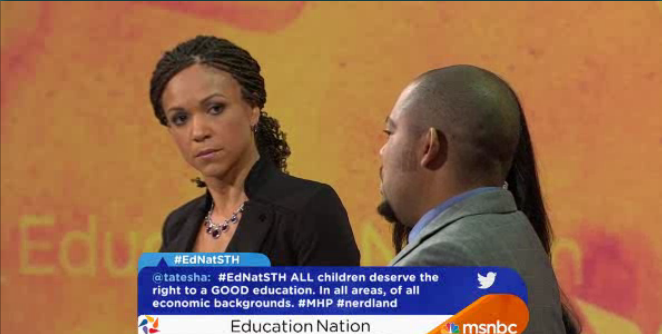
Have you ever wondered what is like behind-the-scenes when you are on a national television show? My first visit to MSNBC was in 2012. I had given interviews about various education policy topics on on local and national radio, but I had never participated LIVE on a national TV network. I was really nervous. Live TV is difficult because you have no idea what questions will be asked, although you usually have a general idea which direction the discussion will go— more on this later in the post. Well, suffice to say that my first experience on national TV was an eventful visit. Jonathan Alter, then the editor at Newsweek, head popped off when I started talking about my research published in the Berkeley Review of Education showing that 40% of African American students had left KIPP charter schools before graduating. (See the post Melissa Harris-Perry Show: Demanding accountability from charters)
ptii-education-nation
The behind-the-scenes backstory that most people don’t know is that my disagreements with Jonathan Alter’s “reformer” perspectives had started backstage where I had told him that most of the information that he was providing in his media interviews about education was wrong. It just went forward from there on LIVE TV. During the commercial break we also had a very vigorous discussion Behind-the-Scenes @MSNBC @MHPshow | Cloaking Inequity:

Fact Check: Why Did it Take So Long for ESEA to Get Done? - Politics K-12 - Education Week

Fact Check: Why Did it Take So Long for ESEA to Get Done? - Politics K-12 - Education Week:

Fact Check: Why Did it Take So Long for ESEA to Get Done?

Politics K-12


Everyone is excited that the Elementary and Secondary Education Act is finally moving and agrees it's taken way too long law to get a facelift. But what exactly accounted for the big delay?
Sen. Harry Reid, D-Nev., the Senate minority leader, pointed the finger directly across the aisle in a speech Wednesday, just before the House was set to take up the bill to reauthorize the ESEA. He said Republicans obstructed past efforts.
"I'm happy to have participated in getting something done with Elementary and Secondary Education, led by, on our side, the senior senator from Washington [Sen. Patty Murray]," he said on the Senate floor. "We were able to get it done because of her good work and others. But it wasn't that we didn't try before. We couldn't get it done before because of the obstruction of Republicans."
Actually, it was a lot more complicated than that.
There were many, many reasons that a bipartisan Senate bill to revise ESEA didn't make it over the finish line back in 2011, even though it had the support of three education committee Republicans, including Sens. Mike Enzi, the top GOP lawmaker on the panel at the time and Lamar Alexander, the current chairman of the panel and the co-author the current Every Student Succeeds Act. Both of them said publicly at the time that they wanted to see the legislation get to the floor. (Rep. Mark Kirk, R-Ill., also supported the bill.)
So what were the major obstacles? Sure, some Republicans (like Sen. Rand Paul of Kentucky) hated the bill and would have probably tried to kill it, or at least not helped along the process.
But the Obama administration wasn't exactly in love with the legislation, either, in part because it didn't include a requirement for teacher evaluation through student outcomes. (Administration officials may now be privately regretting not doing more to move that bill forward, since it was arguably stronger from their perspective than the legislation on the table now.)
The civil rights community was also not a huge fan of the 2011 legislation (it's given a measured endorsement to this version).  And accountability hawks were worried the bill would only get weaker on the floor (because of Republicans, but also because of teachers' unions and Democrats allied with them).  
So the 2011 bill's sponsor, former Sen. Tom Harkin, D-Iowa, said he didn't want to move forward, since a parallel process in the House was partisan. And that was it for ESEA in 2011. 
Similarly, in 2013, Harkin tried to move another bill (this time with support from Democrats only, although Alexander made it clear he wanted to see it move to the floor). House Republicans, meanwhile moved a GOP-only version. 
And the administration was pretty aloof to these efforts. It didn't threaten to veto the Senate Democrats' bill, of course, but it also didn't rush out to help its path forward, either. The administration didn't even put out a statement of support on it.  (Officials were worried the bill would get weaker on the floor, advocates told me at the time.)
The very earliest attempt to get ESEA across the finish line was back in 2007. And it failed largely because of lack of support from the Bush administration and teachers' unions. 
On the other hand? Reid's comments on Murray's efforts seem to be right on the money. The top Democrat on the Senate education committee, is considered an ace negotiator. (As is Alexander). Their cooperation helped save the bill when it appeared doomed earlier this year.
And, working with their House counterparts, Reps. John Kline, R-Minn., and Bobby Scott, D-Va., they ended up with a product that governors and state chiefs love and the civil rights community is (relatively) happy with. That's no small feat, considering negotiations started with an effort to ditch annual testing.  Fact Check: Why Did it Take So Long for ESEA to Get Done? - Politics K-12 - Education Week:

Top 12 Concerns About Every Student Succeeds Act (S 1177 & HR 5) | Truth in American Education

Top 12 Concerns About Every Student Succeeds Act (S 1177 & HR 5) | Truth in American Education:

Top 12 Concerns About Every Student Succeeds Act (S 1177 & HR 5)

Photo credit: FEMA/Bill Koplitz (Public Domain)


The information below is a collaboration between Mary Byrne, EdD of Missouri Coalition Against Common Core, Emmett McGroarty of American Principles Project, Jane Robbins of American Principles Project, Erin Tuttle of Hoosiers Against Common Core, Karen Effrem, MD of Education Liberty Watch and Florida Stop Common Core Coalition, Glyn Wright of Eagle Forum and Kevin Baird of Eagle Forum.

Top 12 concerns about the Every Student Succeeds Act (ESEA reauthorization):

  1. PROCESS VIOLATES TENENTS OF AMERICAN GOVERNMENT – OF TRANSPARENCY IN THE BILL PROCESS AND DELIBERATIVE DEBATE. Process of forwarding conference report echoes the process of (Un) Affordable Care Act “You have to pass it to see what’s in it” – that is. Congress won’t be reading it.
  2. HEAVILY INCENTIVIZES STATES TO MAINTAIN COMMON CORE STATE STANDARDS: As a requirement of the Act, states must “demonstrate” to the Secretary that they have adopted standards that are aligned to the same definition of “college and career” standards used to force states into adopting Common Core under NCLB waivers.
  3. ASSESSSMENT OF NON-COGNITIVE ATTITUDES, BEHAVIORS, and MINDSETS: Bill will maintain momentum for increasing non-academic data collection of student and family information into statewide longitudinal data systems.
  4. PARENT RIGHTS: The Salmon Amendment in HR5 that allowed parents to opt out of high-stakes state assessments is no longer included. Students whose parents opt them out of the test, must be included in the 95% participation formula.
  5. EROSION OF STATE POWER OVER EDUCATION: The state accountability system must be structured as per the federal bill.
  6. FEDERAL CONTROL OF STANDARDS CONTENT: Bill language appears to require standards that align with career and technical education standards, indicating that the standards must align to the federally approved Workforce Innovation and Opportunity Act.
  7. NO CHECKS ON FEDERAL POWER, FEDERAL GOVERNMENT IS JUDGE AND JURY OF ITS OWN ACTIVITY – NO SUNSET OF LAW: The framework would only “authorize” ESEA for four more years, as opposed to the typical five, but, there’s no sunset provision in the bill, so it could go on in perpetuity.
  8. EXPANSION OF GOVERNMENT ROLE IN CHILDCARE/DISINCENTIVE TO ACTIVELY SEEK EMPLOYMENT: Bill is said to expand Head Start to childcare with Child Care Development Block Grant Act of 2014 so that no work requirements will be expected of low income parents to access grant money to pay for childcare.
  9. ADVANCES PROFITING BY PRIVATE CORPORATIONS USING EDUCATION DOLLARS THAT SHOULD GO TO CLASSROOMS: Increasing the education budget to fund private investors to implement government- selected social goals is outside the scope of improving education, and outside the authority of Congress as described in the U.S. Constitution.
  10. INCREASED ESEA SPENDING: ESSA authorizes appropriations for fiscal years 2017-2020. Spending authority will increase by 2% each year.
  11. EROSION OF LOCAL CONTROL: The conference report language encourages states to form consortia that, without congressional approval, may be determined illegal.
  12. DATA PRIVACY: Language in the conference report appears to rein in the Secretary of Education’s power and protect student data by inserting prohibitions of collecting additional student data, but makes no attempt to reverse the harm already done by Secretary Duncan’s modification of the Family Education Rights and Privacy Act (FERPA)

Introduction
Legislators are headstrong in staying the course and passing a 2015 reauthorization of ESEA currently known as the No Child Left Behind Act. They say this law is fundamentally broken and we need to fix it this year. But, the rush to do so, undermines the democratic process of public Top 12 Concerns About Every Student Succeeds Act (S 1177 & HR 5) | Truth in American Education: 

Why is the #GOP Losing the Base? ESEA Reauthorization is one Reason. » Missouri Education Watchdog

Why is the #GOP Losing the Base? ESEA Reauthorization is one Reason. » Missouri Education Watchdog:

Why is the #GOP Losing the Base? ESEA Reauthorization is one Reason.

fb esea 2


The Republican machine is astounded, gobsmacked, and incredulous that the heir apparent to the Presidency is barely making a blip in the polls.  The substitutes to the chosen one aren’t popular either.  Juan Williams, a Democrat, writes in The Hill the GOP is at its ‘breaking point’.  Well, maybe that’s where it needs to be as it adopts the tactics used by Democrats in passing the Affordable Care Act (which has proven to be anything but affordable) in the current push for ESEA reauthorization.  In short, a 1000 plus page bill, only released to the public two days ago is set to be voted on in The House today.
You can see (above graphic) Republican Senator Lamar Alexander’s approval of this current ‘fix’ of NCLB which gave the Federal Government power to direct the states in their educational development/delivery.  This bill doesn’t ‘restore’ educational responsibilities to states, school districts, classroom teachers and parents.  There are still the carrots/sticks used by the USDOEd to beat these entities into submission for federal money creating unfunded mandates for the states.
Note to Rence Priebus.  This example of rushing through a bill without due diligence and attention to close reading is one reason the dreaded ‘outsiders’ are surging in the polls.  There are no real differences between the Democrats and the Republicans when they pass bills.  Whichever party is in power will make certain the crony capitalists and/or special interests are protected.  Even when *facts* are given to Republicans, they refuse to engage and seriously discuss what’s actually in the bill.  From Florida Stop Common Core Coalition:

Rebuttal to US House Ed. Committee Talking Points on ESSA

December 2, 2015
Karen R. Efrem, MD – Executive Director
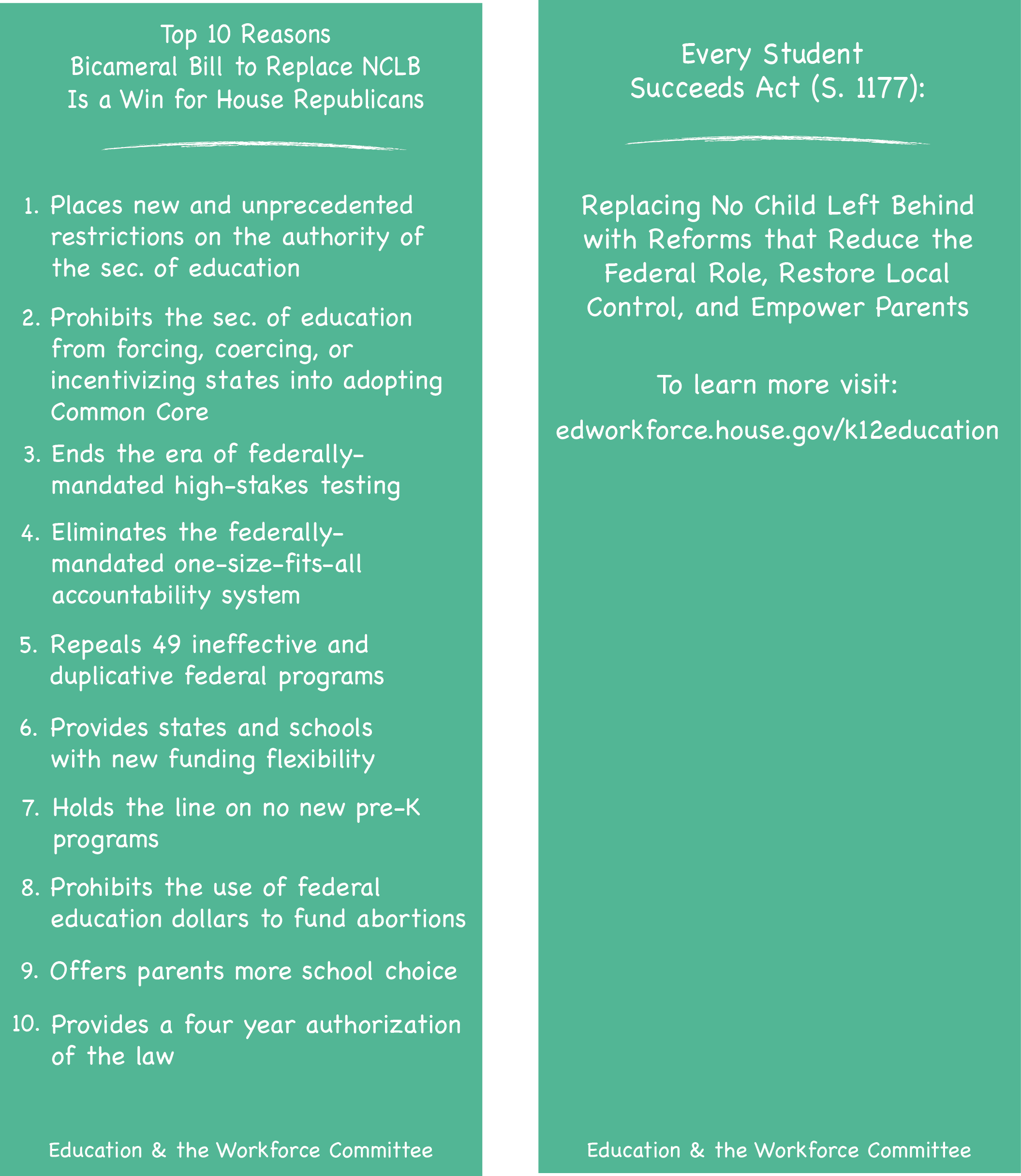
The House Education and Workforce Committee put out an infographic trying to convince their members that the 1061 page monstrosity released only about 48 hours before the final vote to rewrite No Child Left Behind is a Republican “win.”  They are trying to make their members feel okay about throwing our children to the Common Core beast and ignoring more than 200 parent groups in 46 states and instead listening to the Washington Cartel education elites and corporate raiders.  Here are their claims followed by the truth.1)      CLAIM: Places new and unprecedented restrictions on the sec. of education
TRUTH:  There is no enforcement mechanism for any of these restrictions and the sec. of education still has veto power over the state plans that still mandate standards and assessments similar to Common Core. (Details HERE)
2)      CLAIM:  Prohibits the sec. of education from forcing, coercing, or incentivizing states into adopting Common Core
TRUTH: ESSA heavily influences standards within the bill itself. This requirement to have the standards comply with 11 different unconstitutional federal statutes setting up standards similar to Common Core will be statutory a state must comply with it regardless of what the Secretary does or doesn’t do. (Details HERE)
3)      CLAIM:  Ends the era of federally mandated high-stakes tests
TRUTH: Tests are still federally mandated along with 95% participation with no opt-out clause as was present in the House bill.  There are new mandates for the tests to be psychologically profiling “higher order thinking skills” and “strategies to improve 
Why is the #GOP Losing the Base? ESEA Reauthorization is one Reason. » Missouri Education Watchdog:

Are Low U.S. Scores on International Tests Caused by High Child Poverty or Bad Schools? | janresseger

Are Low U.S. Scores on International Tests Caused by High Child Poverty or Bad Schools? | janresseger:

Are Low U.S. Scores on International Tests Caused by High Child Poverty or Bad Schools?


Early in November, the NY Times published what seemed to me an inconclusive and confusingcommentary by Eduardo Porter on what is causing children in the United States to score below other developed nations on international tests of academic achievement.  Porter discusses research findings of respected academics—one study by Martin Carnoy and colleagues from the education department at Stanford University and another study by Jane Waldfogel at Columbia University and international colleagues—which demonstrate that the primary cause of lower scores on international tests by American children is significantly greater childhood poverty in the United States.  Porter contrasts the point of view of these researchers with the opinion of Andreas Schleicher who runs the international PISA test.  Schleicher claims that PISA’s research demonstrates that American society does not really tolerate such a relatively high rate of childhood poverty at all and that the problem is located in our public schools.
Seeming unable to reconcile such contradictory views, Porter satisfies himself by calling for school improvement: “Whatever the failings of the rest of society, it still seems clear American schools can do better.”  Of course we must expect schools to do the best they can and there exists a need for school improvement, but I found myself dissatisfied with Porter’s analysis. The international data that I have seen clearly demonstrate that the U.S. has far higher child poverty than the nations that outscore our children on international school achievement tests.
Then there are the decades’ of research confirming that poverty, inequality and growing residential segregation by income all affect school achievement.  Most striking is the relatively recent research of Sean Reardon of Stanford University whose longitudinal data confirm the connection of school achievement gaps (among children in the United States) to growing economic inequality across the United States and to the fact that residential patterns have rapidly been segregating by income across America’s large metropolitan areas. Reardon’s research does not track international comparisons, but it conclusively connects income inequality to school achievement. Reardon documents that across America’s metropolitan areas the proportion of families living in either very poor or very affluent neighborhoods increased from 15 percent in 1970 to 33 percent by 2009, and the proportion of families living in middle income neighborhoods declined from 65 percent in 1970 to 42 percent in 2009. Reardon shows that along with growing residential inequality is a simultaneous jump in an income-inequality school achievement gap among children and adolescents.  The achievement gap between students with income in the top ten percent and students with income in the bottom ten percent is 30-40 percent wider among children born in 2001 than those born in 1975.
In an analysis that speaks directly to the issue of comparative international child poverty, just Are Low U.S. Scores on International Tests Caused by High Child Poverty or Bad Schools? | janresseger:

Don’t meet me in St. Louis - The Washington Post

Don’t meet me in St. Louis - The Washington Post:

Don’t meet me in St. Louis


St. Louis is a great city — but its public school system is deeply troubled, and as teacher Peter Greene writes below, its teachers are “at the epicenter of just about every kind of assault on public education going on these days.” Here, from Greene’s engaging Curmudgucation blog, is a primer on what has befallen the St. Louis public schools for years now. Greene is a veteran teacher of English in a small town in Pennsylvania, who writes about a wide range of education issues.

By Peter Greene
St. Louis teachers are currently caught at the epicenter of just about every kind of assault on public education going on these days.
Their immediate concern is easy enough to spot. St. Louis teachers have remained frozen in time, sitting on the same step of the salary schedule for six years. In other words, if you were hired as a first-year teacher for St. Louis schools back in 2009, you are still making a first-year teacher’s salary today. The school district’s salary schedule shows that the steps have been adjusted once in that time span. So if you started in 2009 at $38,250, you’re now making $39,270. This is of course problematic because it would take $42,404just to keep pave with inflation. Meanwhile, as of two years ago, the mean wage for an elementary teacher in Missouri was $48,460. The union did reject the offer, but there’s not much more they can do. Teacher strikes are illegal in Missouri.
So St. Louis teachers have been taking an inflation-created pay cut every year, along with the added insult of remaining in the same place on the salary scale. The district has offered a 3.5 percent raise over a year and a half, with no prospect of advancing. (Also, just in case that’s not insulting enough, I just discovered that Missouri allows anyone to look up individual teacher salaries.)
You’ll be unshocked to learn that St. Louis teachers have been heading out the door in record numbers– in many cases within their very first week of school. This is not just a St. Louis thing; Missouri has been battling an inability to attract and retain teachers for years, to the point that they actually put together a group to study on the problem. It’s enough of a problem that a “non-profit” group is on the scene trying to help. Even Teach For America has been in St. Louis, but has not even met its own goals for putting its quickly trained teachers in St. Louis classrooms. And while there’s no reason to think that St. Louis teachers are mercenary and money-grubbing, when you are having trouble feeding your family and another district will offer you over $20,000 more to work there,  who wants to tell their children, “Sorry, no meat this week because I want to keep being noble.”
Meanwhile, there are folks who claim that St. Louis schools are extra tough because of discipline problems, and there is clearly some sort of problem with the administration of discipline in Missouri school. A report released last spring shows that Missouri suspends African-American youths at a higher Don’t meet me in St. Louis - The Washington Post:

The Every Student Succeeds Act (ESSA): More Observations | deutsch29

The Every Student Succeeds Act (ESSA): More Observations | deutsch29:

The Every Student Succeeds Act (ESSA): More Observations


On Monday, November 30, 2015, the Every Student Succeeds Act (ESSA) document was made public. It is 1,061 pages long and is being rushed to the full House for a vote on December 02, 2015, with one hour of debate (limited to one-minute speeches) scheduled for 12 noon EST.
Only two days later.
The best explanation for the rush is that those sponsoring the bill, Senators Lamar Alexander and Parry Murray and Representative John Kline, believe that ESSA passage has already been arranged.
A delayed vote might mean that some of those sure Congressional votes become less sure. Sometimes it is hard to tell the difference between the so-called democratic process and the pressure sale.
On November 30, 2015, I wrote a post based upon my quick, 4 1/2-hour perusal of the ESSA document. In this post, I expand upon previous observations and add a few new ones.
ESSA is undeniably test-centric, and even as it includes language about state and local rights to set opt out policy, it includes language to lock in testing for “95 percent of all students” grades 3 thru 8 and at least one grade in high school in each state seeking Title I funding.
The attempted lock-in comes in the way that ESSA mandates that at least “95 percent of all students” be tested. Here is the exact language (page 88):
(E) ANNUAL MEASUREMENT OF ACHIEVEMENT.—
(i) Annually measure the achievement of not less than 95 percent of all students, and 95 percent of all students in each subgroup of students, who are enrolled in public schools on the assessments described under subsection (b)(2)(v)(I).
(ii) For the purpose of measuring, calculating, and reporting on the indicator described in subparagraph (B)(i), include in the denominator the greater of—
(I) 95 percent of all such students, or 95 percent of all such students in the subgroup, as the case may be; or
(II) the number of students participating in the assessments.
(iii) Provide a clear and understandable explanation of how the State will factor the requirement of clause (i) of this subparagraph into the statewide accountability system.
In ESSA, states are called upon to use test scores for school “accountability.” Earlier in the document, ESSA calls for test that are “used for purposes for which such assessments are valid and reliable” (page 53). However, no testing company is foolish enough to advertise its student achievement tests as “valid and reliable” for grading schools.
I am waiting for a state official with chutzpah to challenge the federal government in court over this nonsense.
I mentioned in my first post on ESSA that the federal government’s efforts to pressure states into forcing students to test will likely lead to lawsuits. All it would take is for a single state to challenge the federal government on this mandated 95-percent-testing rule to put the supposedly state-control-advancing USDOE on the hot seat. My guess is that in the current climate of displeasure with federal overreach into state education policy, the federal government would back down lest it further fuel the grass roots opt-out movement.
But the goal of the writers of ESSA is to put in language that will get the votes, not language that works in lives lived outside of Washington, DC.
Moving on.
One issue of concern in the Student Success Act (SSA), the House precursor of ESSA, involved portability of Title I funding– the money following the student– which I immediately viewed as an accounting and budgeting nightmare. In SSA, portability of funding was the rule. In contrast, ESSA does not require states to treat Title I funding as portable, but it does allow local education agencies to follow such a course by The Every Student Succeeds Act (ESSA): More Observations | deutsch29:

EFF complaint says Google broke privacy pledge by tracking students | The Verge

EFF complaint says Google broke privacy pledge by tracking students | The Verge:

EFF complaint says Google broke privacy pledge by tracking students


The EFF is asking for a federal investigation into whether Google broke a pledge to honor student privacy with its educational tools. Today, the group filed a complaint with the FTC, alleging that Google for Education collects a broad range of data on students' browsing habits and gives administrators too much power to enable that collection. "We are calling on the FTC to investigate Google's conduct, stop the company from using student personal information for its own purposes, and order the company to destroy all information it has collected that's not for educational purposes," said EFF staff attorney Sophia Cope in a statement.
Google's educational initiative encompasses versions of its various web services, as well as Chromebook laptops and approved teaching material. In early 2015, the company signed the Student Privacy Pledge, a voluntary agreement that bars companies from selling student information, using data for anything but "authorized education purposes," and changing privacy policies without notice. President Barack Obama has promoted the pledge alongside more formal student privacy reforms, and around 200 companies currently abide by it.
COMPLAINT SAYS GOOGLE'S DATA COLLECTION GOES BEYOND LEGITIMATE EDUCATIONAL PURPOSES
But the EFF claims that Google goes beyond these limits. The complaint says that Google collects data to improve its own services, instead of for purely educational purposes. While Google stopped scanning student accounts for advertising purposes even before signing the pledge, the EFF argues that it still serves ads on non-educational services, which can be used while students are logged into school accounts.
The complaint also claims that Google automatically enables the Chrome Sync service on its Chromebook laptops, storing detailed browsing information by default. While users can turn Chrome Sync off, school administrators can override their settings using Google's system management tools. And the EFF alleges that administrators also have the option to let third-party websites track location data, which it says is "unquestionably sharing personal information beyond what is needed for educational purposes."
"OUR SERVICES ENABLE STUDENTS EVERYWHERE TO LEARN AND KEEP THEIR INFORMATION PRIVATE AND SECURE."
The EFF, which revealed its complaint alongside a larger campaign for student privacy, says that Google will soon restrict sync settings on educational Chromebooks. But it calls this a "small step in the right direction." Google, meanwhile, disputed the accusations. "Our services enable students everywhere to learn and keep their information private and secure," said a spokesperson. "While we appreciate EFF's focus on student privacy, we are confident that these tools comply with both the law and our promises, including the EFF complaint says Google broke privacy pledge by tracking students | The Verge:

Family engagement to become a big part of federal ed policy :: SI&A Cabinet Report

Family engagement to become a big part of federal ed policy :: SI&A Cabinet Report :: The Essential Resource for Superintendents and the Cabinet:

Family engagement to become a big part of federal ed policy


(District of Columbia) Parent and family engagement plays a key role in the compromise legislation released earlier this week by Congress that would reauthorize the Elementary and Secondary Education Act.
The bill, which is expected to be formally introduced next week and likely taken up in earnest before the Christmas holiday, returns to states authority to design and implement a wide variety of accountability and performance controls but maintains long-standing federal requirements on student testing.
If approved it would also recast the nation’s primary education law as the “Every Student Succeeds Act,” while doing away with adequately yearly progress and its sanctions – the centerpiece of the No Child Left Behind act.
It would also clearly prohibit the federal government from mandating or incentivizing states to adopt any particular set of curriculum standards, including the Common Core State Standards.
The new bill would, however, expand themes around parent and family engagement set out in the existing NCLB.
For one, the new language is more inclusive, striking the term “parental involvement” and replacing it with “parent and family engagement.”
There is also greater precision around what districts need to do to bring parents and family members into their student’s education. States and schools are directed to ensure the involvement of “parents and family members in jointly developing the local educational agency plan(s),” and to provide “coordination, technical assistance” to help “build the capacity” of all schools with planning and implementing effective parent and family engagement aimed at improving student performance.
This may include “meaningful consultation with employers, business leaders, and philanthropic organizations, or individuals with expertise in effectively engaging parents and family members in education.”
There is also specific mention of the problems some targeted subgroups face in participating more in school activities.
Schools must still conduct an evaluation of the “content and effectiveness” of a parent and family engagement policy and still identify “barriers to greater participation by parents in activities authorized by this section (with particular attention to parents who are economically disadvantaged, are disabled, have limited English proficiency, have limited literacy, or are of any racial or ethnic minority background).”
The new bill still requires local educational agencies to reserve at least 1 percent of their Title I allocation to assist schools in carrying out the parent and family involvement activities.
According to a briefing memo released by the House Education and Workforce Committee, states will be allowed to design their own accountability systems, which must  “identify and support” struggling schools.
Plans for how states would tackle the problem would be submitted to the U.S. Secretary of Education for a review limited to ensuring “that the plan is consistent with the law.”
Testing would still be required in reading and math for grades 3 through 8 and once in high school, as well as in science, which must be assessed three times between grades 3 and 12.
“States may pursue flexibility to develop and implement innovative assessments through a pilot Family engagement to become a big part of federal ed policy :: SI&A Cabinet Report :: The Essential Resource for Superintendents and the Cabinet: