Latest News and Comment from Education

Tuesday, November 24, 2015

My Best Resource for Historical Facts About American Education: LINK FIXED! | Diane Ravitch's blog

My Best Resource for Historical Facts About American Education: LINK FIXED! | Diane Ravitch's blog:

My Best Resource for Historical Facts About American Education

Click on picture to Listen to Diane Ravitch


When I was a young historian, back in the 1970s, I would occasionally search for a fact about American education in the nineteenth or early twentieth century to help me write an article or book. There was no Internet. I wasn’t sure which books had the right statistics. So I invariably called the National Center for Education Statistics (NCES), which is the statistical arm of the U.S. Department of Education (actually there was no Department of Education until 1980 [Congress passed the legislation in 1979, and the Department became operational in 1980]; the NCES was the longstanding research and statistics arm of the U.S. Office of Education). The federal role in education began in 1867 under President Andrew Johnson with the creation of a Department of Education, whose sole mission was to collect and disseminate information on the condition and progress of education in the United States. In 1868, however, due to fears that the new Department might eventually seek to exert control over state and local education policy, the Department was demoted to the U.S. Office of Education. Its central purpose, the collection and dissemination of accurate information, is today the role of the NCES.
When I called for information, there was one person who knew where to find whatever I was looking for. Not opinion or interpretation, just the facts. His name was Vance Grant. He invariably took my calls and just as invariably found the answer, if it existed in federal records.
In 1991, I became Assistant Secretary in charge of OERI (the Office of Education Research and Improvement) and NCES was part of my agency–the most important part. I met Vance Grant, and I had an idea. Why not assemble all the historical data into a publication? With the help of the very able career staff at NCES, especially Tom Snyder and Vince Grant, and with the help of historian Maris Vinovskis, who had taken a leave at my request from the University of Michigan to work with OERI staff, the publication became a reality.
I can say now in retrospect that this publication was the most useful thing I did during my two years in the federal government.
You too can browse its pages and charts and graphs via the Internet to see the growth of education in the United States.
Although not many people know of its existence, it is still the only reliable source of historical data on American education.My Best Resource for Historical Facts About American Education: LINK FIXED! | Diane Ravitch's blog:

A New ESEA: A Cheat Sheet on What the Deal Means for Teachers - Teacher Beat - Education Week

A New ESEA: A Cheat Sheet on What the Deal Means for Teachers - Teacher Beat - Education Week:

A New ESEA: A Cheat Sheet on What the Deal Means for Teachers

Teacher Beat


My colleague Alyson Klein has been working double duty to bring you all the details on the bill that will replace the No Child Left Behind Act.
(Quick refresher on how this works. Both the House and Senate have passed their own versions. To iron out differences, the two bodies appoint conferees, which have crafted this outline.) 
Both chambers are expected to vote on the compromise measure, called the Every Student Succeeds Act, next month. Alyson has secured some legislative language featuring the new version's accountability and school improvement sections, so make sure to check that out first.
But what would the compromise mean for the law's teacher provisions, including the "highly qualified" teacher mandate? Here's our best guess based on the language we've seen so far: 
No mandated teacher evaluation.  This is a big one. States and districts can use teacher-quality funds to set up new teacher-evaluation systems, but they don't have to. This is a big change from the Education Department's ESEA flexibility waivers, which required them to revamp these reviews and to integrate student achievement. (States ended up stumbling on implementation and the department, after initially taking a harder-line stance on enforcement, is at this point looking the other way.)
Goodbye to the "highly qualified" teacher requirements. This is the other big one. Both the House and the Senate proposals eliminated the HQT provisions, and the compromise measure follows suit. We'll have a lot more on what this means for the field in upcoming days, so stay tuned. The bottom line is that federal intervention regarding teacher qualifications—a first when NCLB was finalized in 2002—will be all but eliminated in the new bill.
A funding windfall for states with rural poverty.  Most of the ESEA programs dole out cash by formula, usually weighted for population and poverty. The teacher-quality formula grant, usually called Title II, has a 35/65 ratio of population to poverty. For years some lawmakers, notably Sen. Richard Burr, R-N.C., have complained that this weighting favored states with larger populations and concentrated rather than spread-out poverty. And he managed to get a new weighting formula written into Title II. Under the bill, the $2.3 billion would be given out under a 20/80 ratio after a ramping-up period. A hold-harmless would ensure a minimum allocation for all states. (Note to program administrators: Any ideas about how this would affect individual states? Please contact me if you have some insight.)
Class-size restrictions. Title II grants could continue to be used for class-size reductions, but only "to evidence-based levels." (Good luck trying to parse that research.) More than a third of Title II funds are now spent on hiring teachers to reduce class size. 
Equity language preserved. The NCLB-era teacher-equity requirement is maintained and slightly modified to refer to teacher effectiveness, rather than qualifications. Now states would have to describe how they make sure low-income and minority children "are not served at disproportionate rates by ineffective, out-of-field, and inexperienced teachers." As in the past, though, the Education Department doesn't have many tools to enforce these plans.
Program consolidation. Some smaller teacher programs, like Transition to Teaching and Mathematics and Science Partnerships, would lose their authorization. And there are a few important programs that continue on and even a few new authorizations.
  • The compromise would protect the SEED program, which supports professional-development activities.
  • The bill would authorize the STEM Master Teacher Corps, a program that the White House backs. (Sen. Al Franken has introduced legislative language for this program several times over.)
  • And it would authorize a teacher and leader incentive program that sounds a lot like a reworked Teacher Incentive Fund.
  • Which teacher program really dodged a bullet? That would be the Teacher Quality Partnership grants, a teacher-preparation initiative. The House bill sought a repeal of this program (which, confusingly, lives in the Higher Education Act), but the compromise preserved it.A New ESEA: A Cheat Sheet on What the Deal Means for Teachers - Teacher Beat - Education Week:

Teachers Evaluating Teachers: Where PAR Programs Thrive - NEA Today

Teachers Evaluating Teachers: Where PAR Programs Thrive - NEA Today:

Teachers Evaluating Teachers: Where PAR Programs Thrive

teachers evaluating teachers


If there is one thing that staunch union members and steadfast school district officials agree on, it’s this: Recruitment and retention of good teachers is key to operating successful schools. The Peer Assistance and Review (PAR) program is proof.
Kathy Castle is president of the Elgin Teachers Association (ETA) in Illinois, where PAR got it start in 2012 following two years of planning. “[PAR] is the best method for a struggling teacher to truly learn if there is a future for them in the classroom,” Castle says. “It is the least disruptive process, and one of professionalism and collaboration.”
The program utilizes a joint labor-management team—called a “PAR panel”— the skills of novice teachers and veteran teachers in need of intervention because they are not performing at a level deemed acceptable by their district.
Participating teachers volunteer to work with CTs for one or two years. For some CTs, their involvement in PAR propels them into a prosperous teaching career. For others the interactions can lead to a sub-standard evaluation by panel members and an invitation to resign. Regardless of the outcome, union and district panelists are aligned by the common goal of supporting teachers in need and work closely with each other and the CT.
“Research shows that teachers learn their craft best from other teachers,” says Bonnie Cullison, vice president of programs for the NEA Foundation, which has provided grants to several local Associations with PAR programs.
“PAR programs allow for job-embedded support where teachers in need get real-time feedback on lessons and support in how to measure learning,” she says. “For the union, there is a significant benefit in being a partner in (PAR). It goes a long way to professionalizing teaching.”
Shelley Potter, president of the San Antonio Alliance of Teachers and Support Personnel (SAATSP) in Texas, says there are times when a teacher’s contract is not renewed. Although they “ obviously have the potential to succeed,” she says, “ the simply did not get the support they needed.”
The San Antonio PAR program, which includes 15 panelists, is in development with a roll out planned for fall of 2016. Potter says PAR is a way of “owning our own profession” and determining jointly with district officials who is best suited for the San Antonio Independent School District.
“We want to maintain high standards for our district,” she says.
While PAR has not been adopted widely, it has thrived in places like Toledo, Ohio, and Montgomery County, Md. And staff and members of Nevada’s Clark County Education Association (CCEA) have helped to hire 16 consulting teachers to work with 200 new teachers at 22 schools.
“The goal of the program is to support great instruction and to retain teachers in our highest-needs schools,” says CCEA vice president Theodore Small.
Jeron Shelton has worked with 40 teachers since he started as a peer consulting teacher (PCT) three years ago at Elgin School District U-46 in Elgin, Ill.
“The most gratifying aspect of being a PCT is being able to see how teaching truly influences student learning,” says Shelton. A member of the Elgin Teachers Association, Shelton is one of four Elgin PCTs who work with six veteran and 11 new teachers.
“One of the biggest challenges is making sure that the teacher, administrator, and I are working as a cohesive team,” he says. “If all parties don’t work together, students suffer and potentially good teachers leave the profession.”
______________________________________________________
The NEA Foundation’s Institute for Innovation in Teaching and Learning has played a vital role in the development of PAR programs, particularly regarding the establishment of labor-management teams between local unions and school district leaders. These collaborative efforts strive to improve schools and other education environments by connecting local leaders to national resources, sharing online curriculum on labor-management issues, designing and implementing professional development systems for teachers, and training evaluators to support new and struggling educators. Opportunities for participation in foundation programs can be found here

More Proof That American Teachers Are Underpaid And Deserve More Respect

More Proof That American Teachers Are Underpaid And Deserve More Respect:

More Proof That American Teachers Are Underpaid And Deserve More Respect

Just another reason to appreciate these superheroes.


 Here's one more indication that American teachers work really, really hard -- and don't make nearly enough. 

An analysis released Tuesday by the Organisation for Economic Co-operation and Development looks at the state of education around the world, examining everything from intergenerational mobility in education to graduation rates to teacher pay. 
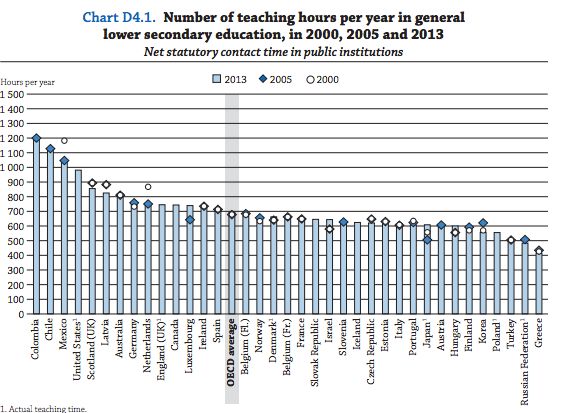
American public school teachers are underpaid compared to workers in the U.S. with similar education levels, the OECD found. Elementary school teachers in the U.S. make 67 percent of what college-educated workers in other professions earn. High school teachers earn 71 percent of what other college-educated workers make. 
Outside of the U.S., the picture is better -- but only slightly. On average, across OECD countries, elementary school teachers earn 80 percent of what college-educated non-teachers make. 
Yet even though American teachers make comparatively less money, all evidence points to the fact that they work their butts off. 
The OECD found that American teachers spend more time in the classroom than teachers in almost every other surveyed country, as illustrated by the graph below. 

It's no wonder most Americans think public school teachers are unappreciated and underpaid. 
______
Rebecca Klein covers the challenges faced in school discipline, school segregation, and the achievement gap in K-12 education. In particular, she is drilling down into the programs and innovations that are trying to solve these problems. Tips? EmailRebecca.Klein@huffingtonpost.com.
______
Related Stories:
 More Proof That American Teachers Are Underpaid And Deserve More Respect:

The Global Search for Education: Bring on the Change | Shanghai Daily

The Global Search for Education: Bring on the Change | Shanghai Daily:

The Global Search for Education: Bring on the Change

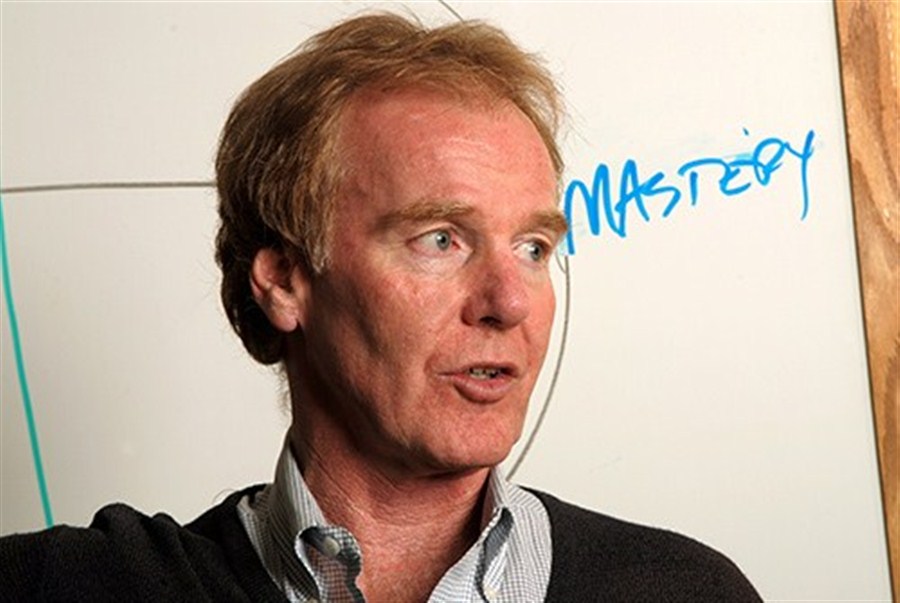
“We have to keep remembering our purpose. In education it is to grow people and to help society evolve.” — Peter Senge


AT the IB Heads World Conference in The Hague, I talked to Peter Senge, the renowned expert on systems, business management and learning, and senior lecturer at MIT. His bestselling book, The Fifth Discipline: The Art and Practice of The Learning Organization, teaches companies how to be smarter by fostering aspiration, developing reflective conversation and understanding complexity. In the interview that follows, he discusses the differences between learning systems in business and education, and why he thinks right now we are having an “Education Renaissance.” He also offers summaries of his innovative educational systems and some successful learning strategies for the 21st century, such as abandoning monolithic tests and requirements, recognizing that there are many different types of learners, and the IB program. Additionally, he looks at some of the setbacks in creating innovative change. His advocacy for “learning-centered” schools gives a jolt to education as important as the one he gave to business with The Fifth Discipline.
How do you define a learning “system”? How do you see the main differences between systems thinking for business and for education?
The obvious difference starts with the aims. In business, you are trying to achieve a business mission that involves serving some particular customer. In education, you are trying to grow people. This also involves the aim of serving a “customer” but in many ways the customer is a bad metaphor used too casually in education, because the students are both the “receivers” and the co-creators of learning. But mostly, they need to be seen as the co-creators. Learning occurs when learners learn. So this is not simply a matter of professionals (i.e. teachers) producing a particular type of product (students). It is a joint process of exploration and mutual development.
A common element that connects both business and education is the need to grow an organizational climate or culture that supports ongoing collaboration, risk-taking, and a deep sense of purpose and commitment. So in this particular way, leadership is quite similar in education as in business. What I always remind people is the single biggest difference from a leadership standpoint is the complexity of the school — in particular the complexity of the stakeholder environment. Businesses have no stakeholder analogous to a parent. Parents have a profound commitment to school because they have a deep commitment to the well-being and growth of their children. But what also comes along with that is the potential for fear and avoidance of taking risks that could adversely influence my child. Lastly, the political context of education is very different, especially in public education. But for all education, there is a degree of visibility that goes with how we educate kids that is quite different than in business.
How can we also avoid the traps of treating education as a business when the product needs to be human beings who can lead satisfying lives?
I think the simple response is we have to keep remembering our purpose. In education it is to grow people and to help society evolve. There are these two fundamentally different but related purposes in education: benefiting students and benefiting the future of our society. Education is the only institution in society that has a 50 to 70 year time horizon. It has the strongest potential to influence the future, just as business has the greatest power in the present. But no business has a time horizon of this scope and the potential to have the sort of impact on society that education does.
What school systems or schools are you familiar with that have established a collaborative inclusive learning organization? What are the key measures of success they have shown?
Within the SoL Education Partnership, there are now 15-20 school districts with close to about 1000 schools all together. When you visit these schools, you’ll see a profound shift in the climate, from the classroom to the school as a whole. Teachers and students learning together. A real appreciation for the leadership of students in the ongoing process of transforming education, ongoing inquiry, reflection and innovation in pedagogy. In short, these schools really do create learning environments.
The very first thing you notice when you consider the consequences of this effort is deep engagement by teachers and students. Teachers are learning, the students are learning. The two are connected because they’re both contributing to an overall environment of continuous learning. Second, you see the depth of the learning. Today, there is way too much emphasis on superficial mastery of technique rather than deeper learning, for example in the sciences and mathematics. Lastly, you start to notice a more inclusive reach to very diverse learners. Because there is a strong emphasis on visual thinking skills, especially at the early ages, learners who are operating in a language that is not their native language do not find themselves in the same disadvantage as in the classroom emphasizing only verbal skillfulness.
Perhaps the greatest single outcome is the growing evidence that the whole systems approach connects very deeply with the intuitive systems thinking capabilities of all children. For example, the many learners who struggle with the traditional pedagogy and the traditional cultural bias towards certain types of learning (like verbal facility and rapid deductive reasoning) are no longer disadvantaged in an environment that is focused on relationships and processes of change.
What is different about learning outcomes needed for the 21st century versus the 20th century in terms of the key competencies required? How do you see the key competencies required of teachers to enable this?
The key differences in competencies I believe lay in the depth of understanding; the appreciation of interdependency and collaboration; and reconnecting head, heart and hand. Children need to come to a deep confidence that they can learn, that they can solve complex problems and that they can do this together. The problems we face in our societies – from global problems with like climate change to more local ones like inequity and loss of purpose and connection to one another – are beyond the reach of existing institutions and their reliance on hierarchical authority. People need to collaborate to solve these problems and this is where students need to build new competencies. Fostering this collaborative learning of how to face the challenges that mean the most to us will require teachers who are engaged in building the same competencies. We teach who we are not just what we know. Teachers who are used to working in silos and standing and delivering the curriculum will be unable to meet the needs of today’s learners. This is why leadership, like principals who build school cultures of collaboration and risk taking, is so important.
What do you see as the most concerning shortcomings of the 21st century learning environment? How can teachers and students work to counteract these shortcomings?
Fragmentation and excessive individual competition destroy the natural spirit of learners who truly want to learn. Over a very long time, school has become a place of performing for a teacher’s approval, or scoring on the test. This was never conducive to learning and it is less credible for students who no longer expect teachers to be the font of all knowledge, since they have access to so much information on their own, but really need teachers who join the learning process with them, as guides and co-learners. Fragmentation can only be overcome by an education process that is deeply rooted in the interconnectedness of knowledge, just as excessive competition can only be overcome by building cultures that strike a more healthy balance between individual and collective learning.
What would be your ideal vision for education in 2030?
That the variety of schools matches the variety of learners. We all learn in different ways and a truly learning-centered school (versus a teaching-centered school) will be able to serve many types of learners. Such a school would also be far more embedded in the larger community, so that parents and family are deeply connected as well to the learning process – students, teachers and community members building more healthy communities.
How do you see the strengths of the IB curriculum and learning system in this regard?
IB has an extraordinary infrastructure to support learning across cultures and contexts. Guided by a shared philosophy of learning as deep human development, IB could be a world leader in continually testing out new ideas and accelerating the spread of fundamental innovations like systems education. Without a good network for testing and diffusing ideas like this that have so much promise, they will never get refined and grow. There is no one answer to what is needed for the future of education. What is most needed is communities of collaboration exploring rigorously the territory of deeper learning that can truly serve our most basic societal needs. My feeling is that the IB network is already stepping into this space.
Join me and globally renowned thought leaders including Sir Michael Barber (UK), Dr. Michael Block (U.S.), Dr. Leon Botstein (U.S.), Professor Clay Christensen (U.S.), Dr. Linda Darling-Hammond (U.S.), Dr. MadhavChavan (India), Professor Michael Fullan (Canada), Professor Howard Gardner (U.S.), Professor Andy Hargreaves (U.S.), Professor Yvonne Hellman (The Netherlands), Professor Kristin Helstad (Norway), Jean Hendrickson (U.S.), Professor Rose Hipkins (New Zealand), Professor Cornelia Hoogland (Canada), Honourable Jeff Johnson (Canada), Mme. Chantal Kaufmann (Belgium), Dr. EijaKauppinen (Finland), State Secretary TapioKosunen (Finland), Professor Dominique Lafontaine (Belgium), Professor Hugh Lauder (UK), Lord Ken Macdonald (UK), Professor Geoff Masters (Australia), Professor Barry McGaw (Australia), Shiv Nadar (India), Professor R. Natarajan (India), Dr. Pak Tee Ng (Singapore), Dr. Denise Pope (US), Sridhar Rajagopalan (India), Dr. Diane Ravitch (U.S.), Richard Wilson Riley (U.S.), Sir Ken Robinson (UK), Professor Pasi Sahlberg (Finland), Professor Manabu Sato (Japan), Andreas Schleicher (PISA, OECD), Dr. Anthony Seldon (UK), Dr. David Shaffer (U.S.), Dr. Kirsten Sivesind (Norway), Chancellor Stephen Spahn (U.S.), Yves Theze (LyceeFrancais U.S.), Professor Charles Ungerleider (Canada), Professor Tony Wagner (U.S.), Sir David Watson (UK), Professor Dylan Wiliam (UK), Dr. Mark Wormald (UK), Professor Theo Wubbels (The Netherlands), Professor Michael Young (UK), and Professor Minxuan Zhang (China) as they explore the big picture education questions that all nations face today.
C. M. Rubin is the author of two widely read online series for which she received a 2011 Upton Sinclair award, “The Global Search for Education” and “How Will We Read?” She is also the author of three bestselling books, including The Real Alice in Wonderland, is the publisher of CMRubinWorld, and is a Disruptor Foundation Fellow. The Global Search for Education: Bring on the Change | Shanghai Daily:

California’s Support for K-12 Education Ranks Low by Almost Any Measure - California Budget & Policy Center

Education - California Budget & Policy Center:

California’s Support for K-12 Education Ranks Low by Almost Any Measure


This fact sheet shows that California K-12 spending lags the nation using nearly any measure of school funding. California ranks 42nd among all states and the District Columbia in K-12 spending per student, based on a new Budget Center analysis that adjusts the most recent spending figures for differences in states’ costs of living.


Study analyzes NAEP, Common Core math alignment | eSchool News | eSchool News

Study analyzes NAEP, Common Core math alignment | eSchool News | eSchool News:

Study analyzes NAEP, Common Core math alignment

Panel urges addition of more math content to NAEP math framework upon next revision

naep-math


A new study of the math alignment between the Common Core State Standards (CCSS), adopted by most states, and the National Assessment of Educational Progress (NAEP), the longtime barometer of academic achievement among the nation’s students, found “reasonable agreement” overall but also some areas of 4th and 8th grade math where there was less of a match.
The study, the second in a series of three examining the relationship between NAEP and the Common Core State Standards in math, was conducted by 18 math educators, supervisors and mathematicians convened by the NAEP Validity Studies Panel (NVS), an independent panel charged with examining issues related to the validity of the NAEP assessments.
The panel found that 79 percent of NAEP items in 4th grade math assessed content included in the CCSS at grade 4 or below. However, the match rate was lower in some areas: 47 percent for data analysis, statistics, and probability, 62 percent for algebra and 68 percent for geometry.
In the 8th grade, 87 percent of NAEP items assessed math included in the CCSS at grade 8 or below—a degree of alignment the report described as “strong.” At the same time, the authors found that 42 percent of the Common Core State Standards for grades 6, 7, and 8 were not being tested by any items in the 2015 NAEP item pool.
The report’s authors suggest that the National Assessment Governing Board, the bipartisan body that sets policy for the testing program, consider adding content from these areas to NAEP’s mathematics framework when it is next revised.
The panel found that most of the differences reflect the CCSS’s intention to shift instruction in certain topics to later grades. The extent to which instruction has actually been aligned with the CCSS is beyond the scope of the study, which examines only the relationship between test items and standards. The authors note that changing standards is far simpler and faster than the arduous process of changing curriculum and instruction.
“The Common Core State Standards are more focused than previous standards in their attempt to create a coherent progression in mathematics instruction from elementary to high school,” said Fran Stancavage, a managing researcher at AIR and co-author of the report. “Consequently, it is not surprising to find these differences in emphasis between the CCSS and the NAEP framework, which was last revised more than 10 years ago.”
NAEP, known for offering a dependable measure of national student progress over time, has always had to strike a balance between remaining independent of passing fashions in curriculum and instruction while also appropriately reflecting important shifts in the educational landscape, according to the report. While it is too early to know how the implementation of the Common Core State Standards will play out over the next several years, the authors point out that most states are already using CCSS-aligned assessments for the purposes of educational accountability.
“We are at a time in education when teachers, administrators and students are grappling with the changes brought about by many states’ move to new, more rigorous standards that will prepare our students for college and work,” said George Bohrnstedt, an AIR Institute Fellow and chairman of NVS’s panel. “The NVS study results suggest that as those standards are implemented, NAEP needs to ensure that it continues to be well-aligned with the mathematical content being taught in the nation’s classrooms.”
The NVS panel is planning a 3rd study for 2017 that will provide important additional data on how well NAEP is measuring the Common Core State Standards and how well Common Core content fits into the NAEP framework in math.
“Study of the Alignment of the 2015 NAEP Mathematics Items at Grades 4 and 8 to the Common Core State Standards for Mathematics” can be found at www.air.org. AIR conducts the NVS under contract from the U.S. Department of Education’s National Center for Education Statistics.
Material from a press release was used in this report.Study analyzes NAEP, Common Core math alignment | eSchool News | eSchool News:

Monday, November 23, 2015

Choking students out of school is never acceptable - The Hechinger Report

Choking students out of school is never acceptable - The Hechinger Report:

Choking students out of school is never acceptable

Brutality does not teach accountability, on camera or off


W ORLEANS — Only people who believe that children are uneducable or not even children would slam, choke, jail and expel their non-compliance. When you believe all children can learn, you search for lessons that incite changes in thought processes and behaviors.
This national difference of opinion has drawn attention, and New Orleans is no exception. Last week, a parent told the Times Picayuneshe filed a complaint with the state Education Department after viewing a recording of Wilfred Wright, KIPP New Orleans Leadership Academy’s dean of students, putting her daughter in a chokehold and dragging her down the street. A school incident report says a staff member, who it would not identify, was breaking up a fight between two girls. The parent doesn’t have a copy of the video, but a screenshot of the video shows a staffer with his arm around a girl’s neck. The staffer was put on leave pending an investigation.
Let’s be clear. Slamming and choking students does not teach them how to be accountable; it teaches them how to slam and choke. But as this case unfolds, there will undoubtedly be people who will blame the student and her behaviors for the choking. That’s because videos that often corroborate students’ accounts of inappropriate restraints are often used to shame student victims in other situations.
The backlash aimed at the abused student at Spring Valley High School in South Carolina is so strong that it partially helped old video regain traction. In this years-old video recorded in a Chicago Vocational Career Academy classroom in 2011, a student verbally harasses and physically threatens a substitute teacher while the class laughs wildly. People are posting this and similar videos as evidence why uncontrollable students get the abuse they deserve.
Blaming students for classroom behavior reveals how little regard we have for black children as well as the teaching profession; people literally want black folk to disappear. Noted charter school advocate and leader Eva Moskowitz recently had to defend the use of a “got to go” list in one of her schools. For years, education rivals accused Moskowitz and other charter leaders of counseling or “pushing out” students in the name of creating a school culture of ‘no excuses’ and academic excellence. But harsh disciplinary practices aren’t confined to charter schools. As the South Carolina case shows, traditional schools will even use police tactics to rid themselves of blacks. Nevertheless, people don’t disappear. We can’t expel or slam our way to success.
But schools keep trying. The Council of State Governments Justice Center found disabled students, minority students and LGBT students are disproportionately suspended and expelled from school. What the data won’t show are the abuses that push students out of school without a suspension. It would be understandable if the KIPP student left the school after the choking. Maybe it’s our systems and not the people that are the problems.
The research consistently shows that “when students are removed Choking students out of school is never acceptable - The Hechinger Report:

Admissions Quota Proposed in Brooklyn School Rezoning - The New York Times

Admissions Quota Proposed in Brooklyn School Rezoning - The New York Times:

Admissions Quota Proposed in Brooklyn School Rezoning


Responding to concerns that a plan to redraw two Brooklyn school zoneswould fill an elementary school with affluent white children that currently serves mostly low-income minority children, Education Department staff members said on Monday that students receiving free or reduced-price lunches would be given admissions priority for half the seats in each class at the school.
The department has said it wants to rezone the Dumbo and Vinegar Hill neighborhoods, where apartments sell for millions of dollars, so that children now zoned for Public School 8 in Brooklyn Heights, which is overcrowded and has a mostly white student body, would be zoned for Public School 307, which serves a public-housing project, educates mostly black and Hispanic children and has room to spare.
The proposal to set aside half the school’s seats came during a presentation of the rezoning plan to the community education council covering P.S. 307, the locally elected body responsible for voting on zone lines. Some parents at the school had asked the department for such set-asides to prevent the school population from becoming largely white.
Whether preserving a portion of seats for students with lower incomes ultimately accomplishes those parents’ goal would depend on how many students in the redrawn zone want to attend P.S. 307. Families living in the zone would have priority over students from outside the zone, even those who qualified for subsidized lunch.
The Education Department said its current projections assume that the school would eventually have enough capacity for 30 percent of its students to come from outside the zone. The department also said that, though its plans call for the rezoning to take effect in 2016, it would not put the admissions plan in place until at least the following year, so as not to risk violating the terms of a federal grant.
Faraji Hannah-Jones, co-president of the P.S. 307 parent-teacher association, expressed displeasure with the department’s proposal. (Mr. Hannah-Jones’s wife, Nikole Hannah-Jones, is a staff writer at The New York Times Magazine.)
“When we said 50 percent, we didn’t say 50 percent with conditions,” he said. “We said 50 percent, period.”
He added: “We don’t want P.S. 307 to become P.S. 8.”
The rezoning plan has drawn objections from current P.S. 307 parents, as well as parents who would fall into the expanded P.S. 307 zone. The Education Department originally planned to meet with the P.S. 307 council in September, but held off in order to hold a series of meetings with parents, teachers and neighborhood organizations. After hearing the department’s presentation on Monday, the council has 45 days to vote on it. The council will vote only on the proposed new zone lines, not on the idea of setting aside half the school’s seats for low-income families.
The Education Department recently abandoned a similar rezoning proposal on the Upper West Side of Manhattan amid intense controversy. Under that proposal, several blocks were to be moved from a zone serving a Admissions Quota Proposed in Brooklyn School Rezoning - The New York Times:

Alabama Teacher of the Year Resigns: The Backstory, Part I | deutsch29

Alabama Teacher of the Year Resigns: The Backstory, Part I | deutsch29:

Alabama Teacher of the Year Resigns: The Backstory, Part I

Ann Marie Corgill 3
Ann Marie Corgill


On November 20, 2015, I drove from southern Louisiana to central Alabama in order to extensively interview Ann Marie Corgill, the 2014-15 Alabama Teacher of the Year who abruptly resigned on October 30, 2015.
The interview lasted over four hours. I decided to seek a face-to-face interview because I knew I would be asking some pointed questions, and I thought it best to do so in person.
Corgill has an intriguing story to tell, and in a series of posts, I intend to tell it, including information on Corgill’s professional history as a public school teacher in both Alabama and New York; her story about becoming Alabama’s Teacher of the Year, and the detailed circumstances surrounding her resignation, including the media attention.
For this first post, I focus on the how her story became national news.
Indeed, being the one to break the news of the sudden, unexpected departure of a state teacher of the year is quite a scoop.
Let me begin with October 31, 2015, the day that I first read about the abrupt resignation of Alabama’s 2014-15 Teacher of the Year, Ann Marie Corgill in the New York Daily News.
The Daily News article appeared to draw all of its information from this October 29, 2015, AL.com article that, in turn, draws most of its information from Corgill’s resignation letter.
Furthermore, the AL.com article also notes that Corgill “was not immediately available to comment Thursday morning [October 29, 2015].” Still, when I first read the article, I assumed that AL.com had been in touch with Corgill in order to receive a copy of the resignation from her. After all, it was Corgill’s resignation, so it seemed logical that if the media had been alerted and had a copy of the resignation letter, then it must have been Corgill who provided it.
This was not the case. In fact, when the AL.com story broke, Corgill was still in Alabama Teacher of the Year Resigns: The Backstory, Part I | deutsch29:

Happy Thanksgiving | Johnathan Chase | LinkedIn

Happy Thanksgiving | Johnathan Chase | LinkedIn:

Happy Thanksgiving


Happy Thanksgiving


A lot of people thought it was fiction and this is all real stuff. I had visited my friends during the Thanksgiving break, Ray and Alice, who lived in this abandoned church. They were teachers at a high school I went to just down the road in the little town of Stockbridge, Massachusetts.
And a friend of mine and I decided to help them clean up their church, and because I had gone to school there, I was familiar with all of these little back roads and nook-and-cranny places. And I knew a place that local people were using to get rid of their stuff….
So it wasn’t like some pristine virgin forest that we’d–you know, were screwing around with. And our pile of garbage, well, we couldn’t tell the difference once we threw ours down. But there was someone who could and that happened to be the local chief of police, a guy named Bill Obanhein, who we called Officer Obie. And he confronted us that next morning after Thanksgiving with our crime…
And I turned it into a little story. And then, of course, I decided to stay out of school because the civil rights movement was going on, the ban the bomb, clean the water, fix that, do this, you know, I mean, all the world was changing and I wanted to be where that was happening.
And so I left school and, of course, that made me eligible as it were to, you know, join up and get sent over to Vietnam. And I didn’t really want to go and little did I realize that when I went down to the induction center that they–well, they found me ineligible, and I just couldn’t believe it. And so I turned it into a song. It took about a year to put together, and I’ve been telling it ever since just about…
Well, it’s celebrating idiocy you might say. I mean, thank God, that the people Happy Thanksgiving | Johnathan Chase | LinkedIn:

In exchange for local flexibility, accountability plans will require work | EdSource

In exchange for local flexibility, accountability plans will require work | EdSource:

In exchange for local flexibility, accountability plans will require work


I have a thought for school district staff, board members and others characterizing the process for developing Local Control Accountability Plans (LCAPs) as too time-consuming, tedious and cumbersome.
Quit your belly-aching!
Districts and other local educational agencies have just been relieved of a slew of bureaucratic compliance mandates tied to dozens of old state categorical programs. Those mandates required hours of accounting, tracking, reporting and general “bean-counting” of dollars spent. They limited district spending to the multiple, mostly narrow confines of the various categoricals and carried, as well, the threat of losing funds because someone bean-counted wrongly. Now districts can meld the old pots together to spend the funds much more flexibly, free from the strict and multiple prerogatives of Sacramento. As a member of my local school board, I have seen firsthand how this can work better.
The deal – that many folks now seem to be conveniently forgetting – was that in exchange for dropping all of that work and for having all this new flexibility districts would be fully transparent around their spending and engage community stakeholders in spending decisions.
Guess what? That is going to take some real work, people.
From some who merely see it as “compliance” work, I sense a failure of imagination. The intent of the Local Control Funding Formula (LCFF) is that the LCAP serve as a living, breathing, continuously improving “comprehensive planning tool” (see LCAP template, page 1), developed and implemented with the school community. Ongoing, strategic planning and effective community engagement are two things districts have not historically been asked to do. Faced with these new expectations, it is easier to treat the LCAP as an exercise in filling in boxes and checking off stakeholder contact compliance. Instead, we ought to be figuring out how to make the deal work as intended.
For its part, if the state believes its new “local control” mantra, it will need to seriously invest in expanding both district and local stakeholder capacity to engage in the new strategic planning dialogue. That means the state will need to improve the quality of the planning, the depth and reach of the engagement, the readability of the LCAP and the ability of local communities to understand what they find there. The PTA is calling for a billion-dollar investment in parent engagement. That would be a start.
Accessibility of the LCAP to the lay person is an issue, no doubt. However, readability can be solved with executive summaries, better technical and graphic LCAP design, electronic templates and progressive layers of links to more detail for the more interested and engaged reader. (Along In exchange for local flexibility, accountability plans will require work | EdSource: