Latest News and Comment from Education

Monday, November 23, 2015

Commentary: For LAUSD, maybe it's not the time to hire an outsider - LA School Report

Commentary: For LAUSD, maybe it's not the time to hire an outsider - LA School Report:

Commentary: For LAUSD, maybe it’s not the time to hire an outsider


It’s getting down to crunch time: Thanksgiving . . . Christmas . . . Last day on the job for LA Unified Superintendent Ramon Cortines.
By next week, names for his replacement will begin to flow with a list of candidates that could include such well-regarded figures from across the county as Rudy Crew, a former Chancellor of New York City schools;Alberto M. Carvalho, Superintendent of Miami-Dade County Public Schools; Valeria Silva, superintendent of St. Paul’s public schools; and Richard Carranza, superintendent of schools in San Francisco.
No doubt all of them have fine resumes.
But in thinking about what awaits the next occupant of Cortines’s 24th floor office, one might wonder if an outsider with little knowledge of the district would necessarily make the best choice for LA Unified, given the issues at hand. Never mind the larger question, why would anyone even want the job. Consider the current state of affairs:
  • An independent financial review panel just reported that the district is facing deficits that could reach $600 million within four years.
  • The district is hemorrhaging students, nearly three percent a year, costing hundreds of thousands in lost state and federal revenues.
  • Pressure is mounting on the district to reduce health care benefits and increase employee pension contribution, already triggering union opposition.
  • Academic performance across the district was abysmal, judging by the most recent statewide tests.
  • The charter war within the district is intensifying, with a plan by outsiders to create hundreds more charter schools to serve as many as half the district enrollment.
  • The seven members of the elected school board, who serve as the superintendent’s bosses, are hard-pressed to agree on what day it is, let alone on how to solve intractable problems.
No doubt, the winning candidate would convince all or most of the board members that the challenges are not insurmountable. Pay and benefits are not likely to be Commentary: For LAUSD, maybe it's not the time to hire an outsider - LA School Report:

3 Local Foundation Heads Try to Intervene in Broad Foundation LAUSD Plan | Nonprofit Quarterly

3 Local Foundation Heads Try to Intervene in Broad Foundation LAUSD Plan | Nonprofit Quarterly:

3 Local Foundation Heads Try to Intervene in Broad Foundation LAUSD Plan

Baldwin-Hills-school


In philanthropy, it is rare to see foundations protest each other’s work, but in Los Angeles, three foundations are speaking out about what they see as the potential undercutting of parent participation by the Broad Foundation in its new initiative to remake the public school, and they are even offering to intervene.
The letter, sent to the LAUSD Board of Directors, LAUSD Superintendent Ramon Cortines, United Teachers Los Angeles President Alex Caputo-Pearl, and Broad Foundation Founder Eli Broad, reads in part:
The California Community Foundation, the California Endowment and Weingart Foundation have invested in efforts to educate and inform parents and to build their leadership skills to become stronger advocates for their children and communities. In some cases, we have supported programs and projects related to the LAUSD, while in other instances we have supported the development of charter schools, pilot schools and partnership schools. Our priority has and will always be to ensure poor and vulnerable communities have access to high quality educational options and are informed about what makes for a good school. Recently, the Broad Foundation released a provocative proposal to significantly increase charter schools in communities that have high concentrations of underperforming schools. In the midst of the controversy surrounding this proposal, we must remember that our priorities are families and children. Superintendent Cortines has consistently reminded us that the schools belong to the community, but it takes community, with parents at the forefront, to make the schools great.
It continues:
At this point, our foundations are not interested in taking sides on the Broad initiative; rather, we are bullish on the matter of full and robust participation of community, parental and youth engagement on key, critical questions – such as the Broad Charter School proposal, and the desirable attributes of a soon-to-be-hired school superintendent.
What we are willing to do is offer ourselves as neutral conveners interested in doing what is best for all of our parents and children. We must engage parents and community members and help them preserve their opportunity to secure high quality education for their children. L.A.’s vibrant future depends on it. We are open to what form our role might take, and willing to listen to constructive input from you.
As NPQ has previously written, the Broad Foundation has been pushing a greatly contested plan to significantly expand the number of charter schools in the Las Angeles Unified School District (LAUSD). Now, as a part of that plan, a nonprofit organization has been established to advance the scheme. To date, only part of its 11-member board has been announced, but it will include Eli Broad or a designee.
The new organization is called Great Public Schools Now, and is apparently the body that will take the next steps in a plan initially proposed by the Eli and Edythe Broad Foundation. The plan calls for raising $490 million to enroll half the students in LAUSD in charters over the next eight years. It has met strong opposition from the teachers 3 Local Foundation Heads Try to Intervene in Broad Foundation LAUSD Plan | Nonprofit Quarterly:

Why federal spending on disadvantaged students (Title I) doesn’t work | Brookings Institution

Why federal spending on disadvantaged students (Title I) doesn’t work | Brookings Institution:

Why federal spending on disadvantaged students (Title I) doesn’t work


Executive Summary
The Elementary and Secondary Education Act (ESEA) is being reauthorized. Its largest program, Title I, provides funding to states and districts to improve education for disadvantaged students. However, its funding per student is quite low, averaging about $500 to $600 a year. And there is little evidence that the overall program is effective or that its funds are used for effective services and activities. Large proportions of school principals report using Title I funds for teacher professional development, which many studies have shown to be ineffective and which teachers do not find valuable. Other services on which principals spent Title I funds include after-school and summer programs, technology purchases, and supplemental services, which also have been shown to be ineffective, and class-size reductions, which are unlikely to be of the size needed to generate effects found in previous research.
Achievement gaps between disadvantaged students and their better-off peers are large and have existed for decades. Narrowing these gaps will mean investing more in research to identify effective approaches, or increasing Title I spending by five to eight times more per student, or both. Focusing effective interventions on the neediest students may provide a way forward that is consistent with fiscal realities.
Introduction
Efforts to reauthorize the federal Elementary and Secondary Education Act (ESEA) have generated contentious debates about annual testing and accountability. Both the Senate and House versions, now headed to conference, maintain annual testing and push accountability back to the states.
Curiously missing from the debates has been the evidence of whether or not ESEA achieves its objectives.
The largest ESEA expenditure by far is for its Title I program, which in 2014 provided $14 billion to states to improve student achievement. But the last national evaluation that measured Title I’s effectiveness, the ‘Prospects’ study, did not find evidence that it improved student achievement.[i] The most recent national assessment of Title I did not measure its effectiveness, though it pointed to broad trends on the National Assessment of Educational Progress showing gains in achievement, especially for minority students. These gains may be due more to NCLB’s stricter accountability, however. Accountability created incentives for all public schools to improve.
The question here is whether Title I funds are spent effectively.
Follow the money
Title I has a 60-year history, which is plenty of time for it to develop funding quirks. Funds flow to districts based on their counts of students in poverty, which is determined by the Census Bureau. Districts determine which schools get funds by rank-ordering schools based on poverty levels. Once funds arrive at a school, however, they are used for students at risk of failing to meet state learning standards. A student’s poverty level plays no role in determining whether the student is eligible for Title 1 services. And if a school serves at least 40 percent economically disadvantaged students, funds can be used for the entire school (a ‘schoolwide’ program).
There is a well-known correlation between poverty and student achievement, and Title I no doubt serves students who are both poor and underperforming. But the school lunch program does not measure the calorie intake of low-income students and give their lunches away if low-income students are getting ‘enough’ calories. But that is how Title I treats a low-income student who is making satisfactory academic progress.
Title 1 is spread so thin that its budget of $14 billion a year turns out not to be much money.[ii]The threshold for operating a Title I schoolwide program is that 40 percent of a school’s students are eligible for free or reduced-price lunch, and current data show that 51 percent of students are eligible. Not surprisingly, many schools operate schoolwide programs, in fact about half of all public schools in the United States.[iii]
Assuming these schools have average enrollment, which is about 500 students, almost 25 million students attend schools that operate schoolwide programs. The upshot is that after allowing for the money also spent on ‘targeted-assistance’ programs (which operate in schools whose poverty levels are below 40 percent), Title I is spending about $500 to $600 per student. The national assessment of Title 1 used a survey of states, school districts, and schools to estimate Title I expenditures, and essentially reached the same conclusion. Their more exact estimate is that Title I spent $558 per student in a high-poverty school and, another spending quirk, spent $763 per student in a low-poverty school.[iv] Education spending was $12,400 a year per student in 2013, which means from the federal perspective, Title I amounts to about 5 percent more per student than would otherwise have been spent.[v]
Realistically, how much improvement can we expect by adding 5 percent to education spending? Data show huge achievement differences for students in poverty compared to those who are not. The National Assessment of Education Progress reported in 2015 that the average fourth grader eligible for free lunch scored 209 in reading, and the average fourth grader that was not eligible for free lunch scored 237. That 28-point gap is roughly comparable to being behind by more than two grade levels. The gap is 25 points in eighth grade, which is still very large.
Spending another $500 seems unlikely to close these kinds of gaps much or at all.
Maybe the funds can be focused on fewer students or spent on highly effective activities or services. But, by design, schoolwide programs do not target specific students. The programs are intended for the whole school, though schools might operate after-school programs or basic skills programs that benefit only those students that attend them. And the question of whether the money is spent effectively is preceded by a question that itself is hard to answer: how is the money spent?               
What is purchased with Title I funds?
In 2010, the Government Accountability Office visited 12 school districts in four states to explore what happened to the money. The nation’s ‘watchdog’ agency could not simply check a database or spreadsheet to determine how Title I money was spent. They had to send investigators into the field. This is not a criticism of the GAO. There is no database they could have referenced, so they went to the field to learn what they could. They did note in their report that Education Department officials ‘want to allow schools to spend the money to meet their unique needs and to be free to spend the money creatively.’
The money might be spent creatively but what the GAO reported is not much cause for thinking the money is spent effectively.[vi] Most of the money—84 percent—is spent on ‘instruction,’ which is not surprising for a program that operates in schools. Some districts used funds for teacher professional development in the form of workshops or by hiring coaches to support regular classroom teachers, or funded smaller class sizes, provided after-school programs and summer-school programs, or bought technology hardware or software.
These findings are corroborated by recent data from the Early Childhood Longitudinal Study’s kindergarten cohort, which administered a survey to principals of schools that included a kindergarten. Principals were asked how they spent Title 1 funds. The survey did not ask dollar amounts or proportions, unfortunately. Principals checked off ways in which money was spent without indicating how much was spent. The table counts principals not receiving Title 1 funds as responding ‘no spending’ in each category.


The table shows that 81 percent of principals reported spending Title I money on professional development.  The percent is higher—93 percent—in urban schools and in schools with high poverty rates (more than 75% free or reduced price lunch). How much is spent on professional development is hard to assess because the districts report spending in categories such as ‘instruction’ that includes teachers and teacher aides. If teachers hired through Title I are coaching other teachers, they are counted as teachers and not as Why federal spending on disadvantaged students (Title I) doesn’t work | Brookings Institution:

States disagree on whether to release glitchy Common Core test results - CSMonitor.com

States disagree on whether to release glitchy Common Core test results - CSMonitor.com:

States disagree on whether to release glitchy Common Core test results

After a Common Core testing system overload last year forced many students to end the exams early, states are now deliberating the validity of the scores for those who were able to complete the test.


The first results of new Common Core-aligned standardized tests are in, but widespread computer glitches in a system that facilitated the exams have left some states wondering if scores are valid.

During testing, many students in Nevada, Montana, and North Dakota, among other states, were forced to end the tests early when the computer system adapting questions for difficulty based on student answers became overloaded.

Now, states are considering the release of the test results for those who finished.

Even though seven out of 10 students in Nevada were not able to complete the tests, the state was confident enough to release its results this week. North Dakota had considerably fewer problems during testing, and released the scores last month.

But Montana, on the other hand, is sitting on the results for now even though more than 80 percent of its students were able to take the test. Authorities say they want to wait until the scores are made completely valid.

"It's really important for us to be careful and thoughtful and making sure what we release has context and makes sense for parents and teachers," Emilie Ritter Saunders, spokeswoman for the Montana Office of Public Instruction, told The Associated Press.

Steve Canavero, interim Nevada superintendent, is taking a different approach to the scores.

"We invested a lot of time and a lot of energy. To have it fundamentally fail and not provide any return to the field, I felt was not acceptable," he told AP.

The results honor the hard work of students and teachers, he added, and that districts could make use of the data even if parents don’t appreciate it.

Most US states have adopted Common Core standards and incorporated them into federally mandated standardized tests. Many parents, however, have expressed disapproval over what they see as government overreachStates disagree on whether to release glitchy Common Core test results - CSMonitor.com:

Physical Fitness Test Results News Release - Year 2015 (CA Dept of Education)

Physical Fitness Test Results News Release - Year 2015 (CA Dept of Education):

State Schools Chief Tom Torlakson Announces Physical Fitness 

Test Results Show Students Mostly Holding Steady 


SACRAMENTO—State Superintendent of Public Instruction Tom Torlakson announced that the percentage of students who met the Healthy Fitness Zone (HFZ) performance standards in all six areas declined slightly but mostly remained stable this year, according to the results of the 2014‒15 Physical Fitness Test.
"The release of these results is a good reminder that all parents and role models need to encourage children to eat nutritious foods and exercise regularly," said Torlakson. "Students need to be healthy to succeed in the classroom and beyond."
More than 1.3 million students in grades five (455,897), seven (439,476), and nine (441,730) took the FITNESSGRAM® during the 2014‒15 school year (Table 1)—a series of six separate tests that measure aerobic capacity, body composition, abdominal strength, trunk extensor strength, upper body strength, and flexibility.
In all three grades the percentage of students who performed all six tests at the highest level decreased compared to the last two years. Overall, approximately 26.4 percent of students in grade five, 32.5 percent of students in grade seven, and 37.6 percent of students in grade nine scored at the highest levels, called the HFZ. This represents levels of fitness that offer protection against diseases resulting from sedentary living (Table 3). The multi-year comparison is available on Table 4.
Torlakson, an avid runner and former high school cross country and track coach, demonstrated his commitment to fitness by launching a Team California for Healthy Kids initiative shortly after taking office. The initiative brings together educators, community leaders, athletes, and other celebrities to help schools offer healthy choices to students.


Students continued to improve in Aerobic Capacity from 2013 to 2015, one of the six areas assessed annually and is considered among the most important gauges of health (Table 2). Aerobic Capacity is the ability to perform large muscle, high-intensity exercise for prolonged periods.
Please note that the HFZ performance standards for the Body Mass Index (BMI), one of the three body composition test options under Body Composition, were updated for the 2013‒14 fitness assessment period. Thus, current Body Composition scores cannot be compared to previous years.
This is the 16th year for reporting physical fitness test results in California public schools. The program was first authorized in 1976 and reestablished in 1995 by Assembly Bill 265. The following year, the State Board of Education designated FITNESSGRAM® as the required physical fitness test to be administered to students in grades five, seven, and nine.
The 2014–15 physical fitness results for schools, school districts, counties, and the state are available on the California Department of Education (CDE) Physical Fitness Test Results Web page. More information is also available on the CDEPhysical Fitness Test Web page. 
# # # #
Tom Torlakson — State Superintendent of Public Instruction
Communications Division, Room 5206, 916-319-0818, Fax 916-319-0100
Last Reviewed: Friday, November 20, 2015


5 things to know about the financial cost of testing | Philadelphia Public School Notebook

5 things to know about the financial cost of testing | Philadelphia Public School Notebook:

5 things to know about the financial cost of testing


The Notebook is examining standardized testing this month. The topic is the focus of our upcoming edition due out this week.

1. Pennsylvania Gov. Wolf has requested a total of $58.3 million for testing in the current budget.
The Pennsylvania Department of Education (PDE) contracts with Data Recognition Corp. (DRC) for the PSSAs and the Keystones. Both contracts run through June 2016 and cover test development, administration, scoring, and reporting. In 2014-15, the company received about $30 million for the PSSAs – about $39 per student tested – and $27 million for the Keystones.
DRC also provides classroom diagnostic tools and other preparatory materials through theeDirect website.
2. The  actual costs of testing to districts and schools – including staff time, prep, and materials – are hard to estimate.
Districts and schools generally don’t separate out these costs. In the Philadelphia School District, for example, assessment, curriculum, and instruction are combined in one department.
PDE also does not break out separate testing administration costs.
The Council of the Great City Schools, in a report issued in October, analyzed testing expenses for the 200,000-student Hillsborough School District in Florida and found the total to be $2.2 million in testing expenses, which made up about one tenth of one percent of the district’s annual budget of $2.2 billion.
The Council’s report cited a recent study by the Brown Center on Education Policy at the Brookings Institution estimating that the expenditure on standardized assessments by states across the country is about $1.7 billion annually – or about $34 per student – and said: “Although the number appears high, the report suggests that if these dollars were reinvested in classrooms or teacher raises, the student-teacher ratio would fall by only 0.1 student, and teacher salaries would increase by only $550 per teacher annually.”
3. Districts generally don’t track the costs of test preparation activities as distinct from other instructional time.  
In the Philadelphia School District, for example, schools are supplied with materials to aid 5 things to know about the financial cost of testing | Philadelphia Public School Notebook:

Teacher to governor: This is what I take personally - The Washington Post

Teacher to governor: This is what I take personally - The Washington Post:

Teacher to governor: This is what I take personally


Indiana Gov. Mike Pence recently created a mini-firestorm in his state when he was talking to teachers at an elementary school about the newly designed standardized tests called ISTEP. Noting that policymakers had expected the scores to go down because the tests were new and more difficult, he indicated that educators shouldn’t take the results personally.
Of course, it’s hard for teachers not to given that the results are linked to teacher evaluations, though Pence, a Republican, is supporting legislation that would hold teachers harmless for a year because the tests are new. Still, there was immediate reaction to Pence’s comments, including from the camp of Glenda Ritz, a Democrat who is the superintendent of public instruction in Indiana and who briefly campaigned for governor until dropping out this past August. Annie Mansfield, spokeswoman for Ritz’s reelection campaign, said in a news release:
“Working with students every day is a calling, and any teacher who heard Governor Pence’s ‘don’t take it personal’ suggestion would be offended. Teachers and schools do take it personally when they are told they are failures because of high-stakes testing.”
According to the Star Press, Pence’s press secretary Kara Brooks said he had been misunderstood. She was quoted as saying:
“The Governor was explaining to a dedicated third-grade teacher that we are in a transition year and that the decline in scores was fully anticipated.”
Teachers weren’t mollified by the explanation. Here’s one reaction from Donna Roof, who has taught in Indiana public schools for 30 years and is a co-founder of an advocacy group called the Northeast Indiana Friends of Public Education, which was created to inform the public about the effects of legislation and education reform policies that are instrumental in dismantling and privatizing public schools. She has testified before the Indiana State Board of Education, written letters to lawmakers, spoken with lawmakers of both parties, and hosted conferences of her organization with attendees from Illinois, Michigan, and Ohio. This appeared on her organization’s blog.
Here’s the open letter to Pence from Donna Roof:
So, Governor Pence, you recently told a teacher not to take the ISTEP results personally.
Well, actually, Governor…
When I see developmentally inappropriate education curriculum,
Teacher to governor: This is what I take personally - The Washington Post:

Charter growth is ‘like the Wild West.’ | SanDiegoUnionTribune.com

SD County sees rise in non-local charters, lawsuits | SanDiegoUnionTribune.com:

Out-of-town charters spur lawsuits

Charter growth is ‘like the Wild West.’


They pop up in strip malls and churches offering an alternative to the traditional classroom experience.
For many students, these small charter schools — some are satellite branches of sorts — provide a new chance at an education with flexibility and an opportunity to learn outside the box. But school districts say they’ve been inundated by stealth charters that show up — usually without notice that’s required by law — poaching students and the state attendance funds that come with them.
San Diego County has seen a rise in “out-of-district” charters in recent years — mostly independent-study programs authorized by small districts in the eastern reaches of the region. The arrangements can be appealing because the authorizing districts don’t stand to lose students, and they receive a percentage of the charter’s revenue in exchange for varying degrees of oversight and often administrative support services.
Regardless of what’s driving this trend, it has sparked bitter turf wars that have pitted districts against one another and stirred costly litigation.
“It’s been described as the Wild West out there,” said Scott Patterson, deputy superintendent of business services at the Grossmont Union High School District, which is suing to shut down two charters — Diego Valley and Julian — that operate learning centers in its boundaries under agreements authorized by the Julian Union School District. “When you have charters from far-flung districts operating in Grossmont, it gets to issues of accountability and oversight. Where is the oversight? We know we’re not providing it.”
Charters are publicly funded schools (including traditional classroom-based programs, independent-study programs and hybrids) that operate independently under agreements intended to foster innovation. For charter students, the appeal of nontraditional programs has nothing to do with the law, or the public agency that signed off on the agreement.
Nearly 200 students and supporters — some of them wearing neon yellow T-shirts with the message #DefendSchoolChoice — staged a rally at Thursday’s Grossmont school board meeting to protest the lawsuits and offer testimony about their charter school experiences, with public relations assistance from former San Diego City Councilman Jim Madaffer’s consulting firm.
Reading from a printed statement, Cloey Peel told the board that Julian Charter School’s Alpine Academy, which was authorized by the Julian Union School District, has given her a meaningful education that accommodates a personal medical condition that requires her to miss school.
“Everyone is helpful and makes me feel like I belong at this school,” said Cloey, 16. “I plan on graduating with the honor of saying Julian Charter was there for me, through it all, to guide me in the right direction. ...”
Ricardo Soto, senior vice president and general counsel for the California Charter School Association, said San Diego County school districts are threatened by non-classroom-based charters that he believes operate SD County sees rise in non-local charters, lawsuits | SanDiegoUnionTribune.com:

California student suspension rate drops as ‘willful defiance’ punishments decline | EdSource

California student suspension rate drops as ‘willful defiance’ punishments decline | EdSource:

California student suspension rate drops as ‘willful defiance’ punishments decline


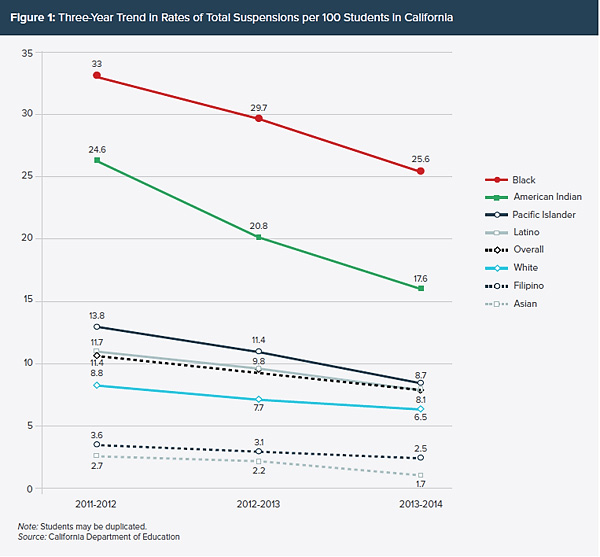
School suspension rates have fallen in California for students of every ethnicity in the last three years, a sign that a shift in discipline practices in many school districts is starting to have an effect, according to a study released Monday by the Center for Civil Rights Remedies at the UCLA Civil Rights Project. The study includes a spreadsheet of the number of suspensions by ethnicity in 901 California school districts.

At the same time, lower rates of suspension were correlated with higher academic achievement for every racial group in the state, the study found. For African-American students, the correlation was the strongest. While some parents and educators expressed concern that suspending fewer students would lead to chaos and lower academic scores, the study found evidence of the opposite.
The findings “push back” on the idea that “you’ve got to kick out bad kids so good kids can learn,” said Daniel Losen, director of the Center for Civil Rights Remedies and the lead author of the study, “Closing the School Discipline Gap in California: Signs of Progress.” “There’s no research to support that, and data suggest the opposite is much more likely.”
Lower suspension rates were correlated with higher academic achievement for every racial group in the state, the study found.
A push by some educators, advocates and California legislators in recent years to replace “zero-tolerance” discipline policies with conflict-diffusing approaches accelerated in 2014 when the U.S. Departments of Justice and Education jointly issued a guidance letter advising schools that the disproportionate application of discipline to certain groups of students may violate federal civil rights laws. “In short, racial discrimination in school discipline is a real problem,” the guidance letter stated.
A chart with graphs on it.
In California, the total number of suspensions, including both sending students home and sending them to an in-school area away from their classrooms, fell from 709,580 in 2011-12 to 503,101 in 2013-14, the study found, using data from the California Department of Education.
Even with declining rates of suspension, students in certain ethnic groups continue to be more likely to be suspended, and disciplined more harshly than other students for the same offenses, the study found. The largest difference was in the “disruption/defiance” category where African American students received 7.2 more suspensions than white students per 100 students.
The study is the first statewide analysis of the relationship between the Academic Performance Index, which is a score assigned to a school based on student test performance, and rates of suspension, Losen said.
The state discontinued the Academic Performance Index after the 2012-13 academic year, so the study only examined the correlation between lower rates of suspension and higher Academic Performance Index scores for the 2011-12 and 2012-13 academic years.
Driving the decline in suspensions was a steep drop in suspensions for “disruption or willful defiance,” a category used to describe non-violent misbehavior. Seventy-seven percent of the decline was the result of fewer suspensions for willful defiance, the study found.
The Los Angeles Unified School District in 2013 became the first school district in the state to ban suspensions for willful defiance. Two other large California student suspension rate drops as ‘willful defiance’ punishments decline | EdSource:

Newark’s Baraka to launch “community schools” in South Ward–with Cerf’s blessing | Bob Braun's Ledger

Newark’s Baraka to launch “community schools” in South Ward–with Cerf’s blessing | Bob Braun's Ledger:

Newark’s Baraka to launch “community schools” in South Ward–with Cerf’s blessing

Baraka meets with Christie. shortly after the mayor's election.
Baraka meets with Christie. shortly after the mayor’s election.


Newark Mayor Ras Baraka and Christopher Cerf, the state-appointed superintendent of the city schools,  are soon expected to launch a “community schools initiative” that would, if successful, create a network of up to 10 schools that offer health and other services as well as enhanced educational programs.  The initiative, aimed primarily at the city’s impoverished South Ward, could be announced as early as next week.
The plan is based on the “global village” plan Baraka pursued with support from educators at New York University while he was principal of Newark’s Central High School. A new version of the proposal was recently produced by Lauren Wells, the mayor’s chief academic officer, who also worked with Baraka while he was at Central.
Thousands of students at City Hall last May when protesters almost shut the city--and part of the state--down.
Thousands of students at City Hall last May when protesters almost shut the city–and part of the state–down.
In her proposal, dated in September, Wells wrote that a city hall-based office of comprehensive community education (OCCE) “seeks to launch and support 10 full-service community schools.
“OCCE will identify the 10 community schools through competitive request for proposals process to all eligible district schools demonstrating a substantive interest and readiness to implement evidence-based approaches to creating community schools.”
She described community schools as a model that “organizes the resources of the Newark’s Baraka to launch “community schools” in South Ward–with Cerf’s blessing | Bob Braun's Ledger:

With A Brooklyn Accent: Which Way Will Campus Protests Go?

With A Brooklyn Accent: Which Way Will Campus Protests Go?:

Which Way Will Campus Protests Go?


One of my great fears with the current wave of campus protests is that Universities will respond to student protests by trying to reshape student and faculty attitudes rather than having universities change who they recruit and admit and hire. Right now, what institutions seem to be doing, in part because this is what students are asking for, is creating new "Diversity Offices," while initiating workshops and training sessions, along with a handful of new courses, some voluntary some mandatory, to make faculty and students more aware of their own biases.
If this is all the current protest movements achieve, the changes will be marginal. Universities will simply produce more culturally sensitive elites to rule over a nation where upward mobility is frozen, wealth is concentrated at the top and the middle class is shrinking.
The bigger challenge is to get Universities to recruit and fund far more students from low and moderate income communities and from marginalized communities.

In a school like Fordham, or even Columbia and NYU, it means recruiting less students from gentrified urban areas and wealthy suburbs and more students from communities like the Bronx, Mount Vernon, or Southeast Queens.
It also means recruiting far more faculty of color, and faculty who WANT to teach students who are first in their families to go to With A Brooklyn Accent: Which Way Will Campus Protests Go?:

La. Gov.-Elect John Bel Edwards Wants a New State Superintendent. | deutsch29

La. Gov.-Elect John Bel Edwards Wants a New State Superintendent. | deutsch29:

La. Gov.-Elect John Bel Edwards Wants a New State Superintendent.


One of Governor-Elect John Bel Edwards’ desires is to rid Louisiana of education superintendent John White.
Even though Governor Bobby Jindal promoted and endorsed White as state superintendent, technically it is the Board of Elementary and Secondary Education (BESE) that hires the superintendent and the Senate and Governmental Affairs Committee that confirms BESE’s hire.
And technically, it is BESE that would vote to fire him– which some see as an impossibility since most of those seated on the incoming BESE appear to be on White’s side.
However, there are ways to rid Louisiana of John White, ways that go beyond mere BESE configuration. As governor, John Bel Edwards is well leveraged to pressure White to either resign or to prompt BESE to vote him out.
On November 22, 2015, I spoke with Louisiana Representative Brett Geymann (Lake Charles) regarding the leverage that Edwards has in fulfilling his preference for a new state superintendent.
brett geymann  
Rep. Brett Geymann
“Two things,” Geymann began. “First is the BESE ethics bill. There are two versions, one sponsored by me [in 2014], and the other, by Bob Hensgens [in 2015]. It had the support of the House to move two years ago and died by the Jindal administration in the Senate Governmental Affairs Committee.” Geymann explained that in negotiations for the Common Core Compromise bill that passed, no other anti-La. Gov.-Elect John Bel Edwards Wants a New State Superintendent. | deutsch29:

Late-Stage Draft of ESEA Reauthorization Bill | Truth in American Education

Late-Stage Draft of ESEA Reauthorization Bill | Truth in American Education:

Late-Stage Draft of ESEA Reauthorization Bill


Education Week shared what they thought to be a late-stage draft of the Elementary and Secondary Education Act (ESEA) reauthorization that confirms much of what has already been leaked.  We do not know if this is final version approved by the conferees on Thursday, but it’s likely pretty close.
It’s also 391 pages so enjoy the light reading material.  This is what our Representatives are supposed to fully vet and then vote on within two days.


Late-Stage Draft of ESEA Reauthorization Bill | Truth in American Education:

Educational Redlining: How Zillow’s School Ratings Help Segregate Communities | janresseger

Educational Redlining: How Zillow’s School Ratings Help Segregate Communities | janresseger:

Educational Redlining: How Zillow’s School Ratings Help Segregate Communities


Heights Community Congress has just released Educational Redlining: How Zillow and GreatSchools Profit from Suspect School Ratings and Harm Communities,  a report on the practice by Zillow, the real estate website, and GreatSchools to guide home buyers to choose communities according to color-coded school ratings posted online. Heights Community Congress (HCC), founded in 1972, is Greater Cleveland, Ohio’s oldest fair housing enforcement organization.  For over four decades HCC has been conducting audits of the real estate industry to expose and discourage racial steering and disparate treatment of African American and white home seekers.  This blog covered HCC’s preliminary work on educational redlining here.
Ralph Day, author of HCC’s report, explains that GreatSchools, launched by the venture capital group, NewSchools Venture Fund, “arbitrarily divides schools into three categories—green, yellow, and red.”  In most states GreatSchools’ ratings merely represent the aggregate standardized test scores of each school’s students.  Day continues: “The act of coloring red whole communities of schools is an alarming reminder of mortgage redlining of recent past, which was declared illegal with the passage of the Fair Housing Act in 1968.  Anecdotal evidence suggests that many home seekers automatically exclude whole communities with ‘red’ labeled schools from their search.  And Zillow in its book (Zillow Talk) exacerbates this trend by cheerfully steering home buyers into the highest rated (highest income) GreatSchools areas they can afford.”
Day summarizes GreatSchools’ methodology:  “In most states, GreatSchools rates schools on their standardized test scores alone.  Schools of the same grade levels are ordered within their state from high scores to low.  Then a school’s rank is converted to a number 1 through 10, where 10 means the school is in the top 10 percent, 1 the lowest 10 percent, 5 and 6 about in the middle, and so on.”  Day continues: “In the past, mortgage redlining was practiced to systematically withhold financing from certain communities that lenders chose for Educational Redlining: How Zillow’s School Ratings Help Segregate Communities | janresseger: