Latest News and Comment from Education

Saturday, November 14, 2015

CA educators push back against unregulated charter schools that threaten students’ futures « Education Votes

CA educators push back against unregulated charter schools that threaten students’ futures « Education Votes:

CA educators push back against unregulated charter schools that threaten students’ futures

Untitled2

TAKE ACTION ›

Tell lawmakers it’s time for tougher standards and more oversight and accountability for charter schools. CLICK HERE ›


It’s not unusual for parents to see educators when dropping off their kids at school. But this morning, within the Los Angeles Unified School District (LAUSD), parents saw educators outside holding up signs and handing out flyers. They were using their free time before class and their unified voice to alert parents that the future of their child’s education could be in danger.
“We want to make sure the parents understand the dangers of the Broad Walmart plan,” said Cecily Myart-Cruz, a middle school English and language arts teacher. “They want to take 50 percent of our students outside of LAUSD and put them into unregulated charter schools that are not held to the same rigorous standards as traditional public schools.”
That plan is being promoted by billionaire Eli Broad, who heads up the Eli and Edythe Broad Foundation. He’s going around securing a half-billion dollars from his rich buddies, including the Walton Family, because he wants to build 260 new charters in the district and enroll more than 300,000 LAUSD students. Charter schools are funded using taxpayer dollars but are run by private companies and are often exempt from the rules and regulations governing traditional public schools.
Right now in our public schools, parents have the right to join with educators and have a say in their child’s education,” said Myart-Cruz, who is also vice president of the United Teachers of Los Angeles (UTLA), which represents more than 31,000 educators and health and human service professionals. “However, we know that parents and students have absolutely no voice with unregulated, privately-run charters. Also, public schools have to take in all students. Unregulated charters do not.
Untitled
CA educator Cecily Myart-Cruz
“If we lose 50 percent of our students to unregulated charters, that means we’re going to have 50-percent less of a teaching force. The sizes of those classes remaining in the public schools are going to be sky high. Students won’t get the one-on-one interaction they need and deserve.”
Myart-Cruz says this is why it’s a bad idea to let billionaires run our public schools. She says instead of investing in unregulated charters, people like Broad and the Walton Family should work with educators and public schools to implement proven strategies and policies that inspire children’s natural curiosity and imagination and ignite their desire to learn.
“Teaching middle school students—that is my life blood, my calling” said Myart-Cruz. “Opening upTo Kill a Mockingbird and talking about character analysis, narration—I know how to bring these concepts to life for my students. I know what CA educators push back against unregulated charter schools that threaten students’ futures « Education Votes:

CURMUDGUCATION: PA: Testing Stutter Steps

CURMUDGUCATION: PA: Testing Stutter Steps:

PA: Testing Stutter Steps


Pennsylvania may or may not be close to getting a budget, or a temporary budget patch, or a deal to at least pay schools while the full budget continues to circle the drain. The new changes about every three or four hours.

But word comes out of Harrisburg that the budget talks also include discussion-- again-- of the use of the Keystone exams as a graduation requirement.

The Keystones are our version of the Big Standardized Test, theoretically aligned to the Pennsylvania Core Standards. The Pennsylvania Core Standards are of course one more version of the Common Core that are totes different from the national version because ours have the word "Pennsylvania" in the title and also don't have the word "Common" in the title, so completely different thing, absolutely. The Keystones are also our very own exam system even though I once sat through a state training on the testing in which we used PARCC materials and were assured those would work just fine. So there's that.

The original grandiose plan was for Keystone exams in every single subject area, but some problems have emerged with that plan including A) it turns out to be hard, B) it turns out to be expensive and C) pretty much everybody thinks the tests we have so far are crap.

It is C that has triggered an ongoing discussion about using the Keystones as graduation requirements. That requirement is supposed to happen for the class of 2017, which means that it's happening now because most schools give the exams in 10th or 11th grade in order to have some wiggle room to rescue the fails. People can't help noticing that a huge number of students who have are otherwise likely to complete graduation requirements are likely to be denied a diploma because of this crappy bubble test. And yes-- the Keystone is transparently the same old stupid bubble test because we have avoided on-line testing because we tried it once years ago and it was disastrous, so we are still bubbling in dots with our pencils.

Many of our legislators would like to press pause. And last summer, State Senator Lloyd Smucker managed to get a bill to pause the Keystones as a grad requirement for at least two years. This is no small thing-- Smucker is no friend of public education, but in fact has been a mover and shaker in pushing a Pennsylvania Achievement School District, a tool that Tennessee reformsters have found simply awesome for privatizing public schools. So even Smucker thinks that Keystones-as-grad-requirements is not ready for prime time. Which makes a little sense-- privatizers need to label 
CURMUDGUCATION: PA: Testing Stutter Steps:

Your School Shapes How You Think About Inequality : NPR Ed : NPR

Your School Shapes How You Think About Inequality : NPR Ed : NPR:

Your School Shapes How You Think About Inequality

Two students passing through each other to get a glimpse of another way of life


Ask yourself this question: Were you aware of inequality growing up?
Your answer may depend in part on where you went to high school. Students at racially diverse schools, particularly black and Hispanic students, are more tuned in to injustice than students going to school mostly with kids that look like them.
That's one of the main threads of a new book by Carla Shedd, an assistant professor of sociology and African-American studies at Columbia University. In Unequal City: Race, Schools, and Perceptions of Injustice Shedd goes straight to the source: the students at four Chicago public high schools. She even let the kids pick their own pseudonyms.
Unequal City cover
Unequal City
Race, Schools, and Perceptions of Injustice
Paperback, 225 pages
purchase
Two of the schools were largely segregated: one had no white or Asian students. The other two were fairly diverse — by Chicago standards — one with about a third white or Asian students and the other, a magnet school, with more than half.
Shedd followed the schools from 2001 to 2011, a turbulent decade when the city demolished its infamous high-rise public housing units and began closing public schools in large numbers.
I spoke with Shedd about how school segregation can damage a student's sense of self.
Let's jump right in. What did the students have to say?
Black and brown kids going to their neighborhood school, many of them didn't have the concrete experiences to know that maybe their experiences are unequal. Those kids are very different from the kids who leave their neighborhood and go to a school downtown and sit with classmates very different from them. They see what's similar and they see what is different. This is mind blowing for 14, 15 and 16-year-olds who are making sense of who they are. It will form their perceptions of opportunity.
So what does that look like from the student perspective?
Both Alex and TB live on the South Side of Chicago in all black neighborhoods. Alex travels all the way from the South Side to just north of Chicago's downtown for his school. He has a racially mixed group of friends and his experiences confirm both his privilege and his disadvantage.
Alex went on a shopping trip with his friends to the mall downtown. So, he's in a mixed group of friends, they're doing something social, and a store security guard believed that one of their group members was shoplifting. The guard approached them and pulled out the three black kids in the group and told them they had to leave. Alex was really stressed by it.
And the contrast is TB. He has been searched but not arrested multiple times. He still thinks the police are fair. I asked him, "How do you feel when this happens?," And he says, "Doesn't this happen to everyone?" It's almost normal for him. TB's school can't confirm that what he experiences is not the norm for everyone else.
So, students of color in segregated schools might be less aware of inequality, but in diverse schools, they might be overwhelmed by it. Where's the balance?
With kids in segregated schools I talk a little about dosage. If they have a lot of these Your School Shapes How You Think About Inequality : NPR Ed : NPR:


Judge: Phila. schools should heed seniority, hire counselors

Judge: Phila. schools should heed seniority, hire counselors:

Judge: Phila. schools should heed seniority, hire counselors

School District of Philadelphia headquarters.


The Philadelphia Federation of Teachers has won another round in its battle with the School District over seniority and counselor staffing levels.

A Common Pleas Court judge denied the district's request to overturn an arbitrator's finding that the district violated the union contract in 2013 when it ignored seniority in recalling laid-off counselors.

In an order filed Tuesday, Judge Linda A. Carpenter also backed the arbitrator's decision that the PFT contract required each school to have at least one counselor on staff.

Union president Jerry Jordan said Thursday that he was "delighted with Judge Carpenter's decision that clearly there should be one counselor in every school for the children."

He added: "I think that this is a big victory for the children. I hoped that her ruling would be the end of this, and that the counselors would be restored to the schools."

But that will not be the case.

A district spokeswoman confirmed that the district had filed an appeal in Commonwealth Court on Thursday, but she declined further comment.

Citing financial woes, the district laid off all 283 counselors in June 2013. It brought back 126 that fall without regard to seniority, and required many of them to serve students at more than one school.

Principals selected the counselors who were recalled, and the PFT filed a grievance.

During a hearing before Carpenter in September, district lawyers argued that Ralph Colflesh, an independent arbitrator, had misinterpreted the PFT contract and overstepped his authority when he ruled in July that every public school in the city should have a full-time counselor.

The district contended that the PFT contract did not contain language covering the recall or reassignment of laid-off counselors. The district also said counselors were restored to the schools they had left based on where the needs were the greatest. To do otherwise, the district said, would have resulted in "mass reshuffling."

The district has said it would cost $3.4 million to hire enough counselors to have one in every school and millions more to


Read more at http://www.philly.com/philly/education/20151113_Judge__Philly_schools_should_heed_seniority__hire_counselors.html#O2XaGucK4BR6xCJG.99


Will President Obama's Education Reformers Own Up to Their Failures? - Living in Dialogue

Will President Obama's Education Reformers Own Up to Their Failures? - Living in Dialogue:

Will President Obama's Education Reformers Own Up to Their Failures? 


By John Thompson.
Perhaps because I’m an incorrigible supporter of President Obama on almost every non-education issue, I grasped at straws hoping that his and Arne Duncan’s staffing of the Education Department with former Gates Foundation true believers in market-driven reform would not create a mess. Even though they flew in the face of a large body of social science and the professional judgments of teachers, I hoped the Race to the Top (RttT), School Improvement Grants (SIG), and other innovations wouldn’t be a waste of money – or worse.
Before turning to other recent criticisms of the Duncan administration’s alphabet soup of technocratic, top-down mandates, I must recall my most naïve response to the RttT, the SIG and, later, NCLB waivers. In 2009, the Obama administration was in the process of saving the nation’s schools and the entire economy from the Great Recession. It was (then) investing less than $10 billion on pilot programs, while pushing the $100 billion of American Recovery and Reinvestment Act (ARRA) bailout. In such a situation, the United States could afford a set of competition-driven experiments.
If the RttT and the SIG worked, that would be great. If they didn’t, we could learn important lessons. Such experiments, however, would require an objective evaluation of their outcomes, as well as a willingness of the administration to honestly confront the results. At the time, I couldn’t have known that Arne Duncan and his team of former Gates Foundation administrators would be so allergic to facing up to facts.
Now, we are getting the next best thing as conservative reformers, as well as educators, are calling them to task. One of the most recent examples of the pushback is conservative reformer Andy Smarick’s challenge to Joanne Weiss’s defense of the RttT. Weiss personified the administration’s overreach. As director of the RttT, she set out to impose corporate school reform on states and localities across the nation.
Weiss ignored the need for checks and balances of authority, and then she seemed to blame states and localities for the failures of her federal micromanaging of school policies. Smarick concludes, “even when federal education officials are pure of heart, their plans reliably underperform, as in the case of SIG, the backlash to NCLB and Common Core, the disappointing results of educator evaluation reform, and the disintegration of the federally funded testing consortia.” (I don’t agree that federal policies always under-perform, but it is a safe bet that grandiose federal social engineering always will.)
Some of the best critiques of Weiss’s spin can be found in the comments prompted by her article in theStanford Social Innovation Review. Almost all of the fifty-plus comments were negative, and many were Will President Obama's Education Reformers Own Up to Their Failures? - Living in Dialogue:

Schools Matter: AERA Concludes the Facts Are Factual about VAM

Schools Matter: AERA Concludes the Facts Are Factual about VAM:

AERA Concludes the Facts Are Factual about VAM


The American Education Research Association (AERA) can be counted on to remain irrelevant to research discussions of great social significance.  Not surprisingly, AERA's shrinking membership numbers havecoincided with the org's steady drift into the arms of education reform schoolers and the corrupt CorpEd foundations that are laser focused on redirecting education at all levels into corporate revenue streams.  

AERA's complacency and complicity have been sickening to watch, with their kowtowing to Bill Gates and his various bad ideas culminating last year when AERA announced a fellowship program for doctoral students interested channeling and then relinquishing their doctoral research to the Gates's MET database.

Now almost 20 years after legitimate researchers starting ringing the alarm bell on the value-added muddle that was thrust upon the education world by the tobacco-chewing ag statistitian, Bill Sanders, and six years after the National Academy of Sciences sent their hair-on-fire letter to Arne Duncan (which was ignored), warning him about including not-ready-for-prime-time VAM in Race to the Top requirements , AERA has finally concluded that the truth must be true:  VAM is not a legitimate tool for ANY high stakes education decisions.  

From AERA's announcement:


. . . . In recent years, many states and districts have attempted to use VAM to determine the contributions of educators, or the programs in which they were trained, to student learning outcomes, as captured by standardized student tests. The AERA statement speaks to the formidable statistical and methodological issues involved in isolating either the effects of educators or teacher preparation programs from a complex set of factors that shape student performance.

“This statement draws on the leading testing, statistical, and methodological expertise in the field of education research and related sciences, and on the highest standards that guide education research and its applications in policy and practice,” said AERA Executive Director Felice J. Levine.

The statement addresses the challenges facing the validity of inferences from VAM, as well as specifies eight 
Schools Matter: AERA Concludes the Facts Are Factual about VAM:

Philosophers vs. Welders: Can’t We Have Both? - Education Writers Association

Philosophers vs. Welders: Can’t We Have Both? - Education Writers Association:

Philosophers vs. Welders: Can’t We Have Both?

Image of Philosophers vs. Welders: Can’t We Have Both?


There was plenty of levity on Twitter in the wake of Republican presidential candidate Marco Rubio’s declaration that “we need more welders, less philosophers.”(This English major would have preferred he said “fewer” welders, by the way.)
Consider this inspired mashup from ProPublica’s Alec MacGillis:

In fact, there are strong arguments to be made that welders and philosophers both fill vital roles in a well-rounded society, rather than cancel each other out. Ideally all students would have opportunities to pursue work that interests them  – whether it involves Plato or a plasma cutter. 
Rubio’s larger point – that the nation has significant vacancies in the skilled trades – is a fair one. And it’s an important part of the larger debate over whether preparing all students for college is a reasonable, or even desirable, goal. 
As college-and-career readiness advocates will tell you, the larger goal is to give more students choices after high school, rather than letting assumptions adults make about them as they enter high school force them into either a vocational or college prep path that determines their futures. (Tracking and ability grouping remainhighly contentious issues.)
Inside Higher Ed points out that this isn’t the first time Rubio has come down hard on philosophy majors – or the more traditional college paths, for that matter. And among many fact-checkers to challenge Rubio’s claims that welding is a more lucrative field than philosophy were Politifact, Vox, and the Washington Post. To be sure, there is not a clear winner. As Boston Globe columnistMark Pothier notes, the Bureau of Labor Statistics’ pay scales for those professions encompass several different types of jobs that vary widely by location. That being said, you’ll certainly find more job openings listed nationally for welders than those demanding philosophy degrees.
But the gold medal goes to the New York Times for actually finding a philosopher-turned-welder who has written a book extolling the virtues of his overlapping fields.)  Matthew B. Crawford found work at a think tank after graduating from the University of Chicago with a degree in Philosophy, the New York Times reports. But he was unhappy, and later became a welder and author. From the New York Times:
One of his books, “Shop Class as Soulcraft,” is devoted to debunking the notion that manual trades are mindless. “The division between knowledge work and manual work is kind of dubious, because there is so much thinking that goes on in skilled trades,” Mr. Crawford said. As for the payoff, Mr. Crawford rejects the idea that philosophers cannot figure out how to earn a living.
“It’s obviously kind of a reductive approach to think of your course of study in college as merely a means to a paycheck,” Mr. Crawford said, suggesting the study of things like happiness can be enriching in ways that are hard to measure. “And nobody goes into philosophy because they think it’s going to make them rich.”
Writing for the Washington Post earlier this fall, Jeff Selingo dug into a Gallup Poll of 30,000 college graduates. Just 38 percent of individuals who graduated within the past 10 years “strongly Philosophers vs. Welders: Can’t We Have Both? - Education Writers Association:

School board chief: How to fix the mess we’ve made in Florida’s public schools - The Washington Post

School board chief: How to fix the mess we’ve made in Florida’s public schools - The Washington Post:

School board chief: How to fix the mess we’ve made in Florida’s public schools

In September Florida’s school superintendents issued a public attack on the state’s accountability system that uses standardized test scores to measure students, teachers and schools, saying that they “have lost confidence” in the system’s accuracy and called for a  suspension and a review of the system. Since then there have been solutions proposed that call for an end to the use of the Florida Standards Assessments (FSA) for accountability purposes and a switch to national tests. For example, Seminole County Superintendent Walt Griffin proposed three national tests — the Iowa Test, the SAT and the PSAT — as substitutes in different grades.
Here’s a different suggested solution, from Steve Luikart, chairman of the school board in Florida’s Pasco County. Luikart spells out the problem — and how it was created — and poses questions to be answered in creating a solution.


Steve Luikart is chairman of the school board in Pasco County, Florida.School board chief: How to fix the mess we’ve made in Florida’s public schools - The Washington Post:


The Anti-Bullying Policies That Are Actually Working - The Atlantic

The Anti-Bullying Policies That Are Actually Working - The Atlantic:

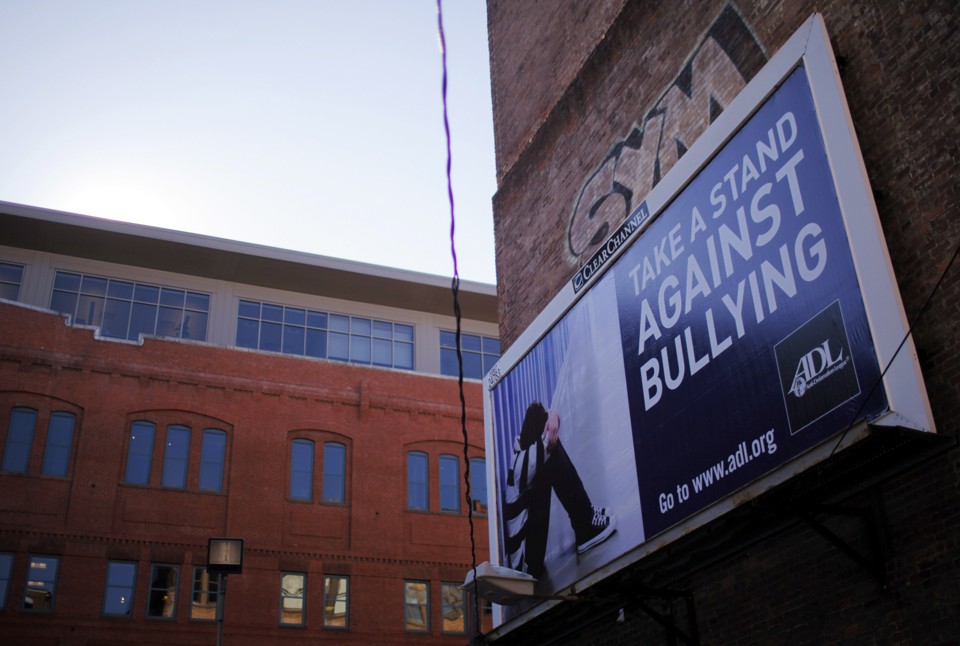
What’s the Recipe for an Effective Anti-Bullying Policy?

Lots of states have passed legislation targeting this problem, but it can be hard to get kids to take the efforts seriously.


At her Moraga, California, junior high school, Rachel Jackson was a safe-school ambassador (SSA), part of a program that trains student volunteers to intervene in bullying situations among their peers.

SSA runs throughout the school year and requires students and teachers to work together, two elements of effective anti-bullying programs, experts say. But in practice, Jackson remembers, student apathy eroded some of the potential.
“About half of the SSAs took the program seriously,” says Jackson, now 16. “However, the majority of students … didn’t exactly see it as an opportunity to really make a change.”
Getting students—particularly junior high schoolers—to take bullying seriously is a daunting task for teachers, administrators, and school counselors. But a study published this month in JAMA Pediatrics suggests that anti-bullying efforts, including laws many states have passed in the past five years, appear to be helping the 20 percent of kids in the U.S. who say they’ve been bullied in the past 12 months.
Researchers at Columbia University analyzed responses from more than 62,000 high-school students in 25 states who participated in a survey conducted by the U.S. Department of Education. (States with anti-bullying laws passed before 2010 were excluded.) Those who attended schools in states with anti-bullying legislation that included at least one of the DOE-recommended key componentswere 24 percent less likely to report that they’d been bullied in the last year, and 20 percent less likely to say they’d been cyberbullied.
Three components stood out as particularly effective: Laws should include a statement of scope; have a clear description of prohibited behaviors; and require school districts to develop and implement policies at the local level, says lead author Mark Hatzenbuehler, an associate professor of sociomedical sciences at Columbia University’s Mailman School of Public Health.
“Anti-bullying programs vary a lot, so we can’t say yet what is the gold standard,” Hatzenbuehler notes.
On a basic level, state anti-bullying laws outline procedures for receiving, recording, and responding to complaints of bullying by students. But they vary tremendously. New Jerseyhas what are considered the toughest anti-bullying laws in the country, whereasMontana, the 50th state to enact a law, provides a definition of bullying and that’s about it. (Montana also had one of the highest rates of reported bullying in Hatzenbuehler’s study.)The Anti-Bullying Policies That Are Actually Working - The Atlantic:

Our Child Is a Girl | An Anonymous Mom

Our Child Is a Girl | An Anonymous Mom:

Our Child Is a Girl

TEEN GIRL BATHROOM


The ACLU of Illinois represents the family of a female student denied access to the locker room at her high school because she is transgender. Recently the U.S. Department of Education's Office of Civil Rights found that the school was violating the girl's federally protected rights. The family has not spoken publicly about this case, seeking to protect their family's privacy. The mother of the student, however, shared this statement with the ACLU of Illinois. We are pleased to share it with you.
My husband and I laughed recently when our daughter said her friends say, "You're the most famous anonymous person." Laughter has been rare these days.
That's because our daughter is "Student A" at the center of the recent controversy over whether a girl who is transgender should be permitted to use the girls' locker room.The Department of Education's Office of Civil Rights says yes. Our school district -- Township District 211 -- insists that students "of the opposite sex" should not be permitted in the girls' locker room.
For the record, we agree with District Superintendent Daniel Cates about not permitting students of the opposite sex in the locker room. But the inconvenient fact for Mr. Cates and his supporters is that our daughter is not "of the opposite sex."
She is a girl.
The district wrongly assumes what many who are not educated about the issue assume: That what makes a girl a girl and a boy a boy is simple anatomy. We believed this, until our daughter came along. Despite early signs -- from as young as 4, when she declared herself a girl, to the fact that she had mostly girlfriends growing up, played with dolls, begged to wear girls' clothes, insisted on wearing a Hannah Montana wig while she danced around the living room and was heavily distraught over the male characteristics of her body -- we were still shocked and ill-prepared when, at the end of 7th grade, our daughter again told us that she was a girl and had to live openly as one.
This is a difficult concept to grasp. However, just because something is difficult to understand, does not mean we should mock it or deny its existence. When we were struggling to understand, we sought out medical professionals and support groups. Through this education process, we learned that gender extends beyond the sex a person is assigned at birth. We learned that scientific evidence has determined that gender is also determined by the brain's anatomy, which is why the sexual Our Child Is a Girl | An Anonymous Mom:

Educators hear from advocate decrying school privatization - The Daily Nonpareil - Council Bluffs, Iowa: Local News

Educators hear from advocate decrying school privatization - The Daily Nonpareil - Council Bluffs, Iowa: Local News:

Educators hear from advocate decrying school privatization

Click on picture to Listen to Diane Ravitch


America’s public school system is under assault.
That’s the message public education advocate Diane Ravitch brought to the Council Bluffs-Omaha area as a guest speaker presented by the Metropolitan Omaha Educational Consortium.
Ravitch, the author of “Reign of Error: The Hoax of the Privatization Movement and the Danger to America’s Public Schools,” is famous for attacking standardized testing, school choice, billionaires meddling in schools, the Common Core State Standards and other aspects of what she describes as the corporate reform movement in education.
The Omaha-based consortium – which is hosted at the University of Nebraska at Omaha and made up of Omaha’s metropolitan districts in Nebraska as well the Council Bluffs Community School District – brought hundreds of educators to the CenturyLink Center on Thursday evening to hear Ravitch’s comments and suggestions.
“I think she energized teachers a little bit,” said Mary Beth Runge, a teacher mentor at Thomas Jefferson High School. “The teachers I went with and talked to said that they felt validated that someone with her credentials gets it, that we’re under assault and the public might understand it for their own school in their neighborhood but doesn’t understand the system-wide issues that public schools and public school teachers face.”
Ravitch was assistant secretary of education under President George H.W. Bush and spent years working for think tanks before she began criticizing some of the policies she had helped craft.
During a breakfast talk organized by MOEC for community leaders and school administrators, Ravitch said she realized strategies like charter schools – where private entities operate public schools with fewer regulations – weren’t helping.
“I’m doing this because I’m so angry at the balance of power,” she said Friday morning. “I helped to create this monster that I’m now fighting.”
Nancy Edick, dean of the University of Nebraska at Omaha College of Education, described the 77-year-old speaker as “the champion for public schools across the country” and said Ravitch’s blog, dianeravitch.net, was a leading voice in American education. Runge said she challenged the “false narratives” about education privatization and accountability.
“That carrot and stick mentality, she said, just doesn’t work,” Runge said, adding that four solutions Ravitch gave that she took home with her Thursday evening were to increase neonatal care, to put health clinics in schools, to reduce class size and to raise salaries for teachers.
“She ended the speech saying support for public education is the civil rights issue of our time,” Runge said. “I thought that was really powerful.”
A good crowd from Council Bluffs attended Thursday, she said. On Friday morning, several Council Bluffs officials could be spotted in the crowd of leaders, which Ravitch praised as being more inclusive than most communities can muster given the conflict that often pits community leaders together over education issues.


Ravitch also praised Nebraska, which as thus far not allowed charter schools or adopted the Common Core State Standards. Iowa, on the other hand, has adopted the Common Core through its Iowa Core standards, and has Educators hear from advocate decrying school privatization - The Daily Nonpareil - Council Bluffs, Iowa: Local News:
Educators hear from advocate decrying school privatization

Locascio: Cage-busting and feeding the calves —- Teachers as decision-makers - Richmond Times-Dispatch: Guest-columnists

Locascio: Cage-busting and feeding the calves —- Teachers as decision-makers - Richmond Times-Dispatch: Guest-columnists:

Locascio: Cage-busting and feeding the calves —- Teachers as decision-makers


There’s an old adage that you can’t make a calf grow by weighing it. Teachers can’t make young minds grow by continually testing them, either. In such cases, excessive focus on measurement can come at the expense of intellectual nourishment and exercise.
Efforts to reform education through exhaustive high-stakes testing has once again become a topic of criticism and commentary, with the Obama administration recently emphasizing the need for more moderation and coherence in the use of standardized tests. A recent study by the Council of the Great City Schools reports that typical graduates of an urban high school will have taken more than 110 mandated standardized tests in their K-12 career, a number that does not even include other tests “benchmarking” progress. The study found an average of 6.2 standardized tests per year for kindergarten students, climbing steadily to more than 10 high-stakes tests per year in both eighth and 10th grades. FairTest reports in another recent study that student “opt-outs” in protest to excessive testing are now at record levels.
Teachers and administrators have long recognized the opportunity cost of such extensive standardized testing — the time allocated to teach actual content and skills is sacrificed to prepare children for testing.
One of the other deleterious effects of excessive testing is the lost opportunities for teachers to personally engage in important decision-making relating to their classrooms. The constellation of teachers’ decision-making used to be widely acknowledged to include decisions relating to curriculum, instruction and assessment of students’ progress, as well as myriad other aspects of establishing and maintaining positive classroom cultures.
To be sure, teachers still make weighty decisions relating to pacing, classroom dynamics and responses to student behaviors, but many other facets of teacher discretion have been narrowed and dictated by testing. Too often the state standards — rather than being a foundation upon which curriculum is built in a manner most appropriate to individual classrooms and students — become for many teachers the entirety of the curriculum, absolving teachers of much curricular decision-making.
Similarly, the specific formats of high-stakes tests (mostly framed around “selected responses” like multiple-choice) dictate the format of classroom tests in a manner that limits students’ opportunities to utilize capacities for thought beyond memorization or skills beyond strategic test-completion.
The curriculum’s narrowing and crowding out of meaningful assessment limits the potentials for critical, creative and divergent thought and, even more troubling, leads many students to discount the value of such thought. Diane Ravitch has recently blogged about how demoralizing this phenomenon is for many excellent teachers. Despite pre-service teacher candidates getting repeated exposure to all manner of authentic assessments as a part of their teacher education programs, they find themselves similarly disheartened by the paltry classroom assessments in place in actual classrooms as they start their careers.


The Legal Case Unions Fear They Cannot Win - WSJ

The Legal Case Unions Fear They Cannot Win - WSJ:

The Legal Case Unions Fear They Cannot Win

Can government workers be forced to pay fees to unions? The Supreme Court seems inclined to say no.


It has been a difficult five years for government-employee unions, and the Supreme Court appears poised to strike another blow. During the current term, the justices will hear Friedrichs v. California Teachers Association, a case challenging rules in 23 states—including California, Illinois and New York—that force government workers to pay hefty “agency fees” to unions that they have no interest in joining.
Labor activists call these “fair share fees,” on the theory that nonunion workers, even if they don’t pay full dues, still benefit from collective bargaining—for example, from a wage increase negotiated by union representatives. In a brief filed last week with the Supreme Court, the California Teachers Association argued that such fees are vital “to avoid labor strife, to secure economic stability, to insure the efficiency and continuity of state and local governments.”
Forty years ago, the Supreme Court bought that argument. The court’s 1977 ruling inAbood v. Detroit Board of Education affirmed a Michigan law that required teachers opposed to their union to pay the agency fee anyway. For decades, this precedent has supplied unions with a steady stream of revenue from nonmembers.
Yet labor leaders are increasingly pessimistic about the agency fee’s prospects in court. Last year the California Teachers Association produced a remarkable document for internal consumption titled, “Not if, but when: Living in a world without Fair Share.” Several months later, eight state teacher unions under the aegis of the National Education Association turned out a strategic document titled, “Engaging members and leaders in a non-agency world.”
What has them spooked? In recent years the Supreme Court has narrowed the prerogatives that unions enjoyed under Abood. The 2012 ruling in Knox v. SEIU held that a California union had violated the rights of nonmembers when it assessed a special fee to support political campaigns without first asking the nonmembers to opt in.
Equally important, the justices seemed to signal that they would be willing to reconsiderAbood entirely. “Because a public-sector union takes many positions during collective bargaining that have powerful political and civic consequences, the compulsory fees constitute a form of compelled speech,” Justice Samuel Alito wrote for the majority inKnox. “Our cases to date have tolerated this ‘impingement,’ and we do not revisit today whether the Court’s former cases have given adequate recognition to the critical First Amendment rights at stake.”
Now, in Friedrichs, the court will hear a case that turns on precisely that issue. The lawsuit was brought by Rebecca Friedrichs and nine other California educators against the California Teachers Association (CTA). It argues that forcing teachers who do not belong to the union to pay agency fees averaging $650 annually violates their First Amendment rights, and that the union’s collective bargaining is itself a political act that they should not have to support.
If the Supreme Court in the end does overturn Abood, the practical effect could be the equivalent of passing a national right-to-work law for government employees.
Although labor leaders have vigorously contested these cases, they have also begun to prepare for a potential loss by getting back to the basic task of recruiting members. The American Federation of State, County and Municipal Employees and the Service Employees International Union have organized aggressive campaigns to convert nonmembers who pay the agency fee to full membership before the Supreme Court rules on Friedrichs. Afscme’s goal, according to press reports, is to persuade 30% of its estimated 130,000 fee payers to join (total membership is 1.3 million). Locals are running The Legal Case Unions Fear They Cannot Win - WSJ: