Latest News and Comment from Education

Tuesday, November 3, 2015

What Teachers Do: A Little Common Sense In This Must-See Video

What Teachers Do: A Little Common Sense In This Must-See Video:

What Teachers Do: A Little Common Sense In This Must-See Video

Turns out the teachers got it right. The wheels are falling off the so-called “education reform” project which dismissed the voices of teachers – and particularly their unions – with no little vitriol.
Reformers offered clear, simple answers to the supposed failings of America’s schools. High-stakes testing, they claimed, would measure failed schools and teachers. Charters would provide motivated alternatives, after failed schools were closed. Cyber schools would move education into the dot-com age. Teach for America students would supplant tired, old teachers.
Now reality is starting to bite. The Obama administration – chief apostle of high stakes standardized testing – now warns against devoting too much class time to testing and test prep. Charters have been exposed for wasting literally billions on schools that never open or close after a few months. The growing number of scams and rip-offs is too big to ignore. Teach for America students tend to leave schools before they gain the experience vital for teaching. Assailing teachers not surprisingly prompts the best to leave early. Cyber schools, a recent study reported, are so bad it is as if the students never attended school.
The most hyped charter chain – the Success Academy schools in New York City – turn out to have lists of “got to go” students who don’t perform well. It is relatively easy to lift average test scores if you eliminate the laggards.
Common sense now gets a new hearing, as parents and teachers revolt across the country. As National Education Association President Lily Eskelsen García calmly explained to critics on “Morning Joe,” none of the countries that have been rising in international comparison do any of the things that the reformers tout. They make teaching an honored profession, train What Teachers Do: A Little Common Sense In This Must-See Video:


CURMUDGUCATION: Rescuing Strivers from Those People

CURMUDGUCATION: Rescuing Strivers from Those People:

Rescuing Strivers from Those People


Today in Bloomberg View, Mike Petrilli is airing out his ideas about how charters should be the lifeboats that rescue strivers from the chaos of disruptive students.

His thesis is pretty simple-- strivers suffer from being trapped in classrooms that are disrupted by non-strivey students, so if we could screen for strivers and get them into a safe, striver-friendly school, rescuing them from chaotic public schools where disruptive students are, for a variety of both good and bad reasons, allowed to suck up the disruptive lion's share of time and attention.

As I said just a few days ago, when Petrilli was defending Eva Moskowitz's push-out policy, his point is not completely without merit. Every teacher on the planet has had That Student, without whom their class runs so much more smoothly. And every teacher understands the impact of the group-mind in a classroom in terms of atmosphere and what can be accomplished. And every teacher who's been working for more than ten years has seen the impact of policies that have aggressively pushed for all students, regardless of skill or inclination, back into the regular classroom.

However, I have some huge problems with Petrilli's narrative.

The Myth of the Climb to the Middle Class

In his very first paragraph, Petrilli provides a definition of a striver:

Low-income strivers -- impoverished families who follow the rules and work hard to climb the 
CURMUDGUCATION: Rescuing Strivers from Those People:


School vs. Society in America’s Failing Students - The New York Times

School vs. Society in America’s Failing Students - The New York Times:

School vs. Society in America’s Failing Students


Here’s the good news: American schools may not be as bad as we have been led to believe.
Ah, but here’s the bad news: The rest of American society is failing its disadvantaged citizens even more than we realize. The question is, Should educators be responsible for fixing this?
The perennial debate about the state of public education starts with a single, seemingly unassailable fact. American students sorely lag their peers in other rich nations and even measure up poorly compared with students in some less advanced countries.
Americans scored more than halfway down from the top in the last round of the so-called PISA standardized tests in math, administered in 2012 by the Organization for Economic Cooperation and Development to 15-year-olds in about 60 countries. They scored about a third of the way down in reading and almost halfway down in science.
The lackluster performance has reinforced a belief that American public education — the principals and teachers, the methods and procedures — is just not up to scratch. There must be something wrong when the system in the United States falls short where many others succeed.
But is the criticism fair? Are American schools failing because they are not good at their job? Perhaps their job is simply tougher.
In a report released last week, Martin Carnoy from the Graduate School of Education at Stanford, Emma García from the Economic Policy Institute in Washington and Tatiana Khavenson from the Institute of Education at the Higher School of Economics in Moscow, suggest that socioeconomic deficits impose a particularly heavy burden on American schools.
“Once we adjust for social status, we are doing much better than we think,” Professor Carnoy told me. “We underrate our progress.”
The researchers started by comparing test scores in the United States with those in France, Germany, Britain, Canada, Finland, South Korea, Poland and Ireland. On average, students in all those countries do better than American children.
But then the researchers divided students into groups depending on the number of books in their homes, a measure of the academic resources at families’ disposal. This adjustment significantly reduced the American deficit, especially among students on the bottom rungs of the resource ladder.
American students from families with the least educational resources, as it turned out, scored better on the PISA math test than similar children in France and about the same as Britons, Germans and Irish.
Encouragingly, disadvantaged American students have made more School vs. Society in America’s Failing Students - The New York Times:

Education Reform – Testing kids on content they’ve never learned - Wait What?

Education Reform – Testing kids on content they’ve never learned - Wait What?:

Education Reform – Testing kids on content they’ve never learned


A primary goal of the Corporate Education Reform Industry is to privatize public education by persuading policymakers that the nation’s system of public education is failing.
A key strategy of choice for the so-called reformers and their political lackeys is to prove that students and teachers are failing by requiring massive amounts of standardized testing the measures students on concepts and content that haven’t learned.
Take for example, the NEW SAT, which Connecticut has now mandated for use in the 11thgrade.
[Read Once again Connecticut elected officials are wrong to mandate the SAT for all 11th graders (Wait, What? 11-2-15) which includes education advocate Wendy Lecker’s recent commentary piece on the NEW SAT.]
A New York Times article last week entitled, Everything You Need to Know About the New SATlaid out the facts about the NEW SAT including the news that,
“The addition of more-advanced math, such as trigonometry, means the test will cover materials from a greater number of courses.  That will make it 
Education Reform – Testing kids on content they’ve never learned - Wait What?:

Child Care Annual Aggregate Report SFY 2014-15 - Child Development (CA Dept of Education)

Child Care Annual Aggregate Report SFY 2014-15 - Child Development (CA Dept of Education):

Child Care Annual Aggregate Report SFY 2014-15 


Number of Children Served by Program Type1 During State Fiscal Year (SFY) 2014-15

Program TypeChildren (N)
General Child Care
55,243
CalWORKs Stage 2
90,465
CalWORKs Stage 3
46,889
Alternative Payment
38,157
California State Preschool
180,354
General Migrant Care
3,902
Severely Handicapped
200
Total2
391,582
Source: CDD-801A Monthly Child Care Reports for SFY 2014-15.
Note: Data summarized in this table represent an unduplicated count of children by program type who received subsidized child care and development services any time during the SFY. These data do not reflect the number of children served during a given month. Missing and unknown data are excluded.
The list below provides the names and contracts included within each program type:
  • General Child Care includes the following program contracts: Center-Based Child Care (CCTR) and Family Child Care Home Education Networks (CFCC).
  • CalWORKs Stage 2 includes the following program contract: CalWORKs Stage 2 (C2AP).
  • CalWORKs Stage 3 includes the following program contract: CalWORKs Stage 3 (C3AP).
  • Alternative Payment includes the following program contracts: Alternative Payment (CAPP) and Migrant Alternative Payment (CMAP).
  • California State Preschool Program includes the following program contract: California State Preschool Program (CSPP).
  • General Migrant Care includes the following program contract: Center-Based Migrant Child Care (CMIG).
  • Severely Handicapped includes the following program contract: Severely Handicapped Care (CHAN).
2 Child counts are unduplicated within each program type. A child may be counted more than once if they received services within multiple program types during the year. The total does not equal the sum of the rows. Rather, the total represents the unduplicated number of children served regardless of program type.
Questions:   CDMIS Staff | cdmis@cde.ca.gov | 916-445-1907

Will Competency-Based Learning Rescue the Testocracy? - Living in Dialogue

Will Competency-Based Learning Rescue the Testocracy? - Living in Dialogue:

Will Competency-Based Learning Rescue the Testocracy?


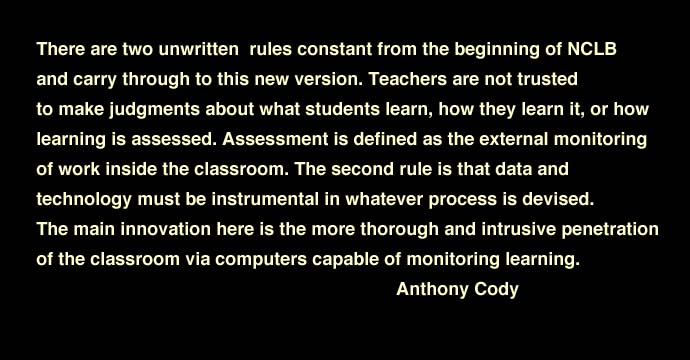
By Anthony Cody.
We have been badgered for the past 14 years by reformers insisting on the fierce urgency of change, and they have had their way – twice! First, seven years of NCLB, followed by the past seven years of Race to the Top, and now the “next generation” of tests, which were promised to be “smarter,” computer-adapted, and deliver results more quickly. None of it worked. Scores on the independent NAEP tests are flat or down. The SBAC and PARCC tests are more difficult without being any “smarter” in telling us about what our students can do. The idea that these tests could somehow promote and measure creativity and critical thinking is debunked. The growing opt out movement poses a huge threat to the standardized testing “measure to manage” paradigm.
So what is to be done?
Reinvent the tests once again, using technology. And who better for the job than Tom Vander Ark, formerly of the Gates Foundation, and now associated with a long list of education technology companies. The latest package of solutions is being called “competency based learning,” and it was featured prominently in theDepartment of Education’s latest “Testing Action Plan.”
Jobs to be done. To get at the heart of value creation, Clayton Christensen taught us to think about the job to be done. Assessment plays four important roles in 
Will Competency-Based Learning Rescue the Testocracy? - Living in Dialogue:

Schooling in the Ownership Society: Byrd-Bennett, SUPES & Harcourt's goal in Detroit: Loot and then burn.

Schooling in the Ownership Society: Byrd-Bennett, SUPES & Harcourt's goal in Detroit: Loot and then burn.:

Byrd-Bennett, SUPES & Harcourt's goal in Detroit: Loot and then burn.

Byrd-Bennett's inner circle, Tracy Martin, Sherry Ulery and Rosemary Herpel, followed her from Cleveland and Detroit.


I'm glad that Chicago reporters are finally uncovering the depth and breadth of the SUPES scandal. Today, the trail leads them back to Detroit where Barbara Byrd-Bennett was brought in to run the district as a high-paid consultant after leaving Cleveland. In the end, I predict the trail will extend even farther and higher up, as the edu-criminals begin rolling over to save their own skins.
According to today's Sun-Times:


An FBI agent believed corrupt former Chicago Public Schools CEO Barbara Byrd-Bennett worked to “fraudulently steer” a $40 million contract to one of the country’s biggest educational publishers while she worked for the Detroit schools.
This should come as no surprise to anyone who's been following the case or to those of us who have been writing about the takeover of Detroit's public school system, which smelled of corruption and mismanagement from day one.


With the help of three accomplices brought over from Cleveland, including Tracy Martin and Sherry Ulery, to rig the bidding process, BBB funneled big contracts to testing/textbook giant Houghton Mifflin Harcourt. Turns out, she was on Houghton's payroll before and after Detroit. Martin, Herpel and Ulery then became part of BBB's inner circle at CPS and have now been named in the SUPES indictment.

Here's the FBI warrant on BBB from Detroit.

More from S-T:


The feds told the judge an “unusual financial transaction” took place about three weeks before the contracting process for the Detroit deal began. Records show the FBI’s “analysis of bank account belonging to Schooling in the Ownership Society: Byrd-Bennett, SUPES & Harcourt's goal in Detroit: Loot and then burn.:

Rick Smith – Letting Teachers Voices Through the Media Embargo | gadflyonthewallblog

Rick Smith – Letting Teachers Voices Through the Media Embargo | gadflyonthewallblog:

Rick Smith – Letting Teachers Voices Through the Media Embargo

FullSizeRender


I met Rick Smith for the first time in person this summer in Washington, D.C.
He had traveled to our nation’s capital to cover the Badass Teachers Association(BATs) Congress of which I was a member. Though I’d seen pictures and videos of him and even been on his daily radio show a handful of times, I was surprised to see him standing there in the lobby. He looked exactly like his pictures.
Often when you meet someone like that in the flesh, you get a glimpse behind the mask at how much the persona differs from the person. For example, when I was a journalist and interviewed Marvin Hamlisch, he was much more the cranky old man than the consummate showman.
But Rick was just… Rick. Faded denim, golf shirt, tousled hair under a ball cap.
He treated me to breakfast in the hotel restaurant and we talked about politics, activism and education. In a way it was like being on his show except there was no audience. Maybe he didn’t speak as loud and didn’t feel the need to explain the background of a subject for listeners at home, no station identification, but other than that it was pretty much the same.
He’s the real deal. What you see – or usually hear – is what you get.
I remember thanking him for trucking all the way from northern Pennsylvania to be Rick Smith – Letting Teachers Voices Through the Media Embargo | gadflyonthewallblog:

David Hursh’s New Book, The End of Public Schools: The Corporate Reform Agenda to Privatize Education | deutsch29

David Hursh’s New Book, The End of Public Schools: The Corporate Reform Agenda to Privatize Education | deutsch29:

David Hursh’s New Book, The End of Public Schools: The Corporate Reform Agenda to Privatize Education

the end of public schools hursh
(The Kindle version is already available on Amazon.com. Moreover, this flyer from Routledge includes information on a 20 percent discount.)
David_Hursh_2014-108-S
David Hursh


University of Rochester (New York) education professor David Hursh has a new book coming out on November 23, 2015: The End of Public Schools: The Corporate Reform Agenda to Privatize Education (Routledge).


Hursh’s The End of Public Schools is divided into five chapters:
Chapter 1: The Demise of the Public in Public Schools
Chapter 2: Understanding the Rise of Neoliberal Policies
Chapter 3: Governor Cuomo and the Neoliberal Attack on Public Schools, Teachers, and Unions
Chapter 4: The Gates Foundation, Pearson, and Arne Duncan
Chapter 5: Manufactured and Real Crises: Rethinking Education and Capitalism
In this post, I offer a glimpse into each chapter via thought-provoking excerpts that attest to the overall quality of Hursh’s book. (Note: In-text citations removed for ease of presentation.)
From Chapter 1, “The Demise of the Public in Public Schools”:
We need to understand that the education reforms are not minor changes in how schools are administered, or how tests and curriculum are created, or 
David Hursh’s New Book, The End of Public Schools: The Corporate Reform Agenda to Privatize Education | deutsch29:

CURMUDGUCATION: Magnet vs. Charter

CURMUDGUCATION: Magnet vs. Charter:

Magnet vs. Charter


Once again, I had a version of this conversation.

Me: Charters are not public schools because they are not open to or committed to taking all students. They filter and cream and push out and refuse to backfill.

Reformster: What about magnet schools? Those are public schools which have stringent admission requirements. They don't educate every child, either, and they also pick and choose.

I can illustrate the hole in this argument by imagining the following contrasting conversations.

Conversation #1

Student: I would like to attend your most excellent magnet school!

School: Unfortunately, you have not met our stringent entry requirements. However, as is our legal and ethical responsibility, we will make sure to provide you with a full education elsewhere within this school district.

Conversation #2

Student: I would like to attend your delightful charter school!

Charter: Unfortunately, we don't want you. We don't have space for you. You are too old. You aren't 

WSJ: The High-Priced Death of Common Core


I've been saying this for a while, but yesterday the Wall Street Journal put it out in the main stream media-- the Common Core as a single unifying force in US public education is dead.

The actual headline for Michael Rothfeld's piece is "Financial Woes Plague Common-Core Rollout." But "plague" is a generous description of the situation Rothfeld describes.

Five years into the biggest transformation of U.S. public education in recent history, Common Core is far from common. Though 45 states initially adopted the shared academic standards in English and math, seven have since repealed or amended them. Among the remaining 38, big disparities remain in what and how students are taught, the materials and technology they use, the preparation of teachers and the tests they are given. A dozen more states are considering revising or abandoning Common Core.

In other words, the dream that Common Core would be the single educational vision of the entire country-- that dream is dead. Dead dead deadity dead.

But Rothfeld's piece lays out a not-always-recognized (at least, not by people who don't actually work in education) culprit for the demise. He lists the usual suspects-- politics, testing, federal overreach. But the article is most interested in another malefactor-- finances.

The total cost of implementing Common Core is difficult to determine because the country’s 
WSJ: The High-Priced Death of Common Core

California's Attorney General Is Investigating The Online Charter School Industry - BuzzFeed News

California's Attorney General Is Investigating The Online Charter School Industry - BuzzFeed News:

California’s Attorney General Is Investigating The Online Charter School Industry

Students at virtual charter schools lag significantly behind their peers in brick-and-mortar classrooms, sparking big worries among education advocates.


The for-profit online charter school industry is the target of an investigation by California Attorney General Kamala Harris, according to a filing by K12 Inc., the country’s largest online charter management company.
K12 received a subpoena in late September from the Bureau of Children’s Justice at the California Attorney General’s office, the company said in its quarterly earnings report. The subpoena, K12 said, was part of an industry-wide investigation. There are 14,500 students enrolled in virtual schools run by K12 Inc., up from just 650 in 2002.
The California Attorney General’s office said it could not comment on ongoing investigations.
Virtual charter schools are public schools that exist entirely online: Taxpayer dollars pay for students in kindergarten through 12th grade to take classes from home, communicating with their teachers over the internet. About two-thirds of the country’s virtual charters are run by for-profit companies like K12, which hire teachers and management and provide the school’s curriculum and software.
A scathing report last week from Stanford’s Center for Research on Education Outcomes (CREDO) found that online charter schools have an “overwhelming negative impact” on students’ learning compared to traditional brick-and-mortar schools.
Over the course of a school year, the CREDO study said, virtual school students lost out on the equivalent of 180 days of learning in math and 72 days reading. The California's Attorney General Is Investigating The Online Charter School Industry - BuzzFeed News:

Better pay, more time to plan and one other thing teachers want from you - LA Times

Better pay, more time to plan and one other thing teachers want from you - LA Times:

Better pay, more time to plan and one other thing teachers want from you

Teaching
Amid a shortage of teachers in California, a new report calls for attracting more people to the profession by making teaching more prestigious. 
 (Anthony Russo / For The Times)


en Arielle Bourguignon started teaching at 24th Street Elementary in Jefferson Park about two years ago, she felt UCLA's education school had prepared her well.
But if it were up to her, she would change the perception of her profession. “Some people see us as glorified babysitters,” she said.
Jane Fung, a veteran, award-winning kindergarten teacher at Belvedere Elementary in East L.A., would change something else. “I would make sure that elementary and middle school teachers have a period off where they could either prep or collaborate,” she said. “It should be embedded into our profession."
Changing the teaching profession by making it more prestigious and giving teachers more planning time are just two proposals that are part of a new report from the Center for American Progress, a liberal think tank in Washington. The report, which was provided to The Times and is being released Tuesday, calls for a comprehensive overhaul of the pipeline for becoming a teacher and staying in the classroom.
The report, written by former Obama administration official and current CAP Executive Vice President Carmel Martin, CAP's teacher policy director Lisette Partelow and CAP's vice president of education policy Catherine Brown, points out different ways to make teaching a more desirable profession. It calls for making teacher preparation programs more selective, requiring licensing exams to be more relevant, increasing teacher salaries, paying better teachers more, making tenure more meaningful, and reorganizing the school day so that teachers have more time to plan.
The individual proposals have been suggested previously by various groups, but the report ties these ideas together. “We think there is this almost perfect storm that is about to hit the education sector in that there’s this broad consensus that we dramatically raise the bar,” Martin said in an interview. “We need to make some radical changes in how the profession is organized.”
The report comes amid a teacher shortage in California, though not in L.A. Last year, the California Department of Education estimated that the state would be short 21,482 Better pay, more time to plan and one other thing teachers want from you - LA Times:

Mike Klonsky's SmallTalk Blog: In response to war on unions, the CTU prepares its troops for battle

Mike Klonsky's SmallTalk Blog: In response to war on unions, the CTU prepares its troops for battle:

In response to war on unions, the CTU prepares its troops for battle

"Our plan will eliminate the big government unions entirely..." -- Scott Walker
Gov. Rauner's war on the unions, especially teacher unions, is modeled on his pal, Gov. Walker's war in Wisconsin. Walker's plans include preventing federal workers from collective bargaining, creating a national right-to-work law and eliminating the National Labor Relations Board. He has already succeeded in taking away teacher collective-bargaining rights.

Unlike Walker, Rauner is facing a Democrat-controlled legislature. So he is holding the state budget hostage in an effort to get Democrats to crush the CTU and other public employee unions in exchange for releasing badly-needed state funds. The question is, will Dem political bosses Madigan and Cullerton go along with the sociopath governor in exchange for a budget deal. So far they have resisted. With 2016 elections on the horizon, there are not many Democrats in Springfield who are ready to go back to their districts and face the wrath of union constituents and their families.

Capitol Fax's Rich Miller writes in Crain's:
The governor cannot win this fight in the pro-union, Democratic Mike Klonsky's SmallTalk Blog: In response to war on unions, the CTU prepares its troops for battle:

The Very Persistent Delusions of Billionaire-Edureformers | the becoming radical

The Very Persistent Delusions of Billionaire-Edureformers | the becoming radical:

The Very Persistent Delusions of Billionaire-Edureformers


Billionaire-Edureformer extraordinaire Bill Gates “sat in a gray easy chair” at Clemson University’s Tillman Hall (yes, that Tillman Hall) to pontificate once more on education reform.
Gates soothed the crowd by explaining “that if they get frustrated at the lack of change in American education policy, they should ‘go into a charter school’ to see quality change,”reported Nathaniel Cary.
And, on que, “Gates defended the Common Core,” and of course, “innovation,” before tossing out his old standby: “Improving the quality of teachers across the country is the only way to close the gap for all students, an initiative his foundation supports [read: ‘purchases’], he said.”
Delusion 1: Gates has financed and perpetuated the same accountability policies started in the early 1980s. If there is a “lack of change” in education (and there is), it is very much at Gates’s feet (or enormous wallet).
Delusion 2: School choice, including charter schools and public school choice, has resulted in outcomes that are indistinguishable from traditional public schools, as I detailed in 2010, and as the Center for Public Education concludes in this October 2015 analysis:
In general, we find that school choices work for some students sometimes, are worse 
The Very Persistent Delusions of Billionaire-Edureformers | the becoming radical:

Review of Journeys: Are @KIPP charter schools pathological? | Cloaking Inequity

Review of Journeys: Are @KIPP charter schools pathological? | Cloaking Inequity:

Review of Journeys: Are @KIPP charter schools pathological?


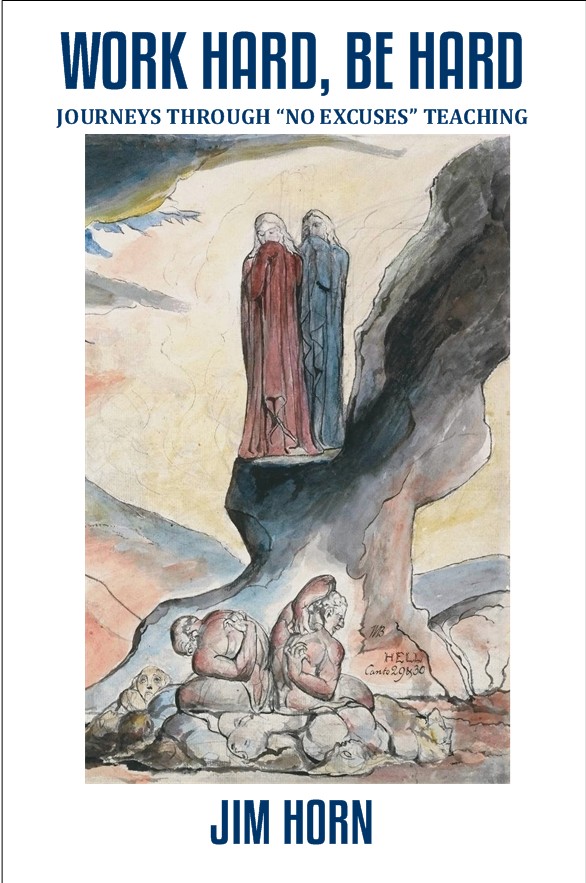
Are @KIPP charter schools pathological? Jim Horn et al. will soon publish a new book entitled Work Hard, Be Hard: Journeys Through “No Excuses” Teaching. The following is a review based on the advance copy that I received.
jkh_mfa_3-12-11__3Jim Horn et al. have collected important perspectives from current and former Knowledge is Power Program (KIPP) teachers in a new book entitled Work Hard, Be Hard: Journeys Through No Excuse Teaching. The KIPP corporate charter school chain of schools has received hundreds of millions of dollars in corporate, local, state and federal dollars since its inception in 1994. The KIPP charter chain was started by Mike Feinberg (See Frank Convo with KIPP’s Mike Feinberg: Do you call BS?) and Dave Levin, Teach For America alums, have found ready allies in the corporate education reform movement— whose policies are focused on private control of public schools.
Since the KIPP charter chain is privately controlled, they have also restricted access and only allowed a select few outside research projects to enter their schools. Horn wrote in Journeys that he requested access to KIPP schools to expand his sample and was rejected by the charter chain. Sadly, this is not an isolated example of KIPP refusing to cooperate with researchers. I personally experienced the restrictive nature of KIPP schools to outside researchers. A few years ago, KIPP Austin relayed in conversations with a UT-Austin research team that they were having problems with BlackBE HARD K font blue sized student attrition. A colleague and myself set up a research design that protected their anonymity and we expressed our intent to publish the work. Then the KIPP program was featured on Oprah as an ideal location for Black students and the Austin campus of the KIPP charter chain backed out of the research project. That sequestering experience inspired a peer reviewed research study independent of KIPP Austin published by the Berkeley Review of Education examining the attrition of Black students out of KIPP and other charter schools. We found that charters in Texas often had double and triple the attrition rates of traditional urban public school districts. In fact, Cloaking Inequity, my education policy and social justice blog, was first begun to address the KIPP public relations machine that respond to the black student attrition study. In their press releases, KIPP Review of Journeys: Are @KIPP charter schools pathological? | Cloaking Inequity:

Possible candidates emerge in LAUSD superintendent search | 89.3 KPCC

Possible candidates emerge in LAUSD superintendent search | 89.3 KPCC:

Possible candidates emerge in LAUSD superintendent search


The search for Los Angeles Unified’s next superintendent enters a new phase this month as recruiters reach out across the country to approach qualified candidates.
After the LAUSD’s school board decides on the type of candidates it wants to interview, the search firm it hired will begin calling people who could be a good fit to run the second largest school district in the nation.
Although recruiters for the firm Hazard, Young, Attea and Associates won't reach full tilt for several more weeks, there are already names of potential candidates floating among those who have active interest in the search — and they have opinions on the kind of leader the district should seek.
“They need to find a person who is tough, and compassionate, who is fiscally responsible,” said former Los Angeles County Supervisor Zev Yaroslavsky.
That’s the reputation Yaroslavsky himself earned in nearly 40 years in elective office. So does he want to be the next LAUSD superintendent as some have suggested?
He laughed. “I have not gotten a call from a recruiter. I’m in a new phase of my life and very happy about it,” said Yaroslavsky, who stepped down as county supervisor last year and has his own public policy institute.
Yaroslavsky said he gave LAUSD the names of several potential candidates when the school district asked him for help. He wouldn’t say which names he gave them.
But former Fountain Valley superintendent Marc Ecker did share his short list.
“Mike Hanson from Fresno Unified School District, another very successful superintendent. There’s a new superintendent in Oakland, although he’s only been there a couple of years,” he said.
Also on Ecker's list are the school superintendents in Pomona, Long Beach, and Fremont in Northern California. Ecker’s opinion has weight because he’s a partner with Leadership Associates, a large search firm that bid on but lost out on a contract two months ago to search for LAUSD's next superintendent.
Ecker said if he was running the search, he’d call his friend, San Francisco schools superintendent Richard Carranza, one of the rising stars in California public schools.
“Richard is an extremely dynamic individual, he’s extremely bright. He’s the superintendent of a large urban school district, L.A. Unified is a large urban school district. And Richard Carranza is a Latino,” Ecker said.
But does Carranza even want to be LAUSD superintendent?
“I’m so busy doing the work I’m doing in San Francisco that, you know, I haven’t even thought about that,” Carranza said.
Since his appointment in 2012, Carranza said San Francisco schools have improved academically, and now parents are choosing his district’s traditional schools over charters and private schools.
That is a situation that LAUSD would like to be in, given dropping enrollment and the challenge facing the district from charter school advocates.
People from LAUSD who he would not name talked to Carranza about the superintendent search at a conference in Long Beach last month. He said they told him “just how important they saw the leadership of the district, how important they thought it was going to be to have somebody come into the district who is willing to make a commitment to be in the district for the long haul.”
If Carranza and any of the others do decide to submit their resumes, the school Possible candidates emerge in LAUSD superintendent search | 89.3 KPCC: