Latest News and Comment from Education

Wednesday, September 30, 2015

¿COMMUNITY ENGAGEMENT BY ROBOCALL? - 4LAKids - some of the news that doesn't fit:

4LAKids - some of the news that doesn't fit: ¿COMMUNITY ENGAGEMENT BY ROBOCALL?: L.A. Unified wants to know when parents want school to be in session (Redux):

¿COMMUNITY ENGAGEMENT BY ROBOCALL?: L.A. Unified wants to know when parents want school to be in session (Redux)


Phone survey seeks input for three-year school calendar


BY HOWARD BLUME | LA TIMES | HTTP://LAT.MS/1KLZR8R

also see+hear:

30 Sept 2015  ::  Los Angeles school district officials are considering redoing a telephone survey after technical glitches complicated a weekend attempt to determine parents' and employees' opinions about the academic calendar.
The survey sought feedback on when the school year should start, how long winter break should last and how important it is to have the same days off for elementary and secondary schools. The district also wanted to know how people feel about having the first semester finish before winter break and about the timing of enrichment and intervention programs.
The effort arose out of discontent with the L.A. Unified School District's decision to move up the start of the traditional school year into August, rather than beginning after Labor Day, in September.
Calls went out to 550,000 households, including both parents and employees. The automated phone system made the first attempt Friday night, and then tried again on Saturday if it collected no information.
But the system’s software is designed to pause if there is noise on the receiving end. And background noise, apparently, was enough to derail the effort. In all, the phone system collected 58,000 surveys, but the district also received about 50 complaints.
“Some people said they couldn’t respond to the survey,” said Paul Ishimaru, an administrator in operations who manages the phone system. With background noise over a certain level, the system “may either attempt to start and then stop, and or it may never deliver the message.”
One option for an academic schedule would be a significant departure from past practice: a five-week break in summer and a seven-week vacation in winter.  Although that alternative was one of six presented to a calendar committee, officials have not seriously considered such a schedule in recent times.
The survey presented that approach by asking parents if they would like a “year-round” style calendar that allowed for four-week intercession classes in both the winter and summer. These courses would allow students to catch up or get ahead academically.
In past years, there was no phone survey. Instead, district staff worked out the schedule with input from employee unions. The calendar then went to the Board of Education for approval.
On the recommendation of Supt. Ramon C. Cortines, the district had switched to the earlier, August start in 2011. The goal was to allow high school students to avoid having first-semester finals after winter break.
Before the switch, parents were able to weigh in with their views on the calendar through an online survey, but few participated.
Since then, a contingent of parents has been persistently unhappy over the early start. For one thing, they said school was in session during more of the intense heat of summer, especially a problem in the San Fernando Valley.
Some parents also had greater difficulty scheduling vacations and summer enrichment programs for their children. Parents turned in petitions with thousands of signatures requesting that school begin after Labor Day.
The district bent a little this year, starting later in August.
The discontented parents had an ally in school board member Richard Vladovic, who wanted the issue revisited, and Cortines agreed to4LAKids - some of the news that doesn't fit: ¿COMMUNITY ENGAGEMENT BY ROBOCALL?: L.A. Unified wants to know when parents want school to be in session (Redux):

A little background/updated: LAUSD PHONE SURVEY SEEKS INPUT FOR THREE-YEAR SCHOOL CALENDAR


Sep 30, 2015  ::  In an effort to get as much input as possible into the planning process, LAUSD is polling parents, teachers and other school-site staffers about the upcoming school calendar.
More than 58,000 people responded last Friday and Saturday to the survey, which seeks information about what date the school year should start and when the first semester should end, how long winter break should be, whether elementary and secondary schools should be on the same calendar and how enrichment and intervention programs can best be accommodated.
The results will be compiled for a calendar committee convened by Superintendent Ramon C. Cortines. Rather than having to go through the process annually, he instructed the panel to recommend calendars for the next three years – through 2018-19.
“Our students and our employees and their families should be able to plan ahead,” the superintendent said. “This is not a debate that we should be having every year.”
The school calendar has become a contentious issue since 2012, when the school board instituted an “early-start” schedule, beginning classes in mid-August rather than after Labor Day. Critics complained that the early start to the school year cut into family vacations or put kids in classrooms during the sweltering summer days. Others, however, said that finishing first semester before winter break was better for them academically.
This year’s start date was Aug. 18, an effort to broker a compromise between the two sides.
The calendar committee is currently looking at six options; five of them would start school in early to late August, while the sixth would have a post-Labor Day start. The proposal, dubbed Option 5, includes a seven-week winter break and an official summer break of just five weeks, which would give students the opportunity to make-up classes or to take enrichment classes.
The phone poll had been scheduled to end on Tuesday, but some respondents reported that they were unable to complete the survey because of technical difficulties. As a result, Mr. Cortines has extended the deadline.
The District did a survey prior to implementing the early-start calendar, but it was conducted online and generated limited results.
“We opted to do a phone poll this time so that we could reach all parents, teachers and other employees who work at all of our schools,” said Zsuzsanna Vincze, director of School Operations.  “This is an important issue, and we want to make sure we get feedback from as many people as possible.”
School Board member Mónica Ratliff suggested a phone survey during discussions of this year’s calendar.
“I greatly appreciate Superintendent Cortines’ commitment to gathering feedback from the many stakeholders who lack internet access, and I look forward to reviewing this feedback. While internet surveys can appear easier to conduct than telephone surveys, they do not allow us to access the opinions of the many families who lack Internet access.”
“I was, obviously, disappointed by the reports of some technical difficulties that arose with the phone surveys. I commend the Superintendent and staff for their quick and diligent responses to these reports and for their commitment to facilitate input on the instructional calendar.”
More about Barbara Jones
2cents_thumb

Parents, teachers and other school-site staffers are expected to opine-in-an-informed-manner  upon the following in a telephone survey – a blind call –without the benefit of actually seeing the following?


A little background/updated: LAUSD PHONE SURVEY SEEKS INPUT FOR THREE-YEAR SCHOOL CALENDAR

New Maple Community Center Breathes New Life — Hmong Innovating Politics

New Maple Community Center Breathes New Life — Hmong Innovating Politics:

New Maple Community Center Breathes New Life 


Early this month, HIP joined La Familia Counseling Center for the 10th Anniversary of the Sacramento Hispanic/Latino Parade. On a street more known for its traffic, seeing families and children lined up along Franklin Boulevard was a welcomed change. This parade celebrated Sacramento’s deep-rooted Latino heritage and the stubborn resiliency of our South Sacramento community. 
Before the Sacramento City Unified School Board voted to close Maple Elementary and 6 other neighborhood schools in a controversial 4-3 decision, the vibrant campus was full of colorful laughter and supported by passionate parents. For those families, Maple was more than just a school. It was a place where they felt they belonged. It was a place they took ownership of because it represented hope for a better future. I thought to myself during the final tour of Maple Elementary, 'is this really it?' I felt frustrated because this community had endured so much and instead of celebrating Maple's tremendous parent involvement, the District shut the door on this incredible community. I wondered, what can we do to transform this space so that it will continue to meet the needs of our South Sacramento community? 
For two years, this campus sat completely vacant until this past July when La Familia signed a lease to officially take over Maple Elementary.  Maple Elementary is now re-opened as the Maple Neighborhood Center where it will serve as La Familia’s headquarters and resource hub for families.
Our community deserves a place to gather, grow and prosper. As a Mexican proverb states, "They tried to bury us. They didn't know we were seeds."New Maple Community Center Breathes New Life — Hmong Innovating Politics:
New Maple Community Center Breathes New Life

Lawsuit says California budget violates school funding guarantee | The Sacramento Bee

Lawsuit says California budget violates school funding guarantee | The Sacramento Bee:

Lawsuit says California budget violates school funding guarantee


Students, administrators, teachers and board members participate a "listening circle" at Mesa Verde High School on Wednesday, March 25, 2015, in Citrus Heights, Calif. A recent lawsuit contends that the recent state budget improperly manipulates the state’s school-funding guarantee.
Students, administrators, teachers and board members participate a "listening circle" at Mesa Verde High School on Wednesday, March 25, 2015, in Citrus Heights, Calif. A recent lawsuit contends that the recent state budget improperly manipulates the state’s school-funding guarantee. Randy Pench rpench@sacbee.com


California school boards want a judge to force changes to the June state budget that would provide more money for schools, among the interests that fared best in this year’s plan.
In a lawsuit last week, the California School Boards Association argues that the budget improperly included additional spending on childcare within the voter-approved constitutional guarantee for spending on K-12 schools and community colleges. The guarantee should have been adjusted, or “rebenched,” to reflect the change, the suit contends.
“This case is not about childcare. It is about the proper interpretation of Proposition 98,” the lawsuit reads, referring to the 1988 ballot measure that established the guarantee.
THE CURRENT BUDGET HAS $68.4 BILLION IN PROPOSITION 98 SPENDING, UP FROM $66.3 BILLION IN THE LAST BUDGET.
Childcare programs had been part of the schools budget before being removed during the recession. At the time, the suit says, lawmakers adjusted the Proposition 98 guarantee to reflect the lower spending. It’s only fair that the guarantee be adjusted upward now that some childcare spending is back within the formula, the lawsuit claims.
The desired adjustment would increase school funding by $150 million to $180 million, the lawsuit said.
A confluence of factors meant that Proposition 98 absorbed almost all new state revenuethrough June 2016. The phenomenon led to grumbling among advocates for some health and welfare programs, which also sustained deep cuts during the recession.
“Funding child care from Proposition 98, as this year’s budget does, is consistent with the California constitution, with state statute, and with the Legislature’s past practice,” Department of Finance spokesman H.D. Palmer said. “We’re confident that the court will concur with this conclusion.”
The suit marks the second recent high-profile effort by the school boards group to change an aspect of state fiscal policy toward schools. In August, the organization championed a bipartisan bill to relax a state cap on school district budget reserves. The measure never advanced before lawmakers left town for the year.Lawsuit says California budget violates school funding guarantee | The Sacramento Bee:

NY Gov Cuomo creates a Common Core Commission that is too big to fail | lacetothetop

NY Gov Cuomo creates a Common Core Commission that is too big to fail | lacetothetop:

NY Gov Cuomo creates a Common Core Commission that is too big to fail


Governor Cuomo has once again tapped former Citigroup chairman Richard Parsons to lead his second Commission on education. The first one ended in a report ironically entitled “A Final Action Plan.”  I wonder if this means a teacher will be tasked with directing Citigroup’s next $45 billion bailout?
This Commission is comprised a lot of fractured reputations that haveprivately agreed to do some mending. Let’s be clear, these reputations have taken a well-deserved hit because the parents of 225,000+ children have been screaming for help and these leaders have ignored their call. For many in this Cuomo Common Core group, it is not an act of altruism, but one of self-preservation.
Yet, I remain hopeful that the predetermined solution arrived at this committee in a few months will present some form of compromise.  There is no way these figureheads would risk what little is left of their reputations.
Take for instance AFT President Randi Weingarten.  Randi has hitched her hopes and future to the Hillary Clinton bus and there is no way she can afford another misstep- especially in her home state of NY.  She robo called for Cuomo, fully supports Common Core testing IN ALL GRADESstood by UFT President Mulgrew as he threatened to punch anyone in the face that opposed Common Core…  I could go on, but considering her role is the President of the teachers’ union, I think that should suffice.
Then there is our new NY Commissioner of Education Elia.  She wore out her welcome pretty quickly by insisting parents of the opt out moment just needed to be educated on the matter.  She shared some more of her profound thoughts on education when suggesting that the solution for NY’s education NY Gov Cuomo creates a Common Core Commission that is too big to fail | lacetothetop:

Schools Matter: Common Core and the Incredible Shrinking Imagination

Schools Matter: Common Core and the Incredible Shrinking Imagination:

Common Core and the Incredible Shrinking Imagination


One of the many technocratic mandates of the Common Core Standards comes in the form of an insistent rationing of the kinds and amounts of reading materials that schoolchildren should be exposed to at different grade levels.   

Below is the breakdown from the Common Core website.  Notice that as children get older, they are to get less and less reading in the form of imaginative literature.  


Those who argue that there are connections between the kinds of reading material that children are allowed and encouraged to ingest and the direction and scope of their ethical and intellectual growth, and I count myself in this group, have looked askance at the mandated percentages of literature vs "informational text." 

We are extremely skeptical of David Coleman's rationing of literary works as adolescents get just old enough to appreciate the great poetry, drama, and fiction that our civilizations, past and present, have produced. 

Notice just above in the last two lines of the quote from the Common Core web page that Coleman and his tiny cadre of technocrats blame NAEP for this rationing of imaginative literature in the higher grades, as "to measure students' growth toward college and career readiness, assessments aligned with the Standards should adhere to the distribution of texts across grades cited in the NAEP framework."

After all, isn't it all about alignment with NAEP expectations, which, by the way, have been decidedly set at unrealistic levels for a long time, for the sole purpose solely of making public schools look worse they are.

The only problem with this "follow NAEP" rationale is that the NAEP reading framework was changed in 2009 to "adhere" to the demands of Bill Gates and his Common Core assault, which was paying Coleman and his tiny band of non-educators to come up with a national curriculum that would better align with 
Schools Matter: Common Core and the Incredible Shrinking Imagination:

Co-opting the Movement? Get the inside story on the Education Town Hall BUS | Education Town Hall Forum: Weekly Broadcast Archives, Extended Discussion, plus Monthly BUS Ride

Co-opting the Movement? Get the inside story on the Education Town Hall BUS | Education Town Hall Forum: Weekly Broadcast Archives, Extended Discussion, plus Monthly BUS Ride:

Co-opting the Movement? Get the inside story on the Education Town Hall BUS


This week on the Education Town: Organizing for Education Justice and Attempts to Co-Opt the Movement. The Education Town Hall BUS — BadAss TeachersUnited Opt Out, and SOS March — is riding on a different schedule this month. Listen live via TuneIn Thursday, October 1, 11:00 a.m. Eastern, or check back for recording.
BUS ethlogoDenisha Jones, University professor, justice advocate, and national activist with all three BUS organizations, co-hosts with Thomas Byrd. Guests are long-time teachers and activisits, Bess Altwerger (Towson State) and Michael Flanagan (NYC).

Co-Opting “opting out” and Save Our Schools

Up first: Bess Altwerger, Howard County School board member and professor at Towson University.
Topic: Attempts to co-opt the “opt out” movement and how Save Our Schools March was instrumental in developing the current education activist movement.

Co-Opting “badass educators” and Call for Education Justice

Up next: Michael Flanagan, a teacher in NYC and organizer for the Call to Education Justice NYC conference on Saturday October 17.
Topic: Upcoming conference and how TFA is trying to co-opt the Badass Teachers Association.
The Education Town Hall broadcasts from Historic Anacostia in Washington, DC, Thursdays
at 11:00 a.m. Eastern on We Act Radio.
Listen live via TuneIn.
Shows are archived for convenient listening shortly after broadcast.
The Education Town Hall BUS is a monthly program
organized by BadAss TeachersUnited Opt Out, and SOS March.
The program regularly airs on the 4th Thursday of each month, with occasional changes due to Papal visits and other logistical challenges.
Co-opting the Movement? Get the inside story on the Education Town Hall BUS | Education Town Hall Forum: Weekly Broadcast Archives, Extended Discussion, plus Monthly BUS Ride:

National Education Association Says ‘Bernie Can’t Win’: We Will Endorse Hillary: Members Furious

National Education Association Says ‘Bernie Can’t Win’: We Will Endorse Hillary: Members Furious:

National Education Association Says ‘Bernie Can’t Win’: We Will Endorse Hillary: Members Furious


As the first Democratic debate approaches, members of the National Education Association – the largest labor organization in the US – is split over which candidate they should support in the upcoming presidential election. They’re not the only ones. In general, union leaders are endorsing Hillary Clinton, while rank-and-file members are more inclined to support Bernie Sanders.
It is unusual for a union to support a candidate so early in the process, but the NEA leadership has stated that it wants to identify the potential winner early on in order to “play a significant role in the next administration’s conversation and decision-making about public education.” What is more telling, however, is why the leadership settled on Clinton:
Clinton is the best positioned candidate to win both the Democratic primary and general election. She has unmatched organizational strength, ground game, and fundraising ability to defeat the candidate of the Koch brothers.
In other words, they are endorsing who they believe is the “safe” choice and – according to common wisdom – most likely to be able win the White House next year. Significantly, both Clinton and Sanders earned “A” marks for their congressional legislative records – but then, Sanders is a (oh, horrors!) Socialist.  It appears that the NEA leadership is settling on what they think they can get, not who is likely to do a better job.
Apparently, the NEA leadership is oblivious to what has been going on, not only in the US, but around the world. The people have had enough with the status quo. Sanders has already demonstrated that he not only can win the nomination, but the general election as well. Furthermore, his support for issues that educators are most concerned with is clear: collective bargaining, tuition-free college, and opposition to charter schools.
Clinton, while expressing support for higher teacher pay and smaller class sizes, has said, “I actually do believe in charter schools.”  And, despite the increasingly vocal outrage over student load debt slavery, she won’t go as far as to advocate for free college.  Furthermore, though Clinton started out as a Progressive, she has – for the sake of political survival – compromised too much in moving toward the center.
Sanders’ positions may seem radical, but they are needed after a generation of corporatist National Education Association Says ‘Bernie Can’t Win’: We Will Endorse Hillary: Members Furious:

Federal grant boosts charters, management organizations too :: SI&A Cabinet Report :: The Essential Resource for Superintendents and the Cabinet

Federal grant boosts charters, management organizations too :: SI&A Cabinet Report :: The Essential Resource for Superintendents and the Cabinet:

Federal grant boosts charters, management organizations too


(District of Columbia) As part of the federal government’s commitment to charter schools, the U.S. Department of Education announced this week an award of more than $157 million to states for distribution in support of charters.
The lion’s share of the money – some $125 million ­– will fund new grants aimed at supporting about 400 new and expanded public charter schools in Arizona, Colorado, Illinois, the District of Columbia, Ohio, Oregon, Nevada and South Carolina.
A major exclusion, however, was California, which was not awarded any new charter grant money. In 2010, California received a five-year, $250 million grant that “supported the launch of dozens of new charter schools” and served as “a major driver of the remarkable growth of California’s charter school sector,” according to a statement from the Charter Schools Development Center.
CSDC noted that the biggest beneficiary of the money was Ohio, “widely-recognized as the state with the nation’s most troubled charter school sector.”
Department officials provided no explanation of how the money was divided, but U.S. Education Secretary Arne Duncan said in a statement that charter schools have proved an important option, especially in low-income urban centers.
“All students have the right to an education that prepares them for college and their careers, and we’re thrilled that a growing number of charter schools create opportunities for students to achieve just that,” Duncan said in a statement. “In particular, we are excited to see so many high-quality charter management organizations focused on replicating successful models in high-needs communities. As we celebrate charter schools that help children from disadvantaged backgrounds, we must continue empowering educators to create great schools while holding ourselves to the highest possible standards of excellence.” 
The money comes through the Charter Schools Program, an allocation set up by Congress specifically for charter schools, charter management organizations and school districts engaged in charter oversight. The funding is distinct from other federal programs that charters are eligible for, including Title I, Title III and Part B of the Individuals with Disabilities Education Act.
Since 2009, the Charter Schools Program has invested more than $1 billion in charter schools.
The remaining $32 million is set to be divided between charter management organizations that have never before received direct federal support and are focused on serving students that otherwise would be attending low-performing schools.
Those recipients are:
  • Achievement First, Inc., Connecticut
  • Across the Bridge Foundation, California
  • Baltimore Curriculum Project, Maryland
  • Einstein Group, Inc., Louisiana
  • Lawndale Educational and Regional Network, Illinois    
  • Mastery Charter High School, Pennsylvania
  • Noble Network of Charter School, Illinois
  • RePublic Schools, Tennessee
  • Success Academy Charter Schools, Inc., New York
  • UP Education Network, Inc., Maryland
  • Uplift Education, Texas
  • West Denver Prep DBA STRIVE Preparatory Schools, Colorado

Federal grant boosts charters, management organizations too :: SI&A Cabinet Report :: The Essential Resource for Superintendents and the Cabinet:


Exclusive: Bankruptcy Is a “Huge Opportunity” to Privatize Schools Says EdBuild | PR Watch

Exclusive: Bankruptcy Is a “Huge Opportunity” to Privatize Schools Says EdBuild | PR Watch:

Exclusive: Bankruptcy Is a “Huge Opportunity” to Privatize Schools Says EdBuild

The school privatization movement has long sought to consign public schools and locally elected school boards to the dust heap of history to usher in a brave new world of “free market” schools instead of free and universal public education.
One big reason for this obsession?
There’s at least half a trillion dollars a year up for grabs for corporations that want to line their coffers with taxpayer money. K-12 education, Rupert Murdoch explained in a press release a few years ago, is a “$500 billion sector in the U.S. alone that is waiting to be transformed.”
But the transition to for-profit education has been too slow for some advocates who have some new and rather drastic ideas on how to pick up the pace, according to information obtained by the Center for Media and Democracy/PRWatch.

"Bankruptcy Might Be the Thing that Leads to the Next Education Revolution"

In a year which marks the 10th anniversary of Hurricane Katrina, school “reform” advocates gathered in New Orleans under the aegis of billionaire Betsy DeVos’s American Federation for Children (AFC).
Held at the luxurious Hyatt Regency Hotel in the Business District—far from the wards devastated by Katrina—the AFC Policy Summit was a celebration of New Orleans’ school privatization spree in the aftermath of the disaster took the lives of 2,000 Americans and destroyed entire neighborhoods.
But in the absence of a new hurricane that would sweep away public schools, a man-made calamity might do the trick. Such was the argument of Rebecca Sibilia, who is the CEO of a new non-profit education group: Edbuild.
“When you think about bankruptcy … this is like a, this is a huge opportunity for school districts. And this is something that Ed Build is going to focus on. Like bankruptcy is not a problem for kids; bankruptcy is a problem for the people governing the system, right? So, when a school district goes bankrupt all of their legacy debt can be eliminated. And when we are answering questions that Andy [Smarrick] and Mike [McShane] put forward, like how are we going to pay for the buildings, how are we going to bring in new, umm, operators when there is pension debt? Like if we can eliminate that in an entire urban system, then we can throw all the cards up in the air, and redistribute everything with all new models. And so, you’ve heard it first: bankruptcy might be, like, the thing that leads to the next education revolution,” Sibilia explained."
Here's a video of Sibilia's joyful response to the idea that bankruptcy is a "huge opportunity."

"A Naked Power Grab"

“This sounds like an attempt at a naked power grab,” Saqib Bhatti an expert in municipal finance with the Roosevelt Institute told the Center for Media and Democracy. Bhatti explained how bankruptcy could potentially lead to the kind of public-to-private “redistribution” Sibilia has in mind.
“Once you’ve cleared any hurdle the state has set up and file for Chapter 9 bankruptcy, the case goes before a federal judge who reviews the bankruptcy plan the municipality has submitted. The judge can only accept it or reject it, and is
- See more at: http://www.prwatch.org/node/12932#.dpuf


Education Research Report: Review of Report on the Effectiveness of Teacher Development Programs

Education Research Report: Review of Report on the Effectiveness of Teacher Development Programs:

Review of Report on the Effectiveness of Teacher Development Programs


Home


A recent report from TNTP, formerly known as The New Teacher Project, argues for fundamental changes in the way public school districts think about teacher professional development (PD) and growth. But a new review of that report explains key weaknesses and cautions against policy use of the report’s findings and conclusions, notwithstanding the report’s presentation of useful original data about how educators experience the PD.

Heather C. Hill, the Jerome T. Murphy Professor in Education at the Harvard Graduate School of Education, reviewed The Mirage: Confronting the Hard Truth About Our Quest for Teacher Development for the Think Twice think tank review project at the National Education Policy Center, housed at the University of Colorado Boulder’s School of Education.

The TNTP study uses original data collected from teachers and administrators in three school districts and one charter network. The report contends that PD options are often a poor fit for teacher needs, rendering those options ultimately unsuccessful in improving teacher evaluation scores. Hill’s review praises the study’s descriptive passages, including evidence that teachers find a lack of coherence in school district offerings and in the utility of their own PD.

Hill’s review, however, cautions readers about the report’s calculations of per-teacher cost estimates for PD, which TNTP determined by including salary increases resulting from development credits and master’s degrees. Because this choice is at odds with much of the prior research on this topic, it is a weaker component of the study. The analysis comparing growth in teacher evaluation scores to teachers’ PD experiences suffers from a number of issues as well, including a mis-match between the behaviors rewarded by teacher evaluation and the PD features explored in this study, Hill writes. In this vein, many of the report’s statements – such as that teachers are “marching in place” in terms of evaluation scores, lean toward hyperbole rather than reason.

However, the report does conclude with an astute comparison of the coherence of professional development in public districts to that of charter networks, finding that charter networks maintained a much more coherent system, one in which teachers were expected to improve and where they had regular feedback and opportunities for out-of-classroom practice in instructional techniques.

Hill concludes that “readers who rely more on the report’s empirical evidence and less on its hyperbolic statements will profit from reading this report.”
Education Research Report: Review of Report on the Effectiveness of Teacher Development Programs:

Thousands of Charter Schools Close: Rip Off Taxpayers, Steal Students’ Future | janresseger

Thousands of Charter Schools Close: Rip Off Taxpayers, Steal Students’ Future | janresseger:

Thousands of Charter Schools Close: Rip Off Taxpayers, Steal Students’ Future


Last week I received a press release about a new report: Center for Media and Democracy Publishes Full List of 2,500 Closed Charter Schools.  What to do with this information?  What does it really mean?  Isn’t the threat of possible school closure really the point of school choice driven by the theory of the marketplace?  Good schools will open and stay open but the bad ones will go out of business when parents vote with their feet.  Isn’t this the very mechanism by which the marketplace is supposed to hold schools accountable?
I opened the link to the Center for Media and Democracy’s website to learn the significance of the new report, which announced: “Among other things, this data reveal that millions and millions of federal tax dollars went to ‘ghost’ schools that never even opened to students… (N)early 2,500 charter schools have shuttered between 2001 and 2013, affecting 288,000 American children enrolled in primary and secondary schools…. For example, in the 2011-2012 school year, charter school students ran two and a half times the risk of having their education disrupted by a school closing and suffering academic setbacks as a result of closure.  Dislocated students are less likely to graduate.  In 2014, Matthew F. Larsen with the Department of Economics at Tulane University looked at high school closures in Milwaukee, almost all of which were charter schools, and he concluded that closures decreased ‘high school graduation rates by nearly 10%.  He found that the effects persist ‘even if the students attend a better quality school after closure.'”… Then there are the charter schools that never opened despite tax money from a federal program to help more entities apply to create even more charters.  Drilling down into the data of just one state in just one school year, 25 charter schools (or, really, just prospective charter schools) awarded grants in 2011-12 never opened in Michigan.  The non-profit groups behind these were granted a total of $3.7 million in federal tax money in implementation and planning grants, and they also received at least $1.7 million in state tax dollars.  These charter schools exist only on paper, in this case on grant notification forms and in databases of state expenditures.”
Back in May, the Center for Media and Democracy released another in-depth report that demonstrates the failure of the marketplace as a regulatory mechanism for schools.  In fact CMD’s report in May raises serious concerns about lack of regulation in the charter sector: “CMD’s review of appropriations reveals that the federal government has spent a staggering Thousands of Charter Schools Close: Rip Off Taxpayers, Steal Students’ Future | janresseger:


Mike Klonsky's SmallTalk Blog: SpEd cuts delayed? If you don't hit it, it won't fall

Mike Klonsky's SmallTalk Blog: SpEd cuts delayed? If you don't hit it, it won't fall:

SpEd cuts delayed? If you don't hit it, it won't fall


Winston jukes stats. Ignores CPS's own report on SpEd needs.

At yesterday's board meeting... Parent Wendy Katten of Raise you hand says, "My son's school lost four positions, they have no change in their enrollment there. You are going to face lawsuits."

At least one Board member (Jesse Ruiz?) apparently agrees with Wendy. He mutters into a hot mic -- "Yes we will." Look for him to be called on the carpet today by Rahm's people who will remind him to "speak when we tell you to speak."

Ald. Scott Waguespack (32nd) appeared on the parents’ behalf to offer a mild threat in language he thought the board could appreciate.

“These children need more assistance, not less,” he said, adding that “the lawsuits that will rain down” on the board by special ed parents will cost more than the cuts are projected to save.
Slick CEO Claypool is feeling the heat and moves to cover his ass. Now he's saying that CPS says it will delay the cuts until it "reevaluates every school's needs". A small victory. Shows that if you hit it hard enough, it will fall.

Cielo Muñoz, a special education teacher at Penn Elementary, described how the school security guard is now pitching in to change diapers. “Students are not getting the services they need,” she said after the board meeting. “I have three Mike Klonsky's SmallTalk Blog: SpEd cuts delayed? If you don't hit it, it won't fall:

A Bureaucrat Testifies to Where Student/Teacher Data is Sent & For What Purpose. Confirmed: It’s Cradle to Grave. » Missouri Education Watchdog

A Bureaucrat Testifies to Where Student/Teacher Data is Sent & For What Purpose. Confirmed: It’s Cradle to Grave. » Missouri Education Watchdog:

A Bureaucrat Testifies to Where Student/Teacher Data is Sent & For What Purpose. Confirmed: It’s Cradle to Grave.


2010 CCSSO Powerpoint


The blueprint for data retrieval has been in plain view for quite some time now if legislators and citizens were curious to know how/why data was being gathered on students and teachers.  Some legislators (Republican and Democrat) scoffed at the idea on why parents would be alarmed that their child’s personally identifiable information was being disseminated to unknown entities without parental knowledge and/or permission, and attempts at data privacy bills were stalled by Republican leadership on the state level.  A September 2013 MEW post, Common Core Standards and Data Collection Connection, described what data collection included, the purpose, the funding of the systems and how it aligned to the Common Core Standards:

The Common Core proponents say the standards are only that: standards.  They contend they have nothing to do with the Longitudinal Data Systems and personally identifiable data collection.

Are there data collection requirements associated with the Common Core State Standards?

There are no data collection requirements of states adopting the CCSS. Standards define expectations for what students should know and be able to do by the end of each grade. Implementing the CCSS does not require data collection. The means of assessing students and the data that results from those assessments are up to the discretion of each state and are separate and unique from the CCSS.
From the National PTA:
Is the federal government compiling student and family data into a federal database? No. Common Core is not a mechanism for federal data collection. Confusion over data collection likely comes from a misunderstanding of the National Education Data Model (NEDM), which is actually a framework describing the types of data that individual districts and states may choose to use to answer their own questions about policy. The NEDM does not contain any data, and there are no data collection requirements for the Standards. Federal law prohibits the reporting of aggregate data that could identify individual students. In addition, the federal government does not have access to the student-level information held in state databases.
What is their response to this Illinois Data Warehouse September 2010 pdf document?

The State Core Model – PESC

www.pesc.org/library/docs/…/State%20Core%20Model%2011-17.pdf‎
It was developed by CCSSO as part of the Common Education Data Standards  The Model is designed to address unique, complex P20 SLDS relationships, business …. (and sometimes prenatally) to age 3; and preschool programs (also called …… along the educational pipeline, which in higher education involves the 
On page 2 it states there is a clear connection with data collection, state longitudinal data systems and in fact, the sets come preloaded with Common Core learning standards:
1.0   Abstract
The State Core Model is a common technical reference model for states implementing state longitudinal data systems (SLDS). It was developed by CCSSO as part of the Common Education Data Standards (CEDS) adoption work with funding from the Gates Foundation.
The Model includes early childhood (EC), elementary and secondary (K12), post-secondary (PS), and workforce (WF) elements, known collectively as “P20,” and establishes comparability between sectors and between states. The State Core Model will do for State Longitudinal Data Systems what the Common Core is doing for Curriculum Frameworks and the two assessment consortia.

The core purpose of an SLDS is to fulfill federal reporting (EDEN/EDFacts), support SEA, LEA, and research data-driven decision making, and enable exchange of comparable data between education agencies. The Model could enable states to vastly reduce the number and burden of data collection by replacing 625 distinct Federal reporting types with record-level data collections. In addition, it A Bureaucrat Testifies to Where Student/Teacher Data is Sent & For What Purpose. Confirmed: It’s Cradle to Grave. » Missouri Education Watchdog:

How much do big education nonprofits pay their bosses? Quite a bit, it turns out. - The Washington Post

How much do big education nonprofits pay their bosses? Quite a bit, it turns out. - The Washington Post:

How much do big education nonprofits pay their bosses? Quite a bit, it turns out.


The Securities and Exchange Commission recently finalized a rule forcing businesses to share data with workers that expose how much more their chief executives make than they do.
In that spirit, let’s take a look at the compensation of the chief executives of three very large education non-profit organizations heavily involved in standardized testing — the College Entrance Examination Board, known as the College Board, which owns the SAT college admissions exam and the Advanced Placement program; the Educational Testing Service, which administers the SAT and AP exams for the College Board as well as other assessments for other organizations); and ACT, Inc., which owns the ACT college admissions and also is responsible for other tests and programs.
It’s easy to mistake big non-profits such as these as for-profit companies, because they operate in similar fashion. They pay their top people a lot of money, charge fees for their services, make investments, market and lobby legislators. So how well do their executives do financially? Pretty darn well, it turns out. And many of their subordinates do just fine, too.
According to the latest publicly available 990 tax forms filed to the IRS by the three organizations, which operate under 501(c)3 tax exempt status because of their declared educational missions:
  • Kurt Landgraf, now the former president and chief executive officer of the Educational Testing Service, earned for the 2013 fiscal year ending Dec. 31, 2013: $1,307,314 in reportable compensation and $42,210 in estimated other compensation from the organization and related organizations. [See the ETS 990 here.]
  • Jon Whitmore, the chief executive officer of ACT, earned for the 2013 fiscal year ending Aug. 31, 2014: $672,853 in salary, plus a bonus of $150,000, and other reportable compensation of $12,949, plus retirement contributions of $57,152,  plus other nontaxable benefits of $18,109. That’s a total of $911,073. [See the ACT 990 here.]
  • David Coleman, the president and chief executive officer of the College Board, as well as a trustee, earned for the 2013 fiscal year ending June 30, 2014: $690,854 in reportable compensation plus $43,338 in other compensation from the organization and related organizations. Total: $734,192. (Coleman, a co-author of the Common Core State Standards in English Language Arts, joined the College Board in 2012, and was new in his job). [See the College Board 990 here.]
High compensations at big non-profit organizations are permitted by the U.S. tax code. Major hospitals and research institutions are tax-exempt non-profits, as, in fact, was the National Football League for decades. (The NFL announced earlier this year it was ending its tax-exempt status, which, according to this Washington Post story, means that it will have to pay taxes on its income but “will no longer have to file yearly tax forms that publicly disclose details like executive pay, including for Commissioner Roger Goodell, who made $44 million in 2012.”)
A spokesman for the Internal Revenue Service said agency officials would not discuss the issue of tax-exempt status for the College Board, the ACT and ETS. But Marcus Owen, an attorney who was the director of the Exempt Organizations Division of the Internal Revenue Service for 10 years, said that non-profit organizations can pay their chief executives what “comparable institutions would pay for similar services under similar circumstances.” He said, “You can’t say $100,000 is too much or too little or just right without knowing more,” adding that non-profits that exceed market rates for compensation purposes are required to pay an excise tax.
In 2007, the Iowa attorney general’s office wanted the IRS to review the salaries of the Iowa City-based ACT after The Des Moines Register disclosed that ACT was paying board members more than 98 percent of nonprofit corporations nationally and that some ACT board members received more than $40,000 annually to attend four meetings. The ACT remained nonprofit.
Spokesmen for the College Board, the ETS and ACTs said that executive compensation experts help them set salaries for their leaders. Tom Ewing, director of external affairs at the Educational Testing Service, said:
ETS’s executive compensation, including for our president, is informed by guidance from expert independent compensation consultants and relevant market data for similar executive 
How much do big education nonprofits pay their bosses? Quite a bit, it turns out. - The Washington Post:


The Troubling Link Between School Funding and Race - The Atlantic

The Troubling Link Between School Funding and Race - The Atlantic:

The Data Are Damning: How Race Influences School Funding

Research shows that in Pennsylvania’s public schools skin color, not economics, determines how much money districts get.


PHILADELPHIA—In America, schools with a lot of minority students are chronically underfunded. Is that the case because these students are poor, and poor communities have fewer resources for funding their schools? Or, is it because of the color of these students’ skin?
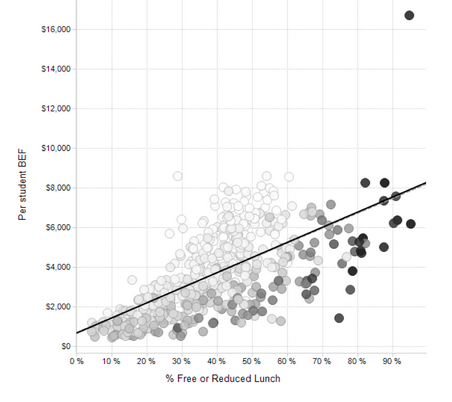
Unsettlingly, recent research from data scientist David Mosenkis finds that poverty alone does not explain the underfunding. Mosenkis delved into funding data for 500 school districts in the state of Pennsylvania. Because richer school districts are able to drum up more cash through taxes, they should receive less state funding, and poorer districts should receive more. He looked at how much money they received and sorted those findings based on race and income.
Using a broad scope, Mosenkis found what one might expect: On the surface poor districts do receive more state funding than rich schools. But when he delved deeper into the data, sorting by race, what he found was disturbing.

District Funding, by Racial Composition and Poverty Level

Black dots represent districts with no white students and white represents districts with 100 percent white students. (David Mosenkis)

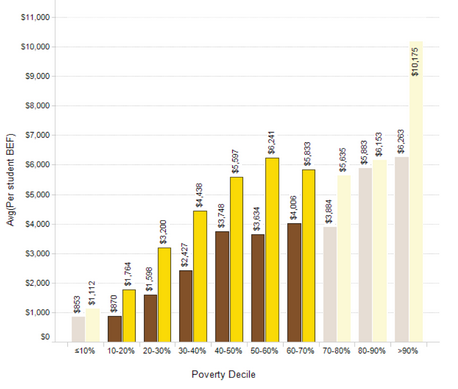
“If you color code the districts based on their racial composition you see this very stark breakdown. At any given poverty level, districts that have a higher proportion of white students get substantially higher funding than districts that have more minority students.” That means that no matter how rich or poor the district in question, funding gaps existed solely based on the racial composition of the school. Just the increased presence of minority students actually deflated a district’s funding level. “The ones that have a few more students of color get lower funding than the ones that are 100 percent or 95 percent white,” Mosenkis said.
Issues with scarce budgets and troubled urban schools aren’t new, and they exist all over the country. In an article published in The Atlantic in 1954, Henry I. Willett attempted to answer the question of whether or not public schools cost too much by saying, “The amount spent for educational purposes as compared with amounts spent for many other items and services, including luxuries, would indicate that the importance of education in our democracy is not yet realized: and the hour is growing late.”
In Pennsylvania, the crisis is particularly acute. The state’s former governor stripped the education budget significantly. In the years since, schools have shuttered, teachers have been fired, and the schools that remain are existing on bare-bones budgets. Earlier this year, two children died after getting sick at district schools where no nurses were on duty due to budget reductions. Pennsylvania is also one of the only states in the country that hasn’t had a specific formula in place for distributing government aid to its districts. That’s left lots of room for partisan politics and funding bias.

Funding Per Student, by Race and Poverty Level

Brown represents less white districts and yellow represents more white districts. (David Mosenkis)

This year, Pennsylvania Governor Tom Wolf—who took office in January—proposed increasing education funding in the state. And after studying the disbursement of funds, the Basic Education Funding Commission has voted toadopt a new formula that would theoretically address much of the bias when it comes to how state funds are doled out. That’s great, but the new formula hasn’t actually been enacted and the state has yet to actually pass a budget.
But even when both of those tasks are complete, it won’t eradicate the problem of racial bias in the state’s school funding appropriation. Mosenkis says that the The Troubling Link Between School Funding and Race - The Atlantic: