Latest News and Comment from Education

Monday, September 21, 2015

NEWSLETTER: #FightForDyett Hunger Strike Ends/Common Core Test Results – The Network For Public Education

NEWSLETTER: #FightForDyett Hunger Strike Ends/Common Core Test Results – The Network For Public Education:

NEWSLETTER: #FightForDyett Hunger Strike Ends/Common Core Test Results

Community Outrage


On Saturday, after 34 days, the #FightForDyett hunger strike came to an end. The very same day, I was lucky enough to speak with Jitu Brown about the end of the hunger strike. You can listen to my full, uninterrupted, interview with Jitu here.
NPE has also put together a history of the hunger strike in the words of the hunger strikers themselves, through a compilation of radio and television interviews. The compilation includes my three interviews with Jitu.
The hunger strike may have ended, but the #FightForDyett is far from over. NPE is proud to have stood behind the parents, grandparents and community members that forced the first re-opening of a school slated for closure in the nation.

Results from the 2015 administration of Common Core aligned tests are starting to trickle in. This marks the first year of results in some states, while others have seen several years of falling scores. Some states administered the Partnership for the Assessment of College and Careers (PARCC), others administered the Smarter Balanced Assessment Consortium (SBAC), and a handful administered their own state created exams. One thing is consistent however – passing rates plummeted, and the failure narrative is ubiquitous.
Illinois – Scores plummet, CTU responds
Preliminary PARCC results were released last Wednesday, the same day the Illinois state board voted to approve the cut scores set by PARCC states. Headlines read “Most Illinois students fall short on new PARCC tests” and “Vast majority of Illinois students fail new test, preliminary results show.” In response to the released scores Chicago Teacher’s Union President Karen Lewisdeclared, “These arbitrary scores are designed to advance the narrative of failed schools and bad teachers.”
You can read more about Illinois’ scores here.
Ohio – State changes PARCC cut scores
Ohio took the PARCC last year as well, but has already decided to abandon the test for 2016. Results were released last week but the state board did not adopt the PARCC consortium cut scores, instead adopting their own. According to PARCC cut scores, only 35-40% of Ohio elementary and middle schoolers met expectations, but 65-70% will meet expectations with the state adopted cut scores.
You can read more about the Ohio cut scores here and here.
Oregon – Smarter Balanced scores drop
Like other states, the release of SBAC scores in Oregon revealed a drop in students meeting expectations. Reports proclaimed “two-thirds of Oregon students read and write well enough to be on track for college or a good job and just 40 percent cut it in math” and a video created by The Oregonian declared, “about half of Oregon students are on track to be ready for college.” A big part of the story in Oregon however was the high opt out rate in some areas of the state. The state as a whole just met the federal 95% participation rate, but not a single high school in Portland met participation targets.
For an analysis of Oregon’s test results, read this.
Maine – three years, three different tests
Maine switched to the Smarter Balanced test last year, but before results were released last week they had already abandoned the test and put out a request for proposal for a new one. Between 2014-2016 Maine has administered three different tests, rendering results all but useless. A Maine headline read, “New standardized test results for Maine public schools are in, but they reveal little.
Watch union leaders and state officials react to changes in Maine’s assessment program in this video.

Please consider sharing a link to this newsletter, and ask your friends and colleagues to join our network so they too can stay informed. It is up to all of us to do what we can to preserve and protect our public schools.
Thanks for all you do,
Robin Hiller
Executive Director
Network for Public Education

NPE recently announced the location for our 3rd Annual National Conference, which will be in Raleigh, NC the weekend of April 16th – 17th. Mark your calendars now to hear keynote speaker Rev. Dr. William J. Barber II.
Rev. Barber is the current president of the North Carolina State Conference of the NAACP, the National NAACP chair of the Legislative Political Action Committee, and the founder of Moral Mondays.
You can read more about Rev. Barber and #NPE16NC on our website.


The Network for Public Education is an advocacy group whose goal is to fight to protect, preserve, and strengthen our public school system, an essential institution in a democratic society.
Over the past two years, donations to The Network for Public Education helped us put on two National Conferences, and the first PUBLIC Education Nation. In the coming year, we will hold more events, and work on the issues that our members and donors care about the most!
To make a tax deductible donation, go to the NPE Fund website. We accept donations using PayPal, the most trusted site used to make on-line payments.
NEWSLETTER: #FightForDyett Hunger Strike Ends/Common Core Test Results – The Network For Public Education:

Take the CEO and Policymaker Challenge—Teach A Year in a Poor Public School!

Take the CEO and Policymaker Challenge—Teach A Year in a Poor Public School!:
Take the CEO and Policymaker Challenge—Teach A Year in a Poor Public School!

photodune-9195581-demanding-teacher-xs


I would like to challenge CEOs and education policymakers, and anyone else who thinks they know best what teachers should do, even though they have never been in a classroom, except perhaps for a few photo opts, to take the teaching challenge.
Spend a semester teaching in a poor public school, which now, due to funding cuts, includes what used to be considered middle class schools.
I am talking about all those who intentionally or unintentionally demean teachers and what they do as ineffective. If you have spent a nickel funding Teach for America, this challenge is for YOU!
If you have time to redesign schools, and tell teachers how to teach, you have time to get in there and actually teach how you preach!
Let’s call it CEOs or Policymakers for Public Schools! This is not an odd idea.
Early in 1974, Florida’s Gov. Bob Graham impressed many when he spent time working, a full eight hour day in different jobs. He experienced first-hand the hard work and problems found in those work positions. His jobs included service as a police officer, park ranger, iron worker, bus boy, railroad engineer, construction worker, Take the CEO and Policymaker Challenge—Teach A Year in a Poor Public School!:

#FightForDyett Interview Timeline – The Network For Public Education

#FightForDyett Interview Timeline – The Network For Public Education:

#FightForDyett Interview Timeline


Below you will find a history of the Dyett hunger strike, as told by the hunger strikers themselves in radio and television interviews. The #FightForDyett hunger strike lasted 34 days, and is the first example of a community successfully stopping a public school from being closed.
NPE continues to stand in solidarity with the community as they struggle to remain part of the decision making process for Dyett, and to provide the children in their neighborhood with a strong curriculum that will prepare them in meaningful ways for the future.

9/19 Jitu Brown’s First Interview After Ending Hunger Strike


9/16 Chicago Tonight – Dyett High School Hunger Strike


Proposed L.A. charter school expansion aims for 130,000 seats, draft document says - LA Times

Proposed L.A. charter school expansion aims for 130,000 seats, draft document says - LA Times:
Proposed L.A. charter school expansion aims for 130,000 seats, draft document says


A Confidential draft obtained by The Times seems to confirm earlier reports that the Broad Foundation is or was hoping to place half of the students in the Los Angeles Unified School District into charter schools over the next eight years.
The 44-page report (The Great Public Schools Now Initiative) is dated June 2015 and titled "The Great Public Schools Now Initiative."

“The opportunity is ripe for a significant expansion of high-quality charter schools in Los Angeles,” the report states in its executive summary. “Thanks to the strength of its charter leaders and teachers, as well as its widespread civic and philanthropic support, Los Angeles is uniquely positioned to create the largest, highest-performing charter sector in the nation. Such an exemplar would serve as a model for all large cities to follow.”
Charters are independently run, publicly financed schools that are exempt from some rules that govern traditional schools; most are non-union. L.A. Unified already has a greater number of charters, more than 200, and charter students, about 16% of enrollment, than any school system in the nation. But the draft expansion plan envisions much more.
The document describes an eight-year goal of creating 260 charter schools that would deliver 130,000 seats “to reach 50% market share,” as the report put it.
The Times broke news of the charter expansion plan in August, relying on confidential sources who cited the 50% figure. When contacted last month, the Eli and Edythe Broad Foundation said the charter plan is in an early, exploratory phase, but declined to provide specific information.
The June draft talks of massive fundraising to affect three areas: facilities, talent and political climate.

“Los Angeles schools are currently on a trajectory to create around 62,000 seats,” the plan states. “With an added investment of $490 million, however, charter schools should be able to create an additional 68,000, reaching the goal of 130,000 seats by 2023.”

For years, the growth of charters has been a point of contention in Los Angeles and across the nation. Locally, the schools have proved popular with parents, contributing to their growth.
Their increase in number also has been fueled by grant support from the Obama administration and philanthropy, including from the Broad Foundation, the Bill and Melinda Gates Foundation and the Walton Family Foundation. Broad and his wife have invested $144 million in charters in L.A. and elsewhere, according to their foundation.
A few hundred teachers on Sunday protested against rapid charter expansion at the new downtown Broad museum featuring the Broads’ extensive modern art holdings.
"Charter schools are destroying public education," retired kindergarten teacher Cheryl Ortega said at the demonstration. "Mr. Broad wants to own 50% of our schools.... That's untenable."
In a response a spokeswoman for Broad said, "As families demand high-quality public school options -- and more students want to attend public charter schools, we want to support them in meeting that demand. Our only interest is in supporting the growth of high-quality public schools."


A con­fid­en­tial draft ob­tained by The Times seems to con­firm earli­er re­ports that the Broad Found­a­tion is or was hop­ing to place half of the stu­dents in the Los Angeles Uni­fied School Dis­trict in­to charter schools over the next eight years.The Great Public Schools Now Initiative


Gary Rubinstein: This Is the Book That TFA Does NOT Want You to Read | Diane Ravitch's blog

Gary Rubinstein: This Is the Book That TFA Does NOT Want You to Read | Diane Ravitch's blog:

Gary Rubinstein: This Is the Book That TFA Does NOT Want You to Read


 Gary Rubinstein, a former member of Teach for America, now a career math teacher in Stuyvesant High School in New York City, has become one of the most formidable critics of TFA, albeit a critical friend.

Here he describes a new bookTeach for America Counter-Narratives: Alumni Speak Up and Speak Out, which consists of chapters by disillusioned TFA, including himself, describing their experiences.
He was stunned to learn that TFA responded to the book, before its release, by saying that “only” 20 people contributed chapters, out of the 50,000 satisfied TFA alumni.
I guess you might say the same about any critical book: Rachel Carson was only one person out of millions of satisfied users of DDT. Ralph Nader was only one person complaining about unsafe automobiles. Jane Jacobs was only one person griping about what high-rise projects were doing to her city. Jacob Riis was only one person complaining about the living conditions of poor people. On and on.
We should all wait for a book written by at least 30,000 people.Gary Rubinstein: This Is the Book That TFA Does NOT Want You to Read | Diane Ravitch's blog:

Dueling studies probe cause of teacher shortage

Dueling studies probe cause of teacher shortage:

Dueling studies probe cause of teacher shortage

Investigations into challenges recruiting and retaining teachers are headed by two groups that are often at odds on education policy in Indiana.


-07_ritz_060415.jpg_20150604.jpg
Indiana Superintendent of Public Instruction Glenda Ritz (Photo: Charlie Nye / The Star file photo)


Reports that some Indiana school districts have struggled to recruit and retain teachers are prompting two investigations into what’s behind those challenges.
Although the studies explore similar issues, their conclusions could be widely different. That’s because they’re headed by two groups that are often at odds on education policy in the state.
On one side: Indiana Superintendent of Public Instruction Glenda Ritz, a Democrat, launched a 49-member commission to identify strategies to attract more educators into Hoosier classrooms and keep them there. She’ll likely use the work product of the commission to form a series of proposed solutions to take to lawmakers next year.
On the other side: Two powerful GOP lawmakers on education matters, state Rep. Robert Behning and state Sen. Dennis Kruse, have pledged to explore why fewer teachers are being licensed at an October meeting.
Views on the forces at work in driving down the number of licenses vary between the two political parties — and sometimes within them, depending on the level of support for traditional public schools and reforms that allow for charter schools and private-school vouchers.
The Department of Education noted the state has seen an 18 percent drop in the number of initial teaching licenses being issued over the past five years, according to data it released when Ritz’s commission was launched. Retention data in the state varies, with recent figures provided by state education officials showing a statewide retention rate of about 81 percent. But data suggest a much lower rate, 61 percent, for Indianapolis Public Schools.
Advocates for public school educators point to a host of new Republican-backed requirements and accountability measures as to what’s driving teachers away from the profession. They argue that any legislative solution must begin with certain lawmakers regaining a respect for educators.
Yet supporters of the education reform movement have long argued that students benefit from accountability requirements because they’re aimed at boosting the achievement of schools. Behning said that although some people allege the reforms Dueling studies probe cause of teacher shortage:


Public school advocates rally support for MPS schools

Public school advocates rally support for MPS schools:

Public school advocates rally support for MPS schools

About 30 demonstrators gather Friday outside North Division High School for a “walk-in” to support public education and oppose the law passed this year that would shift control of some underperforming city schools to the Milwaukee County executive. Similar rallies were held at more than 100 schools.


Teachers, students and supporters rallied at more than 100 public schools across Milwaukee on Friday in a show of support for public education and opposition to the law passed this year that would shift control of some underperforming city schools to the Milwaukee County executive.
Also Friday, the Milwaukee County Board's Intergovernmental Relations Committee passed a resolution opposing the takeover law adopted as part of Gov. Scott Walker's 2015-'17 budget.
"This is an attack on our democratic institutions," North Division social studies teacher Lukas Wierer told about 30 demonstrators gathered outside the building before the start of classes on Friday.
Wierer acknowledged Milwaukee Public Schools' shortcomings, saying administrators and staff must "continue to strive to be better." But he said MPS is the "only institution in this city with the capacity, commitment and legal obligation to serve all of our students."
The state budget signed by Gov. Scott Walker in July gave Milwaukee County Executive Chris Abele broad authority to oversee a special district in Milwaukee for the city's most troubled public schools by turning them over to charter school operators.
The program, devised by Republican state lawmakers from the suburbs, is designed to take some of the district's lowest-performing schools from the control of the Milwaukee School Board and put them under the control of Abele and a commissioner he selects, or directly under MPS Superintendent Darienne Driver, if she chooses to use that authority.
Public school critics, many of whom support using state funding for private voucher and charter schools, argue that some schools are failing to educate some students and that parents should have greater choices for their children.
At North Division High School at 1011 W. Center St., which is thought by some to be a takeover target, protesters lined the sidewalk Friday carrying signs saying "Defend Democracy" and "Support Our Public Schools" and chanting "When public schools are under attack, what do we do? Stand up, fight back."
"We live in a representative democracy. We get to elect our leaders who make decisions for us," said Wierer, a former citizenship teacher. "What these actions are saying is, 'You the people of Milwaukee are not capable of choosing your own leaders, that representative democracy is not for you.'"
Friday's rallies were organized by a coalition of public schools supporters, including the Milwaukee teachers union; Schools & Communities United; and MICAH, the Milwaukee Inner-City Congregations Allied for Hope. Solidarity rallies on behalf of MPS were also planned in La Crosse and some schools in Chicago.
The county committee resolution opposing the law passed Friday is essentially symbolic, as the takeover measure is now law. But it draws a line in the sand between County Board members and Abele, and seeks to ensure that costs associated with operation of the so-called Opportunity Schools and Partnership Program do not fall to Milwaukee County taxpayers, who already pay separate taxes for their schools.
The measure passed 4-1, with Supervisor Deanna Alexander as the lone dissenter and Tony Staskunas Public school advocates rally support for MPS schools:

Why an Early NEA Clinton Endorsement Will Backfire - Living in Dialogue

Why an Early NEA Clinton Endorsement Will Backfire - Living in Dialogue:

Why an Early NEA Clinton Endorsement Will Backfire 


By Anthony Cody.
In May of 2011, as the NEA and AFT participated in planning a major protest of the Obama administration’s education policies, the NEA leadership announced they were endorsing President Obama for re-election,more than a year prior to the election in November, 2012. It was never revealed what union leadership was offered in exchange for this early endorsement, but what we got was four more years of Arne Duncan, more Race to the Top, more Common Core, and more federal demands that test scores be included in teacher evaluations. It appears that NEA leadership may be preparing to make the same mistake by making an early endorsement of Hillary Clinton as soon as October 2nd.
I am not suggesting that NEA endorse Bernie Sanders instead. I think that while Senator Sanders’ campaign has offered much more substance on economic issues, his platform is very weak on K12 education. He should be pressed, as should Hillary Clinton and any other candidate, to take a public stand on the key issues we face regarding public education. I offered some key issues several months ago –– which remain largely missing from the campaigns.
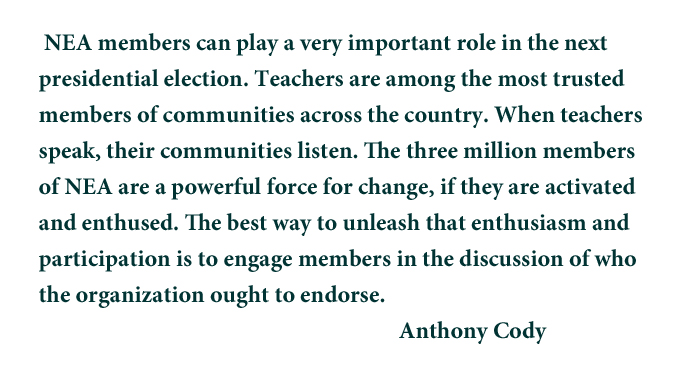
For either candidate to get real grassroots support from NEA members, an endorsement ought to be the result of an extended dialogue with members. Hillary Clinton has engaged in a few phone calls with NEA leaders, but the membership has been left out. We need far more information about how the next president Why an Early NEA Clinton Endorsement Will Backfire - Living in Dialogue:

CURMUDGUCATION: Worshiping Money

CURMUDGUCATION: Worshipping Money:

Worshiping Money


It's in our country's dna, this conflicted view about wealth. The Puritans believed that money and wealth and stuff were unimportant, that anything that glorified the person and not God was bad. But the Puritans also believed that God would watch over His chosen individuals, and so wealth and stuff were a sign that you were one of God's elect.

We also have a history of misplaced disdain for money, like the stereotypical Boomer hippies who could turn their nose up at money because they would never really have to do without it. It is easy to make fun of people who care too much about money when you're not worrying about how you'll get money to feed your kids this week.

But there is a difference between a respect for money and the worship of it. There is even, I'd argue, a difference between greed and the worship of money.

Greed is about the desire to Buy Stuff, to Have More Stuff, to use money for its power of acquisition. But the worship of money is something more. The worship of money imbues money with power and value that it simply does not have.

The worship of money says that money is how we keep score. The worship of money says that 
CURMUDGUCATION: Worshipping Money:

This little light of mine: Scholar activism | Cloaking Inequity

This little light of mine: Scholar activism | Cloaking Inequity:

This little light of mine: Scholar activism


The moment before you are served up to an audience as the attraction for the next hour is always a stressful time. Worried about whether you will be as cogent and articulate as planned and wondering if the technology will work properly is enough to occupy yourself during the verbal introductions and formalities. But during the last year of speaking engagements, I’ve faced an additional unexpected twinge of nervousness. It happens when the person describing my biography utters the words, “Sara is a scholar-activist.”
As I watch the room and see people shift in their seats, with some academics offering a slight smirk or scowl, I sometimes rethink the decision to amend my online biography to begin in this way. I rise to talk, usually about college affordability, wondering if my credibility has eroded as the phrase was spoken aloud. But I have found that as I move through the talk, as I describe the powerful ways societal inequities have reshaped the role of higher education over the last forty years and how opportunities for students have suffered, I become increasingly convinced again that I want to bear the label.
Scholarly activism is not advocacy. Let me say that again, since in my experience people have trouble hearing this. I am a scholar-activist, but not an advocate. The difference is critical. An advocate begins with a core and guiding goal—not a theory—and pushes for changes to achieve that goal. In contrast, a scholar-activist begins with a set of testable assumptions, subjects these to rigorous research, and once in possession of research findings seeks to translate those findings into action. With much respect to my colleagues working in advocacy, I much prefer the latter role since I often have more unanswered questions than clear goals, prefer to turn to data rather than personal beliefs when thinking through policy options, and find that actions are more effective when guided by research.
But for some reason, despite numerous calls (both internal and external) for more scholars to become engaged in discussions about real life This little light of mine: Scholar activism | Cloaking Inequity:

The Importance of Examining Schooling Policing in the Aftermath of McKinney and Ahmed Mohamed - The Atlantic

The Importance of Examining Schooling Policing in the Aftermath of McKinney and Ahmed Mohamed - The Atlantic:

When Schooling Meets Policing

Thousands of sworn law-enforcement officers are posted at U.S. public schools. What does that do to campus culture?


A Lawrence Police Department officer walks a narcotics dog down a school hall in Indianapolis.Michael Conroy / AP


The events have grabbed headlines and public attention, sparking what are now all too familiar debates in the United States about police overreach. In Raleigh, North Carolina, a water-balloon fight at Enloe High School, initiated as a senior-day prank, ended with eight teens arrested and two dozen police officers dispatched to the campus “to restore order.” When a Virginia 4-year-old with ADHD threw a temper tantrum in his prekindergarten classroom late last year—allegedly throwing blocks and hitting and kicking his educators—the school’s principal, according to reports, summoned a deputy assigned to the school, who then handcuffed the child and transported in a squad car to the sheriff’s office. And in a recent episode whose news has since gone viral, a Texas, teen with a keen interest in gadgets built a clock, took it to school to show his teacher, and was sent to juvenile detention when police mistook his device for a bomb

The details of each of these and other cases vary, but the results have largely been the same. In settings where schooling and policing intersect, the disciplining of students—often for behavior as innocuous as school-age pranks or ascommonplace as temper tantrums, and in some cases including children who are so young they still have all their baby teeth—can extend beyond the purview of principals and school staff to law-enforcement who have little to do with education. Data suggests that this is a growing and, for some, disconcerting trend.
Estimates reported by The New York Times in 2009 indicated that as many as17,000 sworn police officers were posted in U.S. schools at the time, and federal data included in a National Center of Education Statistics report offers a closer look at the characteristics of campus-based police. According to the report, a little over three in four high schools and the vast majority of large schools (those with 1,000 or more students)  have armed security staff, with only a slight statistical difference between urban and suburban areas. But there is great variation based on race and class: Schools where at least half of the children are nonwhite, as well as high-poverty schools (meaning those where at least 75 percent of students are eligible for free or reduced-price lunch) are home to the highest percentages in the country of K-12-campus law enforcement.

The origin of school-employed police—who are often officially referred to as “school resource officers” (SROs)—dates back to the 1950s. It arose as part of an The Importance of Examining Schooling Policing in the Aftermath of McKinney and Ahmed Mohamed - The Atlantic:

The NEA May Be About to Endorse Hillary Clinton Without Input From Majority of Members | gadflyonthewallblog

The NEA May Be About to Endorse Hillary Clinton Without Input From Majority of Members | gadflyonthewallblog:

The NEA May Be About to Endorse Hillary Clinton Without Input From Majority of Members


Screen shot 2015-09-21 at 12.23.19 AM
The largest labor union in the United States may be about to endorse Hillary Clinton for President without a poll of its membership.
Leadership at the National Education Association (NEA) has been making troubling moves toward endorsing Clinton that could commit the organization to supporting the Democratic presidential hopeful with no regard for the wishes of its 3.2 million members.
An endorsement could come as early as Oct. 2-3 when President Lily Eskelsen Garciais expected to propose a primary endorsement of Clinton at the NEA Board meeting, according to multiple NEA sources. Then the PAC council would vote. If approved, it would go to the board for a final decision.
However, since this is only an endorsement for the primary election, the matter would not need to go before the Representative Assembly (RA). In effect, the move could sidestep the voices of the RA’s 8,000 delegates representing state and local affiliates, student members, retired members, and other segments of the united education profession.
The decision would be made by a handful of leaders and the PAC council. Though there are thousands of PAC council votes, they are distributed by the amount of money raised by each state’s members. This means that little states like Delaware – where members donate greatly – have a larger vote relative to their membership than other states.
The voices of the great majority of members would be silenced.
Already leadership at the highest levels seems to be trying to consolidate Clinton support.
Last Wednesday NEA Directors were invited to an hour-long conference call with The NEA May Be About to Endorse Hillary Clinton Without Input From Majority of Members | gadflyonthewallblog:

Michael Mulgrew: Firing teachers vs. fixing schools - NY Daily News

Michael Mulgrew: Firing teachers vs. fixing schools - NY Daily News:

Firing teachers vs. fixing schools


Revolving door
BARRY WILLIAMS/FOR NEW YORK DAILY NEWS

How’s this for good management? The boss of a struggling business — after nearly two-thirds of his staff have already walked out the door — responds by threatening to get rid of the remaining workers.

Yet this is the precise situation facing a group of struggling schools, thanks to a “reform” proposal now in state law that essentially blames teachers for the problems of eight New York City schools on the state’s must-improve list. The state mandates that these schools re-interview all existing staff — and systematically push out all employees found to be “unwilling or ineffective.”

This approach is beloved by school “reformers” who keep promoting the notion that that a permanent cabal of ineffective teachers keeps schools like these from succeeding for their students. In fact, the real problem is not teachers staying — it is teachers leaving, fleeing poor management and bad teaching conditions, and leaving chronic instability in their wake.

A UFT review of personnel records at these schools (the state’s technical term for the list they’re on is “out-of-time”) tells a radically different story from that being told by the “reformers” — a story of how hundreds of teachers despair of helping kids in poorly managed and under-resourced schools, and who ultimately, battered by the arduous process, choose to move on to other schools or other lives.

Our review shows that 64% — nearly two-thirds — of the 921 teachers on staff at these eight “out-of-time” schools in 2010 have already bailed out. Almost half of those who left — 45% — went to other schools in the system. About 23% retired. And 21% resigned, heading for different school systems or different careers entirely. Disability, death and other reasons accounted for the balance.

Some schools have had the door revolve even faster. Fordham Leadership has only nine of the 46 teachers who were there in 2010. Banana Kelly High School in the Bronx has only two of the nearly 40 teachers who were there in 2010. Excluding those two hardy veterans, the Banana Kelly staff has been wholly replaced not once, but twice, in the last five years — a turnover rate of nearly 200%.

Rather than scapegoat supposedly bad-apple teachers for these schools’ problems, here’s what needs to happen to institutions on the “out-of-time” list and others in similar circumstances:

Stabilize the situation in these schools. With stability and investment will come progress. Maybe not instant progress, but steady improvement. Only administrators with a track record of collaboration with their staffs and success Michael Mulgrew: Firing teachers vs. fixing schools - NY Daily News:


Russakoff’s “The Prize” Exposes Arrogance and Pride of Chris Christie and Cory Booker | janresseger

Russakoff’s “The Prize” Exposes Arrogance and Pride of Chris Christie and Cory Booker | janresseger:

Russakoff’s “The Prize” Exposes Arrogance and Pride of Chris Christie and Cory Booker


The Prize is Dale Russakoff’s new book about the plan cooked up by then-Newark-mayor Cory Booker and New Jersey governor Cris Christie to transform the schools in Newark, New Jersey as a national model.  Booker’s view was that it was the perfect district for such an experiment because it is small enough that most of the variables could be controlled. Booker traveled to an elite conference in Sun Valley, Idaho to present the idea to Mark Zuckerberg, the CEO of Facebook, who would be asked to donate $100 million.  Booker and Christie’s plan was designed to be top-down, to be announced on the Oprah Winfrey show before the people of Newark knew about it:
“It called for imposing reform from the top down, warning that a more open political process could be taken captive by unions and machine politicians. ‘Real change has casualties and those who prospered under the pre-existing order will fight loudly and viciously,’ the proposal said.  Seeking consensus would undercut real reform. One of the goals was to ‘make Newark the charter school capital of the nation.’  The plan called for an ‘infusion of philanthropic support’ to recruit teachers and principals through national school-reform organizations, build sophisticated data and accountability systems, and weaken tenure and seniority protections.  Philanthropy, unlike government funding, required no public review of priorities or spending.  Christie approved the plan, and Booker began pitching it to major donors.  In those pitches, Booker portrayed the Newark schools as a prize of a very different sort: a laboratory where the education reform movement could apply its strategies to one of the nation’s most troubled school districts.  He predicted that Newark would be transformed into a ‘hemisphere of hope’ catalyzing the spread of reform throughout urban America.” (pp. 20-21)
Russakoff’s book is less about school reform really than about the hubris of Cory Booker and cruel arrogance of Chris Christie, despite that its focus is the imposition of corporatized school reform upon Newark.  Russakoff is at pains to take us into classrooms and to make us see the work of school teachers.  Her approach to portraying the schools through stories of excellent teachers leads to what I see as the book’s flaw—an adoption of “the school teacher as savior” myth.  Russakoff is won over by energetic young principals and teachers in KIPP charters who go to all lengths to save children—including even the creation of a carpool of teachers who pick children in one family up and deliver them home each day to a shelter—to help the children avoid the label “homeless.”  Such efforts, while laudable, cannot possibly be the building blocks of sustainable systems to educate the children of our nation’s poorest families.
Once Zuckerberg had bought in, Booker and Christie set about selling the preconceived plan to Russakoff’s “The Prize” Exposes Arrogance and Pride of Chris Christie and Cory Booker | janresseger:

Mike Klonsky's SmallTalk Blog: WEEKEND QUOTABLES Dyett hunger strike ends

Mike Klonsky's SmallTalk Blog: WEEKEND QUOTABLES Dyett hunger strike ends:

WEEKEND QUOTABLES Dyett hunger strike ends


Strike over. Struggle continues.


Aisha Wade-Bey

“We do have some other ways to continue to make sure we get this high school in our community, where it’s fair and that they have the resources that it needs for our children.” -- Sun-Times
Jeanette Taylor-Ramann

"I'm not an activist, nor a protester, or a hunger striker. I am a mother who wants what's best for my children and young people in my community."-- Tribune
Jitu Brown

"We decided that we will feed our bodies so that until we win sustainable community schools for all of our children, the mayor and cps won't get a moments rest,"
"We have changed the dialogue... We have exposed the inequality."
"We have had several key victories including saving Dyett as Mike Klonsky's SmallTalk Blog: WEEKEND QUOTABLES Dyett hunger strike ends: