Latest News and Comment from Education

Friday, September 11, 2015

A busy second day of the Seattle teachers’ strike | Seattle Education

A busy second day of the Seattle teachers’ strike | Seattle Education:

A busy second day of the Seattle teachers’ strike


8765807_G
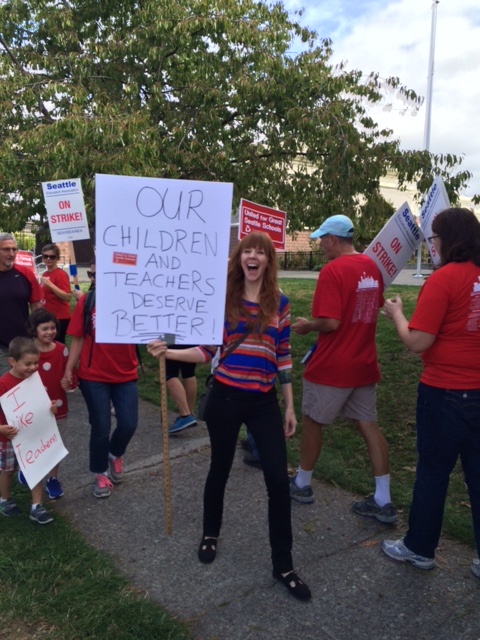
Teachers, parents and students were out on the picket line on day 2 of the Seattle Teachers Association (SEA) teachers’ strike
One parent told me that yesterday morning when she was with the teachers at her daughter’s elementary school, three parents came by in the course of three hours to make sure the teachers had enough water and food.
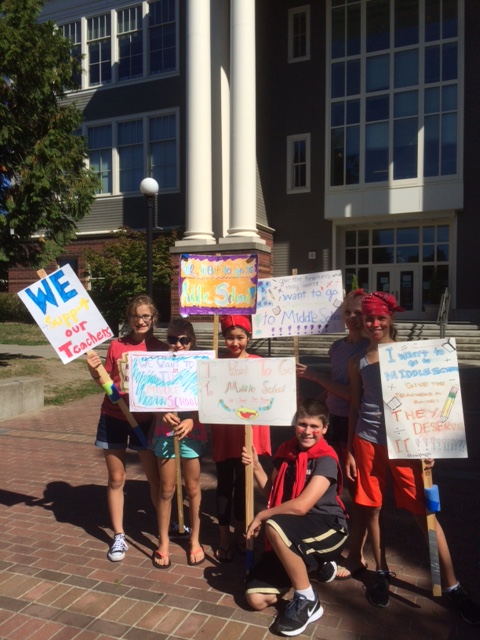
Because images can say more than any words I can write, to follow are photo’s sent to Seattle Education yesterday and this morning of Day 2 of the Seattle teachers’ strike.
Roosevelt
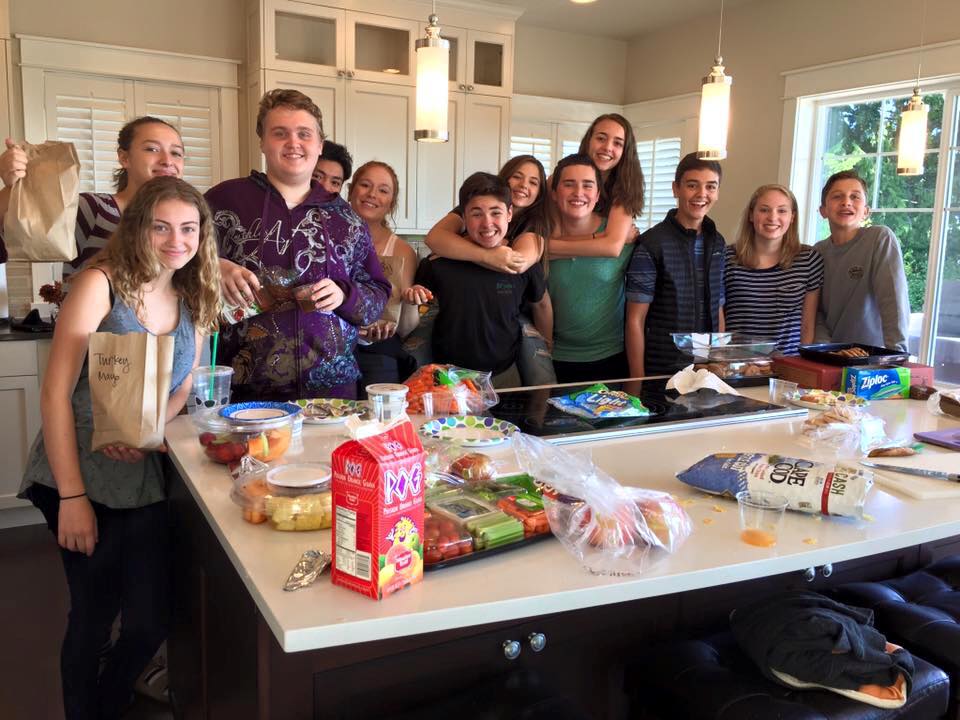
Roosevelt High School students made 200+ brown bag sandwiches for their picketing educators. With food to spare, they ended up visiting 10 schools.
Coe Elementary
Coe Elementary
Coe Elementary
Coe Elementary
Coe Elementary
Coe Elementary
Coe Elementary
Coe Elementary
Franklin High School
Sanislo Ele
Students with their teachers at Sanislo Elementary School.
Yesterday evening was a rally in support of the teachers in the City Council Chambers at Seattle City Hall. The room was overflowing.
Teachers, parents and students spoke. Teachers talked about why they were on strike and parents and students spoke in support of the teachers.
Also yesterday, Wayne Au, PhD, one of the Plaintiff’s in the Supreme Court case challenging the constitutionality of charter schools in Washington State, had an article published in the Washington post titled A Perfect Storm in Washington State.

The misuse of research to support deregulation and privatization of teacher education - The Washington Post

The misuse of research to support deregulation and privatization of teacher education - The Washington Post:

The misuse of research to support deregulation and privatization of teacher education


For years now we’ve been hearing from school reformers that traditional teacher preparation programs at colleges and universities are awful and that what we need is deregulation and market competition. In the following post, two academics evaluate the argument that these programs have failed as well as the value of the programs that school reformers embrace to replace them. This was written by Kenneth Zeichner and Hilary G. Conklin. Zeichner is a professor of teacher education at the University of Washington, Seattle, and professor emeritus in the School of Education at the University of Wisconsin-Madison. A member of the National Academy of Education, he has done extensive research and teaching and teacher education. Conklin is a program leader and associate professor of secondary social studies at DePaul University whose research interests include teacher learning and the pedagogy of teacher education.
This post is an introduction to a paper on the subject by Zeichner and Conklin that is being published by Teachers College Record, titled “Beyond Knowledge Ventriloquism and Echo Chambers: Raising the Quality of the Debate on Teacher Education.”
By Kenneth Zeichner and Hilary G. Conklin
Though there is ample room for debate on how much and what kind of education is best for preparing effective teachers, inferring that one type of preparation does or does not yield better outcomes for students is not warranted by the evidence (National Research Council 2010).
The body of research leads one to expect students in the classrooms of corps members—recruited, trained, and supported by Teach For America—to learn as much or more than they would if assigned a more experienced teacher in the same school (Teach For America, 2014).
Critics of college and university-based teacher preparation have made many damaging claims about the programs that prepare most U.S. teachers–branding these programs as an “industry of mediocrity”–while touting the new privately-financed and- run entrepreneurial programs that are designed to replace them. These critics have constructed a narrative of failure about college and university Ed schools and a narrative of success about the entrepreneurial programs, in many cases using research evidence to support their claims.

The New History Wars Part 3: The College Board is the Real Problem - Living in Dialogue

The New History Wars Part 3: The College Board is the Real Problem - Living in Dialogue:

The New History Wars Part 3: The College Board is the Real Problem 


By Paul Horton.
The Advanced Placement United States History course recently revised by the College Board has recently undergone a second major revision in response to critics from the right who argue that the first revision did not emphasize specific content and that it focused on social history and neglected political and military history.
The second revision responds to these criticisms, but many critics on the right and some who want to see more specific content required continue their criticisms.
Teachers of AP History are growing restless; they have to get on to the teaching of history this year, caught in the middle of a political firefight and another chapter in the culture wars.
The culture wars have no place in history classes except to be taught as a political issue.
Good history is inclusive. Good teachers can combine social history with traditional political and military narratives. Good history teachers understand that religion is a very complex and foundational aspect of United States History. This does not mean that teachers should be teaching “providential history” as some ministers would, it means understanding that the idea of “providential history” has shaped the thinking of some Americans and groups of Americans in very important ways.
The left tends to be identified by the right as promoting social history, identity politics based on victimization narratives, and as hostile to the role of religion in American history. Many veterans don’t believe that the left respects the very real heroism displayed by Americans during wars. There is some truth in this critique because the AP tends to deemphasize military history in favor of free response questions that focus on the more hotly debated issues of race, class, and gender history. On the other hand, the left sees its efforts as attempting to integrate the history of important reform movements, minorities, and political perspectives that were absent from most textbooks and courses until the late seventies as a legacy of Cold War conservatism and McCarthyite anticommunism. So we have a kind of tug of war that intensifies every few years: the debate over the NEH standards in the early and mid nineties is reigniting with the controversy surrounding the Jefferson County, Colorado suspension of the new AP curriculum and the attempts by conservatives to modify the new AP US.
What is written in a textbook or in a set of standards, however, is not history. History is not set in stone. It is The New History Wars Part 3: The College Board is the Real Problem - Living in Dialogue:

Shock Waves Reverberate From Wash. State Charter Ruling - Education Week

Shock Waves Reverberate From Wash. State Charter Ruling - Education Week:

Shock Waves Reverberate From Wash. State Charter Ruling


The Washington State Supreme Court’s ruling earlier this month holding the state’s charter school law unconstitutional has sent shock waves through Washington’s educational establishment, handed charter critics a high-profile victory, and left the schools’ supporters scrambling to keep the state’s small, relatively young charter school sector alive.
In its 6-3 ruling in League of Women Voters v. Washington, the court found that the law approved by voters through a 2012 ballot measure, Initiative 1240, improperly designated charters as “common schools,” and that the schools were not therefore entitled under the state constitution to certain state funds they presently draw on.
Despite the prominent setback for charters, it might be difficult for skeptics of the autonomous, publicly funded schools to create any momentum outside Washington from the decision. For example, in the majority opinion, the justices relied heavily on state precedent regarding the definition of common schools set down in a 1909 state high court ruling. In addition, translating a victory in one state into other states’ legal and political systems won’t necessarily be easy.
All the same, the court’s Sept. 4 ruling delivered a clear rebuke to the state’s charter law that might provide charter critics elsewhere some ammunition.
And it represents the first time that a state supreme court has invalidated an entire charter school law, according to the National Alliance for Public Charter Schools. In a narrower 2011 case, the Georgia Supreme Court ruled in Gwinnett County School Districtv. Cox that the state Charter School Commission improperly approved charters over the objections of local school boards. However, Georgia voters approved a constitutional amendment in 2012 subsequently permitting state-backed charters.
Charter supporters argue that there are potential avenues for Washington legislators to provide public funds to the state’s nine charter schools aside from the general fund budget, even as they vow to keep the schools open through other means such as private donations.
There are ways that the supreme court overlooked to constitutionally fund charter schools in Washington state, said Thomas Franta, the executive director of the Washington State Charter School Association. “These are public schools, and we believe they are absolutely entitled to public funding,” he said.
Meanwhile, critics such as the 85,000-member Washington Education Association, which was a party to the court case, said the victory protected taxpayers who pay for charters but lack the power to oversee them appropriately.
“Public schools should truly be public,” said Rich Wood, a WEA spokesman.
Gov. Jay Inslee, a Democrat who opposed the 2012 ballot initiative to permit charters, so far has resisted calls to convene a special session to work out what’s next for the state’s charters, which serve 1,200 students.

Legal Arguments

The charter ruling is part of a tumultuous political environment for education in the Evergreen State. It’s also the second time in recent years that the court has made big headlines with a ruling about schools. Last month, the court levied a daily $100,000 fine on the state for failing to adequately increase K-12 spending in response to its 2012 ruling in McCleary v. Washington.
The majority opinion in the charter case, written by Chief Justice Barbara Madsen, stated that charters are intended to provide parents with “more options,” then added: “But the new schools came with a trade-off: the loss of local control and local accountability.”
Absent their designation as common schools, charters would lose their funding source from the state’s general budget and therefore no longer be “viable,” Madsen concluded.
“[B]ecause charter schools under 1-1240 are run by an appointed board or nonprofit organization and thus are not subject to local voter control, they cannot qualify as ‘common schools,’” Madsen wrote.
In a partially dissenting opinion, Justice Mary Fairhurst wrote that while she agreed that charter schools were not strictly common schools as set down in state legal precedent, they were still legally eligible to some sort of funding by the state, like other public schools. In addition, charters’ funding source was a separate legal question from the schools’ standing under the state constitution, she argued.
“Nowhere does the act identify a source of funding, it merely states that charter schools must ‘receive funding based on student enrollment just like existing public schools,’” Fairhurst wrote.
The justices returned the case to King County Superior Court to write an order enforcing their ruling by Sept. 26. As of this week, charter backers planned to ask the state supreme court to reconsider its ruling.

Winners and Losers

Those who warned three years ago that the 2012 charter law would distort public education in the state have been vindicated by the ruling, the WEA’s Wood said. Non-traditional public schools that aren’t charters receive public funding, yet are subject to appropriate oversight, he noted.
“The law requires them to be accountable to the voters and the taxpayers who fund them, not just to the small handful of parents who send their children to them,” Wood said.
Last week, the Washington State Charter School Commission decided to explore whether there is a legal remedy to allow charters to remain open for the rest of the school year.
Franta, of the state charter school association, criticized the justices for saying that since charters lacked traditional governance such as elected school boards they were free from meaningful oversight.
“There is more accountability in this public charter school sector than exists anywhere else in the state of Washington,” said Franta, adding that “there is no greater evidence of local control” than where parents choose to send their children to school.
Franta pledged that whether the legislature finds a new way to provide charters with public funds, or if his group has to raise the $14 million needed to operate the charters this school year from private donors, the schools will remain open.
In addition, he suggested that legislators could find avenues in the budget outside the general fund, such as a separate trust fund, to create a state revenue stream for charters that falls outside the court’s ruling.

Wider Ramifications

The ruling’s unique status across the K-12 legal landscape has also raised questions about its implications beyond the state and for the charter sector in general.
The WEA’s Wood cautioned that other states simply don’t have the kind of constitutional Shock Waves Reverberate From Wash. State Charter Ruling - Education Week:

Ed Notes Online: Why Seattle Teacher Strike Matters - MORE and Port Jefferson Station Express Support

Ed Notes Online: Why Seattle Teacher Strike Matters - MORE and Port Jefferson Station Express Support:

Why Seattle Teacher Strike Matters - MORE and Port Jefferson Station Express Support


There's no little irony that social justice oriented teacher unions are leading the way in militancy and a willingness to strike while UFT/Unity type unions are passive. That's why I love it when so-called action oriented UFTers opposed to the leadership try to put down MORE as too "social justicey". They just don't get it.

They should take a good look at Seattle - and Chicago where SJ caucuses - MORE brothers and sisters - CORE and SEE are leading the way against ed deform - 

MORE people are informing their chapters about these events so UFTers who want to fight back understand what it will take - teachers at the school level must go out and work with parents and community to build the kind of support necessary for us to fight back effectively. Or MORE's support for the #FightForDyett – Support the Hunger Strike against School Closings - in Chicago where parents are fighting to keep a school from being closed and savaged by ed deformers. (Chicago teachers lost 10,000 jobs over the past 15 years of deform). 

MORE's Lauren Cohen, Chapter leader at PS 321K, one of the leading opt-out schools in the city, helped organize this support photo:


MORE/ST/UCORE/UFT Chapter Leader Lauren Cohen and her PS 321K chapter
When I began teaching the UFT had a "no contract, no work" mantra - meaning that the day after a contract expired we would be on strike. That only happened in 1967 - and not long after that mantra disappeared, thus leaving us go years without a contract.

Not since 1975 has the UFT been on strike. We know all about the Taylor Law 2 for 1 penalties, the removal of dues checkoff and severe financial - if not crippling - penalties against the union. All these rules came as a result of the 1967 and 1968 UFT strikes. The 1975 strike was an anomaly - no contract on the table - but massive cuts - the leadership did not want to go on strike but was forced to by an outraged membership who saw their schools crippled by massive budget cuts that resulted in the loss of 15,000 jobs. Shanker even went to jail - which we, part of the opposition (Coalition of School Workers - CSW) - 
Ed Notes Online: Why Seattle Teacher Strike Matters - MORE and Port Jefferson Station Express Support:

Mike Klonsky's SmallTalk Blog: Study: Area Union Membership Can Predict Children’s Advancement

Mike Klonsky's SmallTalk Blog: Study: Area Union Membership Can Predict Children’s Advancement:

Study: Area Union Membership Can Predict Children’s Advancement


N.Y. Times

Low-income children rise higher in the income rankings when they grow up in areas with high-union membership.
As unions in this country continue to come under assault, a new study coming out of Harvard, Wellesley (of all places) and the Center for American Progress, finds that unions are key in enabling children from low-income families to escape poverty.

The study shows that unions are needed to push the political system to deliver policies — like a higher minimum wage and greater spending on schools and other government programs — that broadly benefit workers and their families. Three cities that appear to reflect the union effect — San Francisco, Seattle and New York — are all jurisdictions where the minimum wage is rising substantially. This is especially true when you compare them with cities in so-called "right to work" states like North Carolina, Georgia and Mississippi.

Most interesting finding for me... Higher rates of unionization may give rise to certain norms that instill a greater sense of agency in workers.

For example, people who belong to unions are generally aware that Mike Klonsky's SmallTalk Blog: Study: Area Union Membership Can Predict Children’s Advancement:

Why borrowing from the ‘best’ school systems sounds good — but isn’t - The Washington Post

Why borrowing from the ‘best’ school systems sounds good — but isn’t - The Washington Post:

Why borrowing from the ‘best’ school systems sounds good — but isn’t


(Bloomberg)


For years now policymakers have looked at school systems in countries where students excel on international standardized tests, and have attempted to “borrow” what they believe are the practices that result in test-score success. Borrowing best practices seems like a no-brainer, but, in this post, the authors argue that in education, it isn’t always a good idea. This was written by Alma Harris, Yong Zhao and Michelle Jones.
Alma Harris is professor of educational leadership at the Institute of Educational Leadership, University of Malaya, and the Institute of Education, University College London. Yong Zhao is the presidential chair and director of the Institute for Global and Online Education in the College of Education, University of Oregon, where he is also a professor in the Department of Educational Measurement, Policy, and Leadership. Michelle Jones is deputy director at the Institute of Educational Leadership, University of Malaya.

By Alma Harris, Yong Zhao and Michelle Jones
Education policymakers around the globe remain preoccupied with the top-performing systems as the touchstone of their thinking and action, and the appetite for following the “best” education systems shows little signs of waning. Multi-national companies have categorized and summarized the strategies of the most “successful” education systems, and promoted them as a pathway to improvement for less successful systems. To be sure, the process seems logical; if you want to be a better performer, why not borrow or copy the approaches of those who do so much better? The approach is neat, convincing — and potentially misleading.
Let’s imagine that you are a runner and you want to be as good as Hussein Bolt. Would copying his training schedule, his diet and his racing diary really make you an outstanding sprinter? The answer is unequivocally no. The reason for this lies in the complex amalgam of innate ability, physiology, physique, background and personal motivation. In other words, the things that cannot be copied are the things that often matter most.
In education, too, the impact of policy borrowing is far less immediate or Why borrowing from the ‘best’ school systems sounds good — but isn’t - The Washington Post:

Proceed with caution when comparing California tests scores with other states | EdSource

Proceed with caution when comparing California tests scores with other states | EdSource:

Proceed with caution when comparing California tests scores with other states


CREDIT: BERKELEY UNIFIED SCHOOL DISTRICT
Students in California took the Smarter Balanced field test in 2014.
Comparing California scores on tests aligned with the Common Core standards to those in other states isn’t a straightforward process.
California students’ results are among the lowest when compared to the other eight states that have released Smarter Balanced assessment scores so far. But drawing conclusions may be difficult because California’s student population is much larger and its schools enroll more English learners and low-income students. See charts of scores in eight Smarter Balanced states.
“It’s not just a straight across comparison,” Keric Ashley, California’s deputy superintendent of public instruction, warned during a Wednesday conference call with reporters. “We need to factor in being such a large state as we are – a large percentage of English learners, a large percentage of students in poverty. There are a lot of factors that go into place before making that comparison.”
The chart shows a comparison of 3rd grade English language arts results on the Smarter Balanced test in nine states. Click on the graphic to see more results comparing California to other states.
EDSOURCE
The chart shows a comparison of 3rd grade English language arts results on the Smarter Balanced test. Click on the graphic to see more results.
One of the main arguments in favor of the Common Core standards, and the standardized assessments aligned with them, was that for the first time it would be possible to compare annual student performance across dozens of states.
States had the opportunity to administer tests developed either by the PARCC consortium or theSmarter Balanced Assessment Consortium, which California chose. Some states ultimately chose other tests.
A total of 17 states administered the Smarter Balanced assessments, and eight have released preliminary or final Smarter Balanced scores: Connecticut, Delaware, Idaho, Missouri, Oregon, Vermont, Washington and West Virginia. The remaining states will release their scores later.
The Smarter Balanced scoring system is the same in every state, ranging from level 1, the lowest, to level 4, the highest – with the same cut scores set for each level – but each state has its own terminology to describe the different levels.
Generally, a level 3 or 4 means a student has met or exceeded the standards. In most states, level 3 is labeled “proficient,” while Connecticut calls it “meeting the achievement level.” In Oregon, it’s simply listed as a 3 or higher on the state’s press release regarding preliminary scores. In California, policy makers have avoided using the word “proficient” in labeling its scores, instead calling level 3 “standard met” and level 4 “standard exceeded.” See descriptions of the score levels.
Not all states have released composite scores for students from all grades who took the tests – grades 3-8, and grade 11 – making it harder to easily compare performance.
But looking at the results that are available from those eight states, most reported a higher percentage of students who scored at a level 3 or 4 in most grades and subjects compared to California.
Compared to the eight states, the percentage of California students who scored at proficient or above was the lowest or tied for lowest in 3rd- through 5th-grade math and 3rd- through 6th-grade English. California ranked fourth from the bottom for 11th-grade math and English. (Missouri 11th-graders didn’t take the Smarter Balanced test.)
But the lower scores in California may be due to the diversity of its student population. Andy Latham, director of WestEd’s Center on Standards and Assessment Implementation, said states with large numbers of English learners and low-income students, like California, will tend to have lower overall scores.
“It could be an explanation why proficiency levels are not as high as we’d hope, but that shouldn’t be an excuse,” Latham said.
The combined number of students in the eight states was about 3.9 million in 2012-13, according to the most recent data available from the National Center for Education Statistics. California’s student population was 6.3 million that year, Proceed with caution when comparing California tests scores with other states | EdSource:

Mark Weber: Gov. Christie Missing in Inaction for 2015-2016 School Year - NJ Spotlight

Opinion: Gov. Christie Missing in Inaction for 2015-2016 School Year - NJ Spotlight:

OPINION: GOV. CHRISTIE MISSING IN INACTION FOR 2015-2016 SCHOOL YEAR


Governor’s pursuit of GOP nomination leaves little time for his home state, and has pushed his political agenda more and more to the right


mark weber (use)
Mark Weber
It’s time to start another school year in New Jersey! Let’s take roll and see who’s here:
Students? Rested and ready. Teachers? Present, after a summer of planning and preparation.
Parents? Here. Administrators? Here. School boards? Here.
Gov. Chris Christie?
[…]
Is Chris Christie here? Has anyone seen Gov. Christie?
[…]
Bueller?
Uh-oh. Looks like Gov. Christie won’t be around for the 2015-16 school year. And that’s a big problem -- because we have many big problems with New Jersey’s education system, and we need our governor here, ready to work on them.
But like a 17-year-old with a bad case of senioritis, Christie is living in his imaginary future, rather than concentrating on this state’s here and now. All of his policy decisions, including those related to education, are affected by his increasingly unlikely bid for the White House.
Why else would Christie, previously a stalwart defender of the Common Core State Standards, suddenly claim they weren’t working after only one year of formal implementation? Clearly, he is pandering to the national conservative base, which sees Common Core as an unwarranted federal intrusion.
Reasonable people can debate the merits of Common Core; personally, I have my doubts about its developmental appropriateness and overemphasis on language skills in its mathematics sequence. But Christie is in no way involved in a serious critique of the standards. Hamstrung by the ideologies of the primary voters he is courting, he has no choice but to bend to their will.
This need to indulge the far right is also why the governor continues to flout the law and underfund schools. According to the Education Law Center, New Jersey’s state aid to schools is, once again, far less than it should be under the School Funding Reform Act: this year, $1 billion dollars less. Over the past seven years, the accumulated underfunding comes to over $6 billion dollars.
Those who make the claim that New Jersey has “thrown money” at its schools -- like Christie -- should acknowledge that the state has not supplied schools with the money its own law says they need to provide an adequate education.
But solving this problem would require raising taxes. And any Republican presidential candidate who agrees to a tax hike has about as much chance of winning the party’s nomination as Hillary Clinton. Christie knows this, which is why he signed conservative icon Grover Norquist’s anti-tax pledge just last month.
So now New Jersey’s school budgets are being held hostage by right-wing politics -- as is any chance of resolving the state’s ongoing pension problems. Christie’s own Opinion: Gov. Christie Missing in Inaction for 2015-2016 School Year - NJ Spotlight:

Striking teachers say pay gap makes Seattle tough to afford

Striking teachers say pay gap makes Seattle tough to afford:

Striking teachers say pay gap makes Seattle tough to afford


Striking Seattle School District teachers and other educators  wave to motorists as they walk a picket line, Thursday, Sept. 10, 2015, in front of Franklin High School in Seattle. The strike was called when Seattle Public Schools and the teachers union failed to reach an agreement on their contract Tuesday night, and is Seattle's first educator strike in 30 years. (AP Photo/Ted S. Warren)
Striking Seattle School District teachers and other educators wave to motorists as they walk a picket line, Thursday, Sept. 10, 2015, in front of Franklin High School in Seattle. The strike was called when Seattle Public 


SEATTLE (AP) — Teachers in Seattle say they have walked off the job largely because they can't afford to live in the same city as the children they teach.
The educators, who have not received a cost-of-living pay raise in six years, have joined other workers pushing for higher wages that compete with the city's growing, highly paid tech workers.
Olga Addae, a science teacher at Franklin High School, walked the picket line Thursday with other union members who said they will stay out of the classroom until Washington state's largest school district offers a fair compensation package and agrees to stop cutting student services.
"We're doing this for the students and for a better school system," said Addae, a teacher of 21 years.
Teacher Janine Magidman has lived and worked in Seattle for years, but worries her newer colleagues will be priced out.
"The cost of living is just ridiculous," said Madigman, who teaches at Roosevelt High School.
Teachers want to live close to their schools and be a part of those communities, but rents continue to rise while educators' salaries have stagnated, Addae said.
Seattle Public Schools offered a pay increase of nearly 9 percent over three years. The teachers union countered with a 10.5 percent increase over two years.
Teacher salaries range from about $44,000 to more than $86,000 for more experienced educators with advanced degrees, according to the district. In comparison, tech workers can easily draw six figures.
"There's a giant tech surge here in Seattle, with Google and Twitter opening offices," said Tom Leung, co-founder and CEO of Seattle-based Anthology, which connects professionals with employers. "Apple. Cisco. Ebay. It's a who's who of tech."
The companies have run out of workers and space in the San Francisco Bay Area, so they're looking to the Northwest as a key region to add staff, he said.
"It has created an intense amount of competition for highly skilled tech workers," Leung said. "A typical tech engineer can make $150,000 without trying very hard. That does create an impact on the rest of the city."
Rents have ballooned by more than 37 percent since mid-2010, according to Apartment Insights Washington. The median rental price for homes in Seattle in July was $2,354 a month, Zillow reports, compared with a national average of $1,376.
The city is having a housing crisis because more than 40 percent of the new jobs in the region are with Amazon or Boeing, and their starting salaries are twice as much as a teacher who has been on the job for years, Seattle City Councilmember Nick Licata said.
"They're bringing in tons of people, but affordable housing is disappearing," he said. "That means the people who are educating our Striking teachers say pay gap makes Seattle tough to afford:

Thursday, September 10, 2015

Enrollment up at rescued Pittsburgh Woolslair school | Pittsburgh Post-Gazette

Enrollment up at rescued Pittsburgh Woolslair school | Pittsburgh Post-Gazette:

Enrollment up at rescued Pittsburgh Woolslair school

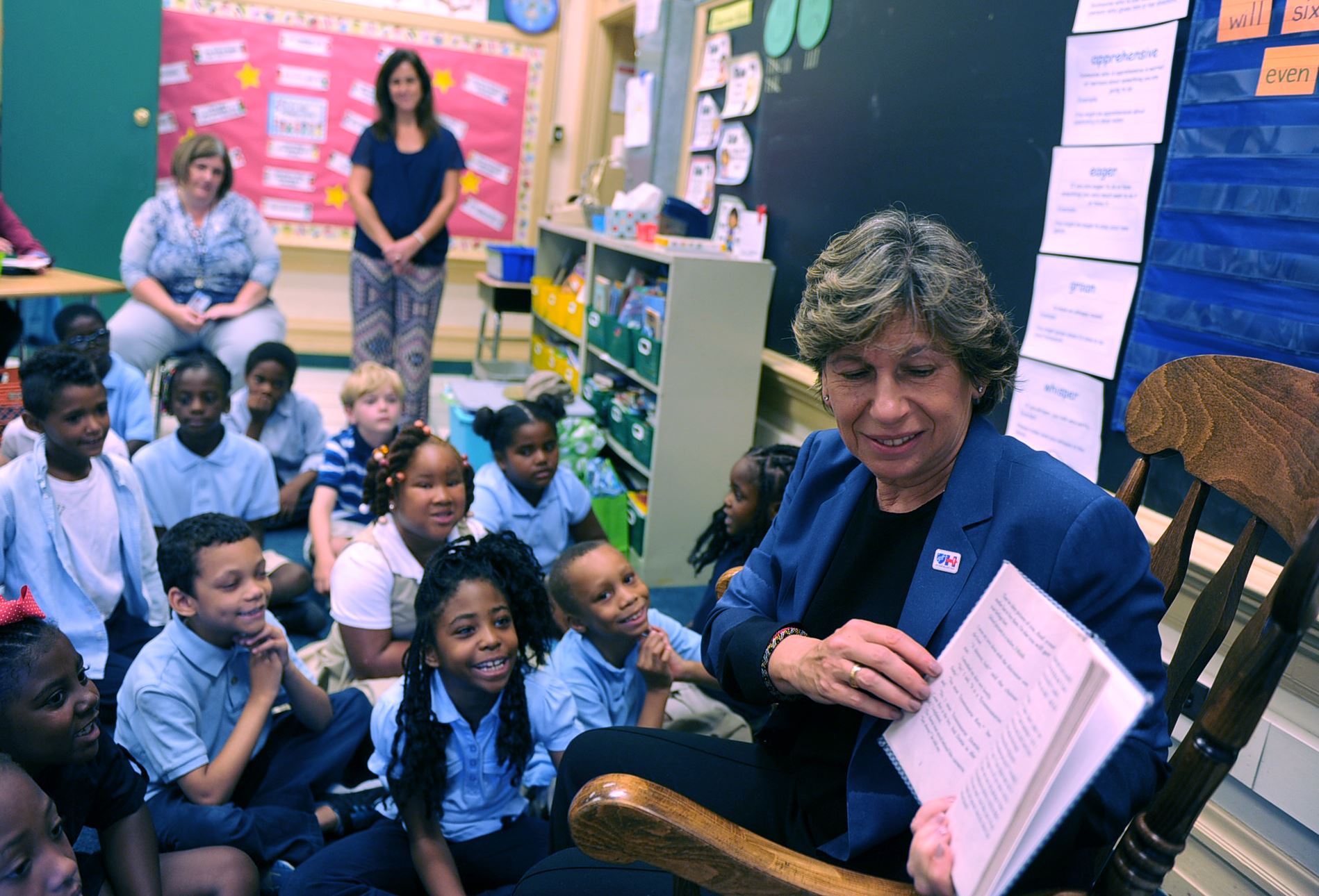
Randi Weingarten, president of the American Federation of Teachers, read to second-grade students at Pittsburgh Woolstair PreK-5 in Bloomfield.
The second-grade classroom at Pittsburgh Woolslair PreK-5 was filled Thursday with children eager to hear American Federation of Teachers president Randi Weingarten read them a story.
Having an adult read a story is an ordinary event in many schools, but the extraordinary part of this story is that Woolslair could have closed last fall. Instead, it has new life with a partial magnet program for STEAM — science, technology, engineering, arts and math — after parents and staff fought to save the Bloomfield school.
At the end of last school year, Woolslair had 104 students, but now it has about 170 present, with 184 enrolled in K-5, said principal Lisa Gallagher. It also has about a dozen pre-kindergarten students.
Although it’s too early for an official count and the numbers could change, much of the growth is in the STEAM magnet, which opened this fall for K-2 students from throughout the city. Other grades also are being offered STEAM classes, and the magnet will expand to additional grades in the years ahead.
Ms. Gallagher said she is “ecstatic,” adding, “This is what the community wanted, teachers and parents wanted.”
The school board voted in 2013 to start the process to close the school in fall 2014, but a new board rescinded that action. Parents and staff got busy, took a survey and found a demand for a STEAM program. As a result, the district approved not only the magnet but also using STEAM to enhance Pittsburgh Lincoln PreK-5 and Schiller 6-8 on the North Side this fall. It also is developing a program for Perry High School on the North Side.
Pittsburgh superintendent Linda Lane, who enjoyed a STEAM lesson at Woolslair the first week of school, said it is too early to know whether the students who chose Woolslair came from other district schools or are increasing district enrollment. However, she said, “The early signs are positive.”
Parent Valerie Allman, who played a key role in helping to save the school and whose son is in Enrollment up at rescued Pittsburgh Woolslair school | Pittsburgh Post-Gazette:

Houston ISD Superintendent Terry Grier is stepping down. | abc13.com

Houston ISD Superintendent Terry Grier is stepping down. | abc13.com:

HISD SUPERINTENDENT TERRY GRIER STEPPING DOWN


Houston ISD Superintendent Terry Grier is stepping down, effective March 1.

"You can't be superintendent in Houston forever, even though you might want to. You just simply can't," Grier said at a press conference Thursday afternoon. "Quite frankly it's just time."

One former Federation of Teachers official told us she doesn't think it's a coincidence that he Grier resigned hours after news broke that an audit found possible illegal activity surrounding contracts for school construction projects.

"Bye Terry," exclaimed long-time Grier critic and leader of the United Urban Alumni Association Gerry Monroe.

Dr. Grier's announcement was met with approval by many of the people we spoke with afterwards.

"Dr. Grier has had a longer tenure as superintendent than most superintendents in urban areas. Too much of that time has been brought with turmoil," says Houston Federation of Teachers President Zeph Capo.

The latest turmoil from an audit that found HISD did not get board approval for several construction projects, and overpaid contractors. District leaders say they'll ask for their money back from contractors they overpaid. And auditors asked HISD officials to keep better tabs on spending.

"It's gonna take 20 years for them to fix what he's done," Gerry Monroe says.

"I was really hoping he'd be stepping down a little bit sooner," says Chris Parish.

Parrish's son is a freshman at Waltrip High School. This father gave Grier's tenure a C.

"We've seen a lot of schools in the area that are going downhill, test scores are one of the biggest factors. They're going down."

We asked Quince Washington, whose son is also a freshman at Waltrip, if he's pleased with Grier.

"Not exactly. But in the past compared to the others we've had, yeah," he says.

Both say they know what they'd like to see in a replacement.

"I would hope we would do a search and move somebody in that has a better handle on urban needs and the sensitivity to the community in terms of school closures and the rebuilding process is slow," explains Washington.

"I'd like to see someone more of the people. Terry Grier seemed to be sitting on his throne and looking down on everybody else. I'd like to see somebody maybe from Houston that really wants to put time and effort into getting this community back on its feet again," adds Parrish.

At 65, Grier receives $300,000 a year under a contract that was to expire next June 30. His resignation is effective March 1. No word from the board on a list of potential replacements or a timeline.

The Houston school district is the nation's seventh largest, with about 215,000 students enrolled.

The Associated Press contributed to this report


Pedro Noguera Leaves To LA and We're The Remainder | The Jose Vilson

Pedro Noguera Leaves To LA and We're The Remainder | The Jose Vilson:

Pedro Noguera Leaves To LA and We’re The Remainder


Pedro Noguera


The first time I got to meet Pedro was November 24, 2009 at around 9am. My principal took a colleague and I to one of the bigger policy conferences I’ve ever been to. By then, I gained a notorious voice for speaking up within connected education circles, but I didn’t see myself making many ripples in the iron-clad colossus that is NYC Public Schools. The bagels came with delicious spreads, and the coffee still steamed as it flowed into my cup at NYU’s Metro Center. Just then, a 6’1″ gentleman stepped to the table, poked every few seconds by a graduate student / handler to prepare for this conference.
One of the first things I managed to muster out of my mouth was, “Nice to meet you. I’ll be taking notes and blogging about it.”
Without missing a beat, he replied with a smirk, “Good, good.”
Despite what we thought in my circle, edu-blogging wasn’t that big a deal to the general populace, even in 2009. Yet, only a week after Pedro’s event, I’d gotten a chance to witness another one of the defining moments in NYC education history in the last 15 years: Chancellor Joel Klein listening to Diane Ravitch reading from her book The Death and Life of the Great American School System for ChalkbeatNY fka GothamSchools. Both Ravitch and Noguera made an impact on my educational activism for very different reasons, Ravitch the reformed reformer / scholar and Noguera the people’s public edu-intellectual. Few education professors had the clout to demand audience with Chancellor Klein, and, within that handful, few enjoyed the celebrity of Noguera and Ravitch.
From my perspective, I had lots to learn from both. Dr. Ravitch used the spotlights she attained to Pedro Noguera Leaves To LA and We're The Remainder | The Jose Vilson:

#FightForDyett Michael Elliot Interview with Jitu Brown – The Network For Public Education

Michael Elliot Interview with Jitu Brown – The Network For Public Education:

Michael Elliot Interview with Jitu Brown 


Please take three minutes to watch this short video made by filmmaker Michael Elliot. Elliot interviewed NPE Board Member and #FightForDyett hunger striker Jitu Brown at the NPE Conference in Chicago. Brown spoke about the disruption and chaos Chicago Public Schools unleashed on two particular neighborhood schools in Bronzeville.
“He shared a story with me about Florence B Price Elementary School and Jackie Robinson Elementary School in Chicago, and their destruction at the hands of Chicago Public Schools,” said Elliot. “Its a tragic story that is echoed around the country, where the voices of communities are ignored and politics takes over.”


California’s Smarter Balanced Results Capture Poverty | deutsch29

California’s Smarter Balanced Results Capture Poverty | deutsch29:

California’s Smarter Balanced Results Capture Poverty


On September 09, 2015, California State Superintendent of Public Instruction Tom Torlakson released California’s Smarter Balanced results, which comprise the largest component of the California Assessment of Student Performance and Progress (CASPP).
As San Jose University professor Roxana Mariachi notes, a major issue with California’s Smarter Balanced results involves the apparent inability of the California Department of Education (CDE) to produce evidence that the Smarter Balanced tests are reliable and valid:
At the September 2nd, 2015 State Board of Education meeting, you heard public comment from Dr. Doug McRae, a retired test and measurement expert who has for the past five years communicated directly and specifically to the Board about validity problems with the new assessments.  He has submitted the following written comments for Item #1 [CAASPP Update] at the latest meeting and spoke again about the lack of evidence for validity, reliability, and fairness of the new assessments.
“My name is Doug McRae, a retired testing specialist from Monterey.
“The big question for Smarter Balanced test results is not the delay in release of the scores, or the relationships to old STAR data on the CDE website, but rather the quality of the Smarter Balanced scores now being provided to local districts and schools. These scores should be valid reliable and fair, as required by California statute as well as professional standards for large scale K-12 assessments. When I made a Public Records Request to the CDE last winter for documentation of validity reliability and fairness information for Smarter Balanced tests, either in CDE files or obtainable from the Smarter Balanced consortium, the reply letter in January said CDE had no such information in their files. I provided a copy of this interchange to the State Board at your January meeting. There has been no documentation for the validity, reliability, or fairness for Smarter Balanced tests released by Smarter Balanced, UCLA, or CDE since January, as far as I know.
“Statewide test results should not be released in the absence of documented validity reliability and fairness of scores. Individual student reports should not be shared with parents or students before the technical quality of the scores is documented.” [Emphasis removed.]
The absence of evidence that Smarter Balanced tests are reliable and valid means that there is no evidence that the tests measure what they purport to measure (i.e., “college and career readiness”), nor is there any evidence that the tests measure anything consistently.
I wrote about Smarter Balanced in November 2014. At that time, the Smarter Balanced Assessment Consortium (SBAC) had decided that “college ready” meant California’s Smarter Balanced Results Capture Poverty | deutsch29: