Latest News and Comment from Education

Thursday, September 10, 2015

Thanks, Congress, for ESEA changes – but listen to parents! | Parents Across America

Thanks, Congress, for ESEA changes – but listen to parents! | Parents Across America:

Thanks, Congress, for ESEA changes – but listen to parents! 


PAA just sent the following via fax to every member of Congress:
Parents call for an ESEA with less focus on testing and charter schools –
more focus on poverty and parents’ priorities for our children
Thank you, Congress, for moving on needed ESEA reforms!
 PAA is pleased that Congress has recognized and moved to address some of the damage done by the No Child Left Behind Act. We thank you for the hard work that has gone into the improved proposals now before you.
As you begin to reconcile the Senate and House ESEA bills, we ask you to listen to parents! After all, we and our children have the most at stake in the outcome of your actions.
For example, the 2015 PDK/Gallup poll showed that more than 2/3 of American parents believe students are being tested too much. They rated tests as the least accurate measure of school effectiveness.
And while support for charter schools has remained steady as the charter sector has grown, parents overwhelmingly prefer reforms that provide more funds for traditional public schools.

PAA’s position
PAA urges Congress to refocus on the original purpose of the federal education law – that is, as a part of the War on Poverty. We call for a renewed ESEA that supports policies and programs that will improve educational opportunity for all children, but especially for those who have the least.
This includes proposals that:
  • replace annual testing mandates with grade-span testing along with meaningful support for more effective assessment and accountability methods,
  • allow parents to opt their children out of any standardized test,
  • support and strengthen local public schools rather than set them up for closure and privatization,
  • promote educationally-sound, healthy, child-centered programs including increased social services,
  • support the recruitment and retention of experienced, professionally-trained teachers,
  • promote thoughtful use of technology that protects children and family privacy and values teacher/student relationshipsand
  • provide meaningful opportunities for a strong parent role in school, district, and statewide education policy-making.
- See more at: http://parentsacrossamerica.org/thanks-congress-esea-listen-parents/#sthash.4zOjLEV0.dpuf


Study: Unions Boost Economic Mobility of Children - NEA Today

Study: Unions Boost Economic Mobility of Children - NEA Today:

Study: Unions Boost Economic Mobility of Children


Larchmont Elem. Sch


Children whose parents belonged to a union as well as those who grew up in geographic areas with high union membership climb higher up the career ladder and earn more money as adults, according to a report by the Center for American Progress (CAP).
The report was released Wednesday at CAP headquarters in Washington, D.C., accompanied by a panel discussion which included former U.S. Secretary of the Treasury Lawrence Summers, Richard Freeman, co-author of the report and an economics professor at Harvard University, and CAP managing director of economic policy and report co-author, David Madland.
Unions are a significant predictor of economic mobility even after controlling for variables including race, industry type, education level of parents, and other factors, said Madland, during his presentation of the reportBargaining for the American Dream: What Unions do for Mobility.
“We found that regions with greater union density had higher mobility for low-income children,” Madland said. “We also found that having a union parent leads to better educational and health outcomes for children.”
The authors, including Wellesley College Professor Eunice Han and CAP policy analyst Brendan Duke, identified this intergenerational union effect as being stronger for less-educated and less-skilled parents. Previous economic studies were referenced by the authors, Madland said, particularly one that employed five factors showing the strongest geographical relationship with mobility: single motherhood rates, income inequality, high school dropout rates, social capital, and segregation.
The CAP report may be the first, according to researchers, to examine the relationship between mobility and another variable that had not been considered: union membership.
“Researchers have produced a plethora of studies on how falling union membership has increased income inequality, and this report will hopefully inspire others to Study: Unions Boost Economic Mobility of Children - NEA Today:

Torlakson Announces Lawsuit Settlement - Year 2015 (CA Dept of Education)

Torlakson Announces Lawsuit Settlement - Year 2015 (CA Dept of Education):

State Schools Chief Tom Torlakson Announces Lawsuit Settlement That Will Add to California Department of Education's Extensive Efforts to Help English Learners


SACRAMENTO—As part of the settlement of a lawsuit involving English learners, D.J., et al. v. State of California, et al.,State Superintendent of Public Instruction Tom Torlakson today announced he is seeking funding from the Legislature and the Department of Finance for three positions within the California Department of Education (CDE) to ensure English learners are receiving quality instruction.
"Serving English learners, who make up nearly one-quarter of our public school students, is one of my top priorities," Torlakson said. "We are eager to carry out the terms of this settlement, including adding staff and providing additional guidance to districts, so together we can make sure English learners get the support they deserve."
The settlement, Torlakson said, describes several steps the CDE will take to ensure all English learners receive instruction. These include sending additional reminders to local educational agencies of their legal obligation to provide English learners with appropriate language instruction, modifying the California Longitudinal Pupil Achievement Data System to make it easier to determine whether a course provides English learner instructional services, and changing the way CDE monitors English learner programs.
During Torlakson's administration, the CDE has taken a number of steps to better serve English learners, including creating an English Learner Support Division and becoming the first state in the nation to integrate the framework for English Language Development with English Language Arts, which equips teachers with the tools to help English learners master English sooner, while keeping up with other subjects.
In addition, CDE has provided extensive professional development for teachers instructing English learners, established a special unit to monitor services for English learners, and established the nation's first State Seal of Biliteracy to be affixed to diplomas of graduating seniors who have demonstrated a high level of proficiency in speaking, reading, and, writing one or more languages in addition to English.
# # # #
Tom Torlakson — State Superintendent of Public Instruction
Communications Division, Room 5206, 916-319-0818, Fax 916-319-0100

Washington Supreme Court expels charter schools from state public school system - Salon.com

Washington Supreme Court expels charter schools from state public school system - Salon.com:

Washington Supreme Court expels charter schools from state public school system

Charter school proponents are reeling in the wake of the court's landmark ruling

Washington Supreme Court expels charter schools from state public school system


This article originally appeared on AlterNet.
AlterNetThe charter school movement has been expelled from Washington state’s public education system, with a Supreme Court ruling late Friday that the privately run schools are not public schools under the state’s constitution. Meanwhile, the quick fix for that sizable hurdle sought by the state’s charter school proponents—a special legislative session—does not appear likely because Washington’s public education sector is embroiled in more controversial and larger battles.

As public schools open across Washington this week, teachers in the largest school district, Seattle, might strike for the first time in 30 years because of an unsettled contract. Other districts across Washington have been striking and settling recently. Also, since mid-August, Washington’s legislature has been fined $100,000 a day by the state Supreme Court for not producing a new school-funding plan. It had been held in contempt of court for missing prior deadlines.
“It is not practical to call a special session on a whim,” said Lisa Harper, a deputy spokesman for Washington Democratic Gov. Jay Inslee, referring to the charter community’s demands. Inslee opposed the 2012 ballot initiative creating charters and their looser regulatory framework that the Court cited, ruling they were not public schools because they were run by private boards.
There are 1 million public school students who deserve a more equitable funding formula, said Harper, highlighting the state’s biggest education issue. In contrast, 1,200 students have enrolled in Washington state’s charters, she said, even though charter supporters are a “vocal community.”
Charter school proponents have three options, all of them “long shots,” said Bill Keim, executive director of the Washington Association of School Administrators. The first would be asking the Supreme Court to reconsider its ruling. The parties have until September 24 to final that motion, before the court ruling becomes final.
The second option was a special legislative session. Third was asking local billionaire Bill Gates, one of the nation’s top charter school benefactors—spending at least $440 million—to write a check to keep the charters open until the legislature acts. “The downside is that would re-enforce that they are private schools,” Keim said.
For all these reasons, Washington’s charter schools face an uncertain future. That is not just because the state’s Supreme Court found they did not fit the constitutional definition of public schools, but because it also rejected the charter lobby’s top Washington Supreme Court expels charter schools from state public school system - Salon.com:

For the record: The Seattle School Board’s vote to provide Superintendent Nyland with authorization of legal action against the teachers | Seattle Education

For the record: The Seattle School Board’s vote to provide Superintendent Nyland with authorization of legal action against the teachers | Seattle Education:

For the record: The Seattle School Board’s vote to provide Superintendent Nyland with authorization of legal action against the teachers


five


On September 8, 2015, with the understanding that a teachers strike was imminent, the Seattle Public School Board voted with 1 abstention from Director Betty Patu and 1 descending vote by Director Sue Peters, to provide Superintendent Nyland with the authority to take any steps necessary to end the strike including bringing a suit against the Seattle Education Association (SEA) or individuals, fine SEA and/or individual teachers or any other action the superintendent can come up with with their attorneys.
Here is the item referred to in the Board Resolution:
5. Authorization of Legal Action. Subject to the direction of and consultation with the Superintendent, the law firm of Perkins Coie LLP is engaged, authorized and directed to take any and all lawful steps necessary to terminate any strike or concerted refusal to perform services by the nonsupervisory certificated staff of the Seattle School District, and is further authorized and directed to bring suit to enjoin such activity against any and all individual employees participating in a strike or concerted refusal to perform services, against any union, association, corporation, or conspiracy of or including such persons, and against other persons or organizations acting in concert For the record: The Seattle School Board’s vote to provide Superintendent Nyland with authorization of legal action against the teachers | Seattle Education:

Mike Klonsky's SmallTalk Blog: Thanks Kenyon... Hey where's J.C. Brizard? ... Day 25 for hunger strike

Mike Klonsky's SmallTalk Blog: Thanks Kenyon... Hey where's J.C. Brizard? ... Day 25 for hunger strike:

Thanks Kenyon... Hey where's J.C. Brizard? ... Day 25 for hunger strike


Thanks to Kenyon super Prof. Peter Rutkoff for inviting us to come engage with students at Kenyon College yesterday. Undergrads we met, including some from Chicago, were reading Jonathan Kozol's "Savage Inequalities", analyzing it against conditions in urban schools today, and brainstorming ways to support struggling schools, parents and students in Knox County and other communities in Ohio.


Peter helped to create the college’s interdisciplinary American Studies program in 1990. His books cover subjects such as the origins of Bebop, styles of baseball, and social theory in Europe and America. Some of his titles include: Irish Eyes, New York Modern: The Arts and the City, Shadow Ball: A Novel of Baseball and Chicago, and Cooperstown Chronicles: Camp and Other Love Stories.


Rahm bounced Brizard
CONNECTIONS...Former Chicago schools CEOJ.C. Brizard was a disaster for CPS. He was bounced unceremoniously by Rahm Emanuelto make room for triple disaster, Barbara Byrd-Bennett. But don't worry. His golden parachute landed him on his feet and Brizard will be using his insider connections to try and hustle big consulting contracts Cross & Joftus.


Cross refers to Christopher Cross, a former Education Department assistant secretary who now is connected with the Broad Foundation.


DYETT PARENTS and Chicago community activists are now in the 25th day of Mike Klonsky's SmallTalk Blog: Thanks Kenyon... Hey where's J.C. Brizard? ... Day 25 for hunger strike:


A perfect education storm in Washington state - The Washington Post

A perfect education storm in Washington state - The Washington Post:

A perfect education storm in Washington state


Washington state is in the center of a perfect storm over education.
Seattle public school teachers are on strike over issues including evaluations, pay and the length of the school day. The strike, called by the 5,000-member teachers’ union, started on Wednesday, Sept. 9, the day the 2015-16 school year was supposed to start.
The state legislature is racking up fines of $100,000 a day since the Washington State Supreme Court ruled on Aug. 13, 2015, that lawmakers have not been adequately funding public schools. Lawmakers were ordered in 2012 to fully fund education but have failed to do so, and the justices got tired of it, ordering up the hefty fines.  As the The Seattle Times reported:
Despite a record-setting 176-day session and a two-year budget agreement that pushed substantial new money into the K-12 system, the court said lawmakers had again failed to live up to what the state constitution calls the state’s “paramount” duty — amply funding schools.
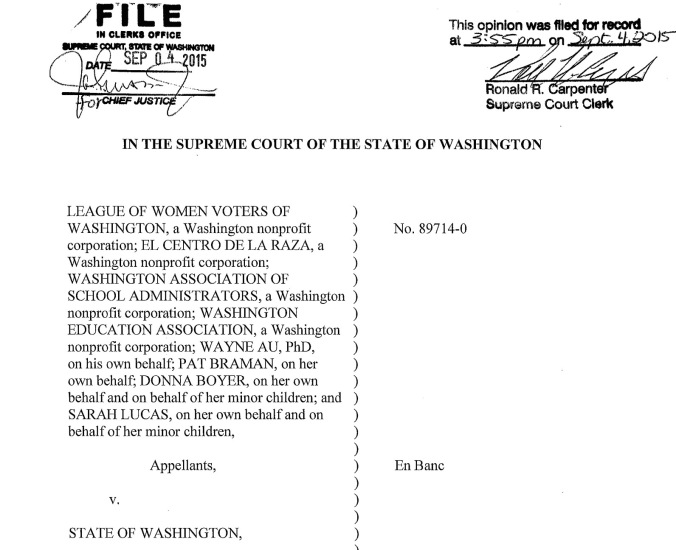
And there is the court’s ruling on Sept. 4, 2015, declaring the state’s charter school law unconstitutional. The law was passed by voters in 2012 — after three earlier attempts failed — with the help of significant financial support from wealthy philanthropists, including Bill Gates. The Supreme Court justices decided that state education funding could not be used for charter schools because charter schools are not operated by elected boards and, therefore, not “common schools.”
Here is a post on what is going on in Washington state by Wayne Au, an associate professor at the University of Washington Bothell and an editor for the social justice education magazine, Rethinking Schools. He was also a  plaintiff in the charter school legal challenge, along with organizations including the Washington Education Association and the League of Women Voters.

By Wayne Au
Friday, Sept. 4, 2015, was a good day for me. Late that afternoon the Washington State Supreme Court issued an earth-shattering ruling for corporate education reformers: By a 6-3 decision, they determined that Washington State’s charter school law was unconstitutional. This felt like a personal victory because I was heavily involved in the fight against charter schools in Washington State. In the lead up to the 2012 election season, where Washington voters would decide on the legality of charter schools here through popular vote on Initiative 1240 (I-1240), I was a very vocal opponent of the initiative and voiced my concerns about charter schools in newspaper editorialspolicy analyseseducational research, and public forums.
Washington State citizens narrowly passed I-1240 by a 50.69 percent majority vote (winning by roughly 41,000 of the over 3,000,000 votes cast), making charter schools law here. In response to the new charter law, I was asked to join a group of individuals and organizations as plaintiffs in a lawsuit challenging the constitutionality of I-1240, where, in addition to lending my name to the suit, I provided expert advice and research in support of the legal arguments.
When the Washington State Supreme Court announced its decision overturning I-1240 as unconstitutional, I was elated. As an educational scholar-activist trying to defend public education from the forces of privatization, rarely have I felt like my personal efforts have contributed so concretely to such an important victory.
At the heart of the Washington State’s Supreme Court ruling was the idea that charter schools, as defined by the law, were not actually “public schools.” The key issue is this: Washington State’s constitution has a provision that only A perfect education storm in Washington state - The Washington Post:

'Fighting for Incredible List of Educational Reforms,' Seattle Teachers Go on Historic Strike | Common Dreams | Breaking News & Views for the Progressive Community

'Fighting for Incredible List of Educational Reforms,' Seattle Teachers Go on Historic Strike | Common Dreams | Breaking News & Views for the Progressive Community:

'Fighting for Incredible List of Educational Reforms,' Seattle Teachers Go on Historic Strike


For the first time in 30 years, Seattle teachers are hitting the picket lines on Wednesday after the teachers union and the school board failed to negotiate a tentative agreement.
The Tuesday decision to strike—made with what the union describes as "an unprecedented, thunderous unanimous vote," closes schools on what would have been the first day of school for roughly 50,000 students.
The problems the public school teachers say are driving the strike include those teachers across the nation have also cited, including an over-reliance on standardized testing and  flawed methods for evaluating educators. The Seattle Education Association (SEA) outlinesthe issues summer-long negotiations have failed to resolve:
Professional pay: We need to attract and keep caring, qualified educators in Seattle, which is one of the most expensive cities in the United States. We've gone six years with no state COLA and five years with no state increase in funding for educator health care.
Fair teacher and staff evaluations: Educators should be evaluated fairly and consistently, and the focus should be on providing the support all educators need to be successful.
Reasonable testing: Too much standardized testing is stealing time away from classroom learning.
Educator workload relief: Current workloads mean many students aren't getting the help they need.
Student equity around discipline and the opportunity gap: We need to focus on equity issues in every school, not just some.
The administration's proposal to make teachers work more for free: It is unrealistic to expect teachers to work more hours without additional pay, and the district administration has been unable to explain how their proposal would help students.
Seventh-grade language arts teacher Theo Moriarty told the Associated Press, "We didn’t want to strike, and it seems to be the only way to have a dialogue with our senior administration."
"We all know it’s an inconvenience but ultimately it’s far better for the future of students and families to get what we’re asking for," he said.
As Seattle Public School teacher Jesse Hagopian told the Real News Network following the vote to go on strike,"The issues that we're taking up are much more than pay."
"Teachers and educational support staff deserve a living wage in a city where the costs are skyrocketing, where teachers can no longer afford to live in the city where they teach," he 'Fighting for Incredible List of Educational Reforms,' Seattle Teachers Go on Historic Strike | Common Dreams | Breaking News & Views for the Progressive Community:

Seattle Schools Community Forum: Thursday Strike Updates

Seattle Schools Community Forum: Thursday Strike Updates:

Thursday Strike Updates


There's a mediator and hopefully, both sides are talking thru this person.  Cross your fingers.

There are still many schools that need support from parents and community.  Check out the list at Soup for Teachers.  They now have over 1600 members.  I myself walked over to the Roosevelt teachers and told them they were welcome to come and use my bathroom anytime today.  

Parent Petition about what parents want from the contract.  They have over 4500 signatures.


From the West Seattle blog:
If the Seattle Public Schools teacher strike continues through the end of the week, please join West Seattle educators and families on Friday afternoon from 12:30-3:00 for an Alki Beach Read-In after a morning of community service in honor of September 11th (check with educators from individual schools for project specifics). ALL families are welcome! We are coordinating with multiple schools for this event and hope to have a great turnout.

Please bring your books, blankets, and back-to-school momentum! Meet near the Statue of Liberty on Alki Beach. Let’s spend the afternoon reading together as we show that we ALL want to be back in school.

Wear red – see you there!

You’re encouraged to RSVP so organizers have an idea of how many people to 
Seattle Schools Community Forum: Thursday Strike Updates:


Wayne Au: Washington State Charter ruling. Part II. | Fred Klonsky

Wayne Au: Washington State Charter ruling. Part II. | Fred Klonsky:

Wayne Au: Washington State Charter ruling. Part II


 Screen Shot 2015-09-04 at 7.25.34 PM


Following the ruling by the Washington State Supreme Court that found the state charter law unconstitutional I posted an article that Professor Wayne Au wrote on charters in 2013.
Wayne was an appellant in the Washington suit.
Wayne contacted me and wanted to let me know that he would be writing a post-ruling article for the Washington Post.
That article appeared today in Valerie Strauss’ column.
Friday, Sept. 4, 2015, was a good day for me. Late that afternoon the Washington State Supreme Court issued an earth-shattering ruling for corporate education reformers: By a 6-3 decision, they determined that Washington State’s charter school law was unconstitutional. This felt like a personal victory because I was heavily involved in the fight against charter schools in Washington State. In the lead up to the 2012 election season, where Washington voters would decide on the legality of charter schools here through popular vote on Initiative 1240 (I-1240), I was a very vocal opponent of the initiative and voiced my concerns about charter schools in newspaper editorials, policy analyses, educational research, and public forums.
Washington State citizens narrowly passed I-1240 by a 50.69 percent majority vote (winning by roughly 41,000 of the over 3,000,000 votes cast), making charter schools law here. In response to the new charter law, I was asked to join a group of individuals and organizations as plaintiffs in a lawsuit challenging the constitutionality of I-1240, where, in addition to lending my name to the suit, I provided expert advice and research in support of the legal arguments.
When the Washington State Supreme Court announced its decision overturning I-1240 as unconstitutional, I was elated. As an 
Wayne Au: Washington State Charter ruling. Part II. | Fred Klonsky:

The Education of Jesse Hagopian | The Progressive

The Education of Jesse Hagopian | The Progressive:

The Education of Jesse Hagopian


https://www.youtube.com/watch?v=ntjsAuLn5OM


Pepper spray seared Jesse Hagopian’s face and tears streamed from his eyes. He had just given a speech at this year’s Martin Luther King Jr. Day celebration, on January 19 in Seattle. In keeping with tradition, the thirty-third annual event began in the gymnasium of Garfield High School, where Hagopian himself attended school and now teaches history. He presented plaques to students who were leaders of the Black Lives Matter movement. After the ceremony, 10,000 people marched toward downtown.
There, Hagopian delivered the event’s final speech, demanding justice for Michael Brown, Eric Garner, Tamir Rice, and other unarmed black males who died at the hands of police.
“I challenged people who celebrate Martin Luther King Jr. but denigrate his true legacy: a life of direct action against injustice,” Hagopian recalls. “He would have been in the streets of Ferguson, demanding that black lives matter. Those who chastise Black Lives Matter as too strident but the next day celebrate Martin Luther King Jr. are doing his memory an injustice.”
Applause rang in Hagopian’s ears as he headed off to complete the day at a birthday party for his two-year-old son. Then, as he walked down the sidewalk, calling his mother on the phone to ask her for a ride, a police officer pepper-sprayed him in the face. A bystander caught the encounter on a cellphone video camera, footage Hagopian is using in a federal lawsuit against the Seattle police.
Hagopian, a nationally known school reform advocate who writes the blog “I Am An Educator,” arrived at the birthday party with his eyes swollen and ear burning. His two sons, especially his six-year-old, were troubled.
“I didn’t know what to tell them,” Hagopian says. “For all the education I do about structural racism and inequality and police brutality, my tongue was tied when my son asked me what happened.”
Jesse Hagopian’s passion for social justice led him to the classroom, something that surprises him given his own struggles in school.
“Most of my life I would have thought of this as the last profession I would have had,” says Hagopian, thirty-six, whose mother is of Armenian descent and whose father is African
- See more at: http://www.progressive.org/news/2015/09/188303/education-jesse-hagopian#sthash.hUQyQjH2.dpuf

Standardized tests don't help us evaluate teachers - LA Times

Standardized tests don't help us evaluate teachers - LA Times:

Standardized tests don't help us evaluate teachers

U.S.


When I was the general counsel of the Los Angeles Unified School District, it was extraordinarily difficult to dismiss underperforming teachers who had tenure. One major problem was that we lacked objective measures of teacher effectiveness. So when the 2001 No Child Left Behind Act brought the nation annual standardized testing for math and reading, I applauded.

Congress is now seriously considering new legislation, the Every Child Achieves Act, which would continue the same testing program. But 14 years on, I think that's a mistake. I believe our exam system is deeply flawed, especially when it comes to teacher evaluation.

First, the results are too variable. Teachers may one year be rated "highly effective" while the next year they are merely "effective" or worse, even though there are no observable changes in their teaching skills or strategies. And researchers have shown that even small variations in the evaluation formulas can produce disparate results. This seemingly uncontrollable variability produces great teacher anxiety that is not worth the damage.

Second, there is reason to doubt the relationship between test scores and an individual teacher's competence. When we had one teacher per classroom, it might have been fair (or at least fairer) to ascribe poor test results to a particular teacher. Now we have more team teaching, and reading and math specialists who, if they are good, can pull up test scores notwithstanding the primary teacher's lack of skill.

We also have come to recognize that merely by changing principals, school scores can rise or fall dramatically. This phenomenon suggests that the synergy created by high-quality leadership (or the dysfunction of bad leadership) may have a significant impact on teacher ratings.

Third, we have the vagaries of student class assignment. In places that still track students on ability, some teachers get high-achieving kids, and a virtual pass, while others have to sweat every day. Similarly, principals often give newer teachers a disproportionate share of students with special needs or disciplinary problems because older teachers don't want them.

There is reason to doubt the relationship between test scores and an individual teacher's competence.

None of the above even takes into consideration the segregation by race or class of school populations because of the continued (indeed, increasing) segregation of housing patterns. Without some means of modifying expectations to the degree of difficulty associated with teaching a particular group of kids, the results penalize teachers who are willing to work in tougher schools. Some states and districts have tried to make adjustments, but no one has developed a widely accepted formula that educators see as fair.

Fourth, the tests are too narrow in scope. They largely focus on math and reading, which obscures the value of elementary teachers who do a great job teaching history, science or music, and makes evaluation of secondary teachers of non-tested subjects like "apples" in comparison with math and English teacher Standardized tests don't help us evaluate teachers - LA Times:

Seattle Education Association’s Day of Service on Friday, September 11th | Seattle Education

Seattle Education Association’s Day of Service on Friday, September 11th | Seattle Education:

Seattle Education Association’s Day of Service on Friday, September 11th


logo
If no agreement is reached and the strike continues Friday, instead of walking the picket lines, Seattle Education Association (SEA) teachers and staff will be dedicating their time to community service in honor of 9/11.
SEA teachers and staff will be holding a food drive on Friday, September 11 from 9:30-3:30 at the following locations
Store Locations: 
Safeway: 7300 Roosevelt Way NE, Seattle 98115
QFC: 11100 Roosevelt Way NE, Seattle 98125
Fred Meyer: 13000 Lake City Way NE, Seattle 98125

Please come support our teachers. The food collected during this drive will be donated to the local food banks that serve families in our community.
Roxhill Community Service
Roxhill Elementary teachers and staff will be doing a clean up of Roxhill Park. If you want to support them in those efforts, please join them.
If you have a location for a Day of Service, please send it to seattled@icloud.com.
Dora Taylor

The 32nd District Democrats pass a resolution in support of the Seattle teachers’ strike

Do you think Superintendent Nyland and the school board (except for Sue Peters) will be starting to get the hint that they are on the wrong side of the fence on this one?
32ndDistrictDemocrats1
Resolution In Support of the Seattle Education Association Contract Proposal to the Seattle School District
WHEREAS the Seattle educators are making perfectly reasonable demands:
  • Professional pay: We need to attract and keep caring, qualified educators in Seattle, which is one of the most expensive cities in the United States. We’ve gone six years with no state COLA and five years with no state increase in funding for educator health care.
  • Guaranteed student recess: Recess time varies wildly across the district, and we believe all students benefit from a guaranteed amount of time for play and exercise.
  • Fair teacher and staff evaluations: Educators should be evaluated fairly and consistently, and the focus should be on providing the support all educators need to be successful.
  • Reasonable testing: Too much standardized testing is stealing time away from classroom learning.
  • ESA workload relief: Educational staff associates provide students with crucial services and support, but their current workloads mean many students aren’t getting the help they need.
  • Office professional workload relief: Office professionals do crucial work and play many roles – and they should be compensated for the extra work they do.
  • Student equity around discipline and the opportunity gap: We need to focus on equity issues across Seattle, not just in six schools.
  • The administration’s proposal to make teachers work more for free: It is unrealistic to expect teachers to work more hours without additional pay, and the district administration has been unable to explain how their proposal would help students; and
Whereas, Seattle educators have sacrificed for 6 years with no pay raises from Olympia, 

The 32nd District Democrats pass a resolution in support of the Seattle teachers’ strike

CURMUDGUCATION: Strikes and Democracy

CURMUDGUCATION: Strikes and Democracy:

Strikes and Democracy


Last night I was asked on twitter if I'm embarrassed by the striking Seattle teachers.

Shouldn't I be? My position on charters has been pretty clear, and recently I've been talking about my support for the Washington court ruling that charters are unconstitutional. I've been exceptionally clear that I believe charters, as currently practiced, are undemocratic in part because they are not run by an elected board and are therefor unaccountable to the voters and taxpayers.

I believe the implication (twitter's 140 characters depend a lot on implication) was that if I believe in the swellness of an elected school board, should I not also believe that teachers are obliged to let that elected school board be their guide and not get all unruly with strikes and stuff?

The answer is no, I don't, but the challenge is to articulate why, because my critic is correct in suggesting there might be an inconsistency there. I don't think so. Let's see if I can explain.

How is a government supposed to work?

We regularly conflate the ideas of how a government is put in place, and how it functions once there.

A monarch could inherit the throne, but once on it, be scrupulous about listening to all voices and supporting the rights of all people. A leader could be put in place by a legitimate election and begin behaving like a tyrant once in office. An elected group could meet in secret and never reveal their processes to the public.

We like democracy because as processes to put officials in place go, it seems the most naturally inclined to be open and inclusive. But the fact that it's democratically put in place doesn't guarantee that a group functions in an open and inclusive way.

Democracy is messy

The openness and inclusiveness are just as important as the electing, because that's part of where 
CURMUDGUCATION: Strikes and Democracy:


PARCC's Cut Scores and Need To Know


The folks at PARCC have set cut scores. You just don't need to know what they are.

The one published cut score is the one that draws the line between levels 3 and 4 ("not quite good enough" and "okee dokee"). That's set at 750 on a scale of 650 to 850. The other levels of cut scores, the projected percentages of students falling within the various troughs-- that's all secret for the time being.

There are three takeaways here for the general public.

There are no standards here

When you set an actual standard, an actual line that marks the difference between, say, ready for college and not ready for college, you set it before you do the measuring.

In my classroom, the grading scale is set before the students even take the test. In fact, before I even design the test. 70% is our lowest passing grade, and so I design a test on which someone would have to display the bare minimum of skill and comprehension to get a 70%.

The PARCC folk are saying that they will draw a line between college ready and not college ready-- but not before the test has been taken. How does that even make sense. How do you give a test 


PARCC's Cut Scores and Need To Know


Seattle Educators on Strike!: Walking the picket line, day one | I AM AN EDUCATOR

Seattle Educators on Strike!: Walking the picket line, day one | I AM AN EDUCATOR:

Seattle Educators on Strike!: Walking the picket line, day one

The first day of the strike by Seattle’s teachers and educational support staff was incredible.  The solidarity for the community was truly inspirational, and the spirits of the educators are high. Teachers at the picket line at Garfield High School were especially proud to have played a roll in launching the rebellion against high-stakes testing that the union is taking up so strongly in the current contract negotiations.
IMG_3527 JesseStrike
Every school across Seattle had an enormous turnout of teachers walking the picket line to demand a school system worthy of the students we educate.  I stepped away from the picket line at Garfield during my lunch break to give this interview, along with the great Wayne Au, about the strike and the recent ruling by the Washington State Supreme Court that charter schools are unconstitutional:
Seattle Teachers Launch First Strike in Three Decades (1/2) Professor Wayne Au and Seattle teacher Jesse Hagopian discuss the reasons for the strike as the superintendent goes to court to compel teachers back to work DATE: 2015-09-09 | LENGTH: 08:16