Latest News and Comment from Education

Thursday, September 10, 2015

Q&A With GLSEN Founder: LGBT Teachers Still Face Barriers - Education Week

Q&A With GLSEN Founder: LGBT Teachers Still Face Barriers - Education Week:

Q&A With GLSEN Founder: LGBT Teachers Still Face Barriers


Kevin Jennings, who founded the Gay, Lesbian, and Straight Education Network (or GLSEN) in 1990, has fought against LGBT discrimination in schools and been active in passing school-based anti-discrimination laws for more than two decades. After leaving GLSEN in 2009, Jennings served as an assistant deputy secretary in the U.S. Department of Education until 2011. He currently is the executive director of the Arcus Foundation, a nonprofit organization dedicated to global human rights and environmental conservation.
In 1994, Jennings published One Teacher in Ten, the first of what would be three essay collections by LGBT teachers documenting their coming-out experiences in the United States and abroad. The third, and most recent, volume was published at the end of August and reflects the growing ease that teachers have about being "out" in their school communities, even as many LGBT educators still feel forced to live in the shadows.
Commentary Intern Luke Towler recently caught up with Jennings by phone to discuss the essay collections. Jennings shared his thoughts on the barriers LGBT teachers and students face and the evolving climate in urban and rural schools.
The interview has been edited for length and clarity.
—Photo by Jurek Wajdowicz
EW: When the first edition of One Teacher in Ten was published in 1994, many of the teachers used pseudonyms to avoid being identified as LGBT by their communities. Now, more than 20 years later, how have teacher and student perspectives about coming out changed?
JENNINGS: I think that the change in the 20 years since the first edition of One Teacher in Ten came out is mind-blowing. To be completely honest with you, to do the first edition in 1994, I pretty much had to twist the arm of virtually every LGBT teacher I’d ever met.
In the new edition, only one person uses a pseudonym in the entire book. And it’s incredible to think how far we’ve come in terms of the fact that LGBT teachers, like their straight colleagues, increasingly feel they can just be open and honest about who they are. Some people say: “Well, why do they need to talk about it?” And my first reaction to that is: “Well, straight teachers talk about what they did on the weekend with their husbands or their wives all the time.” Why should LGBT teachers be living under a double standard?
EW: In the latest edition of your book, One Teacher in Ten in the New Millennium, some teachers, but not all, even note the inclusive environments in rural and urban communities. While there is a growing acceptance of LGBT individuals, how can rural and urban communities continue to improve their climate so that LGBT students and teachers feel welcome and safe?
JENNINGS: Well, the first thing that needs to happen is every district needs a policy saying that it does not discriminate on the basis of sexual orientation and gender identity. It’s very hard for somebody to feel like they’re protected when the policy doesn’t protect them. It comes as a shock to many Americans to find out that in 29 states you can be fired still for being gay or lesbian. And in 32 states you can be fired for being transgender.


So we still have a long way to go just in terms of putting in place basic policies that make people feel protected because in reality, in most states in this country, they are not protected. What I find interesting, though, is the fact that there isn’t always a Q&A With GLSEN Founder: LGBT Teachers Still Face Barriers - Education Week:

9/10/2015 – Charter Schools Aren’t “Public”

9/10/2015 – Charter Schools Aren’t “Public”:

 Charter Schools Aren’t “Public”


Court’s Ruling Charter Schools Aren’t “Public” Is No Surprise

By Jeff Bryant

“The recent ruling by the supreme court of Washington state that charter schools are unconstitutional because they aren’t really public schools has sent advocates for these schools into a fit. But their often over-the-top criticisms of the decision are reflective of what is most often misunderstood about the charter school sector and what that industry has come to represent in the political debate about public schools … Operating under the mask of being purely ‘public,’ charter schools haven’t faced the scrutiny they warrant.”
Read more …

NEWS AND VIEWS

10 Years In, Tulsa’s Pre-K Investment Is Paying Off

NPR

“Researchers who’ve been studying preschoolers in Tulsa say … ‘These children did show huge gains in early math and early literacy skills … They were more likely to be engaged in school, less timid in the classroom and more attentive’ … Today, as eighth-graders … most of these kids are still doing really well … Researchers then compared these eighth-graders to a large sample of Tulsa eighth- and seventh-graders who did not attend preschool. They found that those students were not doing nearly as well … Tulsa’s program is considered a model for high-quality preschool programs nationwide.”
Read more …

When You’re Poor Or Homeless, It Can Be A Long Trip To School, Studies Find

Education Week

“Poverty can limit students’ ability to choose schools, but that doesn’t mean they stay close to home … In Chicago neighborhoods where families made on average less than $25,000 per year, high school freshmen attended a pool of about 13 different schools, commuting on average nearly 3 miles to school … By contrast, in neighborhoods with a median income over $75,000, most students attended a pool of about three local schools, and the commute was on average 1.7 miles … Homeless students traveled longer commutes to school on average than poor, housed students.”
Read more …

Map: How Student Poverty Has Increased Since The Great Recession

The Washington Post

“Not only are more American children poor today than before the Great Recession, but poor kids are increasingly clustered with poor classmates at school … Between 2006 and 2013, the number of students in high-poverty school districts – in which more than 20% of children live below the federal poverty line – increased from 15.9 million to 24 million … Nearly half of the nation’s 50 million public school students go to class with large numbers of peers who are growing up with poverty … The number of children going to class in school districts with even greater student poverty – higher than 40% – also increased, from about 1% to 4% of the national student population. Such high-poverty districts need more money to help address the issues that their students bring to school, including hunger, homelessness and higher risks for mental health challenges.”
Read more …

Unicef Warns Of Lost Generation Of War Children Out Of School

The New York Times

“War and upheaval across parts of the Middle East and North Africa in recent years have driven more than 13 million children from school – 40% of the affected area’s school-age population … In some countries – particularly Syria, which once had one of the world’s highest literacy rates – many children who ordinarily would be third or fourth graders by now have rarely if ever been inside a classroom … Five or 10 years ago, he said, it was unusual to have even 10% of the school-age populations in the region out of school … The collapse in primary education is another compelling reason for families with young children to flee.”
Read more …

How Jeb Bush’s Florida Plan For School ‘Choice’ Created An Industry Of Corruption And Chaos

Alternet

Jeff Bryant writes, “Charter schools may continue to enjoy generally favorable ratings in national surveys of Americans, but many parents and public officials across South Florida, where these schools are now more prevalent than in other parts of the country, openly complain about an education ‘innovation’ that seems more and more like an unsavory business venture … An increasing fear among parents and public officials across South Florida – and Broward County in particular – that any educational value charter schools were supposed to bring to the state is now overshadowed by corruption and chaos linked to money-making … Most people trace the manic scramble for more charter schools in Florida to one source: former governor and current Republican presidential candidate Jeb Bush. In 1996, two years before he became governor, Bush helped steer passage of the state’s first law permitting charter schools. That same year, he led the effort to open the state’s first charter … There’s no doubt Bush’s ties to the charter industry will stay strong during his presidential run.”
Read more …

America’s Teacher Shortage: Rookie Turnover, Recruitment Problems, Struggling Prep Programs, and Hard-to-Staff Positions - The Atlantic

America’s Teacher Shortage: Rookie Turnover, Recruitment Problems, Struggling Prep Programs, and Hard-to-Staff Positions - The Atlantic:

America’s Teaching Force, by the Numbers

The country is struggling to solve its shortage of classroom educators—sort of.


Over the summer, major news outlets reported that the nation is facing dire teacher shortages. Pundits speculated that middling salaries and low prestige of teachers, among other factors, were pushing smart young people to other professions. The number of education majors dropped from 179,000 in 2011-12 to 164,000 the following year.
While the country’s teaching force is certainly dealing with a staffing problem, a closer look at the numbers shows that shortages are centered in particular subject areas and geographic areas. In fact, there may be too many certified teachers in some fields, such as early-childhood education.
Since 2001, the number of public-school teachers in the United States has consistently hovered at 3 million or so; according to Education Week, the tally is 3.12 million this year. The number has kept pace with the growth in K-12 enrollment, so the teacher-student ratio has remained constant, even slightly decreasing, over the last few decades. And while widely publicized layoffs caused some dips in the number of teachers starting in 2009, those numbers have since returned to pre-recession levels. By 2020, the country is projected to have 3.3 million public-school teachers, Education Week reports.

The U.S. Department of Education publishes an annual state-by-state report on teacher shortages dating back to 1990. The most recent report, a 173-page document, lists each state’s shortage areas from year to year, but because states report their shortages differently, the information is inconsistent, and does not include quantitative data. The report fails to analyze the statistics and show how the numbers have evolved over time. Some analysts, such as the education blogger Peter Greene, have compiled their own state-by-state summaries of the problem by aggregating media reports. But many of those analyses, too, fail to provide an empirical and comprehensive assessment of the country’s very nuanced teacher-shortage crisis.  


Still, it’s clear that certain states are scrambling to fill their schools with qualified teachers, including CaliforniaArizona, Oklahoma, Indiana, and Kansas each of which has its own set of reasons for its shortage. California, for its part, laid off 80,000 teachers during the recession, which was followed by a depression in the number of college students pursuing careers in education. Indiana, among states with similar demographics, has struggled to fill positions in both isolated,rural communities and urban areas, two particularly high-needs settings. In Kansas, teachers are “fleeing across the border” to other states, largely because budget cuts have resulted widespread dissatisfaction with the work conditions.
Yet some states, such as New York, have the opposite problem: too many teachers. In New York, just 7 percent of the teachers who were newly certified for the 2013-14 school year were employed as of October of that year, according to state data. Teacher-preparation programs in the Empire State are producing too many elementary-school teachers, as well as educators trained in popular subjects, such as English and history. The education-focused news outletChalkbeat reports that only 1 in 3 graduates from teacher-prep programs are able to find a position in the state.
Why is there so much variation across states, districts, and even positions? As the Indiana example demonstrates, geography is a major factor, with certain cities and rural areas alike scrambling to fill openings. Teachers are needed in Newark,Baltimore, and Philadelphia, for example, where concerns about safety and other challenges in urban schools may deter prospective teachers, according to a growing body of research. Meanwhile, rural districts have struggled to convince young people to relocate to localities where housing and recreational options are limited. In 2013, nearly a third of Mississippi’s districts reported critical shortages, particularly in rural areas. It’s not clear how teacher-staffing issues in these parts have evolved over time. Some experts also suggest that bureaucratic rules are hampering efforts to adequately distribute teachers across the country. Each state has its own certification rules, making it difficult for a teacher to relocate and find work elsewhere.


Another reason for the staffing inconsistencies is that prospective educators tend toward certain subject areas and away from others. On top of early-childhood education, the DOE report suggests that there are few shortages in high-school English, for example. And Education Week reported in 2013 that colleges wereoverproducing elementary-school teachers.
On the other hand,teachers specializing in special education and English as a second language are in high demand; this has been the case for years, though shifting demographics in student populations suggests that the demand is rising. Science positions also tend to be understaffed, particularly in physics and chemistry, as are those in math. Despite the ever-growing emphasis America’s Teacher Shortage: Rookie Turnover, Recruitment Problems, Struggling Prep Programs, and Hard-to-Staff Positions - The Atlantic:


Wash. State Supreme Court's Puzzling Rationale for Outlawing Charter Schools :: Frederick M. Hess

Wash. State Supreme Court's Puzzling Rationale for Outlawing Charter Schools :: Frederick M. Hess:

Wash. State Supreme Court's Puzzling Rationale for Outlawing Charter Schools


Last week the Washington state Supreme Court chose the Friday afternoon before Labor Day to declare the state's charter law unconstitutional. The 6-3 opinion turned on the Washington high court's bizarre ruling that charter schools do not qualify as "common" schools. The court waited nearly a year— until shortly after schools had opened and the school year was underway— to tell more than 1,000 families at nine charter schools that their schools were no longer legal.
In finding charter schools unconstitutional, the Washington Supreme Court broke with the courts in California, Colorado, Michigan, New Jersey, Ohio, and Utah— all of which had rejected similar attacks under their own state constitutions. The Washington high court majority claimed that it had no choice, that its hand was forced by Article IX, section 2 of the state's constitution because charter schools are "not common schools." So, let's take a look at Washington's supposedly restrictive definition of "common schools." Article IX, section 2 provides:
The legislature shall provide for a general and uniform system of public schools. The public school system shall include common schools, and such high schools, normal schools, and technical schools as may hereafter be established. But the entire revenue derived from the common school fund and the state tax for common schools shall be exclusively applied to the support of the common schools.
It turns out that the language is actually quite accommodating. In order to reach the astonishing determination that this loose language somehow prohibits charter schooling, the Washington court reached back to a 1909 case, School District No. 20 v. Bryan and quoted:
["Common schools" are] common to all children of proper age and capacity, free, and subject to and under the control of the qualified voters of the school district. The complete control of the schools is a most important feature, for it carries with it the right of the voters, through their chosen agents, to select qualified teachers, with powers to discharge them if they are incompetent.


There are multiple problems with this as a justification for outlawing charter schools. For one thing, school boards are not the only way for citizens and voters to control of their schools; the Court simply dismissed the relevance of the democratic control exercised through parental choice and charter school boards. Second, there's substantial evidence that district governance does less to empower qualified voters than school district employees who dominate school board elections. That's no reason for courts to question the value of Wash. State Supreme Court's Puzzling Rationale for Outlawing Charter Schools :: Frederick M. Hess:

Teacher's 'free speech' is way too free, court rules - LA Times

Teacher's 'free speech' is way too free, court rules - LA Times:

Teacher's 'free speech' is way too free, court rules


For several years schools and courts have been wrestling with the question of whether students may be disciplined for statements posted online. But what if the person who posts the problematic message is a teacher?

Last week the U.S. 3rd Circuit Court of Appeals in Philadelphia rejected a free-speech claim by Natalie Munroe, a high school English teacher who was fired after publishing a blog containing caustic comments about pupils and parents alike (intended for friends, but not password-protected). The court made the right decision. A teacher has a right to blog — or write a letter to the editor — about politics or social policy or even educational issues. But that right doesn't extend to sarcastic riffs about one's students.

Although Munroe didn't identify either her students or her school by name, she referred to one student as "the jerk who was out three days around our last major assessment because his family took him on trip to Puerto Rico," and quoted the words of another she described as an "obnoxious kid." In a flight of fancy, she offered a litany of alternatives to standard phrases used to evaluate students on report cards. They included "dunderhead," "weirdest kid I've ever met" and "utterly loathsome in all imaginable ways."

After students began circulating some of Munroe's blog posts, several parents asked that their children not be assigned to her classroom. She was allowed to return to the school after a suspension and maternity leave, but eventually was fired. The school cited "poor performance," but Munroe claimed she was punished for engaging in speech protected by the 1st Amendment.

The appeals court convincingly held that Monroe's speech was "sufficiently disruptive so as to diminish any legitimate interest in its expression." The court added that Munroe couldn't benefit from rulings holding that government employees may express opinions on "matters of public concern." That protection must be balanced, the court noted, against the state's interest in the efficiency of public services.

As Judge Robert E. Cowen wrote in the majority opinion: "When a teacher's derogatory comments about his or her students cause numerous parents to tell the school district that they 'don't want her as my child's teacher,' it is appropriate to conclude that his or her speech impedes the performance of the speaker's duties as a teacher."

Teaching is a stressful and often thankless profession, and Munroe isn't the first practitioner to seek release in humor and ridicule. But she shouldn't have posted her put-downs where there was any chance that her students and their parents could see them.

Follow the Opinion section on Twitter @latimesopinion and FacebookTeacher's 'free speech' is way too free, court rules - LA Times:

Ken Robinson on the US academic "caste system" - Business Insider

Ken Robinson on the US academic "caste system" - Business Insider:

A world-leading education expert says the academic 'caste system' is ruining American schools


Image result for Sir Ken Robinson


Beloved education theorist Sir Ken Robinson thinks our philosophy on education is totally backward — and it's made the way we set up our schools breathtakingly stupid. 

In his new book "Creative Schools: The Grassroots Revolution That's Transforming Education,"  Robinson laments the fact that we privilege the kind of intelligence found in academia over those found in the arts or trade work.
"As the story goes, the smart kids go to college. The others may leave school early and look for a job or apply for a vocational course to learn a trade of some sort. Either way," he writes, "they have taken a step down the status ladder in education.
Robinson is a 40-year-veteran in both the US and UK education systems and the man behind the most-viewed TED talk of all-time — the 2006 talk "Do Schools Kill Creativity," in which he champions the diverse range of talents and passions kids have, and which schools quickly beat out of them.
"This academic/vocational caste system," Robinson argues, "is one of the most corrosive problems in education."
By Robinson's measure, one of the most repeated political mantras in the US is severely misguided: No, not all children should go to college.
Giving book smarts more weight than other forms of brilliance puts kids who'd excel in other fields on a path they weren't meant for. In turn, the value of a college degree drops and other forms of work continue to get left out in the cold.
Over the last half-century, college enrollment rates have jumped from 45.1% in 1959 to 68.4% in 2014. Master's degrees are now as popular as bachelor's degrees were in the 1960s, arguably


Read more: http://www.techinsider.io/ken-robinson-says-colleges-isnt-for-everyone-2015-9#ixzz3lLiaTbYC


Seattle schools canceled for second day as teachers strike over pay, hours - Yahoo News

Seattle schools canceled for second day as teachers strike over pay, hours - Yahoo News:

Seattle schools canceled for second day as teachers strike over pay, hours


(Reuters) - Seattle's public school teachers were set to strike for a second day on Thursday, delaying the start of the school year for some 53,000 students as talks about wages, hours and performance evaluations collapsed.

Seattle educators and support staff took to picket lines on Wednesday for the first time in three decades on what should have been the first day of the school year.
The walkout by the 5,000-member teachers' union was the latest upheaval in Washington state's public education system following court cases challenging charter schools and classroom funding.
Classes were canceled again on Thursday in almost 100 public schools and the district said on its website there would be "no school until further notice."
"Seattle Public Schools appreciates our teachers and educators. We are diligently working to reach a fair agreement that puts students first, honors teachers, but is also fiscally sound," the statement said.
The two sides remained at odds over issues ranging from pay to performance to class size, said Rich Wood, a spokesman for the union, the Seattle Education Association,
The strike comes after Washington's top court ruled last week that state charter schools are illegal. In a separate ruling last month, it fined the state $100,000 per day for failing to put forward a plan to fully fund education.
Seattle Public Schools offered a proposed contract that included $62 million in wage increases. The teachers' union wants $172 million in increases.
The union also said the district was insisting on extending the school day by 30 minutes without paying teachers and staff for their time, and that teachers had gone about six years without a cost-of-living pay increase, while rents have been skyrocketing.
(Reporting by Victoria Cavaliere in Los Angeles; Editing by Kevin Liffey)Seattle schools canceled for second day as teachers strike over pay, hours - Yahoo News:
 gallery
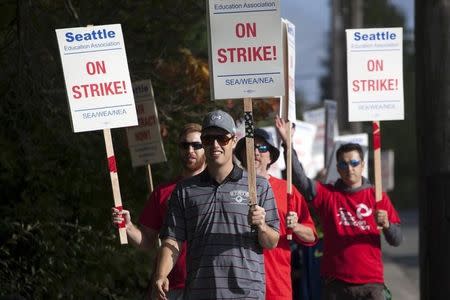
Teachers walk the picket line as they strike outside Roosevelt High School in Seattle, Washington September …

Related Stories

KJ CHEAPS OUT! Raise the rage: Supporters disappointed after failure to get $15 an hour - Sacramento News & Review -

Sacramento News & Review - Raise the rage: Supporters disappointed after failure to get $15 an hour - News - Local Stories - September 10, 2015:

Raise the rage: Supporters disappointed after failure to get $15 an hour
Task force’s ‘total compensation model’ could challenge California’s minimum-wage law


Once the yelling subsided and the police lockdown was lifted, all that was left inside Sacramento City Council chambers was disappointment.

Nine months after Mayor Kevin Johnson pledged to lead the way on income inequality during his State of the City speech, his hand-picked task force presented its opening offer: a modest increase to the city’s minimum wage, culminating at $12.50 an hour by the year 2020, but only for workers who don’t get loop-holed out of the equation under new guidelines.

The September 2 recommendation fell short of what’s been achieved in 10 other California cities—including smaller ones like Oakland and Richmond—and sets Sacramento on a path that could lead to the state Supreme Court.

Johnson, flanked at a podium by task force members, called the deal a “win-win” for his city. Even for a mayor who favors sports metaphors, it was a premature one to choose.

When the task force convened later, it greeted an angry crowd that had been screened at the doors of City Hall for weapons. Labor interests stormed out in a staged protest. At least one minimum wage worker, a mother with two jobs, cried and screamed. Police locked down the building.

In short, the reviews were negative.

“They were very difficult negotiations,” said Joseph Devlin, chief of staff for Councilman Jay Schenirer, who co-chaired the task force. “Not anyone got all of what they wanted.”

Perhaps, but the side that most signified its dissatisfaction was the one calling for a higher wage for the Sacramento News & Review - Raise the rage: Supporters disappointed after failure to get $15 an hour - News - Local Stories - September 10, 2015:


Minimum effort in wage debate


The mayor’s hand-picked task force announced its much-anticipated minimum-wage plan last week. The take home from last Wednesday’s press conference was that “nobody got everything they wanted.” But the reality was that low-income workers were the losers.

And now, the city of Sacramento gets to play guinea pig, at the behest of restaurant and chamber-of-commerce interests.

How we got here: Activists and union workers banged the $15-an-hour drum, and loudly, for about a year. Nationally, Democrats got on board for some kind of wage bump, and Mayor Kevin Johnson followed suit, wrapping his arms around the issue. In May, he launched a task force, whose members included all sorts of stakeholders, to investigate the impacts and benefits. The group dropped its proposal last week: incremental pay bumps through 2020, the end rate being $12.50—a wage lower than what was passed in nearby Bay Area burg Richmond.

The proposal is a nice win for business owners of all stripes. But the bigger issue pertains to a “total compensation” clause in the city’s proposed ordinance.

Total compensation basically allows business owners to not bump the minimum wage for workers who receive other financial benefits, such as tips and health care. That means Joe Employee earning $10 an hour won’t get a pay bump to $12.50 if he gets tips or other benefits from his employer that amount to more than $15 an hour.

Unions call this move illegal. City leaders in Los Angeles and elsewhere have shot similar moves down. Yet Sacramento appears poised to be the legal lab rat when it comes to this carve out, pushed hard by the California Restaurant Association.

That’s unfortunate: Why must Sacramento trailblaze on this?

It’s also worth noting that the city’s proposed minimum wage could possibly be outdone by a new state minimum in five years. It’s not a likelihood, but it’s possible.

It’s nice to see any kind of pay bump for workers. But this latest proposal feels like minimum effort.

Minimum effort in wage debate


Chicago Parents Go on Hunger Strike to Fight Dyett High School Closure |#FightforDyett #WeSupportDyett12

Chicago Parents Go on Hunger Strike to Fight Dyett High School Closure | Essence.com:

Chicago Parents and Activists Are 24 Days Into a Hunger Strike to Fight School's Closure


Chicago parents and community members are in a desperate fight to bar the city from permanently closing the doors of one of its predominately Black high schools.

Eleven parents and one clergyman are 23 days into a hunger strike demanding that Chicago Mayor Rahm Emanuel revamp Walter H. Dyett High School—which serves Chicago's South Side and was closed in June—as the Global Leadership and Green Technology High School. Parents say that by shutting the school's doors, city officials are forcing students to travel farther distances and compete to enroll in selective high schools and charter schools.

Earlier this week, the city announced that it would be reopening Dyett High School as an arts institution, but parents and activists were not appeased. They argue that city officials—many of whom have been hesitant to meet with protestors—simply ignored their requests and made the decision without their input. The group is planning to continue their fight alongside civil rights leader Rev. Jesse Jackson.

"When people say, 'It's a win; you all won something. You should be happy,' there was no negotiation with the Coalition to Revitalize Dyett," protestor Jitu Brown said to the Chicago Sun-Times. "There was no negotiation."

Though Mayor Emanuel, who has shuttered nearly 50 schools since 2013, says that the school closures are beneficial to students and allow them to attend better high schools, many parents feel that the reforms target Black residents.

"The schools Mayor Emanuel have pointed to as options for their children are outside the neighborhood and existing attendance boundaries, across gang lines, militarized, selective enrollment, and/or operated by a private contractor," protestor J. Brian Malone said in a statement. "The parents and community leaders have been explicitly clear in their intention to have a high school in their community that reflects their vision."

Walter H. Dyett High School is located in the historic Bronzeville section in the city's South Side.

Since the hunger strike began on Aug. 17, three strikers have been hospitalized and since released. The 12 demonstrators are only drinking water and juice.

Follow #FightforDyett and #WeSupportDyett12 on Twitter for more updates.Chicago Parents Go on Hunger Strike to Fight Dyett High School Closure | Essence.com:


Wednesday, September 9, 2015

Seattle Schools Community Forum: Strike Updates

Seattle Schools Community Forum: Strike Updates:

Strike Updates


KPLU had this tweet at 6:30 pm:

@kystokes: Campano: She & @SeattleEA exec dir will meet state mediator at 10a, but full team has no plans yet to return to the table. #SPSstrike #waedu

Support for Teachers:


THEREFORE BE IT RESOLVED that the Metropolitan Democratic Club of Seattle stands in support of SEA contract proposals and also acknowledges appreciation of School Board Director Sue Peters’ opposition to Superintendent Nyland’s legal threat against Seattle educators; and
THEREFORE BE IT FINALLY RESOLVED that the Metropolitan Democratic Club of Seattle urges the Seattle School Board to agree to the SEA contract proposals.

From the WestSeattle blog reporting on 34th Dems;  They voted to support SEA and put $500 into strike fund.

From Soup for Teachers Facebook page:


Super good news! Roosevelt students are organizing sandwich making and other goodies for tomorrow, Day 2. They have their own signup genius page and Facebook page. https://www.facebook.com/feedtheteachers
Salmon Bay kids are working on a documentary of the strike.
All in all, parents are networking like crazy, working on supporting education and democracy. Kids are getting a big lesson about collective bargaining, democracy and politics. We're getting stronger and energized.


Businesses to thank for their support


- Top Pot donuts

- Starbucks in Fred Meyer on Leary/Starbucks in Wallingford

- The Station coffeeshop on Beacon Hill

- Veraci pizza

- Solid Grounds coffee

- Mighty-O donuts in Tangletown

- Grumpy D in Ballard (use of bathrooms for teachers)

- Safeway in Wedgwood

- Trader Joe's on Capitol Hill


Please thank these businesses for their support of teachers and the schools in their area.


Finally, it was reported to me that Councilman Tim Burgess said at the 36th Dems that he thought Seattle Schools was wrong to vote to authorize legal action against SEA.  I'm quite surprised. 
Seattle Schools Community Forum: Strike Updates:


CURMUDGUCATION: Washington Charters and Godwin's Other Law

CURMUDGUCATION: Washington Charters and Godwin's Other Law:

Washington Charters and Godwin's Other Law


Over at the Flypaper, the bloggy wing of Fordham Institute's reformster website, Robin Lake had a point to make about the recent Washington State ruling that found the state's charter law unconstitutional.

I get that she's pissed. Lots of charter-loving folks in Washington are, and on the one hand, I don't blame them-- as I observed before, the court's decision to hold onto the ruling until the Friday before schools were supposed to open was, at a minimum, pretty unkind and inconsiderate of the 1,200 students who thought they were going to start school. On the other hand, the Center on Reinventing Public Education, a reformster group of which Lake is director, might try saving some of that outrage for the many charters across the country that have closed up shop without warning, even in the middle of the school year. But yeah-- it was a sucky way for the Washington court to handle it.

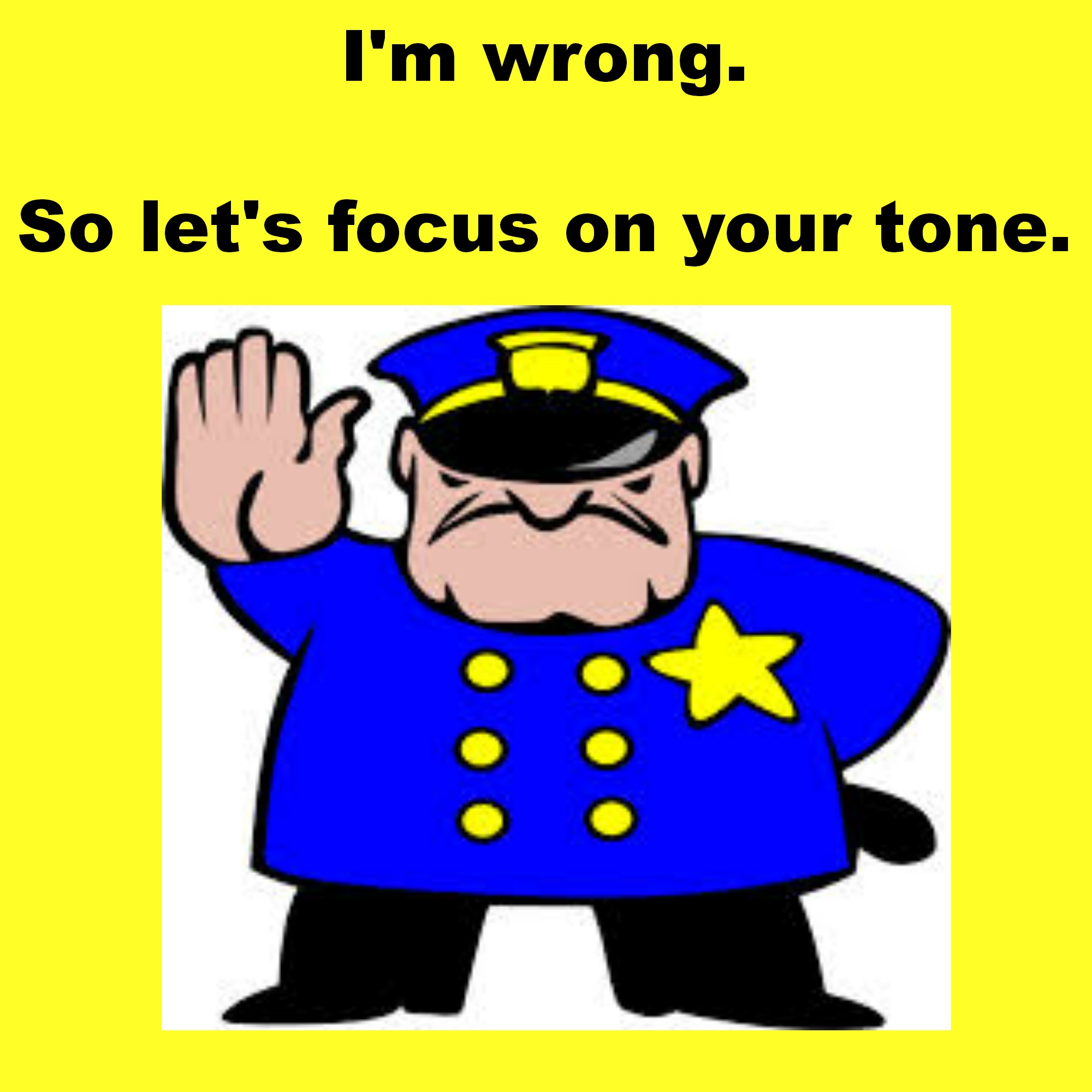
So that's probably why she looked around for a grumpy comparison and landed in the Kremlin. I'm pretty sure this violates Godwin's Lesser-Known Second Law-- when you drag Russian commies into an argument, you're done. If Lake is going to use such over-the-top, ill-fitting analogies, how will she get anyone to take her seriously? Wow, I've never tried concern-trolling before. It's kind of fun. Next time I'm at Wal-Mart, I'm going to look for a Tone Police hat!

So if we can get past the walls of the Kremlin, do we find Lake making a point (or saying things that make the pro-charter position clearer)?

Lake leads with the argument that the court was allowing itself to be jerked around by a 100-year-old law, and goes straight to Why Charters Are Needed Regardless of What the Law Says. She's a 
CURMUDGUCATION: Washington Charters and Godwin's Other Law:


Washington State [Private] Charters Get Their $14 Million | deutsch29

Washington State [Private] Charters Get Their $14 Million | deutsch29:

Washington State [Private] Charters Get Their $14 Million 


Four day after the Washington State Supreme Court ruled that Washington State charter schools do not qualify as “common” (i.e. public) schools, King5.comreports that the Washington State Charter Association has raised the $14 million from private donors in order to keep the nine charter schools open for a year absent any taxpayer funding.
The nine schools are completely privately funded, yet the media cannot seem to stop referring to the schools as “public” schools. King5.com reporter Janna Hanchard does so (“TACOMA, Wash. — Millions of dollars are being set aside to keep the lights on at public charter schools across the state”), as does Robin Lake of the University of Washington’s Center for Reinventing Public Education (“I guess it’s ironic or something that the only public school that will be open in Seattle tomorrow is a charter school”). However, calling schools that have been barred from receiving public funding “public” schools does not make them so.
The September 04, 2015, Washington State Supreme Court ruling dealt with that issue: Calling charter schools “public” schools does not mean that they are according to the Washington State constitution.
In order to become “common” (i.e., public) schools, Washington State charters would need to answer to an elected school board.
They do not.
Thus, it does not matter if the charters have set up their version of accountability. They need to be held accountable to an elected board to qualify as “common” (i.e., public) schools– and to dip into taxpayer money for their funding.
Of course, the politically-charged battle is on, with the Washington State Charter Washington State [Private] Charters Get Their $14 Million | deutsch29:

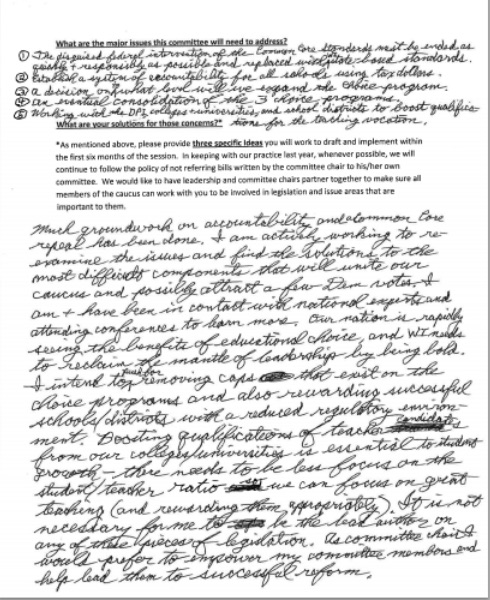
Document Based Question for aspiring leaders in the Wisconsin Legislature | BustED Pencils

Document Based Question for aspiring leaders in the Wisconsin Legislature. | BustED Pencils:

Document Based Question for aspiring leaders in the Wisconsin Legislature


images

Name___________________________ Date_________________
Directions Part 1:
Below are two sets of documents.
  1. Describe each document set.
  2. Explain the intent of each document set.
  3. Compare and contrast the qualifications detailed in each document set.
  4. Using evidence from the documents, please select a candidate to chair your state’s education committee.
  5. Using evidence please craft a letter to the unqualified candidate explaining the reasons for your decision.
Directions Part 2:
  1. Create a world of fantasy.
  2. Complete steps 4-5 again except this time select the other candidate.
If you were able to successfully complete the directions in Part 2 please move to the front of the line.  You are obviously capable of ignoring evidence and unable to reason. Therefore your intentions are at the least questionable and at the most destructive. You are ready for a leadership position in Wisconsin politics.
Document Set #1
Thiesfeldt1Thiesfeldt2


Jersey Jazzman: Teaching Children In Dangerous Classrooms: It's How We Roll

Jersey Jazzman: Teaching Children In Dangerous Classrooms: It's How We Roll:

Teaching Children In Dangerous Classrooms: It's How We Roll


A press release came to my email box today from the Newark Teachers Union:
NEWARK, NJ — Abington Ave is a crime scene. Zero planning, even less consideration.

As one parent explained, "My kids came home last week and yesterday in soaking wet shirts from sweating. Abington is worse than most of the schools right now. They are fixing the school's exterior and the  windows are all covered in plastic. These poor kids have ZERO fresh air. They are surviving on fans that the teachers have supplied! The secretaries have AC units in the office and are also unable to use
them because they are covered in plastic and sealed."

God only knows what air they are breathing in at this school. Deputy Superintendents Brad Haggerty and Peter Turnamian have no kids here, so they rejected any suggestions and ordered all schools remain open.

NTU is sending help. Hopefully, the Mayor's office will too.

John M Abeigon
President- Director of Organization
Newark Teachers Union

Meanwhile, in Camden, the aunt of a student at Bonsall Elementary School posts a video (which I can't embed here because it's on Facebook, so click the link to watch) showing how students on the two lower floors are sweltering in classrooms with no air conditioning.

But up on the third floor, it's nice and cool. Why? Because that floor was taken over by the Uncommon charter chain, which somehow allowed the district to magically acquire the funds necessary for the school's renovation. Except somehow, when it came to HVAC needs, the floors housing classrooms for the public district schools didn't get refurbished in
- See more at: http://jerseyjazzman.blogspot.com/2015/09/teaching-children-in-dangerous.html#sthash.BmcQJYOf.dpuf