Latest News and Comment from Education

Tuesday, September 1, 2015

CURMUDGUCATION: 4 Bad Business Practices for Education

CURMUDGUCATION: 4 Bad Business Practices for Education:

4 Bad Business Practices for Education


"Schools should run like a business" is one of the modern reformster mantras, and schools are so obviously NOT businesses that we can end up overlooking the other problem with this idea-- that reformsters often mean to incorporate practices that aren't even good business practices.

If you have friends or family in the private sector, or if you've just been paying attention, you may have noticed that businesses are increasingly run very, very badly. Many of the principles that reformsters want to apply to education are, in fact, failures in the private sector.

1) Eliminate expertise.

Take, for instance, the belief that industry-specific expertise is not only unnecessary, but undesirable. Even the robber barons rose to power by working up through the jobs of their respective industries and knowing something about how the business work, but nowadays the Cult of Management insists that the only important skill is bean counting and managerial managosity. The last guy to come in to run what used to be one of the major companies in my area had previously managed a toy company and a soup company. He was brought here to run an oil company. He had never worked any job in his life except managing stuff.

These guys frequently make stupid mistakes because they actively avoid listening to people who have worked in their industry. The history of business failures in my part of the country is the history of upper management being filled up with guys who didn't know anything about the industry they were suddenly working in. 

2) Aim at the wrong target.

Reams have been written in the past fifty years about the folly of focusing on short-term financial goals instead of the long-term health of the business. Never mind where the business will be in ten years-- how can we get the stocks to trend upward in the next six months. Since the management nomads will not be here in ten years, anyway, who really cares?

This mistaken direction of the company means that the main job of the company is no longer to 
CURMUDGUCATION: 4 Bad Business Practices for Education:


PA: Charter Windfalls


The financial crushing of Chester Uplands Schools, where teachers and staff are now working without pay while legislators dither over a long-past-due budget in Harrisburg-- well, this mess has ended up dragging ugly worm into the light of day.

Here's an excerpt from the Judge Chad Kenney's ruling nixing the state's proposed relief for CUSD:

The Charter Schools serving Chester-Upland Special Education students reported in 2013-2014, the last reporting period available, that they did not have any Special Education students costing them anything outside the zero (0) to twenty-five thousand dollar ($25,000.00) range, and yet this is remarkable considering they receive forty thousand dollars ($40,000.00) for each one of these Special Education students under a legislatively mandated formula. This means the legislative formula permits the Charters to pocket somewhere between fourteen thousand ($14,000.00) and forty thousand dollars ($40,000.00) per student over and above what it costs to educate them. While this discrepancy needs to be seen in most instances as the operators of Charters taking advantage of legal mandates, it is clear that the Legislature did not mean for its averages to produce such windfalls to the Charter School industry in a distressed district.

(Hat tip to Keystone State Education Coalition) 

Yes, I have to keep explaining this to people because it seems so incredible-- the state of PA has a payment system for charters that doesn't factor in anything about what it actually costs the charters to educate students. The legislature has set it up so that charters like the ones in Chester can pick up a minimum of $15,000 pure profit. 

You may remember a time when a selling point for charters was that they would do more with less. That has never been the case in PA-- charters promise to do whatever they feel like with as much 

PA: Charter Windfalls


Children Don’t Have Constitutional Right to Switch Schools, Appeals Court Rules - WSJ

Children Don’t Have Constitutional Right to Switch Schools, Appeals Court Rules - WSJ:

Children Don’t Have Constitutional Right to Switch Schools, Appeals Court Rules

Parents aren’t guaranteed public-school choice in Arkansas case


Aspen School District students head to their buses after the first day of class in Aspen, Colo., last Wednesday.
Aspen School District students head to their buses after the first day of class in Aspen, Colo., last Wednesday. PHOTO: JEREMY WALLACE/ASSOCIATED PRESS


Public-school parents don’t have a constitutional right to decide where to send their children to school, an appeals court ruled.
The Eighth U.S. Circuit Court of Appeals on Monday rejected claims by a group of Arkansas parents that they had a right to transfer their kids out of a struggling school district in northeast Arkansas to neighboring districts where they thought the children could be better educated.
School officials rejected the transfer applications because they said the children’s assigned district, which is predominantly African-American, is still subject to a desegregation order from more than 40 years ago. The parents, who are white, sued for violations of due process and equal protection, claiming they had a constitutional right to move their kids. A lower court last year dismissed the parents’ complaint.
In a 2-1 decision, the appeals court in St. Louis agreed with the lower court’s decision, saying the Constitution doesn’t guarantee so-called public-school choice.
Courts have said parents can’t be denied the right to choose to enroll their children in private schools. But those rulings don’t apply to parents seeking to move their kids within the public system, the appeals court said. The opinion, written by Judge Lavenski R. Smith, said there was no precedent that supported the position that “a parent’s ability to choose where his or her child is educated within the public school system is a fundamental right or liberty.”
Jess Askew III, an attorney representing the parents, said the case raised “issues of exceptional importance for families and children across the state of Arkansas,” and they would consider asking for a rehearing by the full court.
“I’m pleased that the district court’s judgment was affirmed,” said George Jay Bequette Jr., an attorney who represented the school district.
The plaintiffs’ children are enrolled in the Blytheville School District in Blytheville, Ark., an impoverished small city in northeast Arkansas. The state has classified the district’s high school and middle school as “academic distressed” based on student performance on standardized tests, and the parents sought to move their kids to two nearby, wealthier districts that they said were “better suited to satisfy [the] children’s educational needs.”
Arkansas passed a law two years ago restricting transfers of students enrolled in districts still subject to desegregation orders. Blytheville officials said it was still subject to a 1971 federal mandate requiring racial balance to remedy past discrimination, and said that, as a policy, no transfers were allowed into or out of the district, regardless of the applicant’s race. This year, an amended law was enacted making it easier for parents to transfer districts in the state.
Lawyers for the parents have argued that Blytheville was no longer governed by the mandate, saying the original judge who approved the desegregation plan declared the matter closed in 1978.
The appeals court didn’t take a position on who was right in that regard, saying there wasn’t a constitutional issue.Children Don’t Have Constitutional Right to Switch Schools, Appeals Court Rules - WSJ:
Write to Jacob Gershman at jacob.gershman@wsj.com

I’m a Teacher. What’s your Superpower?! - Lily's Blackboard

I’m a Teacher. What’s your Superpower?! - Lily's Blackboard:

I’m a Teacher. What’s your Superpower?!


15323121972_59e7bce11e_o


I love seeing bumper stickers in praise of teachers.
• Teachers Rule.
• Those who can, TEACH. Those who cannot, pass laws about teaching.
• Teachers have class.
• Teachers make all other occupations possible.
• You can’t scare me, I’m a teacher.
• And one of my favorites, a quote from Frederick Douglass, “It’s easier to build strong children than repair broken men.”
At one time or another, I’ve seen all of these bumper stickers, proudly displayed on cars, professing mad respect and love for teachers. Despite how we sometimes feel under attack and not well supported as educators, the truth is, the public—parents, our students, former students, community leaders—most people love us.
I know the negative media coverage about education can sometimes be disheartening. Pension cuts. Slashed education budgets. Tests, tests, and more tests that don’t help students learn. It’s easy to feel attacked and not appreciated.
For every negative example the media throws our way, we hit back with countless positive examples of teachers and education support professionals going the extra mile to help a child read and write, in order to forge a better path for the future. There are stories of the teacher or counselor who made a big difference that monumentally changed the direction of someone’s life. The lunch lady who saves a child with the Heimlich maneuver. The coach who sees something in a student no one else can see. Movie studios have made millions of dollars from movies that depict these very teachers.
And still, every once in a while, we hear a story that stops us completely in our tracks.
The 2015 National Teacher of the Year is Shanna Peeples, a high school English teacher from Amarillo, Texas. She recently shared her story with us at our Annual Meeting and Representative Assembly in Orlando Florida. Shanna shared her story and we cried, cheered, stood up a little taller and beamed with pride because she’s one of us—an NEA member.
For Shanna Peeples, things weren’t so easy for her as a young child growing up in Texas. She endured more challenges in her young life than some people face over an entire lifetime. Yet, she never let those obstacles stand in the way of her dreams. If you ask her, she will say that she was fortunate to have teachers along the way who encouraged her. These teachers, acting selflessly and perhaps even unknowingly, gave Shanna the tools she needed to become a teacher herself—one who would be recognized by the President of United States for her excellence.
We were so privileged and humbled to have Shanna share her story. Her inspirational, leave-no-stone-unturned message resonated with all of us because we know the sacrifices we make as educators to help ensure that our students are prepared to realize their dreams. Her deeply personal and moving story certainly made me stop and reflect on all she had to overcome to reach this impressive career milestone.
Now that the Representative Assembly is in our rear view mirror and we’re getting ready for back to school, I’ve had I’m a Teacher. What’s your Superpower?! - Lily's Blackboard:

CURMUDGUCATION: If You Want To Help Chester Uplands...

CURMUDGUCATION: If You Want To Help Chester Uplands...:

If You Want To Help Chester Uplands...


If you have not been following the story, know that Chester Uplands School District in Pennsylvania is currently so broke that its teachers and staff are working without pay. You can read up on it here,here and here.

Thanks to a commenter on this blog, I can point you to three places where you can help.

PSEA operates a fund that is used to financially assist teachers in just this sort of situation. Right now only a snail mail address is available, but on-line contributing is supposed to be coming soon.

The school district itself is actually soliciting contributions on its own page. Help out. They only need $1.5 million.

A community member has started a GoFundMe for the teachers. Again, the amount needed is staggering, but it's a way to help.

In the meantime, if you're in PA you might contact your elected representatives and say:

1) Get the damn budget done and passed

2) Fix the incredibly stupid charter funding formula that is draining public schools dry.
CURMUDGUCATION: If You Want To Help Chester Uplands...:

NY State ed commissioner clarifies position on standardized tests | WBFO

State ed commissioner clarifies position on standardized tests | WBFO:

State ed commissioner clarifies position on standardized tests


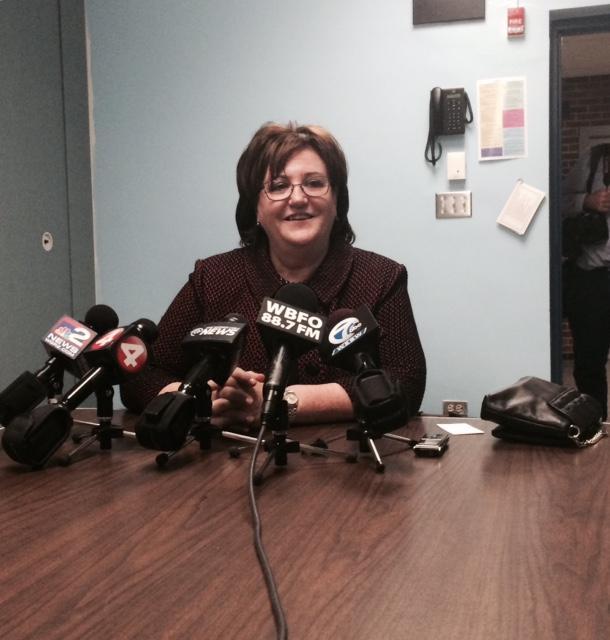
State Education Commissioner Mary Ellen Elia says she won’t prevent parents who want their children to skip the state’s standardized tests from doing so.


The commissioner detailed her views on the controversial Opt Out movement in an interview with public radio and television.
Twenty percent of children this year boycotted the third through eight grade math and English tests associated with the Common Core learning standards.
Commissioner Elia says parents “absolutely” have the right to opt their kids out of state standardized tests, but she says she still wants to talk to them to try to bring them back to the fold.
“We haven’t done enough communication,” Elia said. “But if parents understand it and they still want their child to opt out, that certainly is their right.”
Elia received some blow back when she talked about a “tool kit” she’s putting together to help school administrators in schools where the boycott rate was high, including talking to the state education department’s lawyers, as first reported in Politico.
Some lawmakers, including Jim Tedisco of Schenectady, a former teacher, viewed that as a warning. Tedisco speaking last week, called it a “goon squad” that would try to “intimidate” parents.
Commissioner Elia says her remarks were misinterpreted. She says school superintendents with high test boycott rates have requested that she put together resources to help them reverse the trend . She says the superintendents  wanted her to talk to State Education Department  lawyers on the legalities of  administering the unpopular tests.
“Superintendents have asked me ‘Is it the law? Exactly what does this mean for us? What are the ramifications of this in terms of the federal law,” said Elia who said the “logical” response was to ask her department’s attorneys for answers.
“This is not a threat,” she said.
Robert Lowry, the spokesman for the New York State Council of School Superintendents, says some superintendents did indeed ask for help. Others are trying on their own to convince students to participate.   But he says many more State ed commissioner clarifies position on standardized tests | WBFO:

Standardized testing cripples educational goals - The Daily Athenaeum: Opinion

Standardized testing cripples educational goals - The Daily Athenaeum: Opinion:

Standardized testing cripples educational goals


 At the end of every year in high school, a week was dedicated to the longest, most mind-numbing standardized test imaginable. We were taken to the gymnasium, spaced three feet apart and tested on our skills in reading, mathematics, history and science.

Since my younger sister has entered high school, there are now two weeks set aside each year for testing. During these weeks, students are tested on only reading, mathematics and science. History was cut from the list, she told me, because it was not considered one of the core subjects.
In his book "Class and Schools," Richard Rothstein wrote that because only mathematics and reading count toward "adequate yearly progress" for schools, many schools have minimized time spent on "social studies, literature, art, music, physical education and other important topics where test scores do not result in judgments of school quality."
Some schools have even eliminated these subjects from their curriculum altogether. Not only this, but America spends an obscene amount of money on standardized testing each year. Following the No Child Left Behind Act, annual state spending on standardized tests increased from $423 million to almost $1.1 billion in 2008, according to the Pew Center on the States.
By being considered standard, standardized testing is inherently problematic. People are not "standard"; there is no standard method of learning that works best for every student and no standard speed at which every student learns.
Standardized tests are only capable of measuring a tiny portion of what makes education significant. According to education researcher Gerald W. Bracey, standardized tests are incapable of measuring, and therefore devalue the importance of "creativity, critical thinking, resilience, motivation, persistence, curiosity, endurance, reliability, enthusiasm, empathy, self-awareness, self-discipline, leadership, civic-mindedness, courage, compassion, resourcefulness, sense of beauty, sense of wonder, honesty and integrity."
Furthermore, there is no faster way to ebb the desire to learn quicker than standardized testing. One teacher, Dawn Neely-Randall, told Harvard Political Review how she asked her fifth grade students to write down how they felt about the standardized tests. One student wrote, "I feel like we have to take all these tests, and if I pass the tests I live and if I don’t, I die."
In March of 2002, the "Sacramento Bee" stated, "Test-related jitters, especially among young students, are so Standardized testing cripples educational goals - The Daily Athenaeum: Opinion:

How the Billionaire Kingpins of School Privatization Got Stopped in Their Own Back Yard | Alternet

How the Billionaire Kingpins of School Privatization Got Stopped in Their Own Back Yard | Alternet:

How the Billionaire Kingpins of School Privatization Got Stopped in Their Own Back Yard

A unique coalition in Little Rock, Arkansas is pushing back hard on a Walton Family-funded attempt at a charter takeover.


The debate over public schools in Arkansas has been, for decades, ongoing and often fraught. In 1957, the Arkansas school year began with white mobs viciously attacking nine black teenagers as they attempted to desegregate Little Rock’s Central High following Brown vs. Board of Education, shining a national spotlight on the state and forcing President Eisenhower to send in the 101st Airborne Division. This past January, nearly 60 years after Arkansas’ first desegregation efforts, the state board of education dissolved Little Rock’s democratically elected local school board, the most racially inclusive and representative of its majority-black constituency in nearly a decade. In making the decision, the state overruled widespread public outcry to take control of the largest school district in the state. Two months later, Walton Family Foundation-backed lobbyists launched a brazen legislative push to allow for broader privatization — or put bluntly, “charterization” — of schools across Arkansas. It was a move many believed revealed a carefully orchestrated effort, begun months prior, to undermine the state’s public school system, destroy its teachers unions and turn public funds into private profits. 
Anyone with even a passing interest in public education knows how this story normally ends; one need only look to places like Philadelphia, where Walton dollars have helped launch an explosion of charters, or New Orleans and Detroit, where Walton funds have contributed to a system in which a majority of K-12 students now attend charter schools. Though it is not the only big-money contributor to the education reform movement (the Bill & Melinda Gates Foundation is a key player, as are countless millionaire hedge funders, investment bankers and other titans of finance), no single entity has poured more money into the push for “school choice” than the Walton Family Foundation. As a recent report from In the Public Interest and the American Federation of Teachers notes, “the foundation has kick-started more than 1,500 schools, approximately one out of four charters in the country. Over the last five years [WFF] has spent between $63 million and $73 million annually to fuel new charter openings.”
But this March, Arkansas proved the exception to the ubiquity of Walton rule. Following the introduction of House Bill 1733, which would have vastly expanded the potential for privatization of Arkansas’ public school districts, a collection of grassroots groups, urban and rural school advocates, educators, parents, and other passionate individuals committed to public education mobilized. Recognizing they were out-spent, the collective out-organized the How the Billionaire Kingpins of School Privatization Got Stopped in Their Own Back Yard | Alternet:

Monday, August 31, 2015

Mr. “Rebrand,” Mike Huckabee, Now Common Core “Killer” | deutsch29

Mr. “Rebrand,” Mike Huckabee, Now Common Core “Killer” | deutsch29:

Mr. “Rebrand,” Mike Huckabee, Now Common Core “Killer”


On Monday, August 31, 2015, former Arkansas governor Mike Huckabee sent the following anti-Common Core appeal in an email to potential Republican supporters:
Sign my petition if you agree we must KILL Common Core and ABOLISH the Department of Education. Education is a family function – not a federal function. Period!
Friend, 
  
Across the country, the federal government has hijacked our education system by ramming Common Core down the throats of local governments. Washington bureaucrats are holding classrooms and kids hostage and threatening to punish those who reject their one-sized-fits-all big government mandates.  
  
This radical, recklessness must end! We must shift power back to state and local governments. In my ten years as governor, I fought for 
Mr. “Rebrand,” Mike Huckabee, Now Common Core “Killer” | deutsch29:

Ready to Strike for the Schools Seattle’s Students Deserves! | I AM AN EDUCATOR

Ready to Strike for the Schools Seattle’s Students Deserves! | I AM AN EDUCATOR:

Ready to Strike for the Schools Seattle’s Students Deserves!


bargining team


Today, I went to the Strike Captain meeting of the Seattle Education Association (SEA, the union that represents Seattle’s teachers and educational support staff) and I can tell you that our educators are fired up and prepared to strike, if necessary, to win a contract that helps us achieve the education system that Seattle deserves.


The SEA has been bargaining with the Seattle School District over a new contract all summer. We are now in the final days before school starts and the union and the school district are very far away from reaching an agreement. Thousands of educators will be gathering for general membership meeting on Thursday, September 3rd to either vote to ratify an agreement or to go on strike—but given the disorganized and disrespectful manner in which the Seattle school district conducted itself, I don’t expect that there will be an agreement by the time of our meeting.
It didn’t have to come to this, but the district waited until the last days of summer to respond to any of the proposals put forward by educators or put forward any serious proposals of their own. The proposals from the District, as you will read below, will do almost nothing to support Seattle’s educators or students, and in some cases would do great harm.
In contrast, the bargaining team for the educators has never in my time as a teacher put forward such a visionary set of proposals to advocate for the type of reforms that would dramatically improve our schools.
IMG_1996The union is advocating for a decrease in the use of high-stakes testing. This would include forming a joint committee with the union and the district to accept or reject any standardized testing beyond the federally mandated tests and getting rid of the “Student Growth Rating” that ties tested subject teacher’s evaluations to standardized tests scores. The Seattle School District has inundated our school with dozens of tests that students have to take in their lives as K-12 students, and it’s past time that we reclaim our classrooms for teaching rather than test prep.
The union is also fighting for equitable and ample recess across the school district. Many schools in Seattle—predominantly the schools that serve low-income and students of color—have only 15 min of recess, and the union is insisting that every school have a minimum of 45 minutes. This union demand was an outgrowth of the coalition of parents from around Seattle that formed last school year called “Lunch and Recess Matter” who have been fighting for student’s right to have enough time to play and eat.
IMG_1933-2Moreover, our union wants to implement “race and equity teams” at each work site that could identify structural inequities and institutional racism and make recommendations about how to address those issues. The Seattle Public Schools have been shown to suspend African American students some 4 times higher than their white peers. The School Seattle district should be impressed by the leadership from educators in addressing these injustices in the schools, but instead they have rejected this proposal.
In addition, our union is asking for case load caps for our schools counselors and psychologists so that they can provide the individual attention that all students deserve. At many schools, including Garfield High School where I teach, counselors have hundreds of students on their caseloads Ready to Strike for the Schools Seattle’s Students Deserves! | I AM AN EDUCATOR:

#FightforDyett | Bill Ayers

#FightforDyett | Bill Ayers:

#FightforDyett 


Hannah Arendt describes a freedom involving “participation in public affairs, or admission to the public realm” (Arendt, H. 1963. On Revolution, New York: Penguin, p. 32). The hunger strikers at Dyett HS—fighting for public education in Chicago—are creating the public space right now, tonight. She acknowledges that freedom involves the establishment of certain rights within a domain of privacy, spaces where people are neither coerced nor obstructed, but she argues that this in itself is a rather narrow and negative approach to freedom, that the domain of the personal and the private is not the “actual content of freedom.”  The content of freedom is found, rather, in “a body politic”, that is in those public spaces where people come together freely as authentic beings to name the obstacles to their own humanity: “a body politic which is the result of covenant and ‘combination’ becomes the very source of power for each individual person who outside the constitutional political realm remains impotent” (p. 171).
Arendt describes the American revolution as an event “made by men in common deliberation and on the strength of mutual pledges.  The principle which came to light during those fateful years…was the interconnected principle of mutual promise and common deliberation” (pp. 213-214).  And this “principle which came to light” also drove the French and the Haitian revolutions, the German, the Russian, and the Chinese revolutions, the movements in Hungary in 1956 and Poland in 1979.  In each case, in a time of crisis and change, citizens came together spontaneously—whether in town meetings, communes, workers’ councils and soldiers’ committees, or soviets—in order to create a public space for the expression of their dreams and their demands.  It was in these public spaces that, according to Arendt, freedom came to life, and she referred to them as “treasures”, for they embodied the “hope for transformation of the state, for a new form of government that would permit every member of the modern #FightforDyett | Bill Ayers:


CURMUDGUCATION: Middle Way

CURMUDGUCATION: Middle Way:

Middle Way


In the midst of the back and forth over her comments about New Orleans' Myth of School Makeovers, Andrea Gabor dropped this quote from  Howard Fuller: 

“I do believe things are better for a large number of kids than before Katrina. But I don’t want to be put in the position of saying: pre-Katrina was all bad, post-Katrina is all good. When we set it up that way, we’re negating anything that was positive before Katrina. What that tends to negate is the capacity of black people to do anything of excellence. 

 “The firing of those teachers is a wound that will never be closed, never be righted. I understand the issue of urgency. But a part of this quite frankly has to do with the fact that I do not believe that black people are respected. I don’t believe that our institutions are respected. And I don’t believe that our capacity to help our own people is respected…

 “Its hard for me, because I do support the reforms and think there are some great things that have happened. I do have to ask the same question as Randi (Weingarten)—at what cost? 

 “Even if you talk to black people who drank the Kool-aide: The issue still is– this was done to us not with us. That feeling is deep. It can’t be ignored. It speaks to any type of long-term sustainability of what’s happening in New Orleans. 

 “When black people came out of slavery, we came out with a clear understanding of the connection between education and liberation. Two groups of white people descended upon us—the missionaries and the industrialists. They both had their view of what type of education we needed to make our 
CURMUDGUCATION: Middle Way:


Anthony Cody - Challenging the Gates Foundation - Living in Dialogue

Anthony Cody - Challenging the Gates Foundation - Living in Dialogue:

Anthony Cody - Challenging the Gates Foundation


Report: Low-income, black, disabled students miss school more often | EdSource

Report: Low-income, black, disabled students miss school more often | EdSource:

Report: Low-income, black, disabled students miss school more often


California’s low-income, black and disabled students are more likely to miss school frequently, which can be linked to future achievement gaps and dropout rates, according to a report released Monday.
The national report by Attendance Works found that chronic absenteeism is often the result of a student’s health problems, such as asthma, and absenteeism is often as prevalent among young children as it is among teenagers. At least 10 percent of kindergartners and 1st-graders miss nearly a month of class in a school year, according to the report.
Researchers generally define chronic absenteeism as missing 10 percent of the school year, but states often have their own definitions.
“Although we think about missing too much school as a problem in middle school and high school, it’s really a problem that affects the youngest children,” said Hedy Chang, a report author and director of Attendance Works, a national nonprofit that focuses on increasing school attendance, in a conference call with reporters.
The report came out the same week that the State Board of Education is about to consider making attendance rates a key part of its accountability system.
On Wednesday, the board will decide how to incorporate average daily attendance, or ADA, as a state measure for the federal No Child Left Behind law. Because new scores are unavailable as California transitions to a new testing system, attendance for elementary and middle schools instead will be one way to show if schools are meeting goals under the federal law, called Adequate Yearly Progress, or AYP.


But the average daily attendance number falls short of demonstrating school success, Chang said. The ADA number only shows the average number of students who attend school in a given time. That can mask how many students are chronically absent. Even schools with a 95 percent attendance rate could have 20 percent of students who are chronically absent, Chang said.
“It tells you how many show up every day. It does not tell you that they are missing so much school that they are academically at risk,” Chang said.
Currently, California is one of six states that fails to collect attendance data in its system that tracks student information over time, according to the report. Chang said less than 10 states use chronic absenteeism as part of their accountability plans.
State board officials acknowledge that chronic absenteeism data would be a better measure and education officials are developing a plan to collect information in the future, according to a state board document. (See agenda item 7.) The numbers should be available in 2016-17.
For now, state board officials are recommending that elementary and middle schools set a target of 93 percent average daily attendance.
The California numbers largely reflect the attendance gap seen nationally, where black and low-income students had among the highest percentages of absenteeism, according to the report.
The absentee numbers came from the National Assessment of Educational Progress, tests often known as the Nation’s Report Card that students nationwide take every two years. Students were asked if they missed three or more days of school in the month before taking the test. Researchers averaged the 2011 and 2013 responses.
Nationwide, 22 percent of black 4th-graders and 23 percent of black 8th-graders responded that they had missed at least three days, compared to 19 percent of white students in those grades.
Among low-income children, 23 percent of 4th-graders and Report: Low-income, black, disabled students miss school more often | EdSource:

Attendance Works would like to express its deep appreciation to the Annie E. Casey Foundation and the W.K. Kellogg Foundation  for investing in our development as a national initiative.
In addition, we thank The California Endowmentthe David and Lucile Packard Foundationand The San Francisco Foundation for supporting our work in California;  the William Caspar Graustein Memorial Fund and Community Foundation of Greater New Britain for supporting our work in Connecticut; and the Winthrop Rockefeller Foundation for supporting our work in Arkansas.

Report: Chronic school absenteeism is contributing to academic gaps - The Washington Post http://wapo.st/1LPrN0i

Asthma, other illnesses major reason for young learners' absences, study finds | 89.3 KPCC http://bit.ly/1LPrToG


Teacher Shortage: Who Will Teach the Children?| Uppity Wisconsin

| Uppity Wisconsin:

Teacher Shortage: Who Will Teach the Children?


Kathleen Vinehout
Senator Kathleen Vinehout
"Actions have consequences"


“Please sound the alarm,” Superintendent Mary Baier wrote to me. “We are not able to find people to fill positions in Wisconsin.” She needed a special education teacher and only one applicant had applied to her rural Plum City district.
When the school bells ring across Wisconsin, parents expect classrooms to be filled with qualified teachers. But a dramatic decline in education majors at university-based programs and an exodus of both newly minted and experienced teachers have left Wisconsin parents asking, “Who will teach our children?”
The “impending crisis” is here.
Schools are scrambling to find qualified teachers. For example, less than a month before school started, News 8 WKBT reported the La Crosse district needed to fill 23 positions.
Districts have done more with less for years. Existing teachers covered more classes and received cross training. Districts asked current teachers to go back to school and obtain certification in different subjects. Local schools already share many teachers, guidance counselors and other staff. Teachers move between schools, between districts and even across state lines during the course of their workweek.
Some districts use special “waivers,” or permission to bend the rules on teacher certification, allowing a district to place an unqualified teacher in a position as long as that teacher seeks proper certification.
But the teacher shortage is growing and it affects urban, suburban and rural schools.
Christine Hedstrom works in Human Resources for the Waukesha School District. She told the Milwaukee Journal Sentinel, “You could technically start a school year without an administrator in place, but you need to have a teacher in the classroom.”
But rural schools are particularly hard hit.
Rural schools often have fewer options and already greatly diminished choices for students. They’ve already combined, shared, downsized and cross-trained. Having a teacher in the classroom may not even be possible in some local rural classrooms.
A rural western Wisconsin district board member told me, “We are starting the school year with two positions unfilled”- one of the positions was a Spanish language teacher. “I guess we’ll have to use some type of video/distance learning option,” the board member told me. “But that’s not a good way for students to learn a language.” Spanish is the only foreign language available to students in this rural district.
When I asked folks why we had a teacher shortage, I heard several comments over and over. “Fewer students going into teaching.” “New graduates not staying in Wisconsin.” “More teachers retiring or leaving the profession.” “Teaching is no longer a valued profession.”
The Wisconsin Budget Project reported over the last eight years the number of teachers in Wisconsin public schools fell by nearly 3,000 even as school enrollment increased.
They also reported on a troubling decline in experienced teachers. "In the 2013-14 school year, teaching staff of 39% of school districts had an average of 15 or more years of experience. That share has fallen dramatically since the 2004-05 school year, when 58% of school districts has a teaching staff with an average of 15 or more years or more of experience.” 
Not surprisingly, fewer students are entering the education profession. Statistics from the United States Department of Education show a dramatic drop in the number of university students learning to be teachers | Uppity Wisconsin: