Latest News and Comment from Education

Monday, August 17, 2015

Dollars, Details And The Devil: Top 10 Needed Charter School Reforms

Dollars, Details And The Devil: Top 10 Needed Charter School Reforms:

Dollars, Details And The Devil: Top 10 Needed Charter School Reforms


“Oh it’s a long, long while from May to December,” Maxwell Anderson’s great lyric tells us, “But the days go short when you reach September.” And with the Ohio legislature’s inaction on anticipated charter school reform, the classic tune also reminds us that “One hasn’t got time for the waiting game.”
We already knew that while its citizens waited, the Ohio legislature left town as one festering charter school scandal after another went unaddressed.  In particular, a long-awaited piece of “reform” legislation, HB 2, proposed to address “governance, sponsorship, and management of community schools,” languishes in the wind tunnel located at Broad and High.
But maybe the Cincinnati Enquirer headline “Did dollars or details slow Ohio charter reform”? spoke volumes about the wind tunnel, calm now until September.
The proposed reform legislation would, according to the Enquirer, “prevent failing charter schools from swapping sponsors to avoid closure, require that attendance and financial records be available for inspection, force online schools to track how many hours a student is learning and eliminate conflicts of interest between those who run the schools and the groups policing them.”
The Enquirer article also points out that perhaps $91,726 in timely donations in June and July by charter school leader William Lager might have distracted Republican lawmakers from doing the right thing. After all, isn’t the devil – or is it the dollar – in the details when the subject is Ohio charter schools?
In the meantime, a close look at HB 2 – which is subject to further dissection when the legislature returns – shows that there are many other areas of governance, sponsorship, and charter school management that cry out for reform. So it should come as no surprise that, in reaction to legislative inaction, a group of concerned citizens assembled recently to assist lawmakers in doing the right thing.
In the hope (snicker) of getting some action from our legislators in September, our citizen panel decided to channel the spirit of David Letterman and compile a list of the Top 10 Needed Charter School Reforms. Here are the results of our deliberative body.
#10: Cut legal exemptions
Charter schools are exempt from 150 sections of the Ohio Revised Code.
The legislature needs to eliminate at least half of these exemptions by the end of the current session. After all, if proponents like to call them “publiccharter schools,” they should be more aligned to our system of public education and therefore not need so many exemptions from laws which public schools must comply with due to their public nature. If the charter industry objects, we should not let them have it both ways. Charter proponents should stop using the term public charter schools due to their resistance to increased regulation and fewer legal exemptions. In turn, the public should start using the termcorporate charter schools to better define their nature.
#9: Management companies subject to full review by state auditor
Here’s another classic example of the charter industry having it both ways. If you receive public funds, the public has a right to see how their money is spent or misspent. Add to that the requirement that any furniture, equipment, and real estate purchased with public funds is public property, subject to liquidation at auction upon closure of the school, with the proceeds returned to the state treasury. Recall that White Hat Management took the position that such assets were corporate and not public property. JobsOhio is another example of the principle of having it both ways. Public money and the assets purchased with such funds should not be convertible to private assets through a management arrangement.
#8: Eliminate Non-Profit Sponsors
The charter industry is replete with example after example of someone or some entity having it both ways. Non-Profit charter school sponsors follow that tradition. They accept public funds for serving as charter school sponsors or authorizers but tell individuals and organizations seeking information that as non-profits, they are exempt from public records requests. As with Nos. 10 and 9, if a non-profit organization accepts public funds, it should be responsive to such requests and the same scrutiny that other types of sponsors (school district, educational service center, vocational school district, university) accept as a player in the charter industry. The public is tired of the charter world having it both ways.
#7: Celebrity endorsements and cap on advertising
This charter school reform measure is tied in with Nos. 9 and 8. Public funds should not be used to pay for endorsements to promote charter schools. Worse yet, we’ll probably never find out how much ECOT endorser Jack Hanna or anyone else might have been paid because the management companies maintain they are private entities and resist audits and requests for financial information from state regulators.
#6: Accuracy in advertising
If a rose is a rose, a charter school should be called just that. Ohio is the only one of forty states authorizing charter schools that uses the term community school rather than charter. That term by itself – used in the original legislation – is purposefully misleading. My recent article on charter names pointed out that only a handful have the word charter or community school in their official title. The same is true for television ads, where the name charter isn’t used. As the school year begins and you see and hear ads for charters, listen carefully for what you might not hear in the commercial.
The local public school is a community school and a charter is a charter.
#5: School treasurers.  There is a continuing concern about the ability of charter school treasurers to adequately perform their duties when many serve multiple schools. One former charter treasurer , sentenced to two years in prison, was said to have served as the chief financial officer of at least nine charter schools at the same time, though other treasurers have served more than that number in the past. New legislation is needed to cap the total number of schools a treasurer can serve simultaneously.
#4: Governance reform.  With more than a billion dollars in state education funds being diverted to charter schools, it’s time to require greater transparency and accountability for the use of scarce public dollars, and governance reform is one place to start.  In a previous article, I wrote this statement: “The public school district that has the largest number of its resident students enrolled should be entitled to a seat on the board. Since state funds are deducted from the foundation payments for the district’s resident students and sent to the Dollars, Details And The Devil: Top 10 Needed Charter School Reforms:

Coping with back-to-school stress, K-12

Coping with back-to-school stress, K-12:

Coping with back-to-school stress, K-12


LIFE FAM-SCHOOL-STRESS 1 TB


(TNS) | Going back to school is exciting, invigorating — and stressful.
It’s human nature to feel anxious in the face of change, experts say, but there’s plenty that parents can do to help kids feel prepared for school, from showing small children where the cafeteria and bathrooms are to helping high school freshmen figure out their schedules.
“Anxiety decreases when there are no curveballs and no surprises,” says psychotherapist Fran Walfish, author of “The Self-Aware Parent: Resolving Conflict and Building a Better Bond With Your Child” (St. Martin’s Griffin).
Regardless of the age group, experts say, you should listen to your child’s back-to-school concerns without dismissing them. Try to maintain a calm and confident tone and help your child come up with age-appropriate coping strategies.
Among the tips from our experts:

Elementary school

Push bedtime forward: Establish a school-appropriate bedtime seven to 10 days before the new school year begins, Walfish says. Your kid will have a chance to acclimate to the new routine and will be more likely to be well rested and ready to go on the first day of school.
Prepare your child: Tell your kid a little about what the day’s schedule will be like. It’s also helpful to talk about feelings, Walfish says. You might say, “Some people feel a little nervous or excited or scared on the first day. That’s perfectly normal.”
Pay a visit: If possible, have your kid visit before school begins, Walfish says. Show your chld her new classroom if possible. Kindergartners will want to know what their schedule will be, where the bathrooms are and how to get to the gym, playground and cafeteria.
Plan a play date: If your child doesn’t know kids in his class, consider arranging a play date or two before school begins. The principal may be able to give you a class roster; some schools post class lists at the end of the summer.

Middle school

Get a lock: Sixth-graders tend to focus their worries on the combination locks on their hallway lockers, says psychologist Jennifer Powell-Lunder, co-author of “Teenage as a Second Language” (Adams Media). She suggests purchasing a combination lock for summer practice: “It really brings down a lot of the anxiety.”
Buy strategically: Some kids worry about having the right clothes and accessories, says Michelle Icard, author of “Middle School Makeover: Improving the Way You and Your Child Experience the Middle School Years” (Bibliomotion). You can’t buy everything that’s “in” — and you shouldn’t — but one or two key items can ease the transition.
Arrange an outing: If your kid is stressed out by, say, the decline of an important friendship, encourage him to reach out to other kids, Icard says. “You may have to be the parent who says, ‘Invite a few friends to the movies, and I’ll drive.’”
Don’t overreact: Respond to your child’s social stress seriously but not personally. “That’s normal” is a helpful response. “That makes me so sad” is not. You don’t want your child to feel that your happiness rides on her social success.

High school

Do a dry run: Freshmen worry a lot about logistics, says Powell-Lunder: How will they find their classes? Many schools hold summer orientations; if so, sign up. If not, see if you can arrange a visit for your child and a few of her friends. If they have their schedules, so much the better. You may also be able to go online and get a map of the school.
Head off the rumors: If your kid is worried about getting a “bad” teacher, listen attentively to his concerns, then remind him of other rumors he’s heard in the past that turned out not to be true. You may also want to enlist the help of older siblings or discourage their scare tactics.
Keep an eye on bedtime: Teens really need their sleep, so get your child’s sleep cycle back on track before school begins. The National Sleep Foundation website has useful information and advice for parents of teens.Coping with back-to-school stress, K-12:

The (Possibly) Post-No Child Left Behind Presidency - The Daily Beast Campbell Brown

The (Possibly) Post-No Child Left Behind Presidency - The Daily Beast:

The (Possibly) Post-No Child Left Behind Presidency


The issue of how to education the next generation is one that each presidential candidate needs to address.
Not so long ago but at a moment whose goodwill seems far away, President George Bush signed No Child Left Behind, the bill that still guides U.S. spending on public education.
NCLB updated existing law (the Elementary and Secondary Education Act) to give unprecedented authority to the federal government in reversing decades of school failure, yet was supported by bipartisan majorities in Congress—startling majorities from today’s perspective: 91-8 in the Senate and 384-45 in the House.
The bill’s signing in January 2002 (and the long negotiations leading up to it) seems far away not just because the nation’s lawmakers decided to problem-solve rather than filibuster, and not just because the aim of their cooperation was expanding federal power.
Also different was the belief that fixing education is essential to our social and economic health, and that leading the country requires summoning the political will to tackle this vast problem.
Another election season has begun and our task now needs to be re-establishing the primacy of education in the campaign conversation. Not because NCLB has been a silver bullet (they don’t exist) but because this country needs its leaders and best minds to reach new solutions or we risk losing another generation of poor and high-need children.
That’s where The Seventy Four comes in.
It is often said that education is the “civil rights issue of our time.” As campaign season moves forward, it may be more accurate to think of it as the most important issue of our time.
On August 19, we will partner with the American Federation of Children in hosting the first of two 2015 National Education Summits, bringing Republican presidential candidates to Manchester, New Hampshire, to discuss the challenges facing public education.
Confirmed speakers include Jeb Bush, Chris Christie, Carly Fiorina, Bobby Jindal, John Kasich, and Scott Walker. (Registration information is here. More here on each candidate’s views.)
In October, partnering with the Des Moines Register, we will have a similar dialogue in Iowa with the Democratic candidates.
The timing could not be more important or fraught, with issues like the Common Core standards, how to improve and reward teaching, and potential revisions of ESEA to reduce federal influence dividing lawmakers and advocates and reflecting frustration on the ground about what schools should look like.
Nor has there not been a reconsideration of the White House’s role in education in at least 15 years. President Obama’s pro-NCLB reform views built on his predecessor’s and were not appreciably different from the moderate Republicans he ran against.
The latest ESEA re-authorization effort is closer to being passed than any previous attempt, however, and that effort will likely include a shift back to state-based accountability. Heading the 2016 primary season and beyond, the core competency of any presidential hopeful must include the ability to articulate a vision of the chief executive’s role in educational change—and possibly with diminished powers.
Presidential hopefuls who favor reduced executive authority will need to explain The (Possibly) Post-No Child Left Behind Presidency - The Daily Beast:

Dan Walters: Rating California schools is a big battle | The Sacramento Bee

Dan Walters: Rating California schools is a big battle | The Sacramento Bee:

Dan Walters: Rating California schools is a big battle


 Students Matter, an organization created and financed by Silicon Valley entrepreneur David Welch (pictured), successfully sued the state over teacher seniority and tenure laws, contending that they shortchange “high-needs” students. Now it’s suing 13 school districts for not obeying the Stull Act, the 1971 law that requires teachers to be evaluated based on student achievement. Damian Dovarganes AP

Read more here: http://www.sacbee.com/news/politics-government/dan-walters/article31255874.html#storylink=cpy


California’s largest-in-the-nation public school system educates – or purports to do so – 6 million-plus kids from dozens of socioeconomic, ethnic and linguistic backgrounds.
National academic testing has found that California’s students rank near the bottom in achievement.
The situation spawns two perpetual political debates – whether we’re spending enough money to raise that achievement, and whether there’s sufficient accountability for results.
The money question is in abeyance, at least temporarily. An improving economy, a temporary tax increase and an overhaul of state school aid have raised per-pupil spending from all sources by roughly 50 percent in recent years to $13,000 a year, and from one of the nation’s lowest levels to at least the middle ranks.
Indeed, school spending has increased so dramatically during Jerry Brown’s second governorship that advocates of other programs, particularly health and welfare services to the poor, complain they are being shorted.
A multifront war over who should be held accountable for students’ progress, however, is still raging, and if anything metastasizing like a California wildfire.
Without writing its formal obituary, Brown and other politicians, plus the state’s education establishment, have strangled the test-based accountability system that California adopted in the late 1990s.
Educators, particularly the politically powerful California Teachers Association, despised a system that not only graded schools on how well they were improving academic achievement, but provided the basis for “parent trigger” actions to seize control of ill-performing schools. Nor did the CTA like the potential for using the data to judge teachers’ competence.
The system was overly simplistic and punitive, critics said, didn’t make allowances for differences among students, and encouraged “teaching to the test.”
Legislators, state schools superintendent Tom Torlakson and the Brown-appointed State Board of Education are developing a replacement system, what one planning document calls “an improved accountability system that uses multiple measures to more completely assess the progress schools are making.”
However, it’s extremely difficult, bordering on impossible, to know what will emerge, or when, because pieces are scattered throughout the various policy venues and are being couched in the densely opaque jargon of professional educators.
ACRONYMS ARE FLYING.
Trish Williams, member of the State Board of Education
“Acronyms are flying,” Trish Williams, a member of the state school board, complained during one jargon-packed presentation on a new accountability system in July. “It sounds like a foreign language.”
“I’m trying to put the puzzle together,” another member, Feliza Ortiz-Licon, added.
This is a sample of what consultant Nancy Brownell was telling them:
“The conversation around what we’re learning and the development of the evaluation rubric obviously applies in the context of accounting at the larger context. So while the specifics of really being able to build a system that emphasizes the cohesive framework that leads to a sense of how we are going to operationalize the demands and expectations in Ed Code around the rubric around how the components then of an accountability system that focuses on multiple measures and tries to, as several of you have said, weave the pieces together to help think about the context of the state priorities and how the guiding principles are a lens we want to continue to develop the details.
“I have taken to using a picture of an iceberg in some of the presentations on accountability. There is a lot of agreement in some ways on the surface level. None of us would questionDan Walters: Rating California schools is a big battle | The Sacramento Bee:


Read more here: http://www.sacbee.com/news/politics-government/dan-walters/article31255874.html#storylink=cpy

Want More Teachers? Pay More | Al Jazeera America

Want More Teachers? Pay More | Al Jazeera America:

Want more teachers? Pay more

Recruiting workers to a field is easy, if you’re willing to offer the market wage


Last week the New York Times ran a lengthy piece calling attention to school districts across the country that are having a difficult time attracting new teachers. The piece reported that many school districts are relaxing standards in order to get teachers, in some cases hiring teachers who have not yet completed their training. Others have increased the intensity of recruiting, making more effort to court good applicants. It also reported on some districts going to Puerto Rico or even Spain in search of teachers.
The one tactic that is not mentioned is higher pay. While the piece notes that many recent college grads are opting for higher-paying alternatives to teaching, it does not discuss why school districts are not raising wages as a way to pull some of these people back into teaching.
This is not the first time that we have seen assertions about labor shortages even though wages don’t appear to be growing. It is a regular theme in reporting on the economy. Times columnist Thomas Friedman has repeatedlycomplained that employers can’t get qualified workers due to inadequate training. Last year Slate told its readersthere is a shortage of truck drivers. And the Wall Street Journal ran a lengthy piece on the shortage of skilled workers in manufacturing.
The traditional way to attract qualified workers is to offer higher wages. This is the basic logic of supply and demand. If the price rises, or in this case the wage, then it will also increase the supply.
If it turns out there are not currently enough unemployed workers with the necessary skills, higher wages will lure qualified workers away from competitors. If a company can’t afford to pay enough to get or keep qualified workers, they go out of business. This is the way a market economy works. That’s why half of our workforce no longer works in agriculture. Workers were able to get higher paying jobs in manufacturing. This forced farmers to either use new machinery to increase productivity or face bankruptcy.
The prospect of getting higher pay in the future will also encourage more workers to acquire the necessary skills. People spend years training to be doctors because they get high wages once they have acquired the knowledge needed to be a physician. If there are not currently enough workers with the skills needed by trucking or manufacturing companies, the lure of higher pay will soon attract a more qualified workforce. 
Employers who are willing to pay workers a decent wage and treat them with respect seem to have little difficulty attracting qualified workers in this economy.
But for some reason wages are not rising. There is no major occupational grouping that is seeing rapid wage growth. In most occupations wages are just barely outpacing inflation. This is a strong argument that we really do not have a skills shortage; rather, we just have managers that would rather pay less than the market rate for their workers.
Of course teaching is a special case. In addition to not being an especially well-paying job for college grads, teachers have been vilified for years by politicians and the media. There have been endless stories about how inept teachers are to blame for the poor performance of many of the country’s children.
A few years ago, Michelle Rhee, the former chancellor of the Washington, D.C. school system, was briefly raised toWant More Teachers? Pay More | Al Jazeera America:

When Teachers Flunk

When Teachers Flunk:

When Teachers Flunk


08_06_TeacherTest_01


Let’s say you’re hoping to become a public school teacher in New York City. You have your master’s degree, your chosen discipline, your arsenal of dry-erase markers. Now all that’s left is to take the state’s Academic Literacy Skills Test (ALST), required for certification. On that exam, you may be asked questions based on a passage about Gertrude Stein or a discussion of ethanol production.
Some prospective teachers see such questions as perfectly reasonable measures of intellect and, as such, decent predictors of whether a person will become a good teacher. To others, though, the tests are discriminatory, stacked in favor of privileged white people who grew up in households where parents talked about Gertrude Stein and ethanol production. The tests may measure cultural capital, detractors say, but not teaching ability.
Some say the tests are inherently discriminatory against black and Hispanic teachers, an allegation bolstered at least in part by statistics: The New York Times notes that, last year, “only 41 percent of black and 46 percent of Hispanic candidates passed the test their first time, compared with 64 percent of their white counterparts.” Nor is this merely a New York issue. The Times also found that on the Praxis Core test used widely around the nation, 55 percent of whites passed the math portion the first time around; only 21.5 percent of blacks and 35 percent of Hispanics had such success.
The trend is especially problematic because U.S. schools desperately need more black and Hispanic people to join the teaching corps, which has been far too white for far too long. A study of classrooms in Tennessee found that “the racial dynamics within classrooms may contribute to the persistent racial gap in student performance.”
But is the need for greater racial parity in teaching such that we’re willing to lower the standards? Is hiring teachers who can’t pass a certification exam another form of discrimination, since it will be children of color who are more likely to have these supposedly less-qualified teachers in their classrooms? Or are teacher exams a poor predictor of who will become a good teacher? In other words, are we measuring irrelevant things?
These are the primary questions at the heart of a lawsuit, Gulino v. Board of Education, that concluded this month after 19 years in court. It was brought by minority teachers who argued that the New York state test does not “measure the knowledge, skills, and abilities of experienced teachers.” They claimed to be competent teachers whose only shortcoming was a bad score on a single standardized test.
The case has been decided, piecemeal, by federal Judge Kimba M. Wood, on the 18th floor of the Daniel Patrick Moynihan U.S. Courthouse in lower Manhattan. Her rulings have been complex and nuanced, allowing both sideWhen Teachers Flunk:

Global Free Market: A Perspective and Admonition - teacher/poet/musician/watch cat:

teacher/poet/musician/watch cat: Global Free Market: A Perspective and Admonition:

Global Free Market: A Perspective and Admonition


Free market principles, supported by neo-conservatism or neo-liberalism and perpetuated by a “corporatists’ crusade,” are aligned with the policies of the “Chicago School” ideologues, the World Trade Organization and the International Monetary Fund. These doctrines perpetrate a blitzkrieg deconstruction of the middle class, privatization of public ownership and industry (downsizing and parceling out public companies and services to private interests), government deregulation and cuts to spending (thus, stimulating deep economic recessions) and cutbacks or the elimination of the public sphere and all social funding – hence, turning the working class into the “disposable poor” – to loosen control of the flow of money and to produce “freer trade” in the global market marked by an intransigent belief that “it should be left to correct itself.” Global free market theory has surfed “the waves of fear and disorientation” while advancing an ideology of “unfettered capitalism,” leaving inequality and degradation in its wake (Naomi Klein, award-winning journalist, fellow at the London School of Economics, author and filmmaker).

The free market theory caters to self-interested desires and profit to the detriment of other peoples’ lives, all the while promising “freedom and prosperity.” Free market principles advocate that the rich and poor should be taxed at the same flat rate, despite creating a vast inequity; that, for example, education, health care, retirement pensions, national parks (and most any function intrinsic to essential governing) become privatized; that publicly-owned companies, services and their assets be auctioned off to private investors; and that besides allocating vast amounts of wealth and resources from public to private ownership, in the free market the transfer of private debts to the public sector while public ownership is systematically dismantled ironically continue. 

The free market economic theory was developed by Milton Friedman in the 1950s at the University of Chicago. It has come to underlie the basis for the exploitation of ecological, economic, political, and/or social catastrophes, documented in such places as Chile, Argentina, Brazil, Uruguay, Southern Cone, Poland, Falkland Islands, Bolivia, China, South Africa, Russia, Thailand, Malaysia, South Korea, Philippines, Indonesia, former Yugoslavia, “New Orleans,” Canada, Iraq, Sri Lanka… (Klein) – all attempted transformations through invasion, occupation, and deconstruction, in other words, the ransacking of a country’s natural resources, its culture and industries, and thus forcing austerity on masses of people, while further dispossessing the poor. (Resultant violence, theft, and 
teacher/poet/musician/watch cat: Global Free Market: A Perspective and Admonition:


empathyeducates - Eleven Parents Launch Hunger Strike

empathyeducates - Eleven Parents Launch Hunger Strike:

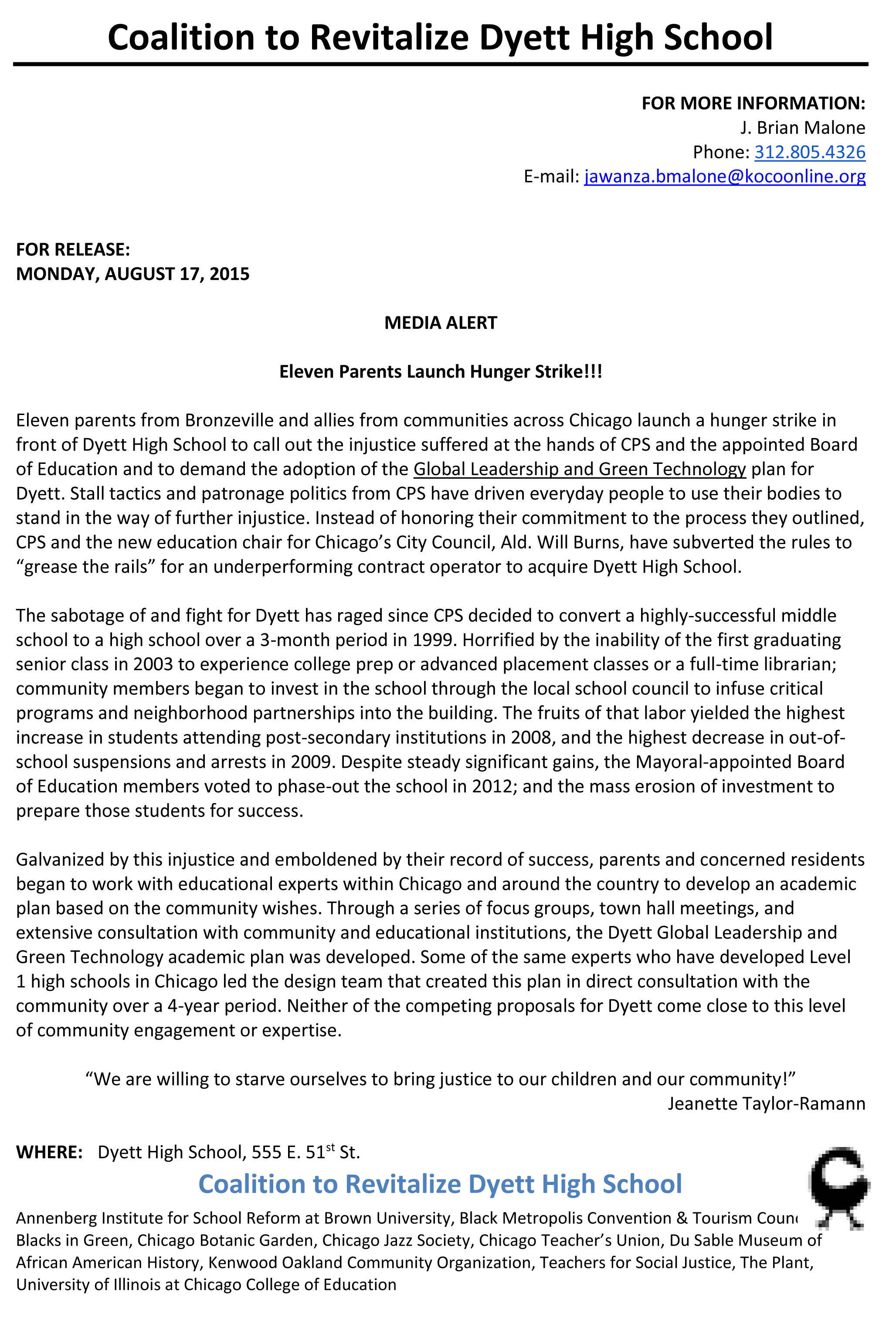
Eleven Parents Launch Hunger Strike!!! Media Alert


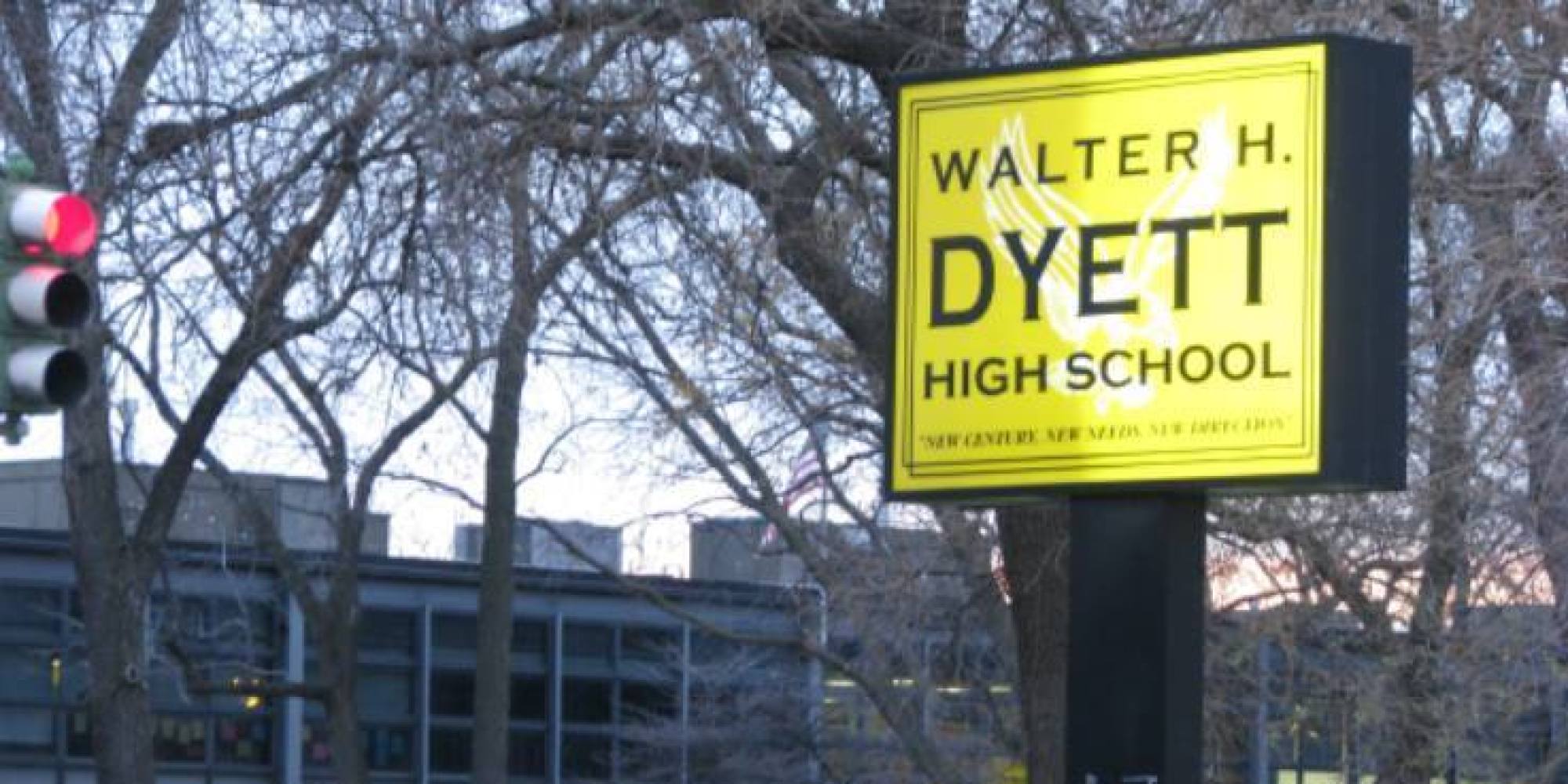
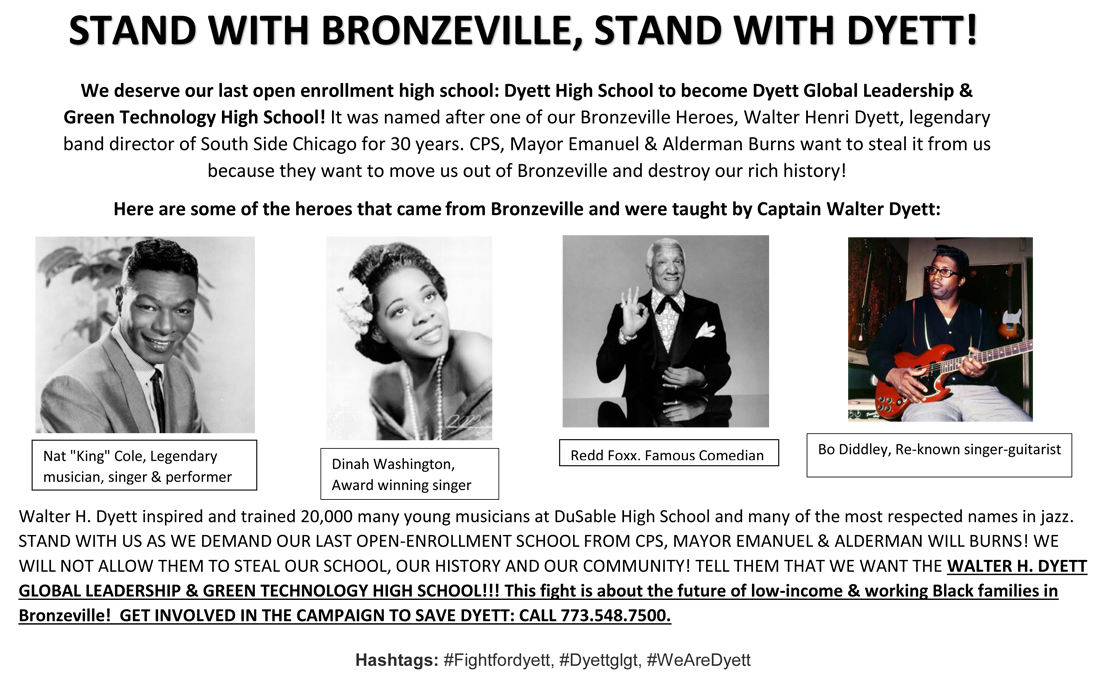
 Eleven parents from Bronzeville and allies from communities across Chicago launch a hunger strike in front of Dyett High School to call out the injustice suffered at the hands of CPS and the appointed Board of Education and to demand the adoption of the Global Leadership and Green Technology plan for Dyett. Stall tactics and patronage politics from CPS have driven everyday people to use their bodies to stand in the way of further injustice. Instead of honoring their commitment to the process they outlined, CPS and the new education chair for Chicago’s City Council, Ald. Will Burns, have subverted the rules to “grease the rails” for an underperforming contract operator to acquire Dyett High School.

The sabotage of and fight for Dyett has raged since CPS decided to convert a highly-successful middle school to a high school over a 3-month period in 1999. Horrified by the inability of the first graduating senior class in 2003 to experience college prep or advanced placement classes or a full-time librarian; community members began to invest in the school through the local school council to infuse critical programs and neighborhood partnerships into the building. The fruits of that labor yielded the highest increase in students attending post-secondary institutions in 2008, and the highest decrease in out-of-school suspensions and arrests in 2009. Despite steady significant gains, the Mayoral-appointed Board of Education members voted to phase-out the school in 2012; and the mass erosion of investment to prepare those students for success.
Galvanized by this injustice and emboldened by their record of success, parents and concerned residents began to work with educational experts within Chicago and around the country to develop an academic plan based on the community wishes. Through a series of focus groups, town hall meetings, and extensive consultation with community and educational institutions, the Dyett Global Leadership and Green Technology academic plan was developed. Some of the same experts who have developed Level 1 high schools in Chicago led the design team that created this plan in direct consultation with the community over a 4-year period. Neither of the competing proposals for Dyett come close to this level of community engagement or expertise.

'We are willing to starve ourselves to bring justice to our children and our community!'
~ Jeanette Taylor-Ramann

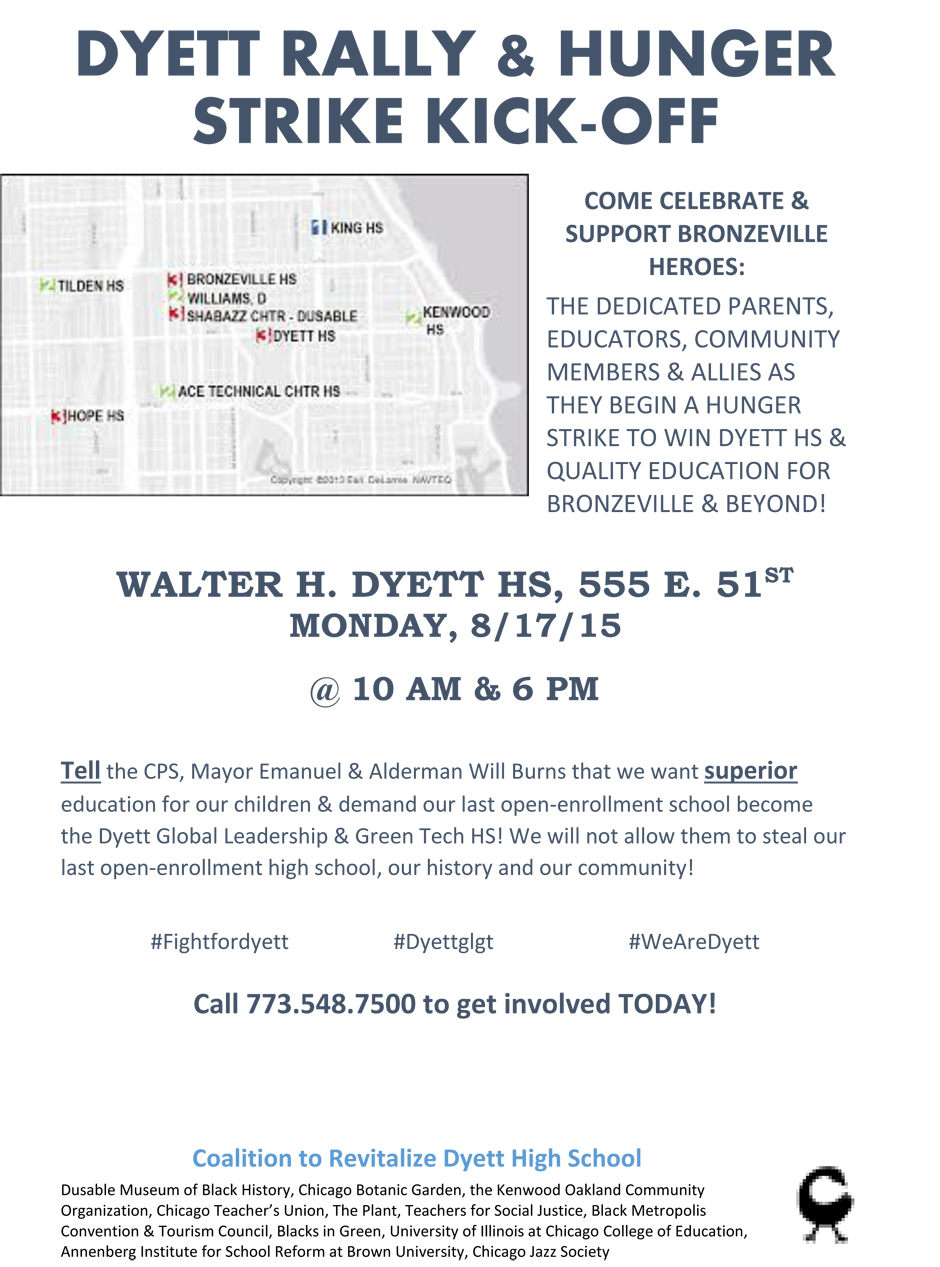
WHERE: Dyett High School, 555 E. 51st Street
RAIN LOCATION: Rainbow/PUSH Coalition National Headquarters, 930 E. 50th Street
WHEN: Monday, August 17, 2015
TIME: 10 AM
 

Share the News. Print and Pass Out [pdf] Fliers


PLEASE DONATE

Eleven Parents Launch Hunger Strike!!!

Eleven parents from Bronzeville and allies from communities across Chicago launch a hunger strike in front of Dyett High School to call out the injustice suffered at the hands of CPS and the appointed Board of Education and to demand the adoption of the Global Leadership and Green Technology plan for Dyett.

Sunday, August 16, 2015

We Have A Long Way To Go With Testing, But Where To? | The Jose Vilson

We Have A Long Way To Go With Testing, But Where To? | The Jose Vilson:

We Have A Long Way To Go With Testing, But Where To?


wile-e-coyote-falling-off-cliff


I’m opting out of the latest testing results discussion.
Columbia University professor Aaron Pallas astutely observed that every city and state politician came to their respective podiums with some variation of “We have a long way to go” as part of their statements about the newly released New York State test scores. Considering how virtually useless they are on an instructional level, it’s amazing how much passion in all directions we’ve ascribed to these numbers. The New York Times lamented the opt-out movement in New York State may have rendered the data useless, or at least may have skewed it in one direction or another.
Um, yes. I suppose anything can skew any set of data, man-made or otherwise. Mass opt-outs are another lever by which some parents provide feedback to unresponsive school systems.
To wit, I know of schools (meaning, I looked at the numbers) who changed their whole curricula, from standards to text books, and only increased their test scores by a few percentage points. I know of schools who used their resources better than others, had better funding per student vis-a-vis donations, or simply had better leadership with a vision for how schools ought to work. Everyone tries to make their case for growth with this undercurrent of urgency, not for student learning per se, but to assure that accountability monsters won’t come at their doors.
In this city, as with so many places across the nation, we’ve grown accustomed to educators as litigators. Professionals in such an uncanny wrong way.
The reasons “we have a long way to go” seem so half-baked is that we can have a long way to go on We Have A Long Way To Go With Testing, But Where To? | The Jose Vilson:

Will New York State Flunk Most of the Class of 2022? | deutsch29

Will New York State Flunk Most of the Class of 2022? | deutsch29:

Will New York State Flunk Most of the Class of 2022?


The New York State Education Department (NYSED) and the NY Board of Regents are standing firm in their allegiance to the state’s Common-Core-aligned exams.
Sure, there is no proof that passing a Regents exam aligned to Common Core will deliver on the ad nauseam “college and career readiness” Common Core advocates promise. There is also no proof that scoring well on a Regents Common Core exam means little more than mastering taking that exam.
When testing stakes are high, teaching and learning are replaced by concentrated test prep. That is the single direction that test-centric reform is driving public education.
And by the time that New York’s Class of 2022 is ready to graduate, New York public school students had better master those Regents Common Core exams. But mastering the exams is not objective; the state is able to manipulate passing rates based upon its cut-score-to-raw-score determinations.
Until 2022, the Regents Common Core exam cut score is 65, but the raw scores associated with that 65 are in flux, and Regents does not have a handle on the fairness aspect. For the 2015 Regents algebra exam, for example, students with more than 80 percent correct were actually penalized by the Regents scoring scheme. Moreover, a student scoring 35 percent on the Regents algebra exam was credited as scoring that “proficient” 65.
In 2015, the state set the cut scores in order to achieve a particular outcome– to allow a certain percentage of students to pass. They did the same in 2014. They also did the same in 2013. The state calls this “stability of passing rates.”
The state determines the percentages of students passing. This means that the state determines the percentage of students failing. The outcome of Regents exam “proficiency” rates rests with the whimsy of NYSED/Regents.
A 65 is the passing score, but what 65 means in terms of actual raw scores is in constant adjustment and re-adjustment by NYSED/Regents. This means that for the class of 2022, the passing score is to be 75 in English and 80 in math– but the raw scores associated with a 65, or 75, or 80 is not fixed. “Proficiency” air hockey.
Yet there are “gains,” right?
Just dismiss any thought of a meaningful, year-to-year comparison. The state’s ability to predetermine the percentages of students “passing” New York’s Regents Common Core exams (and to alter raw-score-to-cut score conversions) makes any Will New York State Flunk Most of the Class of 2022? | deutsch29: