Latest News and Comment from Education

Friday, August 14, 2015

Katrina envy. | Fred Klonsky

Katrina envy. | Fred Klonsky:

Katrina envy.


In 2010 Secretary of Education Arne Duncan was famously quoted as saying that Hurricane Katrina was “the best thing that happened to the education system in New Orleans.”
It was a thoughtless, stupid thing to say considering the devastation Katrina brought to one of the world’s great cities and its people ten years ago.
arne-duncan-looks-for-his-ass
But Duncan is a stupid man prone to saying stupid things. His approach to school reform is to blow everything up, blame teacher unions, promote charters and exclude parents. Hurricane Katrina was a perfect metaphor for him.
And now you have the Chicago Tribune’s Kristen McQueary dredging up the Katrina metaphor again.
“Hurricane Katrina gave a great American city a rebirth,” McQueary wrote the other day in her sad excuse for a newspaper.
She wished for Chicago what happened in New Orleans.
After McQueary caught some hell for the Katrina metaphor she was forced to tweet,“If you read the piece, it’s about finances and government. I would never diminish the tragedy of a thousands of lives lost.”
That is good to hear. Be clear. Kristen McQueary is against thousands of people getting killed by one of the most destructive disasters in U.S. history.
On the other hand it is a bad sign when you have to make that clear.  Who would be for that?
It doesn’t change the fact that the Chicago Tribune, Kristen McQueary and Arne Duncan all display Katrina Envy.
Following Katrina New Orleans fired all the union teachers, closed all the public Katrina envy. | Fred Klonsky:

Mike Klonsky's SmallTalk Blog: McQueary's disaster capitalism fantasy

Mike Klonsky's SmallTalk Blog: McQueary's disaster capitalism fantasy:

McQueary's disaster capitalism fantasy


 "Hurricane Katrina gave a great American city a rebirth." -- Kristen McQueary
"They're trying to wash us away."  -- Randy Newman, Louisiana 1927


The Tribune is on a roll. Weeks after calling for a Mussolini-type dictator to run the school system, editorial board member McQueary now prays for a Katrina-like disaster, suggesting a catastrophe of that magnitude could change Chicago for the better without borrowing money or raising her taxes.

I find myself wishing for a storm in Chicago — an unpredictable, haughty, devastating swirl of fury. A dramatic levee break. Geysers bursting through manhole covers. A sleeping city, forced onto the rooftops. That's what it took to hit the reset button in New Orleans. Chaos. Tragedy. Heartbreak.
Yes, I know McQueary is making a stab at metaphor (or is she?) and probably doesn't really want water damage in her condo. But her disgusting worse-the-better message of New Orleans envy, without a thought for the thousands of people, mostly African-American families,who died or were driven out of the city when the levees broke, comes through loud and clear.

The Tribune's racist insensitivity is only an echo of Obama's Ed Sec. Arne Duncan who anticipated McQueary's piece back in 2010 when he told interviewer Roland Martin,

I spent a lot of time in New Orleans, and this is a tough thing to say, but let me be really honest. I think the best thing that happened to the education system in New Orleans was Hurricane Katrina. 
An embarrassed Obama forced Duncan to apologize for his racist remarks and he did. I'm sure McQueary will have to walk it back as well. But we know what both were really thinking. Duncan drooled over Katrina because it led to the mass firing of city teachers and the destruction of their union. That's McQueary's dream as well. It also led to disaster-capitalism specialist Paul Vallas and his replacement of public schools and public decision-making with charter schools run by corporate boards.

Throw in a little bit of the late Univ. of Chicago free-market economist Milton Friedman who said of Katrina: "This is a tragedy. It is also an opportunity to radically reform the educational system".

And add Mayor Rahm Emanuel's call to "Never let a serious crisis go to waste. And what I mean by that it's an opportunity to do things you think you could not Mike Klonsky's SmallTalk Blog: McQueary's disaster capitalism fantasy:

Back-to-School Reading for Parents: How and why to legally/illegally refuse/opt-out from mandated high stakes tests | Reclaim Reform

Back-to-School Reading for Parents: How and why to legally/illegally refuse/opt-out from mandated high stakes tests | Reclaim Reform:

Back-to-School Reading for Parents: How and why to legally/illegally refuse/opt-out from mandated high stakes tests


A deflated football, Megyn Kelly’s period, Benghazi, and that thing on the top of Donald Trump’s head – distractors all.
As our children continue to be tormented by meaningless, mandated high stakes tests that subvert education tax funds to private corporations as profits, we are being distracted. Let’s get real.
How can parents put a stop to this institutionalized abuse that labels our children for life? Why should our children feel like losers because of invalid tests?
Read AN ACTIVIST HANDBOOK FOR THE EDUCATION REVOLUTION: United Opt Out’s Test of Courage.
United Opt Out Handbook 1
Yes, parents must defend our children from this institutional abuse.
Yes, it will take some courage on the part of each parent – at first.
Since 20% of the children of one state, New York, have refused testing and/or opted-out for their children, the paid politicos are stymied. Other states and communities are also successfully stopping this abuse.
Read AN ACTIVIST HANDBOOK FOR THE EDUCATION REVOLUTION: United Opt Out’s Test of Courage. (Visit Amazon or Information Age Publishing.) Also, visit the United Opt Out National site or Facebook page for state-by-state sample letters and suggestions.

NY Teacher Lederman’s Day in Court | VAMboozled!

NY Teacher Lederman’s Day in Court | VAMboozled!:

NY Teacher Lederman’s Day in Court


VAMboozled!


Do you recall the case of Sheri Lederman? The Long Island teacher who, apparently by all accounts other than her composite growth (or value-added) score is a terrific 4th grade/18 year veteran teacher, who received a score of 1 out of 20 after she scored a 14 out of 20 the year prior (see prior posts herehere and here; see also here and here)?
With her husband, attorney Bruce Lederman leading her case, she is suing the state of New York (the state in which Governor Cuomo is pushing to now have teachers’ value-added scores count for approximately 50% of their total evaluations) to challenge the state’s teacher evaluation system. She is also being fully supported by her students, her principal, her superintendent, and a series of VAM experts including: Linda Darling-Hammond (Stanford), Aaron Pallas (Columbia University Teachers College), Carol Burris(Educator and Principal of the Year from New York), Brad Lindell (Long Island Research Consultant), and me (Arizona State University) (see their/our expert witness affidavitshere). See also an affidavit more recently submitted by Jesse Rothstein (Berkeley) here, as well as the full document explaining the entire case – the Memorandum of Law – here.
Well, the Ledermans had their day in court this past Wednesday (August 12, 2015).
It was apparent in the hearing that the Judge carefully read all the papers prior, and he was fully familiar with the issues. As per Bruce Lederman, “[t]he issue that seemed to catch the Judge’s attention the most was whether it was rational to have a system which decides in advance that 7% of teachers will be ineffective, regardless of actual results. The Judge asked numerous questions about whether it was fair to use a bell curve,” whereby when using a bell curve to distribute teachers’ growth or value-added scores, there will always be a set of “ineffective” teachers, regardless of whether in face they are truly “ineffective.” This occurs not naturally but by the statistical manipulation needed to fit all scores within the normal distribution needed to spread out the scores in order to make relative distinctions and categorizations (e.g., highly effective, effective, ineffective), the validity of which are highly uncertain (see, for example, a prior post here). Hence, “[t]he Judge pressed the lawyer representing New York’s Education Department very hard on this particular issue,” but the state’s lawyer did not (most likely because she could not) give the Judge a satisfactory explanation, justification, or rationale.
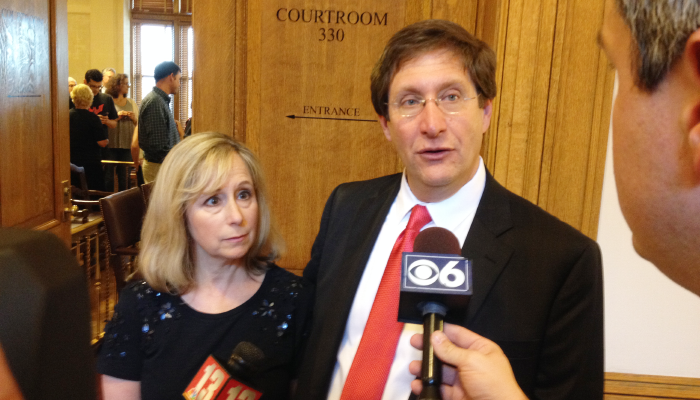
For more information on the case, see here the video that I feel best captures the case, thanks to CBS news in Albany. For another video see here, compliments of NBC news in Albany. See also two additional articles, here and here, with the latter including the photo of Sheri and Bruce Lederman pasted below. NY Teacher Lederman’s Day in Court | VAMboozled!:
a - ledermans_0

NYSAPE Press Release 2015 Scores - NYS ALLIES for Public Education

NYSAPE Press Release 2015 Scores - NYS ALLIES for Public Education:

Opt Out to Sharply Rise as NYS Continues to Sacrifice Children With Flawed Tests & Policies


Yesterday, the New York State Education Department (NYSED) released the results of the 2015 3-8th grade English Language Arts (ELA) & Math exams. ELA scores were essentially flat, and the small increase in Math scores (less than 2 percentage points) was smaller than last year’s modest jump. There was also an increase in the percentage of Level 1 students in ELA, and an unchanged percentage of Level 1 students in Math, suggesting that the ratcheting up of high-stakes is leaving our most struggling students behind.  

Test refusals, also known as opt outs, rose to a record number of 222,500, surpassing advocates’ estimates. More New York parents across the state are informed and have said no to the high-stakes testing regime that is disrupting quality education and harming their children. With no relief in sight, opt out figures are expected to grow significantly again this year until damaging education laws and policies are reversed.

Jeanette Deutermann, Nassau County public school parent and founder of Long Island Opt Out said, "How many more children will we sacrifice to a narrow education, excessive testing, and failure, before New York calls a timeout? How many veteran, master teachers will we watch flee the profession before we untie testing from evaluations? How many schools will close before New York State recognizes that public schools are the foundations of every community? Instead of dreaming up sanctions, SED should be working with educators and parents to change course and right this wrong."

"Governor Cuomo, the Regents and SED have been quick to judge teachers through a sham accountability system that wrongfully reduces highly effective teachers to an ineffective rating and claims public schools are failing when, in fact, they are not.  But they are slow to accept responsibility for the devastating consequences of these flawed testing and evaluation measures on our children, the teaching profession, and our public schools. Threats of sanctions will not deter opt outs. Parents are onto this sham and will continue to opt out children in order to protect them," said Anna Shah, Dutchess County public school parent.

"Considering the amount of time, resources and money devoted to the state assessment system, the resulting data does little to help pinpoint specific student, educator or school strengths and weaknesses.  The entire testing system is a boondoggle to taxpayers and continues to limit our children's educational opportunities," stated Chris Cerrone, Erie County public school parent, educator, and school board trustee. 

Bianca Tanis, Ulster County public school parent said “Chancellor Merryl Tisch has publicly stated that she would think twice before allowing a child with special needs to sit through an ‘incomprehensible exam’ and has called state exams ‘cruel and unusual’. Yet neither the Board of Regents nor NYSED leadership has taken action to inform parents of their right to refuse harmful testing, let alone curb the eighteen hours of harmful state testing that disabled students as young as eight are compelled to engage in. Until the abuse stops, opt outs will continue.”
 
Marla Kilfoyle, Long Island public school parent, educator, and General Manager of the BATs stated, "As research shows, test scores will not close the achievement gap.  We need to begin to invest in proven strategies that close the gap, or we will lose an entire generation of children."  

“The NY State tests are an illegitimate way to evaluate kids, schools and teachers – as shown by the recent  NY Times article, in which questions on the 3rd grade exam stumped the author of the relevant passage.  These tests are designed to make it look like the vast majority of our students and schools are failing, when they are not.  Until the state provides less flawed exams – and a better teacher evaluation system not linked to them – parents will continue to opt out in growing numbers,” said Leonie Haimson, Executive Director of Class Size Matters.

"Pearson has been fired as the state's test vendor, yet our children will be subjected to their tests for another school year. This is outrageous. If Governor Cuomo and members of the legislature who voted to increase the contribution of test scores to teacher evaluation think this is ok, they should prove it by taking the tests themselves. Let our public officials prove that they are smarter than a 5th grader," said Nancy Cauthen, a NYC public school parent.

NYSAPE, a grassroots organization with over 50 parent and educator groups across that state, will be  calling on parents to hand in test refusal letters on the first day of school in order to reclaim their children’s classrooms and to stop the destruction of our public schools.  An updated 2016 test refusal letter is coming soon.  
- See more at: http://www.nysape.org/nysape-press-release-2015-scores.html#sthash.jfrIFvHl.dpuf


New York Schools With Many Opting Out of Tests May Be Penalized - The New York Times

New York Schools With Many Opting Out of Tests May Be Penalized - The New York Times:

New York Schools With Many Opting Out of Tests May Be Penalized


drastic increase this year in the number of students sitting out New York’s standardized exams has created another kind of test, one for state and federal education officials who must decide whether to punish school districts with low participation rates.
And it is far from certain that they will. Last spring, as anti-testing activistsand teachers’ unions rallied parents to have their children opt out, the state and federal Education Departments repeatedly warned that districts with high refusal rates risked losing federal funds. But activists derided these as empty threats, predicting that neither the state nor the federal government would have the stomach to impose penalties in districts where parents were already angry about testing.
Under the Elementary and Secondary Education Act, the federal government has the right to impose various sanctions on states that fail to ensure all students are tested, including withholding Title I funds, which go to schools based on their numbers of poor students. Under the same law, the state itself can withhold funds from districts or schools that do not have sufficient numbers of students tested. The federal government has never imposed such a punishment.
However, no state has had as large an opt-out movement as New York did this year. On Wednesday, the state’s Education Department said that 20 percent of third- through eighth-grade students did not take this year’s exams, quadruple the number from the year before.
It appears that, if it were up to the state alone, there would be little appetite for severe action.
The state education commissioner, MaryEllen Elia, appeared on Thursday to be trying to walk a fine line — not wanting to appear to condone opting out, while saying she hoped the federal government would not withhold funds.
“I do think it’s good for kids to take the assessments,” she said. “I don’t think that it necessarily is good for kids to have resources taken away that should be supporting them in their classrooms.”
Officials at the federal Education Department have awhile to decide what to do. The state will not officially report its test participation rate to the New York Schools With Many Opting Out of Tests May Be Penalized - The New York Times:

Why ‘Community Schools’ Are Taking Root In Florida | StateImpact Florida

Why ‘Community Schools’ Are Taking Root In Florida | StateImpact Florida:

Why ‘Community Schools’ Are Taking Root In Florida


Part of the curriculum at Evans High School


Evans High School in Orange County used to be known as a dropout factory. But since 2007, it’s gone from a two-time F-rated school to a B-rated school – in one of Orlando’s most troubled neighborhoods. Now, the “community school” concept is spreading to other Florida cities.
Evans is in a neighborhood called Pine Hills, where homes and businesses have bars at the windows. One student, found carrying a Taser, said it was due to her dangerous route home. The neighborhood has exceptionally high rates of juvenile crime and referrals to the Florida Department of Children and Families.
“We have long said at the Department of Children and Families that if we’re ever going to get our arms around neglect and abuse, it has to be a community-wide effort.”
DCF Secretary Mike Carroll. He says Evans has succeeded by becoming what’s called a “community school” — addressing the barriers to student success in a high-risk neighborhood.
“Everything from getting a child to school when they need to be there to making sure they’re fed when they arrive at school to making sure it’s safe going back and forth to school. If there are issues at home that may impact the child’s ability to learn when they get to school, that there’s assistance to do that…”
And Evans has shown that the strategy works. From a 50 percent graduation rate in 2007, the school now graduates 80 percent. From an enrollment of 1600, it’s now more than 2400. The secret? Evans principal Jenny Gibson-Linkh says it’s understanding what keeps students from arriving at school ready to learn.
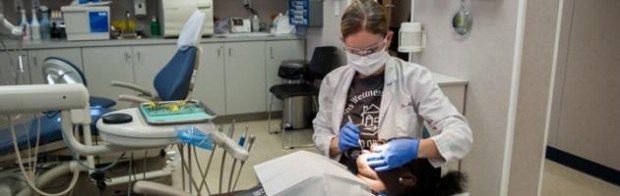
Like abscessed teeth.
“We’re talking about diabetes, we’re talking about, you know, students who can’t afford insulin, who aren’t taking insulin on a regular basis, whose sugar is up and down all the time. You’re talking about students who aren’t eating on a regular basis, so they’ve having difficulties with high blood pressure.”
Evans is the first a community school in the state, spear-headed by the University of Central Florida, the Orange County Public Schools and the Children’s Home Society. The school offers health care, dental care and mental-health care. There’s a huge demand for counseling, says Jarvis Wheeler, director of the community school, and the counselors push their caseloads to meet it.
“A lot of times, our mental-health counselors, they’re seeing members in the community that they couldn’t let go of their caseload, or they’re seeing some of the parents, or they even have groups.”
Evans also serves dinner and keeps pantries stocked with healthy snacks. Working with Second Harvest, the school offers classes in preparing nutritious meals — which students can then take home. And Dave Bundy, director of UCF’s Center for Why ‘Community Schools’ Are Taking Root In Florida | StateImpact Florida:

Causes, potential consequences of testing opt-out movement - Yahoo News

Causes, potential consequences of testing opt-out movement - Yahoo News:

Causes, potential consequences of testing opt-out movement


BUFFALO, N.Y. (AP) — New York is facing a growing rebellion against Common Core-aligned standardized tests. About 20 percent of the state's third- through eighth-graders refused to take the tests this spring, up from 5 percent a year earlier. As state education officials consider the possibility of sanctions against districts with large numbers of students opting out, they also promise a plan to boost participation.
Here are some details:
THE TESTS
The federal No Child Left Behind Act of 2001 requires states to test all students in grades 3-8 in English language arts and math each year. Students in New York are given the tests during two separate weeks in the spring, with each test being administered over three days in 60- to 90-minute sessions.
In 2013, New York aligned the standardized tests with new Common Core learning standards that most states have adopted to better prepare students for college and careers. The standards spell out what skills students in each grade should master and emphasize critical thinking, writing and real-world math.
The state's 2012 teacher evaluation law requires that student test scores be factored into the formula used to rate whether teachers are "ineffective," ''developing," ''effective" or "highly effective." Teachers with two consecutive "ineffective" ratings could be fired.
Student scores also are broken into four categories: well below proficient at the grade-level subject, partially proficient, proficient or excelling.
Test results are released over the summer.
___
THE OPT-OUTS
The more than 200,000 of New York's 1.1 million third- through eighth-graders who refused to take the tests are part of a protest movement that is growing nationally.
New York is believed to have the largest rate of opt-outs so far, but resistance has been reported around the country, including in Colorado, Maine, New Mexico, Oregon, Pennsylvania and Washington. Robert Schaeffer of the National Center for Fair and Open Testing estimated a half-million students nationwide opted out of this year's tests, with numbers varying widely among states and cities.
The percentage of those opting out in New Jersey could rival New York's or reach into the teens, Schaeffer said. A spokeswoman for New Jersey's Education Department declined to release the figure Thursday.
Parents cite a range of concerns, including the amount of classroom time spent on test preparation at the expense of creative lessons and test-stress on their children. Others worry money is being diverted from classrooms to administer and score the tests and that results are released too late to do any good — after the school year has ended.
"For children in urban communities with increased class sizes and decreased funding, the tests are a way to prove that the schools are failing so they can be closed and re-opened as charter schools," said Morna McDermott, a founding organizer of United Opt Out, which issues state-by-state guidance on the topic.
In New York, numerous districts saw more than 30 percent of students opt out and some had more than 80 percent, data from the state Education Department showed. On Long Island, East Islip and Farmingdale saw more than 60 percent of students sit out. In western New York, West Seneca had 71 percent opt out.
___
WHAT'S NEXT
Although federal money could be withheld if less than 95 percent of a district's students participate, that hasn't yet happened. Both U.S. Department of Education spokeswoman Dorie Nolt and state Education Commissioner MaryEllen Elia said their departments were in contact on the issue.
"We will be taking action in New York," Elia told reporters Wednesday, "and analyzing and figuring out what we need to do for districts to get more participation and also looking specifically, district by district and school by school, to figure out with the leaders of those districts exactly what happened there."
She said efforts would include getting parents to understand the importance of assessments in measuring progress toward the higher learning standards. On Thursday, she said a lack of communication with parents was partly to blame and also said the state should move toward administering the tests by computer so the results will be available sooner.
"The quicker that we get it back the more relevant it is," Elia said at a New York City forum on education sponsored by City and State.
Organizers of the opt-out movement appear undeterred. New York State Allies for Public Education is encouraging parents to hand in refusal letters for the 2016 tests on the first day of school.
___
Associated Press Writer Karen Matthews in New York City contributed to this report.Causes, potential consequences of testing opt-out movement - Yahoo News:

School Reform: Does Something Smell Rotten? | Vicki Cobb

School Reform: Does Something Smell Rotten? | Vicki Cobb:

School Reform: Does Something Smell Rotten?


2015-08-14-1439551589-3718204-EducationInc203x300.jpg


The American Revolution ultimately came together with the widespread distribution of a pamphlet that spoke truth about power. Tonight, August 14, is the start of a public awareness campaign to take a close look at the school reform movement through a modern day equivalent of Thomas Paine's Common Sense -- an hour-long documentary called Education, Inc. It is not something that the billionaires behind the so-called reform movement want you to see. The brilliant award-winning film-makers, Brian and Cindy Malone, navigate their way through a complex and seemingly diabolical scheme to "reinvent" education where school reform is sold through a sophisticated advertising smoke screen touting "choice" for children. How do they expose what's really happening? The premise of Education, Inc. is simple: Follow the money.
The pot of $600 billion dollars of taxpayer money, allocated every year to educate American children in public schools, has proven to be irresistible to corporate and political interests. They have found a way to siphon off some of that money for less accountable ventures--charter schools and vouchers--preying on the natural parental desire to give their own kids something better than what they already have. Their business model is simple: shake loose the money so that it changes hands. When money changes hands, pockets are lined. Before you dismiss this premise out of hand, you must see this film.
The Malones want to be totally transparent about money and their own involvement. So they announce upfront that they funded the production themselves out of their savings. For about $20, they are selling DVDs of the movie for private screenings across the country. They are not trying to protect their copyright. They are just trying to recoup some of their costs. Brian Malone told me:
" As far as the message I am trying to get out... we'd like citizens and parents across the country (and the world, see New Zealand and Sweden for example) to be aware of the secretive corporate takeover of public education. There are hundreds of millions of dollars being spent every year to turn over public school to private corporations and free-market ideologues. Through clever marketing and trigger-based political advertising, these hedge fund managers and business interests are picking the pockets of our tax dollars to add to their profit. They use millions of dark money.. that is very hard to trace... and they use powerful language like 'Every child deserves the best choice... etc.' And they count on people to not pay attention to local school board races.... which most people do not.
I want people to know that their public education tax dollars are being stolen right under their noses."
And he encourages organizers of screenings to drop a pin on a map showing their location.
One question not addressed in the film is: Are the new entities created by the reformers--the charters and vouchers--doing a better job than the public schools? I have some insight into that because I served on the board of a charter school for a year and a half. The founding members of the board were honest, idealistic and passionate. It took them five years to finally get the charter for a science and technology K-5 elementary school. I was on the board because I know something about teaching science. I left the board because they didn't use me for my expertise. Running a school is not for the inexperienced. Systems must be put in place so that the focus can be on instruction. In five years, they didn't get the reading/math scores into an acceptable range. They kept their charter mainly because they really spent all the money on the kids and they could account for it. They are still struggling to get instruction right. I wrote a post about that experience. But one take-away fromEducation, Inc. is how could the charters and vouchers be better than public schools School Reform: Does Something Smell Rotten? | Vicki Cobb:

You’re 100 Percent Wrong About Critical Thinking

You’re 100 Percent Wrong About Critical Thinking:

You’re 100 Percent Wrong About Critical Thinking


The many fractious factions in the American education wars fight over standardized tests, teacher pay and whether we are dumber than India and China or much, much dumber than India and China. But they all agree on a single criticism of public schooling in the United States: Not enough critical thinking is being taught in our classrooms.
In pure lexical terms, “critical thinking” is “the objective analysis and evaluation of an issue in order to form a judgment.” Translated into pedagogy, it’s teaching students to be intellectual mavericks, cognitive cowboys who poke bullet holes into every received concept, who duel with Aristotle and Dickinson, who are never complacent, submissive or even quiet. They brim with what Walt Whitman called “original energy.”

Our students, according to pretty much everyone, are crappy critical thinkers. President Obama, who has generally aligned himself with education reformers and charter school advocates, has said critical thinking is a “21st-century skill” American students lack. His sometime ideological opponent, American Federation of Teachers head Randi Weingarten, agrees, despite discounting much else in his reformist policies. Critical thinking is necessary, she said last year, “to prepare for life and citizenship, college and career.” Last year, the State University of New York at Stony Brook started a new course in news literacy, under the belief that “every student in America should acquire the critical thinking skills of a journalist.”

Stony Brook might be aghast to learn that I somehow managed to snag a desk in a newsroom without ever flashing my critical-thinking abilities, latent or otherwise, though I suspect knowing how to write a complex-compound sentence helped matters. Before turning to journalism, I taught at a selective but not quite prestigious high school in Brooklyn (it has since become the latter, in no part due to my work there). I can’t remember “critical thinking” exerting much of an influence in my English classroom. We read books, learned new words, dissected sentences to reveal the syntactic beauties underneath. Sometimes ideas were debated, but not always. Sometimes, I simply told my students things with the expectation that they accepted, remembered and, at some point, regurgitated them—like when Virgil wrote The Aeneid or the difference between who and whom. Not much critical thinking needed there.

I never praised a student for her critical thinking, nor was asked by a student about, say, critical thinking as it pertained to the third book of The Odyssey. Parents always wanted to know how their children were doing, but none ever asked about their critical thinking. It seemed, then, that critical thinking was as relevant to the English classroom as a student’s time on the mile.

Much has changed, at least in the national discussion. Today, critical thinking is often treated like a panacea, the been-there-all-along salve for our myriad pedagogical boo-boos. Common Core, the federal curriculum guidelines adopted by the vast majority of states, describes itself as “developing the critical-thinking, problem-solving, and analytical skills students will need to be successful.” The International Center for the Assessment of Higher Order Thinking, which promotes critical thinking in the classroom, says on its website that “the problems we now face, and will increasingly face, require a radically different form of thinking, thinking that is more complex, more adaptable, more sensitive to divergent points of view.”

I would more readily believe that if I understood what “critical thinking” meant. Its obverse, I suppose, is uncritical thinking, the unquestioning reception and retention of facts. Which, I hate to tell you, is supremely important in mastering any field of knowledge. Uncritical thinking is pretty unsexy, often requiring rote memorization, deadening repetition and, not infrequently, humility before intellects greater than your own (whether Louise Erdrich’s or Albert Einstein’s or just Mr. Greenberg’s during third-period geometry class). Only someone who has uncritically mastered the intricacies of Shakespeare’s verse, the social subtexts of Elizabethan society and the historical background of Hamlet is going to have any original or even interesting thoughts about the play. Everything else is just uninformed opinion lacking intellectual valence.

Look, you can be the most original, iconoclastic thinker out there. You can have deeply contrarian opinions. And those may be impressive, on the surface. But if you really want to impress me and, more important, the engineering department at Google, go ahead and think your way through this:

 A function

To take the derivative of that function—the way I am sure most serious 16-year-olds in Shanghai, Helsinki and Mumbai can—you will have to have spent dozens of hours doing work of the decidedly uncritical kind, learning trigonometric rules that have been around for centuries and will almost certainly outlast your earthly existence. This is true for any discipline, whether biology or Spanish literature. There is a lot more to absorb than to critique. Before becoming a thinker, you have to be a learner.

Critical thinking, though, is sexy. It appeals to the American spirit, always in love with innovation and iconoclasm, the triumph of the individual over history and destiny, over the hoary traditions of Europe. Oh, sure, Leibniz invented calculus, but I’m pretty certain there’s an easier way to do this. We are a nation that wants to hack everything, including learning.You’re 100 Percent Wrong About Critical Thinking:

The NY Opt Out and “Invalidated” Scores | deutsch29

The NY Opt Out and “Invalidated” Scores | deutsch29:

The NY Opt Out and “Invalidated” Scores


In April 2015, approximately 20 percent of students in New York State opted out of the state’s tests in grades 3 through 8.
An August 12, 2015, Syracuse.com article opens as follows:
A large number of students opting out of New York state exams – about 220,000 or 20 percent – raises doubt about the validity of the results and may make them unsuitable to evaluate teachers or schools, according to a Syracuse University professor.
The problem with such a statement is that under no conditions is it a valid use of student test scores to evaluate teachers or schools.
The students are the test takers; these tests purportedly measure their achievement. There is no way to account for all of the possible variables that would enable the New York State Education Department (NYSED) to accurately evaluate teachers and schools using student test scores.
If NYSED could do so– if that $2.7 million it paid to American Institutes for Research (AIR) for the state’s value-added modeling (VAM) teacher evaluation system yielded a product that were really so accurate– then surely NYSED would publicize the details of its VAM calculations.
As it is, New York teachers are kept in the dark about those AIR-created, $2.7 million VAM calculation details– and apparent VAM capriciousness has resulted in acritical lawsuit from teacher Sheri Lederman– who was rated a 14 out of 20 on her “student growth” VAM component in 2012-13 and then 1 out of 20 via VAM in 2013-14.
The VAM stakes are higher for New York teachers in 2015-16, raised from 20 percent of the total teacher evaluation to 50 percent.
Again, this nonsense of grading teachers and schools using student scores was never a valid use of student tests.
Meanwhile, student opt outs in New York are only likely to increase in 2015-16 as parents seek to have their discontent with test-centric education– dare I write– validated by state legislators and education officials.
But it will be a fight: New York education officials confuse student learning with test The NY Opt Out and “Invalidated” Scores | deutsch29:

Thursday, August 13, 2015

Call for Action for Students Affected by CAHSEE - Year 2015 (CA Dept of Education)

Call for Action for Students Affected by CAHSEE - Year 2015 (CA Dept of Education):

State Schools Chief Tom Torlakson 
Calls for Action to Assist Students Affected by the Cancellation of the July California High School Exit Exam


SACRAMENTO—State Superintendent of Public Instruction Tom Torlakson today called the University of California and California State University systems and the Association of Independent California Colleges and Universities to ask for their assistance in helping students who are being denied entrance into college solely because they have not passed the state high school exit exam.

"No student's dream of a college education should be delayed because of an anomaly," Torlakson said. "That's why I am working closely with college administrators and the Legislature to remedy the situation and help these students stay on track for college."

The California Department of Education is working with the Legislature to pass legislation that would suspend the exit exam requirement for the next three years because the exam does not reflect the new state academic standards being taught in schools. Senate Bill 172 has been making its way through the legislative process all year, and if it is approved and signed, students can then get a diploma without passing the exit exam.

With the legislation to suspend the California High School Exit Exam progressing, the $11 million-a-year contract to administer the test was not renewed, and therefore the July exam was not offered as in past years.
# # # #
Tom Torlakson — State Superintendent of Public Instruction
Communications Division, Room 5206, 916-319-0818, Fax 916-319-0100